

Key Takeaways
The best market analysts are often the worst traders
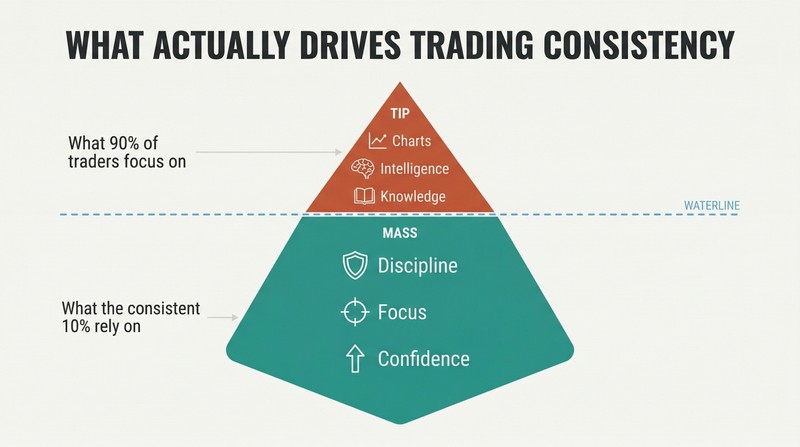
Market knowledge doesn't produce consistency. Douglas spent 18 years coaching traders and discovered that the industry's biggest losers include doctors, lawyers, engineers, and CEOs — society's brightest achievers. Many of the best technical analysts he worked with were terrible traders. Intelligence and analysis can contribute, but they aren't the defining factors.
After moving to Chicago in 1981 to trade at the Board of Trade, Douglas lost nearly everything within nine months. His subsequent two decades of research led to one conclusion: consistent winners think differently from everyone else. They've developed a specific mindset — a set of attitudes that keeps them disciplined, focused, and confident despite constant uncertainty. That mindset, not chart patterns or indicators, separates the roughly 10% who win consistently from the 90% who don't.
Four fears cause nearly all your trading mistakes
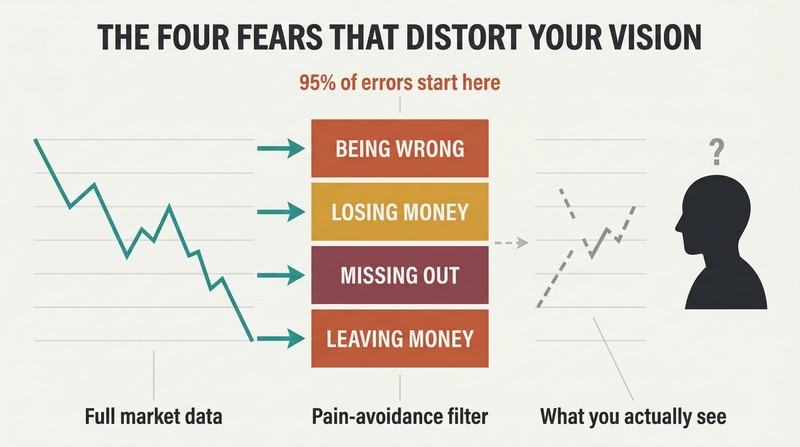
Douglas names four primary trading fears that generate virtually every error:
1. Fear of being wrong
2. Fear of losing money
3. Fear of missing out
4. Fear of leaving money on the table
These fears trigger what Douglas calls pain-avoidance mechanisms — both conscious processes (rationalizing, gathering reassuring info, calling trading buddies) and subconscious ones (blocking threatening information from awareness entirely). A trader in a losing position may fixate on every tiny tick in his favor while a clear downtrend against him becomes literally invisible. Only after exiting does he think, "Why didn't I see that?" The information was always there — his mind hid it to protect him from emotional pain.
Accept risk fully — the one skill most traders never learn
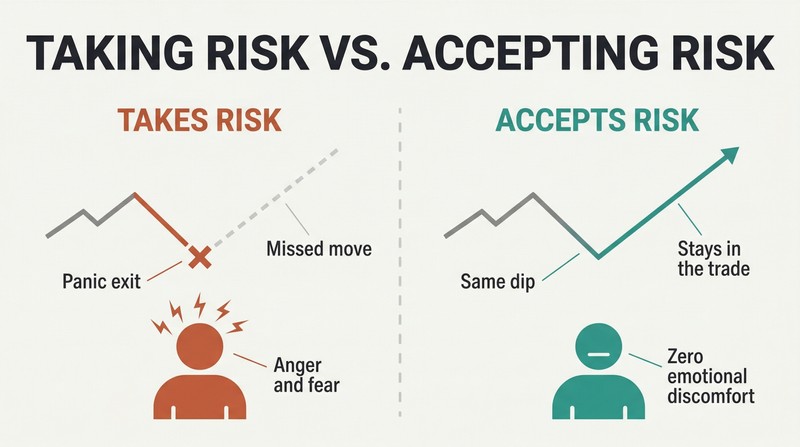
Placing trades isn't accepting risk. Most traders assume they're risk-takers because they trade, but there's a massive gap between taking a risk and accepting it. Douglas describes a CTA named Bob who managed $50 million and understood probabilities intellectually. Bob placed a stop on a belly trade — textbook discipline. But when the market moved a third of the way toward his stop, he panicked and exited at breakeven out of anger. The market then ran 500 points in his favor.
Bob had defined risk without accepting it. True risk acceptance means experiencing zero emotional discomfort about any outcome — being wrong, losing, or missing a bigger move. The best traders exit losing trades without the slightest emotional resonance, then calmly wait for the next edge.
The market generates neutral information — your beliefs create the pain
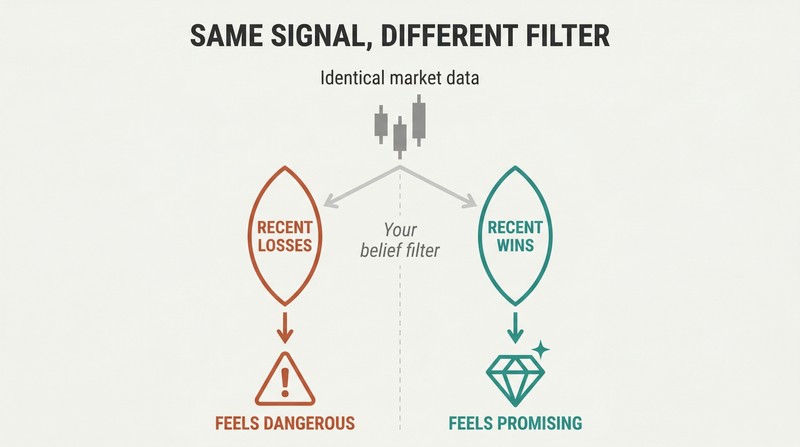
Douglas illustrates this with a child and a dog. A boy gets attacked by a dog. Every dog he encounters afterward — even the friendliest — triggers terror. His mind automatically links any dog-shaped stimulus to his painful memory and projects that pain outward, making the friendly dog appear dangerous. He genuinely perceives threat where none exists.
Traders do the same thing. After two losing trades, the next identical signal feels terrifyingly risky. After three winners, that same signal feels like a sure thing. The market offered identical information both times; only your internal state changed. Your mind's association mechanism links current market conditions to recent experiences, then projects those feelings onto neutral price movement. Understanding that you're generating the pain — not the market — is the first step toward perceiving opportunities objectively.
Install five beliefs that turn trading into a probability game
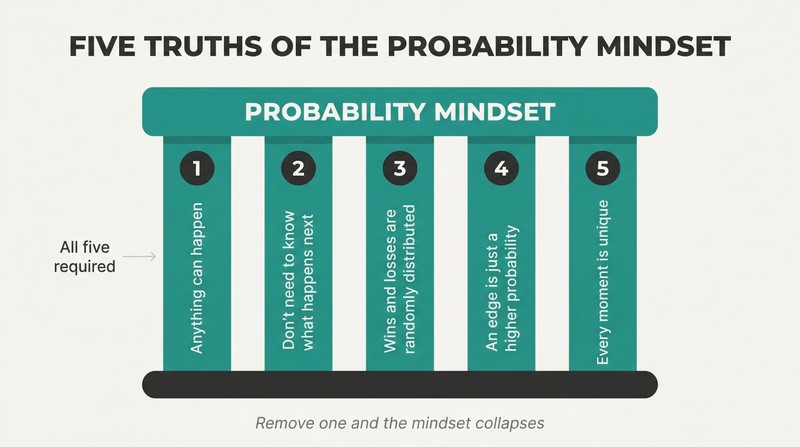
Douglas's framework rests on five fundamental truths that, when genuinely believed, eliminate both fear and overconfidence:
1. Anything can happen
2. You don't need to know what's going to happen next to make money
3. There is a random distribution between wins and losses for any given edge
4. An edge is nothing more than a higher probability of one thing over another
5. Every moment in the market is unique
Most traders give lip service to "anything can happen" while secretly believing they know what will happen next. Douglas argues the test is behavioral: if you truly believed in uncertain outcomes, you'd predefine risk on every trade, cut losses without hesitation, and never let a winner become a loser. Anything less reveals the belief hasn't reached a functional level.
Trade like a casino: own the edge, play every single hand
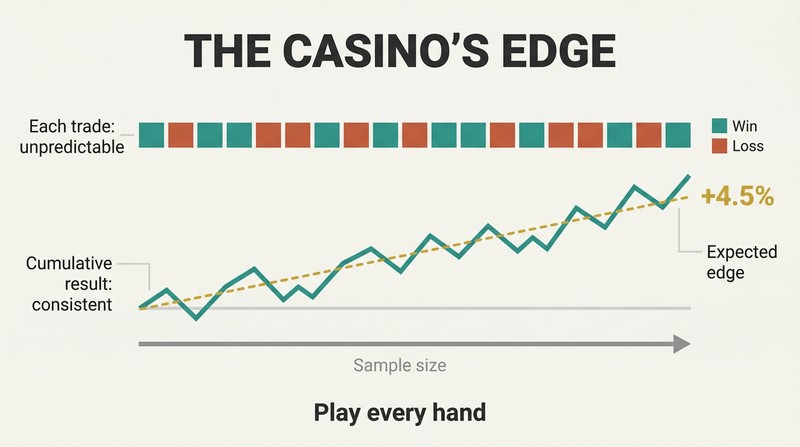
Casinos profit consistently from random events. In blackjack, the house has roughly a 4.5% edge. Over enough hands, the casino nets about 4.5 cents on every dollar wagered — regardless of individual winning or losing streaks. It doesn't predict any single hand. It doesn't get emotional about a player's hot streak. It simply deals every hand and lets the math compound.
Traders can operate identically. If your edge gives you favorable odds over a series of trades, commit to taking every occurrence — not just the ones that "feel right." Skipping trades because of a gut feeling undermines the very probabilities you're relying on. The casino never refuses to deal because the last three hands went to the player. Your job is to keep the odds in your favor and let sample size do the rest.
Be rigid in your rules, flexible in your expectations
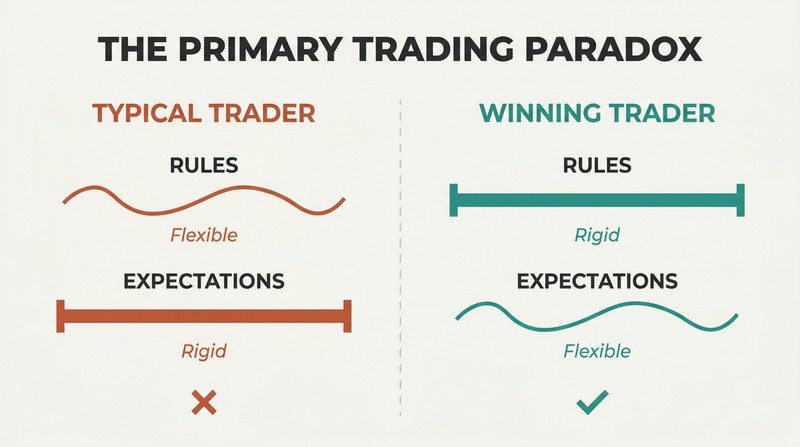
Douglas calls this the primary trading paradox. Rigid rules are essential because trading has almost no external structure — no required beginnings, middles, or endings. Unlike blackjack, which forces you to bet before each hand, trading demands voluntary discipline. Without rigid rules for entry, exit, and risk, you'll rationalize every losing position into a catastrophe.
But expectations must stay flexible. Rigid expectations about what the market "should" do activate pain-avoidance mechanisms when reality disagrees. You narrow your focus to confirming evidence and block contradictory information. A trader watching a market you never trade sees patterns effortlessly — because nothing's at stake and expectations are neutral. The moment money is on the line and you expect a specific outcome, perception warps. Neutral expectations keep your mind open to whatever the market communicates.
Treat every trade as unique — your brain will fight you on this
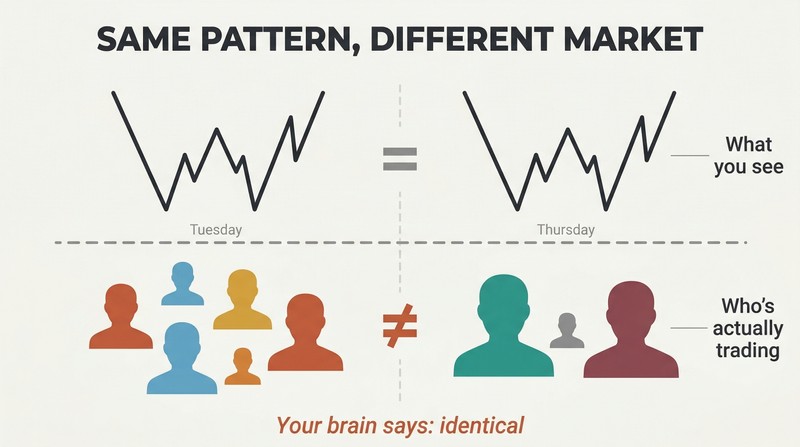
For a pattern to repeat identically, every trader who created the original pattern would need to be present and interact the same way. The odds are zero. Douglas tells the story of a star technical analyst who projected major soybean support with absolute confidence. The semiretired chairman of the brokerage firm picked up the phone, sold two million bushels at the market, and crashed through the support level in thirty seconds. He turned to the horrified analyst and said, "If I can do that, anyone can."
Our minds resist this truth. The association mechanism automatically links current patterns to past ones, making them feel identical. Training your mind to perceive each moment as genuinely unique — despite visual similarities — requires deliberate effort. But it's the key to staying in what Douglas calls the now moment opportunity flow rather than trading your memories.
Blame the market and you block the flow of opportunities
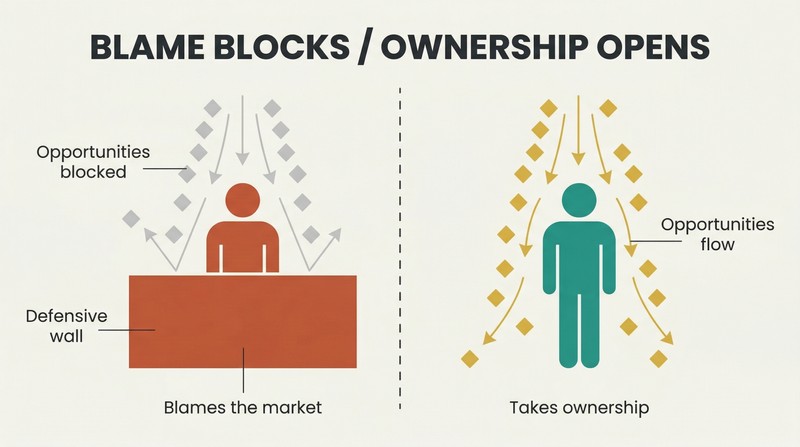
The market owes you nothing. It's a zero-sum environment where every participant is trying to extract money from every other participant. There are no social obligations, no fairness standards, no remedies for losses. Blaming the market for results creates an adversarial relationship that disconnects you from the constant stream of opportunities flowing past.
Douglas observed that traders who planned trades but then followed random tips from brokers would consistently watch their original (unexecuted) trades become big winners. Why? Acting on someone else's idea lets you deflect blame — "It was a bad tip." Acting on your own analysis puts your creative ability on the line, demanding real accountability. Until you accept that every outcome is self-generated — based on your interpretations, decisions, and actions — you cannot perceive the market objectively enough to learn from it.
Euphoria after winning destroys traders as reliably as fear
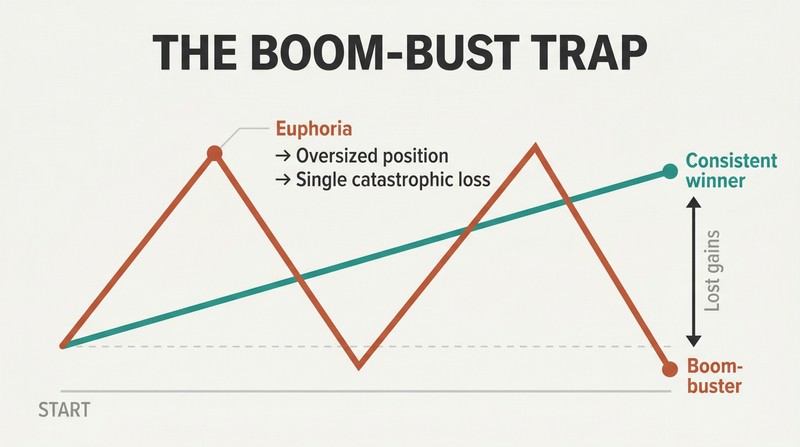
Douglas divides traders into three groups: roughly 10% are consistent winners with steadily rising equity curves; 30 – 40% are consistent losers; and the remaining 40 – 50% are "boom and busters" who've learned to make money but can't keep it. This largest group gets destroyed by euphoria and self-sabotage — forces that only emerge when you're winning.
After a string of winners, overconfidence compels traders to take oversized positions. A small adverse move creates disproportionate losses. The trader freezes, unable to accept that his "sure thing" is failing. Douglas worked with traders who put together incredible streaks — 15 or 20 winning trades in a row — only to give it all back in a single euphoria-fueled disaster. If you mentally recalculated your equity without reckless errors, you'd likely qualify as a consistent winner already.
Execute 20 trades mechanically to rewire your trading mind
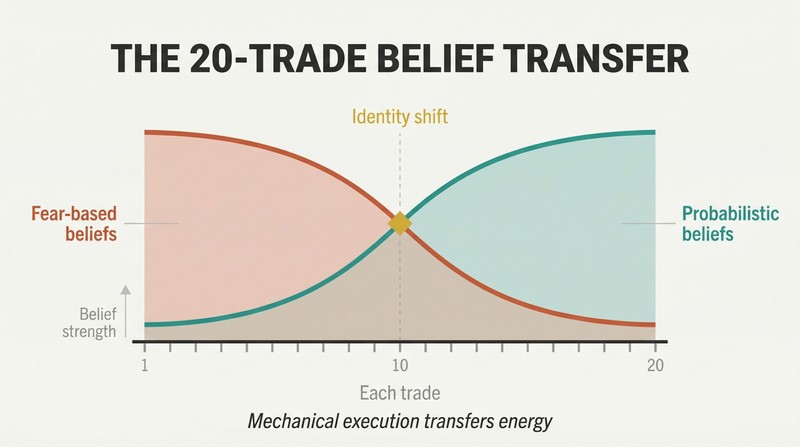
Douglas prescribes a specific exercise. Choose a system with precise, non-subjective entry and exit rules. Commit to executing the next 20 trades exactly as the system dictates — no skipping signals, no adding variables, no overriding based on feelings. Trade at least three contracts so you can scale out in thirds, locking in what Douglas calls risk-free opportunity on the remaining position.
The purpose isn't profit — it's transformation. Each time you execute despite conflicting thoughts, you draw energy out of fear-based beliefs and transfer it to probabilistic ones. Douglas compares this to becoming a runner: he initially couldn't run 60 yards, but daily self-discipline — redirecting focus past every excuse — eventually eliminated all resistance. After enough repetitions, "being consistent" stops requiring effort and becomes identity.
Analysis
Mark Douglas's Trading in the Zone operates at the intersection of behavioral finance and applied psychology, predating Daniel Kahneman's Thinking, Fast and Slow by over a decade yet arriving at remarkably similar conclusions about human cognitive biases. Where Kahneman maps System 1 and System 2 thinking in laboratory settings, Douglas identifies the identical mechanisms — automatic association, loss aversion, overconfidence — manifesting in the uncontrolled laboratory of live markets with real capital at risk.
What distinguishes Douglas from the broader trading psychology canon is his mechanism-level explanation of why knowing the right thing to do and doing it are psychologically distinct. His concept of pain-avoidance mechanisms anticipates what modern psychology calls motivated reasoning — the tendency to interpret evidence in ways that protect existing beliefs. His insight that traders need a fundamentally different relationship with uncertainty, rather than more information, parallels Nassim Taleb's later work on antifragility and the limits of prediction.
The book's greatest strength is also its limitation: Douglas treats virtually all trading failure as psychological. While this is a powerful corrective for the trader drowning in indicators, it underweights the role of genuine edge quality. A trader with perfect psychology but a negative-expectation system will still lose systematically — a point Douglas acknowledges but doesn't dwell on. His framework also lacks empirical validation; the three trader categories (10% winners, 30-40% losers, 40-50% boom-and-busters) are presented as coaching observations rather than rigorous findings.
Douglas's framework for belief change through mechanical repetition — essentially self-administered exposure therapy — is arguably more practical than the cognitive behavioral approaches later trading coaches adopted. By creating structured experiences that contradict fear-based beliefs, he designs a behavioral intervention that doesn't require a therapist. The enduring relevance of this book, published in 2000 before algorithmic dominance, speaks to the timelessness of its subject: markets evolve, but the human tendencies to project past pain onto neutral information and sabotage success through euphoria remain unchanged.
Review Summary
Trading in the Zone receives mostly positive reviews, with readers praising its focus on trading psychology and mindset. Many find it invaluable for developing consistency and overcoming emotional barriers. Critics note repetitiveness and overuse of pop psychology. The book emphasizes thinking in probabilities, accepting risk, and developing a neutral perspective on market information. Some readers consider it essential for novice traders, while others feel it lacks practical techniques. Overall, reviewers appreciate the book's unique approach to addressing the mental aspects of trading.
People Also Read

Glossary
Five fundamental truths
Core probabilistic trading beliefsFive beliefs Douglas argues must become functional at a core level for consistent trading: (1) anything can happen, (2) you don't need to know what happens next to make money, (3) wins and losses are randomly distributed for any given edge, (4) an edge is merely a higher probability indication, and (5) every market moment is unique.
Now moment opportunity flow
Market's present-moment opportunity streamDouglas's term for the continuous stream of opportunities the market presents at each moment. Being 'in' the flow means perceiving and acting on opportunities without mental interference from past experiences or future expectations. Traders exit this flow when fear or overconfidence causes their minds to associate current conditions with past outcomes.
Pain-avoidance mechanisms
Mental processes blocking threatening informationConscious and subconscious mental processes that shield traders from emotionally painful market information. Conscious mechanisms include rationalizing, justifying positions, or selectively gathering reassuring data. Subconscious mechanisms automatically block, distort, or diminish information that conflicts with expectations—making obvious patterns literally invisible while the trader is in a losing position.
Four primary trading fears
Root causes of trading errorsThe four fears Douglas identifies as the source of nearly all trading mistakes: fear of being wrong, fear of losing money, fear of missing out, and fear of leaving money on the table. These fears activate pain-avoidance mechanisms that distort perception and cause hesitation, premature exits, or failure to cut losses.
Black hole of analysis
Futile pursuit of certainty via knowledgeDouglas's metaphor for the trap of believing that more market knowledge will produce consistency. Traders who can't accept risk seek to eliminate it through ever-deeper analysis, creating a vicious cycle: the more they learn, the more they expect from the market, and the more painful it is when the market doesn't comply—driving them to learn even more.
De-activation
Draining energy from a beliefDouglas's process for changing beliefs without trying to destroy them, based on his view that beliefs are structured energy that cannot be eliminated but can be rendered inactive. Energy is drawn out of an old belief and transferred to a new, more useful one through repeated experiences that contradict the old belief. The original belief's structure remains intact but loses its power to influence perception and behavior.
Boom and bust cycle
Winning then losing it allThe pattern experienced by roughly 40–50% of active traders who have learned how to make money but not how to keep it. Their equity curves resemble roller coasters—steady ascents followed by steep dropoffs caused by euphoria-driven overtrading or self-sabotage. They cycle between confidence and devastation without reaching consistent profitability.
Seven principles of consistency
Building blocks of consistent winningDouglas's sub-beliefs that constitute the identity of a consistent winner: (1) objectively identify edges, (2) predefine risk on every trade, (3) completely accept risk or let go of the trade, (4) act on edges without reservation, (5) pay yourself as the market makes money available, (6) monitor susceptibility for errors, and (7) never violate these principles.
Mechanical stage
First stage of trader developmentThe first of Douglas's three developmental stages (mechanical, subjective, intuitive). In the mechanical stage, traders build self-trust by flawlessly executing a rigid trading system over sample sizes of 20+ trades without deviation. The purpose is to install probabilistic thinking and the five fundamental truths as functional beliefs through direct, structured experience.
Threshold of consistency
Point of achieving consistent resultsDouglas's term for the psychological breakthrough point where traders have fully internalized the attitudes and beliefs necessary for consistent profitability. Beyond this threshold, money flows with relative ease and effortlessness because the trader has eliminated fear-based errors and developed genuine self-trust. Very few traders reach this point without significant emotional and financial pain.
FAQ
What's Trading in the Zone about?
- Focus on Psychology: Trading in the Zone by Mark Douglas emphasizes the psychological aspects of trading, highlighting how a trader's mindset can significantly impact their success.
- Mindset for Consistency: The book argues that successful traders think in terms of probabilities and accept risks without emotional discomfort, aiming to develop a winning attitude.
- Market Neutrality: Douglas explains that the market is neutral, and traders must learn to perceive opportunities without fear or past biases, which is crucial for success.
Why should I read Trading in the Zone?
- Improve Performance: The book helps identify and overcome mental barriers that hinder trading success, offering insights into developing an effective trading mindset.
- Learn from Experience: Douglas shares practical advice and strategies from his extensive experience as a trading coach, applicable to real trading situations.
- Shift Perspective: It encourages redefining the relationship with the market, focusing on opportunities rather than threats, leading to a more enjoyable and profitable trading experience.
What are the key takeaways of Trading in the Zone?
- Mindset is Crucial: A trader's mindset is key to success, with an emphasis on thinking in probabilities and accepting trading risks.
- Emotional Control: Managing emotions like fear and pain is essential for maintaining discipline and making sound trading decisions.
- Beliefs Influence Perception: Traders' beliefs shape how they perceive market information, and changing these beliefs can improve decision-making and performance.
What are the best quotes from Trading in the Zone and what do they mean?
- "The market is neutral.": This highlights that the market has no agenda, helping traders detach emotions from market movements.
- "You don’t need to know what’s going to happen next to make money.": Emphasizes accepting uncertainty and focusing on strategies and probabilities rather than predictions.
- "The best traders think differently.": Suggests that successful traders have a unique mindset that allows them to navigate market complexities, essential for consistent results.
How does Mark Douglas define a successful trader in Trading in the Zone?
- Psychological Mastery: Successful traders manage their emotions effectively, making rational decisions based on market conditions.
- Adherence to Principles: They predefine risk and accept trade uncertainty, using strategies similar to casinos and professional gamblers.
- Consistent Execution: They consistently execute their trading plan without deviation, crucial for long-term profitability.
What is the trader's mindset according to Trading in the Zone?
- Thinking in Probabilities: Involves understanding that every trade has a probable outcome, helping traders remain objective.
- Embracing Uncertainty: Successful traders accept market unpredictability, allowing them to act without fear.
- Self-Trust and Discipline: Emphasizes trusting oneself and maintaining discipline, building confidence in strategies and execution.
How does Trading in the Zone define risk?
- Risk Acceptance: Risk is an inherent part of trading that must be accepted without emotional discomfort, understanding losses as natural.
- Emotional Response to Risk: Many traders struggle with risk's emotional aspects, leading to poor decisions; managing these emotions is crucial.
- Predefining Risk: Advocates for predefining risk before trades to maintain control and avoid emotional reactions, essential for discipline.
What are the common psychological barriers traders face in Trading in the Zone?
- Fear of Loss: A paralyzing fear of losing money can prevent trade execution, often stemming from past experiences.
- Overconfidence and Euphoria: Winning streaks can lead to overconfidence and reckless behavior, resulting in significant losses.
- Blame and Responsibility: Traders often blame the market for losses instead of taking responsibility, hindering learning and growth.
How can I develop a winning attitude as described in Trading in the Zone?
- Focus on Learning: View each trade as a learning opportunity rather than just a chance to make money, reducing emotional weight.
- Accepting Uncertainty: Embrace market uncertainty and understand losses as part of the process, allowing confident action.
- Building Self-Trust: Reinforce belief in one's abilities and decisions, fostering a positive mindset and self-trust.
What is the significance of perception in trading according to Trading in the Zone?
- Perception Shapes Reality: A trader's perception of market information influences their decisions, leading to success or failure.
- Emotional Filters: Emotional states can distort perception; recognizing and managing these filters is crucial for objectivity.
- Opportunity vs. Threat: Focus on perceiving opportunities rather than threats, leading to a more positive trading experience.
How does Trading in the Zone suggest overcoming fear in trading?
- Understanding Fear's Source: Fear often stems from past experiences and beliefs about the market; recognizing this helps detach emotions.
- Developing a Risk Framework: Create a framework for understanding and accepting risk, reducing fear and increasing confidence.
- Mindfulness and Presence: Staying present and focused helps avoid fear, leading to clearer thinking and better decision-making.
What are the five fundamental truths about trading in Trading in the Zone?
- Anything Can Happen: Emphasizes market unpredictability and the need for an open mindset.
- You Don’t Need to Know: Success doesn't require knowing future outcomes, reducing pressure to predict.
- Random Distribution of Wins and Losses: Accepts that wins and losses are randomly distributed, aiding in loss acceptance.
- An Edge Indicates Higher Probability: An edge suggests a higher probability of success, crucial for informed decisions.
- Every Moment is Unique: Recognizes that past patterns don't guarantee future results, encouraging adaptability.
Download PDF
Download EPUB
.epub digital book format is ideal for reading ebooks on phones, tablets, and e-readers.








































