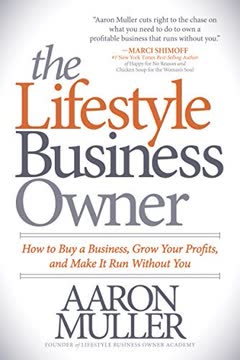
Key Takeaways
1. Embrace the Lifestyle Business Owner Paradigm
The business is built around the lifestyle you want instead of the business being a machine that consumes your every waking moment.
Redefine success. Many entrepreneurs struggle with lack of profits, employee stress, time, and meaning. The Lifestyle Business Owner (LBO) paradigm shifts focus from endless growth to designing a business that supports your desired life, offering a six-figure income for minimal hours. This approach prioritizes personal happiness and fulfillment over the relentless pursuit of more.
Author's journey. The author's own path, from washing trucks at 15 to owning multiple businesses, highlights the evolution from chasing wealth to seeking happiness. After a painful recession and divorce, he realized that "enough is better" and that businesses should serve one's values, not consume them. This led to systemizing his ventures to run without his daily presence.
Three core steps. Becoming an LBO involves a clear, actionable formula: first, acquire a good business; second, significantly increase its profits; and third, empower your team to manage operations independently. This systematic approach addresses common fears like risk, lack of capital, and inexperience, making the dream of business ownership attainable and sustainable.
2. Choose to Buy, Not Start: The Lower-Risk Path
Starting a business from scratch may be romantic, but it is not romantic when people end up selling their business for pennies on the dollar.
Dispelling startup myths. The media often glorifies starting a business from scratch, but this is often the riskiest and most expensive route. Startups face high failure rates, significant initial losses, and substantial opportunity costs, as exemplified by the story of Steve and Abigail's restaurant. Buying an existing, profitable business offers a proven model and immediate cash flow.
Lower risk, higher return. An established business comes with existing customers, a validated business model, and a track record of profitability from day one. This dramatically reduces financial risk compared to a startup, which often takes years to break even. Furthermore, buying allows for a faster path to becoming a lifestyle business owner, typically within one year versus four for a startup.
Logical decision-making. When buying, decisions are based on existing financials and operational data, fostering a more logical approach. Sellers often have diverse reasons for selling—retirement, health, relocation, or other ventures—not necessarily a failing business. This provides opportunities to acquire valuable assets and cash flow at a reasonable price, often with better returns than other investments.
3. Demystify Business Valuation & Secure Funding
To put it simply, how much money the owner makes determines the sale price of the business.
Owner's Discretionary Income (ODI). For small, privately held businesses, the most critical factor in valuation is the Owner's Discretionary Income (ODI). This is calculated by taking the net ordinary income from the P&L statement and adding back all expenses that benefit the owner personally, such as salary, personal travel, depreciation, and interest. This reveals the true cash flow available to a new owner.
Pricing and financing. Most small businesses sell for two to three times their most recent year's ODI, with desirability influencing the multiple. Buyers typically need 10-25% cash down, with banks (often SBA loans) covering 75% and sellers sometimes financing 15%. SBA loans usually require business assets and personal property as collateral, and the process can take up to 60 days.
High ROI potential. A well-chosen business acquisition can yield exceptional returns. For example, a $140,000 cash investment could secure a $400,000 business generating $160,000 ODI, resulting in over $118,000 annual cash flow after debt service—an 85% cash-on-cash return, far surpassing traditional investments like savings accounts or real estate.
4. Strategically Select Your Ideal Business
In my experience, the more glamorous the business is, the less profitable it tends to be.
Beyond passion. While personal interests are a starting point, avoid letting hobbies dictate business choices, as emotional decisions can hinder profitability. Focus on industries that offer strong financial potential and align with your management skills, rather than just the product or service itself. The goal is financial freedom, not necessarily turning a hobby into a job.
Industry insights. Prioritize industries with high profit margins and less direct price competition, such as service businesses (15-20% margins) over retail (10% margins). Niche industries, often overlooked and less glamorous (e.g., specialized laundry services), frequently offer stable income and fewer competitors. Consider recession-proof sectors like healthcare or bookkeeping for stability.
Holistic evaluation. Assess a business using 15 key metrics, including revenues, gross/profit margins, ODI, customer base, and expansion potential. Also, consider your personality (e.g., introversion/extraversion) to find a business that suits your natural working style. Franchises offer proven models but come with royalty fees and less autonomy, requiring careful consideration.
5. Boost Revenues Through Smart Marketing
Marketing is how customers perceive you from start to finish.
Beyond advertising. Smart marketing encompasses every touchpoint that shapes customer perception, from initial awareness to post-service follow-up. It's not just about expensive ads; it's about consistent, positive customer experience, friendly staff, clean premises, and effective communication. The author's auto shop, with a "New Owner. Friendly Service" banner, saw a 65% revenue increase by focusing on this.
Avoid common pitfalls. Don't equate advertising with marketing, as advertising is often the most expensive component. Effective marketing doesn't have to be costly; simple acts like asking for customer feedback can yield significant improvements. Owners must remain the "head of marketing," adapting strategies as customer behaviors and market trends evolve, rather than delegating entirely.
The Smart Marketing Framework. This framework focuses on five key areas:
- Customer Experience: Map the entire customer journey to identify improvement points.
- Repeat Purchase: Implement loyalty programs and make re-engaging effortless.
- Referrals: Design systematic referral programs to leverage satisfied customers.
- Larger Purchases: Build trust through free offerings, then upsell or cross-sell.
- Better Feedback: Establish critical feedback points to continuously gauge satisfaction and address issues proactively.
6. Build and Empower a Stellar Team
Rather than seeing their business as a machine and employees as parts in the machine, lifestyle business owners see their business as a living organism and employees as crucial parts of the organism.
Mindset shift. Effective employee management begins with viewing your business as a living organism, where employees are vital, not replaceable cogs. This means genuinely caring for their well-being, fostering intrinsic motivation, and balancing tough business decisions with empathy. A positive work environment attracts and retains top talent.
Strategic hiring and training. The interview is a poor predictor of job performance (15% accuracy); instead, prioritize applications, reference checks, and job-specific tests. Pay market rate or higher, with performance-based incentives, to attract the best. Crucially, create detailed employee training manuals for every role, documenting step-by-step procedures, company policies, and the "why" behind their work.
Retention and conflict resolution. Retain employees through competitive compensation, a healthy company culture, and understanding individual needs (e.g., flexibility, growth opportunities). Involve employees in decision-making to foster ownership and motivation. Address challenges promptly, privately, and constructively, escalating from verbal warnings to written warnings before termination, always with professionalism.
7. Systemize Operations for Consistent Delivery
The goal of operations is to deliver on your promises consistently, systematically, and automatically.
Consistency is key. Smooth operations ensure your business consistently delivers on its promises, regardless of who is working or how busy it is. This builds customer trust and reputation. Every aspect, from customer service to sales and collections, must be systematized to create a seamless experience.
Workflow and organization. Map out every step of your customer's journey, from arrival to departure, to identify and eliminate inefficiencies, duplications, and bottlenecks. Optimize communication between employees, balancing verbal and written methods. Maintain meticulous electronic records for efficiency, customer perception, and tax compliance, ensuring all employees follow established procedures.
Infrastructure and capacity. Assess your business's current capacity (tools, equipment, staff) and aim for it to be slightly greater than your current revenues (e.g., 20% buffer) to accommodate growth. Invest in necessary physical and legal infrastructure, such as proper legal entities for asset protection, to ensure the business functions optimally and is resilient to challenges.
8. Master Financial Management for Lasting Profitability
Sound financial management allows you to translate your revenues into cash you can take home.
Meticulous records and analysis. Lifestyle business owners prioritize meticulous bookkeeping, not just for tax minimization but for clear insight into financial health. Learning to read financial statements—Profit & Loss, Balance Sheet, and Statement of Cash Flows—is crucial for spotting threats and opportunities early. These statements tell a story about the business's performance and solvency.
Budgeting and monitoring. Create an annual budget with monthly targets for all revenue and expense line items. Proactively compare actual performance against the budget, investigating significant variances. Monitor key financial ratios daily, weekly, and monthly, comparing them to historical data and industry averages to fine-tune profitability.
Smart purchasing. Every purchase decision must be scrutinized for its impact on profitability. A good investment should recoup its cost within 1-2 months, while anything taking 2-5 years is generally poor. Prioritize purchases that directly increase revenues or efficiency, and be frugal, avoiding unnecessary expenditures that drain cash flow.
9. Implement the "Run Without You" Formula
Address your fears + manager + systems = Business that runs without you.
Confronting fears. The primary barrier to becoming a lifestyle business owner is fear: fear that employees don't care, will run the business into the ground, or that customers only come for the owner. LBOs acknowledge these fears but counter them with realistic expectations, robust systems, and consistent monitoring. Imperfection is accepted as the price of freedom.
The manager and systems. The formula hinges on hiring a competent manager and implementing comprehensive systems. A great manager, ideally with prior managerial and industry experience, is crucial for daily operations. They should be confident yet humble, following established procedures. Detailed employee training manuals, including one for the manager, standardize tasks and ensure consistency.
Gradual transition. Most existing businesses can transition to LBO status within about one year. This period involves building sales, systemizing operations, and training the manager. Even as an LBO, a minimum of five hours per week is dedicated to monitoring marketing, financials, payroll, major purchasing, and critical employee issues, ensuring the business remains on track.
10. Adopt a "Both/And" Growth Mindset
Instead of feeling forced to have either A or B, they ask themselves, “How can I have both?”
Beyond binary thinking. Lifestyle business owners reject the "either/or" mentality (e.g., happy employees or profitable business) that limits creativity. Instead, they embrace "both/and" thinking, seeking innovative solutions that allow for multiple positive outcomes simultaneously (e.g., happy employees and a profitable business). This holistic approach fosters innovation and resilience.
Avoid oversimplification. The world is complex; avoid labeling things as simply "good" or "bad." Such oversimplification closes the mind to nuance and prevents a full understanding of situations. LBOs actively question their assumptions, recognizing that their mental models may not always reflect reality, leading to better decision-making.
Value the process and reflect. LBOs value how goals are achieved as much as the goals themselves, prioritizing ethical practices and personal growth. They engage in systemized reflection—personally and with their team—to continuously learn from what worked and what didn't. This ongoing feedback loop drives improvement and fosters a culture of shared ownership.
11. Become an Invisible, Empowering Background Leader
A leader is best when people barely know he exists. When his work is done, his aim fulfilled, they will say: ‘We did it ourselves.’
Shift from commander to background leader. Traditional "commander" leadership, where the owner dictates, hinders autonomy and long-term sustainability. Lifestyle business owners adopt a "background leader" style, empowering employees to make decisions and fostering a collaborative environment. This approach builds goodwill, retains talent, and makes the company more innovative and resilient.
Understand power dynamics. Effective background leadership requires acute awareness of power dynamics: authority (title), agenda (influence), and culture (unspoken rules). Culture power, the most pervasive, shapes behavior without explicit directives. LBOs recognize that to foster genuine collaboration, they must address unspoken rules and create an environment of emotional safety where employees feel comfortable sharing ideas without fear.
Cultivate emotional safety. To transition to background leadership, establish emotional safety by openly sharing intentions and guaranteeing no repercussions for honest feedback. Holding company-improvement workshops, ideally off-site and involving all employees, can facilitate open dialogue about company culture, challenges, and solutions. The owner participates as an equal, demonstrating trust and valuing collective intelligence.