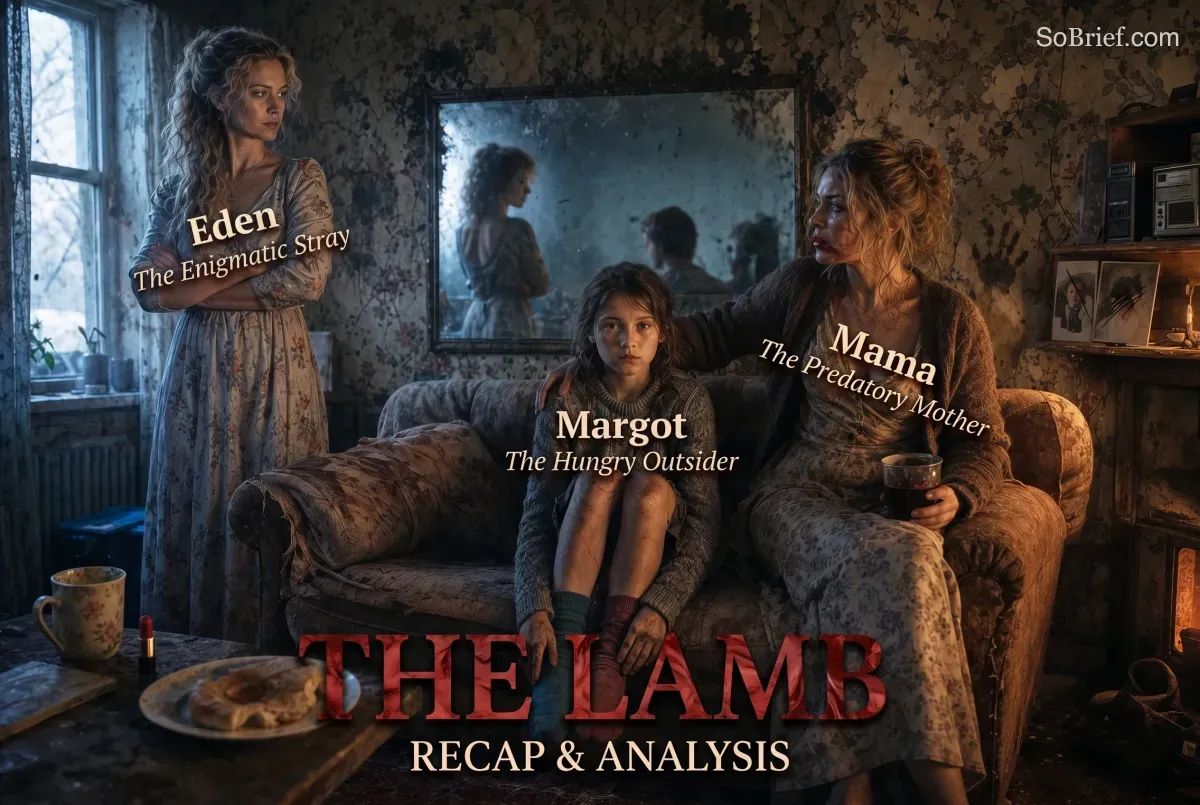


Plot Summary
Six Fingers, Fourth Birthday
The cottage is cramped and mould-speckled, tucked off a quiet road in rural Cumbria. Margot1 is four. The fingers she discovers in the bathtub drain — one still wearing flaking purple nail polish, another bitten to the quick — belong to strangers her mother, Ruth,2 lures from the back roads, drugs with hemlock-laced wine, and butchers for meat.
Ruth2 has taught Margot1 the rules: make strays feel loved before they die, or the flesh turns tough. That night, Margot's1 birthday dinner is a nervous young man roasted with Yorkshire puddings.
Papa7 left before she could form memories of him, and the smoky jumpers stored in the loft are all she has. Mama is beautiful when full. Ugly when hungry. This is the only world Margot1 knows — a place where love and appetite share the same mouth.
The Stray Who Wouldn't Drink
At the height of a snowstorm, a figure materializes from the mist — first a shape, then a woman with straw-blonde hair and uncommonly straight white teeth. Unlike every stray before her, Eden3 hesitates at the threshold. She declines the shower, requests only a warm drink.
When Margot1 hands her tea laced with the usual hemlock, Ruth2 intercepts — pulling the cup away, claiming Margot1 makes terrible tea. Something has shifted. Ruth2 offers Eden3 her real name, something she withheld even from the gamekeeper6 she'd been sleeping with for months.
Eden3 studies the cracked walls without judgment, asks about the hikers who vanish in these parts, and before bed wipes Ruth's2 smeared lipstick clean with her thumb. Ruth2 is unraveled in a way no stray, no lover, no husband has ever managed.
The Gamekeeper's Last Ale
Abbie's4 father — Ruth's2 married lover, the local gamekeeper6 who visits for afternoon trysts smelling of mud and whisky — returns drunk and wanting. Margot1 knows the routine: she prepares a glass of ale heavy with hemlock.
Ruth2 tips the glass against his lips with a single fingertip while Eden3 observes, motionless, curious. As the hemlock drags him under, Ruth2 invites Eden3 to press her palm against his chest and feel his heartbeat fade. Eden3 obliges, pupils dilating, lips parting into a smile.
This is her initiation into something she was already becoming. Afterward, Ruth2 sings along to an old love ballad, specks of blood dotting her collar, while Eden3 trembles on the verge of speech. Whatever words she's searching for won't come. She just wipes away the lipstick again.
Breadcrumbed Fingers by Firelight
By the hearth, Ruth2 and Eden3 feast on pan-fried finger food, trading bites between kisses, while Margot1 sits alone at the table with a single breadcrumbed offering she cannot bring herself to eat. Eden3 has transformed their crude butchery into craft — salt, rosemary, butter searing in the pan.
That night, she smears the gamekeeper's6 blood across Margot's1 lip and calls it lipstick. Ruth2 embraces them all and calls this togetherness, begging Eden3 to stay forever. Eden3 does. She moves into Margot's1 bed; the two singles are pushed together into a nest.
Margot1 is exiled to the couch. She buries the gamekeeper's6 clothes in the garden ditch alongside dozens of previous victims' belongings, but hides his boots beneath a hedge and braids his laces into a bracelet — unable to let him vanish entirely.
Abbie's Papa Never Returns
At school, Abbie's4 green ribbon is slipping loose again. She tells Margot1 her father hasn't come home, that her mother screams through the night and clutches her too tight. She climbed the fell to the big rock where her papa used to take her on his quad bike — nothing.
She believes the ground swallowed him. Margot1 takes Abbie's4 hand and feels its weight like a held stone. She gives Abbie4 her most treasured possession: a wishing hex she made to bring her own father back, now wound with the gamekeeper's bootlace bracelet.
When Abbie4 hugs her, Margot1 plucks a single blonde hair and pockets it. Alone in the ferns that evening, she places the strand on her tongue and swallows — a private communion. Now a piece of Abbie4 rests alongside her father inside Margot's1 body.
Margot's First Stray
Deep in the woods beyond the beck, Margot1 discovers a young woman bleeding against a tree — she fell onto a branch and made the fatal mistake of pulling it free. The hiker is fading, grey-skinned, hazelnut eyes losing focus. Margot1 imagines what hope will taste like seared into muscle.
She helps the stranger across the beck and through the gate, promising shelter and a phone call. Eden3 rushes out, proud-eyed, and sends Margot1 to gather wildflowers and dandelions for the dying woman's hair — because a stray must feel beautiful in her final moments, or the meat spoils.
Behind the closed door of the butchering room, Ruth2 and Eden3 work quietly. Margot1 scrubs the blood-soaked tarp afterward and sees the carcass hanging from its hook. She has proved her usefulness. She now understands the abattoir she lives inside.
Papa Was the Pie
During an argument in the rain, Ruth2 — mud-soaked and furious that Margot1 resists the hunt — drops a truth sharper than any blade. Papa7 didn't run away. Ruth2 killed him, wrapped him in buttery pastry, and served the most beautiful pie their kitchen had ever produced.
They feasted together; four-year-old Margot1 licked the plate clean, calling it the best birthday present she'd ever received. Ruth2 insists they are woven from the same cloth — the same hunger lives in both of them. Margot1 stumbles to the bathroom and vomits until she collapses on the tiles.
The fragments she'd treasured — smoky jumpers in the loft, a wedding photo hidden under a cushion — become memorials to a man she digested years ago. That night, curled on the cold floor, she whispers it aloud: she ate her own papa.7
Whispers Through the Keyhole
After Margot1 bites a schoolyard bully hard enough to draw blood — defending Abbie4 from his9 advances — she is suspended. Ruth2 calls her a mistake to her face. The school bus driver,5 the only adult who has consistently noticed Margot,1 is turned away at the gate with Ruth's2 lie that the girl is sick.
Isolated in the homestead, Margot1 kneels at the bedroom keyhole and watches Eden3 press her body against Ruth's,2 proposing something final: they will consume Margot,1 keep her safe inside their bellies forever, prevent all the pain the world would inflict.
Ruth2 hesitates but relents — her daughter is a risk, too noticed, too loud. When Margot1 is dragged toward the bedroom, she sinks her teeth into Eden's3 arm. Eden3 does not flinch. The window is locked. The key vanishes into Ruth's2 fist.
A Trail of Exhumed Bones
While Ruth2 and Eden3 sleep, Margot1 excavates the garden graves with her bare hands. She pulls plastic bags of rotting clothes from the earth — a bottle of purple nail polish, a suit and tie, the gamekeeper's waterlogged boots — and gathers scattered femurs tangled in shrub roots.
She carries everything across the pasture, dropping bones and fabric in the tall grass like breadcrumbs, all the way to the almond-shaped stone deep in the forest. If she is consumed, this trail will lead someone to the homestead.
Eden3 discovers the empty ditches and her composure fractures entirely for the first time. She combs the woodland for days, recovering most of what Margot1 scattered, but not everything. Some fragments remain in the meadow, half-swallowed by grass, waiting for the right pair of eyes.
A Needle Picks the Lock
Bound to the bed by cable ties, Margot1 pricks her finger on something silver wedged between the floorboards — a rusted sewing needle. She spends the afternoon working it into the old window lock while a dying bumblebee stumbles across the sill beside her. Something clicks.
The window opens to warm summer air, and she drops into the garden, crosses the road, wades the beck, and runs for the treeline barefoot. She sleeps under the almond stone with woodlice, dreaming of reaching Abbie's4 cottage by morning — of green ribbons and fish finger sandwiches and a life scrubbed clean.
But Ruth2 crashes through the ferns before dawn. Eden3 follows. Sandwiched between their ribcages, crushed in their embrace, Margot1 is carried back. Eden3 boards up the windows with planks. The sky disappears behind wood and nails.
Hemlock Stirred Into Stock
Eden3 bakes Margot1 a rabbit pie from the trap they built together months ago — a final meal to fatten her for slaughter. A get-well card arrives through the letterbox, signed with a name Margot1 has never known: Steve, the bus driver.5
She presses her nose to the paper and inhales the faint scent of cigarette smoke. That night, while Ruth2 and Eden3 tangle in their bedroom, Margot1 drags herself toward the stove where a pot of bone stock simmers — stock that will form the base of the pie they plan to bake her into.
She reaches into her pocket for the dried hemlock petals she has been hoarding for weeks and folds handful after handful into the broth, far more poison than any stray has ever received. She stirs slowly. The petals sink among the bones. The trap is set.
The Lamb Is Slaughtered
Ruth2 and Eden3 prepare the abattoir room: fresh black tarp nailed to the corners, a chain and hook fastened to the ceiling, blades polished until they gleam. Margot1 sets the dinner table herself — two places, not three.
In the room of hooks and plastic, they strip her, bind her to the floor, and wedge a wooden spoon between her teeth. Eden3 promises it will be quick. The hemlock Margot1 has been eating for days already squeezes her lungs, racing the blade toward the same darkness. She sees the glint of the knife.
Ruth2 is smiling — a genuine smile, the first in weeks. The world goes red, then grey, and between those colors there is no final thought, only the animal fear of the dark closing in. At some point, the pulse she has felt her entire life stops.
Candlelit Feast, Last Breath
Margot1 wakes without a body. Her carcass swings from the hook, stripped and drained into a copper basin. Ruth2 and Eden3 sit blood-drenched against the wall, euphoric, sharing a cigarette and singing their love ballad — amour, amour, amour.
Later, at the candlelit table, Eden3 serves the pie: golden puff pastry, creamy sauce made from the poisoned stock. Ruth2 hesitates. Then eats. Eden3 closes her eyes at the first bite and moans. As they feast, the hemlock blooms through their blood — what they mistake for euphoria is poison tightening its grip.
Their fingers graze, then go slack. Their heads roll back. Their hands part. From this slumber, Margot1 knows, they will never wake. She made certain of that. Days pass. Their bodies blacken at the dinner table. Flies colonize the pastry. Even in decay, their skulls lean toward each other.
Epilogue
The bus driver5 — Steve5 — breaks through the window glass days later. He searches room by room, finds the cable ties and the abattoir chain, and speaks Margot's1 name into the silence. He weeps.
Eventually he leaves, wrapped in a silver emergency blanket, and drives his minibus away until it is a dot between distant trees. Ghost Margot1 lingers in the bathtub where she once found six fingers. No more bones. No more bodies. The mould still creeps across the walls, and she still longs to taste it.
She feels ancient now, like a standing stone or a language no longer spoken. She knows the landscape will shift, the beck becoming a river, the earth someday an ocean that forgets them all. But for now, this ground is safe for strangers to walk. She made it so.
Analysis
The Lamb operates as a radical inversion of domestic horror, locating monstrosity not in an external intruder but in the architecture of maternal love itself. Lucy Rose constructs a household where cannibalism functions as the logical extreme of possessive intimacy — Ruth2 doesn't merely consume strays, she consumes her lovers, her husband, and ultimately her daughter. The novel's central insight is that the membrane between devouring and nurturing is thinner than civilization admits.
Margot's1 coming-of-age unfolds inside a moral framework where love and consumption are linguistically and physically interchangeable. Ruth2 teaches that making strays feel loved improves the taste of their flesh. Eden3 promises that eating Margot1 will keep her safe inside them forever. The novel asks: when love is defined as incorporation of the other, what space remains for autonomy?
The book's queer dimensions complicate easy moralization. Ruth's2 most authentic self emerges through her love for Eden3 — the first relationship where she surrenders control, reveals her real name, and experiences genuine reciprocity. Yet this same love produces the novel's most horrifying act. Rose refuses to separate queerness from monstrosity or redeem it through respectability, instead presenting desire as a force that intensifies whatever it touches.
Margot's1 resistance — poisoning the stock with the same hemlock used on every victim — reclaims the homestead's own tools against its masters. But her victory is posthumous and pyrrhic. She saves future strangers from the homestead but cannot save herself. The novel's final image — a ghost child in an empty bathtub where she once found severed fingers — suggests that some childhoods produce spirits rather than survivors.
What elevates Rose's debut beyond shock is its sustained tonal control. The child narrator observes her own dehumanization with the same sensory precision she applies to mould on walls or the texture of a classmate's hair. The horror is not that Margot1 lives among monsters — it is that she must decide, with a child's limited tools, whether she is one.
Review Summary
The Lamb is a haunting debut novel that polarizes readers with its graphic depiction of cannibalism and mother-daughter relationships. Many praise Rose's lyrical prose and the book's unsettling atmosphere, comparing it to folk horror and fairy tales. Themes of love, hunger, and coming-of-age resonate strongly. While some found it repetitive or overwritten, others were deeply moved by the emotional core and shocking ending. The novel's blend of beauty and horror left a lasting impact on many readers, marking Rose as a talent to watch in the horror genre.
People Also Read
Characters
Margot
Cannibal's awakening childRaised from infancy in a cannibal household in rural Cumbria, trained to lure strays and help prepare their bodies for consumption. Margot is caught between two inheritances—her mother's2 predatory hunger and the stirrings of her own moral consciousness. She struggles academically, endures bullying, and processes the world through obsessive sensory detail: mould on walls, the texture of bone, the scent of a classmate's hair. Her attachment to Abbie4 represents her first genuine human connection beyond the homestead. Psychologically, Margot exhibits the hallmarks of a child in coercive captivity—hypervigilance, dissociation, compulsive obedience—who is slowly developing the capacity for autonomous moral reasoning. She craves love with the same ferocity her mother2 craves flesh, and cannot always tell the difference.
Ruth
Insatiable mother and predatorMargot's1 mother, a woman whose hunger—for flesh, for love, for being truly seen—is bottomless and self-consuming. She killed her first victim at eleven, luring a homeless woman to a rubble pile and cracking her skull with a brick. Beautiful in a feral way—crooked teeth, smeared lipstick, a body that alternates between gaunt starvation and satiated radiance—Ruth's relationships are transactional until they exhaust their usefulness. She controls Margot1 through violence, emotional manipulation, and occasional devastating tenderness. Her love for Eden3 represents the first time she has surrendered dominance, making her simultaneously more human and more dangerous. She married young, craved a love that burned like fire, and found only men who wanted her silent. The emptiness inside her only grows.
Eden
The stranger who stays foreverA mysterious woman who arrives during a snowstorm and never leaves. Composed where Ruth2 is impulsive, precise where Ruth2 is messy, strategic where Ruth2 is reckless, Eden transforms the household's cannibalism from crude butchery into culinary craft—breadcrumbed fingers, rosemary-rubbed thighs, golden-crusted pies. Beneath her warmth lies a calculating mind: she controls Ruth2 through love and Margot1 through the promise of belonging. A survivor of childhood trauma—her mother died birthing her, her father blamed her for the mess, her baby was taken from her at fifteen—Eden channels grief into dominion. She tells folk tales as instruction manuals for the life she is building. Her definition of protection blurs dangerously with possession, and her love always arrives with conditions.
Abbie
Gamekeeper's grieving daughterMargot's1 school friend and quiet first love. Blonde, gap-toothed, with a green ribbon perpetually slipping from her hair, Abbie is everything Margot1 is not: clean, bright, socially capable. Her father's6 disappearance transforms her from a poised child into something wilder and muddier. She confesses she thinks about Margot1 the way she is supposed to think about boys—a fragile admission that represents Margot's1 one window into a life outside the homestead.
Steve
Margot's quiet moral compassAn aging, cigarette-smoking school bus driver who lets Margot1 sit in the front seat to escape her bullies. The only adult who consistently notices Margot1, asks real questions, and waits for honest answers. He lost his own father young and understands the specific gravity of absence. His kindness is unshowy—a cassette tape, a conversation, a get-well card signed with his name—but it represents every chance the outside world had to intervene.
The gamekeeper
Ruth's reckless married loverRuth's2 affair partner and Abbie's4 father. He visits the homestead for afternoon trysts, smelling of mud, whisky, and his wife's desperate perfume. Large-handed and emotionally shallow, he represents the kind of man Ruth2 consumes in every sense. His name—Mark Greene—appears only on a clothing label. He believes he is the one with power, blind to what his visits truly risk.
Papa
The vanished fatherMargot's1 father, absent since before her fourth birthday. She treasures his smoky jumpers and a hidden wedding photo, constructing an idealized ghost from fragments. Ruth2 married him at seventeen; he wanted a quiet, compliant wife and could not accept her true nature. His departure leaves Margot1 with unanswerable questions about inheritance and identity.
Mr Hill
Margot's dismissive teacherMargot's1 impatient schoolteacher who notices a bruise on her neck but shrugs it off, embodying the institutional failure that allows her abuse to continue unquestioned.
Patrick
Schoolyard bully with knivesA cruel boy who torments Margot1 with penknives and humiliation on the school bus. His aggression mirrors the violence of Margot's1 home life, and their confrontation triggers her suspension and isolation.
Roz
Kind office worker at schoolA warm school staff member who helps Margot1 during her first period with a pad and a bar of dark chocolate—a brief, maternal kindness from a stranger that Margot1 treasures.
Plot Devices
Hemlock
Poison, hex, and final weaponHemlock is the homestead's essential tool—crushed into wine or ale to make strays drowsy and pliable before slaughter. Ruth2 teaches Margot1 it is a hex that brings peaceful sleep, never lethal on its own, just enough to render victims helpless. It grows wild by the beck, as native to the Cumbrian landscape as the violence it enables. Margot1 collects it throughout the story, ostensibly for Ruth's2 supply, but she also consumes it herself, trying to make her flesh taste vile. Critically, she folds massive quantities into the simmering bone stock during her final night. The same substance that subdued every stray becomes Margot's1 instrument of retribution—turning the homestead's oldest weapon against its masters.
The Strays
Language that erases personhoodRuth's2 taxonomy for vulnerable people—the lost, the unhoused, the untethered—identified by a quality she calls being without a house, meaning without an inner anchor. The word sanitizes murder into something closer to foraging: one doesn't kill a stray, one takes them in. Margot1 inherits the language instinctively, but the framework fractures when the gamekeeper6—someone with a family, a name, a daughter who grieves—becomes a stray too. Through Abbie's4 pain, Margot1 begins to see the word as narrative erasure: stripping victims of identity before the knife strips their skin. Eden3 adopts the term fluidly but subtly redefines it—to her, everyone outside their family qualifies, including Margot1.
The Rabbit Woman Story
Folk tale as moral forkEden3 tells Margot1 a bedtime story about a rabbit woman whose fur was stolen by a hunter, transforming her. In rage, she skinned her own kin and ground their bones into flour, baking pies the world devoured unknowingly. The story mirrors the homestead's cannibalism—beautiful surfaces concealing horror, trauma inherited by the vulnerable. But when a stranger in the woods tells Margot1 a different version—where the rabbit women band together to take the hunter's fingers instead—it introduces the possibility of resistance and solidarity. Eden's3 version teaches that cruelty flows downward. The stranger's version suggests it can be redirected upward. This narrative fork becomes the fork in Margot's1 moral development.
The Wishing Hex
Handmade tokens of longingMargot1 builds hexes from twigs, drift-rope, dried flowers, and cockleshells gathered from Morecambe Bay quicksands. Her first hex is a wish to bring Papa7 home—a square of woven sticks with a shell at its center. She gives it to Abbie4, wound with the gamekeeper's bootlace bracelet, transferring her deepest longing to the girl she loves. A cockleshell hex also guards the burial ditch where victims' belongings are hidden. These fragile, handmade objects represent Margot's1 attempts to exert agency in a world where she has almost none—to wish, protect, and give something of herself. When Abbie's4 mother finds the hex and throws it in the bin, it shows how easily a child's power is dismissed.
The Gamekeeper's Boots
Memory resisting consumptionAfter the gamekeeper6 is killed and consumed, Margot1 buries his clothes in the garden ditch but cannot part with his steel-toed boots. She hides them under a hedge, visits them, talks to them, asks whether he misses Abbie4. The boots become a surrogate for the dead—a repository for guilt, grief, and unanswerable questions. Eden3 discovers and buries them, but Margot1 later exhumes them as part of her trail of evidence scattered through the meadow. Waterlogged, worm-inhabited, sprouting leaves from the eyelets, the boots are the gamekeeper's6 most durable remnant—outlasting his body, his memory in his family, and the homestead itself. They are proof that some things resist being fully consumed.
FAQ
Synopsis & Basic Details
What is The Lamb about?
- A Dark Coming-of-Age: The Lamb follows Margot, a young girl raised in an isolated homestead by her mother, Ruth, where the family survives by luring "strays"—lost travelers—into their home, consuming them in ritualistic feasts. The story explores Margot's unique upbringing, her struggle to reconcile her inherited predatory nature with a burgeoning sense of empathy, and the complex, often violent, dynamics of her relationship with her mother.
- Unsettling Familial Bonds: The narrative delves into the twisted concept of love and survival within this unconventional family, where acts of violence are intertwined with expressions of affection. Margot learns to navigate a world where hunger is both literal and emotional, and where the line between nurture and consumption is constantly blurred, leading to a chilling exploration of identity and belonging.
- A World of Secrets: As a mysterious woman named Eden enters their lives, the fragile balance of the homestead is disrupted, forcing Margot to confront deeper truths about her family's past, her own desires, and the inevitable consequences of their hidden existence. The novel is a gothic horror tale steeped in psychological tension and unsettling domesticity.
Why should I read The Lamb?
- Visceral Sensory Experience: Lucy Rose's prose is deeply immersive, drawing readers into Margot's world through vivid sensory details—the smell of mould, the taste of blood, the feel of mud and cold. This creates an unsettling, almost tactile reading experience that lingers long after the final page, making the horror feel intimately real.
- Complex Psychological Depth: Beyond the shocking premise, the novel offers a profound psychological exploration of trauma, inherited violence, and the formation of identity. Readers will be captivated by Margot's internal conflict, Ruth's desperate hunger, and Eden's enigmatic influence, prompting deep reflection on human nature and the capacity for both cruelty and connection.
- Subversive Gothic Themes: The Lamb masterfully subverts traditional gothic tropes, reimagining the isolated house, the monstrous feminine, and the innocent child through a modern, visceral lens. It challenges conventional notions of family, love, and morality, offering a fresh and disturbing take on the genre that will appeal to fans of dark, character-driven fiction.
What is the background of The Lamb?
- Rural Isolation & Primal Survival: The story is set in a remote, unnamed rural area, likely the fells of Cumbria given references to the "Gelt or the Eden" rivers (Chapter 6) and the "Pennines in the Cumbrian regions" (Chapter 23). This geographical isolation is crucial, cutting the characters off from conventional society and forcing them into a primal mode of survival where traditional morality is irrelevant.
- Psychological & Emotional Landscape: The "background" is less about historical events and more about the psychological and emotional inheritance of trauma. The characters' actions are deeply rooted in their past experiences of abandonment, unfulfilled love, and a desperate need for belonging, creating a cycle of violence that perpetuates itself through generations.
- Subversion of Domesticity: The novel takes the familiar setting of a "pebble-dashed cottage" (Chapter 2) and subverts it, transforming a symbol of domestic comfort into a site of horror and consumption. This contrast highlights the unsettling nature of the family's existence, where everyday objects and routines are imbued with sinister meaning.
What are the most memorable quotes in The Lamb?
- "We are what we eat, Mama always said." (Chapter 1): This quote encapsulates the novel's central theme of cannibalism as a familial bond as a literal and metaphorical act of absorption and identity. It highlights Ruth's twisted philosophy, suggesting that consuming others allows them to internalize their qualities, blurring the lines between predator and prey, and shaping Margot's understanding of self.
- "The devil looks as ordinary as you and me." (Chapter 33): Spoken by Mama to Margot, this line is a chilling commentary on the banality of evil and the deceptive nature of appearances. It underscores the novel's exploration of how monstrous acts can be committed by seemingly ordinary people, challenging the reader's preconceptions about what evil truly looks like.
- "Being a mama is a promise you make to be perfect and make no mistakes. And to put yourself second until you die. It mutates into this horrible burden. A weight you have to carry forever." (Chapter 74): This quote reveals Ruth's deep-seated resentment and the immense pressure she feels as a mother, offering a rare glimpse into her vulnerability. It explains her destructive behavior as a desperate attempt to escape the perceived "burden" of motherhood, connecting her actions to a profound sense of entrapment and self-loathing.
What writing style, narrative choices, and literary techniques does Lucy Rose use?
- First-Person, Unreliable Narration: The story is told through Margot's first-person perspective, which is inherently unreliable due to her traumatic upbringing and distorted understanding of the world. This narrative choice forces the reader to constantly question what is real, what is imagined, and how Margot's perception shapes the events, deepening the psychological horror.
- Sensory-Rich, Visceral Prose: Rose employs highly descriptive and sensory language, immersing the reader in Margot's disturbing reality. The text is filled with vivid descriptions of smells ("musty brambles," "thick tobacco smell," "iron smell"), tastes ("earthy must," "metal and musty," "sour and salty"), and tactile sensations ("bedding tickled," "cold blistered our skin," "mud squelched"), making the grotesque feel intimately real.
- Symbolism and Motif Repetition: The novel is rich with recurring symbols and motifs, such as the "strays," the "hexes," the "mould," and various animal imagery (lamb, rabbit, wolf). These elements are woven throughout the narrative, adding layers of meaning and reinforcing the cyclical nature of violence, hunger, and the characters' psychological states.
Hidden Details & Subtle Connections
What are some minor details that add significant meaning?
- The Ever-Present Mould: The black mould in the bathroom (Chapter 1, 25, 62, 81) is more than just a sign of neglect; it symbolizes the pervasive decay and corruption within the homestead and Margot's own psyche. Her act of licking it (Chapter 1, 62) signifies her acceptance, and even embrace, of this internal and external rot, foreshadowing her eventual descent into the family's monstrous ways.
- The Bus Driver's Illegible Tattoos: When Margot observes the bus driver's "fuzzy. Old. Illegible" tattoos (Chapter 52), it subtly hints at the forgotten histories and unreadable complexities of ordinary people. Unlike the strays whose stories are consumed, the bus driver represents a world of unwritten narratives and quiet lives, making his eventual discovery of the homestead's horrors even more poignant.
- Eden's "Perfect" Hair and Teeth: Eden's initial description emphasizes her "perfect hair" and "white and straight" teeth (Chapter 11), contrasting sharply with Mama's "crooked teeth" (Chapter 5). This detail subtly positions Eden as an idealized, almost unnatural, figure of perfection, hinting at her manipulative nature and her ability to present a polished facade that draws Mama in, promising a "cleaner" form of consumption.
What are some subtle foreshadowing and callbacks?
- The "Ammonite Fossil" Metaphor: Mama tells Margot she is her "sweet ammonite fossil" and "only hers to unearth" (Chapter 5). This seemingly tender metaphor subtly foreshadows Margot's eventual fate, where she is literally "unearthed" and consumed, becoming a part of Mama and Eden, a "fossil" of their shared history. It also hints at Mama's possessive and consuming love.
- The Gamekeeper's Boots as a Lingering Presence: Margot's decision to hide the gamekeeper's boots instead of burying them (Chapter 22) is a subtle act of rebellion and a callback to his earlier presence. These boots, "used. Lived in," become a tangible link to the outside world and to Abbie, symbolizing Margot's internal conflict and her desire to preserve a piece of humanity amidst the horror. Their eventual re-exhumation by Eden (Chapter 61) directly leads to Margot's capture.
- The "Rabbit Woman" Story's Evolving Versions: Eden's retelling of the "rabbit woman" story (Chapter 18) initially presents a tale of transformation and survival, but her later, darker version (Chapter 45) reveals the woman's vengeful and predatory nature. This evolution of the story subtly foreshadows Eden's own true intentions and the escalating darkness within the homestead, mirroring the characters' own descent.
What are some unexpected character connections?
- Margot's Connection to the Bus Driver's Grief: The bus driver's confession about losing his own father and feeling "robbed of something" (Chapter 34) creates an unexpected emotional parallel with Margot's own unspoken grief for Papa. This shared experience of loss, though vastly different in its origins, forms a quiet, empathetic bond between them, making his eventual discovery of her fate even more tragic.
- Eden's Shared Trauma with Mama's First Stray: Eden's confession about killing her own mother during childbirth (Chapter 38) and her subsequent consumption of her baby, Bobby (Chapter 57), creates a chilling parallel with Mama's first stray—the woman whose skull Mama cracked open and whose brain she tasted (Chapter 6). This shared history of primal, consuming violence forms the deep, unspoken bond between Mama and Eden, making them "kindred" (Chapter 13) in their monstrosity.
- Abbie's Unwitting Connection to the Homestead's Secrets: Abbie's innocent questions about her father's disappearance and her belief that "the ground has eaten him up" (Chapter 24) create a direct, yet unknown, connection to the homestead's secrets. Her grief and search for answers unknowingly mirror the literal fate of her father, whose remains are buried in the garden, highlighting the tragic irony of Margot's friendship with her.
Who are the most significant supporting characters?
- Steve, The Bus Driver: Steve is crucial as the sole external moral compass and a symbol of the world's quiet empathy. His consistent kindness, genuine concern for Margot's well-being, and eventual discovery of the homestead's horrors (Chapter 80) serve as a stark contrast to the family's depravity, highlighting the limits of intervention and the tragedy of unnoticed suffering.
- Abbie, The Gamekeeper's Daughter: Abbie represents Margot's last tether to normalcy and innocence. Her friendship offers Margot a glimpse of genuine connection and a moral dilemma, forcing her to confront the consequences of her family's actions. Abbie's persistent grief for her father (Chapter 24) also serves as a constant, haunting reminder of the victims' humanity.
- Papa, The Absent Figure: Though largely absent, Papa presence is profoundly significant. His memory, distorted by Ruth's narratives and Margot's fragmented recollections, shapes Margot's identity and her understanding of love and abandonment. His ultimate fate, revealed to be consumption by Ruth (Chapter 54), is a pivotal moment that shatters Margot's last illusions about her family and herself.
Psychological, Emotional, & Relational Analysis
What are some unspoken motivations of the characters?
- Ruth's Desperate Need for Control and Validation: Beyond hunger, Ruth's deepest motivation is a desperate need for control and validation, stemming from her own past experiences of being "expected to be perfect and quiet. Compliant" (Chapter 33). Her consumption of strays and her possessive love for Eden are attempts to fill an emotional void and assert dominance, ensuring she is never abandoned or unseen again.
- Eden's Quest for a "Home" and Acceptance: Eden's motivation, subtly revealed through her past (Chapter 57), is a profound longing for a place where she can be her true, monstrous self without judgment. Her desire to "take root in our homestead" (Chapter 11) and her promise to "never leave you" (Chapter 31) to Mama stem from her own history of being an outcast and a "runner," seeking a family that accepts her inherent nature.
- Margot's Search for Unconditional Love and Identity: Margot's unspoken motivation is a yearning for unconditional love and a stable sense of self, constantly oscillating between her inherited predatory instincts and a nascent empathy. Her attempts to connect with Abbie and the bus driver, and her internal struggle with the "taste of regret" (Chapter 41), reveal a child desperately trying to define herself outside the monstrous framework of her upbringing.
What psychological complexities do the characters exhibit?
- Ruth's Narcissistic Projection: Ruth exhibits narcissistic tendencies, projecting her own unfulfilled desires and insecurities onto Margot and her relationships. Her declaration, "I didn't want to carry a child! I never wanted to be a mama" (Chapter 71), reveals a deep-seated resentment towards motherhood, which she perceives as a "burden," explaining her transactional and often cruel treatment of Margot.
- Eden's Calculated Empathy and Manipulation: Eden's psychological complexity lies in her ability to display convincing empathy while simultaneously manipulating those around her. Her gentle words and comforting gestures (e.g., "I'm only looking after you, Little One," Chapter 27) mask a cold, calculating nature, as evidenced by her past actions and her strategic suggestions for luring strays (Chapter 32).
- Margot's Dissociation and Moral Conflict: Margot frequently dissociates from the horrific reality of her life, describing events with a detached, almost clinical tone (e.g., "I didn't recognise the stray as the woman from the woods anymore. There was a person there, but all I saw was meat," Chapter 37). This dissociation is a coping mechanism, but it also highlights her profound moral conflict as she grapples with her inherited nature versus her growing conscience.
What are the major emotional turning points?
- Margot's First Taste of Papa's Flesh: The revelation that Margot consumed her own father (Chapter 54) is a devastating emotional turning point. This shatters her fragmented memories of him and forces her to confront the full extent of her family's depravity and her own complicity, leading to intense physical and emotional revulsion ("I vomited. And vomited again.").
- Ruth's Confession of Not Loving Margot: Mama's whispered confession, "I'm wondering if it's quite possible I don't love you the same anymore" (Chapter 57), is a brutal emotional blow for Margot. This moment confirms Margot's deepest fear of abandonment and rejection, solidifying her decision to act against her mother and Eden.
- Eden's Story of Bobby: Eden's chilling confession of consuming her own baby, Bobby (Chapter 57), is a major emotional turning point for Margot. It reveals the depth of Eden's own trauma and monstrousness, but also her capacity for a twisted form of "love" and possession, making Margot realize the true nature of the "safety" Eden offers.
How do relationship dynamics evolve?
- Margot and Ruth: From Dependent to Antagonistic: The relationship between Margot and Ruth evolves from a deeply dependent, albeit abusive, bond to one of overt antagonism. Initially, Margot seeks Ruth's approval and love, but as Ruth's focus shifts to Eden and her true nature is revealed, Margot's loyalty curdles into hatred and a desire for revenge.
- Ruth and Eden: From Infatuation to Consuming Codependency: Ruth's relationship with Eden quickly escalates from infatuation to a consuming, almost symbiotic codependency. Eden fills Ruth's "empty belly" (Chapter 46) in ways no one else could, leading Ruth to abandon her previous caution and focus solely on Eden, even at Margot's expense. Their love becomes a shared monstrousness.
- Margot and Abbie: From Friendship to Symbolic Sacrifice: Margot's friendship with Abbie, initially a source of comfort and a connection to normalcy, transforms into a symbolic sacrifice. Margot's act of swallowing Abbie's hair (Chapter 35) and her internal struggle to protect her (Chapter 47) represent her desperate attempt to preserve innocence and break the cycle, even as she becomes a victim herself.
Interpretation & Debate
Which parts of the story remain ambiguous or open-ended?
- The Nature of Margot's "Death" and Afterlife: While Margot's body is consumed, her consciousness persists, observing the aftermath and reflecting on events (Chapter 77, 81). The exact nature of this "afterlife" or "spirit" remains ambiguous. Is it a literal ghost, a metaphorical representation of lingering trauma, or a final act of narrative control by Margot? This open-endedness invites readers to ponder the persistence of consciousness beyond physical death in a horrific context.
- The True Extent of Margot's Complicity: The novel leaves the full extent of Margot's complicity in the family's cannibalism open to interpretation. While she participates in luring strays and cleaning up, her internal monologue often expresses revulsion and regret. Readers are left to debate whether she is a true monster in the making, a victim of circumstance, or a complex blend of both, constantly struggling with her inherited nature.
- The Origin of Ruth and Eden's Monstrosity: While hints are given about Ruth's past (her "first stray," Chapter 6) and Eden's (Bobby, Chapter 57), the ultimate origin of their deep-seated hunger and monstrous nature remains somewhat ambiguous. The novel suggests it's a combination of inherited trauma, unfulfilled desires, and a twisted understanding of love, but the precise "why" is left for readers to ponder, emphasizing the inherent darkness within them.
What are some debatable, controversial scenes or moments in The Lamb?
- The Consumption of Papa: The revelation that Ruth consumed Papa and that Margot participated in eating him (Chapter 54) is highly controversial. This scene challenges the ultimate taboo, forcing readers to confront the most extreme form of familial betrayal and violence. It sparks debate about the limits of human depravity and the psychological impact of such an act on Margot.
- Eden's Story of Consuming Her Baby, Bobby: Eden's casual recounting of consuming her newborn baby (Chapter 57) is another deeply disturbing and controversial moment. This scene pushes the boundaries of horror, forcing readers to grapple with infanticide and cannibalism, and raises questions about the nature of "love" and "protection" in Eden's twisted worldview.
- The "Special Kisses" and Physical Abuse: Ruth's labeling of her physical abuse of Margot as "special kisses" (Chapter 7) is a controversial portrayal of gaslighting and the normalization of violence within the family. This moment highlights the insidious nature of abuse, where harm is reframed as affection, making Margot's struggle to understand love and pain even more complex and debatable.
The Lamb Ending Explained: How It Ends & What It Means
- Margot's Sacrifice and Retribution: The Lamb ending explained: Margot is consumed by Ruth and Eden, baked into a pie as the ultimate "lamb" sacrifice. However, Margot has secretly poisoned the stock with hemlock (Chapter 73), ensuring that her death is not in vain. Ruth and Eden succumb to the poison, dying at the dinner table (Chapter 78), their bodies left to decay in the homestead. This act of self-sacrifice is also a powerful act of retribution, breaking the cycle of violence they perpetuated.
- The Persistence of Memory and Trauma: Despite her physical death, Margot's consciousness lingers, observing the decay of her mother and Eden, and the eventual discovery of the homestead by the bus driver (Chapter 79, 80). This suggests that while the physical cycle of consumption is broken, the psychological impact and the memories of trauma persist. Margot becomes a "ghost in the bathtub" (Chapter 81), a silent witness to the world's indifference and the enduring legacy of her family's horrors.
- A Bleak Hope for the Future: The ending is ambiguous but leans towards a bleak form of hope. The monsters are "fated to dream" (Chapter 81), implying their reign of terror is over. Margot's final act ensures that "this ground was safe for the strangers to tread" (Chapter 81), suggesting a return to a semblance of normalcy for the outside world. However, Margot's own eternal haunting implies that true escape from the past is impossible, and the "world forgets" (Chapter 18, existing analysis) the suffering, leaving the victims' stories to linger as quiet, unsettling myths.
Download PDF
Download EPUB
.epub digital book format is ideal for reading ebooks on phones, tablets, and e-readers.








































