

Key Takeaways
You were domesticated like a pet — and now you do it to yourself
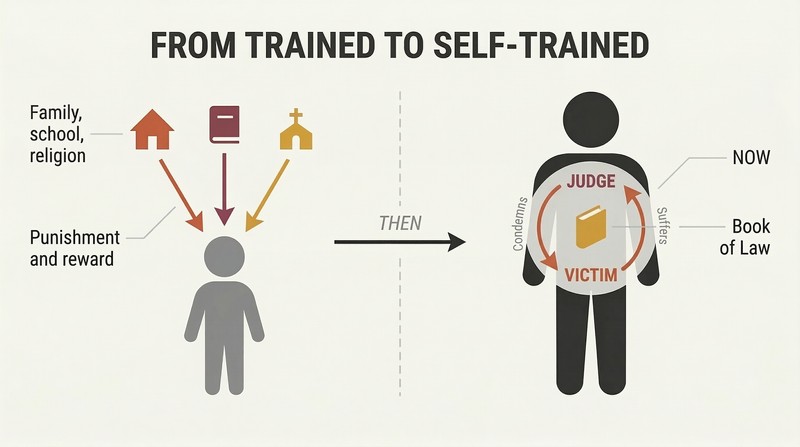
Ruiz's foundational concept is domestication. From birth, parents, schools, and religion hook your attention and install beliefs through punishment and reward — exactly like training an animal. You learned what's "good" and "bad," "beautiful" and "ugly," without choosing any of it. This creates two inner voices: the Judge, who condemns you based on inherited rules, and the Victim, who carries the resulting guilt and shame.
Together they form a self-reinforcing loop. Combined with the internalized belief system Ruiz calls the Book of Law, they rule your mind. Eventually you become "autodomesticated" — punishing and rewarding yourself according to beliefs you never chose. Ruiz claims ninety-five percent of what's stored in this internal rulebook are lies.
Four new agreements can dismantle a lifetime of fear-based programming
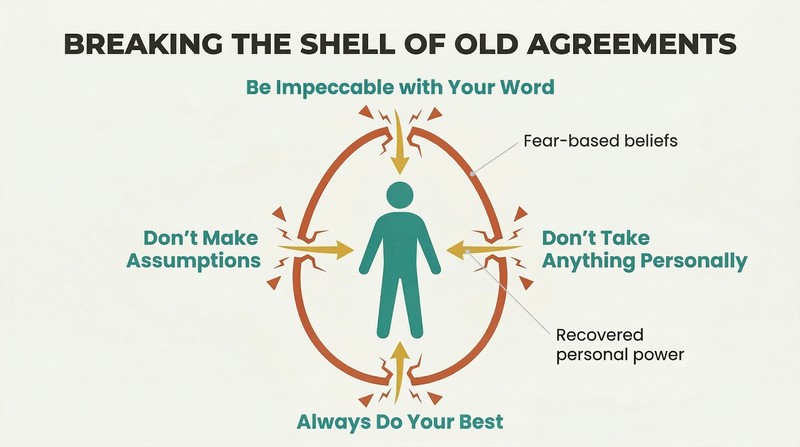
Your personality is a collection of agreements — with yourself, family, society, God. Fear-based agreements drain personal power; you barely have enough energy to survive each day because most of it is spent maintaining old beliefs. Ruiz's four agreements are designed to break the cycle:
1. Be Impeccable with Your Word
2. Don't Take Anything Personally
3. Don't Make Assumptions
4. Always Do Your Best
Each old agreement you break releases stored energy. That recovered power builds momentum to tackle deeper, more entrenched beliefs. Adopt these four, and you generate enough force to overhaul the entire system — transforming what Ruiz calls the personal dream of hell into a personal dream of heaven.
Treat every word as a spell — because it functions as one
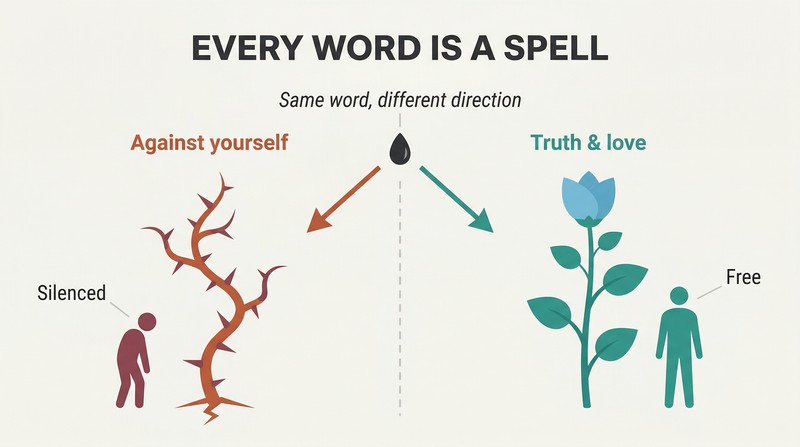
The first and most important agreement: Be Impeccable with Your Word. "Impeccable" comes from Latin pecatus ("sin") — literally "without sin," which Ruiz redefines as "not going against yourself." Words plant seeds in minds. A mother snapped at her daughter, "Shut up! You have an ugly voice." That single sentence silenced the girl for life — she stopped singing, became shy, struggled to speak publicly.
Even self-talk counts. "I'm stupid, I'm ugly, I'll never be enough" is what Ruiz calls black magic aimed at yourself. The antidote: use your word only in the direction of truth and love, starting with how you speak to yourself. One new agreement based on truth can break spells that have controlled you for decades.
Gossip is a computer virus corrupting your mental operating system
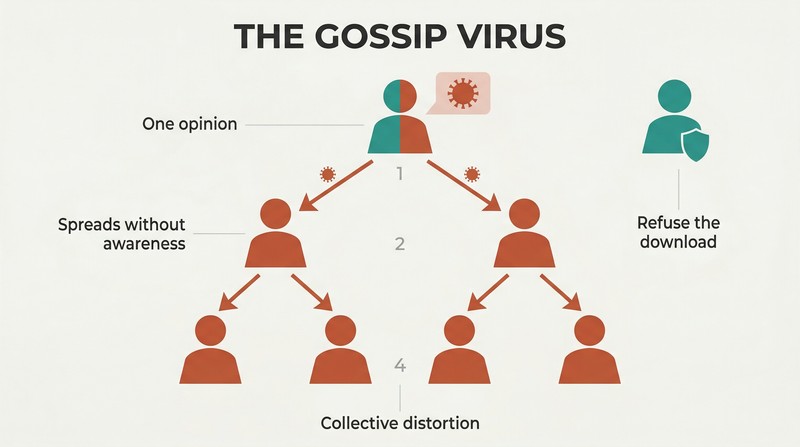
Ruiz compares gossip to a computer virus: harmful code written in the same language as legitimate information, installed without your awareness. Someone tells you a new teacher is "a pompous jerk." You enter the class already poisoned, seeing through someone else's resentful eyes. You spread it, others absorb it, and everyone drops the class. One opinion cascades into collective distortion.
Gossip feels like bonding — "misery likes company" — but it's actually how people transfer emotional poison. Worse are intentional spreaders who gossip for revenge, justifying cruelty as punishment. Being impeccable with your word means refusing to participate in this chain: neither spreading the mental virus nor swallowing it. The healthier your mind, the less fertile the ground.
Nothing anyone does is about you — even direct insults
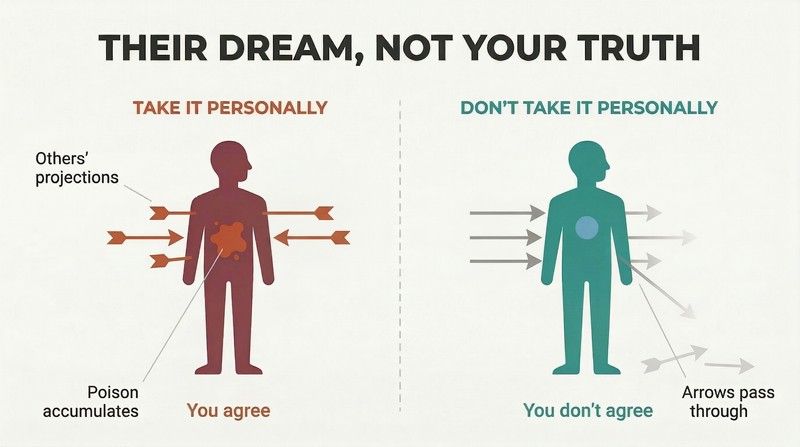
The second agreement rests on one insight: everyone lives inside their own dream. When someone calls you stupid, they're projecting their programming — not revealing truth about you. Ruiz goes to an extreme: even if someone physically harms you, their action reflects their fear, not your worth. The trap is agreement — when you accept their opinion, their emotional poison becomes yours.
What feels like hurt is your own wounds being touched, not new damage inflicted. The immunity works both ways: don't internalize praise either, because your worth shouldn't depend on external validation. Practicing this second agreement alone, Ruiz claims, breaks roughly seventy-five percent of the small agreements keeping you trapped in suffering.
Ask for what you want instead of punishing people for not guessing
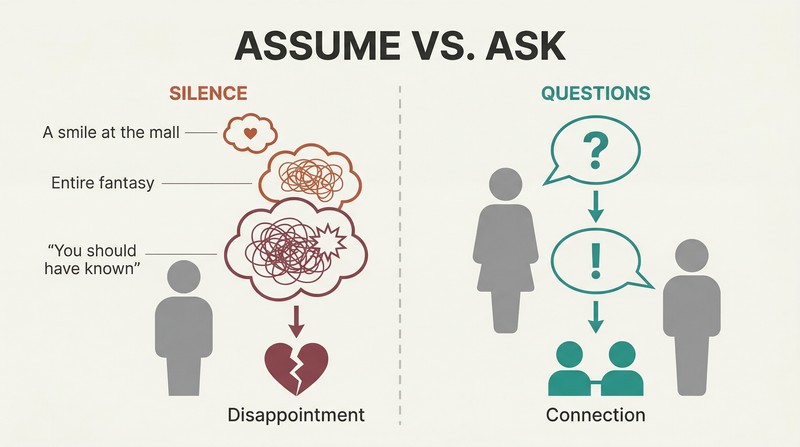
The third agreement targets relationship minefields. We assume partners know what we think and want. When they fail to deliver, we feel betrayed: "You should have known." Ruiz traces an absurd escalation: someone smiles at you in a mall, and you build an entire fantasy relationship from that single moment. The most dangerous romantic assumption? "My love will change this person." It won't — people change only when they choose to.
The cure is embarrassingly simple: ask questions instead of filling silence with fiction. Find someone you don't need to change, and who doesn't need to change you. Clear communication eliminates the emotional dramas assumptions manufacture and makes your word impeccable automatically.
Your best fluctuates hourly — honor the range, not a fixed standard
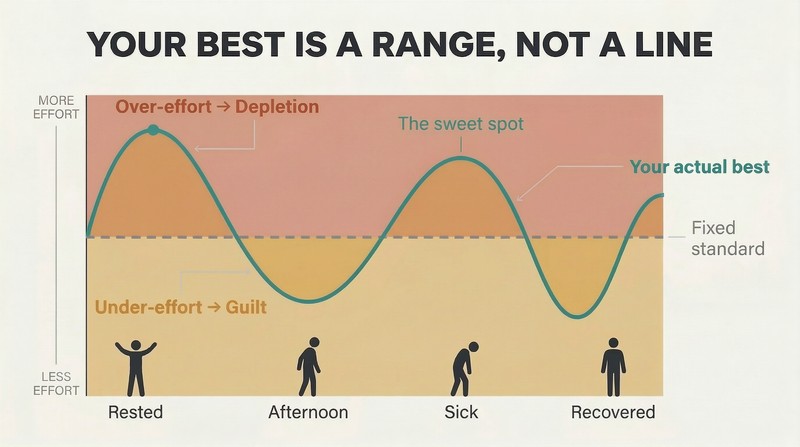
The fourth agreement is the enforcement mechanism for the other three. But Ruiz redefines "best" as variable: your best when rested differs from your best when sick; morning energy differs from midnight energy. A Buddhist parable illustrates the point: a student asks how long it takes to transcend with four hours of daily meditation. Ten years. Eight hours? Twenty years. Why? Because over-efforting sacrifices the joy that is the entire point.
The sweet spot eliminates the inner Judge entirely. "I did my best" is an airtight response to every self-accusation. Doing more than your best depletes you; doing less breeds guilt. Most people act only when expecting a reward — and resent the action. Doing your best for its own sake turns obligation into ritual.
Your self-abuse level sets the exact threshold you'll tolerate
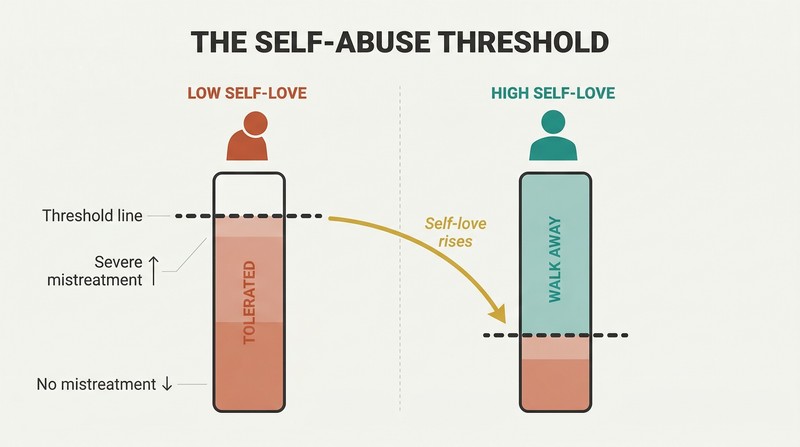
Ruiz makes a diagnostic claim about relationships. If someone abuses you slightly more than you abuse yourself, you walk away. If slightly less, you stay — potentially forever. Someone who internally repeats "I'm worthless, I don't deserve love" will tolerate a partner who humiliates them because it matches their own agreement: "I deserve it. This person is doing me a favor by being with me."
Self-rejection originates in domestication, where we form an impossible image of perfection and punish ourselves for failing to match it. Teenagers take drugs just to be accepted by peers, not realizing the core problem is they don't accept themselves. The prescription is self-love: as it grows, the tolerance threshold rises, and abusive dynamics become intolerable.
Forgive to stop paying for the same wound a thousand times
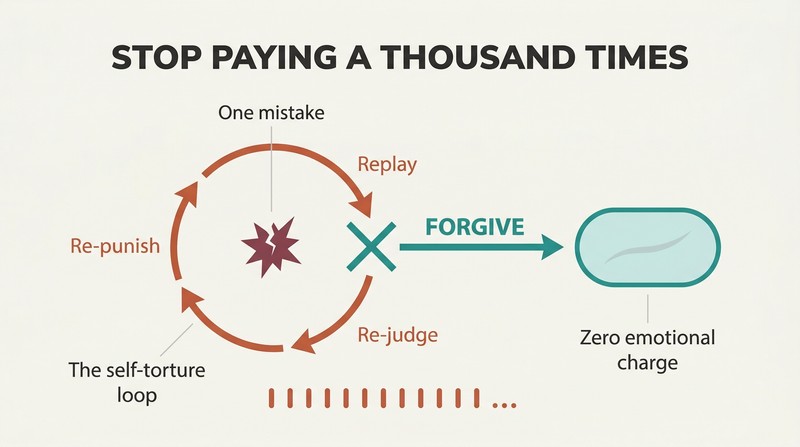
Animals make a mistake, pay once, move on. Humans use memory as an instrument of self-torture — replaying, re-judging, re-punishing. Spouses compound the sentence by reminding each other. Ruiz calls paying more than once per mistake "true injustice." Forgiveness breaks the loop — not as charity for the offender, but because you love yourself too much to keep paying.
The sequence matters: forgive your parents, then others, then God, then finally yourself. Self-forgiveness ends self-rejection and begins self-acceptance. The test is precise: you've truly forgiven when hearing someone's name triggers zero emotional reaction — like touching skin that once held a wound but has fully healed. Without that emotional charge, the cycle of re-punishment has no fuel.
The warrior refrains; the victim represses — master the difference
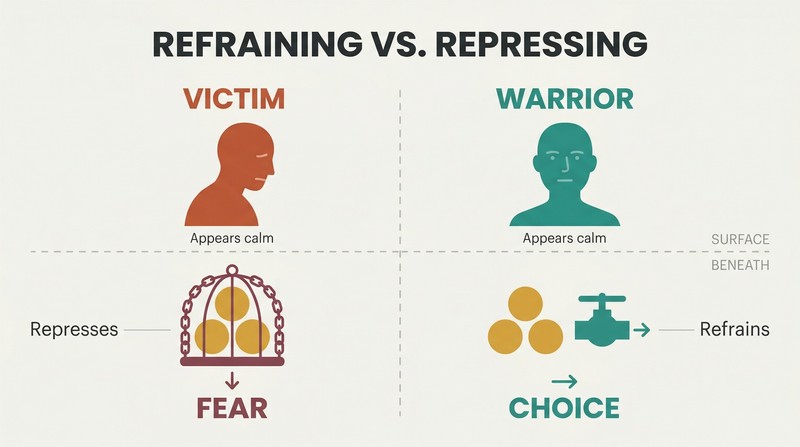
Both appear emotionally controlled on the surface, but the mechanisms are opposite. The victim represses emotions out of fear — afraid to speak, afraid to feel. The warrior refrains: deliberately holding emotions and expressing them at the right moment, not before, not after. Ruiz frames personal freedom as a war against the parasite — the Judge, Victim, and belief system feeding on fear.
Three strategies exist for this battle:
1. Face each fear individually — slow but effective
2. Starve the parasite by controlling your emotions — difficult
3. The initiation of the dead, a symbolic death of old beliefs — fastest but hardest
Warriors don't always win, but they fight. The reward is the chance to transform personal hell into heaven while still alive.
Analysis
The Four Agreements occupies an unusual crossroads: it is essentially cognitive-behavioral therapy dressed in Mesoamerican mysticism. Ruiz's " domestication " maps precisely onto what developmental psychologists call socialization and what schema therapists identify as early maladaptive schemas — deep patterns installed in childhood that persist into adulthood. His Book of Law is functionally identical to Albert Ellis's irrational beliefs in Rational Emotive Behavior Therapy. The Judge- Victim dynamic echoes the punitive parent and vulnerable child modes in Jeffrey Young's schema therapy.
What explains the book's extraordinary staying power — over a decade on the New York Times bestseller list — is not theoretical novelty but architectural elegance. Four rules is the cognitive sweet spot: enough to address major failure modes of human thought, few enough to memorize during a single commute. Each agreement targets a distinct vector of suffering. The first (impeccable word) addresses the stories we tell. The second (don't personalize) addresses the stories we absorb. The third (don't assume) addresses the stories we fabricate. The fourth (do your best) provides the implementation mechanism.
The book's weakest point is its absolutism. "Don't take anything personally — even if someone shot you in the head" strains credulity and risks providing intellectual cover for minimizing genuine harm. The claim that ninety-five percent of beliefs are lies is unfalsifiable by design. And the mystical framing — parasites, black magic, naguals — will alienate analytical readers who most need cognitive flexibility.
Yet the mystical frame may be precisely what allows these ideas to bypass intellectual resistance. Readers who would argue with a therapy manual might accept the same insight delivered as ancient wisdom. The spiritual packaging creates what acceptance and commitment therapists call cognitive defusion — distance from your own thoughts — which is, paradoxically, the book's central therapeutic mechanism.
The most underappreciated contribution is Ruiz's energy economics: maintaining old agreements costs personal power, and breaking them returns it. This reframes growth not as adding discipline but as recovering stolen vitality — a far more motivating frame for people already exhausted by the very patterns they need to change.
Review Summary
The Four Agreements receives mostly positive reviews, praised for its simple yet profound wisdom. Readers find the four agreements practical and life-changing, though some criticize the repetitive writing and new-age elements. Many appreciate the book's emphasis on personal responsibility and mindfulness. Critics argue that the concepts are not original and oversimplified. Despite mixed opinions, numerous readers report significant positive impacts on their lives and relationships after implementing the agreements.
People Also Read


Glossary
Domestication
Childhood belief-programming processRuiz's term for the process by which humans are trained from birth through punishment and reward—by parents, schools, religion, and society—to adopt beliefs, behaviors, and values they never consciously chose. Analogous to training an animal, domestication installs the belief system that controls adult behavior. Eventually, the person becomes 'autodomesticated,' enforcing these rules on themselves without external prompting.
Dream of the Planet
Society's collective shared dreamThe aggregate of all societal beliefs, rules, laws, religions, cultures, and norms that existed before any individual was born. Ruiz frames human society as a collective dream composed of billions of personal dreams. Children are taught to dream this shared dream through domestication, inheriting its assumptions about what is acceptable, beautiful, right, or wrong.
Book of Law
Internal belief system ruling behaviorRuiz's metaphor for the totality of internalized agreements, beliefs, and rules that govern an individual's mind. Like a legal code, it dictates what is true, acceptable, and worthy. The inner Judge uses it to evaluate all thoughts, feelings, and actions. Anything that violates the Book of Law triggers fear, guilt, or shame—even when the rules themselves are based on falsehoods.
The Judge
Inner voice that condemnsOne of two key psychological roles Ruiz identifies in the domesticated mind. The Judge uses the Book of Law to evaluate everything a person does, thinks, or feels, issuing verdicts of guilt and demanding punishment. It operates continuously, turning every perceived shortfall into evidence of unworthiness.
The Victim
Inner voice absorbing blameThe counterpart to the Judge in Ruiz's framework. The Victim receives the Judge's verdicts and carries the resulting blame, guilt, and shame. It generates self-pity and reinforces beliefs like 'I'm not good enough' or 'I'm not worthy of love.' Together, the Judge and Victim create a self-perpetuating cycle of internal suffering.
Mitote
Mental fog of conflicting voicesA Toltec term (pronounced mih-TOE-tay) for the chaotic condition of the human mind, where thousands of conflicting agreements, beliefs, and opinions compete simultaneously—like a crowded marketplace where everyone speaks at once and nobody understands each other. Equivalent to what Indian philosophy calls maya (illusion). The mitote prevents people from perceiving who they truly are.
The Parasite
Judge-Victim-belief system as entityRuiz's term for the combined system of the Judge, the Victim, and the fear-based belief system, which he describes as a living being made of psychic energy that feeds on negative emotions. Like a biological parasite, it lives off its host's energy without contributing anything useful, controlling the mind and thriving on drama and suffering.
Dream of the Second Attention
Conscious reprogramming of beliefsThe process of deliberately choosing new beliefs and agreements as an adult, as opposed to the 'dream of the first attention' (childhood domestication, where beliefs were installed without consent). Requires awareness of existing beliefs and focused attention on replacing fear-based agreements with love-based ones. The Four Agreements serve as tools for this conscious reprogramming.
Initiation of the Dead
Symbolic death of old selfFound in many esoteric traditions worldwide, this is a symbolic death that kills the parasite—the Judge, Victim, and fear-based belief system—without harming the physical body. Ruiz describes it as the fastest but most difficult path to freedom. The 'resurrection' that follows restores the childlike freedom and wildness lost during domestication, but now accompanied by wisdom rather than innocence.
Personal importance
Taking everything as about youRuiz's term for the habit of interpreting others' words and actions as being about oneself. He calls it 'the maximum expression of selfishness' because it assumes the world revolves around 'me.' Personal importance makes a person vulnerable to emotional manipulation, as any opinion can become a hook that delivers emotional poison.
FAQ
What's "The Four Agreements" about?
- Author and Purpose: "The Four Agreements" by Miguel Ruiz is a guide to personal freedom and self-mastery, drawing on ancient Toltec wisdom.
- Core Concept: The book introduces four agreements that can transform one's life by breaking self-limiting beliefs and fostering personal growth.
- Toltec Wisdom: It emphasizes the teachings of the Toltec, a group known for their spiritual knowledge and practices, aiming to help individuals achieve happiness and love.
- Practical Application: The agreements are designed to be practical tools for improving relationships, self-perception, and overall life satisfaction.
Why should I read "The Four Agreements"?
- Self-Improvement: The book offers a straightforward approach to personal development, focusing on changing one's mindset and behavior.
- Emotional Freedom: It provides insights into overcoming emotional suffering and achieving inner peace by altering ingrained beliefs.
- Universal Appeal: The principles are applicable to anyone seeking a more fulfilling and authentic life, regardless of background or belief system.
- Transformative Potential: Readers have reported significant positive changes in their lives by applying the agreements, making it a valuable read for personal growth.
What are the key takeaways of "The Four Agreements"?
- Be Impeccable with Your Word: Use your words with integrity and truth, as they have the power to create or destroy.
- Don't Take Anything Personally: Understand that others' actions are a reflection of their own reality, not yours.
- Don't Make Assumptions: Communicate clearly to avoid misunderstandings and unnecessary suffering.
- Always Do Your Best: Strive to do your best in every situation, which will vary depending on circumstances, but will lead to self-acceptance and growth.
What is the first agreement, "Be Impeccable with Your Word"?
- Definition: Being impeccable with your word means speaking with integrity and saying only what you mean.
- Power of Words: Words are powerful tools that can create beauty or destruction, so they should be used wisely.
- Self-Reflection: This agreement encourages self-reflection and honesty, both with oneself and others.
- Impact on Relationships: By being impeccable with your word, you can improve your relationships and reduce conflict.
What does "Don't Take Anything Personally" mean in "The Four Agreements"?
- Self-Reflection: This agreement teaches that nothing others do is because of you; it is a reflection of their own reality.
- Emotional Immunity: By not taking things personally, you protect yourself from unnecessary emotional pain and suffering.
- Self-Importance: It challenges the notion of personal importance, which is the belief that everything is about "me."
- Freedom from Judgment: This agreement helps you to detach from others' opinions and judgments, fostering inner peace.
How does "Don't Make Assumptions" help in personal growth?
- Clear Communication: Encourages asking questions and expressing what you really want to avoid misunderstandings.
- Avoiding Drama: Making assumptions often leads to unnecessary drama and emotional turmoil.
- Reality Check: It helps in aligning perceptions with reality, reducing the gap between expectation and truth.
- Improved Relationships: By not assuming, you foster better communication and understanding in relationships.
What is the significance of "Always Do Your Best"?
- Dynamic Nature: Your best will vary from moment to moment, depending on your circumstances and state of mind.
- Self-Acceptance: Doing your best helps you avoid self-judgment, guilt, and regret.
- Focus on Action: It emphasizes the importance of taking action for its own sake, not for a reward.
- Path to Mastery: Consistently doing your best leads to personal growth and mastery over time.
How does "The Four Agreements" relate to Toltec wisdom?
- Toltec Tradition: The book is based on the ancient wisdom of the Toltec, a group known for their spiritual knowledge.
- Way of Life: Toltec wisdom is not a religion but a way of life that emphasizes happiness and love.
- Spiritual Masters: It honors all spiritual masters and traditions, integrating their teachings into a cohesive philosophy.
- Personal Freedom: The agreements are tools for achieving personal freedom and breaking free from societal domestication.
What are the best quotes from "The Four Agreements" and what do they mean?
- "Be impeccable with your word." This quote emphasizes the power of words and the importance of using them with integrity.
- "Don't take anything personally." It highlights the idea that others' actions are not about you, freeing you from emotional burdens.
- "Don't make assumptions." This encourages clear communication to avoid misunderstandings and unnecessary suffering.
- "Always do your best." It reminds you to strive for your best in every situation, leading to self-acceptance and growth.
How can "The Four Agreements" transform your life?
- Mindset Shift: The agreements encourage a shift in mindset that can lead to greater self-awareness and personal freedom.
- Emotional Healing: By following the agreements, you can heal emotional wounds and reduce suffering.
- Improved Relationships: The principles foster better communication and understanding, enhancing personal and professional relationships.
- Life Fulfillment: Applying the agreements can lead to a more authentic and fulfilling life, aligned with your true self.
What is the "Toltec Path to Freedom" in "The Four Agreements"?
- Breaking Old Agreements: It involves identifying and breaking self-limiting beliefs and agreements that cause suffering.
- Personal Power: The path emphasizes reclaiming personal power by adopting new, empowering agreements.
- Warrior Spirit: It encourages a warrior-like approach to life, facing fears and challenges with courage and determination.
- Transformation: The path is about transforming your personal dream into one of happiness and love, akin to living in heaven on earth.
How does "The Four Agreements" address the concept of domestication?
- Domestication Process: The book explains how societal rules and beliefs are imposed on individuals from a young age, shaping their reality.
- Breaking Free: It offers a framework for breaking free from these imposed beliefs and reclaiming personal freedom.
- Self-Limiting Beliefs: Domestication leads to self-limiting beliefs that the agreements aim to dismantle.
- Path to Authenticity: By overcoming domestication, individuals can live more authentically and align with their true selves.
About the Author
Other books by Miguel Ruiz


Download PDF
Download EPUB
.epub digital book format is ideal for reading ebooks on phones, tablets, and e-readers.








































