Key Takeaways
1. The Inter-Con: A Microcosm of Afghanistan's Tumultuous History
As Afghanistan lurched through decades of trial and terror, laced with bright but brief beginnings, the Inter-Con was an unbreakable constant.
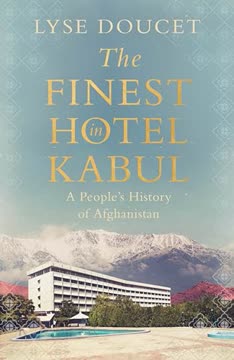
A silent witness. The Inter-Continental Kabul, affectionately known as the "Inter-Con," stands as a unique observer of Afghanistan's turbulent journey from monarchy to multiple republics, communist rule, civil war, Taliban regimes, and a Western-backed democracy. Perched on a hill overlooking Kabul, its concrete and steel structure has endured as a front-row seat to history, reflecting the nation's changing fortunes and the resilience of its people.
More than a hotel. Born in 1969 as Kabul's first five-star luxury hotel, it quickly became its most storied building, hosting everything from fashion shows and beauty pageants to vodka-soaked Soviet receptions, warlord meetings, and American election observers. Its doors remained open through every political system, adapting to whoever set the rules, embodying a very Afghan spirit of survival and continuity despite external pressures.
A mirror to the nation. The hotel's physical state—from faded grandeur to shattered chandeliers and renovated floors—mirrored the country's own cycles of destruction and rebuilding. Its story, told through the lives of its dedicated staff, reveals that war is not just about bombs and bullets, but about dashed dreams, wrecked weddings, and the courage of ordinary people striving to carry on amidst heart-wrenching uncertainty.
2. Golden Era of Glamour and Modernization
The Hotel Inter-Continental Kabul felt like a different country.
An iridescent bubble. Opened in 1969 under King Zahir Shah's "democratic experiment," the Inter-Con was a symbol of Afghanistan's cautious modernization and openness to the world. It offered unparalleled luxury, attracting royals, diplomats, foreign entrepreneurs, and wealthy tourists, creating an "iridescent bubble floating above the city's cares."
International flair. The hotel boasted Lebanese and Swiss managers, a German chef, and staff from across Afghanistan's diverse ethnic groups, all meticulously trained to Inter-Continental standards. It featured:
- The Pamir Supper Club and Nuristan Cocktail Lounge, named after Afghan regions.
- The Bamiyan Brasserie, adorned with a replica of the Buddhas of Bamiyan.
- A Parisian salon by Jean d’Estrées and fashion shows by Pierre Balmain.
- Amenities like tennis courts, a swimming pool, and a bookshop.
A hub of culture. The Inter-Con became a vibrant cultural hub, hosting events like the "Miss Afghanistan" pageant and performances by the legendary Ahmad Zahir, the "Elvis of Afghanistan." It was a place where Cold War enemies socialized, and Afghan women, some in miniskirts, confidently moved through the lobby, reflecting changing social mores in a conservative society.
3. Adapting to Shifting Regimes and Ideologies
Whoever rules Afghanistan sets the rules at the Inter-Con.
Navigating political tides. The hotel's staff, like Hazrat and Amanullah, learned to navigate the country's rapid political shifts, from King Zahir Shah's overthrow in 1973 to the communist Saur Revolution in 1978 and the Soviet invasion in 1979. Each change brought new leaders, new rules, and new anxieties, but the staff's commitment to hospitality remained.
Soviet influence. During the Soviet occupation, the Inter-Con became a de facto media hub for Western journalists, a "luxury prison" where they could report on the war. The hotel adapted to Soviet presence, hosting official functions and even displaying communist literature in its bookshop, while staff discreetly shared information and observed the unfolding conflict.
Resilience and resourcefulness. Despite the departure of international management and the severing of ties with the global Inter-Continental chain, Afghan staff maintained the hotel's standards. They found ways to keep services running, even when supplies dwindled or electricity failed, demonstrating remarkable resourcefulness and loyalty to their "Afghan home."
4. Civil War and the Hotel's Unraveling
Something precious died with him.
A symbol of loss. The Soviet withdrawal in 1989 ushered in a brutal civil war, transforming Kabul into a battleground and the Inter-Con into a casualty. The death of Najib, a long-serving front-desk manager, in a 1990 rocket attack symbolized the loss of innocence and the hotel's increasing vulnerability, as the conflict reached its very doors.
Descent into chaos. With the mujahideen takeover in 1992, the hotel became a temporary barracks for fighters, its revolving doors smashed, its luxurious spaces repurposed. Pianos disappeared, alcohol was hidden, and staff struggled to maintain order amidst the chaos, witnessing the looting of amenities and the defacement of its cultural symbols.
Personal tragedies. The civil war brought immense personal suffering to the staff. Hazrat lost his niece and brother to rocket fire, while Mohammad Aqa's family was displaced and his father killed. The hotel's decline mirrored the country's agony, as its once-gleaming facade became pockmarked with bullet holes and its rooms bore the scars of conflict.
5. Taliban Rule: Imposing Strictures and Isolation
This sinful poison had to be destroyed, not in a dark basement, but before the eyes of the world.
Moral policing. The Taliban's first takeover in 1996 brought a new era of strict Islamic rule, transforming the Inter-Con into a symbol of their ideology. Music was banned, televisions smashed, and alcohol publicly destroyed. The hotel's Buddha frieze was defaced, and statues on its facade were torn down, reflecting a broader campaign against "idolatrous" and "un-Islamic" elements.
A foreign compound. Under Taliban orders, the Inter-Con became the mandatory residence for all foreign nationals in Kabul, including aid workers and journalists. This policy, ostensibly for security, also served to generate much-needed revenue for the cash-strapped regime, as the country became increasingly isolated from the global financial system.
Adapting to new norms. Staff like Amanullah and Hazrat adapted to the new strictures, growing beards and adopting traditional attire. Women were largely confined to their homes, though some, like Malalai, later found roles in security. The hotel, despite its physical decline and the absence of modern amenities, remained a crucial point of contact with the outside world, especially after the installation of a satellite phone.
6. Post-Taliban Hopes and Renewed Violence
Afghanistan was connecting to the world; the world was coming to the hotel.
A new dawn. The fall of the Taliban in 2001 brought a wave of optimism and a promise of reconstruction. The Inter-Con, though heavily damaged, quickly became a hub for returning exiles, journalists, and international forces (ISAF). It hosted the historic 2002 Loya Jirga, where Hamid Karzai was chosen as interim leader, symbolizing Afghanistan's tentative steps towards democracy.
Reconstruction and challenges. The hotel underwent extensive renovations, aiming to restore its five-star glory, with new amenities like mobile phone networks and internet cafes. However, this period was also marked by:
- Accusations of corruption and mismanagement in renovation projects.
- Lingering complaints about service quality and infrastructure.
- The return of targeted attacks and suicide bombings, including devastating assaults on the Inter-Con in 2011 and 2018.
Enduring threats. Despite the presence of international troops and significant aid, the insurgency escalated, and Kabul remained a dangerous city. The hotel, once a sanctuary, became a recurring target, forcing staff and guests to live with constant fear and the grim reality that "danger was dominating their lives."
7. Enduring Resilience of the Afghan Spirit
History always moves in a multitude of singular stories that carry far bigger truths.
Unwavering dedication. Through decades of war, political upheaval, and personal tragedy, the Inter-Con staff demonstrated extraordinary resilience and dedication. Individuals like Hazrat, Amanullah, Mohammad Aqa, and Abida continued to work, often without pay, driven by a deep sense of loyalty to their hotel and an unwavering commitment to supporting their families.
Finding purpose. For many, the hotel was more than just a workplace; it was a source of identity, dignity, and a connection to a better past. Abida, a chef, fought to return to her kitchen after being forced home by the Taliban, finding purpose in her culinary skills. Amanullah, the engineer, tirelessly repaired the hotel's infrastructure, embodying a spirit of rebuilding amidst destruction.
Hope for the future. Even in the darkest times, staff held onto hope for a peaceful and prosperous Afghanistan. They celebrated small victories, like the return of music or the opening of schools for girls, and invested in their children's education, believing that a better future was possible, even if it meant leaving their homeland.
8. The Cycle of War and the Fading of Memory
Everything had changed; nothing had changed.
Repetitive patterns. The book highlights the cyclical nature of Afghanistan's conflicts, with each new regime bringing promises of peace and stability, only to be followed by renewed violence and political infighting. The constant change of flags, leaders, and rules at the Inter-Con underscored this unsettling pattern.
The toll on memory. Decades of war led to the loss of physical keepsakes and a blurring of memories, yet Afghans clung to their recollections as a "weapon to hold fast to the past." However, the sheer scale of trauma and the rapid succession of events also contributed to a collective amnesia, where past horrors were quickly overshadowed by new ones.
A grim inheritance. The younger generation, like Sadeq and Malalai, grew up in a country defined by conflict, inheriting the scars of previous wars. Despite their ambitions for a different future, they found themselves caught in the same cycles of uncertainty and danger, with the Taliban's return in 2021 marking yet another painful repetition of history.
9. Hospitality as an Unbreakable Constant
It doesn’t matter how big your home is, what matters is how big your heart is.
A core Afghan value. Throughout all the political turmoil and devastating wars, the deeply ingrained Afghan sense of hospitality remained a constant at the Inter-Con. From the warm smiles of receptionists to the dedicated service of waiters and cooks, staff consistently extended a welcoming spirit to guests, regardless of their background or the prevailing political climate.
Beyond the rules. Even when official rules changed—such as bans on alcohol or specific dress codes—the underlying ethos of care and service persisted. Staff often went above and beyond, offering discreet assistance to journalists, comforting distressed guests, or simply providing a moment of human connection in a fractured world.
An enduring legacy. Despite the hotel's physical deterioration and the departure of its original international management, the "Inter-Con way" lived on through its Afghan employees. Their commitment to making guests feel at home, even when their own homes were under threat, ensured that the hotel, in its essence, remained a beacon of Afghan hospitality.