
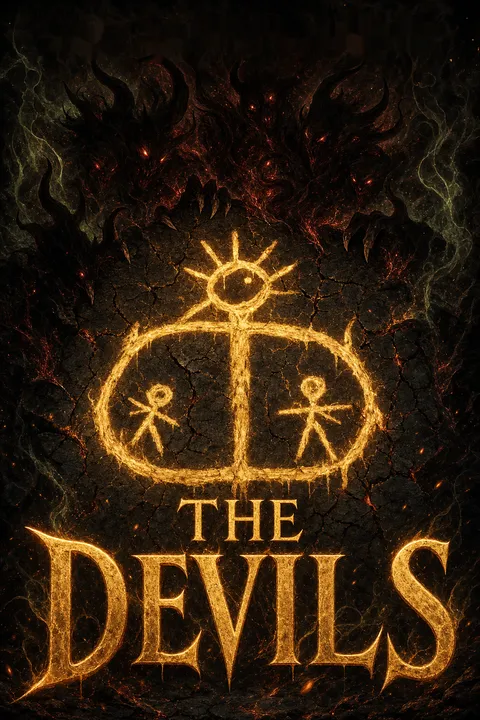


Plot Summary
A Princess Found in the Gutter
In the alleys of the Holy City, Bostro's thugs pin Alex1 against a wall with iron pincers at her face, demanding payment on a debt she inherited and cannot cover. Duke Michael of Nicaea9 intervenes with a sword and a revelation: this feral street rat is the long-lost daughter of the murdered Empress Irene.
He produces half a copper coin matching one Alex1 wears on a chain, split the day she was spirited from Troy as an infant. Michael9 explains that his sister Eudoxia murdered Irene, usurped the throne, and recently died — leaving the Serpent Throne empty.
Cardinal Zizka11 and the Pope endorse Alex's1 claim through a ritual with chained Oracles who scream prophecies of fire and teeth. Alex,1 drowning in debts to three separate criminals, decides the princess swindle beats having her fingers ripped off.
The Chapel's Flock of Devils
Cardinal Zizka11 assigns Brother Diaz4 — a librarian who joined the Church to escape a sex scandal — as vicar of a secret thirteenth chapel within the Celestial Palace. His congregation waits in cells beneath it, behind iron bars thick as his wrist.
Balthazar5 is a proud necromancer, stripped naked to prevent him writing spells on his clothes. Sunny6 is an elf who vanishes when she holds her breath. Baron Rikard7 is an ancient vampire whose charm could seduce a soul from its body, currently so starved of blood he resembles a walking skeleton.
Somewhere in a locked wagon waits Vigga,3 a Norse werewolf too dangerous for the others' company. Pope Benedicta,12 a ten-year-old child, binds them all to escort Alex1 to Troy with a finger-painted smear of red ink — a binding that proves devastatingly effective.
The Massacre at Rolling Bear
The party barely reaches a walled inn before Duke Marcian,13 Eudoxia's youngest son, catches them with beast-men — fox-headed archers, a goat-headed giant, creatures born from his mother's experiments fusing human flesh with animal. A pyromancer sorceress sets the common room ablaze, incinerating guards.
Jakob2 holds the gate with shield and snarl, killing a ram-man and a hound-man before Marcian13 runs him through the chest. But Jakob2 cannot die — cursed long ago by a witch — and even impaled he reaches for the wagon key.
Sunny6 slips invisible from nowhere, turns it in the lock, and the reinforced back drops open. What boils from the darkness is Vigga in wolf form: a horse-sized nightmare of claws and teeth that rips Marcian's13 skull from his shoulders and devours the beast-men like a fox in a henhouse.
Empress or Death
Michael's9 broken leg leaves him behind. The Papal Guard is obliterated. The maid is dead with an arrow in her skull. Alex1 sits in a yard of muddy corpses wearing a dead girl's clothes, her fine dress switched onto a body to fake her own death. She has seven companions: a vampire,7 an elf,6 a retching werewolf,3 a knight pulling arrows from himself,2 a necromancer5 glaring at his wrist, a monk4 clutching a holy relic, and a woman with too many daggers.8
When Diaz4 insists they return to the Holy City, Alex1 overrules him. They'll go to Troy. She has no army, no plan, and no idea how to be an Empress, but her cousins want her dead and the only safety is the throne. She regrets the decision immediately, but now she's stuck with it.
Dumplings Save the Day
They join a pilgrimage to Venice as cover, posing as penitent sinners under Bishop Apollonia's Blessed Company. Weeks of rain and blisters later, the bishop — the devout leader Alex1 admired — reveals she's been bribed by Duke Constans14 with a promise of holy relics. Her guards and an angry mob close in.
Sunny6 materializes to press a blade against the bishop's throat, Vigga's3 fangs lengthen, and Balthazar5 waves a severed hand that shoots fire. Then Baron Rikard7 climbs into the bishop's portable pulpit and begins to speak about his dead wife's estates in Poland, the wallpaper in the dining room, and certain pork dumplings cooked with onion and oil.
Every soul within earshot drops to their knees weeping with ecstatic reverence. They forget the princess, the elf, and that they were ever angry. The congregation slips away while the pilgrims stare at the empty pulpit.
Lost Inside the Looping House
In Venice, a crime lord named Frigo offers passage to Troy in exchange for a white box from an enchanted house. Inside, every hallway leads back to the same fly-blown dining room. Balthazar5 communicates through a reanimated severed head while secretly running a parallel ritual to shatter the Pope's binding.
Each companion is dragged into hallucinated fears — Vigga3 relives being tattooed with warnings after the wolf first killed, Jakob2 confronts his past as the Papal Executioner, Sunny6 attends a masked ball where nobody can see her.
Balthazar's5 scheme backfires: the binding makes him vomit explosively, and when he chokes Brother Diaz's4 breathing to prevent interference, Alex1 steps into the conjurer's circle and punches him in the face. The flies die. The illusion breaks. The box is retrieved, and Frigo arranges a ship.
Fish-Men and Fire on the Water
A gilded warship impales their vessel with its bronze hawk-headed ram — Duke Constans14 aboard, Eudoxia's third son, commanding soldiers fused with fish, crab, and octopus. The ship lists and burns while battles rage across both decks.
In the flooding hold, a phrenomancer pins a needle to Baptiste's8 forehead and turns her against Balthazar;5 he rips it free just before she drowns him. Sunny6 guides Alex1 up the flaming rigging, and when a crab-man follows, she stabs him in an intimate location and he falls into a lamp that ignites the whole deck.
Jakob2 duels Constans14 on the burning aftcastle — outmatched in skill, he lets himself be impaled, then grabs his enemy and falls backward, driving the sword through both their bodies. They vanish into the sea.
Shipwrecked and Separated
The Adriatic spits them across miles of shore. Alex1 and Sunny6 wash up together — Sunny6 dragged the drowning girl to the beach. Vigga3 and Brother Diaz4 find each other among the rocks, their unlikely bond deepening as Vigga3 tracks Alex's1 scent through war-torn countryside.
Balthazar5 and Baptiste8 argue their way inland, robbing corpses for clothes. Jakob,2 found among the dead in a count's corpse cart, is co-opted into a local border war alongside Baron Rikard.7
Meanwhile Duke Sabbas,15 Eudoxia's second son, sends mercenaries and a rival werewolf called the Dane to run Alex1 down. Sunny6 scouts Sabbas's15 camp invisibly, scatters their horses, and poisons their stew with mushrooms — buying time but not safety. The congregation slowly converges, drawn by the binding's tug.
Even a Demon Cannot
At ancient standing stones between two armies paused for peace talks, Balthazar5 speaks the name of Shaxep, a Duke of Beneath. The sun snaps off. Massive wings blot out the sky, jewellery jingles from twenty-nine-pointed antlers, and a voice like thunder announces her greed is a famine, her fury a hurricane.
Baptiste8 collapses sobbing. Jakob2 weeps. Even Rikard7 cowers. Balthazar5 begs the demon to shatter Pope Benedicta's binding. Shaxep examines the smudge on his wrist, clicks her tongue in annoyance, and apologizes — she cannot do it.
The door between worlds closes, the sun returns, and black feathers melt into the grass. If a demon of infinite power cannot break the binding, the congregation is forced toward a staggering conclusion about the child Pope's12 true nature.
The Thief's Confession
In a hidden alcove of the Pharos, Alex1 breaks. The real Alexia Pyrogennetos was a girl she knew in the Holy City's slums — a child who showed Alex1 her half-coin and told her who she truly was. When the Long Pox swept through, the real princess died. Alex1 stole the coin, burned a fake birthmark behind her own ear with bent wire, and took a dead girl's name because she wanted to be not nothing.
The Oracles only held her hands and screamed nonsense — Cardinal Bock and Duke Michael9 decided the words meant what they wanted. Sunny6 listens, then tells Alex1 she is something now, regardless of where she came from. Alex1 begs Sunny6 to run away with her. Sunny6 refuses — not for her own sake, but for everyone else's.
The Plague Pit Swallows an Angel
Sabbas15 corners them at the abandoned Monastery of Saint Sebastian, flanked by twin sorceresses and the Dane. He sheds his golden cloak to reveal grafted wings — the self-styled Angel of Troy. But Brother Diaz4 sees what's underfoot: tombstones. Plague dead buried by the hundred beneath consecrated ground.
He screams at Balthazar,5 who stretches every fiber of power downward and rips the earth open. Corpses boil from the flagstones — centuries of dead monks — dragging sorceresses, soldiers, and the winged duke into a seething pit.
Vigga3 battles a monstrous leftover of Eudoxia's experiments, a patchwork serpent with too many limbs, is swallowed whole, then erupts from inside it. Brother Diaz4 confronts the wolf with the same words Jakob2 once used — that this behaviour is unacceptable — and somehow, trembling before him, it backs down.
Crowned Beneath the Flame
Troy's Pillar is less building than landscape — a mountain of masonry thrust from the sea, the Hanging Gardens green at its summit, Saint Natalia's Flame burning at the tip of the Pharos above. Lady Severa,10 the impeccable Warden of the Imperial Chamber, greets Alex1 at the dock.
Duke Michael9 waits at the Grand Lift, alive and healed. In the Basilica of the Angelic Visitation, Grand Patriarch Methodius crowns Alex1 before every noble family and the full congregation of the Chapel. Brother Diaz4 gives the blessing.
Father Diaz,4 now — he converts to the Eastern Church and stays as Alex's1 personal chaplain. The binding tugs satisfied in every devil's gut. Then comes the price of power: a political marriage to Duke Arcadius,16 Eudoxia's eldest and last surviving son, arranged in secret by Michael9 and Cardinal Zizka.11
The Handmaidens Unmask
On the wedding night, Arcadius16 proves unexpectedly decent — they share wine, agree to a marriage of convenience, and actually begin to like each other. Then Placidia, who picked Alex's1 fingernails so gently that morning, grips Arcadius16 by the wrist and ice crawls up his arm.
He shatters across the marble like dropped porcelain. The four handmaidens are surviving members of Eudoxia's coven — pyromancer, cryomancer, aeromancer, fog-conjurer — placed close to the throne for exactly this moment.
Alex1 flees barefoot through her palace, climbs the rain-slick exterior of the Pharos clinging to gargoyles, and reaches the gallery at the top. She yanks the chain beside the brazier. Saint Natalia's Flame turns blue — the ancient signal for the elves, the only alarm loud enough to reach the harbor where her protectors' ship is preparing to sail.
The Uncle's True Face
Scrambling through Michael's9 rooms, Alex1 finds a letter from Cardinal Zizka11 addressed to her uncle. It details their shared plan: use Alex1 as bait to lure Eudoxia's sons to their deaths, then crown Michael9 Emperor.
The handmaidens were positioned by Severa10 to eliminate Arcadius16 once the marriage neutralized him. Michael9 arrives, sees the crumpled paper in her bloodied hand, and sheds his warmth like a borrowed coat. He admits he murdered Irene himself and blamed Eudoxia to start the civil war decades ago.
He never intended Alex1 to survive. He draws his sword. Sunny6 appears from nowhere, lands an invisible kick that staggers him, and Alex1 flees through the palace's secret passages — into a labyrinth of hidden stairs while a duke and four sorceresses hunt her through her own home.
Devils Rush Back to Troy
From their departing ship the congregation sees Saint Natalia's Flame burning blue and turns back — even Balthazar,5 who stays aboard, then dives into the harbor and swims. On the Grand Lift, Jakob2 reads betrayal in the guards' posture a breath before they strike.
He, Sunny,6 Vigga,3 and Baptiste8 fight in the rising cage, hurling traitors into the void. At the top they split: Jakob2 climbs toward the Pharos alone. The others battle through the Hanging Gardens. Lady Severa10 reveals herself as a sorceress, controlling Vigga3 with a phrenomantic needle until Balthazar5 rips it free using a breakthrough in elemental theory.
He pursues Severa10 into the Athenaeum and discovers the truth beneath the identity: she is Empress Eudoxia herself, who transferred her soul into her servant's body before dying. They duel with lightning and fight to a standstill before Eudoxia vanishes.
Through the Flame and Off the Edge
Atop the Pharos, Baron Rikard7 arrives as a swarm of bats and turns his glamour on the coven sorceresses, tricking them into worshipping him so completely that one immolates her own sister at his request. Alex1 smashes another with a stone block, and Rikard7 burns Placidia in the brazier, though the effort leaves him scorched and ancient.
Below in the gardens, Severa10 releases another of Eudoxia's amalgamated horrors. Vigga's wolf devours it from inside out but then turns — and Baptiste,8 who always said she would never stick her neck out, dies confronting the beast.
In the throne room, Michael9 impales Jakob2 twice and drops a statue on him. But the unkillable knight2 drags himself up the Pharos steps, straight through the roaring column of Saint Natalia's Flame, and tackles the traitor duke over the parapet. They fall together, burning, into the sea.
The Price of an Empire
Cardinal Zizka11 arrives from the Holy City with the gall to offer congratulations. Alex1 confronts her with the letter. Zizka11 shrugs — she told Michael9 to burn it. Alex1 demands the congregation's freedom. Zizka11 refuses: Vigga3 is uncontrollable, Rikard7 catastrophically dangerous, Balthazar5 a demon-bargainer.
An elf6 at a Trojan Empress's side would doom them both — elves are despised here above all places. Alex1 wins one concession: Father Diaz4 stays as her chaplain. The rest must return to their cages beneath the Celestial Palace.
Zizka11 offers a path forward: support the union of East and West, prepare Troy for the elves' inevitable return. Alex,1 who grew up haggling over stolen goods, tells the cardinal this arrangement will cost the Church dearly. God has deep pockets, Zizka11 replies.
All Bad Things Must End
Jakob2 washes up alive in a fishing net, days later, and limps back to the Hanging Gardens. Alex1 offers him an ancient hero's sword and command of a new crusade. He refuses — he knows what happens when he leads armies — but accepts a small icon of Saint Stephen, patron of protectors.
In the Basilica, he rests one hand on Baptiste's8 new tomb beside the heroes of the Second Crusade. Alex1 and Sunny6 share a last conversation beneath the trees. Sunny6 tells Alex1 to do good for someone else, since she cannot do it for her.
The kiss they both want stays unspoken. On the ship, Vigga3 crawls into her cage and will not come out. Balthazar5 is clapped in irons, already scheming. The binding pulls them home, and Troy dwindles to a point of light on the horizon.
Epilogue
A carriage crawls through the Holy City's sweltering streets on Saint Tabitha's Day. Mother Beckert, a stern German missionary with a prostitute's daughter's practicality and iron faith, arrives to replace Father Diaz4 as Vicar of the Chapel of the Holy Expediency.
She shares the ride with a charming young man named Caruso, also summoned by Cardinal Zizka.11 Beckert has known Zizka11 since seminary — has despised and admired her in equal measure. She understands what the Thirteenth Chapel demands, and what it costs.
When Caruso mocks the prostitutes clogging the streets, she fixes him with the stare she once used to sentence the convicted, and tells him that the worst sin is not lust but hypocrisy. About virtue, she says, he has a great deal to learn. The cycle begins again.
Analysis
The Devils is a story about the distance between what institutions demand and what people actually are. The Church preaches twelve virtues but operates on a thirteenth — expediency — and the Chapel of the Holy Expediency exists precisely because the gap between doctrine and reality requires someone to work in the filth. Abercrombie's insight is that the devils are not redeemed by their mission so much as revealed by it. Each discovers what they have always been, stripped of pretension: the cowardly monk4 finds courage, the proud magician5 finds humility, the violent werewolf3 finds tenderness she cannot sustain.
The book's central question — where is the soul? — runs parallel through Eudoxia's literal experiments in fusing flesh and the narrative's figurative ones. If Eudoxia10 split human from animal to find the divine spark, the story splits virtue from appearance to the same end. The most soulful character is an elf6 the Church declares has no soul. The most faithful act is performed by a necromancer5 who bargains with demons. The bravest sacrifice comes from a knight2 who considers himself beyond salvation.
Alex's1 confession that she stole a dead girl's identity inverts the fairy tale of the lost princess. The con becomes the truth — not because the lie is revealed as honest, but because identity is revealed as performance that hardens into reality. What ultimately legitimizes Alex1 is not bloodline but the willingness to stay when she could run, to be crowned knowing she is a fraud, and to govern anyway because someone must. The Pope's unbreakable binding literalizes the theology: if a child's finger-painting defeats a Duke of Hell, then either power is arbitrary or divinity is real. Abercrombie leaves the question unresolved, which is more honest than most fantasy and most theology. The binding works. That is the miracle. And for Balthazar,5 and for us, it is enough.
Review Summary
The Devils receives mostly positive reviews, with readers praising Abercrombie's character work, humor, and action scenes. Many note it's different from his previous works, with a lighter tone and more comedy. Some find it overly long or predictable, but most enjoy the found family dynamics and morally gray characters. The book is described as fast-paced, entertaining, and full of witty dialogue. While not universally loved, it's generally well-received by fans of Abercrombie and newcomers alike.
People Also Read





Characters
Alex
Street thief turned EmpressRaised in the Holy City's slums as a pickpocket under a criminal fence called Gal the Purse, Alex is declared a lost princess when Duke Michael9 produces matching half-coins as proof of her identity. Sharp-witted, foul-mouthed, and perpetually afraid, she masks vulnerability behind defiance and the survival instincts of someone cornered too many times. Her deepest wound is a conviction that she is fundamentally worthless — a piece of shit, as she'd say — and every kindness feels like a trap about to spring. She learns etiquette from a vampire7, history from a necromancer5, letters from a monk4, and courage from herself. Her arc is a progression from self-loathing street rat to a woman who must decide whether worth can be claimed rather than inherited.
Jakob of Thorn
Immortal crusader knightAn ancient Templar cursed by a witch so he cannot die, Jakob has fought in crusades spanning more than a century and carries the cumulative wounds of all of them. Every step is an ordeal, every joint clicks, every breath aches where old steel once pierced him. He serves as the congregation's military anchor and reluctant moral compass, haunted by a past in which he rose to pinnacles of power as Grandmaster, Papal Executioner, and Champion — only to find nothing at the summit but corpses. He swore oaths of honesty, poverty, and temperance to atone, but the man who cannot die cannot stop fighting. His tragedy is that the immortality meant as punishment denies him the redemption of a final sacrifice.
Vigga
Tattooed Norse werewolfA Norse werewolf convicted by the Celestial Court and tattooed head to toe with warnings — BEWARE down her cheek, DANGER across one buttock. Before the bite, she was already a Viking raider who burned churches and killed for sport. She is reckless, lustful, forgetful, and possessed of a sweetness that surfaces unpredictably between bouts of slaughter. Her relationship with the wolf is her central tension: she insists she has it muzzled, but the beast within operates by its own hunger, and each transformation risks everything she has tried to become. She processes trauma by forgetting it — tossing regrets away like nutshells — and her greatest fear is not the wolf itself but the mounting evidence that she was a monster before it ever arrived.
Brother Diaz
Reluctant monk turned chaplainA Leonese monk assigned as Vicar of the Chapel of the Holy Expediency, Diaz never wanted to be a priest — his mother forced him into vows after a sexual indiscretion. He is a natural bureaucrat and librarian thrust into a world of werewolves, vampires, and demons, perpetually terrified and perpetually clearing his throat. His cowardice masks genuine decency and a talent for administration that proves as decisive as any sword. He clings to the vial of Saint Beatrix's blood like a drowning man to driftwood. His transformation from fawning careerist to someone willing to stand before a wolf and call its behaviour unacceptable is the book's quietest and most complete arc of redemption, driven by discovering that faith means something only when tested.
Balthazar
Proud necromancer and scholarA necromancer who considers himself among Europe's top three practitioners, convicted of Black Art and pressed into papal service. His pride is oceanic; his self-pity, when that pride is punctured, equally vast. He refers to himself by his full name — Balthazar Sham Ivam Draxi — at every opportunity, views everyone as intellectually inferior, and considers sorcery a lesser discipline than his precise magic. Yet beneath the posturing lies genuine brilliance and an evolving capacity for selflessness. His obsessive attempts to break the Pope's binding form a through-line of escalating failure that culminates in a theological revelation he never sought. His growth from imprisoned egotist to a man capable of putting others first is achieved with maximum complaint and minimum grace.
Sunny
Invisible elf and quiet guardianAn elf who turns invisible by holding her breath, Sunny was captured young, displayed in a circus as a freak, and had one ear clipped with sheep shears by people claiming to serve God. She is the quietest member of the congregation and the most reliable — always present, always watching, rarely noticed. Her emotional register runs from deadpan to devastating, with dry wit nobody recognizes as humor. She craves connection but has spent a lifetime learning that visibility leads to violence. Her developing bond with Alex1 is the book's most tender thread, complicated by the knowledge that an elf at a Trojan Empress's side would be a death sentence for both. She expresses love through small invisible acts: tucking in blankets, evening out laces, arriving when needed.
Baron Rikard
Ancient charming vampireAn ancient vampire of aristocratic bearing who has survived centuries on charm, blood, and exquisite timing. He appears initially as a withered skeleton but rejuvenates as he feeds, eventually presenting as a devastatingly handsome man in his prime. His glamour can enthral anyone within earshot — a power he deploys with the nonchalance of someone tipping a waiter. He possesses genuine culture, genuine warmth, and genuine danger in roughly equal measure. Unlike the other congregation members, the Pope's binding does not compel him — he lacks a soul for it to grip. He stays because he chooses to, a fact that transforms him from the most dangerous monster to perhaps the most moral member of the group, since every one of his sacrifices is freely given.
Baptiste
Jack of all deadly tradesThe congregation's most experienced member and its unofficial den mother, Baptiste has been assistant barber, spy, pirate, dressmaker's apprentice, lady-in-waiting to the Queen of Sicily, and dozens of other professions. She carries more daggers than anyone can count and wears a scar across her lips that never stops smirking. Her motto — never stick your neck out — is contradicted by everything she does. She functions as the group's practical intelligence: lock-picking, wound-stitching, horse-trading, and navigating every social stratum with the same brazen confidence. Her ongoing verbal war with Balthazar5 masks a mutual fascination neither will admit. She is defined by competence, resilience, and an instinct for survival sharpened by decades of perilously close calls.
Duke Michael
Alex's princely uncleAlex's1 supposed uncle, a duke without a dukedom who presents himself as a noble exile seeking to restore his murdered sister's daughter to the throne. Handsome, warm, and disarmingly sincere, he has the gift of making anyone feel believed in. His motives for finding Alex1 and guiding her toward Troy are the engine driving the entire plot, but the question of whether his kindness is genuine haunts every interaction.
Lady Severa
Warden of the Imperial ChamberTroy's Warden of the Imperial Chamber, Severa is the most competent person in every room she enters — tall, poised, and capable of anticipating needs before they are spoken. She served under Empress Eudoxia and survived, which speaks to either extraordinary loyalty or extraordinary adaptability. Her intelligence and grace make her the perfect administrator, but her true depths remain carefully hidden behind impeccable manners.
Cardinal Zizka
The Church's ruthless strategistHead of the Earthly Curia, the Church's sprawling political and bureaucratic engine. A stout woman with ink-stained fingers and a dragon's gaze, she operates without sentiment in service of what she considers the greater good. She views people as instruments and morality as context-dependent. Her thirteenth virtue — expediency — governs every decision, and she sees no contradiction between deep faith and absolute ruthlessness.
Pope Benedicta
The ten-year-old PopeA girl with a mole above one eyebrow and an irrepressible curiosity about dancing corpses, elected Pope amid fierce controversy. She applies the binding with a finger-painted smear that proves unbreakable by any power in creation. Whether she is genuinely the Second Coming of the Saviour or merely an extraordinarily gifted child remains the book's deepest theological question — one that even demons cannot settle.
Duke Marcian
Eudoxia's youngest, most brutal sonEudoxia's youngest son, a violent brute in gilded armor who commands her beast-men as an army. Arrogant and quick to cruelty, he is the first and least subtle of Alex's1 four cousins to make a move for the throne.
Duke Constans
Charming duke with a fleetEudoxia's third son, a charming hedonist who dressed his mother's fish-human hybrids in naval uniforms and used them as pirates. A superbly skilled swordsman with a talent for banter and a fatal tendency to underestimate the unkillable.
Duke Sabbas
The self-styled Angel of TroyEudoxia's second son, who grafted his mother's wing experiments onto his own back and styled himself a divine warrior. Prideful and theatrical, he leads mercenaries including a rival werewolf called the Dane.
Duke Arcadius
Eudoxia's eldest, subtlest sonEudoxia's eldest and most politically astute son. Unlike his violently ambitious brothers, Arcadius projects easy charm and claims no desire for the throne — preferring to wield influence from beside it rather than upon it.
Plot Devices
Pope Benedicta's Binding
Leashes the flock to their missionApplied by the ten-year-old Pope12 as a simple red smear across each wrist, the binding compels the congregation to escort Alex1 to Troy and see her enthroned. Any thought of escape triggers violent nausea; sustained resistance causes projectile vomiting. Balthazar5 attempts to break it three times — through toenail-scribed runes, elaborate Venetian ritual, and summoning a Duke of Hell — failing each time more spectacularly. The binding's inexplicable durability becomes the book's central theological evidence: if nothing in creation can undo it, the child who applied it may truly be the daughter of God. It functions simultaneously as a physical chain, a narrative engine preventing the characters from abandoning their impossible mission, and a gradually unfolding proof of divine authority that transforms a sceptic's prison into a believer's vocation.
Eudoxia's Sarcomantic Experiments
Creates the book's monstersThe dead Empress Eudoxia spent decades fusing human and animal flesh in an attempt to locate the soul within the body. Her creations range from soldiers with fox heads and goat legs to sailors merged with crabs and octopi. Each of her four sons repurposed them differently: Marcian13 bred warriors, Constans14 dressed pirates, Sabbas15 grafted wings onto himself. The most horrifying result is the leftover creature — a building-sized conglomerate of failed experiments stitched together, a patchwork serpent with too many limbs and no coherent mind. Beyond their function as antagonists, the experiments embody the book's central question about the soul: where it resides, whether it can be captured, and what happens when human boundaries are erased.
The Half-Coin
Proves Alex's royal identityA copper coin split in two, with matching ragged edges. Duke Michael9 carries one half; Alex1 wears the other on a chain against her skin, polished smooth by years. According to Michael9, the coin was divided the day infant Alexia left Troy, so there could be no doubt of her identity when found. When the halves are held together before the Grand Patriarch and Troy's nobility, their perfect fit serves as the simplest and most convincing physical proof of legitimacy. The coin operates as the oldest validation technique in the confidence artist's repertoire: a tangible, inarguable object that lends weight to a story people already want to believe, reducing the question of who should rule an Empire to whether two pieces of copper match.
Saint Natalia's Flame
Beacon, warning signal, climax arenaA sacred fire at the very summit of the Pharos — Troy's tallest tower, built atop the already colossal Pillar. Tended by a silent nun, it has burned without interruption for centuries, its light reflected by a dome of mirror chips to guide ships into harbor. A chain beside the brazier drops powder that turns the flame blue, an ancient warning that the elves are coming. Alex1 pulls the chain in desperation, repurposing a civilizational alarm as a personal SOS. The flame serves as Troy's heartbeat and most potent symbol: rekindling it after the climax represents imperial renewal. As the setting for the final confrontation, the gallery becomes a cage of fire and sky where the only exits are the stairs behind and the longest drop in Europe ahead.
Vigga's Wolf Transformation
Ultimate weapon, ultimate liabilityWhen Vigga3 transforms she becomes a horse-sized nightmare of claws and insatiable hunger, driven by the wolf's search for what she calls the good meat. The transformation is triggered by rage, danger, or the full moon, and while human Vigga3 can sometimes choose the moment, the wolf operates by its own logic entirely. It cannot distinguish friend from enemy and feels no loyalty, restraint, or remorse. The congregation deploys the wolf as a weapon of last resort — it annihilates Marcian's13 army, devastates Constans's14 galley, and destroys Sabbas's15 forces — but each release carries the risk that the wolf will turn on its own handlers. The tension between devastating asset and existential hazard is the defining anxiety of the book's action sequences.
FAQ
Basic Details
What is The Devils about?
- A Monk's Unholy Mission: Brother Diaz, a minor monk with a troubled past, is unexpectedly appointed vicar of the clandestine Chapel of the Holy Expediency within the Holy City's Celestial Palace.
- Escorting a False Princess: His mission is to escort Alex, a streetwise thief believed to be the long-lost Princess Alexia Pyrogennetos, heir to the Serpent Throne of Troy, across a war-torn continent.
- A Congregation of Monsters: Diaz's companions are the Chapel's "flock" – a collection of magically bound outcasts including a werewolf, vampire, immortal knight, mercenary, elf, and necromancer, tasked with doing the Church's dirty work.
Why should I read The Devils?
- Darkly Humorous and Brutal: The novel blends Joe Abercrombie's signature grim humor and visceral action with a surprisingly poignant exploration of morality and identity.
- Compelling, Complex Characters: The core group of "devils" are deeply flawed, often monstrous, but also surprisingly human, offering a fresh take on fantasy archetypes.
- Subversive Fantasy Epic: It deconstructs traditional fantasy tropes, presenting a corrupt Church, ambiguous heroes, and a world where survival often requires embracing the very evils one fights.
What is the background of The Devils?
- A Fractured, War-Torn Europe: The setting is a fantasy version of Europe, marked by centuries of conflict, religious schism (East vs. West Church), and the lingering threat of the elves from the East.
- Echoes of Ancient Empires: The world is built upon the ruins of the Carthaginian Empire, whose advanced magic and architecture (like the Pillar of Troy) hint at lost power and knowledge, contrasting with the current age's struggles.
- A Church of Power and Hypocrisy: The Holy City is the center of the Western Church, depicted as a place of immense spiritual authority intertwined with rampant corruption, political maneuvering, and a willingness to use any means necessary for its survival.
What are the most memorable quotes in The Devils?
- "Everyone's got something, don't they?": This early line from Brother Diaz encapsulates the novel's view of universal human failing and the shared burden of sin, setting a tone of weary pragmatism.
- "You have to treat people like oranges... Squeeze what you can from the bastards, then waste no regrets when you toss away their wrung-out skins.": Gal the Purse's cynical advice to Alex highlights the harsh survival philosophy of the streets and the transactional nature of relationships in this world.
- "The Chapel of the Holy Expediency is no place to get... all dogmatic.": Baptiste's pragmatic warning to Brother Diaz defines the core principle of their mission and the moral flexibility required to navigate the world's darkness.
What writing style, narrative choices, and literary techniques does Joe Abercrombie use?
- Multiple Third-Person Perspectives: The narrative shifts between the viewpoints of key characters (Diaz, Alex, Jakob, Vigga, Sunny, Balthazar, Baptiste, Rikard), offering intimate access to their thoughts, fears, and often contradictory motivations.
- Dark Humor and Ironic Tone: Abercrombie employs a cynical, often darkly comic tone, juxtaposing moments of extreme violence or despair with dry wit and gallows humor, undermining traditional heroic narratives.
- Visceral and Grounded Prose: The writing is direct, gritty, and focused on sensory details, particularly in action scenes, making the violence feel brutal and impactful rather than stylized or heroic.
Hidden Details & Subtle Connections
What are some minor details that add significant meaning?
- The Ever-Present Smell of Fish: The recurring mention of the fish market smell in the Holy City and later the "fishy" smell of the sea creatures highlights the pervasive, inescapable nature of the mundane and the unpleasant, even in sacred or fantastical contexts.
- The State of Character's Hands: Details like Alex's bitten nails, Diaz's inky fingers, Jakob's scarred knuckles, Vigga's tattooed hands, Sunny's long thin fingers, and Balthazar's once-beautiful hands now stained and burned, subtly reflect their pasts, professions, and current struggles more than dialogue often does.
- The Condition of Clothing: The state of characters' clothes – Diaz's ill-fitting habit, Alex's borrowed finery, Vigga's strained vest, Balthazar's lice-ridden dead man's trousers, Jakob's patched armor – serves as a constant visual reminder of their displacement, lack of resources, and the harshness of their journey.
What are some subtle foreshadowing and callbacks?
- Environmental Decay as Foreshadowing: The crumbling state of buildings (Celestial Palace, Venice, the Abbey, the Athenaeum) and infrastructure (Aqueduct, Dam) subtly foreshadows the decay of institutions and the fragility of order in the face of time, conflict, and internal rot.
- Recurring Phrases and Actions: Phrases like "They might put me down, but I'll never stay down" (Alex), "Hold on to something" (Sunny, Rikard, Balthazar), "I should've quit after Barcelona" (Baptiste), and actions like characters constantly adjusting their clothes or wiping sweat, become subtle callbacks that underscore recurring themes of resilience, clinging to hope, regret, and discomfort.
- The Symbolism of Doors and Gates: Repeated descriptions of doors (locked from the outside, missing, secret, barred) and gates (shuddering, broken, rising, falling) subtly foreshadow moments of entrapment, escape, revelation, and the shifting boundaries between safety and danger, or between worlds.
What are some unexpected character connections?
- Vigga and Brother Diaz's Relationship: The development of a sexual relationship between the werewolf and the monk, initially born of desperation and proximity, evolves into a strange form of mutual comfort and understanding, subverting traditional notions of purity and monstrousness.
- Alex and Sunny's Friendship: The bond between the street thief and the invisible elf, two outcasts who find solace and trust in each other, provides a core of genuine connection amidst the pervasive cynicism and betrayal, highlighting the unexpected places where loyalty can be found.
- Balthazar and Baptiste's Rivalry/Partnership: Their constant bickering and mutual contempt mask a surprising effectiveness as a team and a grudging respect, demonstrating how shared adversity can forge alliances even between those who despise each other.
Who are the most significant supporting characters?
- Lady Severa: Initially presented as a loyal servant, her true identity as the body-swapped Empress Eudoxia is a major twist, revealing the depth of Eudoxia's sorcery and the pervasive nature of deception at the highest levels of power.
- The Pope (Benedicta the First): Despite her youth and seemingly naive demeanor, her immense magical power and the unwavering faith she inspires are the source of the binding that drives the plot, making her a pivotal, albeit often unseen, force.
- Cardinal Zizka: As the pragmatic, ruthless Head of the Earthly Curia, she embodies the Church's commitment to expediency, orchestrating events from the shadows and serving as the ultimate authority figure the Chapel must answer to.
Psychological, Emotional, & Relational Analysis
What are some unspoken motivations of the characters?
- Diaz's Search for Purpose: Beyond escaping embarrassment or seeking advancement, Diaz's journey reveals a deep-seated need for meaning and validation, finding it unexpectedly in his responsibility for the monstrous flock and his burgeoning compassion.
- Alex's Fear of Being "Nothing": Alex's relentless drive to survive and her willingness to embrace the Princess identity stem from a profound fear of worthlessness instilled by her harsh past, making her pursuit of the throne as much about self-validation as power.
- Jakob's Pursuit of Redemption: Jakob's willingness to undertake dangerous missions and his constant self-recrimination are driven by a desperate, perhaps futile, search for atonement for past sins and failures, particularly those related to his immortality and lost ideals.
What psychological complexities do the characters exhibit?
- The Duality of Monster and Human: Characters like Vigga, Rikard, and Sunny grapple with their monstrous natures and the remnants of their humanity, experiencing internal conflict between violent impulses and desires for connection or normalcy.
- Trauma and Adaptation: Many characters display psychological scars from past trauma (Sunny's circus life, Jakob's battles, Alex's street survival), which manifest as coping mechanisms like emotional detachment, cynicism, or a constant state of hyper-vigilance.
- Identity and Performance: Alex, in particular, constantly performs different identities (thief, princess, leader), blurring the lines between who she is and who she pretends to be, highlighting the constructed nature of self in response to external pressures.
What are the major emotional turning points?
- The Massacre at the Inn: This event shatters the group's initial complacency and forces them to confront the brutal reality of their mission and the deadly nature of their enemies, solidifying their reluctant alliance through shared trauma.
- Baptiste's Death: Baptiste's death serves as a stark reminder of the mission's cost and the fragility of life, deeply impacting characters like Balthazar, Vigga, and Jakob, and forcing them to confront their own mortality or lack thereof.
- Alex's Confession to Sunny: Alex revealing her true identity and past to Sunny is a moment of profound vulnerability and trust, marking a turning point in their relationship and Alex's acceptance of her own complex origins.
How do relationship dynamics evolve?
- From Captors/Captives to Comrades: The initial dynamic of Diaz as reluctant vicar and the others as his monstrous charges gradually shifts through shared peril and mutual reliance, fostering a sense of camaraderie and even affection within the group.
- The Shifting Power Balance: While Diaz is nominally in charge, leadership often falls to those with the most relevant skills in a given crisis (Jakob in combat, Balthazar in magic, Baptiste in negotiation), creating a fluid power dynamic based on necessity rather than hierarchy.
- Unexpected Bonds of Affection: Relationships like Alex and Sunny's friendship, Diaz and Vigga's affair, and Jakob's paternal concern for the others develop organically through shared experiences, demonstrating that connection and care can emerge in the most unlikely circumstances.
Interpretation & Debate
Which parts of the story remain ambiguous or open-ended?
- The True Nature of the Pope's Binding: While Balthazar concludes the binding's strength comes from Pope Benedicta being the Second Coming, the narrative leaves room for doubt, presenting it as a matter of faith and interpretation rather than a scientifically proven fact.
- The Fate of Missing Characters: The ultimate fates of characters like Sunny (exiled), Vigga (caged), Balthazar (caged), and Jakob (washed ashore) are left open-ended, suggesting their stories continue beyond the narrative and that their "end" is merely a pause in a longer cycle.
- The Future of Troy and Alex's Reign: The novel ends with Alex on the throne, but her position is precarious, her marriage political, and the threat of the elves and internal enemies looms, leaving the long-term stability and success of her rule uncertain.
What are some debatable, controversial scenes or moments in The Devils?
- The Justification of Expediency: The core theme of using monstrous means for righteous ends is constantly debated within the narrative, prompting readers to question whether the Church's actions, or the characters' compromises, are truly justifiable or merely self-serving.
- The Depiction of Religious Institutions: The portrayal of the Church as corrupt, power-hungry, and hypocritical, willing to employ "devils" and engage in political maneuvering, is a controversial take on religious authority, challenging traditional notions of piety and divine guidance.
- The Nature of Good and Evil: The novel blurs the lines between good and evil, presenting "monsters" with moments of profound humanity and "righteous" characters with deep flaws, forcing readers to question whether inherent nature or actions define morality.
The Devils Ending Explained: How It Ends & What It Means
- Alex is Crowned Empress: Alex successfully reaches Troy and, through a combination of her companions' efforts, political maneuvering by Duke Michael and Cardinal Zizka, and her own unexpected resilience, is crowned Empress, securing her position through a political marriage to Arcadius.
- The Devils Return to Captivity/Exile: By the terms of the Papal binding, the surviving members of the Chapel of Expediency (Vigga, Balthazar, Sunny, Rikard) are compelled to return to the Holy City for renewed imprisonment or exile, their service complete but their freedom denied. Jakob, having seemingly died saving Alex, washes ashore later, still unable to die.
- The Cycle Continues: The ending reinforces the novel's cyclical structure and themes of expediency. Alex's rise is built on lies and violence, the Church remains pragmatic and willing to use "devils," and the world's problems (political instability, external threats) persist, suggesting that the need for morally ambiguous actions and the presence of "devils in the shadows" is eternal.
The Devils Series Series

About the Author
Other books by Joe Abercrombie



Download PDF
Download EPUB
.epub digital book format is ideal for reading ebooks on phones, tablets, and e-readers.








































