

Key Takeaways
Your brain rewires itself throughout life, demolishing the myth of fixed wiring
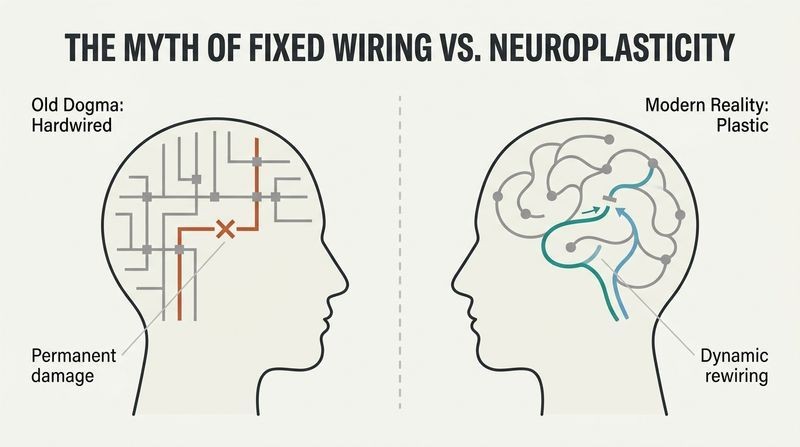
The core thesis overturns 400 years of dogma. Mainstream science long insisted the adult brain was hardwired like a machine: fixed parts, fixed locations, no growth after childhood, no recovery from damage. Doidge documents a revolution led by scientists he calls neuroplasticians, who proved the opposite. The brain changes its physical structure and function in response to thought, activity, and experience.
The evidence is dramatic. Cheryl Schiltz lost her balance system to an antibiotic and felt she was perpetually falling. A device sending signals from her tongue to her brain restored equilibrium, and eventually her brain relearned balance without the device. Blind people learned to "see" through cameras wired to their skin. The brain is a self-changing organ, not a static piece of hardware.
What's striking is how the machine metaphor, born from Galileo and Descartes, actively blinded researchers for centuries. Once you assume the brain is a clock, you stop looking for growth. This mirrors Thomas Kuhn's insight that paradigms determine what scientists can even perceive. The neuroplasticians faced ridicule not because their data was weak but because it violated the reigning worldview. A caution worth adding: plasticity is not infinite malleability. Severe damage, genetic constraints, and critical-period windows all limit change. The revolution is real, but popular enthusiasm sometimes inflates "the brain can change" into "anyone can rewire anything," which the careful science does not support.
We see with our brains, not our eyes, so senses can be swapped
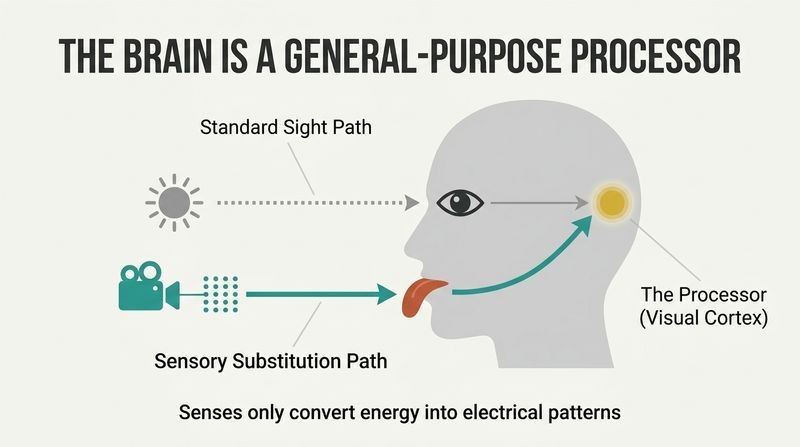
Sensory substitution proves the brain is a general-purpose processor. Paul Bach-y-Rita, whom Doidge calls the father of modern neuroplasticity, argued that our sense organs merely convert energy into electrical patterns. The brain, not the eye or ear, does the perceiving. This means one sense can substitute for another.
His inventions made this concrete. A blind person seated in a chair with 400 vibrating stimulators against their back, fed by a camera, learned to recognize faces, judge distance, and even duck a ball thrown at the lens. The vibrations on skin became genuine visual perception located out in the world. A later version routed signals through the tongue. Scientists confirmed with brain scans that touch signals entering the tongue get processed in the visual cortex. A ferret's optic nerve rewired to its auditory cortex still produced sight.
This dissolves the ancient "law of specific nerve energies," which held each nerve carried its own irreplaceable sensation. Bach-y-Rita's reframe anticipates modern theories of the brain as a prediction machine that cares about information structure, not its source. It also grounds Andy Clark's "natural-born cyborg" idea: because the brain treats a blind man's cane or a camera as just another data port, merging with tools is natural, not alien. One nuance: substitution works best for spatially structured senses like touch and vision, which share a two-dimensional receptor sheet. Substituting for smell or taste, which rely on chemistry, has proven far harder, suggesting the brain's flexibility has structural limits.
Neurons that fire together wire together, and fire apart wire apart
Michael Merzenich mapped the rules of change. Using microelectrodes on monkeys, he showed brain maps are not fixed or universal but vary person to person and shift with use. Cut a nerve, amputate a finger, or sew two fingers together, and the map reorganizes within weeks according to competition for cortical territory.
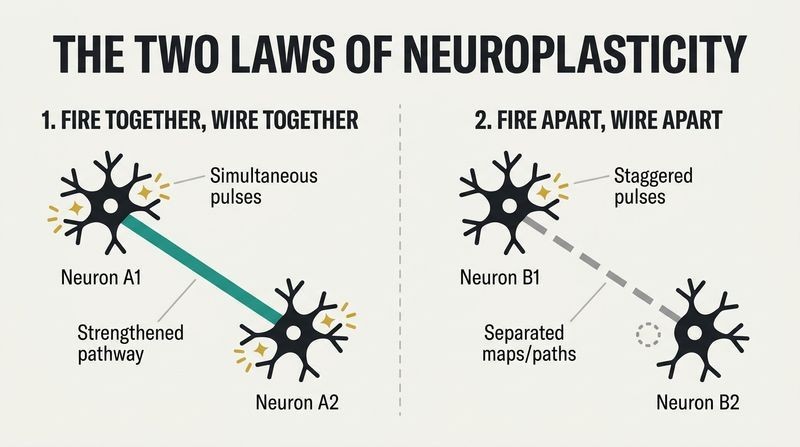
Two laws govern the rewiring.
1. Neurons active at the same moment strengthen their connections (Hebb's law, actually proposed by Freud decades earlier).
2. Neurons that fire at separate times form separate maps.
This explains why webbed fingers share one brain map until surgically separated, why bad habits are hard to break (they claim map space and defend it), and why second languages are hard: your native tongue has already colonized the linguistic real estate. Learning is competitive.
The competitive framing is the underappreciated jewel here. Most people imagine the brain as a container being filled, but Merzenich shows it as contested territory where practiced skills evict neglected ones. This reframes "use it or lose it" from cliche to mechanism, and it has sharp implications: multitasking rarely produces lasting change because divided attention fails to drive map reorganization. It also complicates self-improvement optimism. Because plastic change is competitive and self-defending, entrenched habits enjoy a genuine neural advantage, which is why unlearning is harder than learning. Merzenich's insight that maps also become more efficient (fewer neurons, faster firing) with mastery elegantly explains why we do not simply run out of brain space.
Build weak brain functions directly instead of working around them
Barbara Arrowsmith Young rebuilt her own broken brain. Born with severe asymmetry, she could ace memory tests yet could not read a clock, understand cause and effect, or grasp the relationship between symbols. The standard approach was compensation: audiobooks for poor readers, extra time on tests, color-coding. These work around a deficit but never fix it.
She chose to attack the weakness instead. Inspired by Rosenzweig's rats, whose brains grew heavier in enriched environments, she designed grueling exercises targeting her weakest function, spending hours reading clock faces of escalating complexity. Not only did she learn to read clocks faster than normal people, her grasp of grammar, logic, and math improved too. She founded a school where children strengthen specific weak functions through targeted drills, some raising reading from a first-grade to seventh-grade level in fourteen months.
This challenges the entire accommodation model that dominates special education, and the tension is genuine. Compensation delivers immediate function; remediation gambles time on deeper repair. Arrowsmith's approach echoes the classical education tradition of rote memorization and elocution drills that strengthened auditory and motor capacities, practices dropped in the 1960s as "irrelevant." There is provocative cultural commentary here: the decline of eloquence may reflect atrophied brain functions, and PowerPoint may be the ultimate compensation for a weak premotor cortex. A fair criticism: Arrowsmith's evidence rests heavily on case reports rather than randomized controlled trials, and independent replication has lagged. The principle is compelling, but the specific program awaits rigorous validation.
Force the good limb into a sling to resurrect the paralyzed one
Edward Taub cracked stroke recovery with learned nonuse. His deafferented monkeys stopped using an arm not because they could not move it, but because they learned during the shock period after injury that trying failed. The failure trained them to give up. Stroke patients suffer the same trap.
Constraint-induced therapy breaks the trap. Restrain the healthy arm in a mitt for 90 percent of waking hours, then drill the affected limb six hours a day using incremental "shaping," rewarding tiny gestures toward a goal. A patient who had his stroke 45 years earlier still improved. Brain scans show the shrunken map for the affected arm doubles in size. Taub, who was hounded for years by animal-rights activists over his Silver Spring monkeys, showed 80 percent of chronic stroke patients regain substantial arm function.
The learned-nonuse concept is a profound psychological insight hiding inside a neurological therapy: the brain generalizes from early failure and stops trying, so the deficit becomes partly self-inflicted. This resonates with Martin Seligman's learned helplessness, where organisms that experience uncontrollable failure quit even when control returns. Taub's genius was recognizing that recovery requires overwhelming this learned pessimism through forced, massed, incremental practice, the same logic behind immersion language learning. The parallel to exposure therapy for anxiety is direct. One caveat the field acknowledges: the intensity is brutal and expensive, and it only helps patients retaining some finger movement, though the clinic later extended methods to fully paralyzed hands and aphasia.
When obsession strikes, relabel it and refocus to rewire the circuit
OCD is a stuck gearshift in the brain. Jeffrey Schwartz identified three hyperactive components: the orbitofrontal cortex fires a "mistake feeling," the cingulate triggers dread, and the caudate nucleus, normally an automatic gearshift, fails to let the thought pass. The three lock together, which Schwartz calls brain lock, so the false alarm keeps blaring.
The treatment manually shifts the gear. When an attack hits, the sufferer relabels it ("this is not germs, this is my OCD") to gain distance, then deliberately refocuses on a pleasurable activity like gardening or music for fifteen to thirty minutes. This grows a competing circuit, releases dopamine that rewards it, and by the fire-apart-wire-apart principle weakens the obsessive pathway. Brain scans confirm the locked areas begin firing separately. Eighty percent improve when combined with medication.
Schwartz's method is quietly radical: it is a talking therapy validated by before-and-after brain scans, dissolving the old wall between psychology and neurology. Its resemblance to mindfulness meditation is not accidental. The relabeling step trains the observer stance Buddhists cultivate, watching a thought without being consumed by it, and cognitive scientists now call this decentering. The approach also cleverly sidesteps the flaw in traditional cognitive therapy, which drags patients back into obsessive content by debating it. Schwartz's key distinction is that OCD sufferers already know their fears are irrational; the problem is the feeling, not the belief. Changing behavior, not arguing with the thought, is what rewires the circuit.
Sexual taste is largely acquired and wired in during critical periods
The libido is a gourmet, not a glutton. Human sexuality shows extraordinary plasticity: we vary wildly in what attracts us, and tastes can be acquired, added, and occasionally lost. Freud located critical periods for sexuality in early childhood, when patterns of attachment get wired into the brain and shape adult attraction. A man raised by a volatile, seductive mother found himself compulsively drawn to unstable, cruel women, while kind women bored him.
Internet pornography demonstrates acquired taste in real time. Doidge treated men who found they needed harder content to stay aroused (tolerance), grew less attracted to real partners, and developed impotence that vanished when using porn. Each viewing session paired images with the dopamine of orgasm, wiring new maps that outcompeted old attractions. The content of hardcore porn has escalated precisely because users build tolerance.
This chapter is the book's most culturally combustible, and its central claim, that repeated pairing of images with dopamine reward reshapes arousal templates, is mechanistically plausible given everything Merzenich established about map competition. It anticipated later debates about porn-induced erectile dysfunction that clinicians now take seriously. The distinction between wanting (dopamine-driven craving) and liking (endorphin-driven satisfaction), drawn from Berridge and Robinson's addiction research, is crucial: users can crave what they no longer enjoy. A fair critique: the clinical evidence is anecdotal and drawn from a self-selected therapy population, and causation between porn and dysfunction remains contested in the broader literature. Still, the plasticity framework offers a testable model that pure instinct theories cannot.
Imagining an action changes your brain almost as much as doing it
Mental practice builds physical brain structure. Alvaro Pascual-Leone taught two groups a piano sequence. One physically practiced two hours daily for five days; the other only imagined playing. Both showed nearly identical changes in their motor maps, and the imaginers reached the physical group's third-day skill level. In another study, subjects who merely imagined finger exercises gained 22 percent more strength, versus 30 percent for those who physically trained.
Imagination and action share the same neural machinery. Visualizing the letter A lights up the visual cortex as if you saw it. This is why mental rehearsal works for athletes and musicians, and why Anatoly Sharansky played months of mental chess in a Soviet prison cell to keep his sensory-deprived brain from degrading. Thoughts leave material traces, quietly dissolving Descartes' wall between immaterial mind and physical brain.
The finding that imagined muscle contractions build measurable strength is genuinely counterintuitive and points to a truth: much of what limits early strength gains is neural, the brain learning to recruit muscle fibers, not the muscle itself. This is why novice lifters improve fast before any visible growth. Pascual-Leone's deeper contribution is the tortoise-and-hare distinction between fast, reversible synaptic strengthening (cramming) and slow, durable structural change (mastery), which explains why sustained practice beats bursts. His metaphor of the plastic brain as a snowy hill, where repeated sled runs carve tracks that become hard to escape, elegantly captures why the same plasticity that liberates us can also imprison us in rigid habit.
A phantom limb reveals pain is a brain opinion, not a body report
Pain is constructed, not merely received. V. S. Ramachandran studied phantom limbs, the vivid felt presence of amputated arms afflicting 95 percent of amputees, often with chronic pain in a limb that no longer exists. Because the brain map for a missing hand gets invaded by the adjacent face map, touching an amputee's cheek can be felt in the phantom fingers.
Illusion can cure the pain illusion. Ramachandran built a mirror box: the patient places the good hand so its reflection appears where the phantom should be. Moving the reflection tricks the brain into "seeing" the phantom move, unfreezing it and dissolving pain. This works because pain, like body image, is the brain's constructed opinion about the body's state, gathering evidence from many sources rather than passively reporting injury.
Ramachandran's reframing, pain as an opinion rather than a readout, updates the 1965 gate-control theory of Melzack and Wall and aligns with modern predictive-processing accounts where the brain infers bodily states from noisy signals. The clinical payoff is enormous: it validates why placebos genuinely reduce pain (brain scans show pain regions quieting) and why battlefield soldiers feel no pain until safe. The mirror box, costing pennies, treating conditions that resisted surgery and drugs, is a rebuke to high-tech medicine. A limitation worth noting: mirror therapy helps roughly half of patients, works best soon after onset, and fails once maps have atrophied for years, reminding us that plasticity has a use-by window.
Learn something genuinely new to keep your aging brain from decaying
The brain grows new neurons until death. The old dogma held the brain could never regenerate. Then researchers found neurogenesis, the birth of new neurons from stem cells, in the adult hippocampus, continuing into old age. Aging mice in enriched environments grew up to fivefold more hippocampal neurons and scored better on learning tests.
Two activities matter, and they differ. Physical exercise, especially fast walking, generates new neurons, while learning prolongs their survival. But the learning must be genuinely novel and demanding. Replaying mastered skills like reading the newspaper or practicing your longtime profession does not engage the plasticity control system. Merzenich argues age-related memory loss stems partly from a neglected attention system producing "fuzzy engrams." Ninety-year-old Stanley Karansky kept learning Russian, astronomy, and rock collecting, sharpening his mind through relentless novelty.
The prescription cuts against comfortable middle-age habits. The brain treats familiar competence as maintenance, not growth, so the crossword you have done for decades does little. This aligns with George Vaillant's Harvard study finding that continued engagement predicts vibrant aging, and with research linking dancing, which demands learning new sequences, to lower dementia risk, while passive bowling shows no benefit. Merzenich's emphasis on focused attention connects to the neurochemistry of acetylcholine, which sharpens memory encoding. One honest caveat: the correlation between mental activity and reduced Alzheimer's does not prove causation, since early undetectable disease may cause people to withdraw from stimulating activities. Age-related memory loss, though, appears genuinely reversible with the right exercises.
The same plasticity that frees you can also trap you in rigidity
Doidge calls this the plastic paradox. The brain's malleability produces both flexible and rigid behavior. Once a plastic change becomes established, it can block other changes, which is why our most stubborn habits, addictions, and prejudices are themselves products of plasticity, not failures of it. Pascual-Leone's snowy-hill image captures it: early sled runs carve tracks that grow so efficient it becomes hard to take any other path.
This scales from individuals to whole cultures. Bruce Wexler argues that as plasticity declines with age, people increasingly try to change the world to match their fixed internal maps rather than update themselves. Totalitarian regimes exploit this by indoctrinating the young, when the brain is most plastic. Immigration is a brutal cortical workout because a new culture competes against networks wired during native critical periods. Culture shock is literally brain shock.
The plastic paradox is the book's most important corrective to feel-good neuro-optimism. Plasticity is morally neutral machinery; it entrenches the tyrant's propaganda as readily as the pianist's skill. This connects to why psychotherapy is hard, why civil wars can erupt where neighbors coexisted, and why civilization is, as Doidge puts it, always one generation deep. Wexler's argument that aging brains micromanage their environment to preserve internal structures offers a neurological gloss on why political and religious rigidity often deepen with age. The unsettling implication is that persuasion has limits: entrenched worldviews are anatomical, not merely opinions, which explains the durability of cultural conflict better than appeals to reason alone.
Psychotherapy physically rewires neurons by turning memory into narrative
Talking is a neuroplastic intervention. Eric Kandel won a Nobel for showing that learning changes neurons: a sea snail forming a long-term memory grows from roughly 1,300 to 2,700 synaptic connections. Crucially, our thoughts can switch genes on or off, reshaping brain anatomy. Psychotherapy works by this same mechanism, altering gene expression and synaptic structure.
Doidge's patient Mr. L. illustrates the process. Depressed for forty years after losing his mother at 26 months, he had turned off his emotions and sabotaged relationships. Through analysis he converted unconscious procedural memories (automatic emotional patterns) into explicit, narratable ones, and separated the fused ideas of separation and death wired together in childhood. Brain scans confirm successful therapy normalizes prefrontal and limbic activity. Turning haunting ghosts into settled ancestors is neural retranscription.
Kandel's molecular work gives psychoanalysis, long dismissed as unscientific, a genuine biological foundation, which is a remarkable rehabilitation. The distinction between procedural memory (unconscious, bodily, formed early) and explicit memory (conscious, narratable) illuminates why early trauma resists words yet erupts in behavior: it was encoded before the explicit system matured. This dovetails with Bessel van der Kolk's work on how trauma lives in the body. The insight that reactivated memories become briefly editable before reconsolidating, drawn from Nader's research, explains why reliving in a safe relationship enables change. A reasonable challenge: Mr. L. is a single case, and whether recovered early memories are accurate or reconstructed remains genuinely contested in memory science.
Analysis
Doidge's achievement is synthetic rather than experimental. He is a psychiatrist and journalist who stitches together two decades of scattered discoveries into a single narrative arc: the fall of the machine-brain and the rise of the self-changing brain. The book's structure, pairing each scientist with a transformed patient, is both its storytelling strength and its epistemic weakness. Case studies are vivid and memorable, but they are also the softest form of evidence, and Doidge's enthusiasm occasionally outruns the controlled trials. A careful reader should distinguish the rock-solid findings (Merzenich's map reorganization, Kandel's molecular work on learning, adult neurogenesis, critical-period plasticity) from the more speculative extensions (porn addiction, some Arrowsmith claims, aspects of the psychoanalytic chapter).
What elevates the book above popular-science cheerleading is the plastic paradox. Doidge refuses the lazy conclusion that plasticity means limitless self-improvement. He insists the same mechanism that heals stroke victims also cements addictions, phobias, and ideological rigidity. This dialectical honesty gives the work philosophical weight, culminating in appendices linking neuroplasticity to Rousseau's perfectibilite and Sowell's constrained-versus-unconstrained visions of human nature. The brain, Doidge suggests, is neither the fixed machine of Descartes nor the infinitely moldable clay of utopian revolutionaries. It is something harder to categorize: opportunistic, competitive, history-dependent.
The unifying thread across every chapter is competition for cortical territory governed by attention and timing. Once that principle clicks, the disparate stories cohere: balance, vision, stroke, OCD, pain, love, and aging are all territory disputes. The book's lasting contribution is dissolving Cartesian dualism with data, showing that immaterial thought leaves material traces. Its lasting risk is that readers extract only the optimism and miss the paradox. Written in 2007, it launched a genre, and while some claims have aged unevenly, its central reframe of the brain as a living, changing organ has become mainstream neuroscience.
Review Summary
The Brain That Changes Itself received mixed reviews, with many praising its fascinating exploration of neuroplasticity and its potential for treating various conditions. Readers found the case studies compelling and the science accessible. However, some criticized Doidge's tendency to overgeneralize, his controversial views on sexuality, and graphic descriptions of animal experiments. The book was lauded for challenging conventional beliefs about the brain's rigidity and offering hope for those with neurological issues. Despite its flaws, many readers found it inspiring and thought-provoking.
People Also Read









Glossary
Neuroplasticity
Brain's ability to change structureThe property of the brain and nervous system to change its own structure and function in response to activity, thought, sensation, and experience. It operates from birth until death, allowing the brain to refine circuits, reassign functions to different regions after damage, and grow new connections. Doidge treats it as the most important shift in our understanding of the brain since neuroanatomy's founding.
Neuroplastician
Scientist studying brain changeDoidge's coined term for the pioneering scientists and clinicians who discovered, proved, and applied neuroplasticity, often against fierce resistance from mainstream neuroscience. Examples include Paul Bach-y-Rita, Michael Merzenich, Edward Taub, V. S. Ramachandran, and Alvaro Pascual-Leone.
The plastic paradox
Plasticity causes both flexibility and rigidityDoidge's central caution that the same neuroplastic capacity enabling beneficial change also produces stubborn, rigid behaviors. Once a plastic change becomes established, it can block competing changes. Many of our most entrenched habits, addictions, and prejudices are therefore products of plasticity, not evidence against it.
Sensory substitution
One sense replacing anotherBach-y-Rita's principle that because all senses convert energy into electrical signals processed by the brain, one damaged sense can be replaced by routing information through another. Demonstrated by devices that let blind people perceive images via vibrations on skin or the tongue, and by his claim that we see with our brains, not our eyes.
Localizationism
One function, one fixed locationThe traditional doctrine that each mental function is processed in a single, genetically fixed brain location, so that damage to that location permanently destroys the function. Rooted in Broca's and Wernicke's discoveries and the machine metaphor of the brain, it left no room for the reorganization neuroplasticity demonstrates.
Brain maps
Cortical territories representing body partsTopographically organized regions of the cortex where parts of the body or aspects of experience are represented, first charted by Wilder Penfield. Merzenich showed these maps are not fixed or universal but change their borders and size with use, governed by competition for cortical space and the timing of neural inputs.
Learned nonuse
Giving up on a limbEdward Taub's discovery that after injury or stroke, repeated early failure to move a limb teaches the brain to stop trying, so the limb's disability becomes partly self-inflicted rather than purely physical. Constraint-induced therapy reverses it by restraining the healthy limb and forcing intensive practice of the affected one.
Constraint-induced (CI) movement therapy
Restrain good limb, drill affectedTaub's stroke treatment that overcomes learned nonuse by immobilizing the patient's healthy arm in a mitt for most waking hours while intensively drilling the impaired limb for hours daily using incremental shaping. It rebuilds shrunken brain maps and helps roughly 80 percent of chronic stroke patients regain substantial function, even decades after injury.
Brain lock
Stuck circuit in OCDJeffrey Schwartz's term for the obsessive-compulsive state in which three brain areas (orbitofrontal cortex, cingulate gyrus, and caudate nucleus) fire together and stay locked on, so false alarms of danger cannot be dismissed. His therapy manually unlocks the circuit through relabeling the thought and refocusing attention on a pleasurable activity.
Mirror box
Illusion device treating phantom painRamachandran's simple device using a mirror to reflect a patient's intact limb into the position of a missing or paralyzed one, tricking the brain into perceiving the phantom or affected limb moving painlessly. It unfreezes frozen phantoms and relieves chronic pain by altering the brain's constructed body image.
Critical period
Window of heightened brain plasticityA brief developmental window during which a brain system is exceptionally plastic and shaped by environmental input, after which change becomes far harder. Examples include the window for vision in kittens, language acquisition, and, per Freud, sexuality and attachment. During critical periods the nucleus basalis stays on, making learning effortless.
Procedural and explicit memory
Unconscious habits versus conscious recollectionTwo memory systems altered in psychotherapy. Procedural (implicit) memory stores automatic emotional patterns and skills without words and dominates the first years of life. Explicit (declarative) memory consciously recollects facts and events, supported by language and the hippocampus. Therapy converts unconscious procedural memories into narratable explicit ones, enabling change.
FAQ
What's The Brain That Changes Itself about?
- Neuroplasticity Focus: The book delves into neuroplasticity, the brain's ability to reorganize itself by forming new neural connections throughout life. This challenges the outdated belief that the brain is fixed after a certain age.
- Personal Triumph Stories: It features inspiring stories of individuals who have overcome neurological challenges, illustrating the brain's capacity for recovery and adaptation.
- Cultural Influence: The book also explores how culture shapes our brains, suggesting a two-way relationship between brain development and cultural practices.
Why should I read The Brain That Changes Itself?
- Inspiring Transformations: The book is filled with stories of personal triumph, motivating readers to believe in their potential for change and growth.
- Scientific Insights: It provides accessible explanations of complex neuroscience concepts, making it suitable for both lay readers and those with a scientific background.
- Practical Applications: Readers can learn strategies for enhancing cognitive abilities and improving mental health, emphasizing proactive brain health management.
What are the key takeaways of The Brain That Changes Itself?
- Brain's Adaptability: The brain is not static; it can change and adapt throughout life, crucial for recovery from injuries and learning new skills.
- Role of Experience: Experiences shape our brains, and engaging in new activities can lead to significant cognitive improvements.
- Therapeutic Potential: Various therapeutic approaches leverage neuroplasticity, demonstrating practical implications in rehabilitation and mental health.
What is neuroplasticity as defined in The Brain That Changes Itself?
- Definition of Neuroplasticity: Neuroplasticity is the brain's ability to reorganize itself by forming new neural connections throughout life, allowing adaptation to new experiences and recovery from injuries.
- Mechanisms of Change: It involves synaptic strengthening and the creation of new neurons, influenced by learning, environment, and rehabilitation practices.
- Implications for Recovery: Understanding neuroplasticity suggests that with the right interventions, individuals can regain lost functions and improve cognitive abilities.
How does The Brain That Changes Itself illustrate the relationship between culture and the brain?
- Cultural Activities Shape the Brain: Cultural practices, such as language and art, can physically alter brain structure and function, highlighting the brain's responsiveness to the environment.
- Examples from Different Cultures: The book provides examples like the Sea Gypsies, who have developed unique visual abilities due to their lifestyle, illustrating specialized cognitive skills.
- Two-Way Interaction: The relationship is dynamic, where the brain shapes culture, and culture shapes the brain, emphasizing the importance of both biological and cultural factors in cognitive development.
What are some real-life examples of neuroplasticity in The Brain That Changes Itself?
- Cheryl Schiltz's Recovery: Cheryl regained her ability to stand and walk through neuroplastic treatments, using a device that stimulated her tongue to process balance signals differently.
- Barbara Arrowsmith Young's Journey: Barbara developed exercises to strengthen weak brain functions, creating a school to help others with learning disabilities, showcasing targeted cognitive training.
- Stroke Recovery: The book details stroke victims who learned to move and speak again through therapies harnessing neuroplasticity, highlighting recovery potential after significant brain damage.
What is constraint-induced therapy as described in The Brain That Changes Itself?
- Therapeutic Technique: Constraint-induced therapy (CIT) involves restraining the unaffected limb to encourage use of the affected limb, promoting neuroplastic changes.
- Focus on Relearning: CIT aims to "unmask" existing motor programs that may still be intact but neglected, helping patients regain function.
- Success Stories: The book provides examples of stroke patients who improved motor skills through CIT, illustrating its effectiveness even years after injury.
How does The Brain That Changes Itself explain the concept of "learned nonuse"?
- Definition of Learned Nonuse: Learned nonuse occurs when individuals stop using a limb or function due to repeated failures, leading to a decline in ability.
- Impact on Recovery: It can mask the brain's potential for recovery, hindering rehabilitation efforts and prolonging disability.
- Overcoming Learned Nonuse: Through targeted therapies like CIT, patients can break the cycle of learned nonuse and regain abilities by re-engaging with the affected limb.
What role does imagination play in neuroplasticity according to The Brain That Changes Itself?
- Imagination and Brain Change: Imagining actions can activate the same neural pathways as performing them, suggesting mental practice can lead to physical brain changes.
- Research Findings: Studies show mental rehearsal can improve performance, highlighting the power of visualization in skill enhancement.
- Practical Implications: Mental practice can be a tool for rehabilitation, aiding recovery and enhancing cognitive abilities, especially for those with limited mobility.
How does The Brain That Changes Itself address the relationship between trauma and neuroplasticity?
- Trauma's Impact on the Brain: Traumatic experiences can lead to lasting changes, often resulting in conditions like PTSD or depression, affecting emotional regulation and memory.
- Healing Through Therapy: Therapeutic approaches can help reframe traumatic memories, leading to neuroplastic changes and emotional recovery.
- Neuroplasticity as a Double-Edged Sword: While it allows for recovery, it can also reinforce negative patterns if not addressed, highlighting the need for targeted interventions.
How does The Brain That Changes Itself explain the effects of stress on the brain?
- Stress and Neuroplasticity: Chronic stress can negatively impact neuroplasticity, leading to changes in brain structure, particularly in the hippocampus.
- Glucocorticoids and Brain Health: Stress hormones can damage neurons and inhibit new brain cell growth, emphasizing the importance of managing stress for cognitive health.
- Recovery from Stress Effects: Therapeutic interventions can mitigate stress effects, promoting recovery and enhancing neuroplasticity, even in stress-related challenges.
How can I apply the concepts from The Brain That Changes Itself in my own life?
- Engage in New Activities: Seek out new experiences and challenges to stimulate brain plasticity, such as learning new skills or engaging in physical exercise.
- Practice Mental Visualization: Incorporate mental practice into routines to enhance skills and promote recovery, using visualization techniques.
- Seek Therapeutic Support: Explore therapeutic options that leverage neuroplasticity for trauma or mental health issues, promoting positive change and recovery.
About the Author
Other books by Norman Doidge

Download PDF
Download EPUB
.epub digital book format is ideal for reading ebooks on phones, tablets, and e-readers.








































