

Key Takeaways
Powering through isn't resilience; it's the myth quietly depleting you
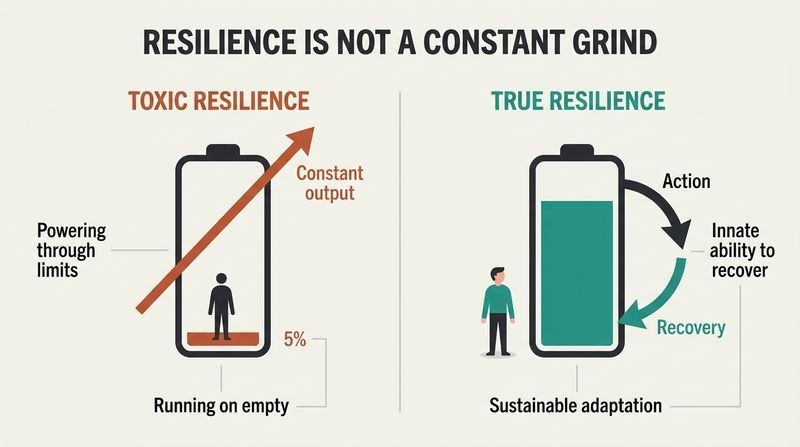
True resilience is not the Energizer Bunny. Nerurkar, a Harvard physician, distinguishes real resilience (your innate biological ability to adapt and recover) from what she calls toxic resilience: pushing past limits, productivity at all costs, and a mind-over-matter grind culture rewards. Her ultramarathoner friend Liz insisted she was fine while running on empty for six months. The diagnosis: chronic stress and atypical burnout.
The tell is universal. Patients walk into her clinic smiling, then burst into tears the moment the door closes. Modern burnout no longer looks like apathy. During the pandemic, 61% of remote workers couldn't disconnect even while burned out. We postpone self-care for some mythical future when we're less busy, giving it least attention precisely when we need it most.
What's striking is how the resilience myth functions as a cultural immune response against admitting vulnerability. This dovetails with sociologist Arlie Hochschild's concept of emotional labor and with research on "toxic positivity." Nerurkar's reframe matters because it removes shame from the diagnosis: struggling is not failing. One caution worth noting: the line between healthy grit and toxic overriding is genuinely blurry, and the book leans on clinical intuition to draw it. A skeptic might ask how anyone distinguishes productive perseverance from self-destructive pushing in real time. Her answer, the canary metaphor of bodily symptoms, offers a more concrete signal than vague self-assessment.
Your body's weird symptom is a canary warning you to stop
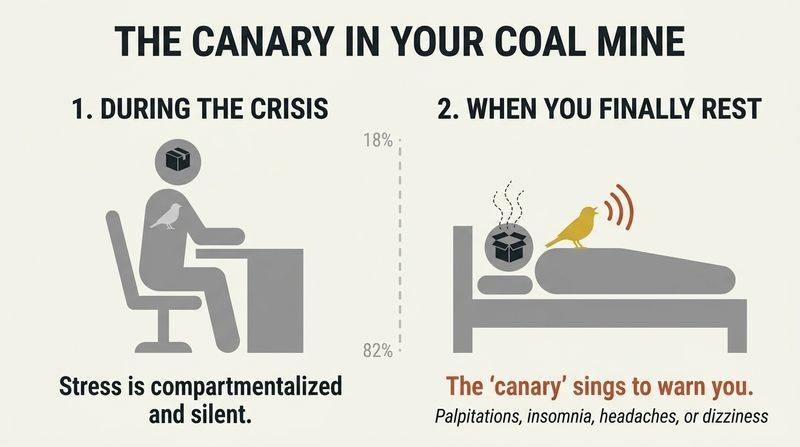
Listen to the canary in your coal mine. Nineteenth-century miners carried canaries to detect odorless toxic gas; when the bird fell silent, danger was near. Nerurkar argues each of us has an internal canary that signals when stress has turned harmful, usually through a physical symptom we're tempted to ignore.
Her own canary was terrifying. As an overworked medical resident logging 80-hour weeks, she felt a stampede of wild horses in her chest during rounds. Every cardiac test came back normal. The culprit was stress. Her palpitations were a delayed stress response: the brain compartmentalizes emotion during a crisis, then releases it once you feel safe, often at bedtime. For her patients, the canary sings through insomnia, headaches, gut trouble, or dizziness.
The delayed stress response is well-documented in trauma literature, echoing why soldiers and refugees often collapse emotionally only after reaching safety, not during the danger. Nerurkar's framing usefully normalizes this lag, which otherwise feels irrational ("Why am I falling apart now that things are fine?"). The canary metaphor also aligns with interoception research: people vary widely in their ability to sense internal bodily states, and low interoceptive awareness correlates with worse emotional regulation. One nuance: attributing symptoms to stress risks masking genuine medical conditions, which is precisely why she emphasizes stress is a diagnosis of exclusion, confirmed only after ruling out other causes.
Change only two things at once, or your brain rebels
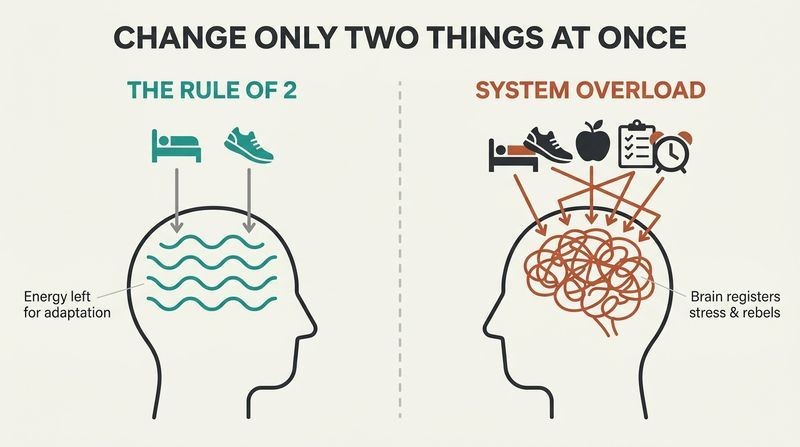
The Resilience Rule of 2. Nerurkar's core prescription: introduce only two lifestyle changes at a time. More than that and your system overloads, because the brain registers even positive change as stress. Her patient Adam overhauled everything on January 1, tracking sleep, food, exercise, and energy in a hundred-page binder. Within two months his enthusiasm collapsed. It wasn't weak willpower; it was biology rebelling against too much too fast.
The science is decades old. In the 1960s, psychiatrists Holmes and Rahe studied 5,000 patients and ranked 43 life events by stress impact. Crucially, joyful events (marriage, a new job, an outstanding achievement) still generated stress because adaptation itself demands energy. Doctors have long used this to counsel patients: two changes maximum for anything to stick.
This constraint is the book's most practical anti-hack, and it converges with behavior-change science from BJ Fogg ("tiny habits") and James Clear, who both argue that scale kills consistency. The Holmes-Rahe insight (that positive change taxes the system) is underappreciated in a self-improvement culture obsessed with total transformation. Neurologically, the claim connects to finite cognitive bandwidth and ego-depletion debates. Worth flagging: the "exactly two" number is more clinical heuristic than hard science, and some high-capacity individuals thrive on bigger overhauls. The deeper principle (respect your adaptive limits and sequence change) is sturdier than the specific figure.
Stop asking what's wrong with you; ask what matters most
Flip the question to escape negative self-talk. Under stress the brain drops into survival mode, ruled by the amygdala, and floods you with self-criticism. Nerurkar borrows a reframe from Dr. Edward Phillips: replace "What's the matter with me?" with "What matters most to me?" This shifts you toward action aligned with your values.
Build a MOST goal and reverse-engineer it. A MOST goal is Motivating, Objective, Small, and Timely, achievable in roughly three months. Then draft a Backwards Plan: write the end goal at the top, today at the bottom, and map each step in reverse like Google Maps directions. Wes, juggling two jobs and three kids on fast food, packed dinners the night before and walked during calls with his kids. Small, values-driven steps closed the gap between knowing and doing.
The "knowing-doing gap" is a recognized problem in behavioral medicine: patients rarely lack information, they lack scaffolding. Nerurkar's Backwards Plan is essentially backward chaining, a technique from goal-setting research and even AI planning, and it maps neatly onto "implementation intentions" (Peter Gollwitzer's finding that specifying when-where-how roughly doubles follow-through). The values reframe also echoes Acceptance and Commitment Therapy, which anchors behavior change in personally chosen values rather than shame. Wes's story illustrates a subtle truth: the barrier was never motivation but a stressed prefrontal cortex unable to plan ahead. Reduce the stress, and planning capacity returns.
Chase meaning, not pleasure; only one kind of happiness lasts
Hedonic happiness runs on a treadmill. Pleasure from a new bag, a Netflix binge, or dessert delivers a dopamine hit, then fades back to baseline. This hedonic treadmill is by design: the third slice of cake never matches the first. These treats are useful circuit breakers for stress but can't cure it.
Eudaimonic happiness compounds. Rooted in meaning, purpose, and connection, it has no treadmill. Ryan, a wealthy music executive crippled by anxiety, rediscovered guitar and hiking (childhood joys tied to his late grandfather) and watched his anxiety recede. One study found eudaimonic well-being was linked to stronger antiviral response and lower inflammation at the genetic level, while hedonic well-being showed the opposite. As the researchers put it: doing good and feeling good imprint the genome very differently.
The hedonic/eudaimonic distinction traces to Aristotle and was revived by psychologists Carol Ryff and Ed Deci. The genomic study Nerurkar cites (Fredrickson and Cole) generated real debate; critics questioned its statistical methods, so the "happiness rewrites your DNA" claim deserves caution. Still, the behavioral core is robust: activities involving mastery, service, and flow predict durable life satisfaction better than consumption. What's practically powerful is her prescription to mine childhood joys, since those often reveal intrinsic motivation stripped of status-seeking. Ryan's arc also quietly critiques the assumption that wealth buys peace; his three condos couldn't touch what a guitar did.
Your phone is the most toxic relationship in your life
Scrolling hijacks your survival wiring. Nearly half of us spend five to six hours daily on our phones and touch them around 2,617 times a day. Even a phone sitting nearby, unused, drains cognitive capacity through what researchers call brain drain. Under stress, the amygdala treats scrolling as scanning for danger, like a tribal night watchman, which amplifies stress and drives more scrolling: a loop.
The media diet, not abstinence. Nerurkar's patient Julian, a self-described newsie consuming headlines from waking to sleep, had unexplained fatigue and irritability, a case of popcorn brain (the mind overstimulated by constant information streams). Her three-part fix: time limits (20 minutes twice daily), geographic limits (phone off the nightstand, an arm's length away), and logistical limits (kill notifications, grayscale the screen). Julian's fatigue and mood recovered.
Nerurkar wisely rejects digital-monk absolutism, citing evidence that reduction beats abstinence for sustainable well-being, which aligns with Cal Newport's "digital minimalism" and self-determination theory (autonomy matters more than deprivation). The night-watchman framing is a compelling evolutionary-mismatch argument: mechanisms tuned for scanning a savannah misfire on infinite feeds engineered to exploit them. The friction tactics (grayscale, distance, notification removal) are consistent with choice-architecture research; small increases in effort meaningfully cut usage. One honest tension: the attention economy is adversarial, deliberately engineered to defeat willpower, so individual tactics, while helpful, address symptoms of a structural problem the book can't solve alone.
Move your bedtime earlier by thirty minutes every two weeks
Sleep and stress share one culprit: cortisol. The stress hormone that fuels fight-or-flight also regulates your sleep-wake cycle. Chronic stress keeps cortisol humming, wrecking sleep, which raises stress, which raises cortisol: the sleep-stress cycle. Sleep-deprived brains show 60% higher amygdala reactivity to negative images and behave strikingly like anxious brains.
Beat bedtime procrastination gradually. Many people know sleep matters yet stay up anyway, a revenge against overscheduled days worsened by blue light from screens that signals the brain to stay awake. Tanya, a grad student sleeping five fitful hours, shifted her 1 a.m. bedtime to 10 p.m. by moving it 30 minutes earlier every two weeks over three months. She replaced late-night screens with gentle stretching. Research links a 10-to-11 p.m. bedtime to better heart health; after-midnight bedtimes carried 25% higher heart-problem risk.
The incremental bedtime shift is smart chronobiology: the circadian system resets slowly, so gradual advances avoid the jetlag-like failure of abrupt changes. Matthew Walker's research corroborates the amygdala-sleep findings and the anxiety link. The "revenge bedtime procrastination" concept, which went viral from a Chinese expression, captures something the productivity literature misses: for the overscheduled, late nights are an autonomy grab, not mere indiscipline, which reframes the fix as reclaiming daytime agency rather than scolding. One caveat on the bedtime-heart study: it is correlational, and night-shift workers or genuine night owls may have different optimal windows, so the "golden hour" shouldn't be treated as universal law.
Pause five seconds before routine tasks to reset your nervous system
The mind-body connection is a law, not woo. Your brain and body talk constantly through channels like the HPA axis. Nerurkar's foundational technique, Stop-Breathe-Be, takes five seconds: stop your body completely, take one aware deep breath, and be present before starting a mundane repetitive task (making coffee, opening email, knocking on a door).
Breath is the only gateway you control. Breathing is the sole bodily process under both voluntary and involuntary control, making it the lever for the parasympathetic "rest-and-digest" system, which cannot fire simultaneously with fight-or-flight. Three tools: diaphragmatic (belly) breathing to brake acute stress, 4-7-8 breathing (inhale 4, hold 7, exhale 8) for sleep, and heart-centered breathing with a hand on the chest for self-soothing. Stanford researchers even located a small brain-cell cluster linking breath rhythm to emotional state.
Anchoring resets to existing repetitive tasks is a habit-stacking maneuver: piggybacking a new micro-behavior onto an established cue, which is far stickier than scheduling standalone "meditation time." The physiology is sound; slow exhalation stimulates the vagus nerve and raises heart-rate variability, a marker of parasympathetic tone increasingly used in performance and clinical settings. The Stanford finding (the breathing pacemaker in the pre-Botzinger complex) is real and elegant. What elevates this beyond generic "just breathe" advice is the insistence on frequency over duration: dozens of five-second resets daily rewire baseline tone more effectively than one long session, echoing spaced-repetition principles from learning science.
A daily twenty-minute walk rewires a stressed brain
Movement shrinks stress and grows the brain. Chronic stress and high cortisol physically shrink brain tissue, but exercise can thicken the prefrontal cortex, improve its connection to the amygdala, and grow new cells in the hippocampus (memory center), potentially cutting Alzheimer's risk by nearly 45%. Overweight adults who start exercising cut premature-death risk by 30% with no weight change at all.
Ditch all-or-nothing thinking. Miles, a former college athlete turned sedentary manager with prediabetes, swapped one daily LinkedIn session for a 20-minute walk, phone-free, treated as a movement meditation. Nerurkar frames the daily walk like brushing teeth: nonnegotiable, done whether or not you feel like it, to build the brain circuit before adding intensity. Even 1-to-2-minute bursts of activity lowered cancer death risk by 40% in one study.
The reframe from cosmetic to cognitive benefit is strategically shrewd; decades of "exercise to lose weight" messaging has demonstrably failed at driving adherence, whereas mood and brain-health motives sustain behavior better. The neurogenesis claims rest on solid work (Kirk Erickson's hippocampus studies, though effect sizes are debated). The "exercise like brushing teeth" framing dissolves the motivation trap that the daily-decision model creates, consistent with research that habits automate away willpower. A useful extension: walking phone-free doubles as exposure practice, familiarizing the body with elevated heart rate and breath so those same sensations feel less alarming during an actual stress spike.
Feed your gut Mediterranean-style; it's your second brain
The gut-brain connection is real cross talk. Your gut houses the body's second-largest cluster of neurons, 95% of your serotonin, and a microbiome that regulates mood, immunity, and stress. Chronic stress degrades this microbiome; better sleep, exercise, and diet strengthen it. Emotional eating (craving fat and sugar under stress) is your amygdala equating calories with survival.
The Mediterranean Diet is the gold standard. Emphasizing vegetables, whole grains, legumes, olive oil, fish, and fermented foods, it has outperformed alternatives across hundreds of studies for brain health, longevity, and mood. One study cut anxiety symptoms in three months; another found a prebiotic-and-fermented-food diet reduced stress by 32%. Practical moves: shop the store's perimeter, add two Mediterranean foods weekly (following the Rule of 2), and keep a food log, which one trial found doubled weight loss.
Nutritional psychiatry is among the fastest-growing frontiers in mental health, and Nerurkar's caution is appropriate: diet correlates with and can worsen conditions without being their sole cause. The microbiome-mood link is genuinely exciting but young; much foundational work is in mice, and human causality remains partly inferential. The SMILES trial she references was a landmark showing dietary improvement reduced depression, though its sample was small. What's practically durable regardless of microbiome mechanisms: the Mediterranean pattern is the most consistently validated diet in all of medicine. Her question "What am I really hungry for?" reframes emotional eating as an unmet need (rest, connection, certainty), a genuinely useful interruption.
Monotasking beats multitasking, which slows you by 40 percent
Multitasking is a myth your brain can't perform. What feels like multitasking is really task switching, and only about 2.5% of people can genuinely do two things at once. For everyone else it weakens the prefrontal cortex and slows productivity by 40%. The fix is the Goldilocks Principle: stress follows a bell curve, and you want the sweet spot, not too little (bored) nor too much (depleted).
Honor breaks and time-block. A Microsoft study found short breaks between meetings measurably lowered brain stress; even a 10-second pause aids neural consolidation (cementing learning). Holly, a burned-out tech worker, adopted the Pomodoro Technique: 25 minutes on one task, 5-minute break, repeat. Add the fake commute (a 10-to-15-minute walk to bookend remote workdays) and Sticky Feet (grounding attention where your feet are) to keep the anxious, future-focused amygdala quiet.
The task-switching research (David Strayer, Earl Miller) is robust: the brain serializes attention and pays a measurable "switch cost" each time. Nerurkar's break-centric productivity runs directly counter to hustle culture and aligns with the science of attention restoration and the surprising finding that rest, not just practice, drives skill consolidation (the Cohen lab study). The fake commute addresses a real pandemic-era loss: commutes served an underappreciated psychological function as transition rituals, buffering role-switching between work and home selves. Sticky Feet is essentially a mindfulness grounding technique repackaged accessibly. The Goldilocks bell curve echoes the century-old Yerkes-Dodson law linking arousal and performance, giving the intuition empirical scaffolding.
Write five gratitudes by hand nightly to quiet your inner critic
Gratitude turns Velcro into Teflon. Under stress the brain makes negative experiences sticky, like Velcro, a survival scanning mechanism. Gratitude practice enables cognitive reframing so those experiences slide off like Teflon. Nerurkar prescribes writing five specific things you're grateful for, and why, by hand each night, because handwriting engages different neural circuitry than typing and improves retention. Benefits in studies accrued gradually, growing larger 12 weeks out.
Then release the past through expressive writing. Developed by psychologist James Pennebaker, expressive writing means writing your deepest thoughts about an emotional issue for 15-to-20 minutes over four consecutive days, then discarding the pages. It has been shown to reduce doctor visits, ease depression, and boost immune function. Jeanette processed a brutal breakup this way; Nerurkar used it to make sense of her own wild-horse palpitations.
Both techniques rest on unusually strong evidence for self-help interventions. Pennebaker's expressive-writing paradigm has been replicated across hundreds of studies since the 1980s, with measurable immune and health markers, making it one of psychology's most durable findings. The gratitude literature is solid though not miraculous; effects are modest and, as Nerurkar honestly notes, delayed rather than instant, which distinguishes her account from inflated "gratitude changes everything" marketing. The handwriting claim connects to research on deeper encoding through motor engagement (Mueller and Oppenheimer's laptop-note-taking studies). Her insistence that gratitude is not toxic positivity is crucial: acknowledging good while struggling is different from denying the struggle.
Analysis
The 5 Resets belongs to a maturing genre: the physician-authored, evidence-backed antidote to wellness-industry snake oil. Aditi Nerurkar's structural move is to medicalize stress without pathologizing the sufferer. By insisting stress is biologically inescapable and that 60-to-80% of doctor visits carry a stress component while only 3% of doctors counsel on it, she positions herself in a genuine gap in Western medicine's sick-care-over-health-care model. The book's spine is behavioral, not inspirational: fifteen concrete techniques governed by one meta-rule, the Resilience Rule of 2, which functions as an inoculation against the very overhaul-everything impulse that self-help typically encourages.
What distinguishes the work is its coherent physiological through-line. Nearly every technique traces back to a single mechanism, shifting dominance from the amygdala (survival, self-preservation) toward the prefrontal cortex (planning, regulation), often via the breath and the parasympathetic system. This gives the book unusual internal logic; the resets are not a grab bag but variations on one neurological theme, leveraging neuroplasticity. That consistency is also a limitation: the amygdala-versus-prefrontal-cortex framing is a useful simplification that the neuroscience community would consider cartoonish, and some cited studies (the genomic happiness work, the correlational bedtime-heart data) carry more uncertainty than the confident prose conveys.
The book's deeper cultural argument is its most valuable contribution: that "toxic resilience" and hustle culture have redefined self-destruction as virtue. This connects to broader critiques from Jonathan Crary, Byung-Chul Han (the "burnout society"), and Anne Helen Petersen on millennial burnout. Nerurkar's clinical vignettes, while composited and occasionally tidy in their resolutions, humanize abstract mechanisms effectively. The target reader is the high-functioning, depleted professional who suspects something is wrong but has been trained to override it. For that reader, the book delivers a rare combination: permission to stop, a mechanistic explanation for why they feel broken, and a sequenced, low-friction path back. Its honest emphasis on gradual, unglamorous, imperfect progress is its quiet strength.
Review Summary
The 5 Resets receives mixed reviews, with an overall positive reception. Readers appreciate its practical stress management techniques, science-based approach, and accessible writing style. Many find the book helpful for developing resilience and managing daily stressors. However, some critics argue that the content is repetitive, lacks originality, or oversimplifies complex issues. The book's emphasis on small, achievable changes and its holistic approach to stress management are frequently praised, while its structure and organization receive mixed feedback.
People Also Read








Glossary
The Resilience Rule of 2
Change only two things at onceNerurkar's core principle that you should adopt only two new lifestyle changes at a time, then add two more once those stick. Because the brain registers even positive change as stress, attempting more risks system overload and abandonment. Rooted in 1960s Holmes-Rahe research showing all life changes, including joyful ones, generate measurable stress through the demand to adapt.
The canary in the coal mine
Bodily symptom signaling harmful stressNerurkar's metaphor for the physical symptom that warns your stress has become unhealthy, borrowed from miners who used canaries to detect toxic gas. It might appear as palpitations, insomnia, headaches, gut problems, or dizziness. The symptom signals it's time to slow down and reset before permanent damage occurs.
Delayed stress response
Emotions surface after crisis passesThe brain's tendency to compartmentalize emotion during an acute crisis for survival, then release it once you feel psychologically safe, often at bedtime or after the threat ends. Explains why people fall apart after good news (a cancer all-clear) or after reaching safety, as seen in refugees and Nerurkar's own bedtime heart palpitations.
MOST goal
Motivating, Objective, Small, Timely goalA stress-reset goal that is Motivating (energizing), Objective (trackable), Small (nearly guaranteed to succeed), and Timely (achievable in about three months). It clarifies your "why" and gives direction, replacing the vague pursuit of happiness with a concrete, values-aligned target.
Backwards Plan
Map goal steps in reverseA technique for reaching a MOST goal by writing the end goal at the top of a page and today at the bottom, then filling in each step in reverse order, like Google Maps directions run backward. It makes the path concrete and helps overcome the hardest part of change: the first step.
Hedonic treadmill
Pleasure fades back to baselineThe phenomenon whereby pleasure-based (hedonic) happiness from consumption or treats delivers a dopamine spike that quickly returns to your baseline set point, leaving you craving more. Useful as a temporary stress circuit-breaker but unable to produce lasting well-being, unlike meaning-based eudaimonic happiness.
Eudaimonic happiness
Lasting happiness from meaningHappiness centered on meaning, purpose, connection, and altruism rather than pleasure. Because humans are meaning-seeking, it has no treadmill and compounds over time. Examples include volunteering, gardening, learning an instrument, or creative work. One study linked it to lower inflammation and stronger antiviral gene expression.
Popcorn brain
Mind overstimulated by digital streamsA term coined by researcher David Levy for the brain state caused by too much time online, where circuitry starts to "pop" from constant fast-paced information. Over time the brain habituates to the stream, making it harder to disconnect, slow down, and engage with the slower pace of offline life.
Media diet
Three-part limits on screen useNerurkar's three-part strategy to curb digital overconsumption: time limits (about 20 minutes twice daily), geographic limits (phone off the nightstand and an arm's length away), and logistical limits (disabling notifications, using grayscale). Aims for reduction, not abstinence, since research shows reduction produces more sustainable well-being.
Sleep-stress cycle
Stress and poor sleep feed each otherThe self-reinforcing loop in which stress raises cortisol, which disrupts sleep, which raises stress and cortisol further. Because cortisol regulates both fight-or-flight and the sleep-wake cycle, chronic stress keeps it elevated, degrading the ability to fall asleep, stay asleep, and wake rested.
Stop-Breathe-Be
Five-second nervous-system resetA foundational five-second technique: stop your body completely, take one fully aware deep breath, and be present before beginning a mundane repetitive task. Repeated dozens of times daily, it activates the mind-body connection and shifts the nervous system away from stress by engaging the breath, the body's only voluntary-and-involuntary process.
The Goldilocks Principle
Aim for just-right stressNerurkar's framing of stress as a bell curve: too little leaves you bored and unproductive, too much leaves you anxious and depleted, and the middle is your adaptive sweet spot where you feel motivated and engaged. The practical remedy for the overstressed is honoring short, frequent breaks.
Fake commute
Walk to bookend remote workA 10-to-15-minute walk taken before and after a remote workday to psychologically transition between home mode and work mode, replacing the mental function of a real commute. It helps the brain compartmentalize roles, restoring the focus and boundaries that vanish when work and home occupy one space.
Sticky Feet
Ground attention where feet areA grounding technique Nerurkar learned in yoga: imagine your feet as webbed and spread wide, taking up maximum surface area, and keep your mind where your feet are. It anchors you in the present moment and quiets the future-focused, what-if anxiety driven by the amygdala.
Expressive writing
Write deepest feelings, then discardA technique developed by psychologist James Pennebaker: write continuously about your deepest thoughts and feelings on an emotionally significant issue for 15-to-20 minutes across four consecutive days, ignoring grammar, then discard the pages. Studies link it to fewer doctor visits, reduced depression, better immune function, and emotional release.
FAQ
What's The 5 Resets about?
- Focus on Stress Management: The 5 Resets by Aditi Nerurkar provides strategies to manage stress and burnout, offering five actionable resets to rewire the brain and body.
- Research-Backed Techniques: The book includes scientific research and practical techniques that are easy to integrate into daily life, supported by personal anecdotes and patient stories.
- Holistic Approach: It emphasizes that stress is a natural part of life, encouraging a shift in perspective towards self-compassion and sustainable change.
Why should I read The 5 Resets?
- Addressing Universal Issues: With a high percentage of adults experiencing burnout, the book offers essential tools for managing stress and overwhelm.
- Empowerment Through Knowledge: Insights into the biology of stress empower readers to take control of their mental and physical health.
- Practical and Actionable: The resets are simple and actionable, allowing readers to implement changes without needing extensive time or resources.
What are the key takeaways of The 5 Resets?
- Five Universal Resets: The book outlines five resets focusing on different aspects of stress management, such as clarity, quiet, and self-improvement.
- Mind-Body Connection: Emphasizes the intertwined nature of mental and physical health, with techniques like the Stop–Breathe–Be method for stress relief.
- Self-Compassion and Resilience: Encourages self-compassion and reframes stress as a normal experience, highlighting innate resilience.
What is the Stop–Breathe–Be technique in The 5 Resets?
- Simple Mindfulness Practice: A quick mindfulness exercise involving stopping, breathing, and being present to manage stress.
- Regulates Stress Response: Helps reset the stress response by checking in with the body and mind, applicable during repetitive tasks.
- Enhances Focus and Calm: Improves focus and reduces overwhelm, serving as a quick reset for effective stress management.
How can I implement the Rule of 2 from The 5 Resets?
- Start Small: Focus on making two changes at a time to avoid overwhelm, allowing for gradual and sustainable adjustments.
- Focus on Key Areas: Identify two life areas needing attention, like sleep and exercise, and implement specific changes.
- Track Progress: Use a checklist or journal to monitor progress, celebrating small victories to maintain motivation.
How does The 5 Resets redefine resilience?
- Resilience Myth: Challenges the idea that enduring stress without complaint is strength, promoting recognition and addressing stress.
- Biological Perspective: Frames resilience as an innate ability to adapt and recover, which can be cultivated through the resets.
- Self-Compassion: Encourages self-compassion as a key resilience component, viewing seeking help as a strength.
What is the significance of the mind-body connection in managing stress according to The 5 Resets?
- Interconnected Systems: Highlights the deep connection between mental and physical health, where addressing one improves the other.
- Practical Techniques: Techniques like yoga and breathing exercises engage this connection to reduce stress and promote well-being.
- Empowerment: Understanding this connection empowers individuals to make informed choices for stress management.
What are some practical strategies for finding quiet in a noisy world from The 5 Resets?
- Media Diet: Set limits on screen time and be mindful of media consumption to reduce stress and improve clarity.
- Creating Boundaries: Establish boundaries around phone use, like keeping phones out of the bedroom, to minimize distractions.
- Mindfulness Practices: Engage in mindfulness practices, such as meditation, to cultivate calm and presence in daily life.
What are the benefits of improving sleep as discussed in The 5 Resets?
- Cognitive Function: Enhances memory, attention, and decision-making, equipping the brain to handle stress better.
- Emotional Regulation: Helps regulate emotions, reducing anxiety and irritability, and allows effective processing of emotions.
- Physical Health: Linked to better physical health outcomes, including lower risks of chronic conditions, improving overall resilience.
How does The 5 Resets address the impact of technology on stress?
- Digital Distraction: Discusses how excessive screen time contributes to stress and anxiety, emphasizing the need for boundaries.
- Popcorn Brain Concept: Introduces "popcorn brain," the overstimulation from constant digital engagement, affecting attention spans.
- Strategies for Balance: Provides strategies for managing screen time, like taking breaks and being mindful of media habits.
What are the breathing techniques mentioned in The 5 Resets?
- Diaphragmatic Breathing: Involves deep belly breathing to counteract stress responses and promote calm.
- 4-7-8 Breathing: Involves inhaling for four counts, holding for seven, and exhaling for eight, aiding relaxation and sleep.
- Heart-Centered Breathing: Focuses on deep breathing with hands on the heart and belly, fostering self-compassion and connection.
How can gratitude help reduce stress according to The 5 Resets?
- Cognitive Reframing: Shifts focus from negative to positive experiences, changing the brain's stress response.
- Neural Benefits: Creates neural pathways promoting positive thinking and resilience, making negative experiences less impactful.
- Daily Practice: Encourages maintaining a gratitude journal, noting five daily gratitudes to improve mental health over time.
Download PDF
Download EPUB
.epub digital book format is ideal for reading ebooks on phones, tablets, and e-readers.








































