

Key Takeaways
Speak about what makes your heart sing, not just your job
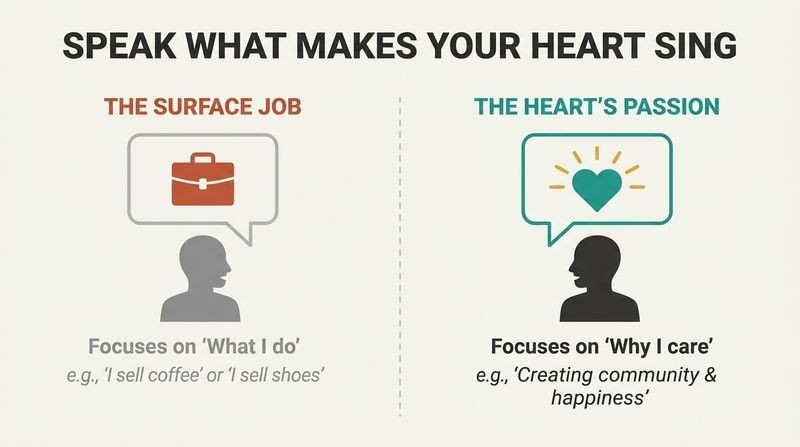
Gallo's first secret reframes passion. When he coaches CEOs, he stops asking "What do you do?" and asks "What makes your heart sing?" A California strawberry executive's dull answer ("promoting strawberries") became electric when he revealed strawberries were his immigrant parents' stepping stone to the American dream. Starbucks' Howard Schultz isn't passionate about coffee but about building a "third place" between work and home. Zappos' Tony Hsieh sells happiness, not shoes. Model Cameron Russell talks about girls' self-esteem, not modeling. Aimee Mullins, a double amputee, is passionate about human potential, not prosthetics. Pace professor Melissa Cardon found passion is central to self-identity and directly predicts investor funding decisions, ranking third among thirteen criteria.
What's striking is how this inverts conventional prep advice. Most speakers rehearse content; Gallo says excavate meaning first. The neuroscience of "emotional contagion" supports him: studies by Bono and Ilies show positive affect physically transfers from speaker to listener. Yet there is a scope limit worth naming. Passion is necessary but not sufficient, and audiences can smell manufactured zeal, which Cardon's own "smart consumers" point acknowledges. The deeper insight connects to self-determination theory in psychology: intrinsic motivation (doing something because it matters to your identity) outperforms extrinsic motivation (money, status). The "heart sing" question is essentially a fast diagnostic for locating intrinsic drive.
Stories sync your brain to your listener's, so tell them
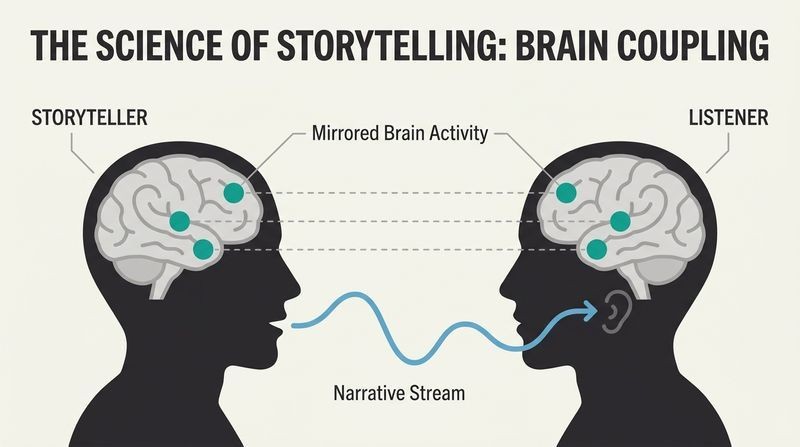
Civil rights lawyer Bryan Stevenson earned the longest standing ovation in TED history and $1 million in donations. Analysis of his 4,057-word talk showed it was 65% pathos (emotional stories), 25% logos (data), and only 10% ethos (credentials). He opened not with prison statistics but with his grandmother telling him he was special. Princeton neuroscientist Uri Hasson calls the mechanism "brain-to-brain coupling": fMRI scans reveal a listener's brain activity mirrors the storyteller's, region for region, when the emotion region lights up in one, it lights up in the other. This coupling vanished when listeners heard a story in a language they didn't understand. Researchers Walker and Glenn proved narrative's raw power: adding invented stories to thrift-store junk raised resale value by 2,700%.
Aristotle's ethos-logos-pathos triad, over two millennia old, gets validated by MRI, which is genuinely remarkable. Hasson's coupling research reframes persuasion as literal neural entrainment rather than rhetorical trickery. One caveat: the 65% pathos figure describes an activist appealing to conscience, not a scientific or financial pitch where over-reliance on emotion can erode credibility. The wiser reading is proportional, that even data-heavy talks need a narrative spine. This dovetails with Jerome Bruner's finding that facts wrapped in story are recalled up to twenty times more than facts alone, and with the "identifiable victim effect," why one named child moves donors more than statistics about millions.
Rehearse relentlessly so you sound like you're not rehearsing
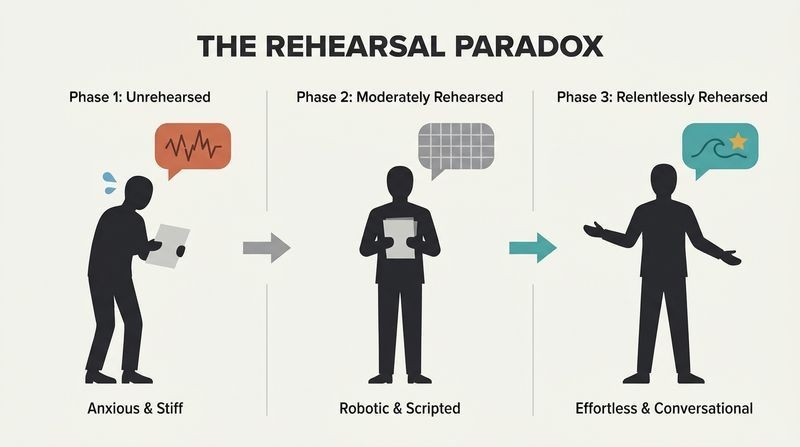
Authenticity is engineered, not spontaneous. Punk musician Amanda Palmer's celebrated "Art of Asking" talk looked effortless but took four months, feedback from 105 people, and rehearsals at potlucks, art schools, and even on airplanes. Steve Jobs, remembered as a charismatic natural, was so nervous before his first TV interview he nearly got sick, and read stiffly from notes in 1984. He improved every decade through obsessive practice. Gallo prescribes hitting a conversational pace: audiobooks run 150 to 160 words per minute, Stevenson speaks around 190, Tony Robbins races at 240 (near auctioneer speed), and monotone Henry Kissinger crawled at 90. The goal is talking to the audience like a friend at dinner.
The paradox that authenticity requires preparation resolves once you separate content from delivery. Deliberate practice, the concept Anders Ericsson built and Gallo invokes via the 10,000-hour idea, frees working memory. A rehearsed speaker isn't faking; they've automated the mechanics so attention can flow to genuine connection. This mirrors athletes and jazz musicians, whose improvisation rests on thousands of drilled hours. The word-per-minute data is a useful, underused metric, though pace should serve meaning, and strategic pauses (Taylor's dramatic silences) matter as much as speed. The real lesson: nervousness is not disqualifying, it is the universal starting point that practice overwrites.
Novelty is the brain's tripwire, so teach something genuinely new
The brain cannot ignore novelty, and it rewards learning with dopamine, the same chemical released by gambling and drugs. Northwestern's Martha Burns calls dopamine the brain's "save button": when it fires during an experience, we remember it. Deep-sea explorer Robert Ballard reframed the ocean by noting NASA's one-year budget could fund ocean exploration for 1,600 years. Statistician Hans Rosling animated global health data so vividly his talk drew millions of views and became Bill Gates's favorite. Susan Cain challenged a room full of talkers by arguing there's zero correlation between being the best talker and having the best ideas. The tactic isn't always brand-new facts, sometimes it's familiar information delivered through an unfamiliar lens.
The dopamine-learning link is real but often oversimplified; dopamine tracks prediction error (the gap between expected and actual), which is precisely why novelty and surprise trigger it. This gives Gallo's advice a sharper mechanism: don't just present new facts, violate expectations. Cognitive science calls the underlying pull "information gap theory" (George Loewenstein), the itch of curiosity that demands scratching. A useful tension: pure novelty without relevance is mere spectacle. The strongest talks, as Gallo's Intel Turbo Boost example shows, tether the new to the listener's daily life. Novelty grabs attention; relevance keeps it. The best communicators braid both.
Engineer one jaw-dropping moment your audience recounts the next day
Every memorable talk needs an emotionally charged event, what Gallo calls the "holy smokes moment." Bill Gates released mosquitoes into a TED audience saying there's no reason only poor people should experience malaria, a stunt that consumed under 5% of his talk yet became the only part anyone remembered. Molecular biologist John Medina explains the mechanism: the amygdala releases dopamine during emotional events, effectively tagging the memory with a chemical "remember this" note. This is why people recall exactly where they were on 9/11 but forget where they left their keys. Neuroanatomist Jill Bolte Taylor held a real human brain onstage. Steve Jobs pulled the Macintosh from a bag and let it speak. Five vehicles create these moments: props, shocking statistics, images, memorable soundbites, and personal stories.
The "flashbulb memory" framing is powerful, though the research carries a cautionary footnote Gallo doesn't dwell on: flashbulb memories feel vivid but are often inaccurate, as studies of 9/11 recollections show. Emotional arousal boosts confidence in a memory more reliably than its fidelity. For a presenter this is fine, the goal is stickiness and sharing, not courtroom accuracy. What elevates this secret is its economy: a single well-placed shock outperforms an hour of even delivery. It connects to the peak-end rule (Kahneman), audiences judge experiences by their most intense moment and their ending, not the average. Design the peak deliberately.
Disarm audiences with observations and stories, never rehearsed jokes
Humor lowers defenses and makes you likable, and people do business with people they like. Ken Robinson's "schools kill creativity" is the most-viewed TED talk ever, propelled by self-deprecating anecdotes about professors treating their bodies as transport for their heads. But Gallo is emphatic: don't tell jokes. Unless you're a professional comedian (Seinfeld spends two years perfecting a single Pop-Tart bit), jokes feel inauthentic and risk bombing. A Harvard Business Review study found outstanding executives used humor twice as often as average ones (17.8 versus 7.5 times per hour), and their bonuses correlated with it. Five safe alternatives: anecdotes and observations, analogies and metaphors, quotes, video clips, and photos.
The jokes-versus-humor distinction is the sharpest practical advice here. Rod Martin's research frames humor as an "ingratiation tactic" and social skill, which explains why observational humor works: it signals shared perception rather than performance. The neurochemistry is elegant, endorphins from laughter counteract the adrenaline of fight-or-flight defensiveness, literally turning walls into windows (Chris Bliss's phrase). A nuance worth adding: humor is culturally and contextually loaded, and self-deprecation that charms in one culture can undermine authority in another (research shows women and minorities often pay a higher credibility cost for it). The safest humor punches at absurdity or at oneself, never at the audience.
Cap talks at 18 minutes because listening drains glucose
TED enforces an 18-minute maximum for everyone, from Bill Gates to Tony Robbins. The reason is physiological, not stylistic. Texas Christian University's Paul King identified "cognitive backlog": as listeners accumulate information they must hold and retrieve, anxiety mounts like piling on weights until they mentally drop everything. The brain, though only three pounds, is an energy hog, and active listening depletes glucose, the fuel neurotransmitters need. Roy Baumeister's willpower research showed even suppressing distractions drops glucose measurably. Eighteen minutes is long enough to be substantive, short enough to hold attention, and perfectly shareable online. JFK's inaugural ran about 15 minutes; his moon-shot speech at Rice ran under 18. Constraint forces clarity and, counterintuitively, unleashes creativity.
The glucose-depletion model of self-control has faced serious replication challenges since Baumeister's original work, so the biochemical claim should be held loosely. But the practical wisdom survives regardless of mechanism: attention is finite and degrades over time, a finding robust across educational research on the "attention decrement" in lectures. The stronger argument is informational, not metabolic. Constraint as a creativity engine is well-supported (Marissa Mayer's point that sonnets and haikus thrive on limits). The 18-minute rule works less because of blood sugar and more because brevity forces ruthless prioritization, exposing whether a speaker actually knows their single core message.
Structure everything in threes, the number the mind holds best
The rule of three is one of communication's most durable tools: people retain about three chunks of information easily, and retention collapses beyond that. Bell Labs' George Miller famously pegged working memory at seven items ("plus or minus two"), but modern researchers put the comfortable limit closer to three or four. History runs on threes: "life, liberty, and the pursuit of happiness," France's "liberty, equality, fraternity," three-part flags, the holy trinity. TED speakers exploit it constantly: Neil Pasricha's three A's of awesome (attitude, awareness, authenticity), Kevin Allocca's three drivers of viral video. Gallo's practical tool is the message map: one Twitter-length headline, three supporting messages, and stories or stats reinforcing each, all on a single page.
Miller's "magic number seven" is one of psychology's most cited papers, though Miller himself was somewhat tongue-in-cheek about the number, and Nelson Cowan's later work indeed revised the real capacity down to about four. Gallo's use of three is defensible and pragmatic. The message map is the book's most portable artifact, functioning like a pyramid principle (Barbara Minto) for spoken word: lead with the conclusion, support with three pillars. One extension: three creates not just memorability but rhythm and a sense of completeness (setup, tension, resolution), which is why comedy's rule of three and storytelling's three-act structure both endure. Structure is a gift to the listener's limited memory.
Pair words with pictures to sextuple what listeners remember
Vision dominates cognition. Hear information alone and you'll recall roughly 10% three days later; add a picture and recall jumps to about 65%, a sixfold gain called the Picture Superiority Effect. Allan Paivio's dual-coding theory explains it: pictures get encoded both visually and verbally, stamping them more deeply than words, which register only verbally. The killer implication: multitasking is a myth, as John Medina insists, so a text-heavy slide read aloud forces the brain into an impossible split. The fix is TED-style design. The average corporate slide has 40 words; Bill Gates and Brené Brown routinely go 15-plus slides before hitting that count, replacing bullet points with photographs and single statistics. Al Gore's visual global-warming deck inspired an Oscar-winning film.
Dual-coding and the Picture Superiority Effect are among cognitive psychology's best-replicated findings, and Richard Mayer's multimedia learning principles give Gallo firm ground. The precise "10% to 65%" figures circulate widely but trace to shakier sources than the underlying effect, so cite the direction, not the decimals. The deeper principle is redundancy avoidance: Mayer's research shows identical text and narration together actually hurts learning (the "redundancy effect"), which is exactly why word-dense slides backfire. Images should complement, not duplicate, speech. Worth noting the medium's ceiling too, spoken words also paint pictures. Martin Luther King and Janine Shepherd created vivid mental imagery with zero slides, because the visual cortex activates for imagined scenes.
Recruit multiple senses because the brain craves rich input
Beyond sight, the strongest talks engage sound, touch, and even imagined taste and smell. Michael Pritchard demonstrated his water filter by turning sewage, pond water, and rabbit droppings into a glass he drank onstage. Dr. Elliot Krane stroked his arm with a feather, then ignited a blowtorch beside it, to convey what chronic pain does to the nervous system. Amanda Palmer stood on a milk crate to make audiences feel a street performer's life. Roger Ebert, having lost his voice to cancer, recruited three friends plus a computer voice to break the monotony. Neuroscientist Pascale Michelon notes the visual cortex can't distinguish a vividly imagined event from a real one, so concrete examples and props physically transport listeners into the scene.
This secret extends the visual principle into full embodiment, and it aligns with embodied cognition research showing that sensory and motor regions activate when we merely hear sensory language ("leathery hands" fires the touch cortex). Krane's blowtorch is a masterclass in kinesthetic empathy: the audience flinches, feeling borrowed pain. A practical caution the examples imply, multisensory devices must serve the message, not upstage it, or they become gimmicks that audiences remember instead of the point. The subtler takeaway is that abstraction is the enemy of memory. Whenever a concept threatens to float free, the fix is to anchor it in something the body can picture, hear, or feel.
Stay in your own lane, because audiences instantly detect phonies
The final secret undoes the rest if ignored: be authentically yourself. Sheryl Sandberg nearly cut the story of her daughter clinging to her leg from her TED talk, then included it, admitting she falls short of doing it all, and that vulnerability defined the talk. Jill Bolte Taylor rewrote her ending a week before the conference to share her raw spiritual awakening rather than lecture on stroke, turning a good talk into a legendary one. Oprah told an aspiring "next Oprah" to find her own lane instead. Even Warren Buffett was so terrified of public speaking he chose classes to avoid it and dropped a course before it started, then rebuilt himself through a Dale Carnegie class. Technique without a genuine self behind it is an empty act.
Placing authenticity last is a deliberate rhetorical move: it prevents the preceding eight secrets from curdling into manipulation. The Buffett and Sandberg examples make a quietly radical point, that vulnerability reads as strength, echoing Brené Brown's entire research program on shame and courage. There is a genuine tension worth flagging: "be yourself" and "rehearse 200 times" can seem contradictory. The resolution is that authenticity concerns what you say and why, while practice concerns how, and the two are not rivals. The lane metaphor also warns against cargo-culting great speakers. Copying Robbins's frenetic energy or Jobs's minimalism onto the wrong personality produces the very phoniness audiences reject.
Analysis
Talk Like TED is a business communication manual disguised as a decoding project. Carmine Gallo, a former journalist and corporate speech coach, analyzed over 500 TED talks and interviewed both speakers and scientists to reverse-engineer nine repeatable secrets, organized under three headings: emotional, novel, and memorable. His pitch is that he is writing "Dale Carnegie for the twenty-first century," updating century-old public-speaking intuition with fMRI, dopamine research, and behavioral studies. That framing is both the book's strength and its vulnerability. The strength: Gallo consistently pairs a vivid exemplar (Stevenson, Gates, Robinson, Rosling) with a research citation, giving prescriptions an evidentiary spine most speaking books lack. The vulnerability: the neuroscience is applied loosely, with popular figures (the 10%-to-65% recall jump, glucose depletion, flashbulb accuracy) that have weaker empirical footing than the confident prose implies. A discerning reader should treat the mechanisms as suggestive metaphors and the behavioral advice as sound.
Structurally, the book is an anthology of tactics rather than a single argument, which makes it eminently skimmable but occasionally repetitive; storytelling, for instance, recurs across at least four chapters. The nine secrets are not equally weighted. The most transferable are the message map (headline plus three), the 18-minute constraint, the picture-superiority slide discipline, and the jaw-dropping-moment design principle. These are concrete enough to act on Monday morning.
What Gallo underplays is context-dependence. TED is a specific genre: a friendly, educated, novelty-hungry audience, an idea-first mandate, and a performer alone on a red dot. Board meetings, sales calls, courtrooms, and technical reviews impose different constraints where excessive pathos or theatrical props could backfire. The book's implicit universalism ("we're all in sales now") is motivating but should be tempered by audience analysis. Read as a toolkit rather than a doctrine, and its highest-value contribution is reframing preparation itself: authenticity, passion, and even spontaneity are outcomes of disciplined rehearsal, not alternatives to it. That single reversal justifies the read.
Review Summary
Talk Like TED receives mixed reviews, with an average rating of 3.88/5. Many readers find it helpful for improving public speaking skills, praising its analysis of successful TED talks and practical advice. The book's emphasis on passion, storytelling, and authenticity resonates with readers. However, some criticize it for lacking originality, arguing that the "secrets" are common knowledge. Despite this, many appreciate the examples from TED talks and find the book motivational. Overall, it's considered a useful resource for both beginners and experienced speakers.
People Also Read

FAQ
What's Talk Like TED about?
- Focus on Public Speaking: Talk Like TED by Carmine Gallo delves into the art of public speaking, focusing on how to communicate ideas effectively to inspire and engage audiences.
- Nine Key Secrets: The book reveals nine essential elements that successful TED speakers use, which can be applied to any presentation to enhance its impact.
- Emotional and Memorable: Gallo emphasizes that the best presentations are emotional, novel, and memorable, helping speakers connect deeply with their audience.
Why should I read Talk Like TED?
- Enhance Presentation Skills: The book offers practical techniques used by top communicators to improve public speaking abilities.
- Inspiration from TED Speakers: Filled with inspiring stories and examples, it motivates readers to confidently share their ideas.
- Applicable Across Fields: Whether in business, education, or other areas, the principles can help improve communication effectiveness.
What are the key takeaways of Talk Like TED?
- Emotional Engagement: Connecting emotionally with your audience is crucial for making your message resonate.
- Storytelling Power: Gallo highlights storytelling as a persuasive tool, encouraging the use of personal anecdotes.
- Practice and Authenticity: Emphasizes the importance of practice and being genuine to build trust with the audience.
What are the best quotes from Talk Like TED and what do they mean?
- “Ideas are the currency...”: Highlights the value of ideas in today's society and the need to communicate them effectively.
- “Don’t fake it till...”: Suggests that projecting confidence through body language can lead to genuine self-assurance.
- “Stories are just data...”: Emphasizes storytelling's role in making data relatable and impactful through emotional narratives.
What are the nine secrets shared in Talk Like TED?
- Unleash the Master Within: Connect your passion to your topic to inspire your audience.
- Master the Art of Storytelling: Use personal stories to engage listeners emotionally.
- Have a Conversation: Practice to make your delivery natural and conversational.
- Teach Me Something New: Present novel information to captivate attention.
- Deliver Jaw-Dropping Moments: Create memorable moments that surprise and engage.
How does Talk Like TED define emotional engagement?
- Audience Connection: Emotional engagement involves reaching the audience's hearts and minds, making them feel invested.
- Personal Stories: Sharing personal anecdotes helps create a relatable emotional connection.
- Retention Impact: Emotionally charged presentations are more memorable, resonating deeply with listeners.
What role does storytelling play in Talk Like TED?
- Essential for Connection: Storytelling humanizes the speaker and makes complex ideas relatable.
- Enhances Persuasion: Stories can break down resistance and persuade by appealing to emotions.
- Story Structure: Use personal, others', and brand success stories to illustrate key points effectively.
What is the 18-minute rule in Talk Like TED?
- Optimal Length: Suggests presentations should not exceed 18 minutes to maintain engagement.
- Avoid Cognitive Overload: Longer presentations can overwhelm audiences, reducing retention.
- Encourages Clarity: Forces speakers to focus on core messages, leading to impactful presentations.
How can I create emotional connections in my presentations as suggested in Talk Like TED?
- Personal Stories: Sharing personal anecdotes establishes a connection with the audience.
- Emotionally Charged Events: Incorporate surprising elements to captivate attention.
- Visual and Auditory Elements: Use visuals and vocal variation for a multisensory experience.
How can I use visuals effectively in my presentations according to Talk Like TED?
- Limit Text: Use minimal text on slides to keep focus on the speaker.
- High-Quality Images: Powerful visuals enhance the message and make it memorable.
- One Theme Per Slide: Each slide should convey a single idea for clarity and focus.
What techniques does Talk Like TED recommend for effective storytelling?
- Story Structure: Use a clear beginning, middle, and end to help the audience follow along.
- Vivid Imagery: Descriptive language and metaphors enhance engagement.
- Conflict and Resolution: Include a conflict needing resolution to keep the audience invested.
How can I stay authentic in my presentations as advised in Talk Like TED?
- Be True to Yourself: Authenticity involves sharing personal experiences and vulnerabilities.
- Speak from the Heart: Focus on topics that matter to you and convey passion.
- Avoid Imitation: Find your own voice instead of mimicking others to resonate with your audience.
Hùng Biện Kiểu TED Series Series
About the Author
Other books by Carmine Gallo
Download PDF
Download EPUB
.epub digital book format is ideal for reading ebooks on phones, tablets, and e-readers.








































