


Key Takeaways
More communication breeds more conflict, not more understanding
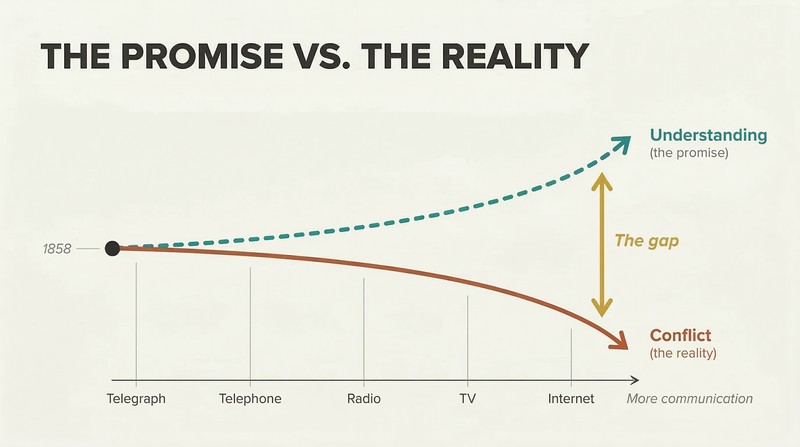
Every communication revolution promised utopia. In 2019, a rare wildflower "superbloom" went viral on Instagram. Influencers and selfie-seekers flooded California's Walker Canyon, trampling flowers, clogging roads, and triggering a public-safety emergency. Joy turned to outrage in an internet minute. For Carr, this is a metaphor for our entire media age. Since the telegraph in 1858, every new technology — telephone, radio, TV, internet — was greeted with promises of world peace and mutual understanding. None delivered.
Sociologist Charles Horton Cooley predicted in 1897 that faster communication would liquefy social structures, but assumed the openness would be benign. He underestimated the demonic in man. Mark Zuckerberg repeated the same error when he declared that "people sharing more" creates a better world. The more we communicate, the worse things seem to get.
When all media collapses into 'content,' nothing has context
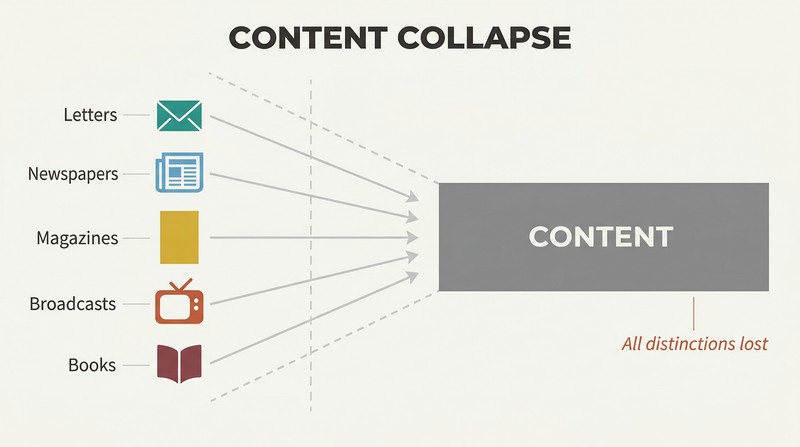
Analog media was fragmented by design. Letters were private; broadcasts were public. Newspapers had sections; magazines had depth. Each format imposed its own pace, norms, and meaning. Digitization swept it all into a single stream — a phenomenon Carr calls content collapse. Facebook's News Feed, introduced in 2006, crystallized the change: an algorithm replaced human editorial judgment, sequencing baby videos next to school-shooting headlines next to toenail-fungus ads, all given equal weight.
The specialized analog tools formed what Carr calls an epistemic architecture — they helped people distinguish the trivial from the vital, the personal from the political, the factual from the fictive. That architecture is gone. Everything is now "content" — a word whose very blandness testifies to the loss of distinctions that once preserved communication's human scale.
Feed algorithms don't inform you — they trigger emotional responses
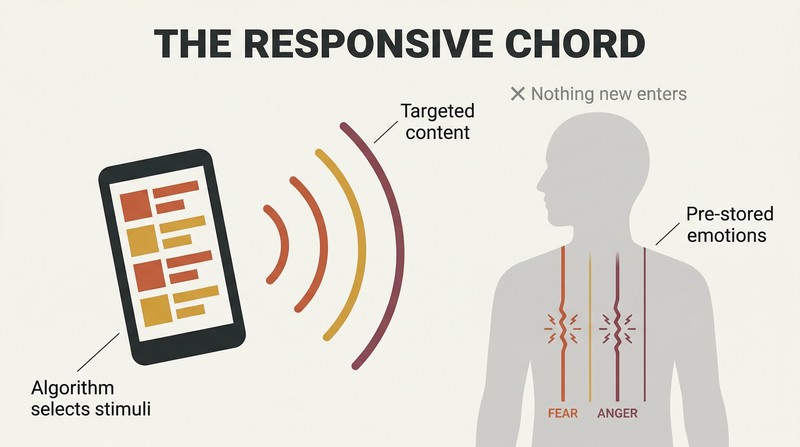
Tony Schwartz's "responsive chord" theory held that effective mass communication doesn't deliver new information — it activates emotions already stored in the audience's memory. His famous 1964 "Daisy" ad for LBJ used simple stimuli (a child, flowers, a mushroom cloud) to trigger nuclear fear in viewers' minds. Social media's feed algorithms automate this process at planetary scale. They analyze behavioral data to calculate which messages will strike the strongest emotional chord in each user, maximizing engagement.
The algorithms know nothing of meaning; they optimize for physiological arousal — quickened heart rate, tensed muscles, dilated pupils. Content is engineered like a potato chip: for compulsion, not nourishment. The essential function of the mechanism of communication is no longer transport. It's manipulation — of information, and by extension, of those receiving it.
Online familiarity breeds contempt more reliably than connection
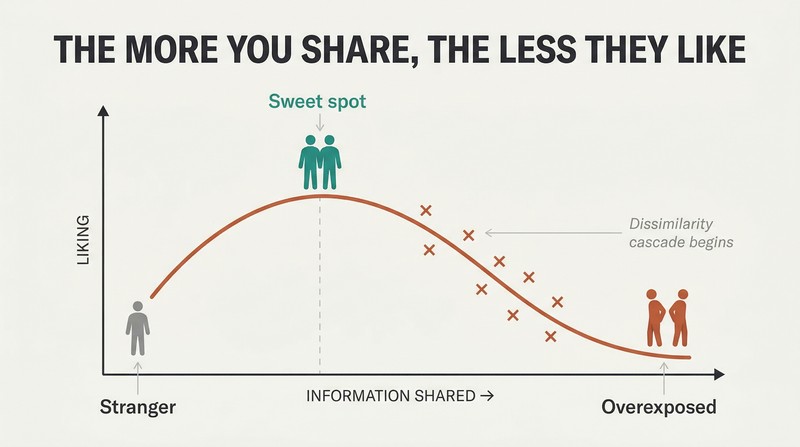
More information leads to less liking. Harvard psychologist Michael Norton ran experiments where participants rated fictional people described by varying numbers of character traits. The counterintuitive result: the more traits revealed, the less participants liked the person. The culprit was dissimilarity cascades — once you encounter one difference, you start weighting all subsequent information as further evidence of difference. Social media supercharges this by encouraging constant oversharing through what psychologists call the online disinhibition effect.
A 1976 condo study found close neighbors were more likely to be enemies than friends, through what researchers called environmental spoiling — exposure to irritating habits. Social media made everyone virtual neighbors. Adam Joinson coined the term digital crowding for the resulting excessive disclosure and contact, which produces anxiety, withdrawal, and aggression rather than connection.
Society gutted centuries of communication law in a single decade
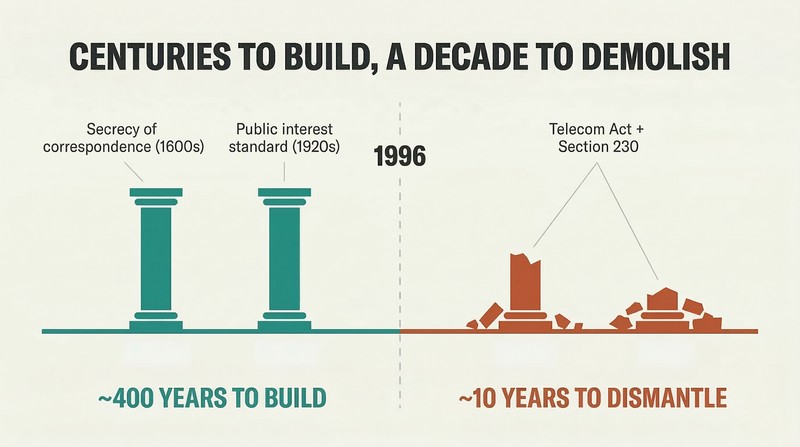
Two legal pillars once governed communication. The secrecy-of-correspondence doctrine, dating to the 1600s, protected the privacy of personal messages — from sealed letters to telephone calls. The public interest standard, established in the 1920s, required broadcasters to serve the common good. Together, they maintained a crucial distinction: private conversations deserved privacy; public broadcasts carried civic responsibility.
The Telecommunications Act of 1996 demolished both. It freed internet companies from common-carriage obligations and the public-interest standard while granting broad legal immunity under Section 230. When Google launched Gmail in 2004 and announced it would scan all messages for data, the public barely flinched. The centuries-old promise that personal correspondence would remain inviolate was discarded just as personal communication moved online. The wiretap became a feature, not a bug.
Repetition is social media's creed — and it makes lies feel true
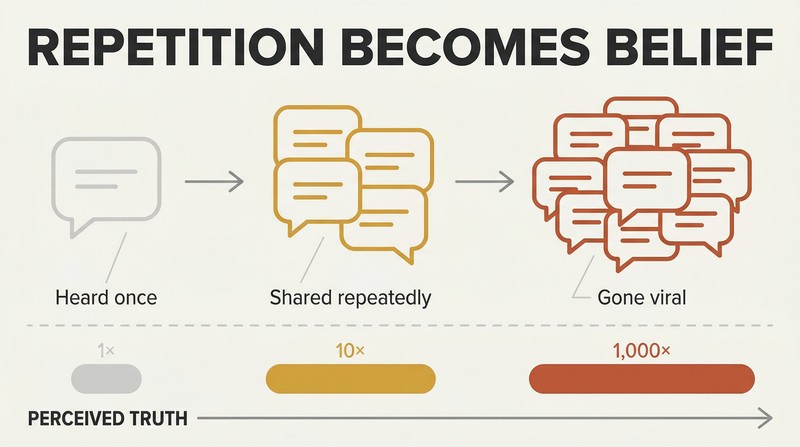
The illusory truth effect, documented since 1977, shows that hearing a statement repeatedly increases belief in its accuracy — even from non-credible sources. Social media is a repetition engine. Automated sharing tools let messages propagate at scale, and each repetition increases the message's perceived truth. An MIT study tracking 125,000 stories over eleven years found false stories were 70% more likely to be shared than true ones, because novelty and surprise attract attention — and falsehoods are engineered for both.
When Twitter engineer Chris Wetherell automated the retweet button in 2009, removing the small friction of manual sharing, the platform's discourse immediately grew nastier and more partisan. "We might have just handed a four-year-old a loaded weapon," Wetherell later worried. The tiny delay he eliminated had been giving people a moment to reconsider before amplifying a message under their own name.
Open media empowers demagogues as easily as democrats
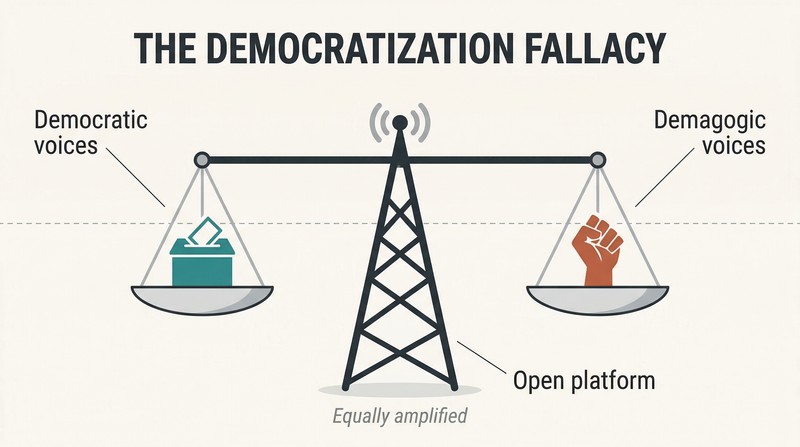
Carr calls this the democratization fallacy — the belief that opening media to all voices necessarily strengthens democracy. Legal scholar Yochai Benkler's influential 2006 book predicted the internet would create a democratic "networked public sphere" with organic, bottom-up quality control. Months later, Facebook launched the News Feed, and algorithmic curation replaced grassroots filtering.
Psychology explains why openness doesn't breed moderation. Duke sociologist Chris Bail found that exposing partisans to opposing views on Twitter made them more extreme, not more thoughtful — people experience foreign ideas as attacks on identity. Meanwhile, the most educated and politically engaged voters have the most distorted understanding of their opponents. Stanford's Fred Turner argues that decentralized communication can be "coupled very tightly to charismatic, personality-centered modes of authoritarianism." The platform becomes the party machine.
Young Americans lost 400 hours of annual face-time in one decade
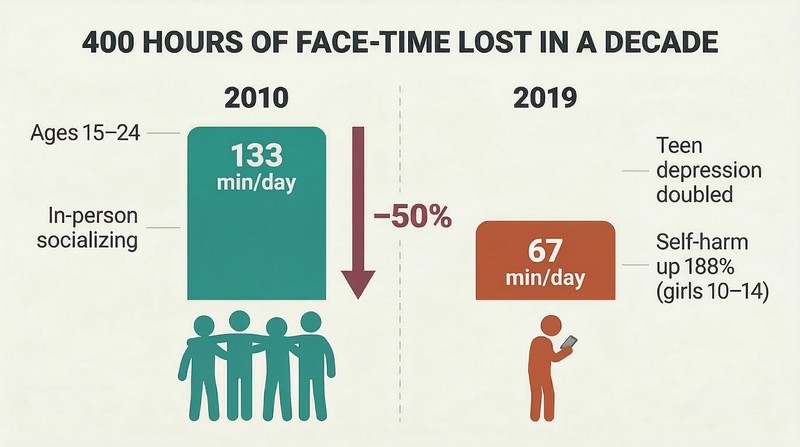
In-person socializing collapsed. Between 2010 and 2019, time spent by 15-to-24-year-olds socializing with friends in person fell from 133 to 67 minutes daily — over 400 fewer hours of face-time per year. Two-thirds of American teenagers now prefer socializing through screens. Far fewer drive, date, attend parties, or work part-time jobs.
The psychological toll has been devastating. Teen depression doubled over the decade. Self-harm hospitalizations for girls ages 10 – 14 rose 188%. Loneliness surged in 36 of 37 countries surveyed by the WHO. Girls suffer disproportionately — they spend more time on social media, face more insults, and are more sensitive to appearance and popularity. As NYU's Jonathan Haidt concluded, social media is "a substantial cause, not just a tiny correlate" of the teen mental health crisis. And patterns of social engagement established in adolescence tend to persist into adulthood.
Social media shrank the self from character to curated identity
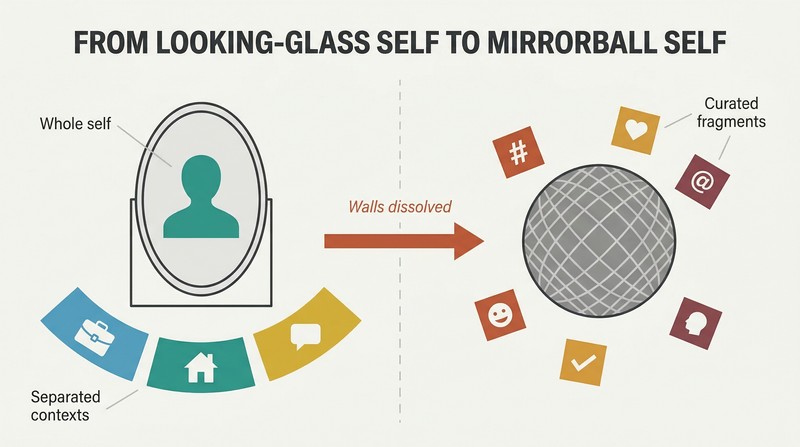
Erving Goffman showed we play different roles on different "stages" — one at work, another at home, another with friends. Physical separation between settings acted as a psycho-social shock absorber. Social media dissolved those walls. When Facebook opened beyond colleges, party photos meant for dorm-mates became visible to parents and employers. Zuckerberg declared: "You have one identity."
People rebelled — migrating to Snapchat, creating fake Instagrams ("finstas"), using private groups — but the deeper damage was done. Cooley's looking-glass self, shaped through face-to-face sympathy, became what Carr calls the mirrorball self: identity reduced to a whirl of curated tribal markers — hashtags, emojis, group affiliations — optimized for machine readability and rapid scanning. Detached from body and place, the self squeezes into a set of codes suitable for transmission through high-speed networks.
AI will make the counterfeit more convincing than the original
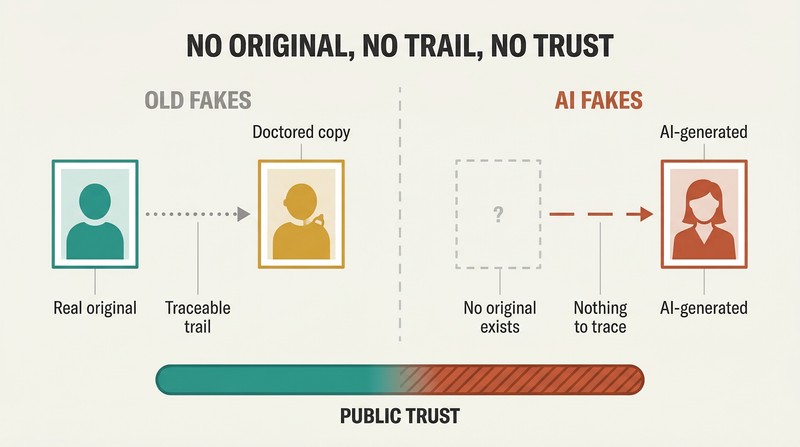
Photojournalist Jonas Bendiksen's 2021 book featured haunting documentary photographs from North Macedonia and a compelling essay — all fake. The people were generated using video-game software; the text was written by GPT-2. Experienced photographers praised the work without suspicion. Bendiksen's stunt previewed a world of AI-generated deepfakes that lack any referent in reality — no original that was doctored, no trail to follow.
The deeper worry isn't that people will believe specific fakes but that they'll stop trusting anything. Law professors Chesney and Citron warn that "authoritarian regimes benefit when objective truths lose their power." Meanwhile, AI companies secretly censor their training data and outputs, becoming invisible arbiters of what speech passes from the past into the future. Businesses determine, through opaque data-cleansing policies, what's allowed to exist in the cultural record.
Reclaim friction, boredom, and contact with the physical world
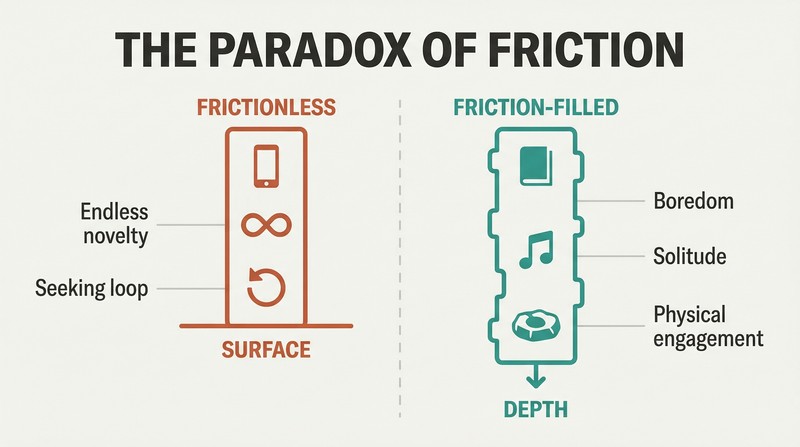
Legal scholars propose "frictional design" — deliberately reintroducing inefficiency into platforms through sharing limits, posting delays, fees for mass distribution, and bans on infinite scrolls. These are digital speed bumps. But historian Thomas Hughes showed that once complex technological systems gain momentum, society shapes itself to them rather than the reverse. The window for systemic reform may have closed.
The book's final image is Samuel Johnson kicking a stone in 1763 to refute a philosopher who claimed reality was all in the mind. The stone didn't care about the theory. Similarly, learning an instrument or reading a long book subjects you to friction — the very condition that opens the door to depth. Social media exploits what neuroscientist Jaak Panksepp called our "seeking instinct," delivering endless novelty. What it relieves us of — boredom, solitude, physical engagement — is precisely what makes deeper living possible.
Analysis
Carr's Superbloom is the most architecturally ambitious critique of digital communication since Neil Postman's Amusing Ourselves to Death (1985), but it updates Postman's broadcast-era concerns with a framework suited to the participatory, algorithmic present. Where Postman worried about passivity — citizens as entertained spectators — Carr inverts the problem: the danger now is hyperactivity. We are not amusing ourselves to death; we are communicating ourselves into fragmentation.
The book's deepest intellectual move is to locate the internet's pathologies not in corporate malfeasance alone but in properties intrinsic to efficient communication itself — properties visible, in retrospect, since the telegraph. By threading Charles Horton Cooley's 1897 insights about 'social media' through every subsequent technological revolution, Carr constructs a genealogy showing that the dysfunction we attribute to Facebook and TikTok is the culmination of a two-century trajectory. This reframing shifts the debate from 'how do we fix the platforms?' to a more uncomfortable question: what if the problem is the very thing we celebrate — frictionless, abundant communication?
Carr's synthesis of the Norton dissimilarity-cascade research with Altman's privacy regulation theory is particularly original. Together, they form a devastating counter to the Zuckerbergian axiom that sharing more creates understanding. The psychological evidence suggests the opposite: beyond a threshold, disclosure breeds contempt, crowding breeds hostility, and exposure to opposing views entrenches extremism rather than moderating it.
The weakest thread is Carr's reliance on Baudrillard's hyperreality framework, which risks the same technological determinism he criticizes in the utopians. If human nature is as fixed as Carr insists, following Cooley, then surely our capacity for resistance is as enduring as our susceptibility to manipulation. Still, the book succeeds as a corrective. In an era dominated by debates about Section 230 and antitrust — all tinker-at-the-margins approaches — Carr forces us to confront the possibility that the machine is working exactly as designed, and that the real reforms required are personal and civilizational, not merely regulatory.
Review Summary
Superbloom explores how communication technologies shape society and human behavior. Carr argues that increased connectivity often leads to social fragmentation and cognitive changes. The book traces the history of communication from letters to AI, examining how each medium impacts our thinking and relationships. While some readers found parts slow, many praised Carr's insights on social media's effects and the need to reconnect with the physical world. The book challenges readers to critically examine their technology use and its societal implications.
People Also Read







Glossary
content collapse
all media merges into one streamCarr's term for the phenomenon in which digitization erases the distinctions of form, register, importance, and context that the analog media system preserved. When all information—news, entertainment, conversation, advertising—flows through a single channel optimized for engagement, it loses the epistemic architecture that once helped people sort the trivial from the vital.
responsive chord
activating stored emotions in audiencesTony Schwartz's communication theory positing that effective media messages don't deliver new meaning but rather trigger emotions and associations already present in the audience's memory. Carr argues that social media's feed algorithms automate this process at scale, matching content to individuals' emotional triggers through statistical analysis of behavioral data.
dissimilarity cascades
differences compound to decrease likingA phenomenon identified by Harvard psychologist Michael Norton and colleagues, in which encountering one piece of information suggesting someone is unlike you causes all subsequent information to be interpreted as further evidence of dissimilarity. The effect explains why more information about a person tends to produce less liking, not more.
environmental spoiling
proximity breeds resentment via exposureTerm from Ebbe Ebbesen's 1976 condo study describing how living close to someone exposes you to their irritating habits and opinions, generating resentment. Because this proximity guarantees the irritants remain in view, antipathy becomes self-reinforcing. Carr extends the concept to social media, where everyone is a virtual neighbor.
digital crowding
online overexposure produces social claustrophobiaAdam Joinson's term for the excessive self-disclosure and social contact that characterizes social media environments. Analogous to the psychological effects of physical crowding in dense cities, digital crowding produces anxiety, withdrawal, and aggressive behavior as people feel impinged upon by the myriad virtual presences pressing in on them.
pseudo-environment
mind's simplified fiction of realityWalter Lippmann's concept from his 1922 book Public Opinion. Because the real environment is too complex for direct comprehension, each person constructs a simplified mental model of reality filtered through available information, personal biases, and cultural stereotypes. People then act based on this fiction rather than on the world as it actually is.
looking-glass self
self-image formed through others' perceptionsCharles Horton Cooley's 1902 concept that a person's sense of self emerges from imagining how they appear in others' minds. The self is socially constructed through feedback loops between one's own mind and the perceived judgments of everyone one interacts with. Carr extends this into the mirrorball self for the social media era.
mirrorball self
identity fragmented across many platformsCarr's update of Cooley's looking-glass self for the social media age. With the self reflected across multiple platforms, feeds, and audiences simultaneously, identity becomes a whirl of fragmented reflections reduced to curated tribal markers—hashtags, emojis, slogans, group affiliations—rather than the richer, context-dependent character shaped by embodied interactions.
illusory truth effect
repetition makes statements seem trueA psychological phenomenon, first documented in 1977, in which repeated exposure to a statement increases belief in its accuracy, even when the statement comes from non-credible sources or was initially doubted. Carr identifies this effect as central to social media's capacity to spread misinformation through cascading shares and retweets.
democratization fallacy
open media doesn't guarantee democracyCarr's label for the mistaken belief that decentralized, participatory media necessarily expands and strengthens democracy. Rooted in utopian assumptions about communication dating to the Enlightenment, the fallacy ignores psychological research showing that more information can entrench bias, empower demagogues, and fragment the body politic.
frictional design
deliberately reintroducing inefficiency into platformsAn approach proposed by legal scholars Brett Frischmann and Susan Benesch to reform social media by mandating design constraints that slow down communication—such as sharing limits, posting delays, fees for mass distribution, and bans on infinite scrolling. Modeled on traditional time-place-manner restrictions on public speech, frictional design aims to encourage more deliberate, civil online behavior.
social penetration theory
relationships deepen through gradual disclosureDalmas Taylor and Irwin Altman's 1973 model describing how relationships develop through four progressive stages of self-disclosure: orientation (superficial chat), exploratory affective exchange (broader but still public topics), affective exchange (intimate revelation), and stable exchange (unrestricted trust). The process is fragile and can reverse at any stage if disclosure becomes unbalanced or offensive.
FAQ
What is Superbloom: How Technologies of Connection Tear Us Apart by Nicholas Carr about?
- Exploration of digital communication: The book investigates how modern communication technologies, especially social media, have transformed society, often with divisive and harmful effects.
- Historical evolution of media: Carr traces the development of communication from oral traditions to AI-driven platforms, showing how each shift reshapes social relations and consciousness.
- Critical analysis of media optimism: The book challenges the belief that more connectivity leads to greater understanding, arguing that it often results in polarization, misinformation, and social fragmentation.
- Interdisciplinary approach: Drawing on sociology, psychology, media theory, and history, Carr offers a nuanced view of how communication technologies influence human behavior and societal structures.
Why should I read Superbloom by Nicholas Carr?
- Insight into digital media’s impact: The book provides a deep understanding of how social platforms and digital media alter communication, relationships, and political discourse.
- Historical and theoretical grounding: Carr situates current issues within a broader historical and philosophical context, referencing thinkers like Cooley, Lippmann, and Baudrillard.
- Relevance to modern challenges: It addresses pressing topics such as polarization, misinformation, mental health crises among youth, and the rise of AI in media.
- Empowerment for mindful engagement: By revealing the mechanisms behind social media’s influence, Carr encourages readers to reclaim agency and authenticity in the digital age.
What are the key takeaways of Superbloom by Nicholas Carr?
- Communication shapes society: Changes in communication technologies alter social structures, influence flows, and individual behavior, often in unpredictable ways.
- Content collapse and algorithmic control: The digital age merges all media into a single stream of "content," curated by algorithms that prioritize engagement over meaning or quality.
- Paradox of social media: While promising connection and democratization, social media often fosters envy, antipathy, and fragmentation due to overexposure and dissimilarity cascades.
- Limits of cognition and empathy: The speed and volume of digital communication favor fast, intuitive thinking over deep reflection, undermining understanding and empathy.
What is the "democratization fallacy" in Superbloom by Nicholas Carr?
- Myth of equal voice: The democratization fallacy is the belief that the internet and social media inherently give everyone an equal platform to speak and be heard.
- Corporate and algorithmic control: In reality, a few large companies control information flow through algorithms and moderation, shaping discourse for commercial interests.
- Fragmentation and polarization: Rather than creating a unified public sphere, digital media often leads to echo chambers, misinformation, and social division.
- Misguided optimism: Early legal and academic narratives embraced this fallacy, delaying effective responses to the harms of digital communication.
How does Nicholas Carr define "content collapse" in Superbloom?
- Loss of media distinctions: Content collapse refers to the merging of all forms of media—text, sound, image, video—into a single digital stream, erasing traditional boundaries.
- Uniform treatment of information: All information is treated as "content" without regard to form, context, or importance, flattening meaning and quality.
- Algorithmic prioritization: Social media algorithms curate this undifferentiated content based on engagement, often promoting sensational or emotionally charged material.
- Impact on understanding: The overwhelming stream of content leads to superficial engagement and the spread of misinformation.
What psychological effects of social media does Nicholas Carr describe in Superbloom?
- Digital crowding and antipathy: Constant exposure to others’ opinions online leads to "environmental spoiling," fostering resentment and avoidance.
- Dissimilarity cascades: More information about others often leads to less liking, as social media amplifies awareness of differences and group antagonism.
- Empathy erosion: Online communication lacks physical cues and sustained attention, making it an "anti-empathy machine" that diminishes understanding.
- Shift to fast thinking: The speed and volume of social media favor intuitive, automatic thinking over reflective thought, increasing polarization.
How does Superbloom by Nicholas Carr explain the spread of misinformation and polarization on social media?
- Informational cascades: False or misleading information spreads rapidly through repetition, as humans imitate and reinforce what they see in their networks.
- Illusory truth effect: Repeated exposure to statements increases their perceived truthfulness, fueling misinformation.
- Group identity dynamics: Sharing antagonistic content about out-groups strengthens in-group cohesion and deepens polarization.
- Platform incentives: Algorithms promote divisive content because it drives engagement, even when platforms are aware of the harmful effects.
What role do algorithms play in social media according to Superbloom by Nicholas Carr?
- Algorithmic editing: Algorithms select and rank content based on predicted engagement, not semantic meaning or public good.
- Manipulation over transmission: Social media algorithms manipulate information flows to maximize attention and time spent on platforms.
- Emotional exploitation: Algorithms exploit users’ emotional triggers, amplifying outrage and sensationalism to keep users engaged.
- Opaque moderation: Content moderation is often indirect, opaque, and driven by corporate interests rather than societal benefit.
How does Nicholas Carr describe the transformation of personal communication styles in Superbloom?
- From letters to email: Communication shifted from reflective, formal letter writing to terse, utilitarian email, prioritizing speed and efficiency.
- Rise of textspeak and IM language: Young people developed compressed, symbolic language for instant messaging, optimized for rapid, multitasked exchanges.
- Impact on thought and culture: This "fingered speech" favors quick, casual exchanges over deep reflection, influencing public discourse and journalism.
- Efficiency over depth: The new style prioritizes brevity and immediacy, often at the expense of nuance and sustained attention.
What does Superbloom by Nicholas Carr say about the impact of AI and large language models on media and communication?
- AI as new medium: Large language models and generative AI represent a new stage where machines produce content, blurring lines between human and machine communication.
- Compression and hallucinations: AI compresses vast data to generate responses, which can be coherent but also prone to fabricated errors or "hallucinations."
- Flood of AI-generated content: Generative AI may flood platforms with cheap, personalized content, reshaping creative industries and information quality.
- Ethical and societal challenges: Issues include bias, censorship, misinformation, and the influence of powerful individuals controlling AI platforms.
What historical and philosophical perspectives does Nicholas Carr use in Superbloom to analyze media and communication?
- Cooley’s social mind: Carr draws on Charles Horton Cooley’s idea that self and society are formed through communication and mutual perception.
- Lippmann vs. Dewey: The book contrasts Lippmann’s skepticism about the public’s capacity for informed democracy with Dewey’s optimism about communication’s potential.
- McLuhan and Baudrillard: Carr references McLuhan’s media theory and Baudrillard’s concept of hyperreality, where simulations replace reality.
- Evolution of communication: The book traces the development from postal systems and telegraphy to broadcast media and digital networks, showing each shift’s societal impact.
What solutions or responses to social media’s challenges does Nicholas Carr discuss in Superbloom?
- Frictional design: Carr highlights proposals to reintroduce "desirable inefficiencies" into platforms, such as posting delays or limits on message forwarding.
- Regulatory approaches: The book discusses EU regulations that give users more control over data and personalization, though their impact is limited without behavioral change.
- Personal and collective agency: Carr suggests meaningful change requires deliberate distancing from hypermediated environments to reclaim stability and presence.
- Skepticism about quick fixes: He warns that technological systems resist change and that users’ habituation to speed makes friction unpopular and hard to implement.
What are the best quotes from Superbloom by Nicholas Carr and what do they mean?
- “The internet is not broken. It’s operating as it was designed to operate.” This highlights that social media’s problems are inherent to its design and human nature, not accidental flaws.
- “Repetition is, in the human mind, a proxy for facticity.” This explains how repeated exposure to statements increases their perceived truthfulness, fueling misinformation.
- “When we are everywhere, we are also no place.” Carr uses this to describe the dislocation of the self in digital media, where constant connectivity erodes identity boundaries.
- “The self collapses into, and must compete with, everything else in the feed.” This illustrates how individual identity becomes fragmented and commodified within the overwhelming flow of online content.
- “To be is to be kickable.” Referencing Samuel Johnson, this quote emphasizes the importance of embodied, material reality as a grounding counterpoint to virtual simulation.
About the Author


Download PDF
Download EPUB
.epub digital book format is ideal for reading ebooks on phones, tablets, and e-readers.








































