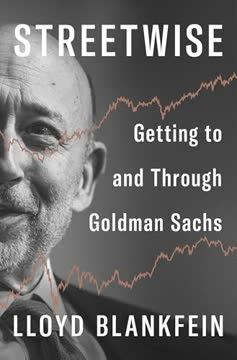
Key Takeaways
1. From Projects to Partnership: The Fuel of Ambition
Being from a place I was in a hurry to leave fueled a restless ambition that has served me well.
Brooklyn Roots. Lloyd C. Blankfein's journey began in the public housing projects of East New York, Brooklyn, a stark contrast to the privileged backgrounds often associated with Wall Street leaders. Growing up in a crowded, working-class household, with a father who sorted mail and a mother who worked as a receptionist, instilled in him a profound drive to escape his circumstances. This early environment, marked by financial tension and a lack of privacy, became a powerful motivator.
Harvard's Challenge. Despite attending failing public schools, Blankfein excelled academically, becoming his high school valedictorian and earning a scholarship to Harvard. This transition from Brooklyn to the Ivy League was a culture shock, highlighting his "urban hick" status and fueling an initial sense of insecurity. However, it also sharpened his "street smarts"—the ability to quickly assess people and situations, a skill that would prove invaluable in his career.
Motivation and Resilience. His childhood experiences, though not as severe as some, fostered a unique blend of motivation and resilience. He learned to navigate diverse social environments and developed a knack for understanding people, which he later leveraged to build relationships and advance his career. This background, he reflects, saved him from the blind spots of privilege and allowed him to connect with people from all walks of life.
2. The Unconventional Entry: Seizing Unforeseen Opportunities
After three years of law school and four-plus years of practice, I called a career mulligan. It was such a bold move, I barely recognized myself.
Lawyer's Detour. Blankfein's initial career path was in law, graduating from Harvard Law School and joining a prestigious New York firm, Donovan, Leisure. Despite his success in tax litigation, he found the work intricate, complicated, and ultimately unfulfilling, feeling a sense of "irrelevance and futility" akin to his father's post office job. This dissatisfaction prompted a radical career change, a "mulligan" that would redefine his professional trajectory.
J. Aron's Chaos. In 1982, he joined J. Aron, a commodity trading firm, a world he knew nothing about. The trading floor was a chaotic, noisy environment, a stark contrast to the quiet law library he left behind. He was initially met with skepticism, being a "College Boy" in a firm where most rose through performance, not pedigree. His initial role as a precious metals salesman involved rapid dialing, keeping clients on the phone, and meticulous trade confirmations.
Goldman's Acquisition. Unbeknownst to Blankfein at the time of his hiring, J. Aron had recently been acquired by Goldman Sachs. This acquisition, initially seen as a misstep for Goldman due to the declining commodity market, would prove pivotal. J. Aron's international connections and mercantile culture, though initially déclassé, brought a global perspective and street smarts that Goldman's domestic-focused business lacked, laying the groundwork for future integration.
3. Innovation as a Survival Strategy: Adapting to Market Shifts
The necessity of breaking into a saturated market is the mother of financial innovation.
Market Transformation. As the commodity boom waned, J. Aron faced decline. Mark Winkelman, a brilliant Goldman partner, was tasked with its overhaul. He transformed J. Aron from a risk-averse arbitrage operation into a "principal" business, embracing risk-taking and applying rigorous analytics and new technology. This shift was crucial for survival and set the stage for significant financial innovation.
Quant Revolution. Winkelman's vision led to the hiring of "quants"—physicists, engineers, and mathematicians—to develop sophisticated tools and products. Armen Avanessians, a key hire, developed the "Armenator," a rudimentary pricing tool that evolved into the Securities Database (SecDB), the backbone of Goldman's firm-wide risk analytics. This technological leap allowed for holistic risk assessment across asset classes.
New Products and Markets. Blankfein, leading the new foreign exchange sales force, focused on creating innovative products for clients, such as "quantity adjusting" and "contingent" options, and the "Universal Commercial Paper." The team also developed the Goldman Sachs Commodities Index (GSCI), which transformed commodities into an investable asset class for institutional investors, demonstrating that commodities could offer a yield and act as an inflation hedge. This period of aggressive innovation, driven by outsiders, allowed Goldman to create new market flows rather than just taking market share.
4. Mastering Internal Dynamics: Navigating Goldman's Partnership Culture
In moments of organizational-chart ambiguity, try simply acting like you’re in charge anyway. If people listen, fine. If they don’t, just shrug and move on. People usually respond to demonstrations of leadership more than to titles.
Ambiguous Authority. Blankfein's rise at Goldman was marked by internal resistance and "organizational-chart ambiguity." When initially tasked with leading the trading side of metals and foreign exchange, senior traders protested, leading to a rescinded promotion. His response was to "simply act like I was in charge anyway," giving instructions as "advice" until practice became official reality. This demonstrated his pragmatic approach to leadership and his ability to navigate internal politics.
Feedback and Self-Correction. His 360-degree performance reviews consistently highlighted criticisms: impatience, harshness, and a perceived closed inner circle. Recognizing the truth in this, Blankfein made a conscious effort to improve, redirecting his cutting humor towards himself and becoming more open. This commitment to self-improvement, even when it meant confronting uncomfortable truths, was vital for his continued ascent.
Managing Thoroughbreds. As he moved into more senior roles, Blankfein learned the art of "managing down"—earning the support of subordinates by respecting their expertise and giving them credit. He understood that in a firm of highly ambitious and competitive individuals, true leadership meant empowering others and fostering a collaborative environment, even if it meant sacrificing personal popularity for collective success.
5. The Imperative of Risk Management: Lessons from Market Crises
The cost of a trading blowup is not just the loss on the position but the way that the aftermath makes you risk-averse and less able to take advantage of new opportunities. That excessive caution can turn out to be even more expensive.
1994 Bond Crisis. The 1994 bond market crisis was Blankfein's first "existential threat" at Goldman. Overconfidence and a failure to quickly adjust to rising interest rates led to massive trading losses, particularly in the London office. This period exposed the dangers of inadequate risk controls and the "moral hazard" of compensation structures that incentivized excessive risk-taking among non-partner traders.
LTCM and Tail Risks. The Long-Term Capital Management (LTCM) crisis in 1998 further underscored the importance of understanding and hedging against "tail risks"—remote but catastrophic possibilities. LTCM's failure, despite being founded by Nobel laureates, demonstrated the arrogance of brilliant minds and the dangers of highly leveraged, correlated bets. Blankfein's experience with these crises instilled in him a deep-seated paranoia about what could go wrong, leading to a focus on hedging even unlikely scenarios.
"Close to Home" Strategy. During the lead-up to the 2008 financial crisis, Goldman's superior risk management, particularly its rigorous "mark-to-market" accounting and independent risk-control function, proved critical. CFO David Viniar's "close to home" mantra led the firm to neutralize its mortgage risk early, long before other firms recognized the impending disaster. This proactive hedging, including buying credit default swaps and even insurance on AIG itself, allowed Goldman to weather the storm better than its peers.
6. Leading Through the Storm: The 2008 Financial Crisis
I’m like a flight attendant during turbulence. Smile like you’re enjoying yourself. If you look afraid, the passengers will freak out.
Overture to Crisis. Blankfein's first full year as CEO, 2007, began with record profits but quickly turned ominous with a sudden 6% drop in one of Goldman's quant hedge funds, signaling turbulence in the subprime mortgage market. This event, though initially contained, revealed the interconnectedness of assets and the dangers of highly leveraged, crowded trades. Blankfein, Cohn, and Viniar made the unconventional decision to inject $2 billion of Goldman's capital into the fund to deleverage it and protect the firm's reputation.
Systemic Collapse. The crisis escalated dramatically with the collapse of Bear Stearns and Lehman Brothers, threatening a complete freeze of the global financial system. Blankfein, along with other bank CEOs, was locked in emergency meetings at the New York Fed and Treasury, grappling with the unprecedented challenge. He advocated for accepting Lehman's bankruptcy, believing that a painful lesson was necessary to fully appreciate the consequences of systemic failure.
Goldman's Survival. Goldman's ability to navigate the crisis was attributed to its strong capital, liquidity, and proactive risk management. The firm converted to a bank holding company to access Fed borrowing and secured a $5 billion investment from Warren Buffett, a crucial vote of confidence that allowed Goldman to raise additional capital. Blankfein's leadership during this period involved constant communication, projecting calm, and empowering his team to focus on client needs, ensuring the firm's survival and eventual recovery.
7. The IPO: A Necessary Evolution for Enduring Capital
When Goldman Sachs went public, someone who was the 150th luckiest person in the world was totally distressed that he wasn’t the 125th luckiest person in the world.
Partnership's Limits. The question of Goldman Sachs going public was a contentious, decades-long debate. While the partnership fostered a unique culture of client focus and long-term commitment, it presented significant disadvantages: unlimited liability for partners and impermanent capital that could "walk out the door" upon retirement, as seen in the 1994 exodus. This structure increasingly hindered Goldman's ability to compete with publicly traded rivals in terms of capital, acquisitions, and talent retention.
The Inevitable Shift. The repeal of the Glass-Steagall Act and the subsequent consolidation wave on Wall Street intensified the pressure. Goldman needed a larger, more permanent capital base to finance M&A deals and expand globally. Despite strong internal resistance, particularly from investment bankers who feared losing the firm's "secret sauce," the strategic necessity became undeniable. A confidential partner survey ultimately revealed a three-to-one majority in favor of an IPO.
A New Era. The IPO in May 1999, priced at $53 a share, transformed Goldman Sachs. While it made partners significantly wealthier, it also introduced new challenges: managing public shareholders, regulatory scrutiny, and the potential erosion of the partnership culture. Blankfein, however, believed the IPO was essential for Goldman to grow and compete internationally, allowing it to maintain its influence and adapt to a rapidly evolving industry.
8. The Modern Merchant Bank: Integrating Advisory, Financing, and Investing
Those three functions, which others thought were incompatible, actually belonged together.
A Holistic Vision. Upon becoming CEO, Blankfein articulated a vision for Goldman Sachs as a "modern merchant bank," integrating the seemingly disparate roles of advising, financing, and investing. He argued that these functions were mutually supportive: being a banker made them better investors, and being good investors made them better bankers and financiers. This holistic approach, he believed, was a unique strength that set Goldman apart from its competitors.
The "Triple Play." The ultimate manifestation of this philosophy was the "triple play"—advising a client on an acquisition, financing it, and investing in it themselves. Blankfein saw this as a virtuous cycle, demonstrating confidence in client ventures and leveraging Goldman's comprehensive capabilities. This strategy, however, necessitated navigating inherent conflicts of interest, which Goldman managed through transparency and a commitment to prioritizing client relationships.
Beyond Traditional Banking. This merchant banking ethos extended to expanding Goldman's asset management and private wealth management businesses, which were seen as considerably "under scale." Blankfein aimed to grow these organically, leveraging the firm's reputation and expertise. He believed that by confidently embracing these multiple roles, Goldman could effectively allocate capital, contribute to economic growth, and solidify its position as a powerful and influential institution.
9. Battling the Narrative: Reputation in the Public Eye
People’s reaction to our making money when others were losing money went from amazed admiration to angry indictment. The response went from an awed “How did you do it?” to an aghast “How did you do it!”
From Hero to Villain. After successfully navigating the 2008 financial crisis, Goldman Sachs initially received widespread admiration for its superior risk management. However, this quickly curdled into intense hostility, epitomized by the "vampire squid" epithet. Blankfein found himself and the firm becoming a scapegoat for the crisis, facing a "continual onslaught from government and the press" that they were ill-equipped to handle.
Congressional Scrutiny. Blankfein was called to testify before Congress, notably the Senate Permanent Subcommittee on Investigations, where he was accused of unethical behavior and misleading clients. The ABACUS transaction, a mortgage derivative product, became a focal point, with critics alleging Goldman designed products to fail while betting against the housing market. Blankfein consistently argued that Goldman acted as an intermediary between sophisticated market professionals, not a fiduciary, and maintained a "close to home" overall mortgage position.
Media Onslaught. The media, hungry for clicks, amplified every criticism, often distorting facts and fueling conspiracy theories. Blankfein's "God's work" comment, intended as a brush-off, was widely misinterpreted, further cementing his image as an out-of-touch Wall Street honcho. The 1MDB scandal, involving corrupt employees in Malaysia, added to the reputational damage, highlighting the challenges of managing a global firm in remote and corrupt environments.
10. Personal Trials, Enduring Perspective: Cancer and Mortality
Remarkably, when I was sick, I didn’t change. I didn’t get more spiritual; I didn’t wish I had lived differently. I must be somewhat okay with my life.
A Sudden Diagnosis. In 2015, Blankfein was diagnosed with advanced-stage, aggressive non-Hodgkin's lymphoma. This life-threatening illness, initially dismissed as allergies, forced him to confront his own mortality while leading a public company. The diagnosis was "inside information," requiring him to maintain his demanding schedule and keep his health status confidential until a public announcement.
Chemotherapy and Support. His treatment involved six intensive rounds of chemotherapy, each requiring four days in the hospital. Despite the physical toll—weakness, hair loss, and a compromised immune system—Blankfein continued to work, supported by his family, friends, and dedicated Goldman team. He found solace in routine, like lap swimming, and reflected on the immense privilege of having access to top medical care and unwavering support.
Shifting Outlook. While he didn't undergo a dramatic spiritual transformation, the experience profoundly shifted his perspective. He gained a deeper appreciation for life's randomness and the importance of gratitude, particularly for his family. The illness reinforced his belief in the value of giving back, leading him to reflect on the aphorism "It's better to give with a warm hand than a cold hand," and strengthening his commitment to philanthropy.
11. The American Edge: Resilience, Risk, and Recovery
For 240 years it’s been a terrible mistake to bet against America. It’s time to update that. It’s been a terrible mistake for 250 years.
Unmatched Resilience. Blankfein attributes the American economy's enduring strength and rapid recovery from crises to its unique culture of risk, resilience, and recovery. Unlike other developed economies, the US consistently bounces back stronger and faster, even from self-inflicted wounds. This is partly due to an individualistic society that admires risk-takers and offers second chances, exemplified by figures like Steve Jobs and Jamie Dimon.
Government's Role. He acknowledges the government's essential role in preventing capitalism from destroying itself, particularly during systemic meltdowns like 2008. While critical of overregulation and "show trials" that can stifle innovation, he believes government intervention is necessary to restore confidence and allow markets to self-correct. The challenge lies in striking a balance between necessary regulation and allowing the "animal spirits" crucial for growth.
Historical Perspective. Blankfein emphasizes the importance of historical awareness for leaders and risk managers. He argues that crises are never truly unprecedented, and understanding historical cycles helps maintain perspective, avoid panic, and foster resilience. His mantra, "risk is risky," underscores the need for contingency planning over forecasting, enabling swift reactions that can appear prescient to outsiders.
People Also Read
 Immersive
 Immersive

 Immersive