

Key Takeaways
Poor money management, not bad strategy, kills most traders
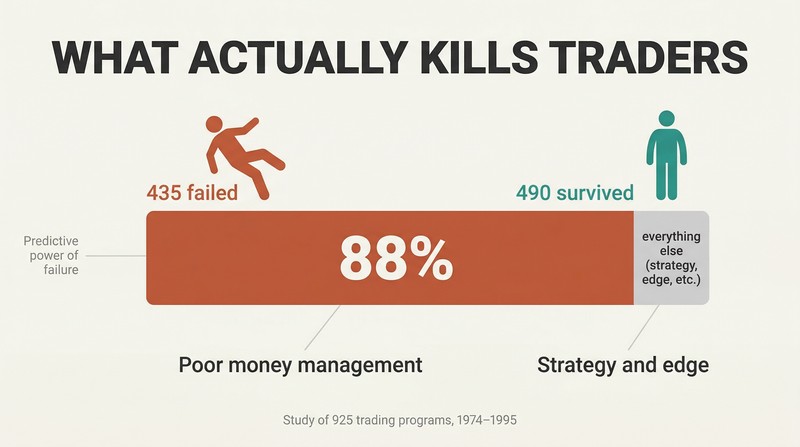
A study of 925 CTAs proved it. Finance professor Fernando Diz analyzed commodity trading advisor programs from 1974 – 1995. Of 925 programs, 435 went out of business. The single best predictor of failure? How long a program spent recovering from its worst drawdown. Two money management variables alone explained 88% of the predictive power of a model using every edge and money management variable combined.
Failed traders had enough skill to survive. Successful programs generated 48% higher monthly returns than failed ones — yet achieved this with lower risk and smaller drawdowns. The Sharpe ratio for survivors was 61% larger. The failed traders' strategies weren't broken; their inability to control losses was the real cause of death.
Place your stop-loss before you even think about profit
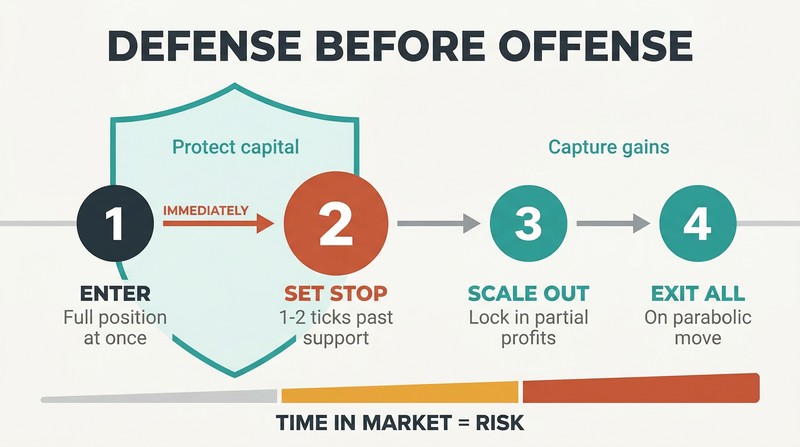
Every strategy in the book shares four rules:
1. Enter your entire position at once — don't add to winners
2. Immediately place a protective stop one to two ticks beyond the nearest support or resistance
3. Scale out as the market moves in your favor to lock in profits
4. If the market goes parabolic or prints a huge range expansion bar, exit everything
Time in the market is risk. The longer you hold, the more exposed you are to price shocks. Every setup in the book should reward you almost immediately. If a trade goes quiet and makes no progress after entry, don't wait for your stop — just get out. Seek a more active opportunity.
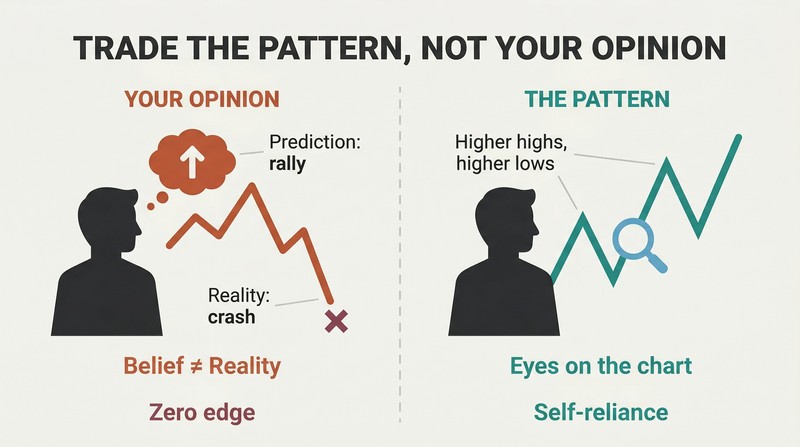
Kill your directional bias — trade the pattern, not your opinion
Larry's "guru-itis" nearly destroyed him. In 1987, he poured 30% of his net worth into OEX call options based on a newsletter guru's prediction of an 800-point Dow rally. He went condo shopping in Maui while the market collapsed. Day after day, his secretary delivered worse news, but the guru kept insisting the "grand supercycle" was intact. The crash came shortly after.
Your educated brain is the second trap. A typical upbringing trains everyone to think identically: bad crop report means soybeans go up, bad inflation means bonds go down. When thousands of traders reach the same logical conclusion, there is zero edge in that thinking. Self-reliance is non-negotiable — if you need someone else's opinion on a trade, you shouldn't be in it.
Profit when breakout players get trapped on false moves
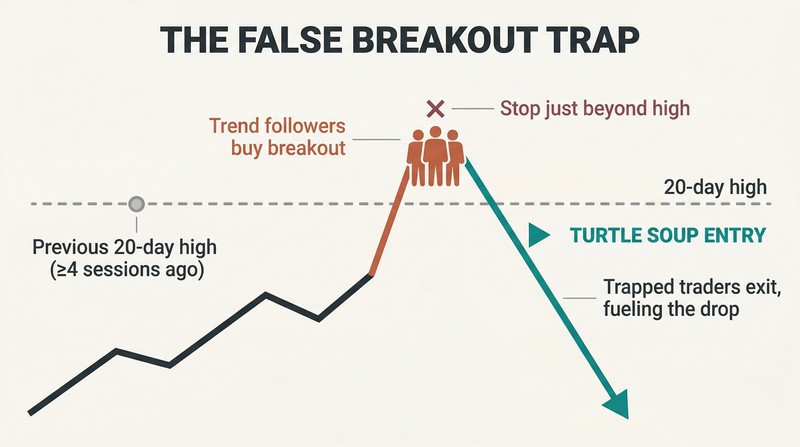
Turtle Soup flips a famous system on its head. The original "Turtle" trading system bought new 20-day highs and sold new 20-day lows — a trend-following approach plagued by false breakouts. Raschke and Connors trade the opposite: when a market makes a new 20-day extreme and immediately reverses, they enter against the breakout with a stop just beyond the high or low. The key qualifier — the previous 20-day extreme must have occurred at least four sessions earlier.
The reversals can be spectacular. Hewlett-Packard rallied 15% after a Turtle Soup buy signal. The September 1995 Yen dropped from 123 to below 119 on a sell signal. A companion pattern, Turtle Soup Plus One, enters one day later, catching even more trapped trend-followers.
When markets shrug off terrible news, follow them higher
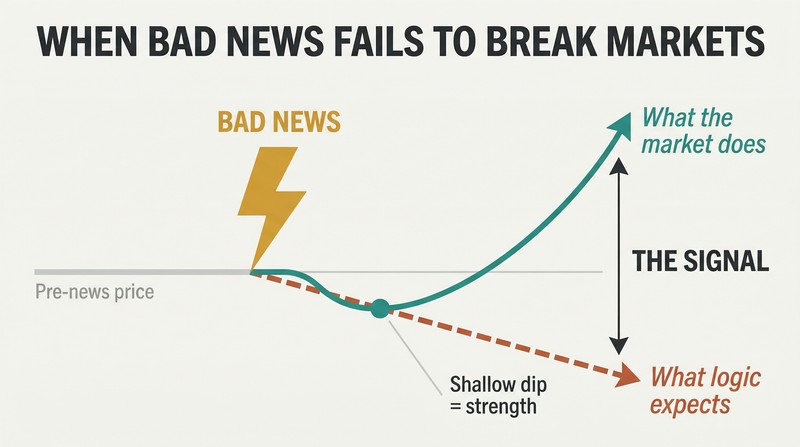
Markets reveal their intentions through reactions to news. In December 1994, the Fed raised rates, Orange County neared bankruptcy, and Mexico devalued the peso. Stocks "should" have crashed — instead the S&P gained 1.5% that month, then rallied 30% over ten months. On September 13, 1995, IBM warned it would miss earnings in a tech-driven bull market. The S&P dipped 2.5 points, reversed, and gained 8 points over two days.
Two specific strategies exploit this. Morning news reversals trade against the initial bond-market reaction to economic reports by entering if prices reverse through the previous day's extreme. Big-picture news reversals buy a stock when it recovers to its pre-crisis price. Motorola lost 15% on cancer-from-phones rumors in 1993, then gained 60% in ten months.
You only need one repeatable pattern to trade for a living
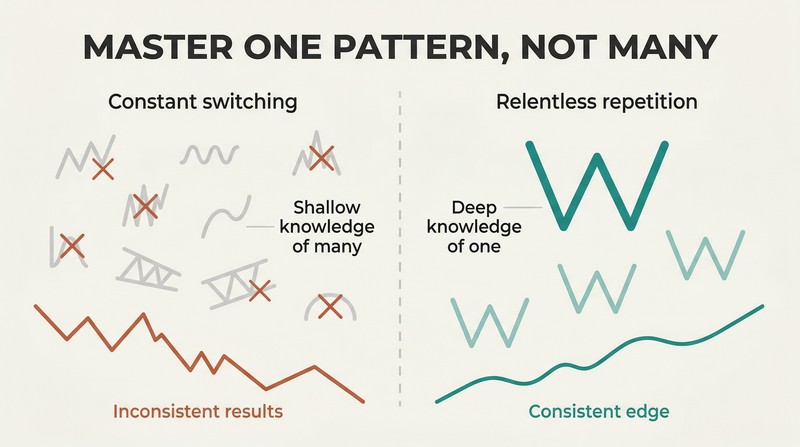
Specialization breeds consistency. The authors know traders who earn their entire living from a single setup — two friends trade only the Anti pattern on five-minute S&P charts, another trades exclusively Three Little Indians on tick charts. These traders spend hours each night studying their one pattern, developing an instinct for the choicest setups. They insist on being purists, often skipping oscillators entirely.
Constant tweaking guarantees failure. If you keep changing indicators, you'll never learn whether any of them actually work. The book presents over a dozen strategies — Turtle Soup, 80-20's, Momentum Pinball, the Holy Grail, Wolfe Waves, and more — but the authors are emphatic: pick the pattern that makes intuitive sense to you, paper-trade it until you believe in its repeatability, then execute it relentlessly.
Exit into buying frenzies — sell when your trade feels best
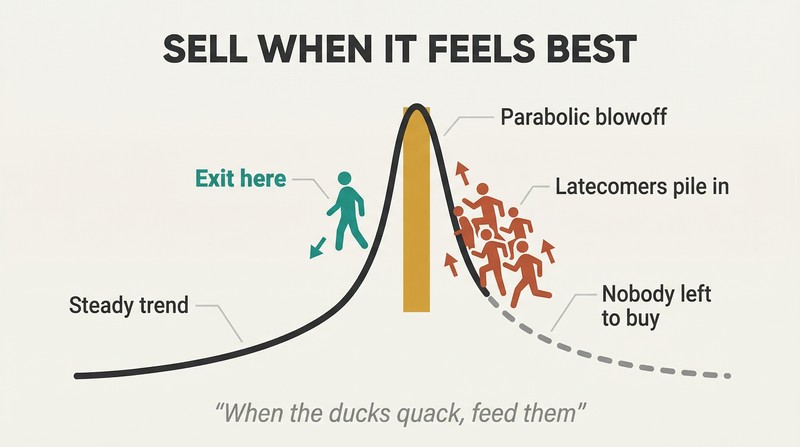
Range expansion bars are exit signals, not entry signals. When a market makes a parabolic run or prints an abnormally wide bar, the last emotional latecomers are piling in. With nobody left to drive prices further, reversal is near. A friend of Linda's, a 20-year professional, puts it bluntly: "When the ducks quack, feed them" — when everybody wants something, that's the perfect spot to sell it to them.
Even legends struggle with exits. A retired market wizard who made over $100 million in futures confessed that mastering his exit strategy was his biggest weakness. Yet his bias toward exiting early was clearly the right approach. The rule: if a trade goes parabolic, exit everything. Never let a winning trade turn into a loser.
Quiet, narrow-range days precede the most explosive moves
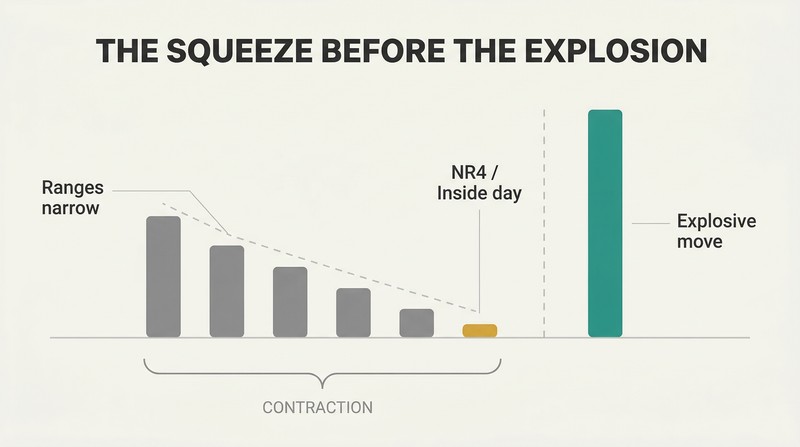
Volatility is cyclical and self-reinforcing. Once it starts contracting, it continues until reaching a critical low — then the cycle reverses with an explosive expansion. The ID/NR4 setup identifies these pressure points: when today is both an inside day and has the narrowest range of four days, place a buy stop above and a sell stop below. Let the market pull you in. Be ready to reverse if whipsawed on entry day — often the best trades follow a fakeout.
The 6/100 historical volatility filter sharpens timing. When the six-day historical volatility drops below half the 100-day reading and an inside day or NR4 occurs, an explosive move is imminent. This combination identified the biggest weekly bond rally in six years in May 1995 to the exact day.
Every swing trade is a test, retracement, or climax reversal
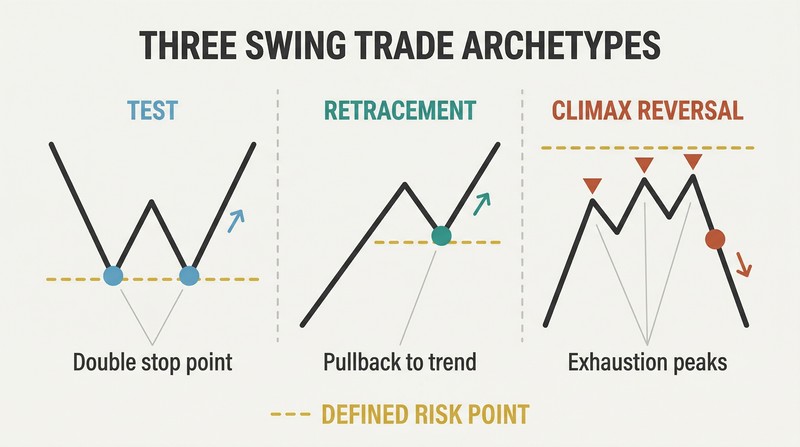
Tests form "double stop points." The market hits a previous high or low and stops again — creating the tightest risk point for entry. Turtle Soup, 80-20's, and Momentum Pinball all exploit test setups. True support or resistance isn't established until a level has been tested.
Retracements enter with the prevailing trend after a correction. The Anti pattern uses stochastic %K/%D hooks to catch momentum resuming. The Holy Grail buys pullbacks to the 20-period EMA when the ADX exceeds 30. Climax reversals trade exhaustion — Three Little Indians (three symmetrical peaks) and Spike and Ledge patterns require seeing the reversal already in place before entering. Every pattern shares one non-negotiable trait: a clearly defined risk point for your protective stop.
Grind to break even — two or three trades will make your month
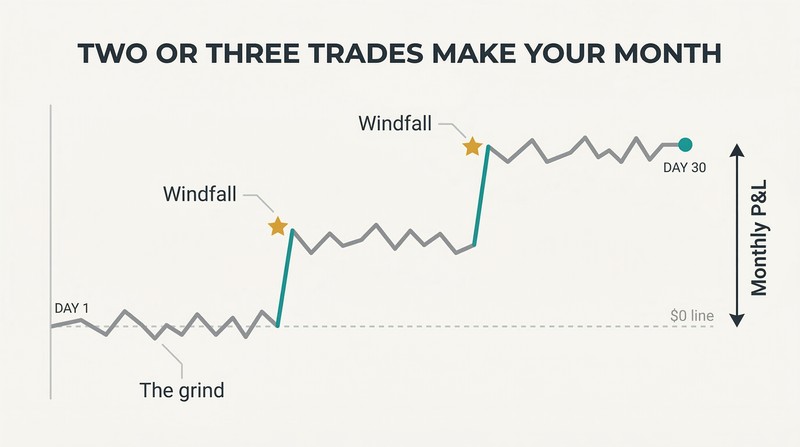
Trading is catching minnows with occasional big fish. Most monthly profits come from just two or three standout trades. The rest of the time, individual wins are small — but losses should be small too. Linda compares it to fishing: keep dropping your line, catching little minnows, and once in a while you'll land something big. Even professional floor traders go weeks without being profitable. The question is always: how much did you lose during those dry spells?
Nightly preparation is the grind that keeps you alive. Both authors keep handwritten notebooks and log every trade with date, time, and fill price. They scan charts each evening, write out the next day's setups, and place resting orders before the open. Linda resets her mental P&L to zero each month — because euphoria, as Larry warns, is an absolute enemy.
Analysis
Street Smarts occupies a singular position in trading literature as a bridge between the discretionary wisdom of pit traders and the quantitative rigor of systematic approaches. Published in 1996 by Linda Raschke and Larry Connors, the book's enduring relevance stems not from its specific setups — many of which have been arbitraged or require adaptation for electronic markets — but from its underlying epistemology of risk. The most radical claim, supported by Fernando Diz's study of 925 CTAs, is that strategy edge is essentially commoditized among professionals. The differentiator is money management — a finding that anticipated modern portfolio theory's emphasis on risk-adjusted returns by reframing it at the individual-trade level.
Raschke and Connors' taxonomy of three trade types — tests, retracements, and climax reversals — provides a categorical lens that transcends any individual pattern. This framework echoes Wyckoff's market phases but makes them actionable across intraday and multi-day horizons. The book's contrarian strand — trading against false breakouts, fading news reactions, exploiting the gap between logical expectation and market reality — anticipates behavioral finance research on herding and overreaction by several years.
The weaknesses are era-specific. Pre-decimalization equity examples, floor-trading references, and the absence of algorithmic competition make some setups less directly applicable today. Yet the meta-lessons remain structurally valid: volatility compresses before exploding, the last participants into a move create the reversal, and the small trader's nimbleness is an underappreciated edge against institutional behemoths constrained by position size and slippage.
Perhaps the book's most counterintuitive contribution is psychological: the argument that logical thinking is the trader's enemy. In a profession that attracts analytical minds, the insistence on subordinating intelligence to pattern recognition and discipline is profoundly uncomfortable — and profoundly correct. Street Smarts ultimately teaches that markets are not puzzles to be solved but environments to be survived, where the modest goal of breaking even is the foundation upon which genuine profitability is built.
Review Summary
Street Smarts is highly regarded for its practical trading strategies and insights into the mindset of professional traders. Readers appreciate the conversational format, specific setups for various markets, and emphasis on money management. The book is praised for its focus on short-term trading, particularly day trading and swing trading. While some strategies may be outdated, the overall philosophy and approach remain valuable. Readers find the nuances, routines, and tips from experienced traders particularly useful. The book is recommended for both novice and experienced traders, offering a range of strategies and philosophical insights.
People Also Read










Glossary
Turtle Soup
Trades failed 20-day breakoutsA swing trading strategy that enters against a new 20-day high or low when the market reverses back through the previous 20-day extreme. The previous extreme must have occurred at least four trading sessions earlier. Named humorously after the Turtle trend-following system it exploits—profiting from the false breakouts that plague trend followers.
Turtle Soup Plus One
Turtle Soup delayed one dayA variation of Turtle Soup where the entry occurs the day after a new 20-day high or low, rather than on the same day. Requires the new extreme day to close at or beyond the previous 20-day high/low. Catches additional trapped trend-followers who entered on the close of the breakout day.
80-20's
Reversal after extreme open-close barA day-trading setup triggered when a market opens in the top (or bottom) 20% of its daily range and closes in the opposite 20%. The next day, if the market exceeds the setup day's extreme and reverses, enter on a stop at the setup day's high or low. Based on Steve Moore's research showing 80-90% morning follow-through but only 50% closing follow-through after extreme-range days.
Momentum Pinball
RSI-of-momentum day-trade signalA short-term overbought/oversold indicator using a three-period RSI calculated on a one-period rate of change (the daily net price change), called the LBR/RSI. A reading below 30 signals a buy setup; above 70 signals a sell setup. Entry occurs the next day on a breakout of the first hour's trading range, with the trade typically held overnight and exited the following morning.
LBR/RSI
Three-period RSI of daily momentumA custom indicator created by Linda Raschke: a three-period Relative Strength Index applied to a one-period rate of change (the difference between today's close and yesterday's close). Values below 30 indicate oversold short-term momentum; above 70 indicates overbought. Used as the setup condition for the Momentum Pinball strategy.
The Anti
Stochastic hook retracement patternA retracement setup using a 7-period %K and 10-period %D stochastic. When the slow %D line establishes a definite trend and the fast %K line pulls back toward it during a consolidation, then hooks back in the direction of %D, an entry signal is generated. Average holding time is three to four days. Works across all markets and time frames.
Holy Grail
ADX pullback to moving averageA retracement strategy that buys the first pullback to the 20-period exponential moving average when the 14-period ADX is above 30 and rising, indicating a strong trend. Entry is placed on a buy stop above the previous bar's high once price touches the moving average. Named semi-humorously for its simplicity and reliability.
Three Little Indians
Three-peak climax reversal patternA subjective climax reversal pattern formed by three symmetrical, progressively higher peaks (or lower valleys). The trader anticipates the third peak forming, waits for price to reverse off it, then enters at-the-market with a stop at the most recent swing extreme. Winning trades reward immediately and should not look back.
Wolfe Waves
Wave pattern with price projectionA five-point wave pattern developed by Bill Wolfe, based on Newton's first law of physics. Points 1 through 4 must form before identifying the pattern. A trend line from points 1 to 3 projects the anticipated reversal at point 5 (entry). A separate trend line from points 1 to 4 projects the EPA (Estimated Price at Arrival)—the profit target.
ID/NR4
Inside day, narrowest four-day rangeA setup combining two conditions: an inside day (higher low and lower high than the previous day) with the narrowest daily range of the last four trading sessions. This range compression signals an imminent volatility expansion. The next day, buy and sell stops are placed above and below the ID/NR4 bar to enter in whichever direction the breakout occurs.
Smart Money Index
First-hour vs. last-hour Dow changeA cumulative index that inverts the Dow's net change during the first hour of trading (representing emotional, uninformed 'weak hands') and adds the net change during the last hour (representing professional 'smart money'). A daily reading above +20 suggests buying the next day; below -20 suggests selling. Used as a short-term directional filter.
Fakeout-Shakeout
Failed breakout reversal tradeA climax reversal pattern where a market breaks out of a ledge, triangle, or consolidation zone, then reverses back through the breakout point. The failed breakout traps participants on the wrong side, creating fuel for a move in the opposite direction. Entry is taken when price exits the other side of the pattern, with a stop at the most recent swing extreme.
Spike and Ledge
Climax followed by narrow consolidationA reversal pattern where a buying or selling climax creates a sharp price spike, followed by a small consolidation area (the ledge). A trade is entered on a breakout from the ledge in the direction opposite the spike, with a protective stop placed on the other side of the ledge. The market should not return to the stop level if the trade is correct.
FAQ
1. What’s "Street Smarts: High Probability Short-Term Trading Strategies" by Linda Bradford Raschke about?
- Focus on Short-Term Trading: The book is a practical manual for active traders, focusing on high-probability, short-term trading strategies for equities and futures.
- Emphasis on Swing Trading: It teaches swing trading, which involves trading around support and resistance levels and using stops to minimize risk.
- Real-World Strategies: The book presents a collection of precise, actionable trading setups and patterns, rather than theoretical technical analysis.
- Experience-Based Insights: Written by two seasoned traders, it shares lessons learned from decades of professional trading, including both successes and mistakes.
2. Why should I read "Street Smarts" by Linda Bradford Raschke and Larry Connors?
- Proven, Practical Strategies: The book offers strategies that have been successfully used by the authors and their colleagues for years.
- Focus on Risk Management: It emphasizes the importance of minimizing risk and using protective stops, which is crucial for trading survival.
- Adaptable to All Markets: The patterns and setups can be applied to any market and timeframe, making them versatile for different traders.
- Realistic Trading Advice: The authors provide honest discussions about the psychological challenges of trading and the importance of consistency and discipline.
3. What are the key takeaways from "Street Smarts" by Linda Bradford Raschke?
- Consistency and Methodology: Successful trading requires a coherent methodology and consistent application of strategies.
- Risk First, Profit Second: Always define and control risk before seeking profits; protective stops are non-negotiable.
- Specialize for Success: Mastering even a single pattern or setup can be enough to make a living as a trader.
- Market Listening: Learn to listen to the market rather than imposing your own opinions or biases.
- Money Management is Critical: The overwhelming reason traders fail is poor money management, not poor entry methods.
4. What is swing trading according to "Street Smarts" by Linda Bradford Raschke?
- Definition and Approach: Swing trading is anticipating the market’s next move, focusing on probable outcomes rather than predictions.
- Types of Trades: The book identifies three main swing trading setups—tests (of highs/lows), retracements, and climax reversals.
- Risk Minimization: The main goal is to minimize risk, not maximize profit, by using tight stops and quick exits.
- Timeframe and Activity: Swing trades are typically held for a few hours to a few days, capitalizing on short-term price movements.
5. How does "Street Smarts" by Linda Bradford Raschke approach money management?
- Essential for Survival: Every strategy in the book is useless without strict money management; keeping losses small is paramount.
- Use of Protective Stops: Always place an initial stop on the entire position, just below/above the most recent high/low.
- Scaling Out and Locking Profits: As trades become profitable, scale out or move stops to protect gains.
- Avoiding Catastrophic Losses: Never add to losing positions, and always exit losing trades quickly to prevent large drawdowns.
6. What is the "Turtle Soup" strategy in "Street Smarts" by Linda Bradford Raschke?
- False Breakout Reversal: Turtle Soup exploits false breakouts of 20-day highs/lows, entering trades when the breakout fails and reverses.
- Entry and Stop Rules: Enter on a reversal above/below the previous 20-day high/low, with a stop just beyond the day’s extreme.
- Short-Term Focus: Trades typically last a few hours to a few days, with tight risk control and trailing stops.
- Re-Entry Option: If stopped out early, the strategy allows for a re-entry at the original entry price within the next day or two.
7. What are the "Turtle Soup Plus One" and "80-20’s" strategies in "Street Smarts" by Linda Bradford Raschke?
- Turtle Soup Plus One: Similar to Turtle Soup, but the reversal entry is triggered the day after a new 20-day high/low, making it easier to anticipate and plan.
- 80-20’s Day Trading: This strategy exploits the tendency for markets that open in one extreme of the daily range and close in the other to reverse the next day.
- High Probability Reversals: Both strategies are designed to capture short-term reversals with defined risk and quick profit-taking.
- Applicability: These setups work across different markets and timeframes, including intraday charts.
8. How does "Street Smarts" by Linda Bradford Raschke use momentum and retracement strategies like "Momentum Pinball" and "The Anti"?
- Momentum Pinball: Uses a 3-period RSI of a 1-period rate of change to identify overbought/oversold conditions, entering on a breakout of the first hour’s range.
- The Anti: Utilizes a stochastic oscillator to spot retracements in a trending market, entering when the fast line hooks back in the direction of the slow line.
- Quick Trades: Both strategies are designed for short-term trades, typically lasting one to four bars or days.
- Confirmation and Stops: Entries are confirmed by price action, and stops are placed at logical swing points to minimize risk.
9. What is the role of the ADX indicator in "Street Smarts" by Linda Bradford Raschke, especially in the "Holy Grail" and "ADX Gapper" strategies?
- ADX Measures Trend Strength: The Average Directional Index (ADX) is used to identify strong trending markets (ADX > 30).
- Holy Grail Setup: Buy the first pullback to the 20-period EMA in a strong trend, confirmed by a high and rising ADX.
- ADX Gapper: Enter trades when a market gaps against the trend in a strong ADX environment, using +DI/-DI for trend direction.
- Objective Entries and Exits: Both strategies provide clear entry, stop, and exit rules, focusing on continuation moves in established trends.
10. How does "Street Smarts" by Linda Bradford Raschke address breakout and volatility expansion strategies?
- Range Contraction Patterns: The book highlights setups like ID/NR4 (Inside Day/Narrowest Range of 4 days) and NR7 (Narrowest Range of 7 days) as precursors to breakout moves.
- Dual Stop Entries: Place both buy and sell stops around the range, letting price action determine trade direction.
- Volatility Filters: Combines historical volatility measures with pattern recognition to identify explosive moves.
- Quick Profit Focus: Trades are held for one to four days, with trailing stops to lock in gains and quick exits if the move doesn’t materialize.
11. What are the key subjective and pattern recognition setups in "Street Smarts" by Linda Bradford Raschke, such as "Three Little Indians" and "Wolfe Waves"?
- Three Little Indians: A climax reversal pattern formed by three symmetrical peaks or troughs, signaling exhaustion and a potential reversal.
- Spike and Ledge, Fakeout-Shakeout: Other subjective patterns that identify exhaustion and failed breakouts, offering low-risk entry points.
- Wolfe Waves: A unique wave structure based on Newton’s law, projecting reversal and price targets using a specific five-point count.
- Tape Reading and Timing: These setups require active monitoring and quick execution, with stops placed at logical risk points.
12. What are the most important psychological and trade management lessons from "Street Smarts" by Linda Bradford Raschke?
- Consistency Over Perfection: Focus on consistent application of strategies rather than seeking perfect trades or exits.
- Preparation and Routine: Doing homework and maintaining trading logs are essential for discipline and long-term success.
- Avoiding Bias and Overtrading: Shut out opinions and avoid trading in dull markets or carrying losing positions overnight.
- Money Management Above All: The book’s research and experience show that superior money management, not just strategy edge, is the main determinant of trading longevity and success.
Bonus: What are the best quotes from "Street Smarts" by Linda Bradford Raschke and what do they mean?
- "Learn to listen to the markets and do not impose your own will upon them." — Emphasizes the importance of adapting to market behavior rather than trading based on personal opinions.
- "Every trading strategy in this manual is absolutely 100 percent useless without proper money management." — Stresses that risk control is more important than any entry method.
- "All you need is one pattern to make a living!" — Highlights the value of specialization and mastering a single setup.
- "The longer you are in the market, the more exposure you have to 'price shocks' or unexpected adverse moves." — Advocates for minimizing time in the market to reduce risk.
- "Consistency. It's the only way to know if what you do works or if it doesn't work." — Underlines the necessity of sticking to a method to evaluate its effectiveness.
Download PDF
Download EPUB
.epub digital book format is ideal for reading ebooks on phones, tablets, and e-readers.








































