

Key Takeaways
You have 26 seconds and six words to win attention
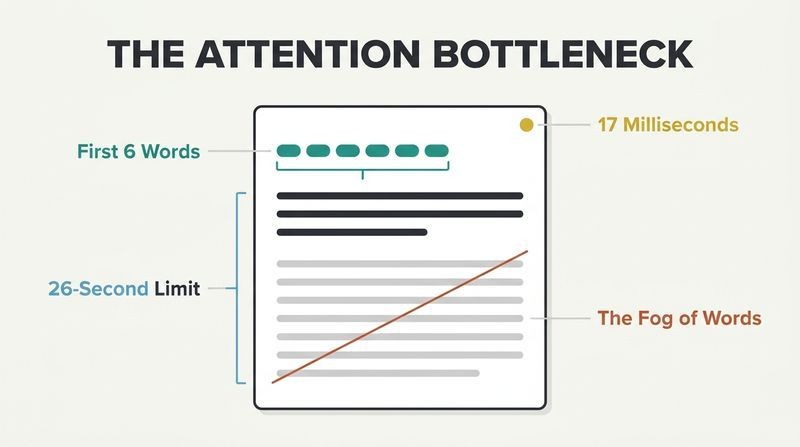
The fog of words is drowning everyone. Eye-tracking studies by University of Maryland professor Ronald Yaros show the average person spends just 26 seconds on a piece of content, a metric he calls "time on text." People spend under 15 seconds on most web pages, and the brain decides in 17 milliseconds whether it likes what it clicked. We check phones over 344 times a day. About one-third of work emails go unread.
The problem has two roots. Technology gave everyone the power to publish instantly and for free, yet people still write memos, emails, and reports as if it were 1980. We were taught that length signals depth: teachers assign papers by word count, thick books seem smarter. Smart Brevity attacks this mismatch head-on.
The diagnosis lands because it names a mismatch most professionals feel but cannot articulate: consumption habits evolved, production habits did not. Worth noting the authors resist the lazy "phones broke our brains" narrative. They cite evidence that humans were always distractible; technology simply weaponized distraction. That nuance matters. Nicholas Carr's The Shallows leans harder on neural rewiring, while cognitive scientists like Daniel Willingham argue attention was always fragile. The 26-second figure should be read as a design constraint, not a lament. If readers give you a fixed budget of seconds, the ethical move is to respect it rather than exploit it, which is precisely the pivot the book makes.
Brevity signals confidence; padding betrays your fear and confusion
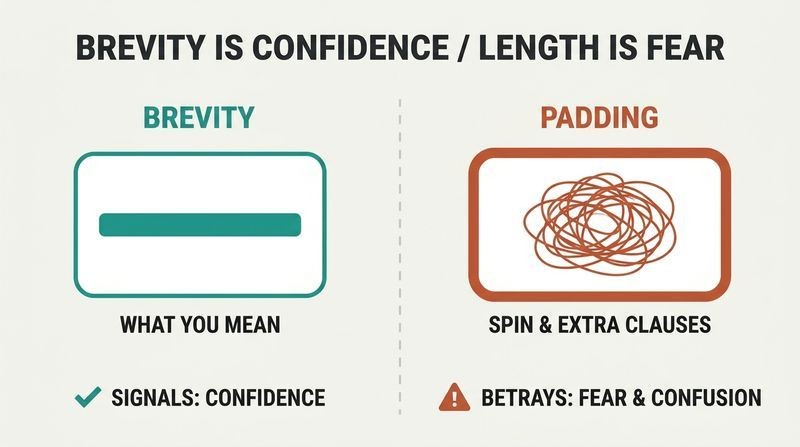
Length is a tell. A sign in the Axios newsroom reads that brevity is confidence and length is fear. When people do not truly understand what they want to say, they paper over the gap with mushy words, long caveats, and pointless asides. Cowards hide in clauses. Mark Twain confessed he wrote a long letter because he lacked time to write a short one.
Watch it wreck real messages. An apology loaded with "but here's what you did first" loses its sincerity. Feedback smothered in flattery buries the one thing someone must fix. Edelman CEO Lisa Ross puts it bluntly: people hide insecurity in extra words, and when you spin or pad, your competence comes into question because you sound all over the place. Just say what you mean, then stop.
The claim that verbosity signals insecurity has real psychological backing. Research on "linguistic hedging" links qualifiers and filler to lower perceived confidence and competence. Yet the equation deserves nuance. In diplomacy, law, and science, careful qualification is precision, not cowardice. A hedged clinical finding may be the honest one. The book's own "short, not shallow" caveat acknowledges this tension. The sharper reading: brevity signals confidence when the author actually understands the material, because mastery enables compression. Einstein's dictum to make things as simple as possible but no simpler captures the boundary. Padding to hide ignorance is the sin, not qualification that reflects genuine uncertainty.
Serve the reader first, not your own ego
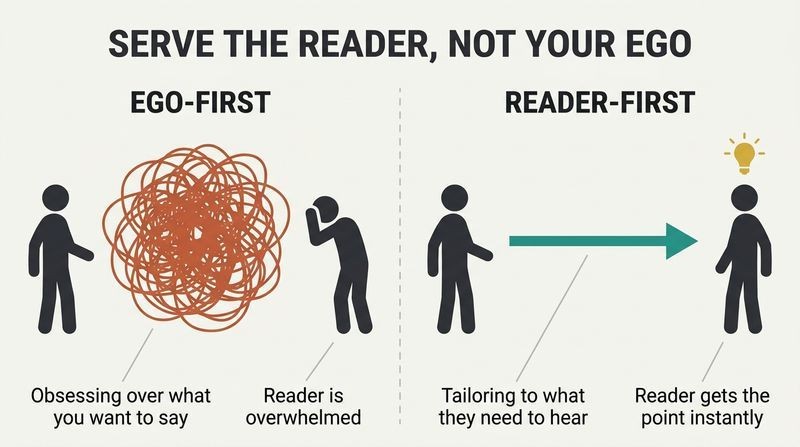
Audience first is the founding rule. The first two words of the Axios manifesto are "audience first." Most communication fails because people obsess over what they want to say rather than what others need to hear. Pope Francis told priests in Slovakia to cut homilies from 40 minutes to 10 or lose the room, joking that the nuns applauded loudest.
Picture one real person. If you write for everyone, you reach no one. Zero in on a specific individual with a real job and real needs, then tailor the message to what you want that person to remember. A test: read a few paragraphs to a friend and ask them to repeat your main point. It is humbling, but it reveals whether you buried the lede or blurted it cleanly.
The single-reader technique echoes a discipline from fiction and copywriting alike. Kurt Vonnegut advised writing for one person, and Ogilvy-era advertisers imagined a single customer across the kitchen table. The cognitive logic is sound: specificity forces concrete choices about vocabulary, prior knowledge, and stakes. There is a subtle risk though. Optimizing for one imagined reader can smuggle in the writer's blind spots about who that reader is, which is exactly why the book's later emphasis on inclusive writing matters as a corrective. The friend-repeats-your-point test is the underrated gem here, a cheap, brutal usability audit most communicators never run.
Every message needs a muscular tease, lede, context, and off-ramp
The Core 4 is the architecture. Smart Brevity structures written communication into four learnable parts:
1. A muscular tease: six or fewer strong words to yank attention (subject line, headline, tweet).
2. A strong first sentence, the lede: tell people something new, surprising, or essential in one direct line.
3. Context, flagged as "Why it matters": one or two sentences explaining significance.
4. The choice to "Go deeper": an optional link or section for those who want more.
Try to fit it on one phone screen. The style traces to David Rogers, a Wall Street Journal editor who slashed a young reporter's 1,200 flowery words into a sharp opener, a must-read fact, and a paragraph of context. The result reads like the buffet where you, the chef, pick what matters so readers never have to.
The Core 4 is essentially the inverted pyramid of classic journalism, refitted for the smartphone. Its genuine innovation is the explicit "Why it matters" line and the "Go deeper" off-ramp, which together solve a problem the old pyramid ignored: giving skimmers permission to leave satisfied while giving depth-seekers a door. That respects reader autonomy in a way most corporate writing does not. Progressive disclosure, a term from interaction design, describes the same principle: show the essential first, reveal complexity on demand. The constraint of one phone screen is more than aesthetic. It imposes a hard budget that forces the ruthless prioritization the whole method depends on.
Broadcast the ONE thing you want remembered, in one sentence
Pick one thing, then trumpet it. The book's single most important instruction: identify the one thing you want people to know and say it in one strong sentence, what journalists call the lede. Busy readers scan to answer two questions: what is this, and is it worth my time?
Talk it out first. Mike Allen's reporter trick: after an event, call a friend and tell them what happened. That blurted sentence is your opening line, every time. We speak more clearly than we write because social cues stop us from boring people face to face. Cliff Sims, a Trump aide, could not make his book flow until he recorded himself telling the stories aloud to his wife and transcribed them. In speeches, state it outright: "If there's one thing you remember today."
The advice to speak before writing exploits a real asymmetry in cognition. Spoken language recruits deep social instincts for relevance and turn-taking that the blank page suppresses, which is why so many people write like stiff bureaucrats but explain brilliantly over coffee. Linguists call this the difference between planned and unplanned discourse. The "one thing" discipline also aligns with memory research: working memory holds only a few chunks, and audiences reliably retain a single headline far better than a list. The hard part is not technique but courage. Choosing one message means consciously sacrificing others, and most communicators would rather include everything than risk omitting the wrong thing.
Give readers signposts so skimmers never get lost
Axioms are your street signs. The bolded phrases scattered through Axios writing, such as "Why it matters," "The big picture," "By the numbers," "The bottom line," and "Between the lines," are called Axioms. They give a scanning brain a clear cue about what comes next and whether to keep reading. "Why it matters" is the most powerful; it borrows the journalistic "nut graf," the paragraph explaining why a story exists, and pulls it up front instead of burying it in paragraph four.
Then format for the eye. Use bullets to isolate three or more related points, since nobody wants to stare at a clump of figures. Bold the words and numbers that must stand out. Keep paragraphs to two or three sentences. These are guardrails, not rigid rules, what the authors call room for "jazz."
Axioms function as what usability researchers call information scent, the cues that let scanning readers predict what a section holds before committing to read it. Jakob Nielsen's eye-tracking work found people read web text in an F-shaped pattern, hitting the left edge and headings hardest, which is exactly the behavior bolded signposts exploit. There is a design tradeoff worth flagging. Overused, these labels calcify into corporate tic, and a message drowning in "Why it matters" and "The big picture" becomes its own kind of noise. The authors' "jazz" caveat is the safeguard: the signpost serves the reader's eye, not the writer's formula.
Choose short, concrete, one-syllable words you can actually picture
Strong words beat spelling-bee words. A strong word is vivid, precise, and something you can see: fire, boat, chop, crush. A weak word is abstract, like "process" or "civics." A rule of thumb: one syllable beats two beats three. Say "lie," not "prevaricate"; "revenge," not "retribution." You would never call a banana an elongated yellow fruit, yet people write that way constantly.
Then cut and activate. Purge foggy verbs like "could," "may," and "might" that tell readers nothing; say whether something is planned, feared, or expected. Use active verbs: "The Taliban captured Afghanistan," not "the situation continues to deteriorate." A middle school teacher, Mark Smith, found parents only read his bolded words, so he put every key point there. Writing coach Paula LaRocque once read a passage where every word was one syllable; its power was its simplicity.
The concrete-word principle rests on solid cognitive ground. The "picture superiority effect" and studies of concreteness show tangible, imageable words are recalled far better than abstractions, because they light up more of the brain's sensory machinery. Orwell made the same case in Politics and the English Language, arguing that stale, abstract language does the thinker's work badly and often dishonestly. The one-syllable heuristic is a clever proxy, since short Anglo-Saxon words tend to be older, more concrete, and more emotionally direct than their Latinate synonyms. The caveat: register matters. Precision sometimes requires a technical term, and relentless monosyllables can read as condescending. The goal is clarity, not artificial simplicity.
Kill half your words after the first draft
Write it, then gut it. Century 21 executive Eddie Berenbaum credits an eleventh-grade English teacher whose advice stuck for 30 years: write, then go back and kill at least half the words. It comes out sharper every time. Venture capitalist Chris Sacca offers a variant: write your whole email, then make the first two or three sentences say everything below, because that is often all anyone reads.
Editing is a game. Mike Allen trims hundreds of words from a reporter's draft, then challenges them to find what is missing. Usually they cannot. He calls it a word diet: never easy, requires discipline, but the result is leaner and better-looking. One slow news Easter he sent "Mike's Big 6" instead of his usual Top 10, and readers wrote in asking to subscribe to the shorter version.
The delete-half rule is the practical engine behind every other principle here, and it mirrors the sculptor's cliche of removing everything that is not the statue. Behavioral evidence supports why it is so hard: a 2021 Nature study by Adams and colleagues found people systematically default to adding elements rather than subtracting when solving problems, even when subtraction is superior. Editing fights an innate addition bias. Sacca's front-load-the-first-sentences hack is especially shrewd because it accepts reader behavior instead of fighting it. The Big 6 anecdote is the quiet proof: readers did not merely tolerate less, they actively preferred it, which is the whole thesis compressed into one Easter weekend.
Even elite, paying readers beg for fewer words
The data humbled the founders. At Politico, VandeHei and Allen wrote 1,600-word columns that lit up cable news, yet about 80 percent of readers quit on the first page, consuming at most 490 words. When they built Politico Pro, a premium service charging businesses over $100,000 a year, they surveyed these high-need subscribers about what they valued most. Only about 5 percent said the longer stories.
That was the founding shock. Even the most discerning, deep-pocketed readers in the world wanted less, not more. The lesson: listen to the data and the customer, not the voice in your head insisting your prose is precious. Axios launched in 2017 on this premise, promising that if readers absorbed only 200 words, those would be the most useful 200 words they read.
This is the book's empirical backbone, and it is a useful antidote to the flattering assumption that smart audiences want more depth. They want more value per second, which is not the same thing. The finding rhymes with product analytics across media: completion rates collapse with length regardless of prestige. There is a selection nuance, though. The 5 percent who wanted long-form may be the highest-value customers, the ones whose decisions justified the six-figure fee, which complicates a pure majority-rules reading. Averages can mislead when a small segment drives outsized worth. Still, the core correction stands. Writers routinely mistake their own effort for reader value, and only data breaks the spell.
Run meetings, speeches, and slides on the same brief discipline
The system scales everywhere. Great speeches are short: the Gettysburg Address ran 272 words. State your one point outright ("the one thing I want you to remember"), give its "Why it matters," back it with a few numbered stats, and restate it at the end. TED caps every talk at 18 minutes, long enough to matter, short enough to hold attention.
Meetings and slides too. Most people were never trained to run a meeting; 90 percent admit to daydreaming in them. Send a one-sentence objective and three-bullet agenda beforehand, cap it at 20 to 25 minutes, and email takeaways after. For slides, treat each like a billboard glimpsed at 65 miles per hour: one message, absorbed in three seconds. Adding an arresting image can lift recall to 65 percent versus 10 percent for words heard alone.
Extending a writing method into meetings and presentations is where Smart Brevity graduates from style guide to operating system, and the cross-format consistency is its quietest strength. The picture-versus-words recall figure draws on John Medina's Brain Rules and the broader multimedia-learning research of Richard Mayer, whose experiments show people learn better from words plus relevant images than from words alone, and worse when slides are crammed with redundant text. Edward Tufte's long crusade against PowerPoint, quoted in the book, makes the same point from a design angle. The 20-minute meeting cap is the boldest cultural claim, colliding with the default 30- and 60-minute calendar blocks that structure most organizations more by inertia than by need.
Analysis
Smart Brevity is a business communication manual disguised as a manifesto, written by three journalists (Jim VandeHei, Mike Allen, and Roy Schwartz) who built Politico and Axios and then commercialized their house style through software called Axios HQ. The book is framework-based and self-referential: it is written entirely in the format it teaches, which is both its cleverest device and its central limitation. Reading it, you absorb the method by immersion.
The intellectual core is a single reframe: stop optimizing for what you want to say and start optimizing for what a distracted reader can absorb in seconds. Everything else (the Core 4, Axioms, one-syllable words, the delete-half rule) descends from that premise. The genuinely original contributions are modest but real: the explicit "Why it matters" line that surfaces significance rather than assuming it, and the "Go deeper" off-ramp that respects reader autonomy. Most of the rest is repackaged newsroom craft, the inverted pyramid and the nut graf, dressed for the smartphone era.
The book's persuasive power comes from data and self-deprecation. The founders confessing that 80 percent of readers abandoned their beloved columns, and that premium subscribers overwhelmingly wanted less, is more convincing than any principle stated abstractly. The weakness is scope creep and commercial motive. The method suits alerts, updates, and internal memos superbly, but the authors' own caveat ("short, not shallow") gestures at territory it cannot serve: argument, narrative, nuance, the slow build. Applied dogmatically, Smart Brevity risks flattening thought into a series of confident assertions with the reasoning amputated. It also functions throughout as an advertisement for Axios HQ, which readers should weigh. The honest verdict: this is a high-utility discipline for the 90 percent of workplace writing that is currently bloated, not a universal theory of communication. Used as a corrective rather than a religion, it is genuinely valuable.
Review Summary
Smart Brevity receives mixed reviews. Many readers appreciate its practical advice on concise writing and clear communication, finding it valuable for business and personal use. The book's format and examples are praised for demonstrating its principles. However, some criticize it as repetitive, overly self-promotional for Axios, and potentially contributing to oversimplification of complex topics. Critics argue it could have been shorter, ironically. While some find it transformative for their communication style, others see it as common-sense advice repackaged. Overall, reviewers agree it offers useful tips but debate its depth and applicability.
People Also Read


Glossary
Smart Brevity
Saying more with fewer wordsA system for communicating in the distracted digital age by delivering maximum value in minimum words. It combines being smart (choosing what truly matters) with being brief (stripping everything unnecessary). The guiding phrase is "short, not shallow." It applies to emails, newsletters, meetings, speeches, and presentations, always prioritizing what the audience needs over what the writer wants to say.
The Core 4
Four-part structure for writingThe four building blocks of any Smart Brevity message: a muscular tease of six or fewer words to grab attention, a strong first sentence (lede) delivering the key point, a context line flagged "Why it matters," and an optional "Go deeper" section or link for readers wanting more. Ideally all fits on one phone screen.
Axiom
Bolded signpost guiding skimmersA bolded label such as "Why it matters," "The big picture," "By the numbers," or "The bottom line" that acts as a street sign for scanning readers, cueing what type of information follows. Adapted from the journalistic "nut graf" but pulled to the front. The company name Axios (Greek for "worthy") plays on the word.
Why it matters
One-line significance statementThe most common and important Axiom. A bolded line following the opening sentence that explains, in one or two direct sentences, why the information is significant: what it changes, what it signals, or its larger context. It must add perspective, not repeat the lede.
Tease
Six-word attention-grabbing openerThe headline, subject line, or first words of a tweet, limited to roughly six strong words. Its only job is to win the split-second decision to keep reading. It should be accurate yet provocative, use active verbs and short words, and avoid being funny, cryptic, or jargon-heavy.
Lede
Strongest single opening sentenceThe one sentence carrying the single most important point, borrowed from journalism. It should tell readers something new, surprising, or essential, be direct and declarative, avoid repeating the tease verbatim, and stand alone as the thing you most want remembered if nothing else is read.
Time on text
Seconds spent reading contentA metric from University of Maryland professor Ronald Yaros's eye-tracking research measuring how long people actually spend on a piece of content. His finding: about 26 seconds on average, with most reading happening in short bursts before attention moves on. It frames the reader's attention as a fixed, tiny budget.
Go deeper
Optional link to moreThe closing element of a Smart Brevity item, offering a link or section for readers who want additional detail, sources, or nuance. Most readers will not click it, but its presence signals thoroughness and lets people choose their own depth, proving brevity need not sacrifice context.
BLUF
Bottom Line Up FrontA military convention ("Bottom Line Up Front") that places a short summary at the top of a memo so the key point is read first. Encountered by BP communications head Geoff Morrell at the Pentagon, it was an early real-world cousin of Smart Brevity's front-loading philosophy.
FAQ
What's "Smart Brevity: The Power of Saying More with Less" about?
- Core Concept: "Smart Brevity" is about communicating effectively by using fewer words to convey more meaning. It emphasizes clarity, precision, and efficiency in communication.
- Authors' Background: Written by Jim VandeHei, Mike Allen, and Roy Schwartz, the book draws on their experiences in journalism and media to offer insights into effective communication.
- Practical Guide: The book provides a structured approach to writing and speaking that helps cut through the noise of modern communication, making messages more impactful and memorable.
- Target Audience: While the authors are media professionals, the book is designed to help anyone—from students to CEOs—improve their communication skills.
Why should I read "Smart Brevity"?
- Improve Communication: The book offers strategies to enhance your ability to communicate clearly and effectively, which is valuable in both personal and professional settings.
- Time Efficiency: By learning to say more with less, you can save time for yourself and your audience, making interactions more productive.
- Universal Application: The principles of Smart Brevity can be applied across various forms of communication, including emails, presentations, and social media.
- Engagement: The book teaches how to capture and maintain the attention of your audience, a crucial skill in today's fast-paced digital world.
What are the key takeaways of "Smart Brevity"?
- Brevity is Confidence: The book argues that concise communication reflects confidence, while verbosity often stems from fear or uncertainty.
- Audience First: Always consider what your audience needs to know, rather than what you want to say, to ensure your message is relevant and engaging.
- Structure and Clarity: Use a clear structure with strong headlines, direct sentences, and bolded key points to guide the reader through your message.
- Practical Tools: The book provides practical tools and tips, such as using bullet points and bold text, to enhance readability and retention.
What is the "Smart Brevity" method?
- Core 4 Elements: The method includes a strong "tease," a memorable first sentence, context with "Why it matters," and an option to "Go deeper" for more information.
- Focus on Essentials: It emphasizes stripping away unnecessary words and focusing on the most important points to convey your message effectively.
- Adaptability: The method can be applied to various forms of communication, from emails to speeches, making it versatile and widely applicable.
- Data-Driven: The approach is backed by data on how people consume information, ensuring that it aligns with modern reading habits.
How can "Smart Brevity" improve my emails?
- Subject Lines: Use short, direct subject lines to grab attention and convey the email's purpose immediately.
- First Sentence: Start with the most important information to ensure it is seen and understood, even if the reader skims the rest.
- Bullets and Bold: Use bullet points and bold text to highlight key information and make the email easy to scan.
- Conciseness: Keep emails brief to respect the recipient's time and increase the likelihood of your message being read and acted upon.
What are some examples of "Smart Brevity" in action?
- Before and After: The book provides examples of traditional communication versus Smart Brevity, showing how messages can be transformed to be more effective.
- Real-Life Applications: It includes case studies from various industries, demonstrating how Smart Brevity can improve communication in different contexts.
- Visuals and Emojis: The book discusses the use of visuals and emojis to convey messages quickly and effectively, adding another layer to the Smart Brevity approach.
- Newsletter Success: Examples of successful newsletters using Smart Brevity principles highlight the method's effectiveness in engaging audiences.
What are the best quotes from "Smart Brevity" and what do they mean?
- "Brevity is confidence. Length is fear.": This quote encapsulates the book's core message that concise communication reflects clarity and confidence.
- "Audience first.": Emphasizes the importance of considering the audience's needs and preferences in communication, ensuring messages are relevant and engaging.
- "If you see everything, you remember nothing.": Highlights the problem of information overload and the need for focused, clear communication to ensure retention.
- "Just say it.": Encourages directness and simplicity in communication, avoiding unnecessary complexity and verbosity.
How does "Smart Brevity" address modern communication challenges?
- Information Overload: The book tackles the issue of overwhelming amounts of information by teaching how to distill messages to their essence.
- Attention Span: It provides strategies to capture and maintain attention in a world where people are easily distracted and often skim content.
- Digital Communication: Offers insights into how digital platforms have changed communication and how to adapt messages for these mediums.
- Behavioral Insights: Uses data and behavioral research to inform its strategies, ensuring they are aligned with how people consume information today.
How can "Smart Brevity" be applied to social media?
- Conciseness: Social media demands brevity, and the book's principles help craft messages that are impactful in limited character spaces.
- Visuals and Emojis: Encourages the use of visuals and emojis to quickly convey tone and context, making posts more engaging.
- Audience Engagement: Focuses on delivering value to the audience, increasing the likelihood of interaction and sharing.
- Platform-Specific Tips: Provides insights into tailoring messages for different social media platforms, recognizing their unique characteristics and user behaviors.
What are some practical tips from "Smart Brevity" for presentations?
- Simplify Slides: Use minimal text and strong visuals to keep the audience focused on the key message.
- Clear Structure: Organize presentations with a clear beginning, middle, and end, emphasizing the most important points.
- Engage the Audience: Start with a strong opening to capture attention and use stories or anecdotes to maintain interest.
- Reinforce Key Points: Repeat the main message throughout the presentation to ensure it is remembered.
How does "Smart Brevity" suggest handling meetings?
- Preparation: Set a clear objective and agenda before the meeting to ensure focus and efficiency.
- Time Management: Limit meeting duration to avoid unnecessary discussions and keep participants engaged.
- Clear Communication: Use Smart Brevity principles to convey key points succinctly during the meeting.
- Follow-Up: Send a concise summary of decisions and action items after the meeting to reinforce outcomes and responsibilities.
How can "Smart Brevity" enhance workplace communication?
- Efficiency: Streamlines communication, reducing time spent on emails, meetings, and reports, and increasing productivity.
- Clarity: Ensures messages are clear and easily understood, reducing misunderstandings and errors.
- Engagement: Helps maintain employee engagement by delivering relevant and concise information.
- Cultural Impact: Fosters a culture of transparency and respect for time, improving overall workplace dynamics.
Download PDF
Download EPUB
.epub digital book format is ideal for reading ebooks on phones, tablets, and e-readers.








































