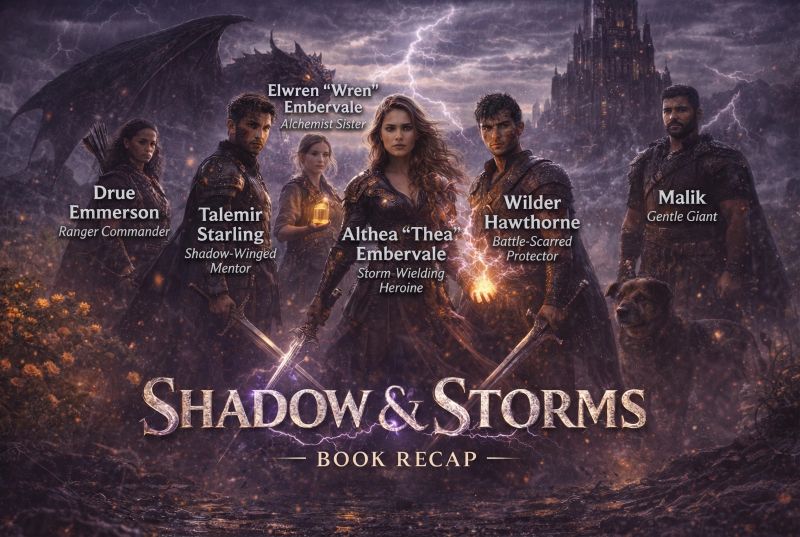

Plot Summary
Prologue
A prophecy shadows the midrealms: in a fallen kingdom's wake, a daughter of darkness will wield a blade in one hand and rule death with the other, and the Veil — the towering wall of mist enclosing the world — will fall. For decades, these words have shaped law and fear. Women were stripped of their right to fight. An innocent girl was blamed as the prophesied threat.
Kingdoms crumbled under the hidden manipulation of King Artos,13 an empath who breeds monsters in secret prisons and bends rulers to his will. Now his former champions — Warswords, the elite monster-hunters sworn to defend the realm — have discovered his treachery. The war for the midrealms begins with a rescue mission to the most feared prison in existence: the Scarlet Tower.
Chained in the Monster Factory
Wilder Hawthorne,2 one of the midrealms' elite Warswords, wakes in the suppressive dark of the Scarlet Tower — a prison at the edge of the Veil where magic is muted and reality warps. Drugged and manacled, he endures forced nightmare cycles: watching loved ones die, reliving his hometown burning, feeling the blows of his own trials over and over.
Between horrors, the torturers show him something tender — his cabin, Thea1 waiting inside — then rip it away. A cellmate named Aemund,21 the man Wilder2 once helped imprison for attempting to poison King Artos,13 leads him to the tower's laboratory.
There, alchemists inject prisoners with shadow magic, turning ordinary people into howlers — mindless cursed soldiers. The Archmage of Chains declares his intention: to remake Wilder2 into a general of darkness for Artos'13 army.
Gold Dust Shatters the Chains
While shadow magic constricts Wilder2 on the laboratory table, Thea1 — newly forged as a Warsword after surviving the Great Rite — fights her way into the tower's depths. She arrived on the island with Talemir Starling,3 Wilder's2 estranged former mentor, a shadow-touched warrior with wings who battled wraiths overhead as diversion.
Thea1 tears a reaper's heart from its chest barehanded, then descends spiral stairs guided by a whisper of lightning she sent to find Wilder.2 In the laboratory, she hurls Talemir's3 sun orchid sphere — a device whose golden essence disintegrates anything shadow-touched on contact.
The explosion turns Wilder's2 enchanted chains to ash, restoring his Warsword strength. He smashes the glass case holding his swords with the Archmage's own skull, and together they carve their way toward the surface through rivers of black blood.
Lightning Reveals the Heir
Three massive reapers block the gates, using a terrified Aemund21 as bait. Their combined shadow power creates an impenetrable wall of darkness, trapping Thea1 and Wilder2 inside while sealing Talemir3 out. Talemir3 had warned that unleashing storm magic would reveal Thea's1 identity as a Delmirian heir to every kingdom.
She decides the world can find out. Lightning erupts from her hands — mighty bolts that burn the reapers' hearts right out of their chests. The barrier shatters. When Wilder2 surveys the tower that nearly unmade him, he asks her to bring it down.
She pours everything into one devastating strike that cracks the tower in two, collapsing the prison into rubble. Aemund21 lies crushed beneath debris; Wilder2 mercy-kills him with Thea's1 dagger. Talemir3 lands before them — alive, winged, grinning — and their improbable alliance solidifies.
Gardens Under the Shadow Dome
Talemir3 transports them by shadow magic to the University of Naarva — a restored campus hidden beneath a dome of darkness he and other shadow-touched maintain around the clock. Inside the shield, sunlight filters through, orchards bloom, and a rebel army camps in surrounding fields.
Wilder,2 who abandoned Talemir3 eight years ago in fury over his mentor's concealed wraith heritage, finally confronts his guilt. Talemir3 tells him plainly that what happened at Islaton — where their brother-in-arms Malik10 was grievously wounded — was never Wilder's2 burden. Their embrace bridges nearly a decade of silence.
Thea1 reunites with her sisters: Anya,4 the shadow-touched eldest framed as the Daughter of Darkness, and Wren,5 the youngest, an alchemist weaponizing fields of golden sun orchids whose essence destroys wraith flesh on contact. The rebellion has resources, numbers, and a forge to arm them.
Artos Marches on Aveum
Torj Elderbrock,8 a fellow Warsword called the Bear Slayer, arrives with catastrophic news: the weapons master Esyllt17 has been imprisoned at Thezmarr by the traitorous Guild Master Osiris,18 and King Artos'13 forces march on the winter kingdom of Aveum. The rebels must act on multiple fronts simultaneously.
Kipp,6 Thea's1 Guardian friend and brilliant strategist, volunteers to infiltrate Thezmarr and free Esyllt.17 The three Embervale sisters will travel to Aveum to persuade the grieving Queen Reyna20 to ally against Artos.13
Everyone else remains to train the shadow-touched army — civilians and ex-soldiers who've never fought as a unified force. Wilder2 drills a hostile cavalry unit that openly resents taking orders from someone who once hunted their kind, while Thea1 leads an all-women combat unit alongside Talemir's3 wife Drue.9 Two weeks is all they have.
Letters from Beyond the Grave
Since their reunion, Thea1 has been filling a notebook with letters addressed to Wilder2 — messages meant for after her death, each signed with a lightning bolt. She believes the jade fate stone she's worn since childhood guarantees she'll die at twenty-seven, her next name day approaching.
When the notebook falls from her pocket, Wilder2 reads the first entries and erupts. He confronts her with the pages, demanding to know why she'd write farewells instead of speaking to him while he's still here. The raw fury breaks something open in both of them.
Their confrontation turns to fierce passion on the war table, scattering maps and army pieces — the first time Wilder2 has allowed himself full physical intimacy since the tower shattered his sense of reality. In the wreckage of their restraint, he comes back to himself: Warsword, lover, whole.
Delmira's Heirs Before Reyna
Queen Reyna20 receives them after three days of silence — a husk in a tattered robe, hollow-eyed in her private chambers. The sisters present Wren's5 evidence: a vial proving Artos'13 empath magic contaminated Aveum's sacred pools and caused King Elkan's death.
Anya4 materializes her shadow wings, declaring herself not a monster but a weapon against the evil at Reyna's20 door. Thea1 cites ancient guild law permitting all capable people to take up arms in dire times.
The queen studies them, then reaches into her robe and presses a vial of Aveum springwater into Thea's1 hands — one of the last bottled before the pools were poisoned, a Warsword healing gift she'd foreseen Thea1 would come for. She speaks cryptically of visions: gold turning to silver, ancient power arising. The alliance is sealed.
The Warsword Rides the Giant
Dawn breaks over Aveum's snowy plains as both armies collide. Wren5 floods an enemy-packed ravine with storm magic, drowning entire units. A frost giant — fifteen feet of shadow-controlled fury — rampages through their lines, impaling soldiers on its spiked club.
Talemir3 flies Wilder2 above the chaos and drops him onto the creature's shoulder. Climbing its hair like rope, fighting off tendrils of nightmare-inducing shadow, Wilder2 drives his sword through the giant's brain and leaps clear as the corpse crashes through enemy formations.
On another flank, Thea1 and Anya4 corner King Artos13 with combined lightning that wraps around his golden armor; he whispers a cryptic thank-you before collapsing. The battle is won at staggering cost. Before it began, Thea1 had settled an old debt in the dark, snapping her lifelong tormentor Seb Barlowe's19 neck when he ambushed her.
Springwater for the Fox
Cal7 drags Thea1 through bloodied snow to where Kipp6 lies with an arachne fang protruding from his chest, venom filming the wound. Their strategist — who wasn't supposed to be on the front lines — wheezes a request for sour mead. His breathing stutters. His eyes go still. Thea1 reaches for the vial of Aveum springwater resting against her heart — the healing gift from Queen Reyna,20 most potent when used on someone beloved.
She pours every drop into his mouth. Silence stretches long enough to fracture her. Then Kipp6 gasps back to life, coughing and cracking a joke about how Thea1 telling a Warsword she loves him nearly killed him twice over. She punches his arm through her tears. The vial is empty. She will never get another.
Thezmarr Falls from Within
With Artos13 in chains, the allies celebrate at the Singing Hare tavern — Thea's1 name day, a wine tasting, music and dancing. But in the cellar, their prisoner oscillates between manic laughter and terrified screaming, his empath magic spiraling beyond control. Wren5 stabilizes him with a tonic.
Before answers come, Dratos,15 a shadow-touched ranger, crashes in breathless: Osiris,18 Thezmarr's Guild Master, has welcomed the reapers into the fortress. The Aveum campaign was a diversion. A reaper king gathers every wraith and reaper from across the midrealms to launch a final assault that would curse every living thing with total darkness.
Their battered army of two hundred must now attack the most impenetrable stronghold in the realm — one specifically designed to withstand siege. Kipp6 begins planning immediately: tunnels from below, oil barrels, and a hall to blow sky-high.
Jasira Wears the Crown
The fortress is a lair — vine blights strangle the walls, and the heads of fortress workers, including Thea's1 friends Sam and Ida, line spikes along the parapets. In the courtyard's chaos, darkness erupts and Princess Jasira14 emerges flanked by wraiths and an enormous reaper.
Artos'13 daughter — reported missing since the eclipse — reveals herself as the true Daughter of Darkness the prophecy foretold. She is the most powerful empath in history, having controlled her own father since childhood. She orchestrated the original attack on Thezmarr as a girl, letting Artos13 frame Anya4 for her crimes.
With a flick of her wrist she forces midrealms soldiers to turn blades on themselves, flooding them with unbearable emotion. No monsters needed — she weaponizes despair itself. Talemir3 lunges for her after she threatens his son; Wilder2 throws himself into the shadow blast meant for his mentor.3
The Women Warriors Return
When everything seems lost, a horn blasts through the darkness. Audra,12 the former librarian who vanished before the Aveum battle, leads an army of armored women on horseback — the women warriors banished from Thezmarr generations ago. Their disciplined charge shatters the monster ranks.
Thea1 rallies to them and calls for a shield wall. Dozens of shields lock into place, and she charges the metal with storm magic. When the wall drops, lightning rolls across it in a wave, annihilating every creature in its path. Inside the fortress, Kipp6 detonates Wren's5 explosives beneath the Great Hall, collapsing the portal from which monsters poured.
Torj8 seals another courtyard portal by leaping into it wielding his war hammer — charged with Wren's5 lightning — and emerges transformed: golden hair turned silver, eyes darkened to storm-blue, the reaper and its vortex banished.
The Stone Was Never Hers
A reaper's blow sends Thea1 sprawling onto a parapet, talons hovering over her heart. She tastes blood and believes this is how fate claims her — the death promised by the jade stone she's worn for twenty-seven years. Then Anya4 appears, feeding her iruseed to revive her senses.
Her eldest sister snaps the stone from Thea's1 neck and holds it between scarred fingers: the stone was never Thea's.1 Anya4 gave it to her as a toddler, a keepsake from an older sister about to be ripped away by darkness.
Twenty-seven was always Anya's4 number, Anya's4 fate. Before Thea1 can process this, a reaper strikes Anya4 from behind. She dies in her sisters' arms, her last words about the world starting over. Her storm magic floods into Thea1 and Wren5 — a final, devastating inheritance.
A Dagger Through Darkness
Thea1 and Wilder2 reach the cliffs beyond Thezmarr — the reaper lair Anya4 had spent years seeking. While Wilder,2 Talemir,3 and Dratos15 destroy reapers inside the cave, Thea1 faces Jasira14 alone.
The princess assaults her with empath-amplified nightmares: Wren5 consumed by vine blights, Wilder2 dying in her arms, her every fear made visceral. Thea1 crumbles to her knees. But her fingers find the jeweled dagger at her belt — a blade connected to the Furies themselves — and their ancient presence burns away the illusions.
She charges the dagger with storm magic and drives it between Jasira's14 ribs, through flesh and bone into the princess's heart. In the distance, the towering Veil shudders and falls in one cascading wave, revealing golden light beyond the mist. The prophecy is fulfilled.
A Flower in the Rubble
On the Plains of Orax, pyres consume the dead while the living watch in silence. Wren5 delivers Anya's4 eulogy, calling her a mosaic of contradictions who mirrored the heart of humanity. Dratos,15 who found Anya's4 body and fled skyward with a broken cry, is not seen again.
Inside the ruins, Wren5 invites the captured Osiris18 — the Guild Master who betrayed them all — to share a pot of tea. He drinks. Her signature poison, the Ladies' Luncheon, kills him slowly while she watches without blinking.
Audra12 accepts the role of Guild Master, inheriting a shattered fortress and a mandate to rebuild it with the returned women warriors. When Wilder2 and Thea1 walk to his cabin, they find it vandalized and burned. But amid the ashes of the broken floor, a single flower blooms.
Epilogue
Three months later, Thea1 and Wilder2 walk into the Laughing Fox tavern to find Kipp6 orchestrating revelry as though war were ancient history. Cal7 has earned his Warsword totem. Torj's8 silver hair catches the light as he watches Wren5 slip away to somewhere private.
The midrealms are healing: Audra12 rebuilds Thezmarr with the returned women warriors, Talemir3 and Drue9 raise their son in Naarva, Vernich11 fishes in retirement. Thea1 and Wilder2 have been traveling unbound by duty for the first time.
Cal7 hands them a letter from Audra12 — a suspected location for escaped wraiths. Wilder2 asks Thea1 if she'll hunt shadow wraiths with him. She says yes. In Tver, they ride side by side as she lassoes her own stallion at last — and, to Wilder's2 lasting delight, accidentally names it Pancake.
Analysis
Shadow & Storms operates as a sustained interrogation of how prophetic narrative becomes political technology. King Artos13 weaponizes the prophecy of the Daughter of Darkness to justify stripping women of martial agency, framing a child for his own atrocities, and consolidating power under the guise of protection. The revelation that Jasira14 — not Anya4 — fulfills the prophecy exposes how interpretation serves the interpreter: identical words can liberate or imprison depending on who controls their meaning. This is not abstract theme work but structural architecture — the entire plot pivots on misattributed identity.
The novel's treatment of trauma achieves unusual specificity. Wilder's2 PTSD manifests not as brooding but as a precise inability to distinguish reality from illusion — a direct consequence of the Scarlet Tower's method of alternating nightmare with false comfort. His recovery proceeds not through heroic willpower but through Thea's1 insistence that vulnerability between equals is not weakness. Their sexual relationship charts his psychological healing with intentionality: each encounter marks a specific reclamation of agency the tower stripped away.
The fate stone twist performs the rare feat of retroactively reframing the protagonist's defining characteristic. Thea's1 reckless fearlessness — her willingness to charge reapers, spy on Warswords, throw herself off cliffs — was built on the belief that death was already scheduled, making risk illusory. Discovering the stone was never hers transforms her from someone who had nothing to lose into someone choosing to risk everything she now knows she has. The distinction between nihilistic courage and genuine conviction becomes the novel's sharpest psychological insight.
Institutionally, the novel argues that systems must be rebuilt by those they excluded. Audra's12 women warriors don't supplement the existing military — they replace its foundations. When Audra12 becomes Guild Master, the patriarchal gatekeeping that produced Osiris18 and enabled Artos13 is structurally dismantled. Wren's5 execution of Osiris18 by tea rather than sword crystallizes this theme: power exercised through traditionally feminine channels — alchemy, patience, intimacy — proves as lethal as any blade, and the new midrealms will be authored by those the old one tried to erase.
Review Summary
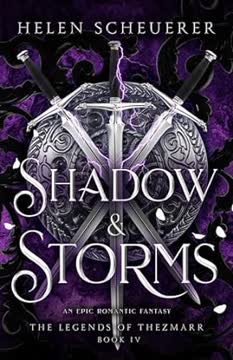
Shadow & Storms concludes The Legends of Thezmarr series with an epic finale. Readers praise the intense action, character development, and satisfying wrap-up of storylines. Thea and Wilder's relationship grows stronger, while side characters shine. The book balances high-stakes battles with emotional moments and explores themes of female empowerment. Some readers found certain plot points predictable, but overall, the series is highly recommended for fans of romantasy. Many express excitement for the upcoming spin-off featuring Wren and Torj.
People Also Read
Characters
Thea (Althea Embervale)
Storm-wielding WarswordA young woman who fought her entire life to become what Thezmarr said she couldn't be: a warrior, and ultimately a Warsword. Born as the hidden heir of the fallen kingdom of Delmira, she was raised at the fortress without knowledge of her royal blood or storm-wielding power. Fiercely independent, reckless by nature, and loyal to the point of self-destruction, Thea defines herself through action rather than title. She carries a jade fate stone she believes marks her for death at twenty-seven, which fuels both her urgency and her fearlessness. Her relationship with Wilder2 anchors her—he is the only person who makes her feel she doesn't need to earn the right to exist. Her central psychological struggle is reconciling the warrior she chose to become with the princess the world demands.
Wilder Hawthorne
Warsword, the Hand of DeathKnown as the Hand of Death, Wilder is an elite Warsword haunted by the belief that everyone he loves suffers for it. The destruction of his hometown Kilgrave, the maiming of his brother Malik10, and his estrangement from mentor Talemir3 have calcified into a guilt complex that manifests as emotional isolation. Beneath the stoic exterior is a deeply tender man capable of devastating vulnerability—but only with Thea1. His time in the Scarlet Tower fractures the armor he spent decades building, leaving him questioning what's real and struggling to accept comfort. Wilder's arc centers on learning that strength isn't solitary endurance but the willingness to lean on others. His love for Thea1 is absolute, possessive in its protectiveness yet ultimately grounded in respect for her autonomy.
Talemir Starling
Shadow Prince, rebel leaderOnce the most celebrated Warsword of his generation—known as both the Prince of Hearts and the Shieldbreaker—Talemir was turned shadow-touched by wraiths years ago, gaining wings, shadow magic, and exile from the world that adored him. He built a hidden rebel force in Naarva, raised a family with ranger Drue9, and waited for the moment the midrealms would need him. He carries the dual burden of unacknowledged heroism and the knowledge that his former apprentice Wilder2 may never forgive him. Warm, commanding, and disarmingly witty, he leads with equal parts pragmatism and idealism. His psychological core is the tension between the man the world thinks he is and the man his family knows—father, husband, protector, dreamer.
Anya
Eldest Embervale, Daughter of DarknessThe eldest Embervale sister, ripped from her family as a child and thrown to the wraiths by King Artos13, who framed her as the prophesied Daughter of Darkness. She survived and became shadow-touched, gaining wings and dark power. Raised in isolation and hunted by the world, Anya's defining trait is controlled fury—a blade that cuts in every direction, including inward. She is abrasive, blunt, and fiercely protective of her reclaimed sisters, but struggles with emotional intimacy after decades of solitude. Her relationship with Dratos15 represents the one vulnerability she permits herself. Beneath her hardness lies a desperate hunger for belonging and an unresolved question: does she want to save the world that rejected her, or burn it down?
Wren (Elwren)
Youngest Embervale, alchemistThe youngest Embervale sister and a gifted alchemist who has always defined her worth through intellect rather than combat. Wren spent years suppressing Thea's1 powers with a tonic to protect her identity, carrying the secret weight of guardianship before either sister knew the truth. Quietly fierce, she masks vulnerability with precision and dry wit. Her growing confidence as a warrior—not despite her alchemy but through it—represents one of the story's most potent arcs of self-actualization. Wren's relationship with Torj8 challenges her belief that softness is weakness, while her bond with her sisters fills a void she's carried since childhood. Of the three Embervales, Wren is the most emotionally intelligent and, when provoked, the most ruthlessly pragmatic.
Kipp
Guardian strategist, Son of the FoxThezmarr's most underestimated Guardian and its best strategist, Kipp masks sharp tactical intelligence behind relentless humor and an obsession with taverns. Self-styled as the Son of the Fox, he deflects pain with jokes but proves himself the rebellion's indispensable mind, planning battles that exploit terrain, timing, and audacity. His loyalty to Thea1 and Cal7 runs deeper than his bravado suggests.
Cal
Guardian archer, the Flaming ArrowA Guardian archer of exceptional skill, quiet and steady where Kipp6 is loud and reckless. Known as the Flaming Arrow, Cal serves as the grounding moral center of the friend group. His devotion to Torj8 hints at a mentorship that shapes his own warrior aspirations, while his patience with Kipp's6 antics conceals a young man driven by duty and quiet ambition.
Torj Elderbrock
Warsword, the Bear SlayerCalled the Bear Slayer, Torj is a Warsword of immense physical power who wields a rune-carved war hammer rather than traditional swords. Beneath his golden-haired, charming exterior lies a man struggling with unspoken feelings and the weight of wisdom he dispenses more easily than he follows. His quiet devotion to Wren5 unfolds gradually, revealing a vulnerability that surprises everyone—himself most of all.
Drue
Talemir's wife, ranger leaderTalemir's3 wife and a formidable Naarvian ranger who co-leads the rebel forces with steel-spined authority. Fiercely independent, she refuses to be defined by motherhood despite raising their son Ryland23 in wartime, insisting that fighting for his future matters more than hiding from danger. Her partnership with Talemir3 is one of equals—marked by mutual respect, relentless teasing, and unwavering trust.
Malik
Wilder's silent brother-in-armsWilder's2 brother in arms and former Warsword who lost his voice and part of his face in a devastating attack at Islaton. Despite his silence, Malik communicates through gesture, presence, and an endless supply of braided leather belts. His quiet strength serves as an emotional anchor for Wilder2, and his gentle friendship with Thea1 predates her relationship with Wilder2, rooted in years of shared respect.
Vernich
Warsword, the BloodletterThe oldest active Warsword, a gruff and uncompromising fighter whose reputation for brutality masks a complicated moral code. Once complicit in harsh training methods that endangered shieldbearers, he slowly reveals a capacity for grudging respect toward those who prove themselves. His decision to join the rebellion signals that even the most cynical warriors choose a side when evil stops being abstract.
Audra
Former librarian, secret warriorThezmarr's former librarian who hides more secrets than her shelves hold. Behind spectacles and a sharp tongue lies a woman deeply connected to the midrealms' oldest institutions and its forgotten fighters. Her disappearance at a critical moment and her cryptic knowledge of the Furies suggest a role far larger than anyone suspects. Audra represents institutional memory weaponized for justice.
King Artos
King of Harenth, empath tyrantThe King of Harenth who presents himself as a benevolent ruler while secretly breeding monsters and manipulating kingdoms through empath magic. His charm masks decades of political sabotage—framing a child for his crimes, engineering the fall of Delmira and Naarva, bending allies to his will. His psychological complexity lies in the question of agency: how much was genuine ambition, and how much was something else entirely.
Princess Jasira
Artos' missing daughterArtos'13 daughter, reported missing after the eclipse attack on Aveum. Her whereabouts concern the rebellion throughout their planning. Beautiful and seemingly vulnerable, Jasira represents the unknowns in the conflict—an unseen piece on the chessboard whose position could change everything. Her connection to her father's empath lineage makes her a figure of both pity and potential danger.
Dratos
Shadow-touched ranger and scoutA shadow-touched ranger with biting humor and deep loyalty to Anya4 and Talemir3. Serves as aerial transport, scout, and reluctant emotional support for the rebellion's leaders.
Adrienne
Naarvian generalA Naarvian ranger and general who serves as Drue9 and Talemir's3 most trusted military commander, bringing disciplined strategy and unwavering composure to the rebellion.
Esyllt
Thezmarr's weapons masterThezmarr's weapons master, imprisoned by Osiris18 for treason. Blunt and pragmatic, he provides critical military expertise once freed by Kipp's6 daring rescue mission.
Osiris
Traitorous Guild MasterGuild Master of Thezmarr who secretly collaborates with the enemy. His betrayal opens the fortress to the reapers, making him one of the midrealms' most despised figures.
Seb Barlowe
Thea's lifelong tormentorA Guardian whose hatred of women warriors manifests in escalating cruelty toward Thea1. His uncle Osiris's18 influence shielded him from consequences for years.
Queen Reyna
Aveum's grieving winter queenAveum's winter queen, devastated by her husband's death. A seer whose cryptic visions prove unexpectedly accurate, she must choose between surrender and war.
Aemund
Scarlet Tower prisonerA nobleman imprisoned for attempting to poison King Artos13. He shows Wilder2 the tower's horrifying experiments, becoming an unlikely guide through its horrors.
Fendran
Chief rebel blacksmithDrue's9 father and the rebellion's chief blacksmith, working at the rebuilt Naarvian forge. He crafts Wilder's2 custom Warsword armor from Delmirian designs.
Ryland
Talemir's tiny winged sonTalemir3 and Drue's9 young son, a tiny winged menace whose gleeful chaos provides moments of levity amid war planning and existential dread.
Plot Devices
The Fate Stone
Drives recklessness and mortality dreadA jade stone Thea1 has worn since childhood, believed to mark its bearer for death at the age engraved on its surface. The stone has shaped Thea's1 entire psychology—her willingness to take impossible risks, her refusal to plan for a future, and her agonizing decision to write death letters to Wilder2. She has thrown it into the sea and found it returned; she has tried to ignore it and failed. It represents the weight of prophesied destiny and how accepting death as inevitable can become either courage or nihilism. Its true significance constitutes one of the story's most devastating revelations, reframing everything the reader assumed about whose fate was sealed and fundamentally altering the emotional calculus of the entire narrative.
Sun Orchid Essence
Equalizer against shadow creaturesGolden flowers cultivated in Naarva under Talemir's3 protective shadow dome, discovered by Drue's9 family years ago. Their extract serves as the natural adversary of anything shadow-touched—when applied to weapons, it makes regular steel nearly as lethal against wraiths and reapers as rare Naarvian steel. Wren5 further weaponizes the essence into explosive spheres that disintegrate shadow creatures on contact and an oil that adheres to enemy flesh. The orchids represent the rebellion's most closely guarded secret: an equalizer that allows ordinary soldiers to fight monsters, democratizing a war previously restricted to elite Warswords. Their cultivation also creates the rebellion's greatest vulnerability—if discovered, their single strategic advantage evaporates.
Aveum Springwater
One-use resurrection giftTraditionally awarded to each Warsword by the kingdom of Aveum upon completing the Great Rite, the springwater can heal mortal wounds and is most potent when used on someone the wielder loves. Queen Reyna20 gives Thea1 one of the last vials bottled before the sacred Pools of Purity were contaminated by Artos'13 empath magic. The vial becomes a one-use moral calculus: Thea1 can save one person, but only once, and she carries it against her sternum beside the fate stone—life and death pressed against the same heartbeat. Its deployment forces an irreversible sacrifice that demonstrates love as the story's most consequential resource.
The Scarlet Tower
Prison and monster-creation facilityLocated on a desolate island at the edge of the Veil, the tower suppresses inmates' abilities while drugging them into cycles of nightmare and false hope—visions of loved ones alternating with unbearable violence, designed to break minds before the body is transformed. Its deeper purpose is creation: alchemists inject prisoners with shadow magic to produce howlers, with plans to convert captured Warswords into generals of darkness. The tower's architecture reinforces its purpose—chains that slither with independent intelligence, cells moved without reason, an amphitheatre pit where inmates fight to the death. Its destruction by Thea's1 lightning is the story's first major act of defiance, simultaneously liberating Wilder2 and revealing the Embervale heirs to the world.
The Prophecy of the Midrealms
Self-fulfilling narrative frameworkThe prophecy—a daughter of darkness wielding blade and death, blackened skies, the Veil falling, a dawn of fire and blood—has dictated midrealms policy for decades, including the banishment of women warriors and the persecution of the Embervale family. Its words have been weaponized by those in power to justify oppression under the guise of prevention. Every element of the prophecy ultimately comes to pass, but the identities behind its figures are not what anyone assumed—making it both literally true and fundamentally misinterpreted. The prophecy functions as political technology: the same words empower or enslave depending on who controls the narrative, proving that destiny serves those who act upon it rather than those who merely interpret it.
FAQ
Synopsis & Basic Details
What is Shadow & Storms about?
- Epic Fantasy Finale: Shadow & Storms is the concluding novel in The Legends of Thezmarr series, following Warsword Althea Embervale and her allies as they face the encroaching darkness threatening to consume their world.
- Rescue and Rebellion: The story centers on Thea's daring rescue of her love, Wilder Hawthorne, from the torturous Scarlet Tower, and their subsequent efforts to unite disparate kingdoms and forces against the tyrannical King Artos and the monstrous legions he commands.
- Prophecy and Destiny: As ancient prophecies unfold and the Veil between realms weakens, Thea, her sisters, and their allies must confront hidden truths about their pasts, their powers, and the true nature of the enemy to make a final stand for the survival of the midrealms.
Why should I read Shadow & Storms?
- Deep Emotional Stakes: The novel delves into the psychological toll of war and trauma, exploring themes of love, loss, sacrifice, and the enduring strength of found family bonds amidst high-stakes fantasy action.
- Rich World-Building & Lore: Readers are immersed in a world filled with intricate magic systems (storm-wielding, shadow magic, empath abilities), complex political alliances, and the dark secrets of monster creation, expanding the established lore of Thezmarr.
- Satisfying Character Arcs: The story provides powerful conclusions to the journeys of beloved characters like Thea and Wilder, showcasing their growth from haunted individuals to formidable leaders willing to challenge fate itself.
What is the background of Shadow & Storms?
- World Under Siege: The midrealms are increasingly plagued by monsters (wraiths, howlers, arachnes, reapers) pouring through a weakening Veil, a situation exacerbated by King Artos of Harenth's manipulation and alliance with dark forces.
- Fallen Kingdoms & Hidden Powers: The ancient kingdoms of Delmira and Naarva have fallen to darkness, their heirs scattered or hidden, while powerful, often feared, magic users like storm-wielders and shadow-touched exist on the fringes or in secret.
- Warsword Tradition & Corruption: The traditional order of the Warswords, protectors of the realms, has been fractured by internal conflict, betrayal (Osiris's alliance with Artos), and the emergence of new, unconventional warriors like Thea and the shadow-touched.
What are the most memorable quotes in Shadow & Storms?
- "Glory in death, immortality in legend.": This motto, shared by Wilder and Malik, is etched onto Wilder's skin and becomes a recurring theme, representing the warrior's code and the lasting impact of their sacrifices, even twisted by villains like the Archmage of Chains.
- "Don't let the world – don't let anyone convince you that you're not enough. Only you define your story.": Featured in the author's dedication, this quote encapsulates the core thematic struggle of characters like Thea and Wren, who defy external expectations and perceived limitations to forge their own paths and identities.
- "A dawn of fire and blood.": Part of the ancient prophecy, this phrase is repeated throughout the book, initially symbolizing destruction but ultimately reinterpreted as the violent, necessary birth of a new era forged from the ashes of the old world.
What writing style, narrative choices, and literary techniques does Helen Scheuerer use?
- Alternating First-Person POV: The narrative primarily shifts between Thea and Wilder's perspectives, offering intimate access to their thoughts, emotions, and experiences, particularly their psychological torment and deepening bond.
- Visceral and Sensory Language: Scheuerer employs vivid descriptions, especially in depicting the horrors of the Scarlet Tower, the brutality of battle, and the raw power of magic, immersing the reader in the sensory experience of the world.
- Symbolism and Foreshadowing: Recurring motifs like storms, shadows, specific objects (the fate stone, the sapphire necklace, the jewelled dagger), and environmental descriptions (dying forests, thriving hidden places) are used to symbolize character states, thematic elements, and hint at future events or revelations.
Hidden Details & Subtle Connections
What are some minor details that add significant meaning?
- The Shifting Nature of the Scarlet Tower: Wilder notes the prison's sounds and layout change, making it impossible to discern reality from illusion ("no way to tell what was real and what was a figment of his imagination"). This detail highlights the psychological warfare employed by Artos's forces, aiming to break minds as well as bodies, a theme echoed in Jasira's later use of empath magic.
- The Sapphire Necklace's Journey: The sapphire necklace, initially given by Talemir's mother with the words "Sometimes, to love someone, we have to let them go," is passed to Wilder, then held by Thea, and finally returned to Talemir. This object subtly tracks the theme of letting go, particularly relevant to Wilder's past guilt and Thea's perceived fate, and symbolizes the enduring bonds of found family across time and distance.
- The Bloodwoods' Transformation: The description of the Bloodwoods changing from a place of "dark glades... beautiful and mysterious" to a dying forest strangled by vine blights ("No leaves peppered the trees' branches; no birds called from above") subtly mirrors the corruption spreading across the midrealms and the desecration of sacred spaces by the encroaching darkness.
What are some subtle foreshadowing and callbacks?
- Aemund's Survival: Aemund, the nobleman Wilder helped imprison, is described as "the last new prisoner who has survived what they do here." This seemingly minor character's survival hints at the possibility of enduring the tower's horrors, foreshadowing Wilder's own resilience and eventual escape, and serves as a callback to Wilder's past actions having unforeseen consequences.
- The Will-o'-the-Wisps: The "beautiful specks of light" in the swamp near the Scarlet Tower that lure travelers astray with "false promises of sanctuary" subtly foreshadow the deceptive nature of the tower itself and the illusions used within, as well as the false promises offered by villains like Artos and Jasira.
- The Ladies' Luncheon Tea: Wren's seemingly innocent "Ladies' Luncheon" tea, mentioned in passing during the war council, is later revealed to be a lethal alchemical concoction used to execute Osiris. This callback highlights Wren's hidden ruthlessness and the unexpected power of her alchemical skills as a weapon.
What are some unexpected character connections?
- Wilder and Aemund's Shared Imprisonment: The unexpected cellmate connection between Wilder and Aemund, the man Wilder helped imprison years prior, creates a powerful moment of dramatic irony and forces Wilder to confront the unintended consequences of his past actions, highlighting themes of justice and fate.
- Audra's Link to the Furies' Daggers: The revelation that Audra's signature jewelled daggers were not merely her weapons but a "long-term loan" from the Furies themselves is a surprising connection that elevates her status from wise librarian to ancient warrior, linking her directly to the divine powers shaping the world.
- Osiris as Sebastos Barlowe's Uncle: The seemingly minor detail that Osiris, the corrupt Guild Master, is the uncle of Sebastos Barlowe, Thea's long-time tormentor, provides a shocking explanation for Seb's privileged position and Vernich's forced apprenticeship, connecting personal grudges to the highest levels of institutional corruption.
Who are the most significant supporting characters?
- Anya Embervale: As the true Daughter of Darkness and the bearer of the fate stone, Anya's tragic arc and ultimate sacrifice are pivotal, revealing the prophecy's true meaning and empowering her sisters, making her a central figure despite her limited time on page with Thea and Wren.
- Kipp Snowden: Beyond comic relief, Kipp emerges as a crucial strategist whose unconventional thinking (the flood zone, blowing up the Great Hall) and unwavering loyalty are essential to the rebellion's tactical success and morale, proving his worth far beyond his initial "useless shieldbearer" status.
- Audra: The former librarian's hidden identity as a leader of the exiled women warriors and her connection to the Furies' daggers make her a vital ally, providing crucial reinforcements at the climax and stepping into a leadership role in the new world order.
Psychological, Emotional, & Relational Analysis
What are some unspoken motivations of the characters?
- Wilder's Need for Control: Beneath his tough exterior, Wilder's time in the Scarlet Tower amplifies his deep-seated fear of losing control (of his mind, his body, his fate). His insistence on being the one to initiate intimacy with Thea after his rescue ("He needed the control") is an unspoken manifestation of this psychological need to reclaim agency after being utterly powerless.
- Anya's Pursuit of Vengeance: While Anya states her desire to fight against the darkness, her intense focus on Artos and her brutal interrogation ("I could watch him die a thousand deaths and still not be satisfied") reveal an unspoken, powerful motivation for personal vengeance stemming from her traumatic past, which risks consuming her and mirroring the darkness she fights.
- Torj's Longing for Connection: Despite his gruff demeanor, Torj's subtle actions and words (watching Wren, asking Wilder about love, his awkwardness with Marise) hint at an unspoken longing for deep emotional connection and perhaps a desire for the kind of relationship Wilder and Thea share, contrasting with his solitary "Bear Slayer" image.
What psychological complexities do the characters exhibit?
- Thea's Recklessness vs. Fear: Thea's belief in her impending death via the fate stone creates a complex psychological duality: a fearless, almost reckless courage in battle ("I'm done running") is intertwined with a deep-seated fear of loss and a desperate need to make her limited time count, particularly with Wilder.
- Wilder's Trauma and Healing: Wilder's psychological state is profoundly impacted by the Scarlet Tower's torture, leaving him with lingering physical tremors and a struggle to discern reality ("It seemed real enough then, too"). His healing is depicted not just physically, but emotionally, relying on Thea's grounding presence and the reconciliation with his past (Malik, Talemir).
- Wren's Transformation Through Loss: Wren's journey from a seemingly sheltered alchemist to a ruthless executor (Osiris's death) showcases a complex psychological transformation. The trauma of losing Samra and Ida hardens her, revealing a capacity for cold, calculated justice driven by grief and a fierce protectiveness of those she loves.
What are the major emotional turning points?
- Wilder's Break in the Scarlet Tower: The moment Wilder is shown the illusion of Thea waiting for him in his cabin, realizing these moments of reprieve are designed to break him, is a major emotional turning point, pushing him to the brink of despair before Aemund's appearance offers a new path.
- Thea's Use of Springwater on Kipp: Thea's decision to use her Aveum springwater, her supposed key to survival, to save Kipp is a powerful emotional turning point, demonstrating her selflessness and the depth of her love for her friends, prioritizing their lives over her own perceived fate.
- Anya's Fate Stone Revelation and Death: Anya revealing the fate stone was hers and her subsequent death is the most significant emotional turning point, shattering Thea's long-held belief about her destiny, unleashing a wave of grief and anger, and fundamentally changing Thea's understanding of sacrifice and agency.
How do relationship dynamics evolve?
- Thea and Wilder's Anchoring Love: Their relationship evolves from master/apprentice and forbidden love to a deep, anchoring partnership. The trauma of separation and torture strengthens their bond, making them each other's primary source of comfort and reality ("I'm real. You're here. With us.").
- The Embervale Sisters' Unity: The relationship between Thea, Wren, and Anya transforms from distant and fractured to a powerful, unified sisterhood. Sharing their mother's letters and facing death together allows them to build trust and connection, culminating in their combined magical power and Anya's final gift.
- Wilder's Reconciliation with Past Mentors/Friends: Wilder's relationships with Talemir and Malik heal and deepen. The initial awkwardness and guilt give way to renewed brotherhood and mutual respect, demonstrating the possibility of overcoming past hurts and finding strength in long-lost connections.
Interpretation & Debate
Which parts of the story remain ambiguous or open-ended?
- The Fate of Escaped Monsters: While many wraiths and reapers are destroyed, the narrative explicitly states that "Some escaped." The exact number, their locations, and whether they pose a continued significant threat to the midrealms or other realms remain open-ended, suggesting future conflicts.
- The Veil's True Nature and Beyond: The Veil falls, revealing "golden light" and implying other realms, but the nature of these realms, whether they are habitable, and what interaction the midrealms will have with them in the future is left largely unexplored, opening possibilities for new adventures.
- The Long-Term Future of the Midrealms: While the immediate threat is neutralized and rebuilding begins, the long-term political stability of the three kingdoms (Harenth under regency, Tver recovering, Aveum mourning), the integration of the shadow-touched, and the overall state of the world are left somewhat open, implying a challenging road to true recovery and peace.
What are some debatable, controversial scenes or moments in Shadow & Storms?
- Anya's Torture of Artos: Anya's decision to torture Artos in the cellar, seeking personal vengeance rather than solely strategic information, is a morally complex and potentially controversial scene. It raises questions about the nature of justice, the cycle of violence, and whether the heroes risk becoming like the monsters they fight.
- Wren's Execution of Osiris: Wren's cold, calculated poisoning of Osiris with the Ladies' Luncheon tea, despite his capture and impending trial, is a shocking and debatable moment. It highlights her transformation and capacity for ruthlessness, challenging traditional heroic morality and sparking debate about justified revenge versus due process.
- Thea and Wilder's Intimacy Amidst War: The scenes depicting Thea and Wilder's passionate intimacy, particularly immediately after battles or moments of intense trauma (like Kipp's near-death or Anya's death), could be debated. While framed as a coping mechanism and affirmation of life/reality, some readers might find the timing or intensity controversial given the surrounding death and suffering.
Shadow & Storms Ending Explained: How It Ends & What It Means
- The Prophecy Fulfilled: Shadow & Storms ending explained: The climax sees Thea, empowered by her sisters' combined magic and the Furies, defeat Princess Jasira, the true Daughter of Darkness, on the cliffs of Thezmarr. This act fulfills the prophecy's promise of a storm wielder turning the tide and bringing a "dawn of fire and blood," marking the end of the age of monsters and Artos's tyranny.
- The Veil Falls & A New Era Begins: Jasira's death causes the Veil, the mystical barrier surrounding the midrealms, to fall, revealing golden light beyond. This symbolizes the opening of the world, the end of isolation, and the potential for new beginnings, though some monsters escape, hinting that the fight for peace is ongoing.
- Rebuilding and Found Family's Future: In the epilogue, the survivors begin rebuilding Thezmarr and their lives. The fate stone's secret is revealed (it was Anya's), freeing Thea from her perceived doom. The core group of allies, the "found family," remains united, facing the future together, with Thea and Wilder embracing their life and love, ready to hunt the remaining threats as partners.
The Legends of Thezmarr Series

About the Author
Other books by Helen Scheuerer
Download PDF
Download EPUB
.epub digital book format is ideal for reading ebooks on phones, tablets, and e-readers.








































