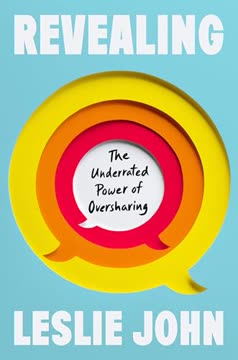
Key Takeaways
1. The Hidden Costs of Undersharing: Why Silence Hurts More Than We Think
Often, when we are cringing with shame after an epic overshare, the person we’ve shared with is actually happy to have been confided in.
Undersharing's missed opportunities. We frequently err on the side of silence, fearing the sting of "too much information" (TMI), but this caution deprives us of profound opportunities. Revealing more than comfortable can build friendships, gain trust, and even lead to finding a life partner, releasing "happiness chemicals" in our brains. The gut-wrenching dread of a "disclosure hangover" often overshadows the potential for deeper connection.
The TLI problem. The real, under-recognized issue isn't TMI, but "too little information" (TLI). This pervasive problem stems from universal cognitive traps like impact bias, where we overestimate how bad negative outcomes will feel, and omission bias, which makes harmful actions seem worse than harmful inactions. These biases push us towards silence, even when openness would be beneficial.
Long-term regret. While the immediate sting of TMI fades faster than we expect, the ache of TLI—the regret of not sharing—often compounds over time. Studies show that "regrettable failures to act" outnumber regrettable actions by nearly two to one, leaving us to curse ourselves with "Why didn't I at least try?" This highlights the profound, often invisible, costs of withholding.
2. Unmasking Our Motives: The Psychology Behind Why We Stay Silent
“Real life consists of bluffing, of little tactics of deception, of asking yourself what is the other man going to think I mean to do,” wrote von Neumann.
The performance of self. We are culturally conditioned from an early age to carefully manage how we present ourselves, often enacting a "front stage" persona while reserving our "true selves" for "backstage" moments. This self-preservation acts as armor against embarrassment, rejection, and judgment, leading us to keep an average of thirteen secrets at any given moment, many concerning romantic lives, finances, or taboo beliefs.
Bluffing and its dangers. Beyond mere self-protection, we sometimes bluff to make a better impression, like feigning confidence in a new role or acting extroverted on a first date. While strategic, this can be dangerous; for example, 80% of Americans lie to their doctors about health issues due to shame, which can be life-threatening. The perceived safety of concealment often masks real risks.
Vulnerability builds trust. Despite our inclination to conceal, openness can foster profound trust. Research shows people often prefer a "confessor" who admits to bad behavior over a "hider" who withholds information, even in high-stakes scenarios like hiring or financial trust games. This is because vulnerability acts as a "high-cost signal," demonstrating trust in others and inspiring them to trust us in return, much like puppies exposing their bellies.
3. The Goldilocks Principle: Finding the "Just Right" Balance in Disclosure
By and large, we like people who reveal to us.
The sweet spot of sharing. Just as Goldilocks sought what was "just right," effective self-disclosure lies in a delicate balance between TMI and TLI. Revealing too little can make us seem superficial, while revealing too much can be off-putting or inappropriate for the context. The goal is to disclose personal information that is somewhat sensitive or unexpected, making us relatable and likable without overstepping boundaries.
Context is king. What constitutes "just right" disclosure is highly dependent on the situation. A revelation that might be TMI in a conservative setting could be refreshingly candid in a looser environment. For example:
- Miss USA's "I would eat everything in the world!" was "just right" for a beauty pageant, making her relatable.
- Miss Trinidad and Tobago's "I would not wear clothes" was TMI for the same audience.
- Sensitive topics like sexual preferences, personal finances, or immoral behavior are consistently deemed invasive across cultures.
Avoiding the extremes. The challenge is to calibrate our sharing, moving beyond rigid rules to embrace trial and error. This involves making unconscious processes more conscious, understanding when and why we share or don't, and recognizing that the right choice isn't always about avoiding risk, but about navigating it thoughtfully to build connection.
4. Your Unique Disclosure Blueprint: Personality, Attachment, and Environment
“A person will permit himself to be known when he believes his audience is a man of goodwill,” he noted back in 1971.
Personality's role. Our individual traits significantly shape our disclosure habits. While many assume extroverts are the most revealing, agreeableness—encompassing compassion, respectfulness, and trust in others—is actually the strongest predictor of "disclosure optimism." Agreeable individuals perceive less risk in opening up, viewing it as a path to stronger relationships.
Attachment styles and flexibility. Our attachment styles, formed in childhood, also dictate our comfort with intimacy and disclosure:
- Securely attached: Most flexible, modulating openness appropriately.
- Avoidant: Tend towards "compulsive closure," keeping guard up.
- Anxious: Often "compulsive confessors," eager to reveal even when inappropriate.
Understanding these tendencies helps us make more intentional choices about when to stretch our "disclosure muscles."
Environmental influences. Beyond internal traits, external factors profoundly impact our willingness to share. Physical environments, like warm lighting or cozy rooms, can foster openness, while cultural norms also play a significant role. Collectivistic cultures, for instance, often discourage personal disclosure to maintain group harmony, whereas individualistic cultures encourage it as a means of self-expression and connection.
5. The Power of "Why": A Strategic Approach to Disclosure Dilemmas
Explicitly considering the pros, in addition to the cons, of revealing will help us; we can even jot them down, like Franklin advised his friend.
Clarifying your purpose. Before revealing, it's crucial to interrogate your "why." What are you truly hoping to achieve? This honest self-reflection helps align your actions with your goals, preventing impulsive disclosures that might backfire. For instance, Paul's discovery of his mother's secret about his brother's death forced him to weigh his desire for openness against honoring his mother's legacy and protecting his living brother.
The Benjamin Franklin upgrade. To navigate complex disclosure dilemmas, a structured approach is invaluable. Benjamin Franklin's pro/con list, adapted to distinguish between the consequences of revealing and not revealing, helps move from intuitive "System 1" thinking to deliberate "System 2" analysis. This 2x2 matrix forces us to consider:
- Pros of revealing
- Cons of revealing
- Pros of not revealing
- Cons of not revealing (often overlooked)
The burden of secrets. Actively concealing information is not inert; it demands mental work, leading to rumination, inauthenticity, and even poorer physical health. While the option to withhold feels empowering, research shows that irreversible decisions often lead to greater satisfaction. By consciously examining the costs of silence, we can make more informed choices, transforming gut churn into clarity and potentially reducing post-decisional regret.
6. Healing Through Honesty: The Profound Benefits of Putting Feelings into Words
Anything that’s human is mentionable, and anything that’s mentionable can be more manageable.
Emotional metabolism. Putting feelings into words, whether through expressive writing, journaling, or speaking aloud, acts as "emotional metabolism." This process, known as affect labeling, reduces activity in the brain's emotional alarm system (amygdala) and boosts activity in regulation centers, literally calming the mind. Even without an audience, simply naming an emotion can make it more manageable, as demonstrated in studies where participants facing tarantulas experienced reduced anxiety after verbalizing their fear.
The power of social sharing. While solitary reflection helps, describing emotions to others can be even more powerful, forcing a structure and logic onto chaotic feelings. Talk therapy, particularly cognitive behavioral therapy (CBT), leverages this, with most evidence-based approaches proving equally effective in improving well-being. Friends and loved ones also play a crucial role, offering validation, social support, and "emotional reappraisal"—helping us reframe overwhelming situations, with "this too shall pass" (temporal distancing) being particularly effective.
Lowering the disclosure threshold. We often reserve deep sharing for extreme traumas, but research suggests we benefit from lowering this threshold for everyday struggles. Studies show that confiding in close others about common worries significantly increases overall happiness. This indicates that we don't always need the "perfect" confidant; simply talking to someone who cares can be profoundly helpful, offering relief from the mental burden of secrets and shame.
7. Building Authentic Connections: Reciprocity and Vulnerability in Relationships
One key pattern associated with the development of a close relationship among peers is sustained, escalating, reciprocal, personal self-disclosure.
The reciprocity imperative. Reciprocity, a deeply ingrained human norm, is a powerful catalyst for friendship. When one person takes the risk of self-disclosure, it signals trust and often prompts a similar level of openness from the other, creating a virtuous cycle. This "give-and-take" dynamic, like hunter-gatherers sharing resources, fosters group cohesion and mutual support.
The art of mutual vulnerability. Friendship blossoms through balanced, escalating, and reciprocal self-disclosure. Arthur Aron's "36 questions" study demonstrates how structured, turn-taking vulnerability builds closeness, with matching emotional depth being more crucial than matching topics. This mutual offering creates a safe space for connection, even extending to interactions with machines, which are perceived as more likable when they "reveal" something vulnerable.
Navigating reciprocity fails. The friendship "fire" can falter in several ways:
- The Fizzle: Lack of reciprocation, leaving one person feeling exposed.
- Choking the Fire: Over-reciprocating with TMI too soon, overwhelming the other.
- Failing to Pass the Torch: One-sided sharing without inviting the other to contribute.
- Mistaking Smoke for Fire: The "illusion of reciprocity," assuming mutual closeness when one person knows much more about the other (e.g., parasocial relationships with celebrities).
These missteps highlight the need for attentiveness and balance in building and maintaining friendships.
8. The Disclosure Dance of Love: From First Dates to Lasting Bonds
The longer you communicate virtually, carefully curating your respective images, the more time and data your brains have to optimistically “fill in the gaps” about each other.
Initial intrigue: Less is more. In the early stages of dating, particularly online, less information can be more attractive. Profiles with fewer traits often garner more interest because dissimilarity is a greater turn-off than similarity is a turn-on. Sharing too much too soon can make one seem unselective or desperate, while a moderate level of availability and a demonstrated curiosity about the other person are more appealing.
The leap of vulnerability. As relationships deepen, the need for disclosure intensifies. Revealing potentially stigmatizing truths, like past divorce or health conditions, can be a necessary risk. While such revelations carry the risk of rejection, they can also foster profound connection and understanding, allowing partners to see the "real you" without misconceptions. The courage to initiate difficult conversations, even one word at a time, can transform a relationship.
Sustaining connection: Keep talking. Long-term relationships often falter not from betrayal, but from a cessation of active discovery. "Mind-reading expectations"—the mistaken belief that partners should intuitively know our thoughts and feelings—inhibit open communication and lead to resentment. Regular, explicit disclosure of thoughts and feelings, especially negative ones, is crucial for maintaining empathic accuracy and relationship satisfaction, ensuring that love continues to grow through mutual understanding.
9. Strategic Authenticity at Work: Navigating Professional Revealing and Concealing
When organizations tell workers to be themselves, they often ignore the reality of how hard it can be for young people, for minorities, for LGBTQ individuals, and for women at large to develop credibility in the workplace.
The workplace persona. The workplace demands a carefully calibrated "front stage" persona, often differing from our authentic selves. While "bringing your whole self to work" is increasingly encouraged, it presents a dilemma: how much to reveal without alienating colleagues or undermining perceived competence. "Discerning authenticity" involves a strategic balance, offering transparency (cognitive openness) about thoughts and preferences, and carefully managing vulnerability (emotional openness) about sensitive inner states.
Navigating invisible stigmas. For individuals with invisible stigmatized identities (e.g., mental illness, neurodivergence, sexual orientation), the decision to disclose is fraught. Concealing can lead to emotional burden and inauthenticity, while revealing risks bias and discrimination. Research suggests it's often safest to build trust before disclosing, or to reveal after securing a job offer, pairing the disclosure with specific accommodation requests to frame it as competence rather than weakness.
When disclosure is inevitable. Some aspects of identity, like pregnancy or progressive disabilities, eventually become visible. In these cases, the question shifts from whether to disclose to when, to whom, and how. Proactive, purposeful disclosure to relevant individuals (e.g., HR or a trusted senior colleague) can help manage perceptions and secure necessary support, rather than allowing the truth to emerge secondhand, which can negatively impact how others perceive you.
10. Leaders Who Dare to Share: Inspiring Trust and Driving Change
A leader confident enough to admit mistakes doesn’t come across as weak—they come across as real.
The warmth/competence tightrope. Leaders, especially women, walk a fine line between appearing warm and competent. While unwavering confidence is often expected, it can backfire, making leaders seem like "confident fools" when they stubbornly defend flawed ideas. Instead, leaders who acknowledge shortcomings or reveal personal weaknesses are often perceived as more authentic, trustworthy, and inspiring, fostering a culture where employees feel safe to offer honest feedback.
Vulnerability as strength. When leaders have established trust, expressing vulnerability can deepen their authority. The school principal who admitted her anxiety about school closure, or the Google executive who shared his 35 job rejections, both inspired greater trust and motivation. This "strength in weakness" demonstrates security and relatability, encouraging followers to connect on a human level. However, such disclosures must be proportionate and purposeful, avoiding "floodlighting" that can overwhelm or appear self-serving.
Catalyst confessions and societal impact. Beyond the immediate team, prominent leaders' deeply personal disclosures can spark broader social change. Magic Johnson's HIV announcement shattered stigma and inspired testing, while Brook Mahealani Lee's subtle jab at pageant weight clauses challenged body standards. These "catalyst confessions" model courage, shift norms, and empower others to speak their truth, demonstrating that vulnerability, when handled thoughtfully, can be a powerful force for positive transformation.
People Also Read

 Immersive

 Immersive

 Immersive



 Immersive








































