


Key Takeaways
Choose beliefs like a carpenter chooses tools — by what they build
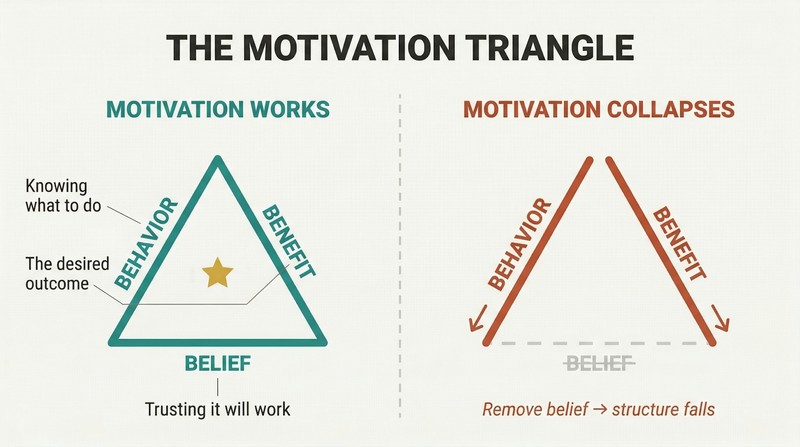
Nir Eyal spent 30 years cycling through diets — low-fat, keto, intermittent fasting. Every plan worked while he believed in it and collapsed the moment doubt crept in. This mirrors Curt Richter's 1950s rat experiment: wild rats drowned within 15 minutes in water cylinders, but rats who were briefly rescued and returned swam for over 60 hours. Their bodies hadn't changed; their expectations had.
The Motivation Triangle captures this insight. Motivation requires three sides:
1. Behavior: knowing what to do
2. Benefit: the desired outcome
3. Belief: trusting your actions will produce results
Remove belief, and the other two collapse. Eyal argues that the most common cause of failure isn't bad strategy — it's quitting before efforts can pay off.
Your brain filters 11 million bits to 50 — beliefs decide what survives
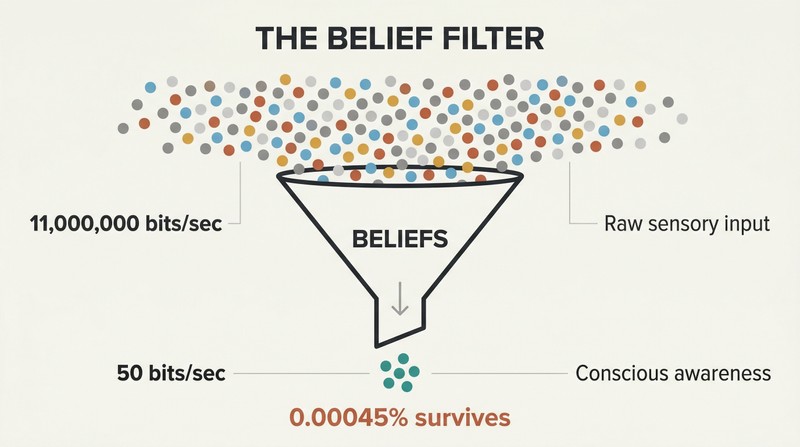
Your senses collect 11 million bits of data per second — equivalent to reading War and Peace twice. Your conscious mind handles about 50. That gap means you're aware of roughly 0.00045% of available information. Beliefs act as a nonconscious editorial team, assembling a curated highlight reel of reality.
Daniel Gisler demonstrated this dramatically: the 56-year-old underwent ankle surgery without anesthesia, using hypnosedation to redirect his attention entirely away from pain. Brain scans of such patients show measurably reduced activity in pain-processing regions. Gisler felt nothing while the surgeon pried screws from bone — until the surgeon said "ten minutes remaining," breaking his focus. The pain of tiny closing stitches hit harder than the entire operation. Same body, same nerves — different beliefs about what to attend to.
When problems get rare, your brain expands the definition
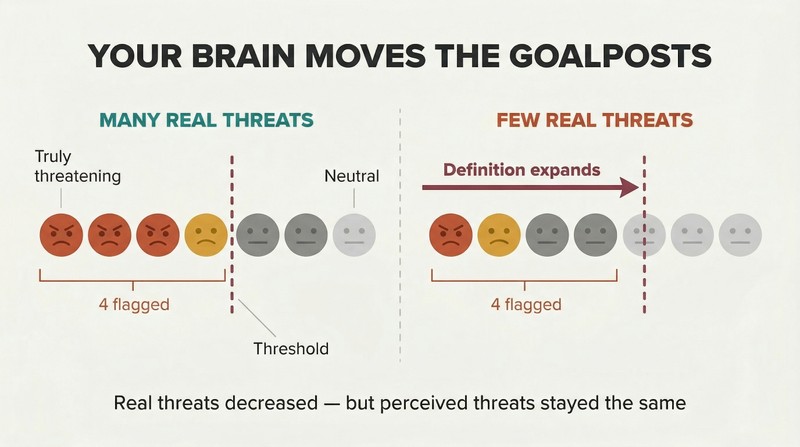
Harvard psychologist David Levari showed participants 800 faces ranging from threatening to neutral, asking them to flag the threatening ones. As researchers reduced angry faces, participants didn't notice fewer threats — they started labeling neutral faces as threatening. Their brains expanded the definition to match expectations. The same pattern held with colored dots and ethics proposals.
This "prevalence-induced concept change" explains real-world puzzles. U.S. violent crime dropped 49% from 1993 to 2019, yet most Americans reported crime was increasing every year. In relationships, the mechanism turns innocent comments into perceived attacks. Eyal recommends combating this through illeism — talking about yourself in the third person ("Sarah is struggling but will figure it out"), which brain scans show quiets impulsive regions without extra mental effort.
Turn your judgment around three ways before you believe it
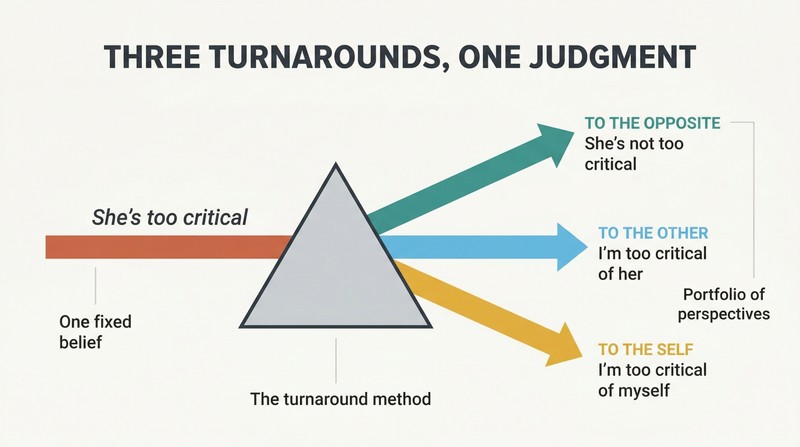
When Eyal's mother mentioned her birthday flowers were wilting, he erupted sarcastically. Decades of believing "she's too critical" had turned practical information into a personal attack. His wife, hearing the same words, perceived a simple observation.
Using Byron Katie's turnaround method, Eyal examined his belief through four questions — Is it true? Can I be certain? How do I react believing this? Who would I be without it? — then flipped the judgment:
1. To the opposite: "She's not too critical" (she had thanked him first)
2. To the other: "I'm too critical of her" (he demanded specific gratitude)
3. To the self: "I'm too critical of myself" (a wilted flower became evidence of his inadequacy)
The goal isn't finding the "correct" interpretation but building a portfolio of perspectives — a range of plausible views that free you from reflexive negativity.
Lucky people don't get more breaks — they see more opportunities
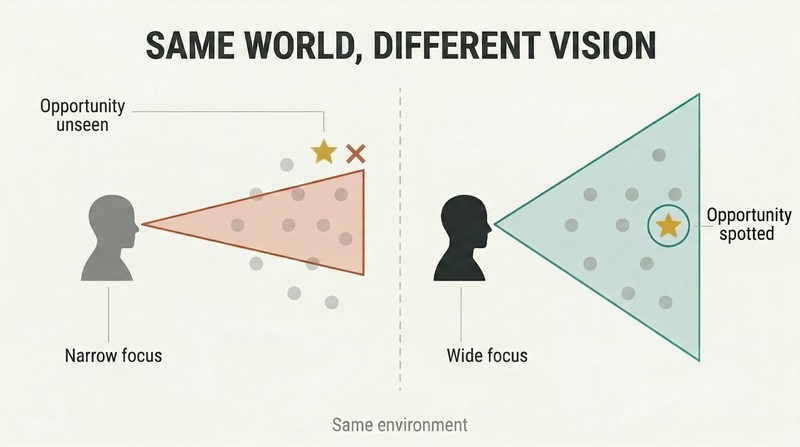
Psychologist Richard Wiseman hid a message in a newspaper task: "Stop counting. There are 43 photos. Tell the experimenter and win $250." Self-described "unlucky" people missed it entirely, too focused on counting. "Lucky" people spotted it easily. They weren't luckier — they were looking wider.
Anne Mahlum embodied this. After watching her gambling-addicted father rebuild his life, she developed a belief that transformation was always possible. That filter helped her notice homeless men others walked past, founding Back on My Feet (15,000+ people served). The same perceptual training led her to spot a fitness opportunity that became [solidcore], sold for nearly $100 million. Research shows 76 – 88% of "lucky" sales breakthroughs resulted from strategic actions. Eyal recommends setting "failure goals" — targets for rejection that paradoxically increase success.
Expectations physically change what you taste, feel, and perform
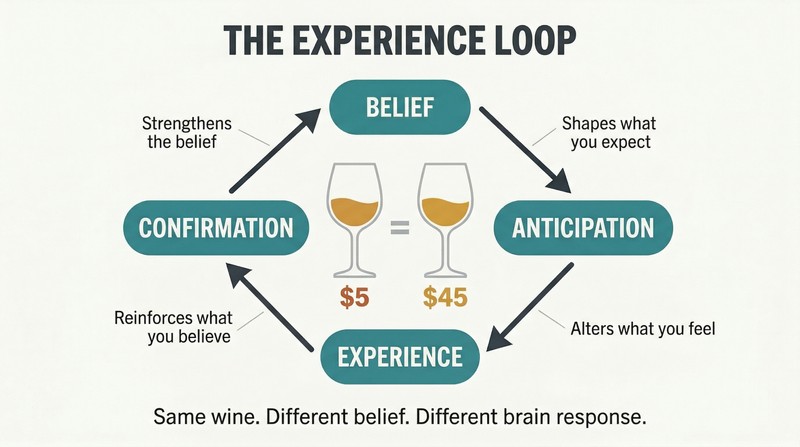
In a Stanford fMRI study, participants drank identical wines labeled "$5" and "$45." The expensive wine didn't just taste better in self-reports — their brains' pleasure centers lit up more intensely. The wine was chemically the same. Their expectations had physically rewired the tasting experience.
Eyal calls this the Experience Loop: a four-step cycle where beliefs create anticipation, anticipation shapes feeling, and feelings confirm the original belief. Liquid Death, a $1.4 billion water brand, exploits this: edgy skull-adorned cans prime drinkers to expect rebellion, transforming ordinary water into a statement. The same mechanism explains why Toyota Corolla owners rated their cars tenth in quality while owners of the identical Geo Prizm ranked theirs twenty-eighth. Same car, different beliefs, genuinely different experience.
Placebos work even when you know they're placebos
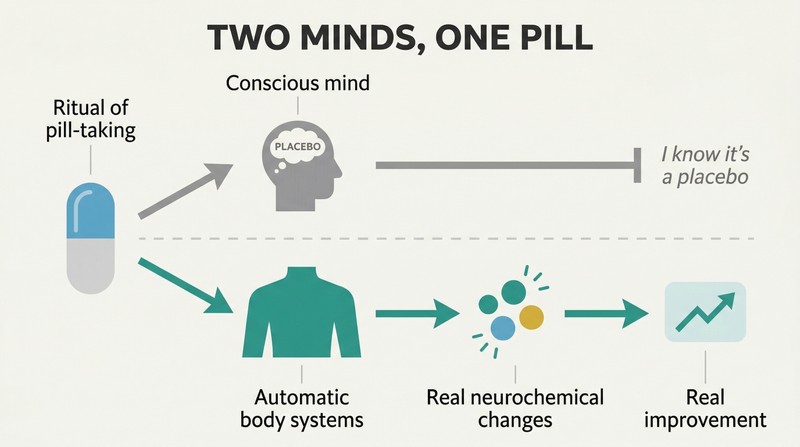
Harvard's Ted Kaptchuk gave IBS patients pills clearly labeled "placebo," explaining the pills were inert sugar that had shown benefits through mind-body mechanisms. After three weeks, the open-label placebo group improved significantly — comparable to effects of actual IBS medications.
Your rational mind processes the label, but your body's automatic systems still respond to the ritual of pill-taking. These unconscious patterns trigger real neurochemical changes — like crying during a movie you know is fiction. This extends beyond pills: pain reprocessing therapy helped 66% of chronic back pain patients become pain-free in four weeks by retraining the brain's predictions through neutral observation of sensations, safety reappraisal, and pairing movement with positive emotion rather than fear.
Positive aging beliefs add 7.5 years — more than exercise or cholesterol
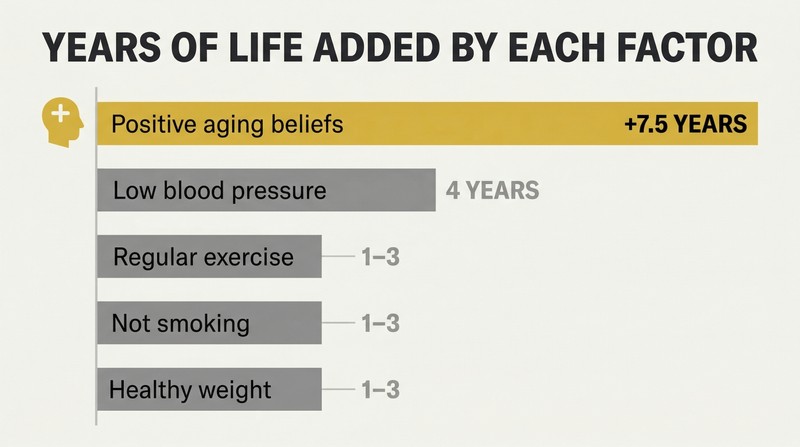
Yale researcher Becca Levy tracked 660 people aged 50+ for nearly 23 years. Those with positive views of aging lived 7.5 years longer — an effect larger than low blood pressure (four extra years), healthy weight, not smoking, or regular exercise (one to three years each). Even more striking: aging stereotypes absorbed in young adulthood predicted cardiovascular events up to 38 years later.
The mechanism isn't magical. Negative aging beliefs ("I might fall," "I'm too old") trigger avoidance of challenges, leading to deconditioning, isolation, chronic stress, and accelerated biological aging. Positive beliefs reverse the cycle: Singapore's Team Strong Silvers, fitness enthusiasts in their late 60s and 70s, maintain routines most people abandon decades earlier — because their beliefs fuel behaviors that reshape what aging means biologically.
Helplessness is your brain's factory setting — agency must be built
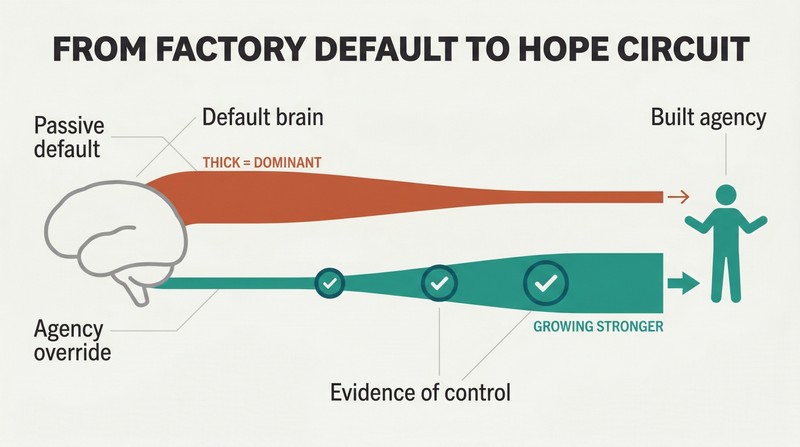
For 50 years, psychologists believed helplessness was learned. Seligman's experiments showed dogs shocked without escape stopped trying even when escape became possible. But modern brain imaging revealed a reversal: passivity is the brain's default. A specific brain region must actively override that default when it detects a possibility of control.
Agency is built through evidence. Arachnophobics who progressively touched a live tarantula in a single two-hour session showed measurable neural rewiring in fear-processing regions. Dashrath Manjhi carved a 360-foot road through solid rock over 22 years with a hammer and chisel after his wife died because a mountain blocked access to medical care. Research confirms an internal locus of control predicts better outcomes across mental health, physical health, relationships, and career — even when objective circumstances are identical.
Fantasizing about success drains the energy you need to achieve it
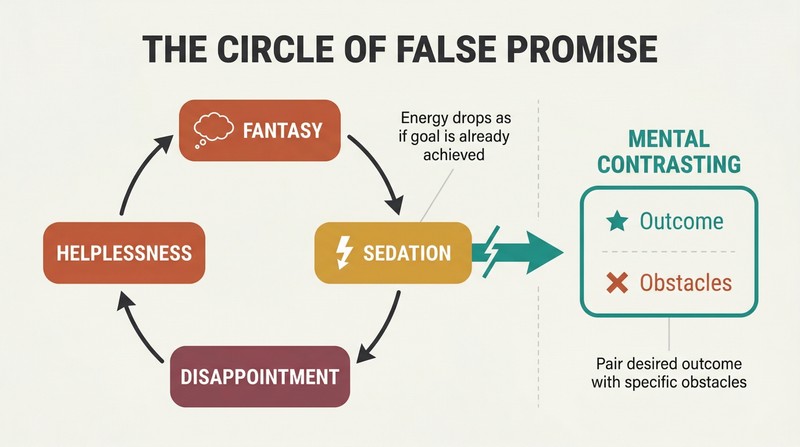
NYU psychologist Gabriele Oettingen found that positive fantasies don't motivate — they sedate. People who vividly imagined achieving goals showed immediate physiological relaxation, as if the goal were already accomplished. From academics to weight loss to careers, more fantasizing consistently predicted worse outcomes.
Eyal calls this the Circle of False Promise: fantasy feeds disappointment, disappointment feeds helplessness, helplessness drives deeper fantasy. The antidote is mental contrasting — pairing desired outcomes with specific obstacles. David Fajgenbaum, a medical student diagnosed with a typically fatal disease, abandoned the Santa Claus theory (waiting for experts to rescue him) and systematically cataloged every barrier. He discovered a drug already on pharmacy shelves that targeted two overlooked biomarkers in his blood work. He's been in remission for over a decade.
Analysis
Eyal's contribution to the self-help landscape is one of sophisticated synthesis rather than single-study revelation. He draws from predictive processing theory (Clark, Seth), placebo research (Wager, Kaptchuk), cognitive behavioral frameworks (Byron Katie, Oettingen), and agency psychology (Seligman, Maier) to construct a unified model of how belief operates through three distinct channels: what we perceive, what we feel, and what we do.
The book's most valuable intellectual move is threading the needle between two extremes that have plagued popular psychology. On one side lies the magical thinking of manifestation culture, which Eyal dismantles with Oettingen's research showing positive fantasies physiologically sedate rather than activate. On the other lies pure rationalism, which demands certainty before action and breeds paralysis. Eyal's 'beliefs as tools' framing echoes American pragmatism — William James's argument that an idea's value lies in its practical consequences — but grounds it in contemporary neuroscience rather than philosophy.
The Three Powers framework (attention → anticipation → agency) maps neatly onto a see → feel → do progression that gives readers a cognitive scaffold without oversimplifying. Each power builds on the last: you cannot feel what you don't notice, and you cannot act on what you don't feel.
Where the book is most provocative is its prayer chapter, which applies the belief-as-tool framework to religion without endorsing or dismissing faith. Eyal's constructive translation concept offers a pragmatic path for the growing 'spiritual but not religious' demographic who — research shows — suffer higher rates of anxiety and depression, possibly because they lack the structured practices they abandoned.
The honest handling of replication failures (the counterclockwise study, the housekeeper study) strengthens the thesis by modeling the intellectual flexibility Eyal advocates. However, the book's core tension — between choosing beliefs pragmatically and remaining evidence-based — is never fully resolved. The line between a liberating belief and a comforting delusion is precisely where the hard work of belief management lives, and that ambiguity deserves more sustained scrutiny than Eyal provides.
Review Summary
Beyond Belief receives overwhelmingly positive reviews (4.63/5), praised for making belief practical rather than abstract. Readers appreciate Eyal's framework showing how beliefs shape attention, anticipation, and agency. The book critiques manifestation culture while offering evidence-based alternatives, pairing hope with action. Standout chapters explore prayer, labels, and nocebo effects. Reviewers value the chapter summaries and practical tools, comparing it favorably to books like Atomic Habits. Some found Part 3 repetitive, but most consider it transformative, with many calling it Eyal's best work—a thoughtful guide for living between certainty and doubt.
People Also Read





Glossary
Motivation Triangle
behavior + benefit + beliefEyal's framework for sustained motivation. Three elements must work together: behavior (knowing what to do), benefit (the desired outcome), and belief (the conviction that actions will produce results). When any side collapses—especially belief—motivation fails and people quit. Distinguishes this model from simpler cause-and-effect views of motivation.
Three Powers of Belief
attention, anticipation, and agencyEyal's overarching framework for how beliefs shape lives through three channels. Attention determines what we perceive and notice. Anticipation shapes what we physically feel and expect. Agency drives what we do and how we act despite uncertainty. Each power builds on the previous, forming a see-feel-do progression that turns internal conviction into external action.
Experience Loop
believe-anticipate-feel-confirm cycleA self-reinforcing four-step cycle explaining how beliefs transform physical experience. Step 1: Believe (form an expectation). Step 2: Anticipate (body physiologically prepares for the expected experience). Step 3: Feel (interpret sensations through the lens of expectations). Step 4: Confirm (reflect on the experience, reinforcing the original belief). Explains why identical wines taste different at different prices.
Portfolio of perspectives
range of plausible interpretationsA set of multiple valid ways to view the same situation or relationship, developed through practices like the turnaround method. Rather than replacing one rigid belief with another, the goal is to hold several perspectives simultaneously and choose the one that best serves connection and understanding in a given moment. Contrasted with the single-interpretation trap of automatic judgments.
Circle of False Promise
fantasy-disappointment-helplessness loopEyal's term for the self-reinforcing cycle created by pure positive thinking. Begins with an uplifting fantasy of success, followed by disappointment when reality requires far more effort than imagined, then helplessness and reduced action, which drives escape back into fantasy. Each cycle deepens the conviction that one is personally inadequate, making future action less likely.
Santa Claus theory
experts will rescue meDavid Fajgenbaum's term, adopted by Eyal, for the comforting but disempowering assumption that someone else—a doctor, expert, or authority—already has the answer to your problem. Directs attention toward finding the right rescuer rather than developing personal understanding, creates expectations of external rescue, and encourages passivity disguised as appropriate deference to authority.
Selective skepticism
question limiting, keep helpfulEyal's recommended approach for evaluating beliefs. Rather than cynically debunking every source of enjoyment or uncritically accepting every assumption, question beliefs that limit you or drain your energy while preserving harmless beliefs that add meaning, joy, or connection. The test: 'Is this belief serving me, or am I serving it?'
Liberating beliefs
beliefs that expand capabilityBeliefs that expand a person's capacity to act, grow, and engage with reality—as opposed to limiting beliefs, which contract one's sense of possibility. A liberating belief must meet three criteria: it holds up to real-world feedback, remains open to revision based on new evidence, and does not require ignoring evidence to sustain. Central to the book's thesis that beliefs should be chosen for usefulness.
Mental contrasting
pair dreams with obstaclesGabriele Oettingen's evidence-based technique for turning wishes into actionable plans. Involves deliberately pairing a vivid image of a desired future with a clear-eyed assessment of specific obstacles in the way. Research shows this creates automatic mental links between challenges and potential responses, producing greater persistence and achievement than either positive thinking or realistic thinking alone.
Constructive translation
reinterpret religious language personallyEyal's approach to participating in religious or spiritual communities without requiring literal theological belief. Involves mentally translating religious language into personally meaningful terms—for example, hearing 'God's love' as universal compassion, or 'divine will' as natural order. Allows intellectual integrity while accessing the psychological and communal benefits of structured spiritual practice.
The turnaround method
flip judgments three waysA practice from Byron Katie's 'The Work,' used extensively by Eyal for relationship repair. After questioning a judgment through four inquiry questions, the belief is flipped three ways: to the opposite ('She's not too critical'), to the other ('I'm too critical of her'), and to the self ('I'm too critical of myself'). Genuine evidence is sought for each version to build a portfolio of perspectives.
Neuroplastic pain
brain-predicted pain without injuryPain sustained not by ongoing tissue damage but by the brain's learned predictions of danger. The brain continues generating pain signals based on expectation and fear even after physical healing is complete. Creates a pain-fear-pain cycle where anticipating discomfort amplifies symptoms and avoidance reinforces the cycle. Treated through pain reprocessing therapy, which retrains the brain's predictions through observation, safety reappraisal, and positive affect.
Download PDF
Download EPUB
.epub digital book format is ideal for reading ebooks on phones, tablets, and e-readers.








































