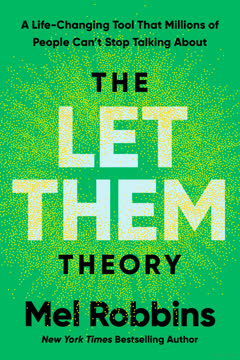
Key Takeaways
Two words end the exhausting cycle of managing other people
“The more you let other people live their lives, the better your life gets.”
Born at a high school prom. When Robbins panicked that her son's 20 friends had no dinner reservation and were heading to a tiny taco bar in a downpour, her daughter grabbed her arm: "Mom, if they want to go to a taco bar, LET THEM. Let them get soaked." The tension instantly dissolved. Within a week, Robbins applied Let Them to traffic, family judgment, dishes in the sink — and felt weirdly above it all.
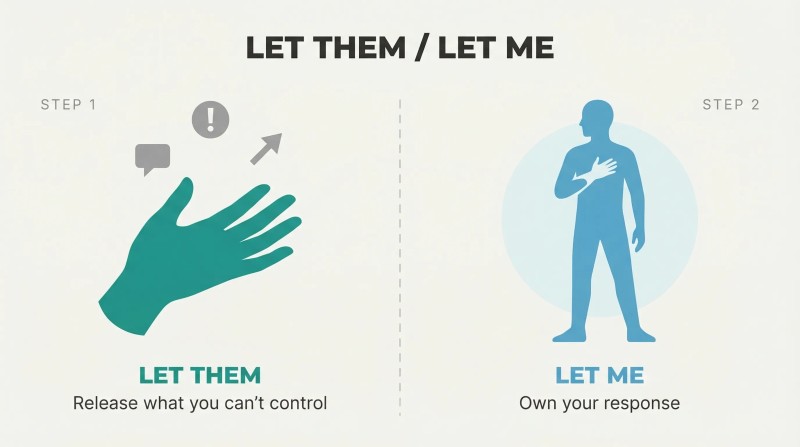
The theory has two steps. Say "Let Them" to release your grip on what you cannot control — others' choices, opinions, and behavior. Then say "Let Me" to take responsibility for your own response. Robbins posted a 60-second video explaining the concept; 60 million people saw it within a week, and thousands got "Let Them" permanently tattooed on their bodies.
"Let Them" alone breeds isolation — "Let Me" is the real power move
“If all you ever do is say Let Them, Let Them, Let Them, it will lead you to feel more isolated.”
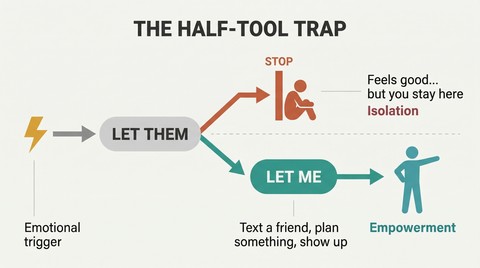
The seesaw trap. Robbins uses a seesaw metaphor: internalizing others' actions sends you down; saying Let Them lifts you into temporary superiority. That jolt feels great — you're above the drama, detached, in control. But if you stay perched there, you become smug, withdrawn, and disconnected from people you actually like.
The real power is in "Let Me." When Robbins saw old friends' girls' trip photos and felt excluded, Let Them stopped the spiral. But Let Me forced honest self-reflection: she hadn't reached out or planned anything in years. Nobody owed her an invite. Let Me prompted her to text old friends, throw a party, and prioritize her social life. Without the second step, the theory becomes an excuse for disconnection — not a tool for empowerment.
Saying "Let Them" resets your brain from survival to strategy
“Focusing on what you can't control makes you stressed. Focusing on what you can control makes you powerful.”
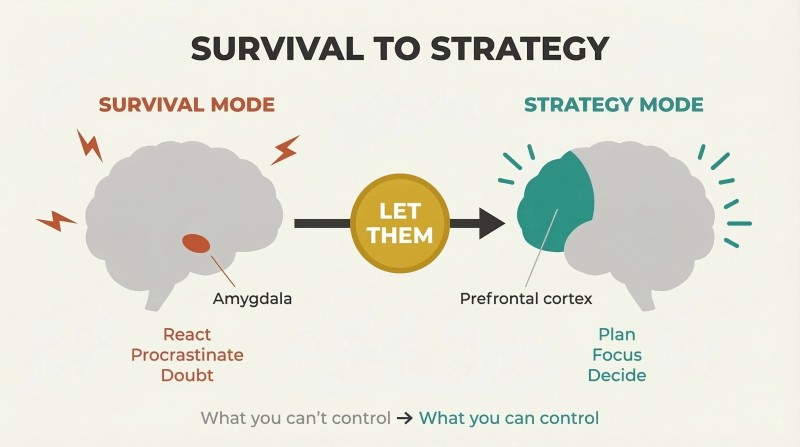
Your stressed brain can't strategize. Dr. Aditi Nerurkar of Harvard explains that stress shifts brain control from the prefrontal cortex — which handles planning, focus, and decisions — to the amygdala, which drives fight-or-flight reactions. Seven out of ten people currently live in this chronic stress state, locked in survival mode where procrastination, self-doubt, and doom-scrolling take over.
"Let Them" flips the switch. When a man coughed openly on Robbins' flight, she spiraled into frustration — until she said Let Them cough, then Let Me cover my mouth with a scarf and put on headphones. The deep breath following "Let Me" stimulates the vagus nerve, signaling the brain to restore prefrontal cortex control. Without this reset, you'd burn hours retelling the story, draining energy that belongs to your goals.
Grant people freedom to judge you — it unlocks yours to act
“Every time you edit what you post, or stay silent in class or at work, or hide in the back of the group photo, you are engaging in self-rejection.”
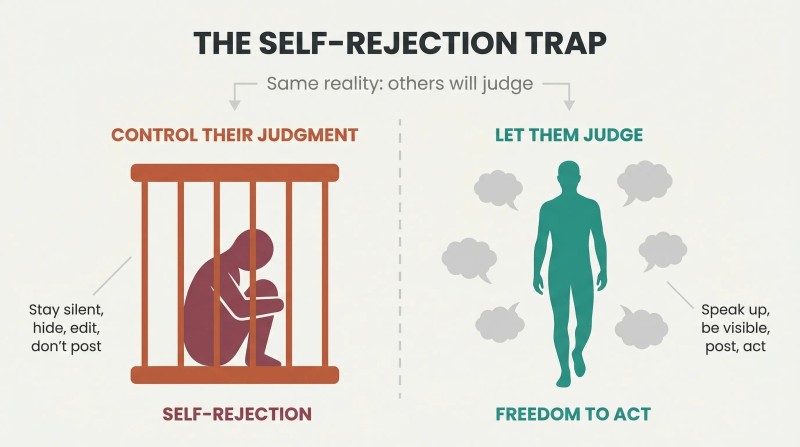
Self-rejection disguised as caution. Robbins spent two years paralyzed from posting about her speaking business online — while $800,000 in debt. She created hundreds of draft posts that never went live because she feared friends would think "Who does she think she is?" This fear cost her years of income and clients.
The math makes it absurd. The average person has roughly 70,000 thoughts daily, most random and uncontrollable. Even loved ones think critical things constantly — Robbins calls her husband "disgusting" every morning when he farts, yet adores him. Two things coexist: someone can judge your career pivot AND still love you. Since controlling anyone's 70,000 daily thoughts is neurologically impossible, stop trying. Make decisions that make YOU proud — when you're proud of yourself, you hold all the power.
Treat adult tantrums with compassion, not compliance
“This isn't a personality trait, it's a pattern.”
The child-adult parallel is startling. Children sulk in corners; adults give the silent treatment. Children throw tantrums; adults rage-text and erupt. Children slam doors; adults do too. Robbins' therapist Anne Davin explained that most people never learned to process emotions as children — because their parents didn't know how either — and now carry that deficit into every adult relationship.
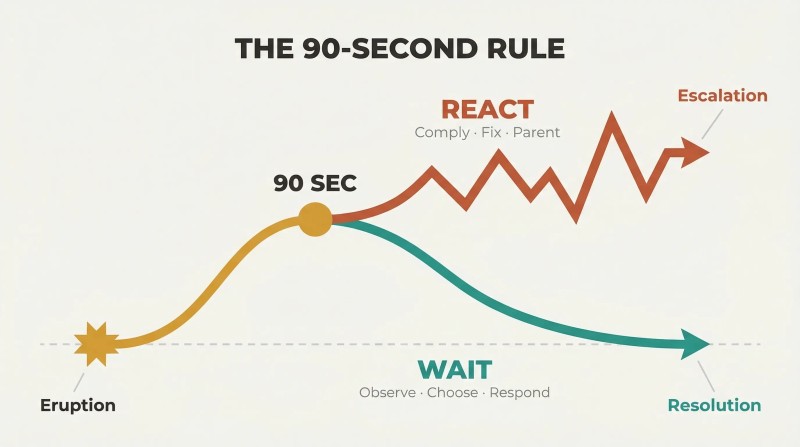
Ninety seconds changes everything. Research shows emotions are chemical bursts that rise and fall within 90 seconds if you don't react. When someone erupts, goes silent, or plays victim, their emotional immaturity is not your fault or problem to fix. Let Them erupt. Then Let Me be the mature adult — decide whether this warrants engagement, remove yourself from toxic text chains, or simply wait before responding. Stop parenting other grown-ups.
Flip jealousy from self-torture into a roadmap for action
“Jealousy is an invitation from your future self.”
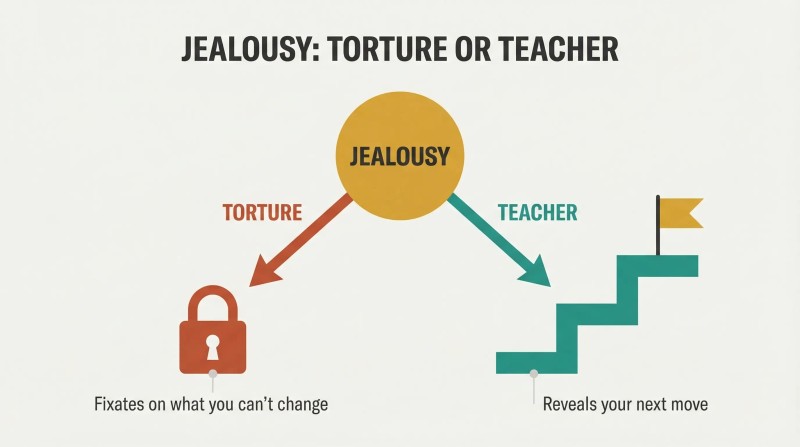
Torture comparison targets the unchangeable. Robbins defines two types of comparison. "Torture" fixates on fixed attributes — genetics, height, family wealth. Her daughter Sawyer spent years miserable comparing her body to sister Kendall's different build and metabolism. If you can't change it in 30 seconds, obsessing over it is pure self-destruction.
Teacher comparison reveals your next move. Robbins' friend Molly, a talented interior designer, spiraled when a neighborhood rival with zero design experience launched a polished website and went viral online. But the rival had simply followed the formula Molly had avoided for years. Robbins reframes this: 95% of what you want is achievable through consistent work. The irritating person triggering your jealousy isn't stealing your success — they're showing you the reps you haven't put in yet.
Adult friendship died as a group sport — rebuild it by going first
“When you are an adult, your social life is your responsibility.”
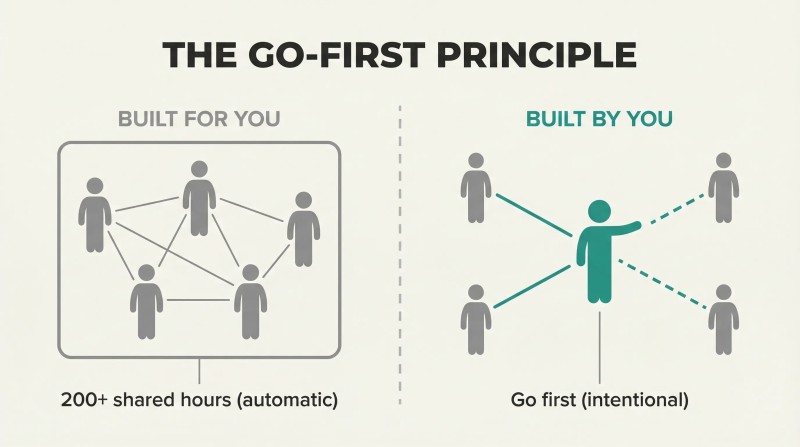
Friendship's structure vanishes overnight. In your 20s, what Robbins calls the Great Scattering hits: school ends, friends scatter, and the built-in structure guaranteeing 200+ hours together — the University of Kansas threshold for "close" friendship — disappears. From ages 21 – 60, you spend more time with co-workers than friends and family combined, yet co-workers often occupy different life chapters.
Robbins rebuilt her social life at 54 after moving to a town where she knew nobody. Her strategy: "go first." She knocked on a neighbor's door, learned baristas' names, and created a Wednesday walking group still running three years later. Her playbook:
1. Compliment people everywhere
2. Ask curious questions
3. Smile and say hello to everyone
4. Do it without expectations
5. Give it a full year
Pressure makes people dig in — model the change instead
“Pressure doesn't create change — it creates resistance to it.”
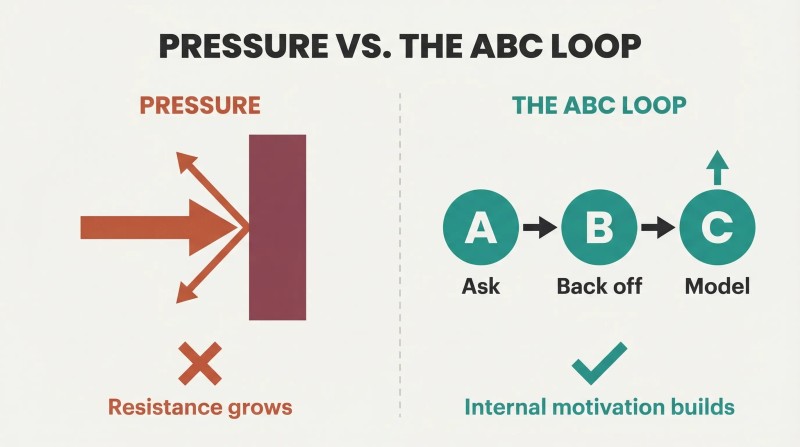
The brain fights your pressure. Harvard psychiatrist Dr. Alok Kanojia explains humans are wired to seek immediate pleasure and avoid immediate pain — exercising hurts NOW; the couch is comfortable NOW. Neuroscientist Dr. Tali Sharot adds that people believe negative consequences won't apply to them; brain scans show the region processing threatening information literally shuts off. Your nagging isn't even registering.
Replace pressure with the ABC Loop:
1. A — Apologize for nagging, then Ask open-ended questions ("How do you feel about your health right now?")
2. B — Back off and observe their Behavior
3. C — Celebrate any progress while Continuing to model the Change yourself
The goal: let someone feel internal tension between their desires and their inaction. That tension — not your pressure — becomes their motivation. Give it at least six months.
Stop rescuing adults — subsidizing avoidance prevents healing
“The more you try to rescue someone from their problems, the more likely they will continue to drown in them.”
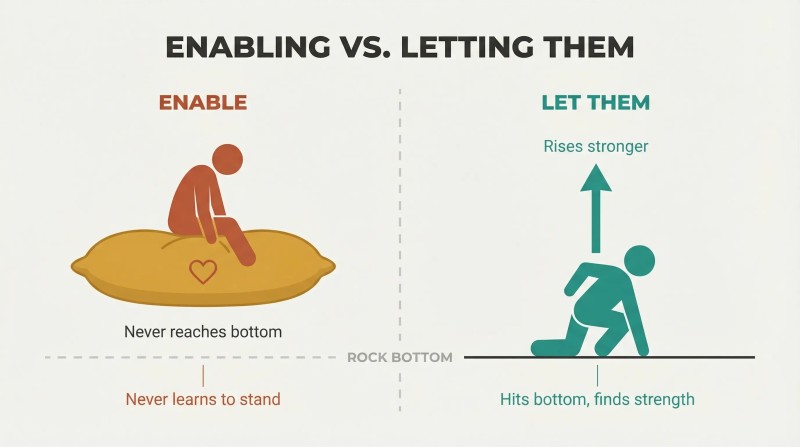
Enabling wears a loving mask. Covering for someone's drinking, paying rent without conditions, or making excuses for destructive behavior feels supportive but shields people from the consequences they need to change. Harvard's Dr. Robert Waldinger insists: "Don't shield them from the consequences of what they choose."
Money is the final lever. When Chris's restaurant was failing, he asked his brother for a loan. The brother refused: "I won't bail you out." It became Chris's rock bottom — he quit the business and confronted his depression and drinking. Robbins draws a hard line: money without conditions is enabling; money with specific conditions ("I'll pay for therapy if you attend sessions") is genuine support. Sometimes the most loving act is refusing to cushion the fall so someone finally builds the strength to stand.
Confusion about someone's feelings IS the answer
“Mixed signals aren't 'mixed' at all. They send a very clear message that you are not a priority; you're a convenience.”
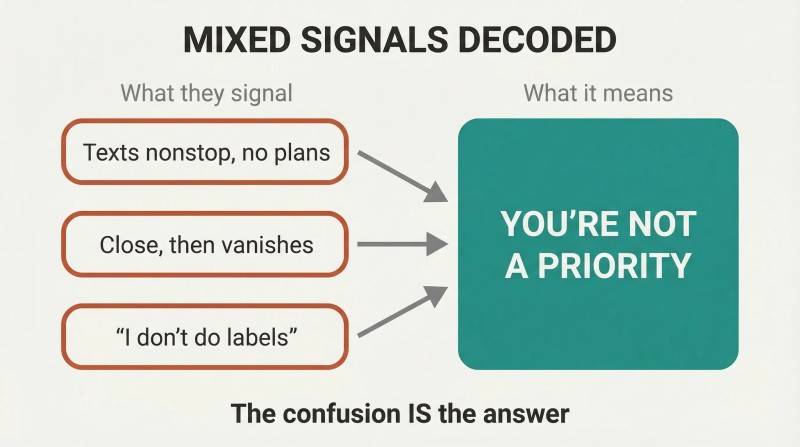
Self-deception is dating's real enemy. When someone texts constantly but never makes plans, hooks up when drunk but vanishes sober, or says "I don't like labels," your instinct is to invent excuses. Robbins is blunt: if they wanted to see you, they'd make plans. The confusion you feel is the message — you're chasing potential, not reality.
The commitment conversation flips the script. Relationship coach Matthew Hussey taught Robbins a framework: don't focus on convincing them — focus on the value of YOUR time. The script: "I've loved spending time with you. I'm looking for a commitment. If you don't see the same thing, this has been great — but I need to invest my time where it's going somewhere." No guilt trip. No accusations. Just standards. Finding love is more about saying no to the wrong people than saying yes to every possibility.
69% of relationship fights won't resolve — decide to accept or leave
“If you're going to choose them, you owe it to them and to yourself to choose them exactly as they are.”
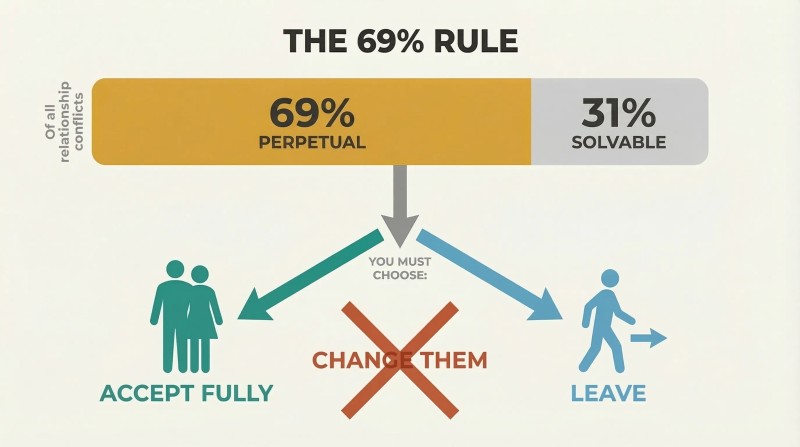
Most fights are permanent fixtures. Researchers John and Julie Gottman spent 40 years studying couples and found that 69% of relationship conflicts are perpetual — rooted in fundamental personality differences that will never fully resolve. One partner is always late; the other compulsively punctual. One craves adventure; the other nests.
Robbins extends her framework to the ABC(DE) Loop. After using A (apologize, ask), B (back off), and C (celebrate, model) for three months with no change, move to D: Decide if it's a deal breaker. Ask: "Could I be with this person forever if they NEVER change?" Then E: End your bitching or end the relationship. Robbins' ADHD drives husband Chris crazy — lost keys, chronic lateness, messes everywhere. He chose to accept it. Choosing someone means choosing all of them, not the polished version you wish existed.
Analysis
The Let Them Theory occupies a strategic position in the self-help landscape — it is applied Stoicism repackaged for the age of social media anxiety and chronic comparison. Where Marcus Aurelius wrote about controlling only your own mind, Robbins distills the principle to two syllables that can short-circuit an amygdala hijack before it spirals into a rage text or a week-long silent treatment.
What distinguishes the framework from garden-variety 'let it go' advice is the explicit warning against passive detachment. Robbins discovered through audience feedback that people who stopped at 'Let Them' became isolated, smug, and disconnected — a pitfall that mirrors well-documented risks of misapplied Stoic detachment. The 'Let Me 'component transforms the theory from avoidance into agency, from resignation into responsibility. This two-step architecture gives it durability across wildly different domains — from a coughing stranger on a plane to a spouse who won't exercise.
The book's empirical backbone is stronger than typical pop self-help. Dr. Tali Sharot's finding that brain regions literally deactivate when processing threatening information provides neurological justification for abandoning fear-based persuasion entirely. Dr. Kanojia's motivational interviewing research explains why open-ended questions succeed where pressure fails. The Gottmans' 69% perpetual-problem statistic reframes marital friction from failure to inevitability — liberating couples from the myth that all problems should be solvable.
However, the framework's radical simplicity is both engine and limitation. Complex dynamics involving abuse, systemic power imbalances, or severe mental illness resist two-word solutions, and the boundary between 'Let Them be themselves' and 'Let Them harm you' could use sharper clinical distinctions. Still, for the majority of readers burning emotional bandwidth on uncontrollable minutiae, this is among the most accessible entry points available — a rare framework that simultaneously improves self-regulation AND relational quality, which most self-help books sacrifice one for the other.
Review Summary
The Let Them Theory by Mel Robbins has received mixed reviews. Many readers praise its simple yet powerful message of accepting others and focusing on self-improvement. They find the book life-changing and appreciate Robbins' personal anecdotes. However, critics argue the concept is common sense, the book is repetitive, and could have been condensed. Some question the originality of the idea, citing potential plagiarism. Despite polarizing opinions, many readers find value in the "Let Them" and "Let Me" principles for managing relationships and personal growth.
People Also Read
 Immersive
 Immersive
 Immersive



Glossary
Let Them Theory
Two-part boundary and empowerment frameworkA framework for managing relationships and reclaiming personal power. Step one ('Let Them') involves consciously releasing your need to control other people's thoughts, actions, and opinions. Step two ('Let Me') redirects your energy toward what you can control—your own response, decisions, and behavior. Created by Mel Robbins after her daughter said 'Let Them' at a high school prom.
Let Me
The action and responsibility stepThe second and more critical half of the Let Them Theory. After releasing control of others' behavior, 'Let Me' prompts you to take responsibility for your own next move—whether setting a boundary, reaching out to a friend, pursuing a goal, or changing how you show up. Without this step, Robbins warns the theory leads to isolation and superiority rather than empowerment.
The Great Scattering
Post-school friendship dispersal phaseRobbins' term for the friendship transition in your 20s when school's built-in social structure disappears. Friends scatter to different cities, jobs, and life stages. Friendship shifts from a 'group sport' (automatic inclusion) to an 'individual sport' (requiring proactive effort). The scattering repeats at every major life transition—marriage, parenthood, career change, divorce, retirement—requiring flexibility each time.
Three Pillars of Friendship
Proximity, timing, and energyThree invisible factors determining whether adult friendships form and endure. Proximity means physical nearness and frequency of contact. Timing means being in the same life chapter with shared experiences. Energy is the intangible click between two people. A University of Kansas study found becoming a 'close' friend requires over 200 hours together—easy during school, difficult for adults who must create those hours intentionally.
Frame of Reference
Someone's experience-shaped perspective lensA concept shared by Lisa Bilyeu, meaning the lived-experience lens through which someone views a situation. When a family member disapproves of your choices, understanding their Frame of Reference—the fears, losses, and experiences shaping their opinion—can transform judgment into compassion. Two people can both be 'right' because they operate from different Frames of Reference shaped by different life histories.
ABC Loop
Three-step influence-without-pressure techniqueRobbins' framework for influencing behavior change without pressure, combining motivational interviewing and social contagion research. A: Apologize for past pressure, then Ask open-ended questions to help someone feel the gap between desires and behavior. B: Back off and observe Behavior without intervening. C: Celebrate progress while Continuing to model Change. Extended to ABC(DE) for relationships, where D means Decide if it's a deal breaker and E means End your complaining or End the relationship.
5 Whys Method
Root cause discovery through repetitionOriginally created by Sakichi Toyoda for Toyota engineering, adapted by Robbins as preparation for difficult conversations. You ask 'Why does this bother me?' five consecutive times, each answer becoming the subject of the next 'why.' The technique uncovers the deeper emotional root beneath surface frustration—often revealing the issue is about your own fear of losing control, not the other person's behavior.
The Standoff
Pressure-resistance deadlock between peopleThe self-reinforcing dynamic that emerges when you pressure someone to change. The more you push, the more they resist—not necessarily because they disagree, but because your pressure threatens their hardwired need for autonomy. The conflict stops being about the actual issue (health, habits, career) and becomes a power struggle over who controls the other person's choices. Only breaks when one person stops pressuring first.
FAQ
What's The Let Them Theory about?
- Focus on Relationships: The Let Them Theory by Mel Robbins emphasizes managing relationships by allowing others to be themselves without interference.
- Two Key Concepts: It revolves around "Let Them" and "Let Me," focusing on letting others express themselves and taking responsibility for your own actions.
- Empowerment and Freedom: Applying this theory helps reclaim time and energy, leading to healthier relationships and a more fulfilling life.
Why should I read The Let Them Theory?
- Practical Guidance: Offers actionable advice on navigating adult relationships, managing stress, and overcoming fear of others' opinions.
- Personal Growth: Mel Robbins shares relatable experiences, inspiring readers to take control of their lives.
- Improved Relationships: Teaches letting go of managing others to foster deeper connections and improve emotional health.
What are the key takeaways of The Let Them Theory?
- Let Them and Let Me: Understand you can't control others, but you can control your reactions, fostering healthier relationships.
- Managing Stress: Emphasizes not letting external factors stress you out, protecting your peace.
- Overcoming Comparison: Transforms jealousy into motivation, viewing others' successes as inspiration.
How does The Let Them Theory help with stress management?
- Reclaiming Power: Teaches to stop giving power to external stressors, reducing anxiety.
- Resetting Your Response: Encourages taking a breath and choosing how to respond to stress.
- Focus on What Matters: Redirects energy towards personal goals and well-being for a peaceful life.
What is the significance of the phrase "Let Them" in The Let Them Theory?
- Freedom from Control: Encourages liberation from trying to control others' opinions and actions.
- Emotional Detachment: Helps detach from others' emotional reactions, maintaining peace of mind.
- Empowerment: Focuses on personal life and decisions, leading to self-confidence and growth.
How can I apply The Let Them Theory to my relationships?
- Set Boundaries: Establish healthy boundaries, allowing others to express feelings without interference.
- Practice Compassion: Understand others' struggles, creating a supportive environment.
- Communicate Openly: Engage in honest conversations to strengthen relationships and foster understanding.
What are some examples of using The Let Them Theory in everyday life?
- Dealing with Difficult People: Use "Let Them" to acknowledge behavior without taking it personally.
- Managing Stressful Situations: Remind yourself to "Let Them" react, staying calm and centered.
- Handling Family Dynamics: Accept family opinions without letting them affect self-worth.
How does The Let Them Theory address the fear of other people's opinions?
- Acceptance of Reality: Accept that people will have negative opinions, freeing you from pleasing everyone.
- Empowerment to Act: Let go of judgment fear, pursuing goals boldly and authentically.
- Focus on Self-Worth: Shifts focus from external validation to internal self-worth, reducing others' opinions' significance.
What are the best quotes from The Let Them Theory and what do they mean?
- "The more you let other people live their lives, the better your life gets.": Emphasizes creating space for personal happiness by allowing others to be themselves.
- "You’ll never feel ready to change your life.": Encourages taking action despite fear or uncertainty.
- "Let Them show you who they are.": Reminds to observe others' true selves without trying to change them.
How can I overcome chronic comparison using The Let Them Theory?
- Recognize Comparison Triggers: Identify triggers like social media or colleagues to overcome feelings.
- Shift Your Perspective: View others' successes as inspiration, not threats.
- Focus on Your Journey: Concentrate on personal goals, cultivating fulfillment independent of others' successes.
How does The Let Them Theory apply to adult friendships?
- Understanding Dynamics: Recognize friendships are influenced by proximity, timing, and energy for meaningful connections.
- Navigating Changes: Encourages flexibility and acceptance of friendship shifts without taking it personally.
- Energy Management: Focus on maintaining positivity and letting go of toxic relationships for healthier connections.
What is the Let Me part of The Let Them Theory?
- Personal Responsibility: Emphasizes taking charge of actions and feelings, being proactive in relationships.
- Creating Connections: Involves reaching out and building friendships, not waiting for inclusion.
- Self-Reflection: Encourages introspection, recognizing when to let go of unserving relationships for growth.
About the Author
Download PDF
Download EPUB
.epub digital book format is ideal for reading ebooks on phones, tablets, and e-readers.








































