
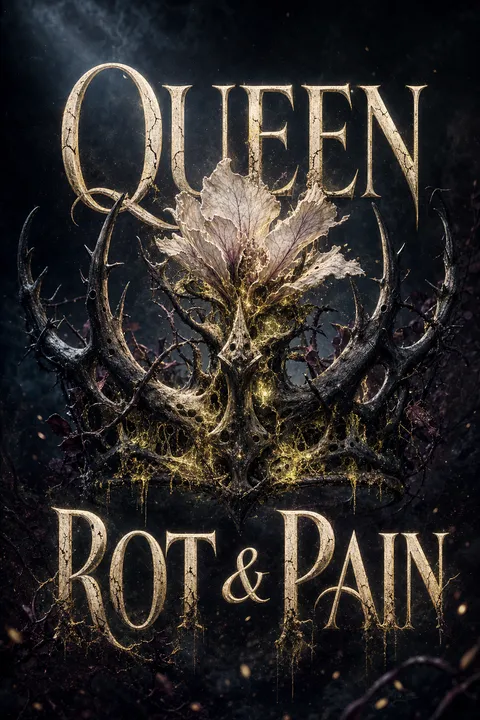


Plot Summary
Prologue
Two centuries earlier, Enosh,2 the god who spreads rot and keeps the bones of the dead, withdrew from the world after losing the woman he loved8 and their unborn daughter. He shut his kingdom, the Pale Court, refused the dead entry, and let the living conjure a false god, Helfa, to weigh down graves. In book one, a mortal midwife named Ada1 stumbled into his crumbling court.
Enosh2 collared her, married her, and softened, promising to spread rot to children and free her late husband if she pledged herself to him. But soldiers ambushed them; Enosh2 was captured and burned by priests while Ada1 fled to hide with her sick father.13 Believing herself pregnant, she tried to return. A villager's knife found her belly first.
The recap frames the sequel as a study in mutual wounding between a traumatized god and a woman conditioned to endure. Enosh's abandonment of duty is grief dressed as tyranny, a two-hundred-year sulk that plunged an entire world into chaos. Ada's defining trait, her stubborn fidelity to vows even bad ones, is what Enosh both prizes and misreads. The prologue also seeds the central irony: a deity who claims dominion over all flesh and bone remains blind to the one thing that matters, the divine life he cannot detect. By opening on betrayal, capture, and a stabbing, the summary primes readers for a romance built not on courtship but on resurrection, revenge, and the negotiation of forgiveness.
Waking Dead Among Whispers
Ada1 surfaces into consciousness inside Yarin's4 Court Between Thoughts, paralyzed and disoriented, her belly torn open by villagers who feared she carried the devil's child.
Enosh,2 half his face burned to raw bone by the priests who tortured him for a fortnight, cradles her yet seethes with accusation: she never returned to the Pale Court as she vowed, and he sensed inexplicable joy in her during their separation. Yarin4 reveals the grim arithmetic behind her presence, having traded her soul for ten corpses.
When Ada1 finally grasps the truth, that a knife ended her and, she believes, their unborn baby,14 grief detonates through her. Enosh,2 certain her pregnancy is a lie masking treachery, seals her mouth and offers only scorn where she begs for comfort.
The novel opens in a liminal, dissociative register that mirrors trauma's fragmentation: Ada perceives her own corpse from outside before crashing back into it. Death here is not release but capture, a collar rebranded. Enosh's rage is textbook wounded attachment, transmuting terror of abandonment into cruelty because vulnerability feels unsurvivable. His mutilation externalizes the psychic damage of torture. Crucially, the scene establishes an epistemological gulf: he trusts his godly senses absolutely, and that certainty becomes the engine of the entire tragedy. Ada's grief for a child he denies existed sets the emotional stakes, positioning maternal longing against divine arrogance.
There Is No Child
Back in his crumbling kingdom, where his servant Orlaigh3 had rotted on the throne awaiting his return, Enosh2 insists Ada1 was never pregnant, claiming his power registers every follicle and any child settling in a womb.
He refuses to heal the knife wounds in her belly, calling them a fitting reminder of her supposed faithlessness. Death has made Ada1 perpetually, agonizingly cold, and Enosh2 becomes the only warmth in his kingdom, a source he cruelly rations.
He fucks her mouth on his throne, spanks her, teases her toward release only to abandon her, punishing an infidelity she never committed. His jealousy fixates on a name, Elric, that his brother4 once plucked from her thoughts. Torn between hatred and craving, Ada1 still presses against him each night for heat.
This section dramatizes coercive intimacy as punishment, where desire and degradation become inseparable. The physiology of Ada's death, her unrelenting cold, literalizes emotional deprivation: she must beg her abuser for the warmth only he provides, a devastating model of trauma bonding. Enosh's sexual cruelty is control masquerading as passion, denying her release to reassert dominance he feels slipping. His obsession with the name Elric shows jealousy metastasizing into paranoid narrative-building; unable to feel a divine child, he invents an infidelity that fits his prior wound. The chapter interrogates how a partner's absolute certainty, even sincere, can become a form of gaslighting.
Crown of Children's Fingers
When Ada1 goads Enosh2 to honor his old bargain and rot the children, he answers with terrible spectacle. Hundreds of dead children shuffle across the bridge into the Pale Court, dissolving into bone that builds a sprawling palace of pillars, staircases, and statues. Then he fuses a crown of little fingers to her skull and christens her the Queen of Rot and Pain: her rot, his pain.
He burdens her with three child corpses whose bony heels clatter behind her everywhere, and dresses her in gowns woven of hair and nail. Orlaigh3 observes that those Enosh2 hates become a crown upon his head, while those he loves get to wear one. The victory Ada1 once craved now tastes like grief, a kingdom purchased with dead innocents.
Enosh grants Ada's wish as a curse, exposing the sadism in granting a desire on hostile terms. The coronation is a grotesque parody of fulfillment: she wanted the world saved and the dead honored, and receives a mausoleum crown made of the very children she loves. The scene crystallizes the book's central symbol, the difference between wearing a crown and being one, love and hatred rendered as identical acts of possession. Orlaigh's aphorism reframes Enosh's cruelty as inverted devotion, planting the disquieting thesis that this god's love and wrath are expressed through the same violent grammar of bone.
The Corpses Confess
Bored, dead, and desperate, Ada1 slices open the leather sealing the mouths of two corpses woven into the throne: Commander Joah Mertok7 and Lord Tarnem,6 father of Njala,8 the woman Enosh2 once loved. From them she extracts a buried history. Njala8 loved Joah7 before she ever met the god;2 her father broke the affair and handed her to Enosh2 in exchange for an army.
Njala8 kept meeting Joah7 in secret and grew pregnant with a mortal child, which is precisely why Enosh2 could sense it. Ada1 seizes the logic that shatters everything: Enosh cannot feel his divine brothers. If her own baby14 is his, and therefore divine, he would never sense it either. She may have died pregnant after all.
Ada turns detective, and the mystery structure gives her agency in a world designed to strip it. The revelation recontextualizes Enosh's entire mythology of grief: the daughter he mourned for two centuries was never his, meaning his defining wound rests on a lie. This is dramatic irony weaponized for hope, the deductive leap that a divine child would be invisible to its own father converts Ada's supposed delusion into plausible truth. The corpses literalize how the past speaks only when forced, and how buried secrets calcify into the architecture of the present, quite literally woven into the throne Enosh sits upon.
The Wet Nurse's Betrayal
Ada1 corners Orlaigh3 at the spring and forces the old servant to confirm the affair she guarded for two centuries. Orlaigh,3 who nursed Njala8 as her own after losing her own infant, hid the secret meetings and now trembles at what exposure could cost her: being woven into Enosh's2 throne beside the others.
She refuses to help Ada1 convince him and coldly warns that she will throw Ada1 to the god2 again rather than sacrifice her own bones, just as she once let Ada1 be recaptured. Realizing Orlaigh3 holds Enosh's2 trust while she holds none, Ada1 devises a riskier path: reach Yarin,4 the brother who bound her soul, who might sense the divine void in her belly and testify to the truth Enosh2 will not accept.
Orlaigh embodies the moral compromise of the powerless: survival ethics forged over centuries of servitude curdle into self-preserving treachery. Her tenderness toward Njala and her willingness to sacrifice Ada are not contradictions but the same wound, the terror of a woman with nothing but her own bones to bargain with. The confrontation reframes the antagonism away from Enosh toward a fellow victim, complicating easy villainy. Ada's pivot to seeking Yarin marks her transition from passive griever to strategist, learning that in a court of gods, truth means nothing without a witness credible enough to be believed.
Buried Beneath His Fury
Warned by Orlaigh3 that Ada1 whispers with corpses and hunts a route to his brother,4 Enosh2 concludes she is scheming to escape him. He carries her outside, lowers her into a grave, and commands the child corpses to shovel dirt while rot spreads over her skin. Terror shatters what remains of her sanity, until she screams that she carries his baby.14 He freezes.
Climbing out, he sits broken on a boulder, unable to complete the burial, and confesses that nothing terrifies him more than losing her. When she strikes him and dares him to throw her back, he holds her instead and admits he loves her. Their rage and grief collapse into desperate coupling on the grass, and Ada1 wins his promise to take her to Yarin.4
The near-burial is the relationship's nadir and its hinge. Enosh's inability to finish, the god of flesh and bone thwarted by his own heart, marks the crack in the omnipotent mask the whole book has been prying at. His confession arrives not as tenderness but as defeat, love wrung out under duress. Ada's slap and her refusal to be comforted assert a self that death and cruelty could not fully erase. The scene stages the paradox of the dark romance: reconciliation forged through the very violence that damaged them, intimacy as the wreckage two ruined people crawl toward because it is the only warmth left.
The Void in Her Belly
At the Court Between Thoughts, Yarin4 passes his hand over Ada1 and finds it: a void that will not answer him, sheltered below her navel, the same absence Enosh2 sensed and dismissed as her resistance. Eilam5 had felt too much life in her; now the brothers agree it is Enosh's divine child,14 trapped alive yet unable to grow inside a dead womb.
Ada1 breaks apart, and Yarin4 lulls her anguished soul into a dreamlike calm for three days. Enosh,2 drowning in guilt over grieving a false daughter for two centuries while abandoning his true wife,1 holds her the whole time. He removes her crown of fingers, lays the three child corpses to rest, and, after rehearsing for days, delivers a genuine apology, begging to begin anew and earn her love honestly.
The confirmation transforms abstract hope into unbearable specificity: not a lost child but a suspended one, alive and frozen at the size of a pea, a horror that fuses miracle and torment. Enosh's apology is the novel's ethical fulcrum, a god learning the mortal grammar of accountability, admitting fault without justification, a language his omnipotence never required. That he must practice it underscores how alien humility is to him. The three-day vigil recasts him from captor to caretaker. Yet the reconciliation carries a bitter engine: their reunion is inseparable from a shared, impossible goal, saving a child that cannot be saved while she remains dead.
A Plan Written in Blood
Enosh2 reveals the price of Ada's1 resurrection: only Eilam,5 god of life, can return her breath, and nothing provokes that reluctant brother like mass death, especially mortals ending their own lives. Enosh2 intends to force Eilam5 into his form through slaughter. First he settles accounts at home, weaving the traitor Orlaigh3 into his throne while Ada,1 hardened, chooses to watch it swallow her.
Then he raises an army from the corpse piles and looses it on the soldiers massed at the Aefen Gate, killing three hundred and two in five breaths. He and Ada1 ride out with the dead marching behind, binding seven survivors as bait, hunting High Priest Dekalon9 who tortured him and the villagers who killed her.
The plan reframes the romance as cosmic extortion: love expressed through genocide, resurrection purchased with atrocity. Ada's choice to watch Orlaigh entombed signals her drift toward the ruthlessness her title demands, a moral erosion the narrative refuses to sanitize. Enosh's strategy exploits a brilliant theological mechanic, that self-slaughter uniquely wounds the god of life, turning suicide into leverage. The staggering body count, three hundred and two in five breaths, establishes stakes of numbing scale while quietly asking whether any love justifies such arithmetic. The couple's shared crusade fuses eros and thanatos, binding intimacy to annihilation.
The Test of the Stake
Eilam5 finally manifests amid the carnage, naked and unimpressed, and refuses to restore Ada.1 He argues that her tender heart will inevitably compel Enosh2 to stop killing, that she is too gentle to survive as a monster among gods. To prove it, he hands Ada1 a wooden stake and dares her to further the slaughter herself by killing a bound soldier, with no divine hand guiding her arm.
Ada1 grips the man's hair, presses the point to his throat, and cannot do it. Her hand trembles, the stake drops into the snow, and Eilam5 vanishes with his verdict confirmed. The failure guts Ada:1 her compassion, the very quality Enosh2 loves, may be exactly what keeps her dead and their child14 forever unborn.
Eilam functions as a cold moral physicist, reading character as destiny. His test is diabolically precise: it identifies Ada's virtue as the load-bearing weakness in Enosh's scheme. The dropped stake is a genuine tragedy of goodness, where empathy becomes an obstacle to salvation, inverting the usual moral calculus. It forces the book's darkest question onto Ada: must she murder her own humanity to reclaim her life and her child? Eilam's smug certainty also reveals divine contempt for mortal feeling as mere sickness, setting up his eventual comeuppance while dramatizing how the powerful pathologize the empathy they lack.
Becoming the Queen
Understanding that mercy costs her the baby,14 Ada1 decides to become the terror her title promises. At Elderfalls she confronts Henry,11 brother of the woman who betrayed her,10 and drives a bone blade through his throat, her first kill, feeling not guilt but a startling rush of life. His cousin Arne,12 who plunged the knife into her belly, is disemboweled and kept alive as a living torch.
Learning her father13 died on the road to the temple, abandoned to drown in his own blood, hardens her further. At Hogsbottom she faces Rose,10 the woman who sold her out, cradling a newborn. Eilam5 pleads for the innocent child, but Ada1 slashes his throat, then stabs Rose10 in the belly, gutting her exactly as she was gutted.
Ada's transformation is a study in trauma weaponized into agency. Each killing is retributive symmetry, gutting the gutter, suffocating the priest as her father suffocated, a survivor rewriting helplessness into control. The narrative refuses to flinch or moralize, letting her feel vitality rather than remorse, which is precisely what makes it disturbing and honest about vengeance's seductive coherence. Cutting Eilam, a god, is the boldest assertion of her new resolve. Yet the sparing impulse toward Rose's baby, before she kills anyway, reveals the cost: she is amputating the tenderness that once defined her. The Queen of Rot and Pain is born through self-mutilation of the soul.
More Than Life Returns
Cornered and unwilling to be defied, Eilam5 agrees to trade a mortal's breath for Ada's.1 Enosh2 negotiates further: he will abandon his vow of vengeance against the temples and resume his neglected divine duties if Eilam5 restores her and never takes her breath again. But the god of life's5 force proves too strong for a mortal shell.
With Yarin4 steadying her spinning soul, the breath remakes Ada1 entirely. She wakes hearing the dead whisper mistress, sensing the flesh and bone of everyone near her, shaping a crooked blade from nothing. She is no longer mortal but a goddess wielding Enosh's2 dominion over rot and bone, immortal, able to grow their divine child,14 and bound by no promise her husband2 made to his brother.5
The botched resurrection is the plot's masterstroke, converting a rescue into an apotheosis that shatters every prior power dynamic. Ada, who spent the book collared, buried, and crowned against her will, becomes ungovernable, no chain of bone will ever hold at her command. It resolves the central tension of coercion by making coercion impossible: Enosh can now only be loved, never obeyed into. The detail that she wields only Enosh's power, not all three, preserves balance while granting her sovereignty. Thematically, the woman dismissed as barren and worthless is reforged into a deity, the ultimate reversal of the mortal contempt that killed her.
Fire at the High Temple
Freed from Enosh's2 truce, Ada1 launches her own crusade to end the threat and finally win peace, razing temples and priests as they ride. At the high temple, built of bone-free marble and veined with hidden pine pitch precisely to burn a god, she enters alone, disguised as a humble mortal wife. She confronts High Priest Dekalon,9 learns her father13 is truly dead, and drives a blade through his lungs.
Dying, he tips a fire basin, igniting the resin and trapping Ada1 in an inferno with no bone to command. Enosh2 charges through the flames, badly burned, to carry her out. Together they blast gathered bone outward, obliterating the thousand-strong army and collapsing the fortress, then Ada1 raises the fallen to finish it.
The temple's design, marble and pitch engineered to immolate a deity, embodies the human world's ingenuity against the divine, and its trap nearly works because Ada's power depends on the very bone the priests excluded. Her infiltration inverts her earlier powerlessness: the disguise of the insignificant wife becomes her deadliest weapon, weaponizing the contempt that once defined her. Enosh's plunge into fire completes his arc, the god who once withheld warmth now walks into flame for her, sacrifice replacing possession. Their joint bone-blast is the marriage rendered as apocalypse, two forces of decay merged, love and annihilation finally indistinguishable and shared as equals.
Epilogue
Months later, Ada's1 belly swells with the child14 that grows now that she lives, and Enosh2 presses endless kisses to it, marveling when a tiny foot pushes back against his palm. A year on, they have a daughter, Amelia,14 raven-haired and blue-eyed, learning to crawl in Ada's1 bone-and-feather garden beneath a painted sky.
Enosh2 dotes as a father; Yarin4 delights as Uncle; Orlaigh,3 spared the throne to serve as maid, chases the toddler. Ada,1 now a goddess, still hunts the last worshippers of the false god Helfa, hanging dissident priests on her great tree and gutting men who dare draw her blood. Their love stays cruel and tender in equal measure, monstrous to the world, wholly devoted within their own.
The domestic coda resolves the resurrection quest with fertility literalized: life returned means life created, the frozen void finally allowed to grow. The imagery of a father feeling his child kick recasts the god of death as a vessel of new life, closing his two-century arc of grief. Yet the ending refuses redemptive softening, Ada continues gutting mortals, hanging priests, embracing her monstrousness. The book insists that its lovers are villains in the world's story and heroes only in their own, a deliberate rejection of moral rehabilitation. The final note, that neither love nor the couple cares about their monstrosity, affirms a dark romance ethic: devotion need not be virtuous to be real.
Analysis
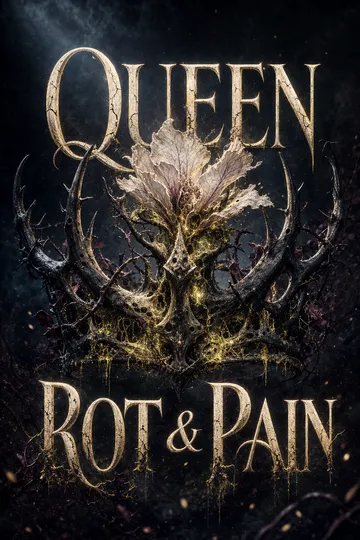
Queen of Rot and Pain is a dark fantasy romance that interrogates whether love can survive being built on coercion, and answers by refusing the easy comfort of redemption. Its central engine is an epistemological wound: a god whose senses are absolute2 cannot perceive the one truth that matters, and his certainty becomes the instrument of tragedy. The narrative uses Ada's1 death and gradual empowerment to reverse the misogynist scripts that governed her life. Called barren, worthless, and disposable, she is murdered by ordinary neighbors for a pregnancy she may or may not carry, then reforged, ultimately, into a deity who commands the very forces that once caged her. This is revenge fantasy operating as a critique of how the powerless are disbelieved, discarded, and blamed. The book's most provocative move is its treatment of morality. Eilam5 wagers that Ada's1 compassion will always halt violence, framing empathy as weakness, and the plot forces her to amputate that tenderness to reclaim her life and child.14 The novel neither celebrates nor fully condemns this; it lets vengeance feel coherent, even vitalizing, while quietly registering the cost. Enosh's2 arc runs opposite, a tyrant learning humility, accountability, and sacrifice, walking into fire for the woman he once withheld warmth from. Their love is deliberately monstrous, and the closing insistence that they are villains in the world's story and heroes only in their own is a thesis statement: devotion need not be virtuous to be true. Thematically, the work fuses eros and thanatos relentlessly, staging intimacy through violence, resurrection through atrocity, and creation through decay. The god of death2 becomes a vessel of new life; the barren woman becomes a mother1 and a goddess. It is a story about reclaiming power from a world that grants none, and the terrible price of that reclamation.
Review Summary
Queen of Rot and Pain is a dark fantasy romance that concludes The Pale Court duet. Readers praise the character development, especially Ada's transformation, and the intense, twisted relationship between Ada and Enosh. The book features graphic violence, steamy scenes, and morally grey characters. While some found the miscommunication trope frustrating, many enjoyed the emotional rollercoaster and satisfying ending. Critics note the writing style can be unclear at times, and some felt the revenge arc was rushed. Overall, the duet received mixed to positive reviews for its unique world-building and complex characters.
People Also Read
Characters
Ada
Dead midwife turned queenA midwife from Hemdale defined by stubborn fidelity to vows and a lifelong ache to be a mother, having been called barren and worthless by the mortal world. Ada enters this book murdered and soul-bound, cold in every sense, grieving a child14 others insist never existed. Her psychology is a battleground between the compassion that made her heal even her enemies and a rising, righteous fury at a lifetime of being dismissed and discarded. She craves warmth, love, and validation, yet refuses to be anyone's obedient chattel. Sharp-tongued, resourceful, and unexpectedly ruthless when cornered, she investigates, bargains, and defies gods. Her arc traces the terrible cost of survival: how far a gentle woman will travel into darkness to reclaim what was stolen.
Enosh
God of flesh and boneThe King of Flesh and Bone, keeper of the dead, ruler of the crumbling Pale Court. Enosh presents a mask of glacial disdain and theatrical cruelty, but beneath it lies a man shaped like humanity, capable of grief, jealousy, and devotion he barely understands. Two centuries of betrayal and recent torture have left him paranoid, certain his godly senses cannot lie. His love expresses itself through possession, punishment, and the same violence with which he expresses hatred, a distinction he cannot yet draw. Driven by terror of abandonment, he confuses control with intimacy. His central struggle is learning humility, accountability, and how to be loved rather than obeyed, a god slowly relearning the mortal art of tenderness.
Orlaigh
Ancient soul-bound servantEnosh's2 soul-bound servant of two centuries, an old woman with a folksy lilt who once nursed the god's2 lost love Njala8 as her own child. Orlaigh is warm, weary, and morally compromised by centuries of servitude, guarding a devastating secret to save her own bones from the throne. Her survival ethics blur loyalty and treachery, making her both maternal comfort and quiet danger to Ada1.
Yarin
Hedonistic god of whispersEnosh's2 brother, the God of Whispers, who rules the Court Between Thoughts and binds souls. Flamboyant, debauched, and cheerfully mad, Yarin speaks into minds, thrives on gossip and chaos, and finds mortal suffering endlessly amusing. Beneath the perversion lies genuine perceptiveness and a surprising fondness that makes him a useful, unpredictable ally. His comic irreverence leavens the book's darkness.
Eilam
Reluctant god of lifeThe third brother, god of life and its absence, whom every mortal meets once. Cold, celibate, and rigidly principled, Eilam despises being forced into physical form and is uniquely vexed by lives cut short, especially self-slaughter. He views mortal emotion as a sickness and reads character as destiny, making him a formidable, judgmental obstacle whose certainty invites his own comeuppance.
Lord Tarnem
Corpse woven in throneA dead nobleman fused into Enosh's2 throne, father of Njala8. Arrogant even in decay, he trades the secret history of his daughter's affair for Ada's1 promise to plead his innocence, hoping to win release from his eternal imprisonment in bone.
Joah Mertok
Corpse commander, secret loverA dead military commander woven into the throne, Njala's8 lifelong love. His decayed confession, that he slit Njala's8 throat at her request to spare her and the child, helps Ada1 reconstruct the two-hundred-year-old truth Enosh2 never knew.
Njala
The god's lost loveThe noblewoman Enosh2 believed he loved and lost, along with her unborn daughter, two centuries ago. Given to the god2 by her father6 for an army, she secretly loved another7 and chose death over return. Her buried story is the lie that poisoned Enosh's2 heart.
High Priest Dekalon
Zealot who tortured the godThe powerful high priest of the false god Helfa who orchestrated Enosh's2 capture and burning and hunted Ada1. Cold and calculating, he fortified the high temple specifically to trap and destroy a deity. He represents mortal faith weaponized against the divine and the human cruelty Ada1 seeks to avenge.
Rose
Villager who betrayed AdaA fisherwoman from Ada's1 village who accepted priestly coin to sell out Ada1 and her father13, setting the murder in motion. Later found in a comfortable new home with a newborn, she embodies the ordinary, self-serving human wickedness Ada1 holds ultimately responsible for her death.
Henry
Rose's complicit brotherRose's10 brother, who chased and cornered Ada1 and threatened to deliver her to the priests dead or alive. He becomes the target of Ada's1 first personal act of vengeance.
Arne
The man with the knifeRose's10 cousin, the villager who drove the blade into Ada's1 pregnant belly. When captured, he suffers a slow, gruesome fate as punishment for the killing that set the entire story in motion.
Ada's father
Ada's dying fatherThe sick old man Ada1 hid with and tried to keep alive, injured protecting her during the ambush. His uncertain fate haunts Ada1 and motivates her search during the crusade across the lands.
Amelia
The awaited divine childThe daughter at the heart of Ada's1 longing, the divine child trapped alive in her dead womb, undetectable to gods. She represents the future the couple fights to secure and the fulfillment of Ada's1 deepest, long-denied wish.
Plot Devices
The soul-bound cold
Death as literal chainAda's1 murdered body, its soul bound by Yarin4, leaves her perpetually, unbearably cold and slowly rotting, with Enosh2 the only source of warmth in his kingdom. This physiology operationalizes emotional captivity: death is described as her collar, tethering her to the god2 who can soothe or withhold his heat at will. The cold forces her to crave and press against her captor even as her mind rebels, dramatizing trauma bonding without abstraction. It also enables uncanny feats, like drowning herself repeatedly in the hot spring by suppressing the reflex to breathe. The device makes abstract dependency visceral and physical, so the reader feels the leash rather than merely understanding it.
The undetectable divine child
Invisible truth drives plotBecause Enosh2 cannot sense his divine brothers, he cannot sense a divine child either. Ada1 deduces that the baby14 she believed she carried, if truly Enosh's2, would be invisible to his otherwise total perception, appearing only as a void the gods cannot read. This single logical inversion converts her supposed delusion into plausible fact and reframes Enosh's2 two-century grief over a daughter he could sense, and thus who was not his. The void in her belly becomes the engine of the entire quest: to save a child14 suspended alive but unable to grow in a dead womb, Ada1 must be returned to life. Setup and payoff span the whole novel.
Provoking the god of life
Atrocity as leverageEilam5, the reluctant god of life, is uniquely tormented by lives ended before their time, and most of all by mortals taking their own lives. Enosh2 exploits this, orchestrating mass slaughter and coercing bound captives into cutting their own veins to force his brother5 into physical form and extort Ada's1 resurrection. The mechanic transforms the romance's rescue into a moral catastrophe, binding love to genocide and making the reader complicit in weighing atrocity against one life. It also fuels Eilam's5 test of Ada's1 resolve and the eventual bargain that reshapes the world. The device gives the third act its terrible logic and its ethical friction.
Crown versus collar
Symbol of love and hateEnosh2 punishes the faithless by weaving them into his bone throne and honors the beloved by crowning them, yet Orlaigh3 notes the unsettling truth that those he hates become a crown upon his head while those he loves get to wear one. When Enosh2 fuses a crown of dead children's fingers to Ada's1 skull and names her Queen of Rot and Pain, the symbol collapses the distinction between adoration and cruelty that defines his character. The crown recurs as coronet, tiara, and finally a self-chosen emblem of Ada's1 transformation. It tracks the couple's shifting power, from imposed humiliation to claimed sovereignty, making a single object carry the arc of the relationship.
The bone-free temple
A trap engineered for godsThe high temple is deliberately built of marble with no bone anywhere, its floors and walls veined with dried pine pitch, an architecture designed to strip a bone-wielding god of power and immolate him. When Ada1 infiltrates disguised as a mortal wife, this design nearly kills her: with no bone to command, she is helpless once the resin ignites. The temple embodies mortal ingenuity against the divine and pays off the running theme that Ada's1 power over rot and bone can be neutralized by clever engineering. It transforms the climax from a slaughter into a genuine peril, requiring rescue and forcing the couple to fight as equals against overwhelming odds.
The Pale Court Duet Series
About the Author
Other books by Liv Zander

Download PDF
Download EPUB
.epub digital book format is ideal for reading ebooks on phones, tablets, and e-readers.








































