

Key Takeaways
Build remarkability into the product, not the ad campaign
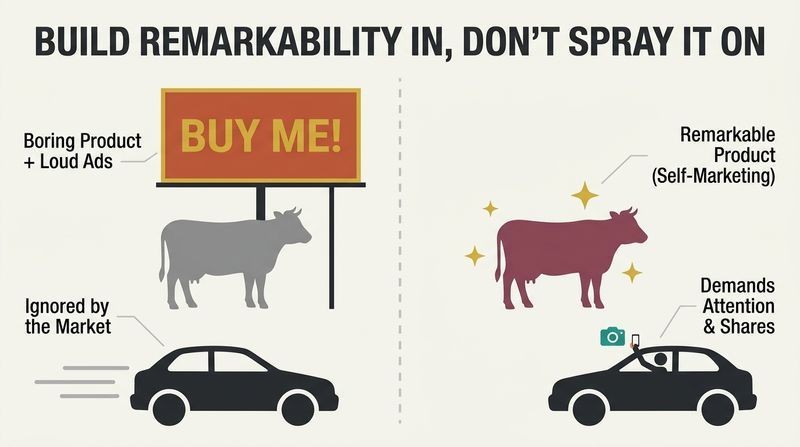
The core thesis is a color. Godin uses the image of driving through France, enchanted by picturesque cows, then bored within twenty minutes because every cow looked the same. A purple cow would stop the car. That is his metaphor for the only marketing that works now: something so remarkable it demands attention.
Remarkable literally means worth making a remark about. Boring products are invisible, a brown cow blending into the field. Godin insists remarkability cannot be sprayed on afterward by the marketing department. It must be engineered into the offering itself. Slicing bread flopped for twenty years until Wonder branded it, but that was the old world. Today, if the thing itself is not exceptional, no advertising budget can rescue it. Stop advertising, start innovating.
What's striking is how Godin collapses the old wall between product design and marketing. Peter Drucker argued decades earlier that the aim of marketing is to make selling superfluous by understanding the customer so well the product sells itself. Godin operationalizes that. The claim has limits, though: some genuinely remarkable products still languish without distribution or timing, and survivorship bias haunts every marketing book. For every Purple Cow that spread, thousands of quirky failures vanished unrecorded. Still, the reframe is durable. In an attention economy, being safe and average is the truly risky bet, a point behavioral economists studying choice overload have independently reinforced.
The mass-marketing machine that built brands is dying
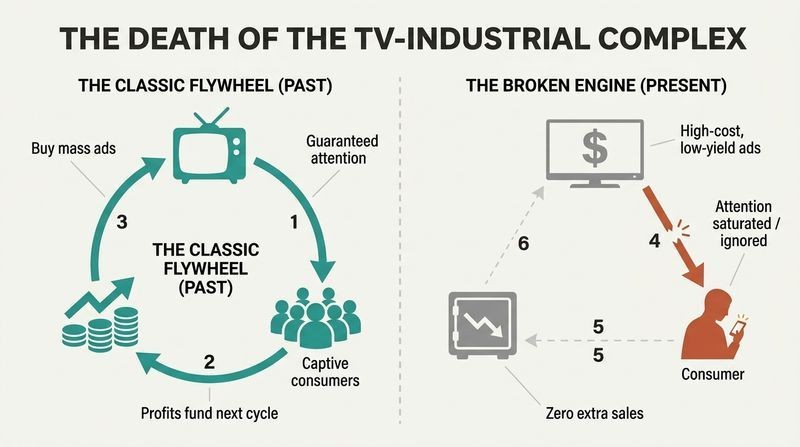
Godin names the beast the TV-industrial complex. For half a century the formula was mechanical: find a growing market, build a factory, buy TV ads, generate sales, funnel profits into more ads. Consumers learned that "as seen on TV" meant quality, so they bought advertised brands. Procter & Gamble dominated entire categories this way. In 1962 an agency literally created the Cap'n Crunch commercial before Quaker made the cereal, confident ads alone would imprint the character on every child.
That engine is hemorrhaging. Consumers are too busy and too satiated to watch. Godin interviewed hotel guests reading the Wall Street Journal and none could name a single full-page advertiser, despite those ads costing more than a house in Buffalo. Awareness no longer converts. Two of Coke's most beloved commercials sold zero extra bottles.
Godin was prescient in 2003, before smartphones, streaming, and ad-blockers accelerated the collapse he described. The economist Herbert Simon's insight anchors it: a wealth of information creates a poverty of attention. Once attention became the scarce resource, interruption-based advertising lost its leverage. Yet the obituary was premature in one respect. Digital platforms rebuilt mass reach through targeting rather than broadcast, and Google's contextual text ads, which Godin himself praised, became a trillion-dollar interruption machine. The complex did not die so much as mutate. The deeper truth survives: paying to shout at satisfied strangers is a losing proposition, whatever the medium.
Target obsessed early adopters, never the fat, ignoring middle
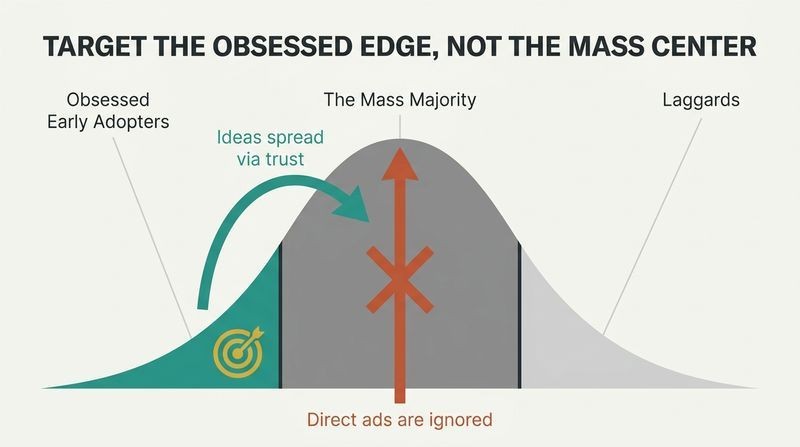
Ideas travel left to right across a curve. Borrowing Geoffrey Moore's diffusion model, Godin maps five groups: innovators, early adopters, early majority, late majority, and laggards. The temptation is to aim at the juicy center where the most people and money sit. That fails, because the majority ignores you and will only buy after their trusted peers vouch for the product.
So the sequence matters. You must win the risk-taking left edge first, then let them carry your idea rightward. Digital cameras spread not through ad campaigns but through gadget-lovers demonstrating obvious advantages to friends every time a laggard pulled out film. One bank found the 10% of customers who used online banking daily also held 70% of deposits. The valuable slice is often the edge, not the mass.
This inverts the intuition baked into a century of consumer marketing, which chased the largest reachable segment. Godin's contribution is arguing that in a saturated market, group value derives from influence, not size. Network scientists like Duncan Watts have complicated the picture, showing that cascades often depend more on the susceptibility of the broader network than on a few special influencers. Sometimes the majority tips for structural reasons no early adopter controls. Yet as a practical heuristic for a founder with limited budget, concentrating fire on the enthusiastic fringe beats diluting it across an indifferent middle. Focus is the affordable strategy.
Serve niches gripped by otaku, obsessive product passion
Otaku is the engine of spread. Godin borrows the Japanese word for a passion stronger than a hobby but short of obsession, the feeling that makes someone drive across town for a rumored ramen shop. Consumers with otaku are the ones who research your product, risk trying it, and spend social capital telling friends.
Crucially, some markets brim with otaku and others have none. Hot sauce is a thriving business of insane heat-seeking sauces with names like Blair's After Death, sold with no advertising. Mustard, arguably more popular, is not a business, because nobody orders it by mail or demands a specific brand. Smart marketers hunt for the market with existing otaku first, then build the remarkable product for it, not the reverse. Find the passionate niche, then feed it.
Godin essentially predicts the long-tail economy that Chris Anderson would formalize a few years later: the internet lets narrow passions aggregate into viable markets. The hot-sauce-versus-mustard contrast is a memorable diagnostic for founders, though it can mislead. Otaku can be manufactured, not just discovered. CrossFit, mechanical keyboards, and specialty coffee cultivated obsession where little existed, through community rituals and identity signaling. Sociologist Pierre Bourdieu would note that otaku is partly about distinction, using consumption to mark taste and belonging. The practical takeaway holds regardless: passion is the fuel of word of mouth, and it is easier to pour gasoline on a fire than to light one from scratch.
Being safe and boring is the riskiest strategy alive
Fear, not scarcity of ideas, is the real obstacle. Godin argues remarkable products are rare not because good ideas are scarce but because standing out invites criticism, and we are trained from first grade to color inside the lines. In a fourteen-block stretch of Amsterdam Avenue, seventy-four restaurants sit dull and forgettable, because their owners, having risked everything to open, refuse to risk a single distinctive choice.
But criticism is the price of remarkability. Cadillac's CTS was mocked as ugly and sold fast anyway, reviving the brand. My Big Fat Greek Wedding, criticized for being too tame, became a $3 million sleeper hit. The Aeron chair looked bizarre and cost $750 in 1994, a seemingly reckless bet that landed it in the Museum of Modern Art. Boring always loses.
Godin reframes risk in a way that echoes Nassim Taleb's later work on fragility: the appearance of safety often conceals the greater danger of slow irrelevance, while bold exposure creates optionality and upside. The schooling critique connects to Ken Robinson's argument that formal education systematically extinguishes divergent thinking. One caveat worth holding: Godin selects winners retrospectively, and the same courage that birthed the Aeron chair also birthed New Coke and countless forgotten flops. Remarkable and reckless can look identical until the results arrive. The honest position, which Godin embraces, is that you cannot know in advance, so you must place many bets and expect failures.
Very good is invisible; only extreme gets talked about
The opposite of remarkable is not bad, it is very good. Godin's sharpest distinction: quality is table stakes, not a story. If an airline lands you safely, you tell no one, because that is simply what was supposed to happen. You share only the extreme: the flaming crepes in first class, or the flight so awful it becomes a saga.
This is why compromise kills. A camel is a horse designed by committee. When every well-meaning stakeholder sands off a rough edge to avoid offending some constituency, the result is vanilla, safe, and unremarkable. Habanero pecan ice cream will never please everyone, and that is precisely its power. The boring middle slot in almost every market is already filled, and its very blandness is its defense. You cannot out-bland the blandest.
This is Godin's most counterintuitive move, separating remarkability from quality entirely. It aligns with research on word of mouth by Jonah Berger, whose work on social transmission found that high-arousal emotion, awe, anger, surprise, drives sharing far more than mere satisfaction. Contentment is inert. There is a tension, though. Extreme differentiation courts polarization, and a product engineered to be talked about can generate negative buzz as easily as positive. Hooters is remarkable and divisive by design. The discipline Godin prescribes, resisting committee-driven compromise, runs against every incentive in a large organization, where consensus feels safe and edges feel like liabilities to be managed away.
Milk your cow hard, then reinvent before it fades
Remarkability has a half-life. Godin frames a four-step cycle. First, earn permission to talk again to those you impressed. Second, arm the sneezers, the influential enthusiasts, with the story and tools to spread your idea across the curve. Third, once profitable, hand it to a different team to milk relentlessly, because commoditization is inevitable. Fourth, reinvest and launch a new cow to the same audience, expecting many failures.
Starbucks was remarkable, then became boring, but that first burst funded thousands of stores. The cautionary tale is Stew Leonard's dairy store, once so magical Godin drove every new hire an hour to see it. The son dumbed it down for the masses, trading one obsessive fan for ten ordinary shoppers. Profitable short-term, but Godin stopped going. Coasting on a past cow is a slow death.
The cycle mirrors the innovator's dilemma Clayton Christensen documented: the very competence that milks a mature product incapacitates the reinvestment needed for the next disruption. Godin's contribution is emotional honesty about why leaders coast. Success feels like omniscience, and a new bet threatens the accolades already banked. Behavioral economics calls this loss aversion, the tendency to protect gains rather than risk them for larger future ones. The Stew Leonard's story is a poignant illustration, though Godin concedes it was rationally profitable in a location-locked grocery business. The lesson is contextual: milking works when your moat is durable, and kills when your market moves fast.
Give sneezers a slogan to script their recommendations
A slogan is a script for word of mouth. In the TV era slogans compressed a message into seconds. Now their job is different: they hand the enthusiastic recommender the exact words to justify passing your idea along, ensuring prospects arrive for the right reason.
Godin's examples strip language away entirely. Tiffany's blue box is a wordless slogan meaning elegance and "price is no object," so every gift spreads the brand. The Leaning Tower of Pisa draws millions because its message is pure and singular, one tower, tilted, easy to put on a T-shirt, while the more beautiful Pantheon in Rome gets a fraction of the crowds because it is harder to summarize. Purity of message makes an idea more contagious. The marketing is built into the thing, not bolted on.
Godin anticipates the meme theory Richard Dawkins seeded and Chip and Dan Heath later systematized in their work on why ideas stick, where simplicity and concreteness top the list of contagious traits. The Pisa-versus-Pantheon comparison is a small masterpiece of cognitive economics: transmissible ideas beat superior ones. There is a subtle danger here. A slogan optimized for spreadability can hollow into a caricature, reducing a rich product to a single tilt. Volvo became "safety" and struggled for years to mean anything else. The script that recruits sneezers can also imprison a brand in its own one-liner, a trade every marketer should weigh.
Redesign the product itself, like Dutch Boy's easy-pour jug
Change the product, not the hype. Godin's favorite move is redefining where the product ends and marketing begins. Dutch Boy realized paint cans were heavy, hard to open, hard to pour, and hard to close, yet nobody had questioned them in decades. They introduced an easy-carry, easy-pour jug. Sales jumped, distribution widened, and the retail price rose. The container was part of the product, because people buy painted walls, not paint.
Schindler's elevators did the same by inverting user behavior: you key your floor at a lobby panel and it assigns your car, turning every ride into an express and letting buildings need fewer elevators. Logitech thrives by treating input devices as fashion, not chips. In each case the marketing investment went into engineering, not media buys.
The Dutch Boy case exposes how much latent remarkability hides in unexamined conventions, what design thinkers call the tyranny of the default. Everett Rogers, whose diffusion research underpins the whole curve Godin uses, identified observability and relative advantage as key adoption drivers, and a better can delivers both instantly and visibly. The Schindler example is subtler and riskier, because it asks users to change behavior, which usually raises adoption friction. It succeeds only when the payoff is dramatic enough to justify the retraining. The broader principle, that packaging, process, and even customer behavior are all product surfaces available for reinvention, dramatically widens where a founder can hunt for an edge.
Make your own career a Purple Cow before job-hunting
The resume is just advertising, and it barely works. Godin extends the thesis to careers. Blasting resumes to thousands of employers is interruption marketing aimed at people with no interest in you, generating no word of mouth. Remarkable people rarely have resumes; they get recruited because sneezers recommend them, moving from jobs they love to jobs they love more.
The secret is not the job-hunting technique but what you do when you are not looking: taking on high-profile projects, running visible risks, tolerating big failures that lead to better projects rather than dead ends. His publicist friend Tracey floundered sending form letters until she narrowed obsessively to become the world's best publicist to plastic surgeons. She became the one inevitable choice. In a career even more than a brand, safe is risky.
This is the book's most personally actionable chapter, and it presages the personal-branding and niche-authority movements that dominate professional life today. Cal Newport's research on career capital dovetails neatly: rare and valuable skills, built through deliberate effort before you need them, generate leverage that generic credentials cannot. The Tracey example demonstrates the counterintuitive power of narrowing rather than broadening a value proposition, which feels terrifying because it forecloses options. Yet there is a real hazard Godin underplays. Hyper-specialization creates fragility if the niche collapses, and remarkable visible risk-taking is far more available to those with financial and social safety nets than to the precarious.
Analysis
Purple Cow is a manifesto disguised as a business book, and its power lies in a single reframe repeated from dozens of angles: in a world drowning in choice and starved for attention, the remarkable is the only thing that travels. Written in 2003 as a series of short, punchy riffs rather than a linear argument, it reads like a collection of blog posts, which it partly was. That structure is both a strength, endlessly quotable and skimmable, and a weakness, because it substitutes accumulation of vivid cases for rigorous causal argument. Godin is a rhetorician first. He rarely distinguishes correlation from causation, and his examples are almost entirely retrospective winners, the classic survivorship trap that makes any success formula look inevitable in the rearview mirror. The Aeron chair, Krispy Kreme, and JetBlue prove remarkability can win, not that it reliably does. Godin knows this and disarms the critique by insisting there is no plan, only a process of going to the edges and placing many bets expecting most to fail. That intellectual honesty is unusual in the genre. The book's enduring value is its timing and clarity. It named the collapse of interruption advertising before smartphones made it undeniable, and it correctly located the new locus of value in word of mouth among passionate niches. Its blind spot is the platform economy that followed: Godin diagnosed the death of mass reach but underestimated how targeting, algorithms, and paid social would rebuild scaled distribution atop the very remarkability he championed. The synthesis today is that both matter, a remarkable product and a machine to amplify it. Read now, Purple Cow feels less like a revelation than common sense, which is the highest compliment a once-radical idea can earn. It won by being remarkable, then became the field it disrupted.
Review Summary
Purple Cow by Seth Godin is a marketing book that emphasizes the importance of being remarkable to stand out in a crowded marketplace. While some readers found it insightful and thought-provoking, others felt it was repetitive and lacked concrete strategies. The book's core message—that businesses must create unique, noteworthy products to succeed—resonated with many, but its examples and approach may feel dated to modern readers. Despite mixed reviews, many found value in Godin's perspective on innovation and differentiation in business.
People Also Read







FAQ
What's "Purple Cow" about?
- Core Concept: "Purple Cow" by Seth Godin is about transforming your business by being remarkable. The book emphasizes the importance of standing out in a crowded marketplace.
- New Marketing P: Godin introduces the concept of the "Purple Cow" as a new 'P' in marketing, which stands for being remarkable and noteworthy.
- Challenge to Traditional Marketing: The book challenges traditional marketing strategies that rely heavily on advertising and suggests that innovation and uniqueness are now crucial.
- Focus on Innovation: It encourages businesses to integrate remarkable features into their products or services from the start, rather than relying on marketing to make them stand out.
Why should I read "Purple Cow"?
- Relevance to Modern Marketing: The book provides insights into why traditional marketing methods are becoming less effective in today's saturated market.
- Practical Advice: It offers practical advice on how to make your product or service stand out by being remarkable.
- Inspiration for Innovation: "Purple Cow" inspires readers to think creatively and take risks in their business strategies.
- Case Studies: The book includes numerous case studies that illustrate successful applications of the Purple Cow concept.
What are the key takeaways of "Purple Cow"?
- Remarkability is Essential: In a world full of choices, only remarkable products and services will stand out and succeed.
- Integration of Marketing and Product Design: Marketing should be integrated into the product design process, not just an afterthought.
- Target Early Adopters: Focus on early adopters and sneezers who will spread the word about your product.
- Continuous Innovation: Businesses must continuously innovate to maintain their competitive edge and avoid becoming obsolete.
How does Seth Godin define a "Purple Cow"?
- Definition: A "Purple Cow" is a product or service that is remarkable and worth talking about, something that stands out in a field of ordinary offerings.
- Remarkability: It must be unique and interesting enough to capture attention and generate word-of-mouth.
- Not Just a Gimmick: The concept is not about being outrageous for the sake of it but about creating genuine value and interest.
- Sustainability: A Purple Cow should have a lasting impact and not just be a one-time novelty.
What are some examples of "Purple Cows" mentioned in the book?
- Aeron Chair: Herman Miller's Aeron chair is highlighted for its unique design and comfort, which made it a standout product.
- Krispy Kreme: Known for its remarkable donuts and customer experience, Krispy Kreme created a cult following.
- Starbucks: Transformed the coffee experience by creating a unique atmosphere and product offering.
- JetBlue: Stood out in the airline industry with its customer service and innovative approach to air travel.
What is the "TV-Industrial Complex" and why is it dying?
- Definition: The "TV-Industrial Complex" refers to the traditional cycle of mass production and mass advertising to drive sales.
- Ineffectiveness: Godin argues that this model is becoming less effective as consumers are overwhelmed with choices and advertising.
- Shift in Consumer Behavior: Consumers are now more likely to ignore traditional ads and rely on word-of-mouth and personal recommendations.
- Need for Innovation: Businesses need to focus on creating remarkable products that naturally generate buzz and interest.
How does "Purple Cow" suggest businesses should approach marketing?
- Focus on Product Design: Marketing should be built into the product from the start, making it inherently remarkable.
- Target the Right Audience: Identify and target early adopters and sneezers who will spread the word about your product.
- Embrace Risk: Be willing to take risks and stand out, even if it means some people won't like your product.
- Continuous Improvement: Always look for ways to innovate and improve your product to maintain its remarkability.
What are some of the best quotes from "Purple Cow" and what do they mean?
- "Stop advertising and start innovating." This quote emphasizes the need to focus on creating remarkable products rather than relying solely on advertising.
- "The essence of the Purple Cow is that it must be remarkable." It highlights the core idea that only remarkable products will succeed in today's market.
- "Safe is risky." Godin suggests that playing it safe in business is actually riskier than taking bold, innovative steps.
- "Ideas that spread, win." This quote underscores the importance of creating products that are easy to talk about and share.
How can a business identify its "Purple Cow"?
- Analyze the Market: Look for gaps or unmet needs in the market that your product can fill in a unique way.
- Customer Feedback: Engage with customers to understand what they find remarkable and what they are looking for.
- Experimentation: Test different ideas and approaches to see what resonates with your audience.
- Focus on Strengths: Leverage your business's unique strengths and capabilities to create something truly remarkable.
What role do "sneezers" play in the "Purple Cow" strategy?
- Definition: Sneezers are influential individuals who spread ideas and products to others, acting as key agents in word-of-mouth marketing.
- Target Audience: Businesses should focus on reaching sneezers who are likely to share their experiences with a wider audience.
- Credibility: Sneezers often have credibility and trust within their networks, making their recommendations more impactful.
- Amplifying Reach: By engaging sneezers, businesses can amplify their reach and increase the likelihood of their product becoming a Purple Cow.
How does "Purple Cow" address the fear of failure in business?
- Embrace Criticism: Godin suggests that being remarkable means some people won't like you, and that's okay.
- Learn from Failure: Failure is part of the process of innovation and should be seen as an opportunity to learn and improve.
- Risk vs. Safety: The book argues that the real risk lies in being boring and not standing out, rather than in taking bold steps.
- Encourage Experimentation: Businesses should create an environment where experimentation and risk-taking are encouraged.
What is the "Law of Large Numbers" in the context of "Purple Cow"?
- Definition: The "Law of Large Numbers" refers to the idea that reaching a large audience doesn't guarantee success if the product isn't remarkable.
- Ineffectiveness of Mass Marketing: Mass marketing often results in reaching many people who aren't interested, leading to wasted resources.
- Focus on Quality Over Quantity: It's more effective to reach a smaller, targeted audience with a remarkable product than to try to appeal to everyone.
- Importance of Word-of-Mouth: Success comes from creating products that people want to talk about and share, rather than relying on sheer numbers.
About the Author
Other books by Seth Godin









Download PDF
Download EPUB
.epub digital book format is ideal for reading ebooks on phones, tablets, and e-readers.








































