

Summary Temporarily Unavailable
This summary is temporarily unavailable and is currently being updated. You can still explore the FAQs and other metadata below.
Key Takeaways
Large-scale political evil begins with a small biological minority
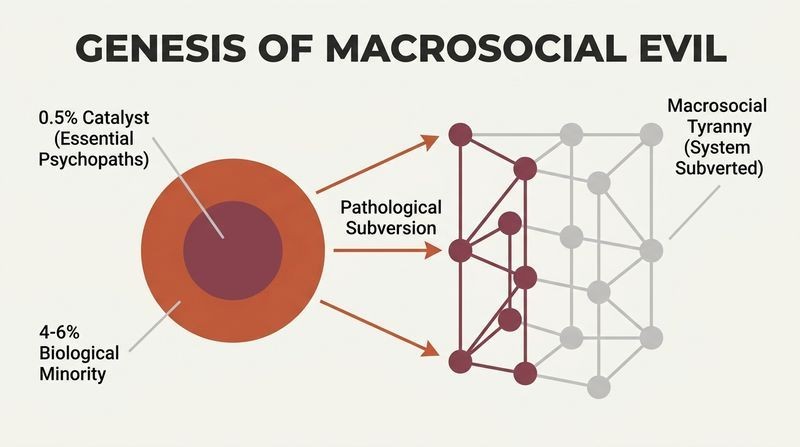
Lobaczewski's central claim is that macrosocial evil (tyranny that swallows whole nations) is not primarily ideological or economic but rooted in psychopathology. A tiny fraction of humans, roughly 4 to 6 percent, carry inherited or acquired psychological deviations. Among them, the essential psychopaths (barely half a percent) act as the active catalyst.
The book was born from lived horror. A group of Polish and Hungarian scientists studied Stalinist rule from the inside during the 1950s and 1960s, most of them arrested, silenced, or killed. Lobaczewski burned his first manuscript minutes before a police search, lost his second in transit to the Vatican, and rewrote the third from memory in New York. He coined the term ponerology (from Greek poneros, evil) for a proposed science studying evil's origins clinically, the way medicine studies disease.
The thesis is bold and unfashionable: that history's atrocities trace to identifiable brain and personality pathology rather than ordinary humans corrupted by circumstance. This cuts against Hannah Arendt's famous banality of evil and Zimbardo's situationist findings, which show normal people committing atrocities under social pressure. The truth is likely a synthesis: pathological individuals seed and steer, while ordinary conformity supplies the muscle. Readers should weigh Lobaczewski's clinical framing against its unfalsifiable risk, diagnosing dead dictators from photographs invites confirmation bias. Yet the core insight, that a conscience-free minority disproportionately shapes power structures, resonates with modern research on corporate and political psychopathy.
Roughly 1 in 25 people has no conscience at all
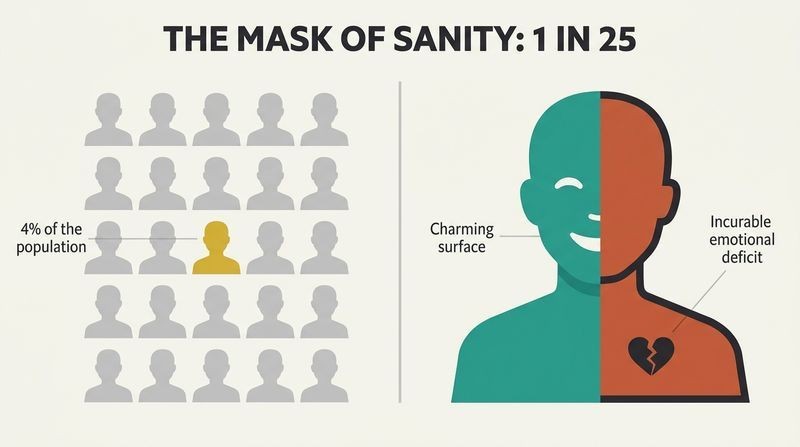
The book leans on research showing antisocial personality afflicts about 4 percent of the population, dwarfing schizophrenia (1 percent) and rivaling anorexia. Most such people never murder or land in prison. They become executives, attorneys, politicians, and physicians, hiding behind what psychiatrist Hervey Cleckley called the mask of sanity.
What defines them is not violence but absence: no guilt, no genuine remorse, no capacity for enduring love. Three traits recur:
1. No sense of guilt for antisocial acts
2. Inability to love truly
3. A smooth, glib talkativeness that easily departs from reality
They imitate emotional words without grasping their meaning, claiming devastation at a loss, then attending a party to forget, and genuinely forgetting. Cleckley hypothesized a profound, incurable emotional deficit beneath the charming surface.
The statistic reframes psychopathy from a rare horror-movie trait into a common feature of everyday life. Robert Hare's later work on white-collar psychopaths and Paul Babiak's Snakes in Suits extend this exact point: the successful psychopath thrives in ambiguous, high-reward environments like finance and politics. Neuroimaging supports the emotional-deficit hypothesis, showing reduced amygdala activation to distressing images. One caveat: conflating clinical psychopathy, sociopathy, and antisocial personality disorder (which Lobaczewski himself flags) muddies the numbers. Still, the practical lesson stands: assuming everyone shares your conscience makes you exploitable, a blind spot the book calls fatal naivete.
Your assumption that everyone is basically good makes you prey
Editor Laura Knight-Jadczyk describes learning this the painful way. She had spent thirty years studying psychology while holding one belief sacred: that deep down all people want to do good. A direct, damaging encounter with a psychopath shattered it.
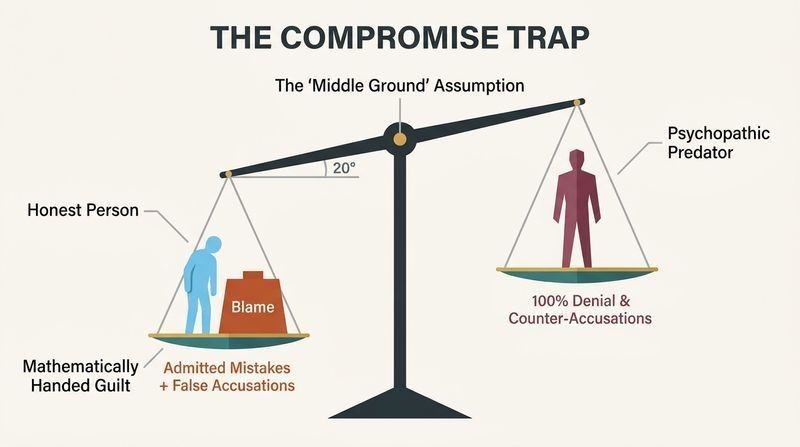
The psychopath is described as a predator whose only real drive is a kind of predatorial hunger. Normal people extend automatic trust and interpret conflict through what Robert Canup called the legal argument: the reflexive assumption that in any dispute, truth lies somewhere in the middle. This mathematically hands victory to the liar. An honest person admits mistakes; a psychopath denies everything and accuses back. Truth twisted by a skilled liar always makes the innocent look guilty. Oaths mean nothing to someone without conscience, so the whole machinery of fairness favors the predator.
This is the book's most immediately useful survival lesson, and it echoes across disciplines. Game theory confirms that unconditional cooperators get exploited by defectors; the winning strategy, tit-for-tat, starts trusting but punishes betrayal. The naive faith in a middle ground also appears in journalism's bothsidesism and in negotiation research on bad-faith actors. What Lobaczewski adds is the emotional mechanism: conscience is spatiotemporal, letting us imagine others' suffering as our own, and predators simply lack that imaginative bridge. The danger of overcorrecting, seeing psychopaths everywhere and becoming paranoid, is real, which is why the book insists on calibrated discernment rather than blanket suspicion.
Ordinary language cannot describe evil; you need clinical objectivity
Lobaczewski argues that our natural world view, the everyday moral and psychological vocabulary we inherit from family and culture, breaks down completely when confronting pathological phenomena. It works fine for normal human affairs but produces only surrogate comprehension and helplessness when a psychopathological factor enters.
He borrows the naturalist's stance: when a blood-sucking creature drops onto your neck in the Amazon, the biologist removes it without anger and studies it, because that is simply its mode of feeding. Adopting this detached, clinical attitude toward human evil protects the mind from being poisoned by revulsion and enables actual understanding. The book's motto, drawn from medicine, is Ignota nulla curatio morbi: you cannot cure what you do not understand. Objective biological and psychological language, not moral outrage, becomes the necessary tool.
This methodological move is the book's intellectual spine and its most contestable feature. Treating evil as disease has genuine payoff: it disarms the mystery that pathological systems rely on for survival, and it resists the vengeful moralizing that Lobaczewski shows perpetuates cycles of violence. It parallels the shift from demonology to psychiatry in mental illness. But the naturalist stance carries a hazard the author underplays: clinical detachment can slide into moral abdication, and labeling adversaries as diseased is itself a tactic tyrannies use. The book walks a genuine tightrope between scientific clarity and the dehumanization it warns against.
Good times breed the hysteria that invites catastrophe
The hysteroidal cycle describes how prosperity sows the seeds of collapse. During comfortable eras, often built on hidden injustice, people lose the appetite for hard self-examination. Why ponder human nature when life's pleasures seem available for the taking? The truth-teller becomes an annoying killjoy; the cult of power replaces psychological wisdom.
Societies then develop what Lobaczewski calls hysteria: subconscious selection and substitution of uncomfortable facts, a fear of thinking about unpleasant things. He points to the quarter-century before World War I, when young officers danced in Vienna's streets singing about the coming beautiful war. This emotional regression, spreading downward from privileged classes, atrophies critical faculties until the society can no longer distinguish sensible voices from pathological ones, opening the door to tragedy.
The cyclical thesis places Lobaczewski alongside historians like Peter Turchin, whose cliodynamics also models recurring waves of social instability, and echoes Ibn Khaldun's medieval theory of dynastic softening across generations. The psychological mechanism he identifies, collective repression of inconvenient truths during affluence, anticipates modern work on motivated reasoning and cognitive dissonance at scale. The claim that comfort erodes wisdom is intuitively powerful but hard to falsify and flirts with nostalgic declinism (every generation believes the previous one was tougher). Its real value is diagnostic: when a society starts punishing those who name problems, treat it as a warning light, not background noise.
Pathocracy: when the conscienceless minority captures the whole state
Pathocracy is Lobaczewski's term for a government where a pathological minority rules over a majority of normal people. It does not arrive fully formed. It grows in phases: schizoidal ideologues author simplistic doctrines, characteropaths (people with brain-damage-driven personality disorders) turn those doctrines into aggressive propaganda, and finally psychopaths infiltrate and seize the leadership, purging the original true believers.
Once established, the ideology becomes a mask, a Trojan horse. Doubletalk emerges: the same words carry one meaning for outsiders and another for initiates. The system cannot govern competently because loyalty and pathology, not skill, determine who holds power. It paralyzes economics, science, and culture, and survives only by terror, expansion, and the constant sense of being threatened by the normal-people majority it rules.
Pathocracy is the book's signature contribution, and its phased genesis model is genuinely illuminating. The pattern of revolutions devouring their idealists, then hardening into psychopath-led machines, fits the arc from 1917 idealism to Stalinist terror, and the Jacobins to the Terror. The doubletalk insight prefigures Orwell's Newspeak with a clinical rationale. Where the framework strains is universality: not every authoritarian regime maps cleanly onto essential psychopathy, and the model risks explaining too much. Modern political scientists would add institutional and incentive structures that Lobaczewski's biological lens downplays. Still, the observation that competence gets sacrificed to loyalty in captured states is devastatingly accurate.
Never name a regime by its ideology; name it by its pathology
Lobaczewski insists that calling a pathocracy communist, socialist, or by any ideological label is the keystone error that renders us helpless. The ideology is merely the disguise a parasite wears; the actual content is completely different from the original idea. He compares it to a psychiatrist who must distinguish the disease from the patient's delusional system. Various delusions can appear in the same illness, and the same delusion in different illnesses.
This is why, he argues, any economic system where the state owns nearly everything is really state capitalism, not communism, an old-style exploiter writ large. Old Polish communists were the first to insist the regime betrayed their beliefs, and they paid with prison or their lives. Fighting the ideology while ignoring the pathology wastes effort and lets the disease spread.
This is a sharp epistemological weapon with wide application. It anticipates the analytical distinction between a movement's stated principles and its operational reality, and it warns against the propaganda trap where fighting an ideology on its own terms legitimizes it. The insight that adherents of an ideology are often its regime's fiercest critics has strong historical support, from disillusioned Bolsheviks to purged party members everywhere. The challenge: separating pathology from ideology cleanly is harder than the book suggests, since genuine ideas do shape behavior and constrain the pathological. Ideas and pathology co-evolve; treating them as fully separable can itself distort analysis.
Twisted language weaponizes your own conscience against you
The book catalogs specific verbal techniques pathological actors use to disable normal thinking. Two are central:
1. Paramoralism: dressing an act in moral language to make the immoral seem righteous, as when abusers claim their cruelty serves a higher good
2. Reversive blockade: insisting loudly on the opposite of the truth, so the average mind, seeking a reasonable middle, lands on a satisfying falsehood
Alongside these run paralogisms (subtly invalid arguments) and conversive thinking (subconsciously blocking, selecting, or substituting uncomfortable facts). Because humans carry a deep instinct that moral rules exist, any moral-sounding slogan is automatically suggestive, even when the moral criteria are invented on the spot. Spellbinders, pathological individuals who flood others with paralogic and paramoral rhetoric, exploit this to enslave less critical minds and build ideological followings.
This is arguably the book's most practically transferable material, mapping neatly onto modern concepts of gaslighting, DARVO (deny, attack, reverse victim and offender), and disinformation. The reversive blockade in particular predicts the big-lie technique: a falsehood asserted with enough confidence drags the discourse toward it. Cognitive science backs the mechanism through anchoring effects and the illusory-truth effect, where repetition breeds belief. What Lobaczewski adds is the moral dimension, showing how conscience itself becomes the attack surface, since only people with functioning moral instincts can be manipulated by moral-sounding language. The conscienceless are immune to their own weapons, a chilling asymmetry.
Living under tyranny builds a psychological immunity outsiders lack
Lobaczewski describes how normal people trapped in a pathocracy gradually develop defenses. At first, contact with pathological authority causes a kind of mental paralysis, a psychophysiological shock that deadens thought. But over years, people acquire practical knowledge, learn the regime's weak spots, and build what he calls psychological immunization.
He recounts his own arrests. In 1951, deprived of water and battered by interrogators, his brain simply stopped functioning. By 1968, facing five interrogators, he calmly asked why so many in their line of work end up in psychiatric hospitals, and was released. Societies develop a sardonic humor, a secret communicative language, and dense underground networks of mutual aid that cross old class lines. This hard-won knowledge, he stresses, cannot be transmitted by literature to those who never lived it, only by objective science.
This section grounds the abstract theory in memoir and gives the book its moral authority. The immunization concept parallels psychological research on stress inoculation and post-traumatic growth, where controlled adversity builds resilience. The observation that oppression forges unusually deep solidarity across former class divisions is echoed in accounts of Solidarity in Poland and dissident networks throughout the Eastern Bloc. The claim that this knowledge is untransmittable except through objective science is both poignant and self-serving, since it positions the book itself as the necessary vaccine. There is real insight here: firsthand experience of manipulation does build a discernment that book-learning alone rarely achieves.
Fight this evil with understanding and forgiveness, not vengeance
Lobaczewski's prescription is startling: therapy for the world rooted in comprehension rather than punishment. Just as making a patient aware they were manipulated by a pathological person begins to heal them, spreading objective knowledge of pathocracy's nature would immunize whole populations and demoralize the pathocrats, whose power depends on staying mysterious and masked.
He calls for forgiveness of the pathocrats, not from sentiment but from naturalistic logic: their behavior is largely biologically determined, so vengeance merely restarts the ponerogenic cycle. He cites Nuremberg as a missed opportunity, arguing that hanging Nazi leaders buried the chance to expose the psychopathology publicly. He envisions replacing punitive law with law based on understanding evil's genesis, protected by a Council of Wise Men screening leaders for pathology, in a future system he names logocracy.
The turn toward forgiveness gives the book an unexpected ethical depth, aligning clinical determinism with the Gospel injunction against judgment that Lobaczewski explicitly invokes. It resonates with restorative justice movements and with truth-and-reconciliation models like post-apartheid South Africa, which chose exposure over retribution. Yet the proposal raises hard questions: if forgiveness requires accurately diagnosing biological causation we cannot fully measure, and if pathocrats will never relinquish power without struggle (as the editor repeatedly notes), the prescription may be more aspirational than operational. The Council of Wise Men also risks recreating the very gatekeeping power it aims to prevent. The vision is humane, its feasibility uncertain.
Analysis
Political Ponerology is a strange and haunting hybrid: part clinical psychology, part political theory, part survivor's testament smuggled out of Soviet-bloc Poland. Its central provocation is that the great political horrors of history are best understood not through economics, ideology, or Arendtian banality, but through psychopathology, specifically the outsized influence of a conscienceless minority who capture and reshape social movements into what Lobaczewski names pathocracies.
The book's greatest strength is its insider vantage. Written by a clinical psychologist who was arrested, tortured, and exiled, and drawing on the destroyed work of colleagues who died for this research, it carries an authority no armchair theorist could claim. Its concepts, ponerogenesis, the hysteroidal cycle, spellbinders, doubletalk, reversive blockade, paramoralism, provide a surprisingly sharp vocabulary for phenomena we now discuss under gaslighting, disinformation, and corporate psychopathy. Decades before mainstream psychology mapped the successful psychopath, Lobaczewski insisted such people cluster in professions of power.
Its weaknesses are equally clear. The biological determinism is often asserted rather than demonstrated, the diagnoses of Wilhelm II, Stalin, and Lenin rest on retrospective inference, and the heavy editorial commentary (comparing the Bush administration to the Kaiser, treating the Protocols as instructive) sometimes undermines the scientific posture the author strives for. The framework risks unfalsifiability and can shade into the dehumanizing labeling it warns against. Yet the core insight endures and unsettles. Systems built on the assumption that everyone shares a conscience are structurally vulnerable to those who do not, and the failure to recognize this, the naive faith in a golden mean between truth and lie, hands power to the ruthless. Whether or not one accepts the full clinical apparatus, Lobaczewski forces a question modern political science mostly avoids: what if a meaningful fraction of the humans seeking power are fundamentally different in kind, not degree? Read critically, it is genuinely illuminating.
Last updated:
Report IssueReview Summary
Political Ponerology receives mixed reviews, with many praising its groundbreaking analysis of evil in politics and psychopathy's role in totalitarianism. Readers find it insightful and crucial for understanding societal issues. However, some criticize its dense, academic writing style and lack of scientific rigor. The book is described as challenging but rewarding, offering unique perspectives on the origins of evil in power structures. Critics note potential biases and outdated views, while supporters argue it's essential reading for comprehending global political dynamics.
People Also Read




Glossary
Ponerology
Proposed science of evil's originsLobaczewski's coined discipline, from the Greek poneros (evil), that studies the causes and genesis of evil using objective biological, psychological, and psychopathological methods rather than moral or historical categories. Its goal is to understand the process by which evil arises (ponerogenesis) so societies can counteract it clinically, the way medicine counteracts disease.
Pathocracy
Rule by pathological minorityA macrosocial system in which a small minority of psychologically abnormal individuals, inspired chiefly by essential psychopaths, seizes control over a society of normal people. The ruling ideology becomes a mask concealing the regime's true pathological nature. It governs through terror, propaganda, and expansion, and cannot administer competently because loyalty and pathology, not skill, determine who holds power.
Essential psychopathy
Inherited total lack of conscienceLobaczewski's term for the most ponerogenically active hereditary anomaly, affecting slightly over half a percent of the population. Marked by a defective instinctive substratum producing no guilt, no genuine love, and a fundamentally different experiential world. Essential psychopaths recognize each other, view normal people as prey, and act as the inspirational catalyst at the core of pathocracy.
Hysteroidal cycle
Prosperity-driven cycle toward collapseA recurring historical pattern in which comfortable, prosperous eras erode a society's psychological and moral discernment. People repress uncomfortable truths, critical thinking atrophies, and collective hysteria spreads until the society can no longer distinguish sensible from pathological voices, opening the door to tragedy. Lobaczewski estimated a roughly two-century periodicity in Europe.
Spellbinders
Pathological individuals who charm followersCarriers of pathological traits, often characteropaths or paranoid personalities, who flood others with paralogical and paramoral rhetoric to impose their distorted world view. Driven by pathological egotism, they create ideologies as tools of self-charming and manipulation, easily enslaving less critical minds while being rejected by psychologically healthy people.
Paramoralism
Immoral acts disguised as moralA manipulation technique in which harmful behavior is cloaked in moral-sounding language, making the immoral appear righteous. Because humans carry a deep instinct that moral rules exist, any moral-sounding slogan is automatically suggestive, even when its criteria are invented on the spot, allowing pathological actors to weaponize other people's conscience against them.
Reversive blockade
Loud insistence on the oppositeA technique of emphatically asserting the opposite of the truth so that the average mind, seeking a reasonable middle ground between a claim and its opposite, settles on a convenient falsehood. A favorite mass-scale method of pathocracies, it exploits healthy common sense's tendency to look for a golden mean.
Conversive thinking
Subconscious blocking and substituting factsPsychological processes by which the mind subconsciously blocks out uncomfortable conclusions, selects away inconvenient premises, or substitutes them with more comfortable data. It protects against personality disintegration in the short term but progressively enslaves a person to their subconscious and, when done collectively, spreads like a contagion through a society.
Characteropathy
Personality disorder from brain damageCharacter disorders caused by acquired brain-tissue damage (from birth trauma, infection, or toxins) rather than heredity. Lobaczewski cites frontal and paranoid varieties as especially ponerogenic. Characteropaths traumatize and deform the personalities of normal people around them, playing a key role in the early phases of pathocracy before psychopaths take over leadership.
Natural world view
Everyday intuitive moral vocabularyThe ordinary system of psychological, social, and moral concepts humans absorb from family and culture. Adequate for normal human affairs, it fails completely when confronting pathological phenomena, producing helplessness and dangerous moralizing interpretations. Lobaczewski argues it must be supplemented by objective, clinical language to understand evil.
FAQ
1. What is Political Ponerology by Andrew M. Lobaczewski about?
- Scientific Study of Evil: The book introduces ponerology as a scientific discipline focused on understanding the nature, origins, and mechanisms of evil, especially as it manifests in political and social systems.
- Interdisciplinary Approach: Lobaczewski combines psychology, psychiatry, history, and political science to analyze how evil arises and spreads within societies.
- Macrosocial Focus: The work emphasizes how small groups of pathological individuals can influence and corrupt entire societies, leading to large-scale suffering and injustice.
- Practical Implications: The book aims to equip readers with knowledge to recognize and counteract the spread of evil in political and social contexts.
2. Why should I read Political Ponerology by Andrew M. Lobaczewski?
- Unique Scientific Perspective: The book offers a rare, scientific, and psychological analysis of evil, moving beyond traditional moral or theological explanations.
- Survival and Awareness: It serves as a survival guide, helping readers understand how psychopathy and other pathologies affect daily life and political systems.
- Empowerment Through Knowledge: Readers gain practical tools to recognize pathological influences, protect themselves, and contribute to societal healing.
- Relevance to Modern Times: The insights are applicable to contemporary political and social challenges, making it a timely and essential read.
3. What are the key takeaways from Political Ponerology by Andrew M. Lobaczewski?
- Pathological Influence: A small minority of pathological individuals can have a disproportionate impact on society, leading to the rise of oppressive regimes.
- Ponerization Process: Societies and ideologies can be gradually corrupted through the infiltration of pathological personalities, resulting in pathocracy.
- Importance of Awareness: Understanding the psychological roots of evil is crucial for prevention and resistance.
- Role of Education: Psychological and social immunization through education and critical thinking is essential for societal health.
4. What is "ponerology" according to Andrew M. Lobaczewski, and how does it relate to political evil?
- Definition of Ponerology: Ponerology is the scientific study of the nature, causes, and genesis of evil, especially in social and political contexts.
- Beyond Morality: It seeks to understand evil using naturalistic and psychological frameworks, rather than relying solely on moral or religious interpretations.
- Focus on Pathology: The discipline analyzes how psychological anomalies, such as psychopathy and characteropathy, contribute to the degeneration of groups and systems.
- Practical Application: Ponerology provides tools to detect, prevent, and counteract pathological influences in society.
5. How does Political Ponerology by Andrew M. Lobaczewski define psychopathy, and why is it important?
- Core Traits: Psychopathy is characterized by a lack of conscience, guilt, or remorse, manipulativeness, egocentricity, and emotional coldness.
- Prevalence and Danger: Psychopaths make up about 4-5% of the population and often appear charming and normal, allowing them to infiltrate positions of power.
- Macrosocial Impact: Their actions can lead to widespread social and political harm, including oppression, genocide, and systemic injustice.
- Central to Ponerology: Understanding psychopathy is essential for grasping how evil spreads and how societies can defend themselves.
6. What is the "ponerization" process described in Political Ponerology by Andrew M. Lobaczewski?
- Definition: Ponerization is the process by which pathological individuals infiltrate and corrupt social and political structures, leading to the rise of pathological regimes.
- Stages of Corruption: It begins with the introduction of pathological ideas, followed by the departure of normal individuals and the rise of pathological leadership.
- Resulting Pathocracy: The process culminates in a stable pathological system where normal values are replaced by pathological norms.
- Societal Consequences: Ponerization leads to moral decay, societal hysteria, and large-scale suffering.
7. What is "pathocracy" in the context of Political Ponerology by Andrew M. Lobaczewski?
- Definition: Pathocracy is a form of government or social system ruled by individuals with pathological personalities, especially psychopaths.
- Emergence: It arises from the ponerization process, where pathological individuals exploit societal weaknesses to gain power.
- Effects on Society: Pathocracy results in systemic oppression, human rights abuses, and the destruction of normal social and moral order.
- Ideological Doubletalk: Such regimes often use propaganda and doubletalk to mask their true nature.
8. How do ideologies become "ponerized" or corrupted according to Political Ponerology by Andrew M. Lobaczewski?
- Dual-Layer Ideology: Ponerized ideologies develop an outer propaganda layer for the masses and an inner, hermetic layer for the pathological elite.
- Infiltration and Distortion: Pathological individuals exploit weak spots in ideologies, contaminating them with primitive or pathological elements.
- Loss of Coherence: The internal coherence of the ideology is destroyed, making it a tool for pathological groups.
- Historical Examples: Even valuable ideologies can be subverted and used to justify destructive actions.
9. What roles do "spellbinders" and "ponerogenic associations" play in the spread of evil in Political Ponerology by Andrew M. Lobaczewski?
- Spellbinders: These are charismatic, pathological individuals who manipulate and control others, spreading destructive ideologies.
- Catalysts for Corruption: Spellbinders inspire followers and maintain ideological control, often hiding their pathological nature.
- Ponerogenic Associations: These are groups with a high concentration of pathological individuals, structured to advance destructive agendas.
- Expansion of Evil: Such associations propagate evil on social and political scales, facilitating the rise of pathocracy.
10. How does Political Ponerology by Andrew M. Lobaczewski distinguish between normal and pathological individuals in society?
- Normal Majority: Most people are psychologically healthy, desiring harmony and goodness.
- Pathological Minority: A small but active minority possess psychological deviations, such as psychopathy or characteropathies, enabling them to harm others.
- Exploitation of Weaknesses: Pathological individuals exploit societal and individual vulnerabilities, often leading to macrosocial evil.
- Societal Impact: The unchecked influence of pathological individuals can destabilize and corrupt entire societies.
11. What practical advice and methods does Political Ponerology by Andrew M. Lobaczewski offer to counteract macrosocial evil?
- Knowledge as Defense: Understanding the nature of evil and pathological processes is the first step in protection.
- Psychological Immunization: Education, awareness, and critical thinking help individuals and societies resist pathological influences.
- Legal and Social Reform: The book advocates for modernized laws and social systems based on scientific knowledge of human psychology.
- Forgiveness and Healing: Emphasizes the importance of forgiveness, rehabilitation, and societal healing over punitive justice.
12. How does Political Ponerology by Andrew M. Lobaczewski address the role of religion and forgiveness under pathocratic rule?
- Religion as Resistance: Religion can provide spiritual strength and moral guidance, helping people resist pathocratic influences.
- Ponerization of Religion: Religious organizations themselves can be corrupted and used to mask pathocracy.
- Forgiveness as Rational Act: Understanding psychological causation justifies forgiveness, breaking cycles of vengeance and aiding societal healing.
- Legal Implications: Calls for laws that reflect psychological understanding, focusing on rehabilitation and protection rather than punishment alone.
About the Author
Andrew M. Lobaczewski was a Polish psychiatrist born in 1921 who lived through Nazi and Soviet occupations. His experiences shaped his interest in psychopathology and political systems. Lobaczewski studied psychology at Jagiellonian University and worked in mental health services. He conducted secret research on the role of psychopathic individuals in governmental systems, facing persecution from authorities. Forced to emigrate to the USA in 1977, he completed "Political Ponerology" in 1984. Despite publication difficulties and health issues, Lobaczewski continued his work in psychotherapy and socio-psychology upon returning to Poland in 1990. He passed away in 2007, leaving behind a controversial legacy in the study of evil and politics.
Download PDF
Download EPUB
.epub digital book format is ideal for reading ebooks on phones, tablets, and e-readers.








































