

Key Takeaways
Flying saucer aliens are the fairies and elves of the modern age
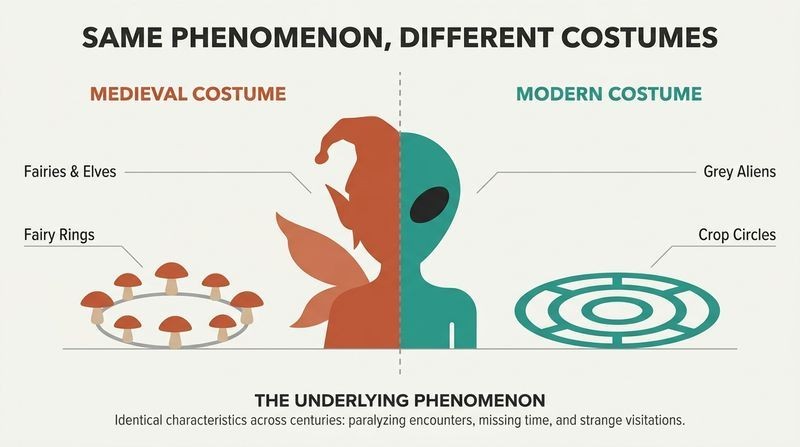
The central thesis is disorienting on purpose. Jacques Vallee, an astronomer and computer scientist who worked on early UFO data, argues that the beings people report seeing near flying saucers are indistinguishable from the elves, sylphs, gnomes, and fairies described for centuries in folklore. The little men in shiny suits, the paralysis of witnesses, the abductions, the strange gifts of food, the rings burned into fields: all of it appears in medieval fairy lore and Celtic legend long before 1947.
Vallee's move is to refuse the two obvious camps. He does not claim saucers are alien spaceships, and he does not claim witnesses are lying. Instead he treats both fairy-faith and ufology as the same underlying human phenomenon wearing different cultural costumes.
What's striking is how this reframing anticipates later work in the psychology of anomalous experience. Sleep paralysis researchers now link the classic "unable to move while a presence watches me" reports to hypnagogic states, a pattern that spans incubus legends, Old Hag folklore, and abduction accounts alike. Vallee's insight also echoes Carl Jung's 1958 essay treating flying saucers as a modern mandala myth. The weakness worth flagging: cross-cultural similarity can be overstated. Some resemblances may reflect the researcher's pattern-matching rather than the witnesses' actual reports, a selection bias that plagues comparative mythology generally.
Stop asking what UFOs are; ask what they do to human belief
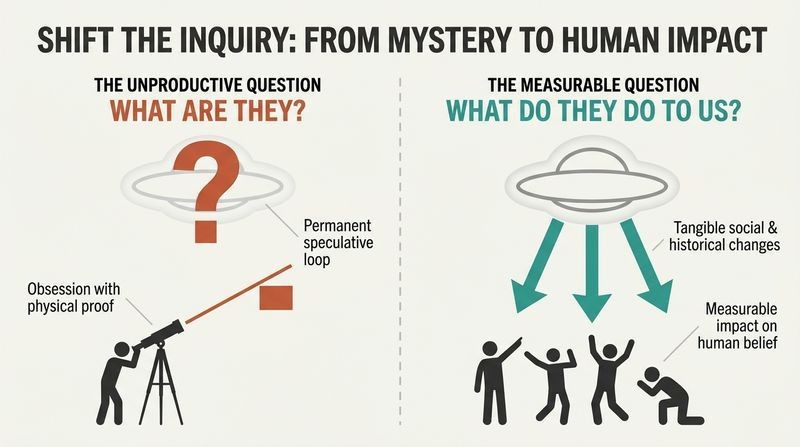
Vallee reframes the entire question. Most researchers, official and amateur, obsess over whether the objects are physically real machines. Vallee calls this a trap. The physical nature may be permanently unsolvable, but the effect on human imagination, behavior, and society is measurable and enormous.
He points to medieval Japan, where luminous objects in the sky triggered peasant revolts, panics, and executions because people read them as heavenly endorsements of their cause. He cites the 1235 case where General Yoritsume ordered a "full-scale investigation" of swaying lights, and his advisers concluded it was just wind moving the stars, an evasion Vallee compares to modern Air Force debunking. The lesson: displays beyond comprehension can reshape the destinies of whole populations, whether or not anything real caused them.
This pivot from ontology to sociology is the book's most durable contribution. It prefigures the modern study of misinformation and mass belief, where the truth value of a rumor matters less than its transmission dynamics. Communications scholars would recognize Vallee's framing as a precursor to memetics. The provocative edge, which some find conspiratorial, is his suggestion that belief itself could be deliberately engineered by governments or advertisers who understand folklore. That claim was speculative in 1969 but reads presciently in an era of coordinated influence operations and viral disinformation campaigns.
The word Magonia names a cloud-country whose sailors were nearly stoned
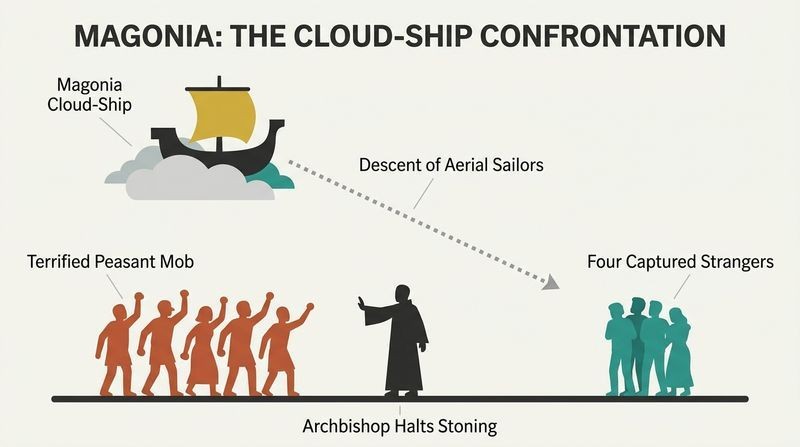
A ninth-century bishop gave the book its title. Agobard, Archbishop of Lyons, recorded that peasants believed in a region called Magonia, from which ships sailed in the clouds to steal crops destroyed by storms. A mob had captured four people, three men and a woman, whom they claimed had fallen from these cloud-ships, and was about to stone them when Agobard intervened by declaring the whole thing impossible.
Occultists told the story differently. In their version, the Cabalist Zedechias had summoned the Sylphs, aerial beings, to show themselves openly. Terrified crowds mistook them for sorcerers and killed the innocents who descended. Either way, the pattern is the passport Vallee wants: aerial visitors, captured humans, communication failure, and a crowd caught between belief and terror.
The Magonia episode is a gem of intellectual history because it shows a rationalist authority figure and an occult tradition arguing over the exact same event, each certain of its frame. That structure repeats endlessly in UFO discourse: skeptic versus believer, both talking past the witness. What's valuable is Vallee's refusal to side with either. Historians of the medieval period note that Agobard was unusually skeptical for his era, which makes him a useful reminder that debunking is not a modern invention. The permanent human reflex to explain away the anomalous is itself part of the phenomenon.
Never eat the food, and other rules shared by fairies and saucer crews
A Wisconsin chicken farmer got pancakes from a saucer. In 1961 Joe Simonton said a hovering craft landed, a crewman handed him a jug to fill with water, and gave him three greasy cakes in return. The Air Force lab found ordinary terrestrial pancake ingredients. Vallee connects this instantly to Celtic fairy lore, where the Gentry give humans magical, inexhaustible cakes, and where the iron rule is that eating fairy food traps you in their world forever. Notably, fairies never eat anything salty, and Simonton's pancakes lacked salt.
The exchange of food, Vallee argues, is a ritual of hospitality that binds giver and receiver, echoed in weddings, funerals, and the Biblical passage about entertaining angels unaware. The saucer story is not sci-fi; it is an ancient ceremony in new dress.
The food motif is anthropologically rich. Sharing a meal to seal an alliance is nearly universal, from Bedouin bread-and-salt customs to communion. Vallee borrows from folklorist Edwin Hartland's observation that eating together constitutes a sacred bond, which grounds the seemingly absurd pancake case in serious ethnography. The skeptical reading, of course, is that a lonely farmer had a waking dream, exactly what the Air Force concluded. Vallee's rejoinder is clever: dismissing the story requires ignoring the precise structural parallels with tales Simonton could not plausibly have known. That epistemic standoff is the book in miniature.
Time bends in Magonia: an afternoon there costs years on earth
Abductees and fairy captives share a warped clock. Vallee catalogs tale after tale where humans taken to fairyland believe they spent hours dancing, then return to find years or centuries have passed. A Welshman thinks he played his flute for a few hours; it was three weeks. A boy named Gitto returns after two years convinced only a day elapsed. The Danish bride who joins the elves for a dance comes home a hundred years later and crumbles to dust.
He places the Betty and Barney Hill abduction of 1961 in this lineage. Under hypnosis the couple recovered a missing two hours they could not account for, during which they described being examined aboard a craft. The relativistic dissymmetry of time, Vallee notes with wonder, appears in folk tales centuries before Einstein.
The missing-time trope is where Vallee's comparative method is most seductive and most contestable. Neurologically, distorted time perception accompanies temporal lobe activity, dissociative states, and confabulation under hypnosis, which is now known to generate false but vivid memories. The Hill case, recovered through hypnotic regression, sits precisely in that danger zone. Yet Vallee's larger point survives the critique: the human mind has always encoded encounters with the uncanny using the same narrative grammar, including time dilation. Whether that grammar reflects an external reality or a hardwired storytelling instinct is the question he deliberately leaves open.
Genetic obsession unites incubus legends, fairy changelings, and abduction sex
The spicy material got censored out of fairy tales. Vallee argues that modern children's fairy tales are sanitized, stripped of the sexual and reproductive themes that gave the original fairy-faith its grip. Fairies steal human babies and leave changelings. They kidnap pregnant women and nursing mothers. They intermarry with humans. The seventeenth-century theologian Ludovicus Sinistrari wrote an entire treatise, De Daemonialitate, cataloging sexual contact between humans and non-human beings, complete with a poltergeist-plagued woman tormented by an amorous incubus.
The 1957 Antonio Villas-Boas case fits the mold: the Brazilian farmer described being taken aboard a craft and made to have intercourse with a strange woman who then pointed to her belly and to the sky. The recurring implication across eras is that the visitors want our genetic material.
This is the book's most transgressive thread, and it prefigured the abduction narratives that would dominate the 1980s and 1990s with their hybrid-baby claims. Folklorists have long noted that changeling beliefs served a grim social function: they rationalized infanticide of disabled infants and the deaths of children, as Vallee himself acknowledges through the 1884 Clonmel cruelty case. The reproductive theme may reveal less about visitors than about perennial human anxieties over fertility, illegitimacy, and bodily autonomy. Read through that lens, the incubus and the abductor are projections of fears about sex and reproduction onto an external, blameless agent.
The 1897 airship proves the vision always matches current technology
America saw a flying machine that could not fly. In 1896 and 1897, before powered flight existed, thousands of Americans across the Midwest reported a great airship with turbines, wheels, wings, and searchlights. Its pilots were folksy Americans who asked farmers for water or hardware and chatted about their invention. Captain James Hooton described its air-brake sounds; others were dragged by its dropped anchor, an anchor-in-the-sky motif that also appears in a medieval Irish tale from around 1211.
Vallee's point is devastating to the nuts-and-bolts theory: the airship was believable to 1897 witnesses but is impossible by our own engineering standards. The craft's appearance tracks whatever technology a culture can imagine. Aerial ships became dirigibles became ghost rockets became flying saucers, always one step ahead of the plausible.
The airship wave is arguably Vallee's strongest empirical card. It documents a mass sighting phenomenon that predates aviation, ruling out the simplest extraterrestrial-hardware explanations and pointing toward a sociocultural engine. Historians of technology would connect this to the period's feverish anticipation of flight, with Jules Verne bestsellers priming the collective imagination. The pattern that visions mirror contemporary tech continues into the present, where witnesses now report drone-like objects and, increasingly, descriptions shaped by science fiction cinema. This cultural tracking is the single most persuasive piece of evidence that the content of the experience is co-authored by the observer's era.
Religious miracles and saucer sightings run on identical machinery
Fatima and Guadalupe are UFO cases in Vallee's ledger. He argues that famous Marian apparitions follow the exact template of UFO encounters: a globe of shifting light, luminous beings within it, localized weather effects, and miraculous cures. At Knock, Ireland, in 1879, fourteen witnesses saw brilliantly lit figures against a gable wall in pouring rain, yet the ground beneath the apparition stayed dry. Cures followed. At Guadalupe in 1531, Juan Diego heard mysterious birdsong, met a radiant girl, and received roses that changed nature, echoing the fairy gifts of coal that turn to gold.
The only difference, Vallee insists, is the message. When the luminous being talks religion, the Church canonizes it. When it discusses fertilizer or engineering, we file a saucer report.
Equating apparitions with UFO encounters is provocative and, to believers of any stripe, offensive, which is partly Vallee's method. The structural parallels he draws (light phenomena, healed witnesses, atmospheric anomalies) are real and have been noted by scholars of religious experience like William James, who studied conversion and mystical states as natural psychological events. The reductive risk is flattening genuinely distinct phenomena into one category by cherry-picking shared features. Still, the core observation holds water: human beings interpret the same class of overwhelming, luminous, boundary-dissolving encounter through whatever cosmology is available, whether that means angels, the Virgin, or extraterrestrials.
A superior intelligence would look absurd, not impressive, to us
Absurdity may be a feature, not a bug. Skeptics dismiss UFO reports precisely because the aliens behave so ridiculously: collecting soil samples, requesting pancakes, speaking gibberish, paralyzing farmers for no clear reason. Vallee flips this. Drawing on the French writer Aime Michel, he argues that the actions of a genuinely superior intelligence would necessarily appear random or meaningless to an inferior one, the way a dog watching a mathematician write on a blackboard sees only noise.
He formalizes this as a proposition: organized action by a superior race must look absurd to the lower one. Coexistence without comprehension is ordinary on earth, where humans, animals, and insects share environments with wildly different nervous systems. The absurdity that repels scientists might be exactly what we would expect from real contact.
This is an elegant epistemological judo move, but it cuts both ways. The claim that absurdity is evidence of superior intelligence is unfalsifiable: any behavior, coherent or incoherent, can be retrofitted to confirm it. Philosophers of science would flag this as a hypothesis immune to refutation, which weakens it as science even as it strengthens it as provocation. Yet the underlying humility is valuable and echoes debates in SETI and animal cognition about whether we could even recognize an alien intelligence. Thomas Nagel's famous question about what it is like to be a bat lurks here: radical otherness may be literally unthinkable from inside our own cognitive frame.
Gather firsthand reports fast in small circles, not giant organizations
Vallee's prescription for real research is deflationary. He is scathing about large UFO organizations, which he says burn money and energy on mailing lists, bookkeeping, and internal feuds while doing almost no actual investigation. Neither a crash program of Nobel laureates, nor computer correlations of millions of sloppy parameters, nor squads scanning the sky with binoculars will crack the problem.
What helps, he argues, is the fast publication of good firsthand reports that circulate freely. Only local residents can judge a witness's standing and reliability. He models this himself with an appendix cataloging 923 landing cases from 1868 to 1968, gathered by cross-indexing sources across continents to trace each rumor back toward its origin. Science, he insists, is not a property of the phenomenon but an attitude in the observer.
The methodological humility here aged well. Vallee's insistence that "there is no such thing as a scientific problem, only a scientific approach" is a crisp statement of an underappreciated truth: rigor is a stance, not a subject matter. His preference for distributed, local, fast data-gathering over centralized bureaucracy anticipates open-source intelligence and citizen science. The 923-case catalog is a genuine scholarly artifact, whatever one thinks of its contents. The obvious limitation is data quality: newspaper reports and secondhand folklore cannot bear the evidentiary weight of controlled observation, a problem Vallee concedes but cannot solve, leaving the whole enterprise perpetually short of proof.
Analysis
Passport to Magonia (1969) is a hinge document in the history of UFO thought, and its author was uniquely positioned to write it. Jacques Vallee, a trained astronomer and computer scientist who helped digitize Air Force sighting data, defected from the extraterrestrial-hardware consensus that dominated his field. His thesis is deceptively simple and genuinely radical: modern flying saucer lore is continuous with the fairy-faith of Celtic countries, the demons and satyrs of early Christianity, and the aerial visitors of the Bible. The pilots of UFOs are the elves, sylphs, and lutins of the Middle Ages in technological drag.
The book's intellectual power comes from what it refuses to do. Vallee declines both the believer's certainty that saucers are alien craft and the skeptic's certainty that witnesses are frauds or fools. He relocates the entire question from ontology (what are they) to psychology and sociology (what do they do to us). This move was ahead of its time and has aged into relevance as the study of rumor, mass belief, and disinformation has matured. His observation that the visions always match contemporary technology, dramatized by the pre-aviation 1897 airship wave, remains the strongest argument against naive extraterrestrial interpretations.
The book's vulnerabilities are equally clear. Comparative mythology invites pattern-matching bias; the researcher who seeks parallels will find them. Hypnotically recovered abduction memories, central to the Hill case, are now known to be confabulation-prone. And the claim that a superior intelligence would necessarily appear absurd is unfalsifiable. Vallee half-concedes these limits, framing his conclusions as conjecture rather than proof.
What endures is the reframing itself. By insisting that imagination is a force that shapes human destiny, and that the same luminous, boundary-dissolving encounter has been narrated as angels, fairies, and aliens across millennia, Vallee gave folklorists, psychologists, and UFO researchers a shared vocabulary. The book is less an answer than a permanent, productive unsettling.
Review Summary
Passport to Magonia examines parallels between modern UFO encounters and historical folklore about fairies, elves, and supernatural beings. Jacques Vallée presents thousands of eyewitness accounts spanning centuries, suggesting these phenomena share identical mechanisms and cultural contexts. Reviewers praise his scientific approach and thorough documentation, though he deliberately avoids definitive conclusions. The book's extensive appendix catalogs UFO landings from 1868-1968. While some find it groundbreaking and thought-provoking, others consider it boring or misleading. Critics appreciate Vallée's refusal to speculate wildly, instead letting patterns emerge from data. Most agree it's a classic, foundational text in ufology that challenges both extraterrestrial and dismissive explanations.
People Also Read
Glossary
Magonia
Legendary cloud-country of aerial visitorsA term recorded by the ninth-century Archbishop Agobard of Lyons for a region peasants believed lay in the sky, from which ships sailed in the clouds to carry off crops. Vallee adopts it as a name for the ambiguous otherworld, neither clearly physical nor purely mental, from which fairies, elves, angels, and UFO occupants all seem to originate across history.
Fairy-faith
Traditional Celtic belief in supernatural beingsThe body of folk belief, documented by scholars like Walter Wentz around 1909, concerning fairies, the Gentry, the Good People, and similar beings in Celtic countries. It includes their appearance, food customs, abductions, changelings, and rings left in fields. Vallee argues this faith is structurally identical to modern UFO belief.
The Secret Commonwealth
Reverend Kirk's system of aerial beingsThe title of a 1691 manuscript by Reverend Robert Kirk of Aberfoyle, Scotland, systematically describing the elves and fairies, their intermediate nature between men and angels, their fluid bodies, their underground homes, their fuel-less lamps, and their ability to appear and vanish at will. Vallee treats it as an early field study of the same beings reported by UFO witnesses.
Humanoids
Reported occupants of landed UFOsVallee's term for the beings reported near landed craft, which he sorts into biological types: giants, ordinary-looking men, winged creatures, and especially two kinds of dwarfs, dark hairy ones with old voices matching medieval gnomes, and human-complexioned ones with oversized heads and silvery voices matching the sylphs and elves of fairy lore.
Daemonialitas
Sexual contact with non-human beingsThe subject of a treatise by seventeenth-century theologian Ludovicus Sinistrari, distinguishing sexual intercourse with incubi and succubi from bestiality. Vallee cites it as historical documentation of the genetic and sexual themes that recur in fairy changeling lore and modern abduction accounts such as the Villas-Boas case.
FAQ
What is Passport to Magonia by Jacques Vallée about?
- Exploration of UFO folklore: The book investigates the connection between modern UFO sightings and ancient folklore, arguing that UFO phenomena are a modern manifestation of older cultural and psychological patterns.
- Historical and cultural analysis: Vallée traces mysterious flying object reports from ancient times through medieval Europe to contemporary encounters, highlighting continuity in human experience and interpretation.
- Interdisciplinary approach: The author combines archaeology, religious texts, folklore, and modern UFO reports to suggest these experiences may be linked to a "parallel world" or hidden dimension influencing human destiny.
Why should I read Passport to Magonia by Jacques Vallée?
- Unique perspective on UFOs: Vallée challenges the conventional extraterrestrial hypothesis, offering a view that UFOs are part of a complex cultural and psychological phenomenon.
- Bridges folklore and modern phenomena: The book connects centuries-old myths about fairies and spirits with contemporary UFO sightings, revealing how belief systems shape these experiences.
- Valuable for multiple audiences: Journalists, scientists, and social researchers can all find relevant data and insights, making it a versatile tool for understanding the UFO phenomenon.
What are the key themes and takeaways from Passport to Magonia by Jacques Vallée?
- Continuity of supernatural encounters: Reports of flying objects and strange beings have existed throughout history, suggesting a persistent phenomenon beyond simple hoaxes or misidentifications.
- Psychological and sociological impact: The phenomenon influences human imagination, culture, and social behavior, sometimes causing fear, fascination, or mass hysteria.
- Invitation to deeper inquiry: Vallée encourages readers to explore the phenomenon as a window into human nature and the mysteries of existence, rather than seeking simple answers.
How does Jacques Vallée link ancient folklore with modern UFO sightings in Passport to Magonia?
- Similar descriptions of beings: Both ancient tales and modern UFO reports describe humanoid entities with unusual features, such as oversized heads and glowing eyes.
- Shared behaviors and phenomena: Abductions, time distortions, and physical traces like landing marks appear in both folklore and UFO cases.
- Cultural adaptation of experiences: The form and interpretation of these encounters change according to the cultural and technological context of the witnesses.
How does Passport to Magonia by Jacques Vallée define and categorize UFO sightings and landings?
- Type 1 sightings focus: The book includes reports involving close encounters with landed objects and occupants, following Vallée’s earlier definitions.
- Strict inclusion criteria: Cases with conventional explanations, missing essential data, or proven photographic fakes are excluded to maintain credibility.
- Consistent data format: Each entry includes date, time, location, witness names, object description, and occupant details for uniformity and ease of reference.
What is the significance of the 1954 UFO wave in Passport to Magonia by Jacques Vallée?
- Central study focus: The 1954 wave in Western Europe is considered the "natural nucleus" for UFO studies due to the volume and quality of reports.
- Rural eyewitness reliability: Many sightings were made by independent, well-known rural witnesses unfamiliar with flying saucers, lending credibility.
- Detailed documentation: Vallée reexamined over 200 cases from 1954 with precise verification, making this section the best-documented in the catalog.
What is the "Secret Commonwealth" and the role of the "Good People" in Passport to Magonia by Jacques Vallée?
- Fairy-like beings with society: The Good People are described as a noble race with their own social order, living in mountains and seas, and interacting with humans.
- Connection to UFO occupants: Vallée draws parallels between these beings and modern UFO entities, noting similarities in appearance and behavior.
- Symbolism of food and hospitality: Rituals of exchanging food, such as the Joe Simonton pancake case, link modern UFO lore to ancient fairy traditions.
What are the "rings" and "nests" discussed in Passport to Magonia by Jacques Vallée, and why are they important?
- Physical traces of landings: The book describes circular depressions or flattened vegetation, called fairy rings or saucer nests, often associated with UFO sightings.
- Mystery of their origin: These rings often show unusual features like magnetic anomalies and scorched vegetation, defying simple natural explanations.
- Link to folklore and UFO lore: Such rings have long been associated with supernatural activity, suggesting a continuity of mysterious phenomena affecting the environment.
How does Jacques Vallée address the nature and behavior of UFO occupants in Passport to Magonia?
- Varied biological types: Reported occupants range from giant beings to dwarfs, winged creatures, and humanoids with oversized heads.
- Absurd and elusive behavior: Occupants often behave in ways that defy logic, giving misleading information and exhibiting abilities like paralysis or sudden disappearance.
- Communication and language: Some witnesses report telepathic communication or hearing voices not coming from the mouth, aligning with historical accounts of supernatural beings.
What does Passport to Magonia by Jacques Vallée say about abductions and time distortions?
- Abductions as a recurring theme: The book documents cases where humans are taken by these beings, paralleling both fairy abduction legends and modern UFO abduction reports.
- Relativity of time: Many stories describe time passing differently in the "other world," a concept echoed in both folklore and UFO narratives.
- Symbolic and psychological significance: These experiences often involve altered states of consciousness, memory gaps, and symbolic rituals.
How does Jacques Vallée interpret the UFO phenomenon in Passport to Magonia—are UFOs physical or psychological?
- Dual nature hypothesis: Vallée suggests UFOs may involve both physical and mental components, possibly linked to a parallel universe or collective unconscious.
- Functioning myth and cultural construct: The UFO phenomenon acts as a modern mythology, fulfilling psychological and social needs.
- Skepticism of simple explanations: Vallée warns against accepting naive extraterrestrial hypotheses or dismissing the phenomenon as mere fantasy, advocating for a broader, interdisciplinary approach.
What are the implications of Passport to Magonia by Jacques Vallée for science and society?
- Challenge to scientific paradigms: The book argues that UFO phenomena expose the limits of current scientific understanding, especially regarding time, consciousness, and reality.
- Potential for social influence: Vallée warns that the UFO myth can be manipulated for political or psychological control, affecting public belief and behavior.
- Invitation to open-minded research: The book encourages deeper inquiry into the phenomenon as part of our collective heritage, emphasizing the value of preserving and studying these experiences.
About the Author
Other books by Jacques F. Vallée

Download PDF
Download EPUB
.epub digital book format is ideal for reading ebooks on phones, tablets, and e-readers.








































