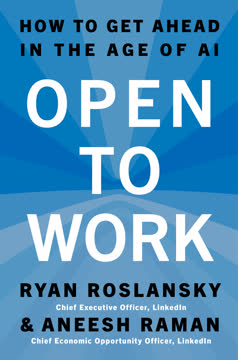
Key Takeaways
1. AI Won't Replace You, But Someone Using AI Likely Will
Every day you wait, the gap between those experimenting with AI and those hesitating widens.
The urgency is real. Artificial intelligence is rewriting the rules of work at an unprecedented, exponential pace. While humans tend to think linearly, expecting gradual change, AI's S-curve adoption means that the technology will never be as basic as it is now, and the pace of change will never be as slow. This creates a dangerous gap between those who embrace AI and those who hesitate, with C-suite leaders already prioritizing AI adoption and two-thirds of corporate leaders considering AI skills a prerequisite for candidates.
Your job is already changing. LinkedIn research reveals that 24% of skills for the average job changed globally between 2015 and 2022, a figure projected to jump to 70% by 2030 due to AI. This means your role is evolving even if you're not changing companies. The fear of this change is biological, a primal response to the unknown, but overriding this instinct to freeze, fight, or flee is crucial. Instead of resisting, learn from the Luddites who fought mechanical looms and ultimately missed the new opportunities created.
AI amplifies human potential. Individuals like Ume Habiba, a software engineer, and Jonetta Gresham, a nurse-turned-project manager, exemplify how embracing AI can be liberating. Ume uses AI for "busywork" like coding, freeing her to focus on her unique "soft skills" like communication and empathy, which AI cannot replicate. Jonetta, initially an AI skeptic, found that AI personalized her learning, allowing her to focus on critical thinking rather than rote memorization. The key is not to understand how AI works, but how to use it as a partner to amplify your distinct human capabilities.
2. Let Go of the "More, Better, Faster" Mindset
Our competitive edge as a species was never our capacity for processing and producing more, better, faster in the first place.
The efficiency trap. For centuries, work has been designed around industrial efficiency, turning humans into predictable components of a productivity machine. From knocker-uppers replaced by alarm clocks to factory workers performing repetitive tasks, the goal was always "more output, better quality, faster delivery." This mindset permeated white-collar work too, where tasks like endless emails and unnecessary meetings became the new assembly line, valuing speed and standardization over deep thinking.
AI exposes the myth of white-collar value. The traditional "collar system" (white, blue, pink) created a hierarchy, with white-collar jobs promising an escape to intellectual work. However, much of this work, even in fields like software engineering, became about efficient information processing—precisely what AI excels at. Anne-Marie Slaughter notes that AI is taking "knowledge jobs" because they often didn't involve much "real thinking" to begin with. This shift is leading some young people to choose blue-collar careers that require irreplaceable human presence and problem-solving.
Reclaim your human purpose. AI's ability to handle efficiency work frees us to focus on what truly makes us human: innovation, creativity, and connection. Paul Cheek defines entrepreneurship as "creating more than is reasonable with the resources we have control of," a mindset now accessible to everyone. Taj English, a developer, used AI as his "junior co-worker" to handle coding, allowing him to build a culturally rooted business, ListedB, based on his unique community insights. This demonstrates that the future of work is about humans using AI to do work that matters, not competing with it on efficiency.
3. Your Unique Human Capabilities (the 5Cs) Are Your Competitive Edge
These aren’t five separate items on a checklist. They feed each other: Curiosity without courage leads to inaction. Creativity without communication remains a private hobby. Compassion gives our work purpose.
Beyond IQ: The brain's true power. For a century, intelligence was narrowly defined by IQ tests, prioritizing speed and factual recall. However, neuroscience reveals the brain's remarkable plasticity, as seen in London taxi drivers' enlarged hippocampi and Anders Ericsson's research on "deliberate practice." This shows that extraordinary talent is built, not just born. Vivienne Ming's research further highlights that "soft skills" like resilience can predict success better than prestigious degrees, challenging the old hierarchy of skills.
The 5Cs: Your irreplaceable human advantage. As AI masters technical tasks, our distinctly human capabilities become paramount. These are the 5Cs:
- Curiosity: The drive to ask "what if" and explore new possibilities, leading to breakthroughs like the polio vaccine.
- Courage: The willingness to act without complete information, taking risks and pushing boundaries, as exemplified by the Apollo 13 crew.
- Creativity: The ability to generate genuinely new ideas and reimagine what's possible, like Steve Jobs combining existing technologies into new devices.
- Compassion: The capacity to feel and express concern, building trust and transforming transactions into relationships, a foundation of human civilization.
- Communication: The power to turn language into meaning, binding us across time and place, and ranked globally as the #1 in-demand skill.
Time for human innovation. These "soft skills" are becoming the new "hard skills," essential for survival in the AI age. They cannot be learned in a weekend workshop but develop through wrestling with hard problems, exploring unexpected paths, and testing novel ideas. Historically, great innovators like Leonardo da Vinci and Albert Einstein had the time and collaborative environment for deep thinking. AI can now handle efficiency, freeing us to reclaim this time for human-centric innovation, allowing us to build, test, and scale new ideas faster than ever before.
4. Unlock the "Lost Einsteins" for an Innovation Explosion
Everyone is amazing. It is simply that the vast majority of people will never lead the life that allows them to actually realize that amazing.
The opportunity gap. Raj Chetty's research on "Lost Einsteins" reveals a stark truth: talent is evenly distributed, but opportunity is not. Children from wealthy families are ten times more likely to become inventors, not due to superior ability, but due to proximity to innovation and role models. This systemic exclusion means countless potential breakthroughs are lost, as individuals with innate capabilities never imagine themselves as innovators because they don't see people like them succeeding.
The ratchet effect of human progress. Human progress has always relied on the "ratchet effect"—shared innovation where each generation builds on the discoveries of the last. From clay tokens to the printing press, communication mechanisms allowed ideas to compound across communities and centuries, leading to scientific leaps like Newton's law of universal gravitation. However, the industrial age shifted focus, causing us to undervalue our distinct human contributions. AI now offers a chance to remember what made us human in the first place: our collective ability to build upon shared knowledge.
AI democratizes innovation. For the first time, AI can personalize learning, democratize access to expertise, and simplify execution, allowing anyone with an idea to build, test, and scale solutions.
- Personalization: AI adapts to individual contexts, constraints, and goals, becoming a bespoke tool.
- Expertise Access: Farmers can apply soil science, mechanics can run engineering simulations, without advanced degrees.
- Execution: Social workers can build apps, teachers can create support tools, factory workers can model workflow improvements without venture capital or elite engineering teams.
This could lead to an "explosion of ideas" from previously excluded people and places, addressing global challenges with solutions waiting in untapped minds.
5. Your Job is a Collection of Tasks, Not a Fixed Title
Automating some subset of a position’s tasks doesn’t make the other ones unnecessary—in fact, it makes them more important and increases their economic value.
Titles are a relic; tasks are reality. We've been conditioned to define ourselves by job titles, which dictate pay, hierarchy, and career paths. However, AI doesn't care about titles; it targets specific tasks. This shift demands a new perspective: seeing your job as a dynamic collection of tasks rather than a monolithic role. This "job crafting" approach, as identified by Adam Grant and others, allows for greater ownership, reduces burnout, and aligns work with individual strengths and values.
The Three-Bucket Framework for navigating AI:
- Tasks AI Can Do Alone: Routine, predictable tasks following clear rules (e.g., generating standard reports, data entry). These are AI's sweet spot and will be automated.
- Tasks You'll Do with AI: Blending human judgment with AI capabilities (e.g., strategic analysis with AI insights, creative drafting with AI as a partner). Here, AI amplifies your skills.
- Tasks That Remain Uniquely Human: Irreducibly human tasks involving the 5Cs (e.g., emotional intelligence, ethical judgment, complex relationship building). These are your durable advantage.
Adaptability is your superpower. Assess your time allocation across these buckets. If too much time is spent in Bucket 1, you're vulnerable. Success means actively moving tasks from Bucket 1 to 2, and using AI in Bucket 2 to free up time for more Bucket 3 work. The bank teller analogy illustrates this: ATMs automated cash handling, but tellers adapted by focusing on "relationship banking," making their human skills more valuable. When smartphones later disrupted banking, those who had cultivated adaptability were better positioned to pivot.
6. Your Career is a Climbing Wall, Not a Ladder
If you’re going to succeed at your own climbing wall, you need to start thinking about your gifts and where people might pay for them.
The ladder is broken. For most of history, careers were entrepreneurial, but the industrial age introduced the "career ladder"—a predictable, linear path of loyalty for security. This model is now obsolete, with professionals in 2025 expected to hold twice as many jobs as previous generations. Modern career theories, from Douglas Hall's "protean careers" to Helen Tupper and Sarah Ellis's "squiggly careers," recognize that paths are now self-directed, purpose-driven, and nonlinear, rewarding creativity and adaptability.
Climb your unique wall. The climbing wall metaphor, exemplified by one-handed champion Mo Beck, highlights that there are many ways to reach the top. Your unique strengths, constraints, and goals dictate your best route. To navigate this, ask yourself three questions:
- Why do you work? Define success on your own terms, beyond external expectations. This intrinsic motivation, like Jonetta's desire for a "career" over a "job," becomes your anchor amidst change.
- What do you uniquely do? Identify your specific combination of capabilities, skills, and experiences. This builds on the 3-bucket framework, revealing your "superpowers" at the intersection of your strengths, like Ume's blend of technical expertise and communication.
- Where do you want to go? Find where your unique capabilities meet real-world problems that matter to you. LinkedIn's AI-powered job search can help uncover paths you might not have considered, aligning your purpose with opportunity.
Two forces shaping your climb:
- Think like an entrepreneur: This isn't just for founders; it's a mindset of testing ideas, adapting quickly, and turning constraints into opportunities. Diego Rubio, who built a recruiting company after college dropout, exemplifies this "permissionless path." Your work product, not just your résumé, becomes your new credential.
- Your network is your navigation system: Beyond vertical mentors, cultivate a multidirectional network of peers and pacing partners. These connections provide "beta" information—insights into opportunities and obstacles—and can lead to collaborations or new ventures. Sharing your expertise publicly, like Ethan Evans did on LinkedIn, helps build this invaluable network.
7. Companies Must Transform from Org Charts to Work Charts
The real challenge here isn’t technical. AI tools are remarkably simple to learn. The real challenge is human.
New tech, old structures. Just as 19th-century factories initially bolted electric motors onto old steam-engine layouts with little productivity gain, companies today risk "doubling-up" by forcing AI into outdated organizational structures. The traditional org chart, designed for industrial-era predictability and hierarchy, is a barrier to the agility needed in an AI-powered world where work constantly shifts and innovation can come from anywhere.
From hierarchy to dynamism. Microsoft champions the "work chart" as an alternative, organizing around outcomes and collaboration rather than fixed positions. Conor Grennan, NYU Stern's Chief AI Architect, emphasizes that AI demands a "complete and total behavioral shift," not just a digital transformation. Innovation will bubble up from employees closest to the work, not just from the top down. This requires leaders to be pro-human, fostering an environment where everyone is an innovator.
Three shifts for organizational agility:
- Lead by Design, Not Command: Leaders must design conditions for innovation, prioritizing speed and adaptability. Microsoft under Satya Nadella flattened hierarchies and fostered a "learn-it-all" mindset. Walmart encourages store teams to experiment, and Citigroup ditched legacy tech to free developers with AI tools.
- See Capabilities, Not Categories: Move beyond degrees and job titles to recognize the full spectrum of employee skills. Byron Auguste's "STARs" (Skilled Through Alternative Routes) highlights how traditional hiring screens out capable talent. AI can help identify hidden skills, like Vivienne Ming's research on resilience, creating a labor market where "what you can do matters most." IBM's review system, focusing on business results, skills, and behaviors, is a model.
- Develop People, Not Tasks: Managers must evolve from supervisors to coaches, helping employees navigate AI's impact and develop their 5Cs. John Wooden's philosophy of "winning people" over just "winning players" is key. LinkedIn offers coaching to all employees, recognizing it as a strategic investment in human potential. Small and medium businesses (SMBs) have a hidden advantage here, as their inherent entrepreneurial mindset and agility allow for faster adoption of these shifts.
8. Economies Need Innovation from All, for All
Building critical infrastructure today means building your own data infrastructure. It’s not just another digital divide. It’s entire generations that will be left out.
Access and adoption are paramount. The success of economies in the AI age hinges not just on inventing AI, but on making its widespread adoption possible. Just as the U.S. dominated the electrical age by rapidly integrating electricity into homes and factories, nations must prioritize AI access and adoption. Kate Kallot's Amini in Kenya, building local data infrastructure for the Global South, exemplifies this, recognizing that without foundational "plumbing," entire regions risk being locked out of the AI economy.
A skills-first future. Maria Flynn of Jobs for the Future warns of a "perfect storm of change" and advocates for an economy that "centers skills" over degrees, creating transparent pathways to quality jobs. This means fostering entrepreneurial thinking at every level, from College Board's new AP Business with Personal Finance courses to cross-disciplinary university programs. Governments must also encourage entrepreneurialism in areas of national interest, as seen in Singapore's deliberate creation of a biomedicine hub.
Three essential shifts for thriving economies:
- Credentials AND Capabilities: Move beyond traditional degrees to value demonstrated skills. India's AI Skills Passport and Karya's hiring of rural Indians for AI training based on their native language capabilities are examples. LinkedIn data shows skills-based hiring can expand talent pools sixfold. Governments, like Maryland and Utah, are leading by eliminating degree requirements for many state jobs.
- Foundational Learning AND Lifelong Learning: Education must become continuous and flexible. Arizona State University's Learning Enterprise offers stackable, modular education for nontraditional students, and Western Governors University pioneers competency-based learning. This approach is crucial as adult education stagnates globally, and the humanities, natural teachers of the 5Cs, need to be re-integrated with technical fields.
- Public Leadership AND Private Partnership: No single entity can manage this transformation alone. Massive private investment in AI infrastructure (Microsoft, Google, Amazon, Nvidia) must be complemented by public efforts to ensure equitable access. Partnerships like Microsoft, OpenAI, and Anthropic with the American Federation of Teachers (AFT) are creating new models for AI training, ensuring technology is developed with educators, not just for them. Leaders who understand this human-centric investment will set their communities up for success.
9. Nobody Beats You at Being You: Embrace Your "Onlyness"
The more you do things that are natural to you, the less competition you have . . . No one is going to beat you at being you.
Your uniqueness is your advantage. In a world where AI can replicate standardized approaches, your distinct differences become your most powerful competitive edge. Your unique combination of failures, triumphs, cultural background, unconventional connections, and quirks—what Nilofer Merchant calls your "onlyness"—is irreplaceable. It's the specific point of view shaped by your singular life experiences, perspectives, and aspirations, allowing you to see problems and solutions that no one else can.
Past experiences as fuel for innovation. Your personal history, even the parts you might have been ashamed of, can be a priceless asset. John Henry, son of Dominican immigrants, turned his "embarrassing" knowledge of dry cleaning into a million-dollar business by servicing film sets, a niche he understood intimately. Leena Nair, global CEO of Chanel, leveraged her outsider status as the first woman in many roles at Unilever to develop exceptional emotional intelligence, which became her strategic advantage. These stories show that what makes you different is often what makes you invaluable.
Authenticity and resilience are unbeatable. Leaders like Scott Galloway, who built his career on speaking messy truths rooted in his personal struggles and rejections, demonstrate the power of radical authenticity. Barbara Corcoran, the "little guy" who built a real estate empire after being underestimated, shows how resilience and an underdog mentality can be powerful fuel. AI cannot replicate the emotional journey of failure and recovery, the courage to speak your mind, or the scrappiness born of necessity. Your "onlyness" is not a bug to be fixed, but a feature to be celebrated, allowing you to create a future that no algorithm can imagine.
10. Take Concrete Action: A 30-60-90 Day Plan for AI Literacy and Human Skill Development
You won’t just be navigating the future of work. You’ll be writing your story into it.
Days 1–30: AI Foundations. The first month is about building basic AI fluency, understanding your job's vulnerability, and connecting with others.
- Get Started with AI: Pick one repetitive task (work or personal) and use an AI tool (Copilot, ChatGPT, Gemini, Claude) to automate or assist. Take a free course on prompting. Don't be discouraged by false starts; experimentation is key.
- Know Where You Stand: List your top 12 daily/weekly tasks and sort them into the Three Buckets:
- Bucket 1: Tasks AI can do alone.
- Bucket 2: Tasks you do with AI tools.
- Bucket 3: Uniquely human tasks (5Cs).
Assess your vulnerability and restructure your time to shift tasks from Bucket 1 to 2, and from 2 to 3.
- Connect with People: Follow 5-10 AI experts on LinkedIn, find 3-5 peers to learn alongside, and ask your manager about company support for AI training. Share your learnings publicly to expand your network.
Days 31–60: Building Your 5Cs. This phase focuses on strengthening your most durable human skills.
- Curiosity and Creativity: Identify a stale work process, spend a week researching how others (including AI) tackle similar challenges, then prototype one creative solution. Use AI as a brainstorming partner to stress-test ideas.
- Communication and Compassion: Invest in one work relationship. Practice active listening, understand their needs, and have one difficult conversation with compassion. Neil Pretty's advice to simply "chat" with colleagues fosters empathy.
- Courage: Identify one bold, visible action (e.g., pitching an idea, applying for a stretch role). Do your homework with AI and trusted peers, then take the leap. Reflect on the experience to build confidence.
Days 61–90: Transformation—Starting Your Climb. Now, integrate everything to chart your career path.
- Why Do You Work? Dedicate time to define your personal vision of success, beyond external expectations. What truly excites you? What values drive this vision? Get outside opinions from trusted individuals.
- What Do You Uniquely Do? Review your 3-bucket tasks, especially Buckets 2 and 3, to identify your top 3-5 unique capabilities and their intersections. Ensure these "superpowers" are visible on your LinkedIn profile. Use AI to address any capability gaps, allowing your unique combination of skills to shine.
- Where Are You Going? Explore where your "why" meets your "what." List 3-5 possible career paths (roles, projects, entrepreneurial ventures). Research these paths by connecting with people already on them. Evaluate paths based on whether they leverage your "what," move you toward your "why," and are realistic. Use LinkedIn's AI-powered job search to discover potential routes and set up job alerts.
People Also Read




 Immersive








































