

Key Takeaways
Negotiate emotions first — logic follows on its own
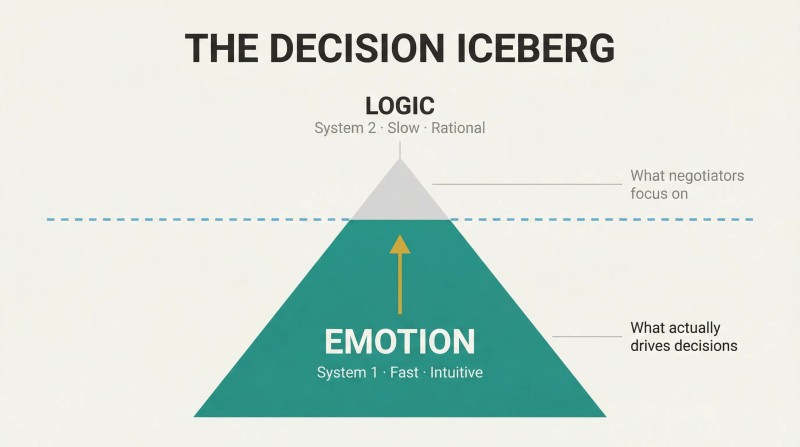
An FBI agent humbled Harvard professors using a single open-ended question. When Chris Voss — the Bureau's lead international kidnapping negotiator — sat across from Harvard Law professors in a role-play, they deployed decades of logic-based tactics. Voss kept asking "How am I supposed to do that?" and they crumbled. At Harvard's negotiation course, he "got literally every dime" from elite students by engaging emotion rather than intellect.
The science confirms it. Psychologists Kahneman and Tversky showed our fast, emotional brain (System 1) steers our slow, rational brain (System 2) — not the reverse. After the deadly sieges at Ruby Ridge and Waco proved rational problem-solving failed in crises, the FBI rebuilt its negotiation program around emotional intelligence and achieved near-perfect hostage resolution rates.
Never split the difference — no deal beats a bad deal
Compromise produces absurd outcomes. If a wife wants black shoes and her husband wants brown, "meeting in the middle" means one of each — the worst possible result. Voss argues most negotiations produce similarly bizarre deals when both sides default to splitting the difference. In kidnapping, compromise can mean paying a ransom and losing the hostage anyway.
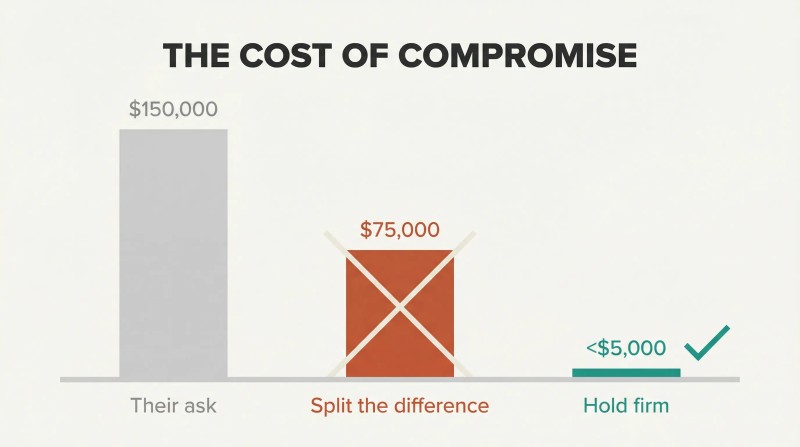
Use deadlines to resist the urge. In Haiti, where kidnappings averaged eight to ten per day, Voss discovered that criminals wanted party money by Friday. By stalling until Thursday, his team settled ransoms for fractions of the opening demand — sometimes under $5,000 against $150,000 asks. Car dealers similarly buckle at month-end, and salespeople near the end of each quarter. The mantra: patience is a weapon.
Repeat their last three words and watch them reveal everything
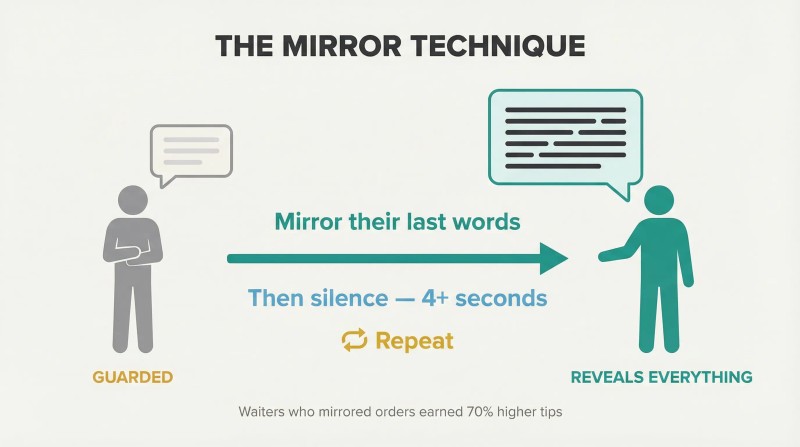
Mirroring is absurdly simple. In the FBI's usage, a "mirror" means repeating the last one to three critical words your counterpart just said. That's it. Psychologist Richard Wiseman found that waiters who merely repeated customers' orders earned 70% higher tips than those using positive reinforcement like "great choice." The technique exploits a deep human instinct: similarity breeds trust.
Pair the mirror with silence. Use what Voss calls the Late-Night FM DJ Voice — deep, slow, downward-inflecting — to project calm authority. The four-step formula: use the DJ voice, start with "I'm sorry...," mirror their words, then go silent for at least four seconds. When a student mirrored her boss's demand for paper copies — "Two copies?" — and simply waited, repeated mirrors shrank the request to two digital backups.
Label the negative emotion out loud to disarm it
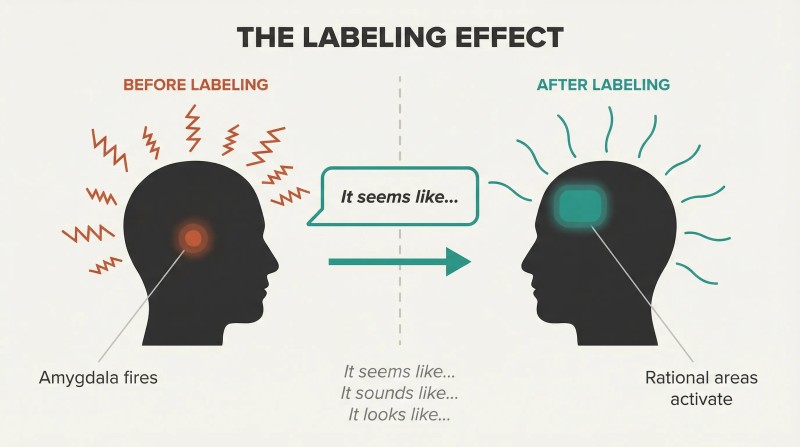
Labeling means naming someone's feeling aloud. Begin with "It seems like..." or "It sounds like..." and describe what you observe. In Harlem, Voss spoke through an apartment door for six hours to three armed fugitives: "It looks like you don't want to go back to jail." All three eventually surrendered, each saying: "You calmed us down." A UCLA brain-imaging study by Matthew Lieberman found that putting words to a fear shifts neural activity from the amygdala to areas governing rational thought.
Silence is labeling's secret weapon. After labeling, stop talking — the pause invites the other person to elaborate. Always use "It seems..." rather than "I think..." — the word "I" shifts focus onto you. Labeling positives reinforces them; labeling negatives strips them of raw intensity.
Stop pushing for 'Yes' — make them safe to say 'No'
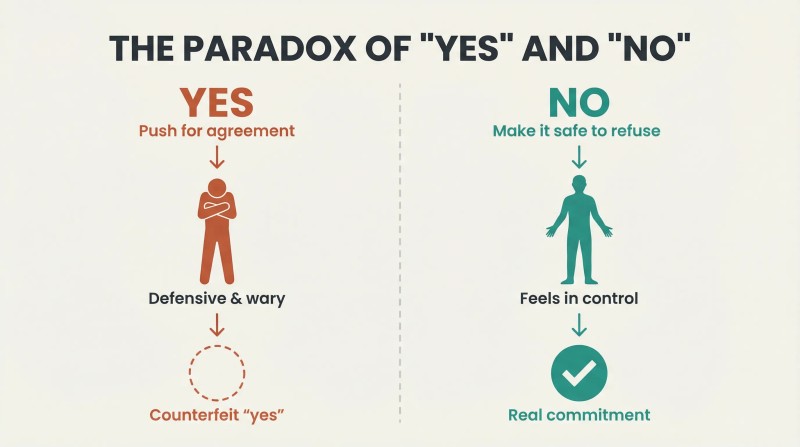
"Yes" comes in three flavors. Counterfeit (they're escaping the conversation), Confirmation (reflexive and empty), and Commitment (the real thing). Most people are so practiced at giving fake yeses that pushing for agreement early backfires. A political fundraiser proved this: his "No"-oriented script — "Are you going to sit and watch without putting up a fight?" — generated 23% more donations than the traditional yes-ladder approach.
"No" creates breathing room. When FBI negotiator Marti Evelsizer's boss tried to fire her, she asked one question: "Do you want the FBI to be embarrassed?" His "No" gave him a feeling of control, and she kept her job. To re-engage someone ignoring your emails, try: "Have you given up on this project?" The implied loss almost always triggers a response.
Aim for 'That's right,' never settle for 'You're right'
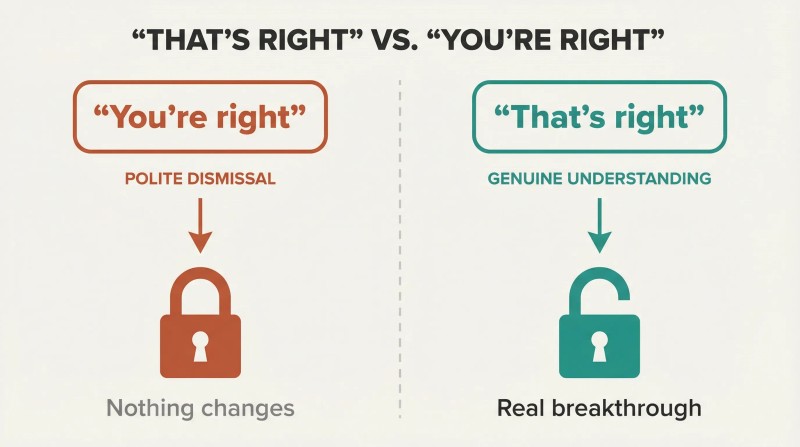
"That's right" signals genuine breakthrough. Philippine negotiator Benjie was coached to summarize terrorist leader Abu Sabaya's worldview — five hundred years of oppression, fishing rights, war damages — back to him. Sabaya went silent, then said: "That's right." He never mentioned his $10 million ransom again. Hostage Jeffrey Schilling eventually escaped.
"You're right" is a polite dismissal. Voss's son Brandon kept crashing into blockers as a linebacker. Each time coaches explained he should dodge, he said "You're right" and changed nothing. Only when Voss labeled the underlying belief — "You seem to think it's unmanly to dodge a block" — did Brandon say "That's right" and actually change. The formula: combine paraphrasing with labeling into a summary that articulates your counterpart's world so completely they feel genuinely understood.
Ask 'How am I supposed to do that?' instead of arguing
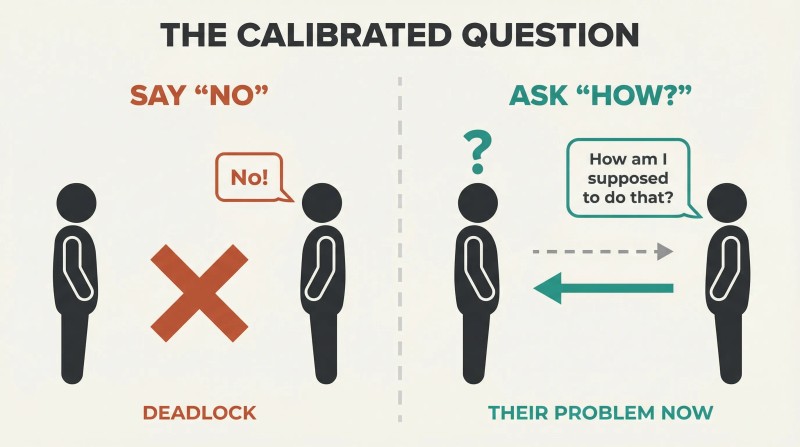
Calibrated questions dissolve confrontation. These open-ended queries starting with "How" or "What" transform demands into joint problem-solving. When Colombian rebels kidnapped ecotourist José and demanded $5 million, his wife Julie answered every demand with questions: "How do I know José is alive?" "How can we raise that much?" The kidnappers grew so confused they held group meetings to strategize. Guards drifted away and José escaped.
Avoid "Why" — it's accusatory in every language. Use "What caused you to do that?" instead. The most versatile question — "How am I supposed to do that?" — says no without the word and makes your problem theirs. Always use calibrated "How" questions to force counterparts to articulate implementation, because agreement is worthless without execution.
List every accusation against you — then say them first
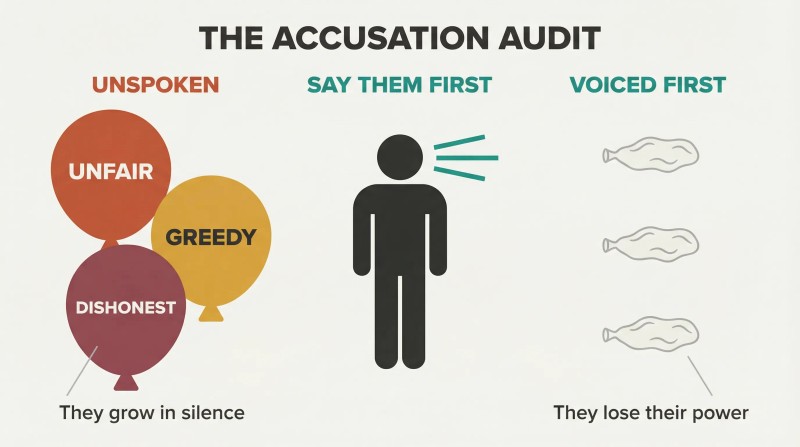
The accusation audit is preemptive disarmament. Before a tough conversation, list every terrible thing your counterpart could say about you, then voice those things first. When contractor Anna had to cut partner ABC Corp's pay from 5.5 to 3 people, she opened with their likely grievances: "You may feel like we treated you unfairly and changed the deal significantly." ABC's representative later said: "We don't feel like you are mistreating us." Anna's firm saved $1 million.
Spoken aloud, accusations deflate. In Voss's classroom, before asking for role-play volunteers in a hostage exercise, he warns: "It's going to be horrible." Laughter erupts, more hands go up than needed. Defense lawyers use the same principle — called "taking the sting out" — stating every weakness in their opening statement so reality can only exceed expectations.
Anchor extreme, shrink your raises, and close on odd numbers
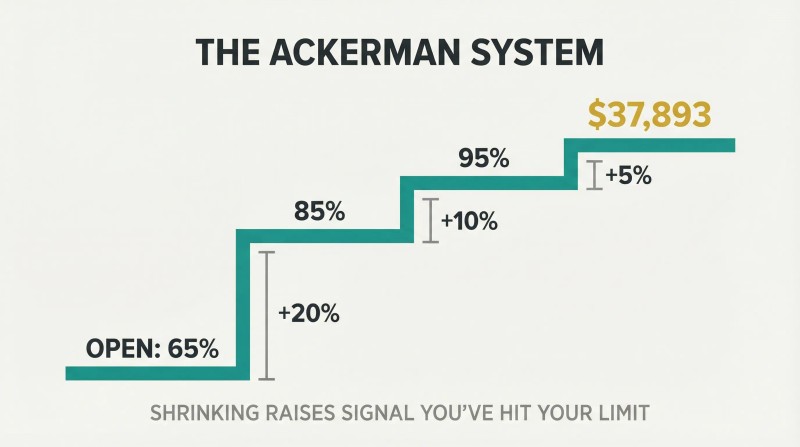
The Ackerman system replaces sloppy haggling. Developed by ex-CIA consultant Mike Ackerman, it follows six steps:
1. Set your target price
2. Open at 65% of your target
3. Raise in shrinking increments: 85%, 95%, 100%
4. Use empathy and calibrated questions between raises
5. Close on a precise, nonround figure (e.g., $37,893)
6. Add a nonmonetary item with your final offer
Shrinking raises signal you're tapped out. In Haiti, Voss closed a kidnapping ransom at exactly $4,751 — so precise the kidnappers believed the family had nothing left. A student used the same system to negotiate a rent reduction when his landlord wanted an increase, closing at $1,829. The agent joked, "You must be an accountant."
Hunt for Black Swans — hidden unknowns that flip entire deals
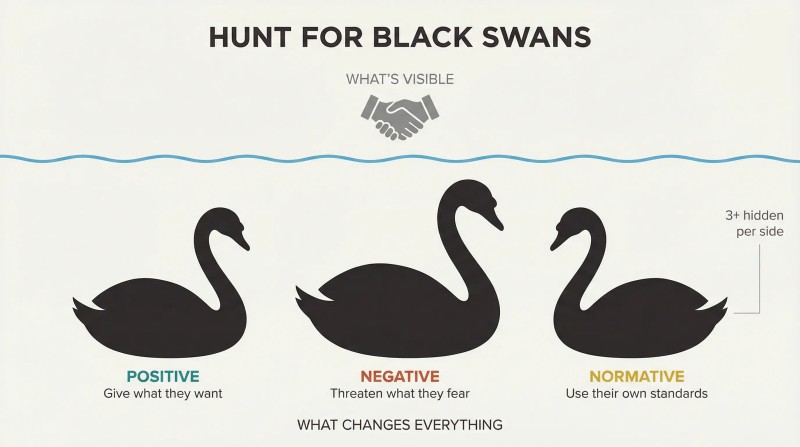
Black Swans are game-changing information hiding in plain sight. In 1981, hostage-taker William Griffin killed a bank teller at his stated deadline — the first time this had ever happened. FBI negotiators missed clues that Griffin wanted to die, including a rambling note containing "after the police take my life" that was never fully read. The unknown unknown cost a life.
Uncover them through face time and deep listening. When an MBA student asked a Charleston broker why anyone would sell a "100% occupied cash cow," a single label flushed out the answer: the seller needed cash to cover failing properties elsewhere. The student acquired the building $700,000 below asking. Black Swans create three leverage types: positive (give what they want), negative (threaten loss), and normative (hold them to their own standards).
Analysis
Voss's contribution represents a genuine paradigm shift in negotiation literature. Where Getting to Yes (1981) treated emotions as obstacles to separate from problems, Never Split the Difference treats them as the operating system through which all human decisions actually run. This is not merely a tactical update — it is an epistemological reframe that challenges fifty years of rationalist negotiation orthodoxy.
The book's credibility rests on an unusual foundation: every technique was field-tested under conditions where failure meant death. This gives Voss's system a Darwinian validity that purely academic frameworks cannot claim. The Ackerman model, calibrated questions, and tactical empathy were not designed in seminars — they were forged through thousands of real hostage crises and refined by iterative failure. When Voss outperforms Harvard professors, it functions as a controlled demonstration of a competing paradigm's superiority.
However, a critical reader should note important tensions. Voss frames his approach as empathy-driven and relationship-affirming, yet techniques like accusation audits, emotional anchoring, and the 'illusion of control' are fundamentally asymmetric in intent. The distinction between influence and manipulation depends heavily on practitioner character — a variable the book largely takes on faith. The framework also systematically advantages the more prepared and emotionally regulated party, which may reinforce existing power imbalances.
The book's deepest insight may be its most understated: negotiation is fundamentally an information asymmetry problem, not a persuasion contest. Nearly every technique — mirroring, labeling, calibrated questions, Black Swan hunting — extracts information while revealing little. This reframes negotiation from debate to intelligence operation, explaining why FBI-born tactics transfer so effectively to car purchases and rent disputes.
The Black Swan concept, while compelling as a capstone, remains the most aspirational idea. Voss identifies unknown unknowns as critical but offers limited systematic methodology beyond 'listen harder' and 'get face time' — an honest limitation of a practitioner's guide that resists full codification.
Review Summary
Never Split the Difference receives mostly positive reviews, with readers praising its practical negotiation techniques and real-world examples. Many find the author's FBI hostage negotiation experience compelling. Critics argue some tactics seem manipulative or culturally specific. Readers appreciate the focus on empathy, active listening, and understanding others' perspectives. Some find the content overwhelming or difficult to apply. Overall, most readers consider it a valuable resource for improving negotiation skills in both professional and personal contexts.
People Also Read





Glossary
Tactical Empathy
Empathy weaponized for influenceUnderstanding the feelings and mindset of a counterpart in the moment while also hearing what lies behind those feelings, in order to increase influence in subsequent moments. Distinct from sympathy, it does not require agreement—only recognition and vocalization of the other person's perspective. Voss calls it 'emotional intelligence on steroids' and 'listening as a martial art.'
Mirroring
Repeating counterpart's last wordsAn FBI negotiation technique where you repeat the last one to three critical words (or the most important words) your counterpart just said. Triggers an unconscious instinct toward similarity and trust, prompting the other person to elaborate without feeling interrogated. Also called isopraxism in behavioral science. Most effective when followed by at least four seconds of silence.
Labeling
Naming emotions to validate themA technique for validating someone's emotion by identifying it aloud using phrases like 'It seems like...' or 'It sounds like...' Neuroscience research shows labeling shifts brain activity from the fear-generating amygdala to rational-thinking areas. Labeling negatives diffuses them; labeling positives reinforces them. The speaker avoids using 'I' to keep focus on the counterpart.
Accusation Audit
Preemptively voicing counterpart's grievancesA preparation exercise where you list every negative thing your counterpart could say about you, then voice those accusations before they can. By stating the worst fears aloud, the accusations sound exaggerated, prompting the other side to downplay them. Analogous to the legal technique of 'taking the sting out' used by defense lawyers in opening statements.
Calibrated Questions
Open-ended queries for influenceCarefully designed open-ended questions beginning with 'How' or 'What' that remove aggression from statements and give the counterpart the illusion of control. They have no fixed answers, buy time, and force the other side to apply mental energy to solving your problems. The signature example is 'How am I supposed to do that?' Voss advises avoiding 'Why,' which triggers defensiveness in any language.
Black Swans
Hidden game-changing negotiation informationUnknown unknowns—pieces of information that sit outside regular expectations and cannot be predicted from prior experience. Adapted from Nassim Taleb's concept for negotiation contexts. Voss hypothesizes that every negotiation contains three to five Black Swans per side. Uncovering them requires face time, deep listening, and a willingness to abandon established assumptions. They function as leverage multipliers.
Ackerman Model
Structured offer-counteroffer bargaining systemA six-step bargaining system developed by ex-CIA consultant Mike Ackerman. Steps: set target price, open at 65% of target, calculate three raises of decreasing increments (85%, 95%, 100%), use empathy between offers, close on a precise nonround number, and add a nonmonetary item with the final offer. Designed to exploit reciprocity, loss aversion, and the psychological weight of specific numbers.
Late-Night FM DJ Voice
Calm, authoritative vocal toneOne of three voice tones available to negotiators, characterized by a deep, soft, slow, and reassuring delivery with downward inflection. Conveys calm authority and trustworthiness without triggering defensiveness. Used selectively to make critical points or de-escalate tension. Voss contrasts it with the positive/playful voice (the recommended default) and the direct/assertive voice (rarely useful).
Behavioral Change Stairway Model (BCSM)
Five-stage influence progression modelA crisis negotiation framework developed by the FBI's Crisis Negotiation Unit proposing five sequential stages: active listening, empathy, rapport, influence, and behavioral change. Rooted in psychologist Carl Rogers's concept of unconditional positive regard. The model holds that real behavior change occurs only after a person feels genuinely understood and accepted, not through logical argument or coercion.
Rule of Three
Triple-testing agreement for sincerityA technique for verifying that a counterpart's agreement is genuine by getting them to agree to the same thing three times within a single conversation. Uses varied tactics—a direct commitment, a summary that elicits 'That's right,' and a calibrated 'How' question about implementation—to uncover falsehoods or lack of conviction. Based on the principle that it is very hard to repeatedly lie or fake conviction.
Accusation Audit
Preemptively voicing counterpart's grievancesA preparation exercise where you list every negative thing your counterpart could say about you, then voice those accusations before they can. By stating the worst fears aloud, the accusations sound exaggerated, prompting the other side to downplay them. Analogous to the legal technique of 'taking the sting out' used by defense lawyers in opening statements.
Chris Discount
Using your name for rapportA technique where you introduce yourself by your first name to humanize the interaction and create what Voss calls 'forced empathy.' By making yourself a real person rather than an anonymous counterpart, you increase the psychological cost of the other side treating you poorly. Voss used this to defuse a confrontation in a bar and to obtain a 10% store discount by simply asking for the 'Chris discount.'
FAQ
What's Never Split the Difference about?
- Negotiation Techniques: The book focuses on strategies from Chris Voss's experience as an FBI hostage negotiator, emphasizing psychological over traditional methods.
- Real-World Applications: Techniques are illustrated for everyday use, from business deals to personal relationships, making it relevant for a wide audience.
- Human Psychology: It delves into understanding emotions and behaviors, highlighting their influence on negotiation outcomes.
Why should I read Never Split the Difference?
- Unique Perspective: Offers insights from a former FBI negotiator, with real-life stories that make the content engaging and relatable.
- Practical Strategies: Provides actionable techniques for immediate application in various negotiation scenarios, enhancing effectiveness.
- Emphasis on Empathy: Teaches the importance of empathy in negotiations, leading to better outcomes and stronger relationships.
What are the key takeaways of Never Split the Difference?
- Tactical Empathy: Involves understanding and acknowledging emotions to build rapport and influence decisions.
- The Power of "No": "No" is a starting point for negotiation, allowing for clarification and productive discussions.
- Avoid Compromise: Encourages seeking creative solutions rather than splitting the difference, which often leads to suboptimal outcomes.
What is Tactical Empathy in Never Split the Difference?
- Understanding Emotions: Recognize and articulate the feelings of your counterpart during negotiations.
- Building Trust: Demonstrates understanding of their perspective, creating a safe environment for open communication.
- Labeling Emotions: Use labeling techniques to validate feelings, diffusing negative emotions and fostering collaboration.
How does Chris Voss define "No" in Never Split the Difference?
- Empowerment Through "No": Provides a sense of safety and control, allowing expression of boundaries and concerns.
- Starting Point for Negotiation: Seen as the beginning of a negotiation, opening the door for further discussion.
- Encouraging Honest Dialogue: Inviting "No" creates a more honest and open dialogue, leading to better understanding and solutions.
What is the "Black Swan" concept in Never Split the Difference?
- Definition of Black Swans: Unexpected information that can dramatically alter negotiation dynamics.
- Importance in Negotiation: Identifying Black Swans shifts dynamics in favor, with every negotiation containing at least three.
- Examples of Black Swans: Real-life examples show how failure to recognize them can lead to negative outcomes.
How can I trigger a "That's Right" moment in negotiations?
- Summarize Effectively: Reflect back what your counterpart has said, including emotions and concerns.
- Use Labels: Validate their emotions to help them feel understood and more open to collaboration.
- Encourage Dialogue: Create a safe environment for expression, leading to breakthroughs in understanding and agreement.
What is the Behavioral Change Stairway Model (BCSM) in Never Split the Difference?
- Five Stages of Negotiation: Consists of active listening, empathy, rapport, influence, and behavioral change.
- Focus on Emotional Connection: Emphasizes establishing a connection to influence behavior positively.
- Real-World Application: Illustrates how successful negotiations lead to meaningful changes in behavior and outcomes.
What are some techniques for building rapport in negotiations according to Chris Voss?
- Mirroring: Mimic body language and speech patterns to create a sense of connection and trust.
- Labeling Emotions: Demonstrate understanding and empathy by labeling the emotions of the other party.
- Active Listening: Ask open-ended questions and summarize points to foster a collaborative atmosphere.
What is the Ackerman model mentioned in Never Split the Difference?
- Four-Step Process: Involves setting a target price, making an initial offer at 65%, and increasing in decreasing increments.
- Psychological Anchoring: Start with a low offer to set an extreme anchor, influencing expectations.
- Non-Round Numbers: Use precise numbers in offers to lend credibility and weight to the proposal.
How can I effectively say "No" in negotiations according to Chris Voss?
- Calibrated Questions: Use questions like "How am I supposed to do that?" to decline while keeping the conversation open.
- Empathy and Understanding: Express empathy and understanding of the other party's position when saying "No."
- Multiple "No" Steps: Use a series of "No" responses before a final rejection to communicate boundaries without shutting down the conversation.
What role does emotional intelligence play in negotiation in Never Split the Difference?
- Understanding Emotions: Recognize and understand both your own emotions and those of your counterpart.
- Building Trust: Demonstrate empathy and validate feelings to build trust and rapport.
- Managing Reactions: Stay calm and composed to maintain control and avoid escalating conflicts.
About the Author
Other books by Chris Voss
Download PDF
Download EPUB
.epub digital book format is ideal for reading ebooks on phones, tablets, and e-readers.








































