Key Takeaways
Your emotional brain is faster, louder, and lazier than your rational one
“Our brains are simply programmed to do as little work as possible, seek maximum pleasure, and generally bask in the sun like a house cat.”
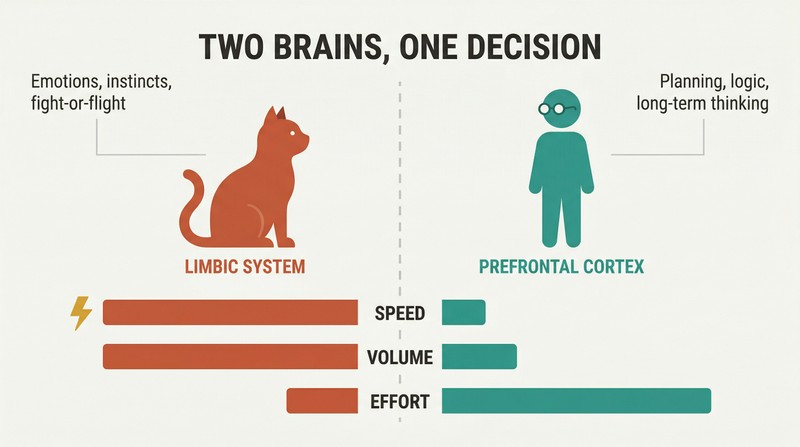
Discipline is a war between two brain systems. The prefrontal cortex — your inner "Albert Einstein" — handles planning, logic, and long-term thinking. Opposing it is the limbic system — a "skittish cat" — governing emotions, instincts, and the fight-or-flight response. The limbic system processes emotional information in fractions of a second, far faster than the prefrontal cortex can muster a rational response. Fear, cravings, and anxiety always jump to the front of every decision queue.
Dopamine intensifies the mismatch. This neurotransmitter floods the brain during and even in anticipation of pleasurable activities, trapping you in short-term reward-seeking. The pleasure principle — our drive to maximize pleasure and minimize pain — means discipline feels like swimming upstream. Understanding this isn't an excuse; it's a battle map for every technique that follows.
Act within five seconds or your fear will talk you out of it
“Given enough time, your monkey mind can convince you of nearly anything.”
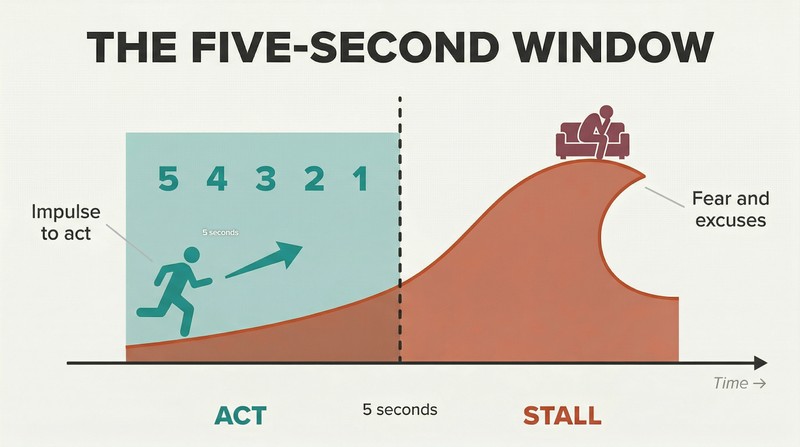
Mel Robbins' Five Second Rule is simple: the moment you feel an impulse to act toward a goal, count 5-4-3-2-1 and physically move. That narrow window is the gap between your rational brain recognizing the right choice and your emotional brain flooding you with excuses. A Canadian study confirmed emotional information is processed in fractions of a second — far faster than abstract reasoning — meaning doubt is always first in line.
A parallel idea from feudal Japan, the Samurai seven breaths, urges decisions within seven breaths: "If discrimination is long, it will spoil." Both frameworks rest on the same insight — you already know the correct action. The countdown isn't thinking time; it's a launchpad that shuts out noise before your limbic system manufactures a reason to stay on the couch.
Stop treating your future self like a stranger
“For chronic procrastinators, that vision of their future selves tends to be blurry, more abstract, and impersonal.”
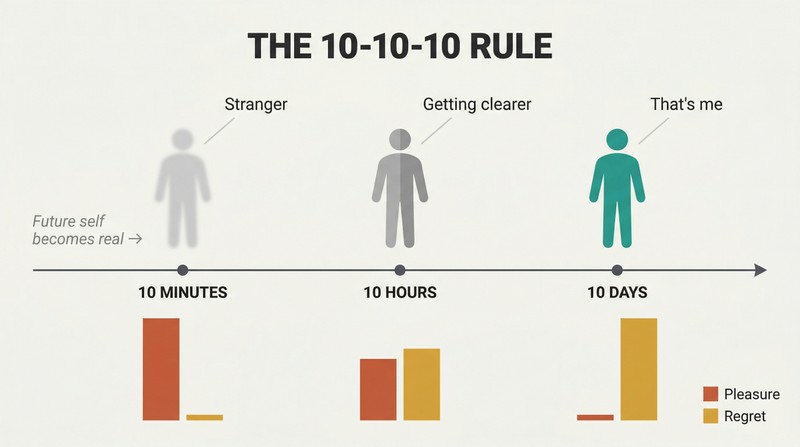
Psychology professor Fuschia Sirois calls it temporal myopia — nearsightedness about time. UCLA professor Hal Hershfield confirmed this experimentally: people who interacted with digitally aged versions of themselves through virtual reality were significantly more likely to save money for retirement. When the future self feels real, present sacrifices feel rational rather than punishing.
The 10-10-10 rule makes this practical. Before caving to an impulse, ask how you'll feel in 10 minutes, 10 hours, and 10 days. At 10 minutes, the pleasure lingers. At 10 hours, mostly regret. At 10 days, you'll wonder what the point was. This zoom-out collapses the emotional distance between who you are now and who you'll be dealing with the consequences tomorrow.
Chain your intentions to daily triggers with if-then plans
“Below your conscious awareness, your brain starts scanning the environment, searching for the situation in the 'if' part of your plan.”
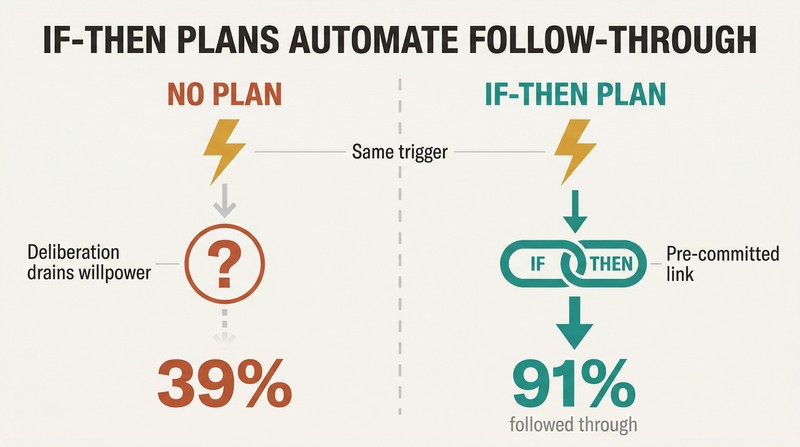
Implementation intentions follow a formula: "If X happens, then I will do Y." NYU psychologist Peter Gollwitzer, who pioneered the concept, found people using if-then plans were two to three times more likely to follow through. In one study, 91% of those with an if-then plan stuck to an exercise program, versus just 39% of non-planners. A meta-review of 94 studies confirmed the effect across wildly different goals.
The power lies in automation. Once you link "6:00 p.m. at work" to "text my partner," the trigger fires the behavior with minimal willpower cost. You can also use it defensively: "If they bring cake at the office party, then I'll immediately drink a big glass of water." The decision is made before temptation arrives.
Redesign your environment so laziness defaults to discipline
“Ultimately, people just went with the option that required the least effort.”
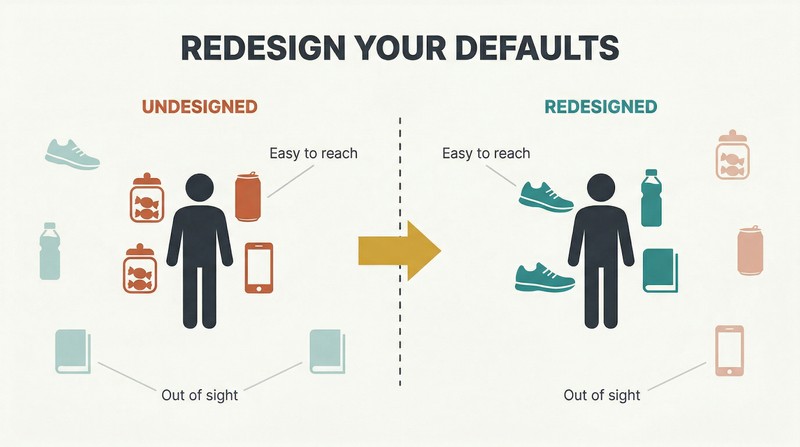
A Cornell study placed Hershey's Kisses in clear or opaque jars, on desks or six feet away. People ate 7.7 Kisses per day from clear, nearby jars versus 3.1 from opaque jars placed six feet away. Stanford's Baba Shiv found distracted participants — those remembering a phone number — chose chocolate cake 50% more often than undistracted ones. Focus erodes invisibly.
The default effect is equally striking. European countries with opt-out organ donation exceed 95% participation; opt-in countries peak at 27%. Apply this: delete social media apps, leave running shoes by the door, stock the fridge with water instead of soda. Make the disciplined choice require zero effort and the undisciplined one require getting up and actively seeking it out.
Break boulders into pebbles and celebrate each tiny victory
“Anything difficult is only a series of easy things.”
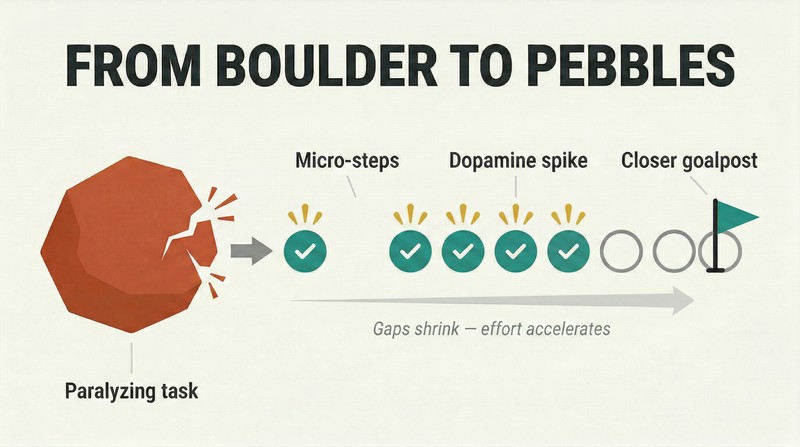
A 200-page report is paralyzing. But "choose the font" and "write one sentence" are nearly impossible to resist. Splitting tasks into the smallest units obliterates the barrier to starting and creates repeated dopamine spikes as you check each item off. Harvard professor Teresa Amabile analyzed over 12,000 diary entries from 238 knowledge workers and found the single biggest driver of motivation was the feeling of making progress toward a meaningful goal.
Proximity to the finish amplifies effort. The goal gradient hypothesis, described by behaviorist Clark Hull, shows people accelerate as they approach completion. In a coffee shop rewards study, time between purchases decreased roughly 20% at each step toward a free drink. Set closer goalposts — lose 5 pounds this month, not 40 in eight — and harness that acceleration constantly.
Bundle a guilty pleasure with an obligation to feed both brains
“There is no need to suffer in the present to get something done for your future self; if you do suffer, then you will lose all motivation and procrastinate.”
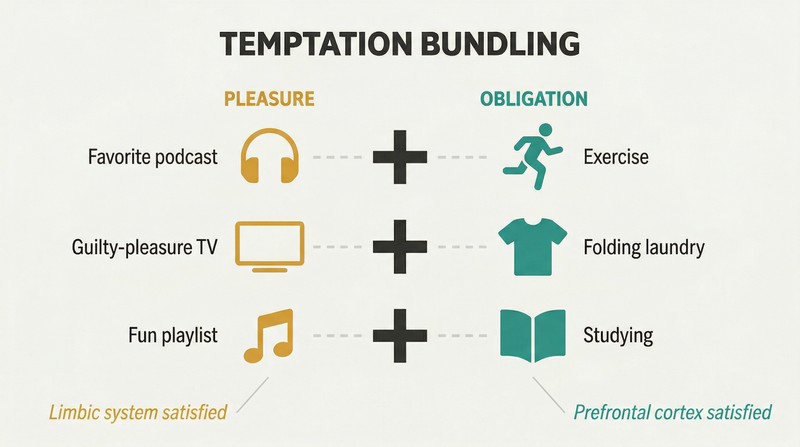
Temptation bundling, conceived by behavioral scientist Katy Milkman at the University of Pennsylvania, pairs something you enjoy with something you'd otherwise avoid. Listen to your favorite podcast only while exercising. Watch guilty-pleasure TV only while folding laundry. Milkman found 51% more participants were willing to exercise when using this technique.
To apply it, make two columns: immediate pleasures on the left, obligations on the right. Then creatively link them. You're satisfying both the limbic system and the prefrontal cortex simultaneously — your present self gets its reward while your future self makes progress. Watch for tolerance building over time; you may need to rotate your bundled pleasures to keep the motivational effect fresh.
Treat willpower like a phone battery — cut trivial decisions
“The brain requires up to 20% of our daily energy consumption, despite being only 2% of the mass of our bodies.”
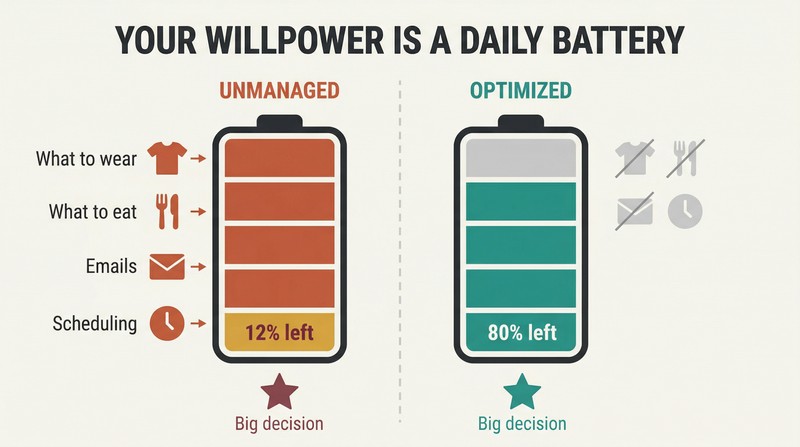
Ego depletion research suggests self-control draws from a finite pool. In Baumeister's 1998 experiments, subjects who resisted eating chocolate subsequently gave up faster on an unrelated puzzle — their willpower was drained by the earlier effort. While some recent replications have raised doubts about the mechanism, the practical insight holds: the more decisions you grind through, the less discipline remains for what matters.
Guard your reserves ruthlessly. Steve Jobs wore the same sneakers, black turtleneck, and jeans daily to avoid burning mental energy on trivia. Automate meals, standardize routines, and batch low-stakes decisions. If a choice won't matter in a few minutes, make it instantly or eliminate it entirely. Every percentage of brainpower preserved is available for the hard pushes later.
Obsess over the daily process, not the distant finish line
“Goals are cheap — what matters is consistent action taken toward them.”
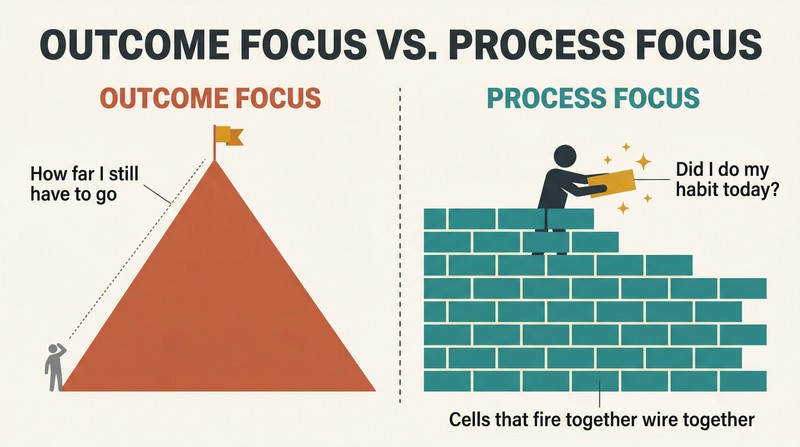
Weighing yourself after a month of dieting and seeing you're nowhere near your 100-pound goal is crushing — even if you maintained excellent habits every day. Outcome focus makes the remaining distance feel enormous and erases the real achievement. Process focus flips the script: instead of "Have I reached my goal?" you ask "Did I do my habits today?" When you answer yes, you celebrate — and that celebration fuels tomorrow.
Hebb's axiom from neuroscience reinforces this: cells that fire together wire together. The more you repeat disciplined daily behaviors, the stronger those neural pathways become until the habit runs on less willpower altogether. Define your ideal self, identify the habits that person practices, then execute only those. The mountain isn't something you climb — it's something you build, brick by brick.
Deliberately practice discomfort — it's a vaccine, not masochism
“You don't want to do any of it, sure. But you can. That's a skill.”
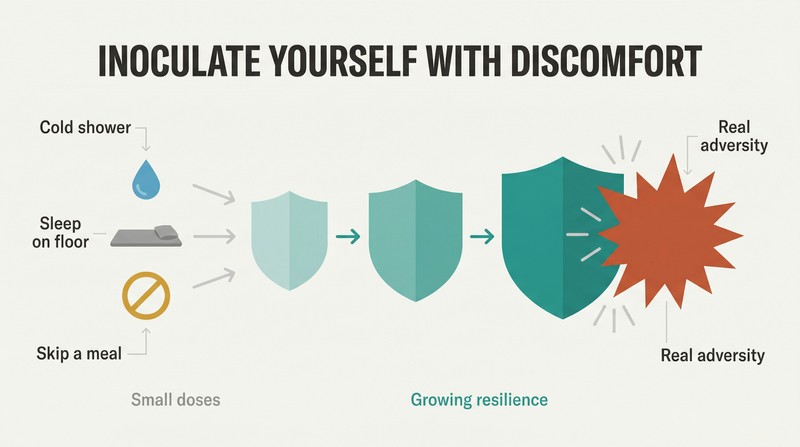
Cold showers, sleeping on the floor, skipping a meal — none sound appealing, and that's exactly the point. Self-discipline is, at its core, the willingness to endure discomfort. Tolerating distress in controlled doses inoculates you against future adversity the same way a vaccine builds immune resistance. Start small: don't keep your phone by the bed. Notice the urge, sit with it, tell yourself "I can do this," then ratchet up.
Stanford's marshmallow experiment showed children who waited for a second marshmallow grew up with higher test scores, lower obesity rates, and fewer substance abuse issues. The capacity to sit with discomfort wasn't a personality quirk — it predicted life outcomes. MRI scans after an eight-week mindfulness course showed a denser prefrontal cortex and a shrunken amygdala. The discipline muscle is real, and it strengthens with use.
Analysis
Hollins' book occupies a curious niche: it repackages well-established behavioral psychology concepts — Baumeister's ego depletion, Milkman's temptation bundling, Gollwitzer's implementation intentions — under the banner of 'neuroscience' while the actual neuroscience remains fairly surface-level. The prefrontal cortex versus limbic system dichotomy, while useful as a working metaphor, oversimplifies the distributed nature of self-regulation in the brain. Hollins acknowledges this by flagging the triune brain theory as illustrative, but then treats the two-brain model as functionally true throughout.
Where the book genuinely succeeds is in synthesis. Rather than deep-diving into any single technique, it assembles a toolkit that maps cleanly onto the stages of a discipline breakdown: awareness (understanding the brain's defaults), prevention (environment design, if-then plans), intervention (Five Second Rule, temptation bundling), and recovery (excuses analysis, delayed gratification practice). This staged architecture is more practical than most discipline books that hammer a single lever.
The weakest link is the ego depletion section, which the author includes while noting its contested status — an awkward hedge that undermines his neuroscience framing. More recent work by Inzlicht and others suggests willpower depletion may reflect motivation shifts rather than literal resource exhaustion. Still, the practical advice — reduce decision load, automate routines — holds regardless of mechanism.
Hollins' most underrated contribution is connecting abstinence-over-moderation to Hebbian neuroplasticity. By arguing that consistent 'no' responses build stronger neural pathways than intermittent 'maybe' responses, he provides a genuinely neuroscience-grounded case for cold-turkey approaches — something the addiction literature has long debated but self-help rarely addresses mechanistically. The book would benefit from engaging with emerging evidence that self-compassion may outperform self-denial as a discipline strategy, and from acknowledging that the relationship between meditation and prefrontal cortex density involves more nuance than a simple 'strengthening' narrative suggests. But as a practical field manual for the chronically procrastinating, it delivers.
Review Summary
Neuro-Discipline receives mostly positive reviews, with readers praising its scientific approach to self-discipline and habit formation. Many find it well-written, concise, and informative, offering practical tips and neurological insights. Some readers appreciate its accessibility and engaging style, while others find it basic or lacking originality. The book is often recommended as a good starting point for those interested in personal development, with several reviewers highlighting its focus on the neuroscience behind discipline and its straightforward presentation of concepts.
People Also Read


 Immersive

Glossary
Five Second Rule
Act before fear intervenesMel Robbins' technique: when you feel an impulse to act toward a goal, count down 5-4-3-2-1 and physically move before your emotional brain can generate excuses or procrastination. The countdown focuses the mind and pre-empts the limbic system's interference, giving the rational prefrontal cortex priority over emotional responses.
Temporal myopia
Nearsightedness about future consequencesCoined by psychology professor Fuschia Sirois, temporal myopia describes the tendency—especially strong in chronic procrastinators—to see one's future self as blurry, abstract, and impersonal. This emotional disconnect makes people prioritize present comfort over future rewards, undermining the motivation needed for self-discipline.
10-10-10 rule
Future-feeling perspective checkA decision-making technique: before acting on an impulse, ask how you'll feel about the choice in 10 minutes, 10 hours, and 10 days. The exercise reveals how short-lived most temptations' pleasures are relative to the regret they produce, helping disconnect from emotional present-tense thinking and reconnect with future consequences.
Implementation intentions
Pre-decided if-then behavioral triggersDeveloped by NYU psychologist Peter Gollwitzer, implementation intentions use 'if X, then Y' statements to link specific situations to predetermined behaviors. They bypass the need for in-the-moment willpower by programming near-automatic responses to anticipated triggers. A meta-review of 94 studies found significantly higher goal-achievement rates across diverse contexts.
Temptation bundling
Pairing pleasure with obligationConceived by behavioral scientist Katy Milkman at the University of Pennsylvania, temptation bundling pairs an enjoyable activity (e.g., a favorite podcast) with a necessary but unpleasant task (e.g., exercising) so both present enjoyment and future progress are achieved simultaneously. Milkman's research showed 51% more participants exercised using this method.
Progress principle
Motivation from visible small gainsBased on Harvard professor Teresa Amabile's research analyzing over 12,000 diary entries from 238 knowledge workers, the progress principle holds that the single most powerful driver of motivation and positive emotion is the feeling of making meaningful progress—even in small increments—toward a goal one cares about.
Goal gradient hypothesis
Effort accelerates near completionOriginally proposed by behaviorist Clark Hull, this principle states that motivation and effort increase as one gets closer to finishing a goal. A coffee shop rewards study found customers accelerated purchases by about 20% at each step toward a free drink. The implication for self-discipline is to set frequent, closer goalposts.
Default effect
People choose the easiest optionThe tendency for people to stick with whichever option is pre-selected or requires the least effort. European organ donation data showed opt-out countries exceeded 95% participation while opt-in countries peaked at 27%. Applied to discipline, it means designing environments so the healthiest or most productive choice requires the least action.
Ego depletion
Willpower drains with repeated useFirst demonstrated in Baumeister et al.'s 1998 experiments, ego depletion is the theory that self-control draws from a limited pool of mental resources. Subjects who resisted chocolate gave up faster on a subsequent puzzle task. While some recent replications have questioned the effect's magnitude, the practical advice to conserve decision-making energy remains widely endorsed.
Hebb's axiom
Repeated neural patterns self-reinforceNamed after neuroscientist Donald Hebb, the principle states that neurons repeatedly activated together strengthen their connections over time—popularly summarized as 'cells that fire together wire together.' Applied to self-discipline, it means consistently practicing disciplined thoughts and behaviors physically rewires the brain to make those patterns increasingly automatic.
FAQ
What's "Neuro-Discipline" by Peter Hollins about?
- Focus on Neuroscience: "Neuro-Discipline" explores how everyday neuroscience can be applied to enhance self-discipline, focus, and overcome the brain's impulsive and distracted nature.
- Two Brains Concept: The book delves into the concept of having two brains: the rational prefrontal cortex and the emotional limbic system, and how they influence our behavior.
- Practical Strategies: It provides practical strategies to trick the brain into better habits and self-discipline by understanding its natural tendencies.
- Mindset and Sacrifice: The book emphasizes the importance of mindset, sacrifice, and letting go of instant gratification to achieve long-term goals.
Why should I read "Neuro-Discipline" by Peter Hollins?
- Understand Your Brain: It offers insights into how your brain works, particularly the battle between the rational and emotional parts, which is crucial for self-discipline.
- Practical Techniques: The book provides actionable techniques to improve focus and discipline, making it useful for anyone looking to enhance their productivity.
- Overcome Impulses: It helps readers understand and overcome their brain's natural impulses and distractions, leading to better decision-making.
- Long-term Benefits: By applying the strategies in the book, readers can achieve long-term personal and professional goals through improved self-discipline.
What are the key takeaways of "Neuro-Discipline" by Peter Hollins?
- Two Brains Battle: The book highlights the constant battle between the prefrontal cortex and the limbic system, affecting our self-discipline.
- Pleasure Principle: It discusses the pleasure principle, where humans seek immediate pleasure and avoid pain, often hindering discipline.
- Trick the Brain: Strategies like the Five Second Rule and temptation bundling are suggested to trick the brain into better habits.
- Mindset Shift: Emphasizes the importance of shifting focus from outcomes to processes and embracing discomfort for growth.
How does Peter Hollins explain the "Two Brains" concept in "Neuro-Discipline"?
- Cerebral Cortex: The cerebral cortex, particularly the prefrontal cortex, is responsible for rational thought, decision-making, and self-discipline.
- Limbic System: The limbic system governs emotions and instinctual drives, often leading to impulsive actions.
- Conflict: The book describes the conflict between these two brain parts as a struggle between logic and emotion, impacting self-discipline.
- Triune Brain Theory: It uses the triune brain theory to illustrate how these brain parts interact and influence behavior.
What is the "Pleasure Principle" in "Neuro-Discipline" by Peter Hollins?
- Seek Pleasure, Avoid Pain: The pleasure principle states that humans are naturally inclined to seek pleasure and avoid pain, often leading to impulsive decisions.
- Dopamine's Role: Dopamine is a neurotransmitter that reinforces pleasure and reward, influencing motivation and self-discipline.
- Short-term vs. Long-term: The principle often leads to prioritizing short-term pleasures over long-term goals, hindering self-discipline.
- Overcoming the Principle: The book suggests strategies to overcome this principle by focusing on long-term benefits and delaying gratification.
How can I "Trick the Brain" according to "Neuro-Discipline" by Peter Hollins?
- Future Self Visualization: Visualize your future self to motivate present actions that align with long-term goals.
- Behavior Chains: Use if-then statements to create automatic responses to everyday situations, reducing decision fatigue.
- Temptation Bundling: Pair pleasurable activities with tasks you tend to procrastinate on to make them more enjoyable.
- Progress Tracking: Break tasks into smaller components and track progress to maintain motivation and discipline.
What is the "Five Second Rule" mentioned in "Neuro-Discipline" by Peter Hollins?
- Immediate Action: The Five Second Rule suggests taking action within five seconds of feeling an impulse to achieve a goal.
- Prevent Overthinking: It prevents the emotional brain from intervening with excuses or fears, promoting immediate action.
- Focus and Clarity: Counting down from five focuses the mind and clears mental clutter, aiding decision-making.
- Empowerment: This rule empowers the rational brain to take charge before the emotional brain can derail intentions.
How does "Neuro-Discipline" by Peter Hollins suggest using "Mind Shift" for better self-discipline?
- Self-Talk: Positive self-talk and visualization are encouraged to reinforce desired outcomes and boost motivation.
- Moderation vs. Abstinence: The book discusses choosing between moderation and abstinence based on personal discipline style.
- Excuse Elimination: Identifying and eliminating excuses is crucial for maintaining self-discipline and accountability.
- Neuroplasticity: Emphasizes the power of neuroplasticity, where repeated thoughts and actions can rewire the brain for better habits.
What role does "Sacrifice" play in "Neuro-Discipline" by Peter Hollins?
- Core of Discipline: Sacrifice is at the core of self-discipline, requiring letting go of immediate pleasures for long-term gains.
- Discomfort and Growth: Embracing discomfort and pushing past boundaries are essential for personal growth and achieving goals.
- Mindset Shift: The book encourages a mindset shift to view sacrifice as a necessary step toward success.
- Long-term Focus: Sacrifice involves focusing on long-term benefits rather than short-term gratification.
How does "Neuro-Discipline" by Peter Hollins address "Creating Space and Calm"?
- Calm the Brain: The book suggests calming the brain to reduce emotional reactivity and improve self-discipline.
- Mindfulness Practice: Mindfulness is recommended to focus attention on the present moment and reduce stress.
- Delayed Gratification: Practicing delayed gratification helps build self-discipline by resisting immediate impulses.
- Discomfort Tolerance: Building tolerance for discomfort is crucial for developing self-discipline and achieving goals.
What are the best quotes from "Neuro-Discipline" by Peter Hollins and what do they mean?
- "The neuroscience of self-discipline is really a tale of two brains." This quote highlights the conflict between the rational and emotional parts of the brain, which affects self-discipline.
- "Self-discipline is sacrifice and letting go." It emphasizes that self-discipline requires sacrificing short-term pleasures for long-term success.
- "Act before your emotional monkey mind can jump in." This quote underscores the importance of taking immediate action to prevent emotional interference.
- "Your brain gains a rare reprieve from the proverbial mouse on a wheel." It suggests that mindfulness provides a break from constant mental activity, aiding self-discipline.
What practical strategies does "Neuro-Discipline" by Peter Hollins offer for improving self-discipline?
- Visualization Techniques: Visualize future consequences to motivate present actions and align with long-term goals.
- Implementation Intentions: Use if-then statements to automate responses to common situations, reducing decision fatigue.
- Temptation Bundling: Pair enjoyable activities with tasks you tend to procrastinate on to make them more appealing.
- Mindfulness and Meditation: Practice mindfulness to calm the mind, reduce stress, and improve focus and self-discipline.
About the Author
Other books by Peter Hollins
 Immersive

Download PDF
Download EPUB
.epub digital book format is ideal for reading ebooks on phones, tablets, and e-readers.








































