

Key Takeaways
Your body and mind are one network, not a machine plus a ghost
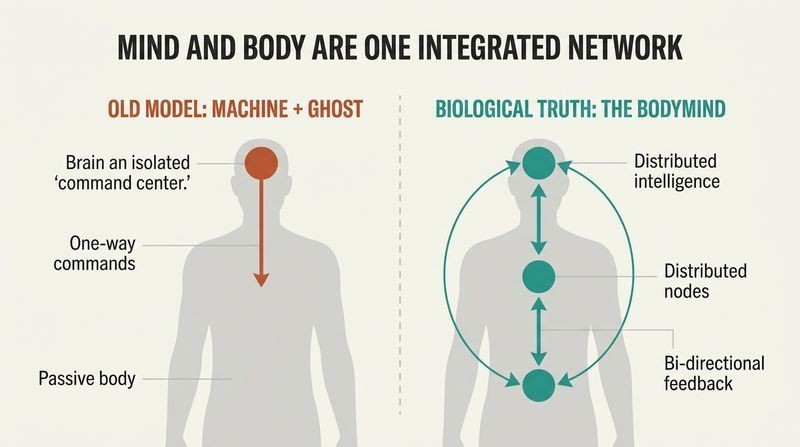
The book's central claim is that the wall between mind and body is biologically false. Pert argues that neuropeptides (short chains of amino acids) and the receptors they dock onto form a single communication system running through brain, gut, glands, skin, and immune cells at once. She calls this the "bodymind," a term borrowed from Chinese medicine. Rather than a brain barking orders down to a passive body, intelligence is distributed everywhere simultaneously, and emotions are the currency of the exchange.
This reframes illness. Nearly every disease, she contends, carries a psychosomatic component, meaning a mind-body dimension, not that it is imaginary. The word psychosomatic simply fuses psyche (mind or soul) and soma (body), a fusion Western medicine treated as taboo.
The claim anticipated now-mainstream science: the enteric nervous system (the gut's roughly 500 million neurons, often called the "second brain") and the vagus nerve's role in the gut-brain axis. Embodied-cognition work from Antonio Damasio (somatic markers) and George Lakoff supports her intuition that feeling is bodily, not purely cortical. What's contestable is the leap from a shared molecular alphabet to a unified "intelligence." Critics note Pert sometimes treats correlation and shared machinery as proof of coordinated purpose. Still, dissolving the hierarchy that ranked "real" physical disease above "imaginary" emotional suffering was a genuine contribution.
Chase the experiment everyone calls impossible, even against orders
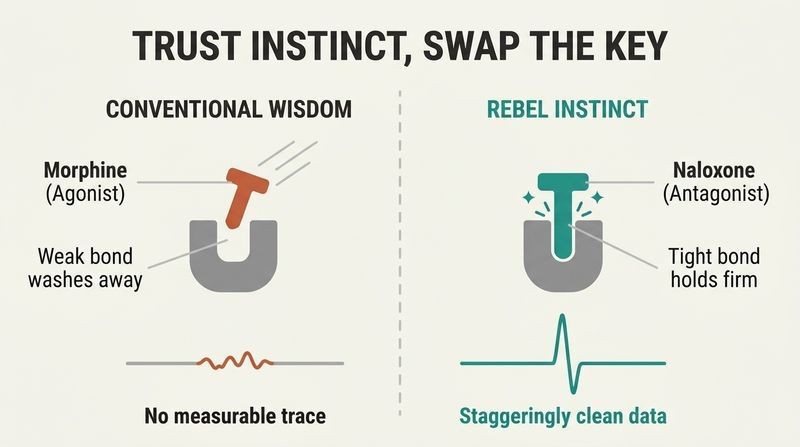
In 1972, as a graduate student, Pert set out to prove the opiate receptor existed, a molecular lock that drugs like morphine slot into. Her mentor Solomon Snyder called it a long shot and eventually ordered her to stop. She continued in secret. The breakthrough came when she swapped radioactive morphine for naloxone, an antagonist that stays stuck on the receptor long enough to be measured.
Her inherited lab creed, passed down from Nobel laureate Julius Axelrod, was blunt: distrust conventional wisdom, trust instinct, and run the simplest possible one-day experiment. Her personal motto was "Question Authority." The staggeringly clean data arrived over a weekend while her five-year-old son sat beside her uncapping vials.
The episode fits a recurring pattern: outsiders and juniors often crack problems experts call unsolvable precisely because they lack sunk-cost loyalty to the reigning method. Compare Barry Marshall, who drank Helicobacter pylori to prove ulcers were bacterial. The danger is survivorship bias. For every Pert who defied her advisor and triumphed, many defiant students simply burned years on dead ends. The defensible lesson is not blanket rebellion but calibrated conviction anchored to a cheap, decisive, falsifiable test, exactly the Axelrod philosophy of the fast one-day experiment that keeps risk bounded.
Emotions are not vague feelings; they are measurable molecules
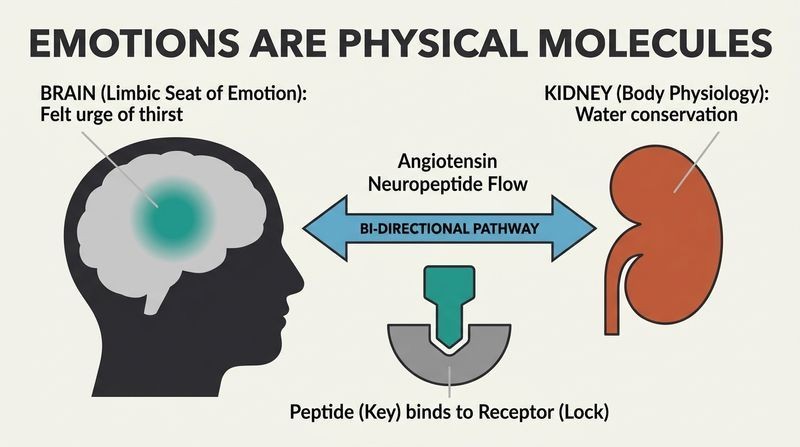
Pert's signature idea is that neuropeptides and their receptors are the physical substrate of emotion. When her team mapped where 22 different neuropeptide receptors cluster in the brain, 85 to 95 percent sat in the limbic system, the classical seat of emotion. Peptides make up roughly 95 percent of all ligands (the chemical keys that bind receptors), and a peptide binding its receptor triggers a cascade that shifts mood, behavior, and physiology together.
She resolves the century-old James-Cannon debate over whether emotions begin in the body or the head by answering: both, simultaneously, a two-way street. Angiotensin illustrates it. The same peptide that makes the kidney conserve water is also the felt urge we call thirst.
Framing emotion as chemistry was radical in 1997 and helped legitimize affective neuroscience. Yet the tidy hope she floats, roughly one peptide per emotion, is almost certainly too neat. Lisa Feldman Barrett's constructed-emotion theory argues feelings are assembled from context and prediction, not fixed molecular signatures. Pert's strength is anatomical: receptors are densest exactly where emotion lives. Her weakness is inferring specific subjective content from location alone. The lasting value is the reframe itself, which erased the false ranking of "real" bodily disease over "merely emotional" distress and gave feelings a physical address.
Most brain communication skips the wiring and floats through the body
Textbooks long pictured the brain as an electrical telephone network, neurons firing across synapses (the gaps between nerve cells). Pert's colleague Miles Herkenham found a puzzling mismatch: neuropeptides and their matching receptors often sit inches apart, far too distant to talk across a synapse. His estimate was that under 2 percent of neuronal communication actually happens at the synapse.
Instead, peptides diffuse through blood and cerebrospinal fluid to reach distant receptors, making the brain behave, in her phrase, like a bag of hormones. What keeps the flood organized is receptor specificity: each receptor binds only its matching ligand. This chemical, non-wired system, she stresses, is far older and more fundamental than the electrical one.
This "volume transmission" concept, chemicals broadcasting diffusely through extracellular fluid, is now an accepted complement to synaptic "wiring transmission," advanced by researchers like Agnati and Fuxe. The precise 2 percent figure is hard to defend, but the qualitative point stands: neuromodulators act slowly and broadly, sculpting mood over minutes and hours rather than milliseconds. It also reframes psychopharmacology usefully. If an SSRI floods serotonin receptors bodywide, then gastrointestinal and immune side effects become predictable rather than mysterious, which is precisely the systemic connection Pert repeatedly draws.
Your immune cells make and hear the same chemicals as your brain
This is the founding evidence for psychoneuroimmunology (PNI), the study of how mind, nervous system, and immunity interconnect. Immunologist Ed Blalock discovered lymphocytes secreting endorphins and ACTH, chemicals believed exclusive to brain and pituitary. Pert and Michael Ruff then found that every neuropeptide receptor in the brain also sits on the surface of human monocytes, the immune system's scavenger cells. Those cells "chemotax," crawling toward peptides they detect.
The implication was heretical: the immune system is not autonomous. It both signals the brain and takes orders from it. The establishment pushed back hard. A Nature editorial warned colleagues against "radical psychoimmunologists," a label Pert's team adopted with pride.
PNI has matured enormously since. Cytokine-induced "sickness behavior," the lethargy and low mood of infection, is now well documented, and inflammation is a leading candidate mechanism in depression. Robert Ader's conditioned-immunosuppression experiments, in which rats learned to suppress immunity in response to a saccharin cue, gave the field experimental rigor. The necessary caution, voiced even by that Nature editorial, is that shared molecular machinery proves the capacity to communicate, not that positive thoughts reliably cure disease. That guardrail against overclaiming, that not every mental state neatly mirrors an immune state, remains sensible.
Repressed emotions lodge in the body and can seed disease
If peptides carry emotion and flow bodywide, then blocking emotional expression jams the network. Pert proposes that unexpressed feelings get stored at the cellular level, in receptors, forming the "unconscious mind" made flesh. She cites Lydia Temoshok's research suggesting cancer patients who buried anger and stayed unaware of their own needs showed slower recovery and larger tumors, while emotionally expressive patients fared better. Echoing Freud, she reframes depression as anger turned against the self.
Her prescription is not forced cheerfulness but honest release. Anger, grief, and fear are healthy emotions when felt and let go, becoming toxic only when denied, suppressed, and allowed to fester into a chronic disturbance of the psychosomatic network.
The "cancer personality" thesis is the book's most contested strand. Large analyses, including a major 2010 review, found weak or no causal link between emotional suppression and cancer incidence, and the idea risks blaming patients for their tumors. The gentler version, however, holds: chronic stress and emotional inhibition measurably affect cortisol, immune function, and cardiovascular risk. James Pennebaker's expressive-writing studies show that articulating trauma improves immune markers. The safe synthesis is that emotional processing supports health, minus the overreach that feelings alone cause or cure catastrophic disease.
A deal Descartes cut with the Pope split mind from body for 300 years
Pert traces Western medicine's mind-body divide to a 17th-century bargain. To obtain human cadavers for dissection, René Descartes reportedly agreed that the Church would retain jurisdiction over soul, mind, and emotions, while science claimed the physical body. This Cartesian split let science advance through reductionism, the strategy of understanding life by breaking it into ever-smaller pieces, but it banished emotion and soul from legitimate study.
The legacy, she argues, is why physicians treat the body while ignoring the mind, and why "psychosomatic" curdled into a slur implying an illness is fake. Her research, she contends, reintegrates what that turf deal severed centuries ago.
The Descartes anecdote works better as origin myth than precise history, but it captures a real institutional legacy: medicine fractured into organ silos that seldom communicate. What's striking is that the reductionist method Pert critiques is also what made her own discoveries possible. She does not reject reductionism so much as ask that it be complemented by a systems view. That mirrors a broad shift across biology, from gene-by-gene analysis toward network and systems thinking, where meaning lives in the relationships between parts rather than the isolated parts themselves.
Science credit flows to senior men; women get erased from their discoveries
Pert did the bench work that proved the opiate receptor, yet in 1978 the prestigious Lasker Award went to Snyder, Hughes, and Kosterlitz, omitting her. When she protested to Mary Lasker and the press, she uncovered a deeper insult: no one had even nominated her. Citation analyst Eugene Garfield documented that she was first author on the field's most-cited papers. She drew a parallel to Rosalind Franklin, whose DNA data Watson and Crick used without proper acknowledgment.
Pert blew the whistle publicly, was branded "the scarlet woman of neuroscience," and paid with years of professional exile, blackballed from top conferences and shunned in Palace corridors.
Pert's story exemplifies what sociologist Robert Merton called the "Matthew Effect," where eminent scientists accrue disproportionate credit, and its gendered cousin the "Matilda Effect," coined by Margaret Rossiter for women written out of science history. Jocelyn Bell Burnell (pulsars) and Lise Meitner (fission) are parallels. The uncomfortable nuance is that Snyder did secure her career by making her first author and sending her to present, unusual generosity. The deeper tragedy is a reward structure where only three names fit a prize, manufacturing exactly the exclusions that ignite such disputes.
Stop trying so hard: intuition and surrender can outrun brute effort
Pert's candidate AIDS therapy, Peptide T, emerged not from grinding lab work but from a computer database search and an intuitive hunch, deduced in days. Developing it, however, took years of institutional warfare, partly because the drug was nontoxic (unlike the favored, highly toxic AZT) and came from the "wrong" paradigm linking brain and immune receptors.
Deepak Chopra told her plainly she was "trying too hard," a concept foreign to her striving temperament. Only after she took up meditation, stopped forcing outcomes, and quit chasing investors did a Dutch benefactor phone unprompted on her funding deadline day and rescue the project. The pattern taught her to trust synchronicity over sheer force.
The "stop trying" lesson dovetails with research on incubation in creativity, where insight often arrives after stepping away, and with the paradox that an overpressed mind misses solutions in plain sight. The skeptical reading is obvious: confirmation bias and survivorship shape her synchronicity stories, recalling the benefactor who called while forgetting the fifty who did not. But the defensible core is neurological, not mystical. Anxiety narrows attention and exhaustion degrades judgment, so strategic rest and reduced striving genuinely improve problem-solving. Surrender, reframed, is cognitive hygiene.
Feel every emotion fully, then release it; that flow is happiness
Pert defines emotional health as keeping the peptides moving. Happiness, she argues, is the felt experience of neuropeptides flowing freely through the bodymind, integrating its systems into one rhythm. Blocked or stuck emotions disrupt the network and set the stage for illness. The Buddhist principle of nonattachment maps onto her biology: let feelings arise and pass rather than grasping or suppressing them.
All honest emotions, she insists, are positive, because they unite mind and body. Her practical toolkit favors touch (she jokes about her "monkey hug therapist," recalling that hugging reversed stress in isolated baby monkeys), meditation, dreamwork, play, and self-honesty over what she dismisses as mainstream "talk and dose" pharmacology.
The fusion of contemplative practice and affective science she gestures toward is now a research program: mindfulness-based interventions show measurable effects on emotion regulation and inflammatory markers. Her monkey-hug reference echoes Harry Harlow's attachment work and later findings on touch, oxytocin, and stress buffering. One caution: "let it go" is easier prescribed than performed, and unstructured venting can sometimes amplify rather than dissolve anger, as Brad Bushman's catharsis studies show. The durable insight is that avoidance and suppression carry real physiological costs, while acknowledging and processing emotion, ideally paired with regulation skills, protects long-term health.
Every drug hijacks receptors your body already stocks; less is best
Pert argues each of us owns a natural pharmacy that produces precisely dosed chemicals for every need. Exogenous drugs, meaning those from outside the body, whether legal or illegal, bind the same receptors as our own ligands and often flood them. Flooded receptors shrink in number and sensitivity, then signal the body to cut its own production.
Biochemically, she claims, there is no clean line between a prescribed antidepressant and street heroin: both distort feedback loops bodywide. An SSRI flooding serotonin also hits gut and immune receptors, which explains its side effects. Even refined sugar behaves like a drug on glucose regulation. Her rule: use the lowest effective dose and take occasional "drug holidays."
The receptor downregulation she describes is real pharmacology, underlying tolerance and dependence for opioids and benzodiazepines. Her equating of prescribed and illicit drugs is rhetorically bracing and partly accurate at the receptor level, though it flattens crucial differences in therapeutic benefit and safety margin, a nuance she does concede for serious depression and infection. The framing anticipated current debates over SSRI discontinuation syndrome and polypharmacy. The prudent reading is not drug refusal but respect for the body's homeostatic machinery, and healthy skepticism toward casual, chronic, high-dose prescribing that ignores the whole system.
Analysis
Molecules of Emotion is a rare hybrid: a working neuroscientist's memoir that doubles as a manifesto for a paradigm shift. Structurally it alternates a "lecture" explaining receptor biochemistry with an autobiography of ambition, betrayal, and reinvention, and that dual structure is exactly what makes the book both compelling and slippery. Pert has two agendas that pull against each other. As a bench scientist she delivers genuinely important, testable work: isolating the opiate receptor, mapping neuropeptide receptors to the limbic system, and demonstrating with Michael Ruff and Ed Blalock that immune cells traffic in the same chemicals as the brain. This helped legitimize psychoneuroimmunology, now a respectable field, and prefigured today's research on inflammation, the gut-brain axis, and the interoceptive basis of emotion. As a memoirist and prophet, however, she increasingly leans on intuition, synchronicity, forgiveness, and God-talk, and the book's back half drifts into 1990s alternative-medicine culture that she helped seed alongside Chopra. The epistemological tension is the book's real subject: a rigorous empiricist who trained under Axelrod's "question authority" ethos gradually decides that the deepest truths arrive as inner voices on Hawaiian volcanoes. Readers should hold both threads. The receptor science is durable; the extrapolations from molecular capacity to sweeping claims about disease causation, healing, and consciousness often outrun the evidence and occasionally veer into patient-blaming. Yet Pert's core reframe endures and has aged well: emotion is not epiphenomenal fluff sitting atop "real" biology but is itself biochemical, bodywide, and consequential. Her account of the Lasker snub also stands as a candid document of how science's reward system erases women and juniors, a structural critique confirmed repeatedly since. The honest verdict: read it for the science and the sociology of discovery, and read the wellness prescriptions as provocative hypotheses rather than settled fact.
Review Summary
Molecules of Emotion receives mixed reviews. Many praise Pert's scientific insights on mind-body connections and her personal journey as a female scientist. Readers appreciate her explanations of neuroscience and emotions. However, some criticize the book for focusing too much on autobiography and straying into alternative medicine. The scientific content is lauded, but Pert's later spiritual ideas are controversial. Readers are divided on whether the book delivers on its promise to explain the science behind emotions or veers too far into personal anecdotes and holistic theories.
People Also Read






FAQ
What's Molecules of Emotion about?
- Mind-Body Connection: Molecules of Emotion explores the intricate relationship between emotions and physical health, focusing on how neuropeptides and their receptors form the biological basis for emotional experiences.
- Scientific Revolution: The book challenges traditional Western scientific views by proposing that the body and mind are interconnected through biochemical pathways.
- Personal Journey: It intertwines the author's personal experiences and struggles in the scientific field, highlighting her discoveries and the challenges faced in gaining recognition.
Why should I read Molecules of Emotion?
- Pioneering Research: The book presents groundbreaking research in psychoneuroimmunology, offering insights into how emotions can influence physical health and well-being.
- Empowerment Through Knowledge: Readers gain a deeper understanding of their emotional and physical health, empowering them to make informed choices about their well-being.
- Inspiring Story: The narrative of the author's journey as a scientist is both inspiring and relatable, showcasing the importance of perseverance and passion in the pursuit of knowledge.
What are the key takeaways of Molecules of Emotion?
- Biochemical Basis of Emotions: Emotions are not just psychological experiences but have a biochemical foundation, with neuropeptides acting as messengers in the body.
- Unity of Body and Mind: The book argues for a holistic view of health, where the mind and body are seen as one integrated system, challenging the Cartesian dualism that separates them.
- Role of Receptors: The discovery of opiate receptors illustrates how our bodies have natural mechanisms for experiencing pleasure and pain, influenced by emotional states.
What are the best quotes from Molecules of Emotion and what do they mean?
- "The body is not a mindless machine; the body and mind are one.": This quote encapsulates the central theme that our physical and emotional health are interconnected, challenging the traditional view of separation.
- "God is a neuropeptide.": This provocative statement suggests that spirituality and consciousness can be rooted in biological processes, inviting readers to reconsider the relationship between science and spirituality.
- "If one is going to kill the king, then one should never wound him, but finish the job and be done with it.": Reflects the competitive nature of scientific research and the importance of decisiveness in achieving success.
How does Molecules of Emotion challenge traditional scientific views?
- Mind-Body Dualism: The book challenges the Cartesian view that separates the mind and body, arguing for their unity through biochemical interactions.
- Emotions as Biological Processes: It presents evidence that emotions are not merely psychological phenomena but have tangible biological underpinnings.
- Integration of Thought: The author bridges Eastern philosophies emphasizing the mind-body connection with Western scientific approaches, advocating for a holistic understanding of health.
What role do neuropeptides play in our emotions according to Molecules of Emotion?
- Chemical Messengers: Neuropeptides act as chemical messengers, transmitting signals between cells and influencing emotional states and physical responses.
- Link to Health: They are integral to understanding the connection between emotions and physical health, suggesting that emotional well-being can impact overall health.
- Regulation of Behavior: Neuropeptides are involved in regulating behaviors, including stress responses, pain perception, and feelings of pleasure.
How does Molecules of Emotion address the mind-body connection?
- Interconnected Systems: The book argues that the mind and body are part of a unified system where emotions influence physical health.
- Scientific Evidence: It provides studies demonstrating how emotional experiences can lead to physiological changes, supporting the mind-body connection.
- Practical Implications: Readers are encouraged to recognize the importance of emotional health, suggesting that addressing emotional issues can lead to improved physical health outcomes.
What is the significance of the opiate receptor in Molecules of Emotion?
- Discovery: The identification of the opiate receptor plays a crucial role in how the body responds to pain and pleasure, linking emotional states to physical sensations.
- Implications for Addiction: Understanding the opiate receptor has significant implications for addiction treatment, revealing interactions with substances like morphine and heroin.
- Foundation for Research: The discovery opened the door for further exploration into neuropeptides and their receptors, advancing understanding of mental health and emotional well-being.
How does Candace Pert's personal journey influence her scientific work in Molecules of Emotion?
- Overcoming Gender Bias: Her experiences as a female scientist in a male-dominated field inform her perspective on the challenges women face in science.
- Passion for Discovery: Personal struggles and triumphs fuel her passion for scientific discovery, making her work relatable and inspiring.
- Integration of Personal and Professional: The intertwining of her personal narrative with scientific findings emphasizes the human aspect of research.
How does Chopra define the psychosomatic network in Molecules of Emotion?
- Interconnected Systems: The psychosomatic network is a complex system where the mind and body communicate through biochemical signals.
- Role of Neuropeptides: Neuropeptides act as messengers conveying emotional information throughout the body, influencing both emotional states and physical health.
- Holistic Healing: The network underscores the importance of holistic healing approaches that address both emotional and physical aspects of health.
What practical advice does Chopra offer for emotional healing in Molecules of Emotion?
- Meditation and Mindfulness: Regular practice can help individuals connect with their emotions and promote a sense of inner peace.
- Body Awareness: Engaging in bodywork, such as massage or yoga, is recommended to release stored emotions and enhance the flow of neuropeptides.
- Journaling and Dream Work: Keeping a journal and recording dreams can help individuals process their feelings and gain insights into their emotional states.
How does Chopra connect spirituality to health in Molecules of Emotion?
- Spiritual Dimension of Healing: Spirituality is seen as essential for health, fostering a sense of connection and purpose.
- Unity of Mind, Body, and Spirit: True healing requires addressing all three aspects, advocating for a holistic approach that incorporates spiritual practices.
- Personal Transformation: Chopra shares his spiritual journey, encouraging readers to explore their spirituality to enhance emotional and physical well-being.
About the Author
Other books by Candace B. Pert






Download PDF
Download EPUB
.epub digital book format is ideal for reading ebooks on phones, tablets, and e-readers.








































