


Key Takeaways
Love craves closeness, desire needs distance: eroticism dies in fusion
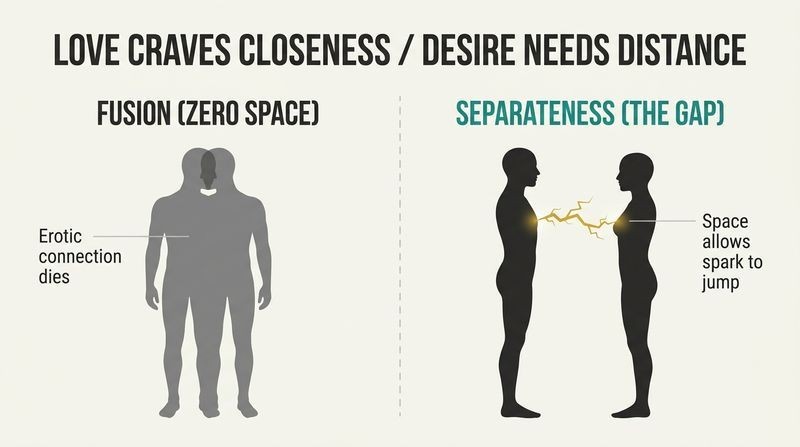
Security and passion pull opposite directions. Perel's central paradox is that the very things that build a solid relationship (familiarity, comfort, predictability, merging) are often the things that suffocate sexual desire. Love wants to shrink the gap between two people. Desire is energized by that gap. When couples confuse love with becoming one, they eliminate the space across which erotic charge travels.
Separateness is a precondition for connection. She uses the image of a synapse: for a spark to jump, there must be a gap. Adele, a happy but sexually numb lawyer, glimpses this when she sees her husband across a room and briefly forgets he is hers. Seeing him as a separate, mysterious man reignites her attraction. Eroticism lives in the tension between anxiety and fascination.
What's striking is how this inverts standard couples-therapy dogma that fixing intimacy automatically fixes sex. Attachment research (Bowlby, Ainsworth) shows humans need a secure base to explore from, and Perel cleverly applies this to eros: only from safety can we tolerate the risk of wanting. Yet the claim invites nuance. For some, especially those with anxious attachment, distance triggers panic rather than longing. Perel's framework may fit avoidant or securely attached couples better than anxious ones. Existentialists like Sartre said the same in different language: the Other's freedom is both what makes them desirable and what threatens us. Desire feeds on that ungraspability.
We ask one partner to be the village we lost
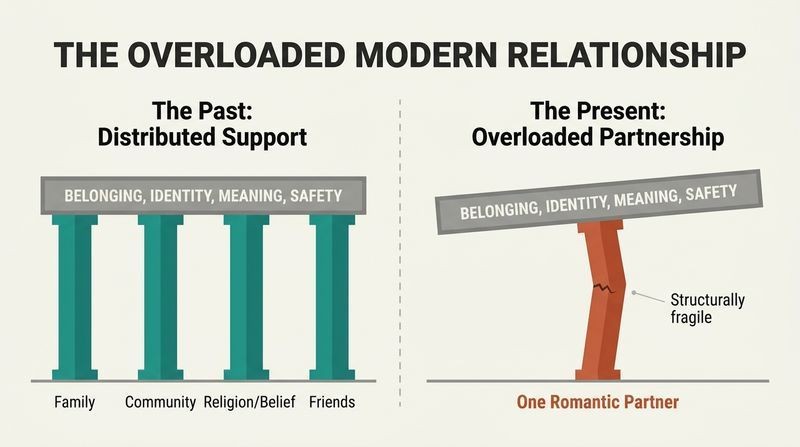
Modern love is overloaded. Historically, people drew grounding, meaning, and belonging from extended family, community, and religion. As those institutions dissolved and we became more mobile and isolated, we loaded all those needs onto a single romantic partner. We now expect one person to be best friend, passionate lover, intellectual equal, co-parent, and cure for existential loneliness.
This creates a crushing weight. Sociologist Anthony Giddens described how sexuality became a property of the self, an open-ended identity project rather than something we simply do. Perel argues this freedom brought a new anxiety: we are freer but more alone. With life spans doubled, "till death do us part" can mean fifty years with one person expected to satisfy every need. No wonder relationships buckle. The dream of one-stop emotional shopping is historically unprecedented and structurally fragile.
This is Perel's sharpest sociological insight, echoing Eli Finkel's "all-or-nothing marriage" thesis: we demand more psychologically from marriage than ever while investing less time in it. Durkheim linked the erosion of collective belonging to anomie and even suicide. Perel translates that macro-story into the bedroom. One extension worth noting: cultures with dense kinship networks (she cites families living several generations under one roof) show less appetite for the Western intimacy ideal precisely because belonging is distributed. The practical implication is underdeveloped here, though: rebuilding friendships, community, and separate interests isn't just good for you, it takes pressure off the couple and paradoxically fuels desire.
Stop waiting for spontaneous sex; deliberately build erotic space
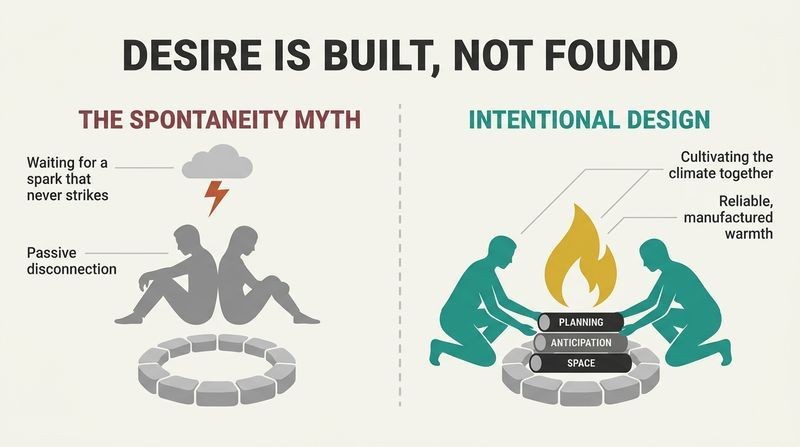
Spontaneity is a myth we hide behind. Perel argues that even the electric early sex we romanticize was the product of hours of preparation: choosing the outfit, the restaurant, the music. Believing sex should "just happen" lets us avoid owning our desire and expressing it with intent. In an established relationship, whatever was going to happen on its own already has.
Committed sex is intentional sex. She reframes "I couldn't resist" as "I don't want to resist." With the gay couple Dominick and Raoul, she compares erotic effort to Dominick's daylong ritual of cooking osso buco: sourcing the meat, the bread, the wine. That was planned for pleasure, not drudgery. Planning creates anticipation, which is the mortar of desire. Anticipation, longing, and yearning can be manufactured with forethought, even after decades together.
This directly counters the cultural script that scheduled sex is unromantic, and it aligns with sex researcher Emily Nagoski's later distinction between spontaneous and responsive desire: many people, disproportionately women, rarely feel desire out of nowhere but respond readily once an inviting context is created. Perel essentially argues context is buildable. Behavioral economics supports the anticipation point: research on "savoring" shows the anticipation of a pleasure often delivers more happiness than the event itself. The challenge is sustaining novelty within planning, since anticipation dulls when the plan becomes rote. The osso buco works because it varies; a rigid Thursday-night slot may not.
Talk is not the only bridge to intimacy; bodies speak too
We've narrowed intimacy to verbal disclosure. Perel argues modern intimacy has been feminized and reduced to talking: sharing feelings, confessing, being a good listener. This leaves many men, socialized toward performance and self-control, feeling chronically deficient, as if they suffer a permanent intimacy deficit needing repair. It also traps women in the idea that their desire is legitimate only inside emotional relatedness.
The body is a mother tongue. Her friend Eddie, repeatedly dumped for not "opening up," married Noriko when neither spoke the other's language. Their courtship was wordless: cooking, baths, leading each other by the hand to see art. Twelve years and two kids later, he credits the absence of pressure to talk. Building a bookshelf, changing snow tires, learning his mother's soup recipe can all carry connection. Overvaluing words does everyone a disservice.
Perel's critique lands against a therapeutic culture built on the "talking cure," and it resonates with attachment theorist Sue Johnson's finding that felt responsiveness, not verbal volume, drives bonding. The gendered framing is a double-edged sword: it usefully validates nonverbal men, but risks essentializing men as inarticulate and women as verbal, a binary Perel herself elsewhere resists. Emotionally focused therapy and somatic approaches (Peter Levine, Bessel van der Kolk) increasingly affirm her point that the body stores truths language glosses over. The deeper claim, that forced reciprocal disclosure can curdle into surveillance and kill mystery, is a genuinely original warning against intimacy-as-interrogation.
Democracy in the bedroom can make for very boring sex
Fairness and desire play by different rules. Perel observes that America's finest civic values (equality, consensus, compromise, mutual respect) can, imported wholesale into sex, produce tedium. Desire thrives on the politically incorrect: power plays, dominance and submission, aggression, objectification, seduction, unfair advantage. Sanitizing sex of all power dynamics can drain its charge.
Eroticized power is not oppression. Elizabeth, a hyper-responsible school psychologist who controls everything in her life, discovers she craves sexual submission with her husband Vito. It functions as a vacation from being in charge. Marcus, a type-A executive, wants to surrender to a dominatrix precisely because he commands all day. Perel argues that playing with roles proves you are no longer controlled by them: prisoners don't fantasize about being prisoners, only the free choose to make-believe. Consensual power play can be liberating, not regressive.
This is Perel's most provocative and most misread argument. She is careful to distinguish the politics of sex (where abuse must be checked) from the poetics of sex (where transgression is play). The insight that we eroticize in the dark what we resist in daylight echoes psychoanalyst Robert Stoller's claim that arousal often recycles old hurts into triumph. Camille Paglia and Anthony Giddens are invoked to frame BDSM as a subversive commentary on an egalitarian culture that represses dependency. A fair challenge: not all low-heat egalitarian sex is boring, and some couples genuinely thrive on tenderness. Perel's point is about permission, not prescription.
Your childhood taught you how much pleasure you're allowed
Desire has an archaeology. Perel calls each person's erotic template an "erotic blueprint," formed by early experiences of love, safety, and dependence. What excites us as adults often reworks childhood hurts. Catherine, humiliated as an overweight teenager, plays a high-priced escort men risk everything for, vindicating her past. Melinda, daughter of a philanderer, becomes a seductress who conquers then discards men, avenging her abandoned mother.
Sometimes love itself becomes the obstacle. James can't desire his wife Stella because as a boy he was recruited to caretake an unhappy mother; love came to mean obligation and self-erasure. The more he loves, the less he can be selfishly aroused. Perel prescribes reconnecting him to his own pleasure, even having him masturbate in Stella's presence, so he learns that attending to himself won't destroy the woman he loves.
Perel here draws on object-relations psychoanalysis (Jessica Benjamin, Michael Bader) without the jargon, arguing that erotic patterns are neither random nor purely biological. Bader's concept of sexual "ruthlessness," the capacity to surrender to one's own pleasure without guilt, is the therapeutic goal. This dovetails with modern differentiation theory (David Schnarch): the ability to hold onto yourself in the presence of another. A useful caution: the deterministic flavor ("tell me how you were loved and I'll tell you how you make love") can overstate childhood's grip. Neuroplasticity and adult corrective experiences suggest blueprints are revisable, which is precisely what Perel's own case successes demonstrate.
Children don't kill desire; parents who stop tending it do
The transition from two to three is seismic. Family life runs on routine, predictability, and safety, exactly the conditions eros hates. Perel watches Stephanie pick the mop over her husband Warren, using compulsive tidying to feel control amid the chaos of small kids. Her erotic energy hasn't vanished; it has been rerouted into sensual, playful, all-consuming caretaking of the children. This is "eros redirected."
Child-centrality is cultural, not inevitable. American parenting has sanctified childhood so thoroughly that a mother sacrificing herself entirely seems normal, while the mother's own sexuality goes invisible. Perel notes that many men, like Leo, can't eroticize the mother of their children (the Madonna-whore split). Carla breaks it by playfully demanding a hundred dollars for oral sex, un-roling "the mother" and freeing his lust. Couples who keep desire alive simply refuse to let the children absorb all their playfulness.
Perel's reframe, that eroticism is a creative life-energy not confined to genital sex, explains why exhausted parents can be bursting with vitality yet sexless: the vitality is going to finger-painting and bedtime stories. This resonates with research by John Gottman showing marital satisfaction typically drops sharply after a first child, and with Esther's cross-cultural observation that mother-desexualization is far more acute in Puritan-inflected America than in, say, French or Latin cultures. The Madonna-whore complex she invokes has Freudian roots and measurable modern correlates (studies link it to lower relationship satisfaction). Her most actionable claim: protecting adult erotic space actually benefits children by modeling that adults have their own loving bonds.
Fantasy is poetry, not prose: don't read it literally
Sexual fantasy solves psychic problems. Unlike daydreaming about a Tahiti vacation (which means you want Tahiti), sexual fantasy is symbolic. Drawing on Michael Bader, Perel argues fantasies are ingenious workarounds that dissolve guilt, fear, and inhibition. In the safe theater of the mind, the insecure become irresistible, the timid become bold, the responsible surrender control.
The submissive is secretly the director. Joni fears her cowboy-ranch submission fantasies make her a masochist like her mother. Perel reframes: Joni is author, producer, and star. The cowboys worship rather than harm her; the fantasy lets her receive care and attention without the humiliating vulnerability of admitting need in real life. A recovering alcoholic terrified of dependence, she uses forceful men who "take" so she needn't ask. Understanding what a fantasy does, not just what it depicts, becomes a direct route to a couple's real conflicts.
This is a genuinely liberating hermeneutic: interpret the function, not the content. It defuses the shame spiral ("what kind of woman wants to be ravished?") that keeps people from even examining their turn-ons. Nancy Friday's collections and Jack Morin's finding that fantasy rapists are notably nonviolent support Perel's decoupling of fantasy from wish. A valuable practical nuance she raises: disclosure is optional. Sharing fantasies can bond (Catherine) or wound (Nat's gang-bang tapes leave Amanda feeling she can't compete). The maturity required to enter a partner's erotic mindscape without judgment is high. When the erotic mind senses criticism, it stops being private and turns secretive.
Acknowledge the third; owning your partner kills your wanting
Every couple lives with the shadow of a third. The third is anyone outside the couple who represents desire's pull elsewhere: the attractive stranger, the ex, the fantasy figure, the porn star. Perel argues, via Adam Phillips, that a couple actually needs the third to define itself. Denying it entirely makes fusion so brittle that even a partner's private fantasy feels like betrayal (as in the film Eyes Wide Shut, where a wife's mere daydream devastates her husband).
Control breeds the very defiance it fears. Excessive monitoring (checking phones, policing friendships, enforcing rules) turns monogamy from a free expression of loyalty into compliance, which invites "acts of exuberant defiance." Some couples instead invite the third in: flirting openly, sharing that the delivery man was hot, admiring each other through strangers' eyes. Recognizing your partner's separate sexuality, that it isn't your property, restores mystery and desire.
Perel treats monogamy as a choice to be periodically renegotiated rather than a default, a stance that was provocative in 2006 and has since fueled a boom in ethical-nonmonogamy discourse. Her cultural relativism on infidelity disclosure (Americans equate honesty with respect; other cultures see protective discretion as respect) is bracing and debatable, since concealment carries its own corrosive costs to trust. The strongest, least controversial takeaway is the psychological one: possessiveness paradoxically deadens desire because you cannot long for what you believe you own. This aligns with reactance theory in psychology, where perceived threats to autonomy provoke the exact behavior being suppressed. Freedom, not surveillance, sustains fidelity.
You cannot own a person, which is why you can keep wanting them
Fulfilled desire seems to extinguish itself. The law of diminishing returns says the more you use something, the less each use satisfies: Paris palls by the fifteenth visit. Applied to love, this predicts inevitable erotic decline. But Perel argues the logic collapses because it wrongly assumes you can possess a person like an iPod. Your partner's separateness is unassailable, their inner life forever ungraspable.
Mystery is the renewable resource. This is why a threat to the status quo (an affair, a long absence, even a good fight) can suddenly reignite desire; the old shoes look new. She counters diminishing returns with a second principle: consistent, skilled investment increases satisfaction, like a tennis player who improves and enjoys the game more. Sustaining desire is less about finding novelty elsewhere than about truly seeing the perpetual stranger you married.
This is the philosophical capstone, and it reframes commitment as liberating rather than confining: because you never fully know the other, there is always somewhere new to go with them. It echoes Proust's line that the real voyage of discovery is having new eyes, and Marcel's insight (via de Botton) that a dose of jealousy revives love ruined by habit. The tennis analogy usefully rebuts the fatalism that passion must fade, aligning with research showing long-married couples can report intense love (Acevedo and Aron's fMRI studies). The subtle risk is romanticizing effort; not all couples want or need high-heat eros, and Perel honorably concedes calmer bonds are valid too.
Analysis
Mating in Captivity is a thesis-driven work of clinical philosophy disguised as a relationship self-help book, and that disguise is both its strength and its difficulty to summarize. Perel refuses the genre's promise of techniques and step counts. Instead she builds a single sustained argument through paired opposites (love versus desire, security versus adventure, intimacy versus eroticism) illustrated by richly rendered composite couples from her practice. The prose is essayistic, allusive, and cross-cultural, drawing on Octavio Paz, Stephen Mitchell, Anthony Giddens, and Michael Bader rather than experiments and effect sizes.
What makes the book enduringly important is its reversal of the reigning American therapeutic assumption that good communication produces good sex, that the bedroom is merely a metaphor for the relationship. Perel treats sexuality as a parallel narrative with its own logic, one that often runs counter to the logic of closeness. Her Belgian-Israeli-American vantage lets her diagnose a specifically Anglo-American pathology: a Puritan-hedonist split that simultaneously oversexualizes the culture and desexualizes the marriage and the mother, plus a can-do work ethic that tries to solve eros like an engineering problem.
The framework's limits are worth naming. Perel generalizes from a self-selected, largely affluent, urban, therapy-seeking clientele; her claims are interpretive rather than empirical, and later desire research (Nagoski, Finkel, Gottman) both corroborates and complicates her intuitions. Her provocations on power play and negotiated non-monogamy, radical in 2006, can read as prescriptive when they are meant as permission-granting. And the emphasis on distance and mystery may serve securely or avoidantly attached readers better than anxiously attached ones, for whom distance reads as threat.
Still, the core insight is close to unassailable and quietly revolutionary: desire requires a gap to cross, and the modern project of merging two people into one seamless unit of total transparency is precisely what starves it. You cannot want what you believe you already possess.
Review Summary
Mating in Captivity explores the tension between desire and intimacy in long-term relationships. Perel argues that familiarity can diminish passion, suggesting couples create emotional distance to reignite erotic spark. While some readers found her insights enlightening, others criticized her emphasis on creating distance over emotional connection. The book offers case studies and unconventional advice, sparking both praise and controversy. Some readers appreciated Perel's non-judgmental approach and unique perspective, while others found the content repetitive or potentially harmful to relationships.
People Also Read










FAQ
What's Mating in Captivity about?
- Exploring eroticism and domesticity: The book examines the tension between erotic desire and the security of committed relationships, exploring how love and desire can coexist.
- Cultural influences on sexuality: Esther Perel discusses how societal norms and personal histories shape our sexual experiences and expectations within relationships.
- Navigating intimacy and desire: It provides insights into how couples can rekindle passion by understanding the dynamics of intimacy and the need for separateness.
Why should I read Mating in Captivity?
- Insightful perspective on relationships: Perel offers a fresh take on the complexities of modern love, making it relevant for anyone in a committed relationship.
- Practical advice for couples: The book provides strategies for couples to navigate the challenges of intimacy and desire, encouraging open communication and exploration.
- Cultural and psychological exploration: It combines personal anecdotes with broader cultural observations, making it both relatable and thought-provoking.
What are the key takeaways of Mating in Captivity?
- Desire needs distance: Perel emphasizes that while love seeks closeness, desire often thrives on separateness and mystery, crucial for maintaining erotic vitality.
- Intimacy can inhibit desire: The book discusses how increased emotional intimacy can sometimes lead to decreased sexual desire, highlighting the need for balance.
- Cultural narratives shape sexuality: Perel explores how societal expectations and personal histories influence our sexual identities and relationships, urging readers to reflect on their own experiences.
What are the best quotes from Mating in Captivity and what do they mean?
- “Sex is a state of grace.” This quote encapsulates the idea that sexual intimacy is a profound experience that transcends the mundane aspects of life.
- “Eroticism thrives in the space between the self and the other.” Perel suggests that maintaining a sense of individuality within a relationship is essential for fostering desire and passion.
- “Desire is often accompanied by feelings that would seem to cramp love’s style.” This highlights the complex interplay between love and desire, indicating that the emotions associated with desire can sometimes conflict with the nurturing aspects of love.
How does Mating in Captivity address the issue of modern intimacy?
- Intimacy vs. eroticism: Perel discusses how modern relationships often prioritize emotional closeness, which can inadvertently stifle sexual desire.
- Communication is not enough: The book argues that while verbal communication is important, physicality and shared experiences also play a crucial role.
- Cultural expectations: Perel examines how societal norms around intimacy and equality can impact sexual dynamics, suggesting that couples may need to navigate these pressures to maintain desire.
What specific methods does Esther Perel suggest for rekindling desire?
- Introduce novelty and risk: Perel encourages couples to bring excitement back into their relationship by introducing new experiences and taking emotional risks.
- Create space for separateness: She advises partners to maintain their individuality and independence, which can enhance desire and prevent feelings of suffocation.
- Engage in playful exploration: The book suggests that couples should approach their sexual relationship with a sense of playfulness, allowing for experimentation and spontaneity.
How does Mating in Captivity define erotic intelligence?
- Understanding eroticism: Perel defines erotic intelligence as the ability to navigate the complexities of desire and intimacy, recognizing that both are essential for a fulfilling sexual relationship.
- Embracing vulnerability: It involves being open to one’s own desires and those of a partner, fostering an environment where both can explore their sexuality without fear of judgment.
- Balancing love and desire: Erotic intelligence requires partners to understand the interplay between emotional closeness and sexual attraction, allowing them to cultivate both in their relationship.
What role does childhood experience play in adult sexuality according to Mating in Captivity?
- Foundational influences: Perel emphasizes that our early experiences with caregivers shape our beliefs about love, intimacy, and sexuality.
- Patterns of behavior: The book discusses how childhood dynamics can create patterns that affect how we express desire and navigate intimacy in adulthood.
- Healing through awareness: By recognizing these patterns, individuals can work towards healing and developing healthier sexual relationships.
How does Esther Perel suggest couples can manage the tension between security and desire?
- Acknowledge the paradox: Perel encourages couples to recognize that security and desire are often at odds, and that both need to be nurtured in different ways.
- Cultivate curiosity: She suggests that partners should remain curious about each other, fostering a sense of mystery that can enhance desire.
- Embrace the unknown: The book advocates for embracing uncertainty in relationships, as this can lead to greater excitement and connection.
What are some common misconceptions about sex and intimacy that Mating in Captivity addresses?
- Intimacy guarantees desire: Perel challenges the belief that increased emotional intimacy will automatically lead to a more satisfying sexual relationship.
- Sex is purely physical: The book argues that sex is not just a physical act but is deeply intertwined with emotional and psychological factors.
- Desire should be constant: Perel points out that fluctuations in desire are normal and that couples should not expect a linear trajectory in their sexual relationship.
How does Mating in Captivity address the impact of parenthood on relationships?
- Parenthood complicates intimacy: Perel discusses how the arrival of children often shifts the focus away from the couple's relationship, leading to a decline in sexual intimacy.
- Redistributing resources: The book emphasizes the need for couples to find ways to reconnect amidst the demands of parenting.
- Reclaiming eroticism: Perel encourages parents to actively work on their sexual connection, even in the midst of family life.
How does Mating in Captivity redefine fidelity?
- Fidelity as a choice: Perel suggests that fidelity should be viewed as a negotiated decision rather than an absolute requirement.
- The role of the third: The book discusses how the presence of a "third" can enhance desire within a relationship.
- Emotional commitment vs. sexual exclusivity: Perel emphasizes that emotional loyalty is more important than sexual exclusivity.

Download PDF
Download EPUB
.epub digital book format is ideal for reading ebooks on phones, tablets, and e-readers.








































