

Key Takeaways
Stop trying to arouse your partner; enjoy your own excitement instead
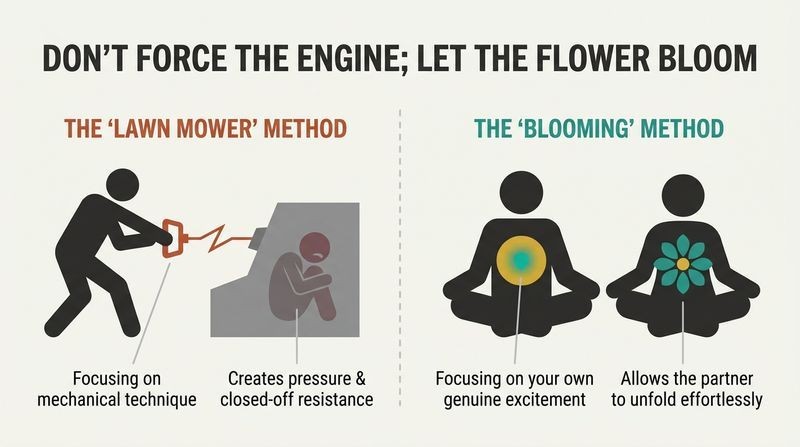
Your wife is not a lawn mower. Snyder opens with a man asking how to get his wife wet. The answer: you don't. Trying to convert a sexual "no" into a "yes" through friction alone is like arguing a toddler into liking broccoli. When passion is high, hardness and wetness happen effortlessly, like a flower blooming. Friction may get you sex, but never good sex.
The real work is your own turn-on. Most couples hurry through mechanical foreplay to get the equipment ready. Snyder counsels the opposite: attend to your own arousal and let your partner attend to theirs. Sex worth having is not about technique, dopamine, or the latest vibrator. It is about coming home to your own sexual feelings.
What's refreshing here is the inversion of the entire performance economy of modern sex advice. Where most guides pile on technique, Snyder argues technique is often the problem, generating pressure that shuts arousal down. This dovetails with self-determination theory in psychology: intrinsic motivation collapses under external goals and surveillance. The lawn-mower metaphor also anticipates Emily Nagoski's spontaneous-versus-responsive desire framework. One caveat: "just enjoy your own excitement" presumes a baseline of trust and safety that distressed couples often lack, which is precisely why they cannot simply relax. The advice is sound but not self-executing.
Your sexual self speaks only yes or no, like a toddler
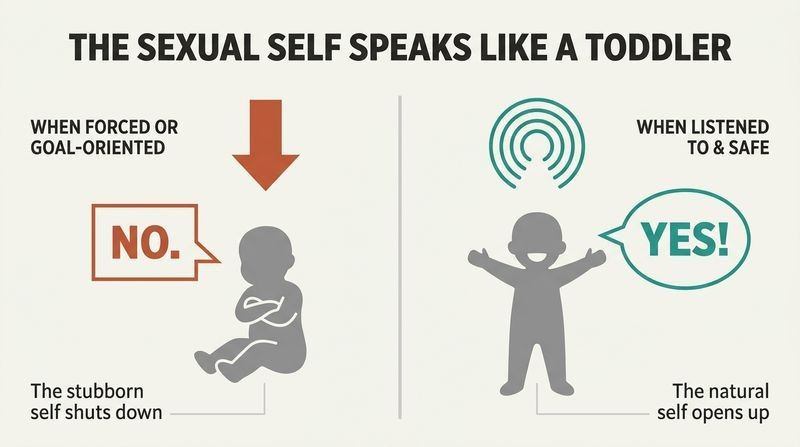
Arousal is honest but nearly mute. Snyder's central construct is the "sexual self," the part of you that gets excited. Its vocabulary is limited to yes or no, and it cannot lie or pretend. Much of sex therapy is decoding what that stubborn yes-or-no is trying to say. When Carmen felt nothing in the bedroom but melted kissing on the couch, her sexual self was signaling that the couch felt safe and the bed felt like a test.
You cannot command it. Set a goal and your sexual self, being childish and brilliant, will reject it. When Paul lost his erection with a woman he loved, his organ was saying "no" because he felt overwhelmed, not because desire was absent. The fix is never force. It is listening.
Framing arousal as a preverbal child is more than charming shorthand. It maps onto research on the limbic and autonomic systems, which operate beneath conscious control and resist top-down override. Trying to will an erection or orgasm activates the sympathetic "threat" response, the opposite of what arousal needs. The toddler analogy also carries a therapeutic implication: you parent this part of yourself with patience, not discipline. A skeptic might note the sexual self is admittedly unscientific, purely subjective. But as a clinical heuristic it earns its keep, redirecting attention from mechanics to meaning.
Great lovemaking mirrors mother-infant bonding, which is why babes and awe belong in bed
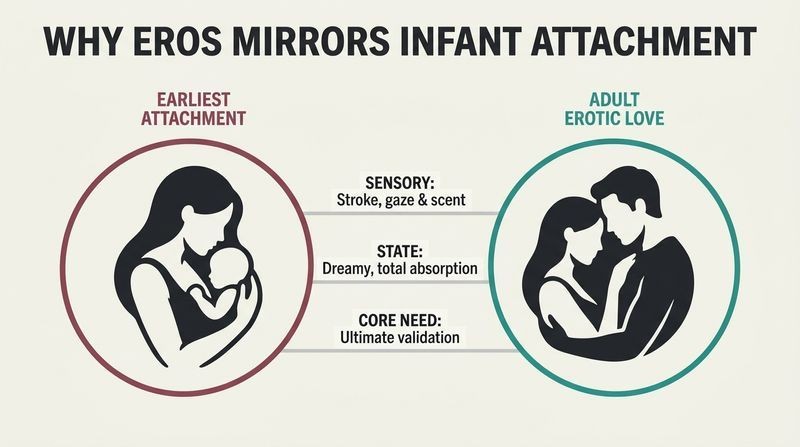
Eros is infantile, in the best sense. All that holding, stroking, eye-gazing, and dreamy satisfaction resembles a mother and nursing baby. Snyder notes love songs are full of the word "baby" for a reason. At the peak of good sex you regress to a childlike state of total absorption, then drift off like an infant asleep at the breast. Scent matters enormously: happy couples often say they simply love how each other smells.
This explains why sex feels so high-stakes. Because eros reawakens our earliest experience of being adored, held, and told we are wonderful, few things make us feel as good about ourselves, or as devastated. Validation ("Yes, that's me, you found me") is the emotional signature of sex that truly lands.
Snyder revives a psychoanalytic lineage (Freud's oral drive, Dinnerstein, object relations) but grounds it in observable clinical texture rather than dogma. Modern attachment neuroscience lends support: oxytocin mediates both maternal bonding and adult pair-bonding, and the same neural reward circuitry lights up. The scent claim is well founded too, given research on MHC-linked mate preference. The risk in the infantile framing is that it can sound reductive or even unsettling to readers who want sex to feel adult and sophisticated. Snyder's point is subtler: adult competence and infantile surrender coexist, and suppressing the latter is what flattens eros.
Selfishness is more erotic than generosity in bed
Passion is healthy narcissism aimed at a partner. Snyder distinguishes pathological narcissism (needing constant praise) from healthy narcissism, the vitality that lets you insist on your own needs. Infants brim with it; life slowly trims it. But your sexual self keeps childhood's expansive self-regard. A generous lover who keeps asking "how do you like it?" often bores his partner, who is secretly starved for his hunger, his selfish abandon. No romance-novel hero pauses to take instructions.
Take pleasure, don't just give it. Snyder reframes oral sex and touch as "taking" rather than "giving." If it feels like work, stop. A partner wants to feel devoured, not serviced. The couple feeding off each other's anxious approval-seeking produces the least erotic sex of all.
This is the book's most counterintuitive and liberating claim, and it cuts against a therapeutic culture that valorizes attunement and consent-as-checklist. Snyder is not dismissing generosity; he is arguing that desire requires the lover to be genuinely turned on, which requires self-focus. Esther Perel makes a parallel case: caretaking and desire often work at cross purposes. The nuance worth flagging is that "selfish" here means self-possessed, not inconsiderate; it presumes a foundation of safety and mutual regard. Misread, it could license genuine disregard. Read correctly, it names why dutiful, anxious lovers leave each other cold.
If sex feels like work, stop immediately; sex therapy is the art of the easy
Life is difficult; sex should be easy. Snyder's mantra is that eros is fundamentally a leisure activity, and your sexual self has no concept of work or obligation. He treats immediate causes (what you are doing right now that sabotages sex) before remote causes (childhood history), an approach he traces to Helen Kaplan and Masters and Johnson. Jill forced herself to climax after arousal had already collapsed; the fix was to be gentle and "hit rewind" to get turned on again.
Tame the ANTs. Automatic Negative Thoughts ("loser," "hopeless") ruin sex like ants ruin a picnic. Affirmations rarely work; the trick is to notice a thought is just an ANT and refuse to feed it attention, so it wanders off bored.
The immediate-cause emphasis is quietly radical: it says you often do not need to excavate your childhood to have better sex tonight. This aligns with the third wave of cognitive therapy, especially mindfulness-based and metacognitive approaches, which teach that relating differently to thoughts beats fighting their content. The "don't serve them tea" stance toward intrusive thoughts is essentially cognitive defusion from ACT. One tension: Snyder simultaneously honors deep remote causes (Jill's abandonment) and downplays them. The resolution is sequencing, address the immediate to create hope and quick wins, then optionally explore the roots.
Treat orgasm like dessert, not the reason you came to dinner
Great arousal makes great orgasms, never the reverse. Snyder, contrarian among sex writers, is unimpressed by orgasms. There is a high road (orgasm as afterthought to intense arousal) and a low road (right friction, low arousal, a hollow release that leaves you hungry). Couples who chase orgasm as the goal have worse sex. Because most men lose all interest post-climax while women retain sexual feeling, the woman should generally have dessert first.
The Two-Step restores connection. Step one: lie together doing nothing, attending to breath, weight, and scent until the mind quiets. Step two: let that stillness become the foundation for arousal, staying selfish and unhurried. Carmen discovered it through yoga; Snyder recognized it as mindfulness applied to sex.
Deprioritizing orgasm is strategically brilliant because goal-fixation triggers the very performance anxiety that blocks response. Snyder's Two-Step is essentially mindfulness meditation repurposed as foreplay, and it echoes Lori Brotto's clinically validated mindfulness-based sex therapy, which improves the concordance between women's subjective and physical arousal. The dessert metaphor is memorable but has limits: some women (and Julia Serano's account of post-transition "girl-gasms") experience orgasm as a genuine main course, diffuse and multiple, which Snyder acknowledges. The deeper point stands. Orgasm outsourced as a partner's assignment ("give her one") reliably poisons the well.
Most women crave being desired the way most men crave being welcomed
Being versus doing. Snyder observes an old but stubborn pattern: a woman's sexual currency is often feeling irresistibly wanted (the eleven-year-old at the pool asking "do you think I'm sexy?"), while a man's is doing something admirable. Melissa did not want Rob to please her better; she wanted to feel his passion, to be chased like the female rat who makes the male pursue her until she relents. Snyder calls the woman the household's "chief sexual officer," tracking whether desire is alive.
Men need to feel welcomed, not evaluated. A man's automatic desire runs on a woman's welcoming smile. When he senses criticism or unhappiness, his desire stops being automatic, and he withdraws, which she reads as rejection. Feeling desired, for many women, is like oxygen.
Snyder is candid that this "conventional script" may be part biology, part culture, and he expects it to persist despite egalitarian ideals. Critics from gender studies would push back hard: framing women as objects-of-desire and men as agents risks naturalizing exactly the arrangement feminist scholars like Deborah Tolman argue suppresses female desire. Snyder partly concedes this, noting self-focus can curdle into body-hatred and that the script says little about women's own pleasure. The rat-sex "Juego" of pursuit is evocative but reads as a generalization; plenty of couples happily invert it. Best taken as a common pattern, not a law.
An erection's real job is freeing a man from worrying about erections
Erections are honest, involuntary, and easily spooked. Men get hard when happy and go soft when unhappy, and losing hardness is itself near the top of the list of things that make a man unhappy, so the problem snowballs. Snyder notes almost all male dysfunctions worsen at the moment of penetration, an ancient dread he links to "vagina dentata" and to men's unconscious fear of lacking the inner resources to satisfy a hungry partner.
Solutions favor mercy over willpower. Rather than the old advice to ignore the erection, Snyder often endorses Viagra as a reasonable accommodation, the male equivalent of lubricant for a menopausal woman. He also teaches men to attend to their own arousal instead of monitoring their partner, and to wait until fully aroused before penetrating.
Reframing the erection as a barometer rather than a tool is genuinely destigmatizing, and it fits the physiology: erection depends on parasympathetic "rest and digest" activation, which anxiety directly sabotages via sympathetic override. Snyder's pragmatism about PDE5 inhibitors is welcome in a field sometimes moralistic about pharmaceutical "cheating." The psychodynamic vagina-dentata material is more speculative and will strike some readers as dated Freudianism, though Snyder deploys it loosely, as metaphor for performance dread. The actionable core, wait for full arousal, focus inward, is solid regardless of whether one buys the deeper symbolism.
Untie sex-knots by seeing the vicious loop, not blaming your body
A sex-knot is a self-tightening trap. Snyder's signature concept: a feedback loop where each partner's natural reaction to a problem makes it worse. He worries he will lose his erection, which makes him lose it; she reads it as rejection and gets upset, which deepens his loss. The knot, not the individual, is the enemy. He catalogs eleven classic knots and their solutions in an appendix.
Naming breaks the spell. The escape is rarely more effort. It is stepping outside the loop: telling your partner you feel nervous (Hal and Deborah), accepting that you have no desire right now (Marnie), or refusing to feed the anxiety. Snyder credits R. D. Laing's book Knots for the image of self-defeating human cycles.
The sex-knot is essentially systems theory applied to the bedroom, a cousin of the demand-withdraw pattern that marital researchers like John Gottman have documented as a top predictor of divorce. Its power is clinical and rhetorical: externalizing the problem (a narrative-therapy move) short-circuits shame and blame, letting partners become allies against the pattern. The framework's limitation is that seeing the loop is necessary but not sufficient; deeply entrenched knots, especially around initiation, often require the harder work of differentiation and, Snyder admits, professional help. Still, the vocabulary alone gives couples a shared, non-accusatory way to talk.
Simmer daily instead of cuddling, which quietly neuters relationships
Simmering keeps the pilot light on. Simmering means taking a brief moment to feel aroused together under conditions where sex will not happen: a lingering goodbye kiss with your face buried in your partner's hair, a two-minute grind before sleep announced as "just simmering." Teenagers do it constantly between classes. It generates no frustrating buildup, just a low erotic hum that sustains a couple's climate more than actual sex does.
Cuddling is its enemy. Snyder warns that couples curled passively in front of the TV are draining whatever charge remains between them. Physical intimacy should carry a little erotic frustration; that is what keeps you in the game. Wives who avoid arousing their husbands, fearing obligation, misunderstand that an erection is not a debt to be paid.
The cuddling warning is provocative and will annoy readers who treasure nonsexual affection, but Snyder's logic is specific: touch drained of eros trains the body to associate the partner with comfort rather than desire, a plausible Pavlovian mechanism he invokes elsewhere. The distinction resonates with Perel's argument that domestic coziness and erotic charge pull in opposite directions. The counterpoint is that oxytocin-rich affectionate touch has real bonding and stress-reducing value, and many secure couples report cuddling fuels rather than kills desire. The reconciliation: simmer intentionally so that not all touch defaults to the comfort register.
Don't force desire with toys or getaways; turn inward to find inspiration
Desire cannot be kept alive, only welcomed back. Over a long relationship desire comes and goes like a child's whims. The consumer fix, novelty, porn, sex dates, fetish props, a bed-and-breakfast, treats symptoms and usually backfires, since your sexual self experiences a romantic weekend as more pressure to perform. Force desire and you get a rebellion. Emily nearly had an affair with a fellow scientist; Snyder linked her longing to her father's illness and her unmet need for connection, not to Sam's inadequacy.
Sanctify the ordinary. The alternative to forcing desire is the Two-Step and mindful presence: going to bed early to talk and maybe make love, keeping the "faith channel" open. Inspiration exists in sex, Picasso-style, but it has to find you working.
Snyder's anti-novelty stance is bracing in a market that sells adventure as the cure for dead bedrooms, and it has empirical teeth: novelty spikes dopamine transiently but does not build the safety and attunement that responsive desire needs. His reframe, that desire is a visitor, not a possession, lowers the stakes that themselves suppress desire. He borrows the religious language of sanctification deliberately, arguing sex and faith are both about connection and both require periodic loss and recovery. The blind spot is that for some couples genuine novelty and even consensual non-monogamy do revive eros; Snyder acknowledges these paths exist but writes primarily for the monogamous majority.
Standing your ground beats leaning on approval as a relationship matures
Differentiation is the engine of lasting eros. Drawing on Murray Bowen and David Schnarch, Snyder argues couples begin with "other-validated intimacy," leaning on each other for approval. When that well runs dry, each partner must learn "self-validated intimacy," managing your own emotions and tolerating your partner's disappointment without collapsing or fleeing. David crumbled whenever Gwen was unhappy; treating his ADHD and helping him stop reacting let him stand his ground, which paradoxically rekindled their connection.
Faith is emotional coherence. Snyder defines faith as the inner balance that lets you keep your footing during the inevitable misery of feeling incompatible. Every couple, like Moses, smashes its first magical tablets (idealization) and must carve a second, plainer set by hand: a real relationship that is authentically theirs.
This is where Snyder's clinical framework matures beyond technique into character. Differentiation theory has robust standing in couples research, and Schnarch's insight, that anxiety-driven fusion, not distance, kills desire, reframes the common assumption that closeness is always good. The provocative implication is that a willing partner is often less erotic than one capable of saying no and meaning it. Snyder's addition of "faith," partly drawn from object-relations and his own religious sensibility, risks vagueness, but functions usefully as the felt confidence that suffering together can be survived and even generative. The message: durable passion requires two whole selves, not two halves.
Analysis
Love Worth Making is a thesis-driven clinical memoir disguised as a sex manual, and its structure is its argument: no exercises, no anatomy diagrams, no dopamine talk, because Snyder believes the field's technical and biochemical obsessions miss the point. Drawing on thirty years and 1,500 patients, he builds an emotional theory of eros around one construct, the "sexual self," an honest, preverbal, infantile core that can only say yes or no and cannot be commanded. Everything else follows from taking that construct seriously: acceptance is "vitamin A," force always backfires, and the therapist's job is decoding what a stubborn no is trying to say.
The book's intellectual lineage is unusually explicit and coherent. Snyder synthesizes Masters and Johnson (arousal as involuntary natural function), Helen Kaplan (immediate versus remote causes), Bowen and Schnarch (differentiation), and the mindfulness tradition (Brotto, Kabat-Zinn) into a single practical stance. His original contributions, "sex-knots," "simmering," the "Two-Step," and the reframing of generosity as less erotic than self-possessed selfishness, are genuinely useful because they externalize shame and lower the performance stakes that themselves sabotage response.
What makes the book distinctive is its refusal of the optimization ethos. Where competitors promise peak experiences and better orgasms, Snyder preaches the sanctification of the ordinary and treats orgasm as dessert. This is contrarian and largely defensible on physiological grounds, since goal-fixation activates the threat response that blocks arousal.
The honest weaknesses are two. First, the psychodynamic scaffolding (vagina dentata, infantile regression) is speculative and unfalsifiable, deployed as evocative metaphor rather than evidence. Second, the "conventional script" of gendered desire, women wanting to be desired, men to be welcomed, is presented as near-inevitable, which gender scholars would contest as naturalizing culture. Snyder partly concedes both, and his self-aware, story-driven humility is precisely what keeps the book trustworthy where a more confident author would overreach.
Review Summary
Love Worth Making receives mostly positive reviews for its fresh approach to sex and relationships. Readers appreciate Snyder's focus on emotions, mindfulness, and personal pleasure rather than mechanics. Many found the book insightful, relatable, and helpful for long-term couples. The use of case studies and humor makes it engaging. Some criticize the heteronormative focus and religious references. Overall, readers value the emphasis on intimacy, communication, and understanding one's "sexual self" to improve sexual experiences in committed relationships.
Glossary
The sexual self
Honest, childlike core of arousalSnyder's central concept for the part of a person that gets aroused. It is honest and cannot pretend, but its vocabulary is limited to yes or no. It never grows up, remains as vulnerable and self-centered as a toddler, resists being commanded or given goals, and must be treated with acceptance and patience rather than force.
Sex-knot
Self-tightening vicious loop in bedA feedback loop in which each person's instinctive reaction to a sexual problem makes the problem worse, pulling the knot tighter. Example: a man fears losing his erection, which causes him to lose it; his partner reads it as rejection and gets upset, deepening his anxiety. The solution is to step outside the loop by naming feelings rather than trying harder.
Simmering
Brief shared arousal without sexTaking a quick moment to feel aroused together under conditions where sex will not happen, such as a lingering goodbye embrace or a two-minute grind before sleep. It creates no frustrating buildup and sustains a couple's erotic climate over time. Snyder contrasts it favorably with passive cuddling, which he says drains erotic charge.
The Two-Step
Stillness first, then arousalSnyder's core practice for couples. Step one: lie together doing nothing, attending to breath, body weight, and scent until the mind quiets. Step two: let that inner stillness become the foundation for arousal, staying unhurried and focused on your own experience. It is essentially mindfulness meditation adapted to lovemaking, useful for restoring desire.
Vitamin A (Acceptance)
Acceptance as sexual nourishmentSnyder's shorthand for acceptance as the essential nutrient for good sex. Your sexual self will not be happy unless you feel accepted in bed for exactly who you are, including your fantasies, quirks, and ways of reaching orgasm. Turning up acceptance, rather than adding technique or novelty, is his most frequent prescription.
Immediate vs. remote causes
Present sabotage versus childhood rootsA distinction Snyder draws from Helen Kaplan and Masters and Johnson. Immediate causes are what you are doing right now in bed that perpetuates a problem; remote causes are deeper childhood origins. Snyder treats immediate causes first because they produce quick relief and hope, reserving exploration of remote causes for later, if needed at all.
ANTs (Automatic Negative Thoughts)
Intrusive self-critical thoughts during sexNegative obsessions about yourself ("loser," "hopeless") that intrude during lovemaking and destroy arousal. Snyder argues positive affirmations rarely work; the effective response is to recognize a thought as merely an ANT and refuse to give it emotional attention, so it grows bored and departs, like not serving unwanted guests tea.
Erotic Self-Focus
Being aroused by one's own desirabilityA concept from researcher Marta Meana describing arousal derived from one's own body and desirability, for example finding it exciting to imagine being looked at. Meana's study found far more women than men endorsed such feelings, which Snyder uses to explain why many women prize feeling desired and why women's magazines feature beautiful women.
Differentiation (self-validated intimacy)
Managing your own emotions in intimacyDrawn from Bowen and Schnarch, the capacity to stay emotionally balanced and stand your ground in a relationship rather than leaning on your partner's approval (other-validated intimacy). Well-differentiated people tolerate conflict and disappointment without fleeing or collapsing. Snyder argues developing this capacity is essential for keeping desire alive as a relationship matures.
Faith
Inner coherence sustaining a relationshipSnyder's term for a kind of inner coherence that lets you keep your balance in a relationship even when miserable, trusting the outcome will be okay. He links it to having more positive than negative "introjects" (internalized voices of important people) and describes it as a muscle that strengthens with courageous use.
FAQ
1. What is Love Worth Making by Stephen Snyder about?
- Focus on sexual feelings: The book explores how sexual feelings operate, emphasizing their emotional and psychological roots rather than just physical techniques or orgasms.
- Long-term relationships: It centers on sustaining great sex and intimacy in lasting, monogamous relationships, addressing challenges that arise over time.
- Integration of clinical insights: Drawing from over thirty years of sex therapy, Snyder combines real-life stories, psychological theory, and mindfulness practices to help couples reconnect.
- Comprehensive approach: The book blends practical advice, emotional self-awareness, and theoretical frameworks to guide readers toward more fulfilling sexual and emotional lives.
2. Why should I read Love Worth Making by Stephen Snyder?
- Unique clinical perspective: Snyder offers nuanced, experience-based insights that go beyond typical sex advice, focusing on emotional and relational depth.
- Addresses real-life challenges: The book tackles common issues like loss of desire, performance anxiety, and communication breakdowns with practical, actionable solutions.
- Accessible and honest style: Written in a conversational tone with short chapters, it’s easy to read and respects the complexity of human sexuality.
- Inclusive and modern: The book acknowledges diverse sexual orientations and challenges conventional gender roles, making it relevant for a wide audience.
3. What are the key takeaways from Love Worth Making by Stephen Snyder?
- Sex is emotional, not just physical: Great sex is rooted in emotional connection, self-acceptance, and vulnerability, not just technique.
- Desire fluctuates naturally: Sexual desire is not constant and cannot be forced; acceptance and presence are key to rekindling passion.
- Mindfulness and differentiation matter: Practices like the Two-Step and sensate focus, along with developing a strong sense of self, are essential for lasting intimacy.
- Breaking conventional scripts: Moving beyond traditional gender roles and expectations can lead to more authentic and satisfying sexual experiences.
4. What is the "sexual self" concept in Love Worth Making by Stephen Snyder?
- Honest but limited vocabulary: The sexual self communicates with a simple "yes" or "no," reflecting genuine arousal or lack thereof.
- Infantile and vulnerable: It remains childlike, craving attention, validation, and acceptance, which explains why sex is deeply emotional.
- Self-acceptance is vital: Feeling accepted for who you are sexually is crucial for connection and enjoyment in lovemaking.
- Foundation for great sex: Understanding and nurturing the sexual self is key to overcoming common sexual challenges.
5. What are the "rules of desire" according to Love Worth Making by Stephen Snyder?
- Beyond friction and fantasy: Good sex requires more than physical stimulation and mental imagery; emotional connection is essential.
- Sex of the heart: Desire is deeply tied to emotional intimacy, gratitude, and awe, not just lust or excitement.
- Psychological changes in arousal: Authentic sexual experience involves focused attention, regression to a more primitive state, and a sense of validation.
- Emotional shifts are key: Recognizing and embracing these emotional changes leads to more satisfying sexual encounters.
6. How does Love Worth Making by Stephen Snyder explain gender differences in sexual desire?
- Women seek to feel desired: Women often need to feel admired and validated, with self-image and emotional safety playing major roles in arousal.
- Men seek to feel welcomed: Men typically need to feel safe and invited to express desire, valuing confidence and leadership in sexual encounters.
- Conventional script challenges: Traditional gender roles—men leading, women following—can create miscommunications and frustrations in relationships.
- Encourages breaking the script: The book advocates for flexibility and mutual understanding to overcome these ingrained patterns.
7. What is the "Two-Step" method in Love Worth Making by Stephen Snyder, and how does it work?
- Step one: Stillness and presence: Partners begin by lying quietly together, focusing on breath and bodily sensations to cultivate mindfulness.
- Step two: Maintain calm during arousal: As arousal arises, couples hold onto inner calm and mindful focus, avoiding rushing or forcing excitement.
- Mindfulness foundation: The Two-Step applies mindfulness to sex, helping partners stay present and connected.
- Leads to better intimacy: This method fosters more satisfying arousal and orgasms by reducing performance pressure.
8. What practical advice does Love Worth Making by Stephen Snyder offer for improving foreplay and arousal?
- Enjoy yourself first: Foreplay should be about mutual enjoyment, not just pleasing your partner or achieving a goal.
- Simmering technique: Couples are encouraged to cultivate brief moments of arousal throughout the day, maintaining an erotic climate.
- Avoid non-erotic cuddling: Too much comfort-focused touch can deplete desire; physical intimacy should pass erotic energy.
- Focus on authentic connection: The book emphasizes honest communication and self-awareness during foreplay.
9. How does Love Worth Making by Stephen Snyder address challenges of intercourse and performance anxiety?
- Intercourse is serious, not play: Recognizing the seriousness of intercourse can help reduce pressure and anxiety.
- Penis-vagina dynamics: Men may experience anxiety or loss of erection at penetration due to emotional pressures, not just physical issues.
- Clitoral stimulation for women: Women’s pleasure often depends on clitoral stimulation alongside intercourse.
- Wait for full arousal: Delaying penetration until both partners are fully aroused improves experience and reduces common problems.
10. What are "sex-knots" in Love Worth Making by Stephen Snyder, and how can couples untie them?
- Sex-knots defined: These are self-defeating cycles in sexual relationships where partners’ reactions worsen problems, such as anxiety or mismatched desire.
- Common examples: Loss of arousal due to negative thoughts, pressure to perform, inability to reach orgasm, and initiation conflicts.
- Untying strategies: Mindfulness, emotional self-regulation, and techniques like sensate focus and the Two-Step are recommended.
- Goal-free sex: Removing goals and pressure from sex allows natural arousal and connection to emerge.
11. How does Love Worth Making by Stephen Snyder address desire, monogamy, and infidelity urges?
- Desire fluctuates naturally: The book emphasizes that desire cannot be forced and will ebb and flow over time.
- Monogamy is a choice: While not "natural," monogamy can thrive with commitment, self-awareness, and setting healthy limits.
- Handling infidelity urges: Snyder recommends self-care practices, such as masturbation and avoiding risky situations, rather than acting on outside attractions.
- Cultivating presence: Practices like the Two-Step help couples reconnect inwardly and maintain intimacy without chasing desire.
12. What are the best quotes from Love Worth Making by Stephen Snyder, and what do they mean?
- Marriage and courage: “Marriage asks, ‘Are you willing to stand up now, or do things have to get worse?’” — highlights the need for emotional courage in relationships.
- Love and bravery: “Being deeply loved by someone gives you strength. Loving someone deeply gives you courage.” — underscores the empowering and vulnerable aspects of love.
- Mindfulness in sex: “Leave your front door and back door open. Let thoughts come and go. Just don’t serve them tea.” — a metaphor for not engaging with negative thoughts during intimacy.
- Sex as sanctification: “Sex in marriage is the darkest and the best…” — reflects how sex can encompass both life’s joys and sorrows, deepening connection.
- Self-preservation in love: “If you love someone, don’t give away what’s best about you. Save it, so you can share it with the person you love.” — emphasizes authenticity and self-care in relationships.
Download PDF
Download EPUB
.epub digital book format is ideal for reading ebooks on phones, tablets, and e-readers.








































