Key Takeaways
Almost every market wizard first blew up their account
“When you start, you ought to be as bad a trader as you are ever going to be.”
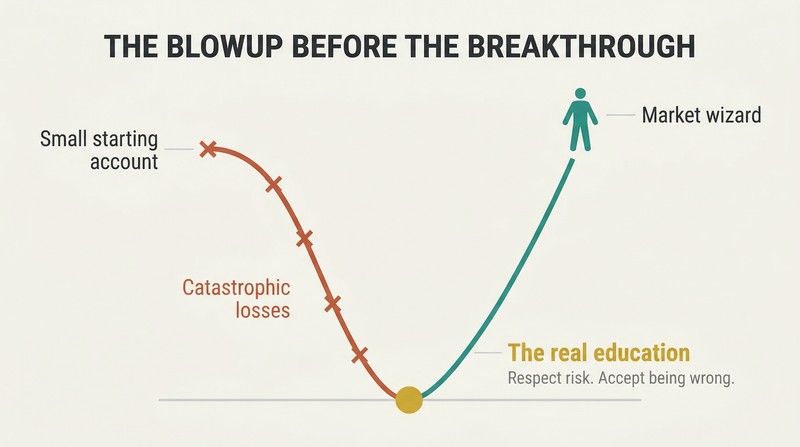
Early catastrophe is the origin story, not the exception. Michael Marcus lost his initial $1,000, then wiped out his father's $3,000 life insurance money, then went bust two more times. Bruce Kovner watched a $45,000 soybean gain evaporate to $22,000 in a single panicked decision. Paul Tudor Jones lost 60 – 70% of his clients' equity on one reckless cotton trade and nearly quit the business entirely. Richard Dennis started with just $400 and lost most of that repeatedly.
These aren't cautionary tales — they're prerequisites. Every devastating loss drilled a permanent lesson into these traders: respect risk, accept being wrong, and never bet the farm on a single idea. The traders who eventually made tens and hundreds of millions all agree their worst early losses were their most valuable education.
Cap risk at 1 – 2% per trade — the one rule every wizard shares
“Undertrade, undertrade, undertrade is my second piece of advice.”
If the book has one commandment, this is it. Bruce Kovner never risks more than 1% of his portfolio on a single trade. Larry Hite's firm holds the same 1% ceiling — no exceptions. Michael Marcus caps exposure at 5% per idea. Paul Tudor Jones monitors total portfolio equity in real-time, and if it drops 1 – 2% in a single session, he may liquidate everything.
Hite's coffee tycoon parable illustrates why. A world-renowned coffee trader — who knew where every boat was, who the ministers were — lost $100 million because he never managed his downside. Five times during dinner he asked Hite what he did. Five times Hite answered: "I just look at the risk." Three months later the tycoon was wiped out. Knowledge without risk control is a loaded gun aimed at yourself.
Any method works if you have the discipline to follow it
“…you could publish trading rules in the newspaper and no one would follow them. The key is consistency and discipline.”
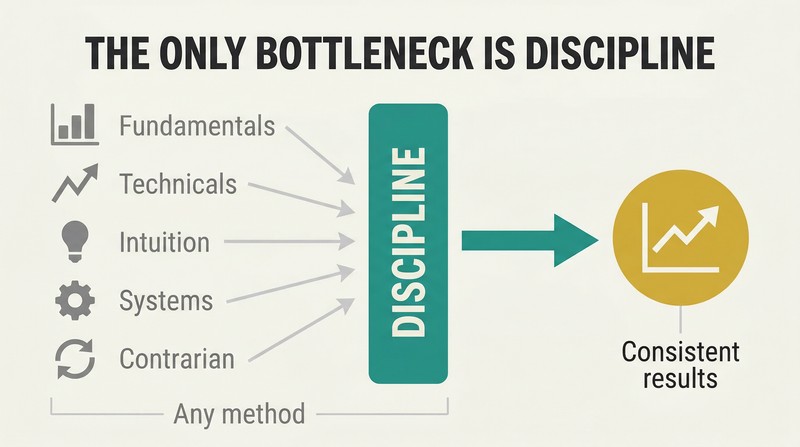
Schwager's central finding across all interviews: the traders used radically different approaches — pure fundamentals (Rogers), pure technicals (Seykota), discretionary intuition (Jones), mechanical systems (Hite), contrarian analysis (Steinhardt). Time horizons ranged from seconds to years. Yet they shared identical attitudes about risk, discipline, and emotional control.
Richard Dennis proved this with his "Turtles." He recruited 23 people with no trading experience, taught them his rules in two weeks, and gave each $100,000 to trade. They averaged roughly 100% annual returns. Dennis named them Turtles after visiting a turtle farm in Singapore. The system wasn't secret — he believed the rules could be published openly. What couldn't be given away was the psychological fortitude to execute them through drawdowns.
When a market shrugs off huge news, that is the real news
“…if a market doesn't respond to important news in the way that it should, it is telling you something very important.”
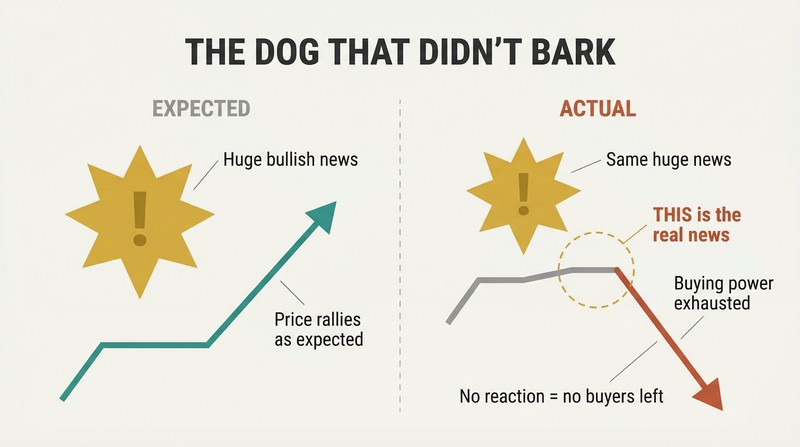
Marcus's soybean lesson is a masterclass. Holding a heavy long position, Marcus watched fantastic export figures hit the tape — the market was expected to lock limit-up for three days. Instead, after briefly touching limit-up, it immediately started trading down. Marcus began selling so frantically that he accidentally ended up short — and the market collapsed. The failure of a market to rally on the best possible news revealed that all buying power was exhausted.
This pattern repeats across every market. When the Iran/Iraq war broke out, gold managed only a $1 rally — Larry Hite recognized it as a great short. When cotton received record Chinese export orders and barely budged, it marked the exact high. A market that can't move on bullish news has nowhere left to go but down.
On some level, every losing trader is getting what they want
“Win or lose, everybody gets what they want out of the market.”
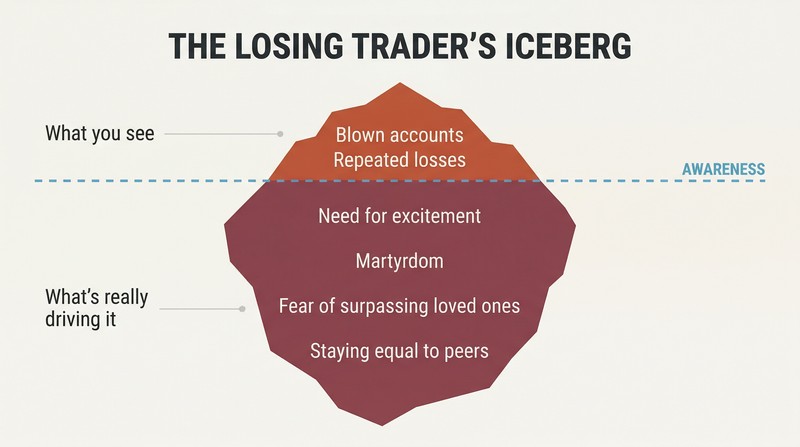
Ed Seykota's most provocative claim. The MIT-trained engineer who turned $5,000 into over $15 million across sixteen years argues that losing traders subconsciously choose to lose — because losing fulfills deeper needs: excitement, martyrdom, or staying on the same financial plane as friends. He describes a trader who reliably builds $10,000 into $250,000, then predictably loses it all, over and over like clockwork.
Dr. Van Tharp's research confirms it. After counseling hundreds of traders with his Investment Psychology Inventory, Tharp found that roughly half had subconscious conflicts sabotaging their results. One floor trader couldn't earn more than $75,000 per year because a protective part of his psyche prevented him from surpassing his alcoholic father. Once the internal conflict was resolved through a ten-minute exercise, he made $650,000 in two months.
Reset your entry price to last night's close every morning
“The most important rule in trading is: Play great defense, not great offense.”
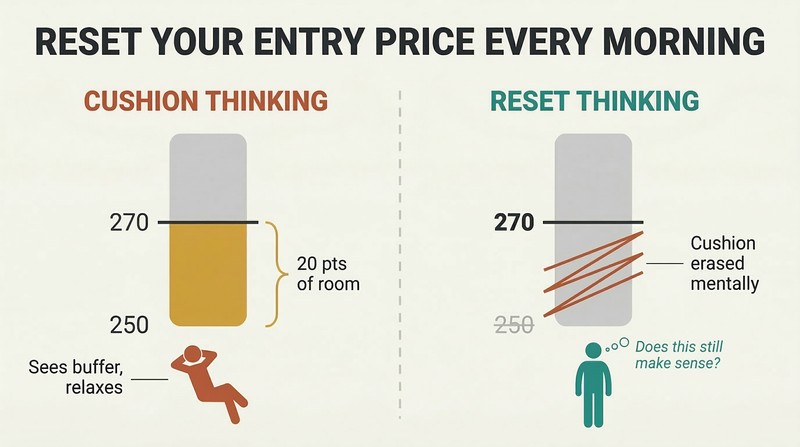
Paul Tudor Jones's mental reframe eliminates cushion complacency. Every morning, Jones pretends he just entered all his positions at the previous night's closing price. If he bought the S&P at 250 and it's now at 270, he doesn't think "I have 20 points of room." He thinks: "I'm long at 270 — does this still make sense?" This forces constant reevaluation and prevents the fatal mistake of riding a winner back to breakeven.
Jones also uses time stops, not just price stops. If a trade that should have moved hasn't budged within his expected window, he exits — even at breakeven. Most traders only watch price; Jones recognizes that a market's failure to move in the anticipated direction within the expected timeframe is equally meaningful. This approach helped him score a 62% return in October 1987 while most were devastated.
Wait for trades like a cheetah stalking a lame antelope
“I just wait until there is money lying in the corner, and all I have to do is go over there and pick it up.”
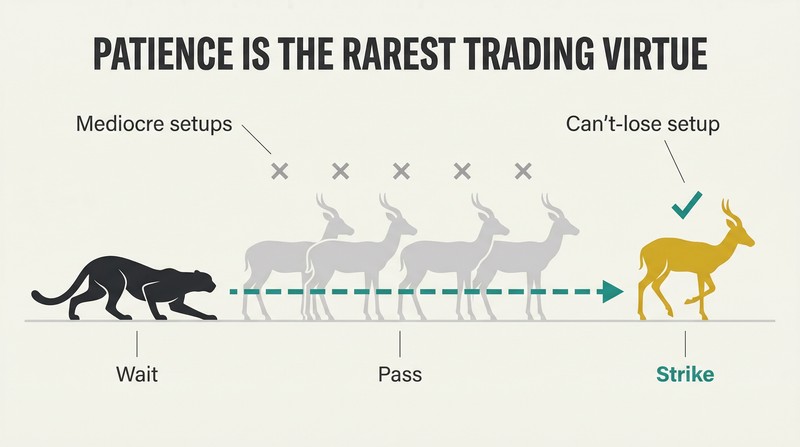
Mark Weinstein's cheetah analogy defines his approach. The cheetah is the fastest animal alive but will hide in a bush for a week, waiting for a sick baby antelope — the can't-lose kill. Weinstein applies this principle so rigorously that he claims no losing weeks since 1980 and a win rate approaching 99%. He only trades when nearly every technical indicator lines up simultaneously.
Jim Rogers embodies the same patience at macro scale. He makes perhaps three to five major investment decisions per year, waiting for situations so obviously mispriced that he describes them as "shooting fish in a barrel." Gary Bielfeldt draws a poker analogy: fold the weak hands quickly — forfeit the ante — but when the odds strongly favor you, raise and play that hand to the hilt. Patience is the rarest and most profitable trading virtue.
Shrink your bets when losing — revenge trading is financial suicide
“I learned to avoid trying to catch up or double up to recoup losses.”
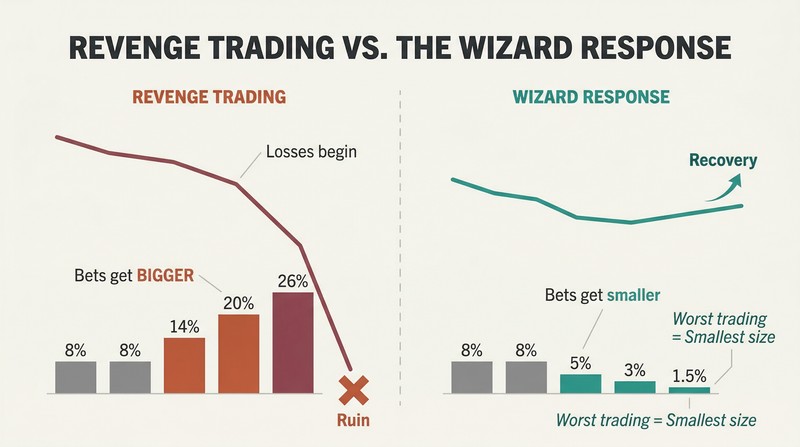
Every wizard does the opposite of human instinct. After a losing streak, the urge is to trade bigger to "get even." Marty Schwartz drops to one-fifth or one-tenth of his normal position size. Paul Tudor Jones progressively reduces until he's back on track — ensuring his smallest size coincides with his worst trading. Richard Dennis stops trading entirely for at least a day to break the cycle of emotional decision-making.
Marcus captures the psychology perfectly: "When in doubt, get out and get a good night's sleep. I've done that lots of times and the next day everything was clear." After a major loss, you enter what Schwartz calls a "catatonic state" — unable to think clearly, desperate to act. The solution isn't more trading; it's less. Get flat, step away, and let clarity return before risking another dollar.
Your ego costs you more than bad analysis ever will
“Don't ever feel that you are very good. The second you do, you are dead.”
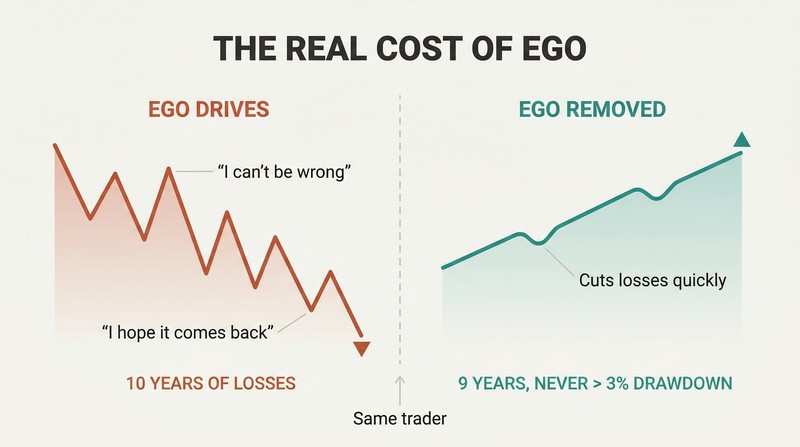
Marty Schwartz's ten years of losing prove the point. Despite good salaries as a securities analyst, Schwartz stayed nearly broke from market losses. The turning point came when he could separate his ego from his trading. Before that, admitting a mistake was more painful than the money lost. After the shift, he never had a month-end drawdown exceeding 3% — for nine consecutive years.
Bruce Kovner frames it differently. He warns traders not to "personalize the market" — treating it as a nemesis trying to humiliate them. The market is impersonal. When a trader says "I wish" or "I hope," they've already lost focus, fighting their ego instead of diagnosing the situation. Kovner also notes that a greedy trader who sizes up too aggressively "always blows out" — another ego-driven error that intellectual brilliance cannot compensate for.
95% of profits come from 5% of trades — never miss them
“If you don't stay with your winners, you are not going to be able to pay for the losers.”
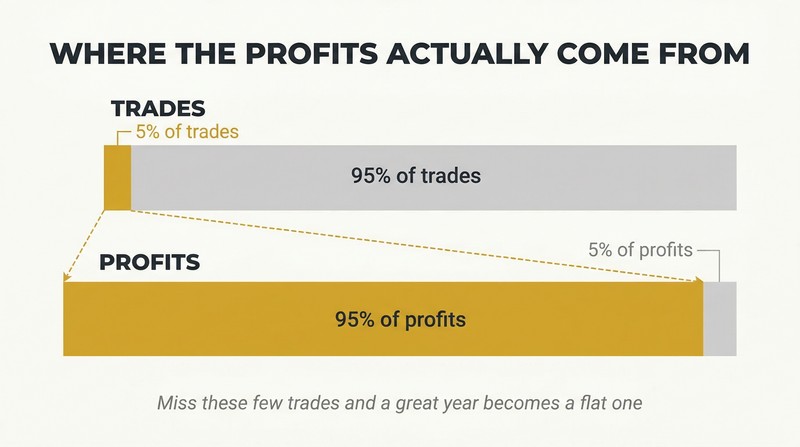
Richard Dennis's math changes everything about how you approach trading. By his estimate, 95% of his profits came from only 5% of his trades. Missing even a handful of those spectacular winners — by being out of the market, taking profits too early, or holding too small a position — could turn a great year into a flat one. This is why Dennis considers the worst trading mistake not a bad loss, but a missed profit opportunity.
The practical implication is twofold. First, cut losing trades quickly to preserve capital for the big wins. Second — and harder — ride your winners with conviction. Ed Seykota held short positions while everyone called a bottom. Marcus held through twelve consecutive limit-up days in soybeans. The ability to sit with a winning position is as rare, and as valuable, as the ability to cut a losing one.
Analysis
Market Wizards is deceptively simple — Schwager interviews brilliant traders and lets them talk. But beneath the war stories lies a rigorous empirical challenge to the Efficient Market Hypothesis that dominated finance departments when the book was published in 1989. If markets are truly random walks, Schwager's subjects — traders compounding at 30 – 100%+ annually for decades — represent statistical near-impossibilities. The book doesn't disprove market efficiency through equations; it does so through an overwhelming accumulation of anecdotal evidence that something beyond luck is operating.
What's most striking from a behavioral finance perspective is how the book anticipates findings that wouldn't be formalized academically for years. Kahneman and Tversky's prospect theory — demonstrating that people are risk-averse with gains and risk-seeking with losses — perfectly explains why most traders cut winners early and let losers run. Every wizard independently discovered the antidote to this bias, decades before it had a formal name in psychology.
The book also contains an underappreciated tension between its explicit message (trading can be taught) and its implicit one (very few people will actually learn it). Dennis trained 23 Turtles using his exact rules, and most succeeded — but Dennis himself later lost over 50% of his managed funds. The system didn't change; something psychological shifted. This suggests that even codified rules are mediated by the human running them, which aligns more with Seykota's provocative 'everybody gets what they want' than with Dennis's rationalist 'it's all about the rules.'
Published in 1989, the book's warnings about trend-following systems becoming crowded proved prescient — a dynamic now studied under 'factor crowding' in quantitative finance. Several traders warned that as more capital chases identical signals, breakouts become unreliable. Thirty-five years later, this remains the central dilemma facing systematic traders, making Market Wizards less a snapshot of a bygone era than a continuously relevant field manual for navigating human nature through markets.
Review Summary
Market Wizards is highly regarded by traders for its insightful interviews with successful professionals. Readers appreciate the diverse trading styles and common traits shared by top performers, such as discipline, risk management, and patience. The book offers valuable lessons on trading psychology, market analysis, and developing a personal strategy. While some find certain interviews less engaging, most consider it essential reading for aspiring traders. Critics note that some content may be dated, but many principles remain relevant. Overall, the book is praised for its wealth of experience and wisdom from market experts.
People Also Read
 Immersive
 Immersive
Glossary
CANSLIM
O'Neil's stock selection frameworkA seven-factor stock selection model developed by William O'Neil. Each letter represents a criterion: Current quarterly earnings (up 20%+), Annual earnings growth, New product or management, Shares outstanding (small cap preferred), Leader in its industry by relative strength, Institutional sponsorship (some but not excessive), and Market direction (buy only in confirmed uptrends). Less than 2% of stocks meet all criteria at any given time.
Variant perception
Informed contrarian trading thesisMichael Steinhardt's core trading concept. A variant perception is a well-researched view that meaningfully differs from the prevailing market consensus. Steinhardt holds positions based on these views until they are no longer variant—that is, until the market has moved to reflect his thesis. The approach requires both deep fundamental understanding and the courage to stand against popular opinion for extended periods.
Turtles
Dennis's trained novice tradersThe nickname Richard Dennis gave to 23 people he recruited and trained as traders in 1984–1985, after visiting a turtle farm in Singapore. Dennis believed trading could be taught; his partner disagreed. The Turtles were trained in approximately two weeks, given $100,000 each, and averaged roughly 100% annual returns—proving Dennis's thesis that discipline and rules, not innate talent, drove trading success.
Explosion position
Saliba's unlimited-potential option spreadTony Saliba's term for an option position with limited risk but open-ended profit potential, designed to profit from a large price move or spike in volatility. Typically involves buying out-of-the-money calls and out-of-the-money puts. Saliba pairs explosion positions in back months with butterfly spreads in front months, using the butterfly's time-decay profits to finance the explosion position's cost.
Investment Psychology Inventory
Tharp's trader assessment testA psychological assessment developed by Dr. Van K. Tharp to measure trading strengths and weaknesses across eleven areas grouped into three clusters: the psychological factor (attitude, conflict, motivation), management and discipline (risk control, patience, intuition), and decision-making (market knowledge, sound judgment, independent thinking). The test ranks respondents by success level and identifies specific areas for improvement.
EPS rank
Stock earnings comparison scoreA proprietary ranking published in Investor's Daily (now Investor's Business Daily) that combines a stock's most recent two quarters of earnings-per-share growth with its five-year annual earnings growth rate, then compares this composite against all other stocks. An EPS rank of 95 means the company's earnings performance has outperformed 95% of all other companies. O'Neil recommends buying stocks with EPS ranks above 80, preferably above 90.
FAQ
What's Market Wizards about?
- Interviews with Top Traders: Market Wizards by Jack D. Schwager features interviews with some of the most successful traders in the financial markets, offering insights into their strategies and philosophies.
- Diverse Trading Styles: The book covers a variety of trading styles, from technical analysis to fundamental analysis, showcasing how different approaches can lead to success.
- Focus on Mindset: A significant theme is the importance of mindset and attitude in trading, emphasizing that success is often more about psychological resilience than specific techniques.
Why should I read Market Wizards?
- Learn from the Best: The book offers readers the opportunity to learn directly from top traders who have achieved remarkable success, making it a valuable resource for aspiring traders.
- Real-World Insights: It provides practical advice and real-world examples that can be applied to one’s own trading strategies, making it relevant for both beginners and experienced traders.
- Inspiration and Motivation: The stories of overcoming adversity and achieving success can inspire readers to pursue their own trading goals with renewed vigor.
What are the key takeaways of Market Wizards?
- Risk Management is Crucial: Many traders emphasize the importance of managing risk effectively, with advice such as "Never risk more than 1 percent of total equity on any trade."
- Emotional Control Matters: Successful traders maintain emotional detachment from their trades, understanding that "If you argue with the market, you will lose."
- Adaptability is Essential: The ability to adapt to changing market conditions and to recognize when a strategy is no longer working is a common trait among successful traders.
What are the best quotes from Market Wizards and what do they mean?
- "Everybody gets what they want": This quote by Ed Seykota suggests that traders' outcomes reflect their true desires, whether consciously or subconsciously, highlighting the psychological aspect of trading.
- "You have to learn how to fall before you learn to fly": This quote emphasizes the importance of learning from failures and setbacks in trading, as they are essential for growth and improvement.
- "Play great defense, not great offense": Paul Tudor Jones stresses the importance of risk management over aggressive trading, suggesting that protecting capital is more important than chasing profits.
How do successful traders manage risk according to Market Wizards?
- Set Clear Stop-Loss Orders: Many traders, including Larry Hite, emphasize the importance of having predetermined stop-loss points to limit potential losses on trades.
- Diversification of Positions: Successful traders often diversify their investments across different markets to mitigate risk, as seen in Hite's approach of trading nearly sixty markets.
- Adjust Position Sizes: Traders like Paul Tudor Jones recommend adjusting position sizes based on current market conditions and personal performance, ensuring that risk is kept in check.
What is the concept of "variant perception" in Market Wizards?
- Understanding Variant Perception: Michael Steinhardt describes variant perception as the ability to see things differently from the consensus view, which can lead to profitable trading opportunities.
- Importance of Independent Thinking: This concept emphasizes the need for traders to develop their own insights rather than following the crowd, which can often lead to poor decisions.
- Application in Trading: Traders who successfully apply variant perception can identify mispriced assets and capitalize on market inefficiencies.
What trading strategies are discussed in Market Wizards?
- Trend Following: Many traders, including Ed Seykota, advocate for trend-following strategies, which involve buying assets that are rising and selling those that are falling.
- Contrarian Trading: Some traders, like Michael Steinhardt, focus on contrarian strategies, betting against prevailing market sentiment when they believe it is mispriced.
- Systematic Trading: The book also highlights the use of systematic trading approaches, where traders rely on algorithms and predefined rules to make decisions, as discussed by Larry Hite.
How do traders in Market Wizards view market efficiency?
- Skepticism of Market Efficiency: Many traders, including Richard Dennis, express skepticism about the efficient market hypothesis, believing that markets can be inefficient and present opportunities for profit.
- Focus on Behavioral Factors: The interviews reveal that traders often consider psychological and behavioral factors that can lead to market inefficiencies, allowing them to capitalize on mispricings.
- Long-Term Perspective: Successful traders emphasize the importance of a long-term perspective, understanding that while markets may be efficient in the short term, they can deviate significantly over longer periods.
What role does psychology play in trading according to Market Wizards?
- Emotional Resilience: The book highlights that successful traders possess strong emotional resilience, allowing them to handle losses and maintain focus on their strategies.
- Self-Reflection: Traders like Ed Seykota stress the importance of self-reflection and understanding one's own psychological triggers to avoid making impulsive decisions.
- Discipline and Consistency: Many traders emphasize the need for discipline in following their trading plans and maintaining consistency, which is crucial for long-term success.
How do traders in Market Wizards view losses?
- Learning Opportunities: Many traders see losses as valuable learning experiences that can help refine their strategies and improve future performance.
- Acceptance of Risk: They understand that losses are an inherent part of trading and do not let them affect their overall confidence or decision-making.
- Focus on Long-Term Success: Successful traders maintain a long-term perspective, recognizing that a few losses do not define their overall trading success.
What is the CANSLIM method mentioned in Market Wizards?
- Acronym for Stock Selection: CANSLIM stands for Current earnings, Annual earnings, New products, Shares outstanding, Leader or laggard, Institutional sponsorship, and Market direction.
- Focus on Growth Stocks: This method emphasizes selecting stocks with strong earnings growth and market leadership, which are likely to outperform the market.
- Combines Technical and Fundamental Analysis: CANSLIM integrates both technical indicators and fundamental metrics to identify high-potential stocks.
How can I apply the lessons from Market Wizards to my own trading?
- Develop a Trading Plan: Create a comprehensive trading plan that includes risk management strategies, entry and exit points, and a clear understanding of your trading style.
- Learn from Mistakes: Embrace failures as learning opportunities, as many successful traders have done, and continuously refine your approach based on past experiences.
- Stay Informed and Adapt: Keep abreast of market developments and be willing to adapt your strategies as conditions change, just as the traders in the book have demonstrated throughout their careers.
Market Wizards Series
About the Author
Other books by Jack D. Schwager
Download PDF
Download EPUB
.epub digital book format is ideal for reading ebooks on phones, tablets, and e-readers.








































