

Key Takeaways
You can be one generation from the land and lose everything
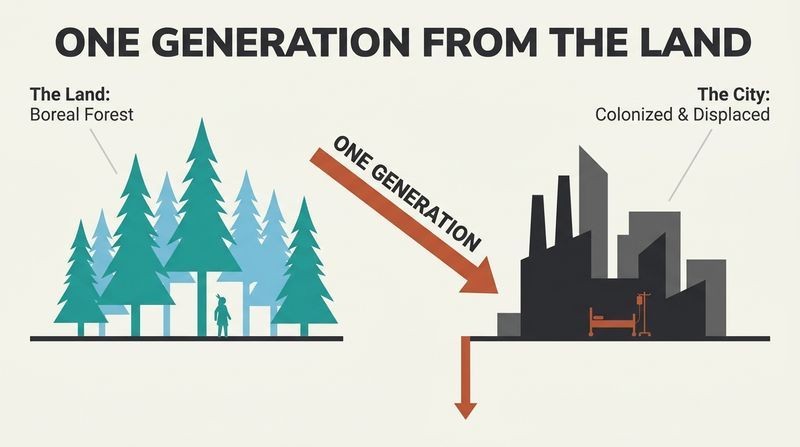
Thomas-Muller opens with his father, Peter Sinclair Sr., a Cree bushman who at age five mistook the first airplane he saw for an angel, a white cross in the sky. He heard this story from his father while the man was dying drunk in a Winnipeg hospital. That image crystallized the book's core wound: in a single lifetime, his family went from living off the boreal forest to living in a colonized city.
His mother, sixteen and pregnant, fled their reserve in 1977 for Winnipeg, choosing city services over a home community so violent it was nicknamed Dodge City. She survived residential school, then gave birth in a hospital run by nuns. That paradox, having to leave the land to be safe when leaving the land caused the danger, drives the memoir.
The opening reframes colonization not as distant history but as compressed personal time. This matters because settler narratives often relegate Indigenous dispossession to a mythic past, blurring accountability. By anchoring genocide to his own father's childhood, Thomas-Muller collapses that distance. The framing echoes trauma research by scholars like Maria Yellow Horse Brave Heart, whose concept of historical trauma describes cumulative psychological wounding across generations. What distinguishes this account is its refusal of simple victimhood: the mother's flight was a rational, agentic choice inside an impossible system, illustrating how oppression forecloses good options rather than merely inflicting harm.
Losing your elders can sever a family's connection to land and sobriety
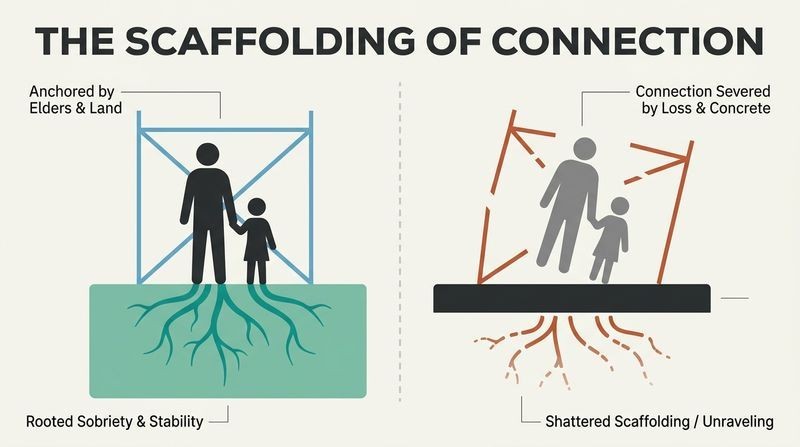
As a child, Thomas-Muller spent summers on the family trapline at Jetait, walking rabbit snares with his great-grandfather, eating berries, learning the muskeg's biology. His great-grandparents were the emotional core, taking in troubled kids from the reserve and feeding them love. When both died within a short time, the family unraveled. His mother stopped taking him north. The grounding link to the land dissolved.
He describes it almost neurologically: city concrete separates the body from the Earth's sacredness, muddling one's energy. After the elders passed, his mother and aunties slid into drinking, partying, and abusive relationships. He watched his mother hospitalized repeatedly by violent partners. The absence of land and elders was not sentimental loss but the removal of the scaffolding that had held the family upright.
This insight anticipates what public health now calls the social determinants of health: connection, place, and intergenerational support predict outcomes more powerfully than individual willpower. The claim that concrete literally disrupts mental processing is poetic rather than empirical, yet it rhymes with emerging research on nature exposure reducing cortisol and rumination (attention restoration theory). The deeper argument is structural: when colonial policy severs people from land-based kinship networks, addiction and violence rush into the vacuum. Framing dysfunction as downstream of dispossession, rather than as cultural deficiency, inverts the deficit narratives that have long pathologized Indigenous families.
Trauma inherited from residential school gets transmitted, not chosen
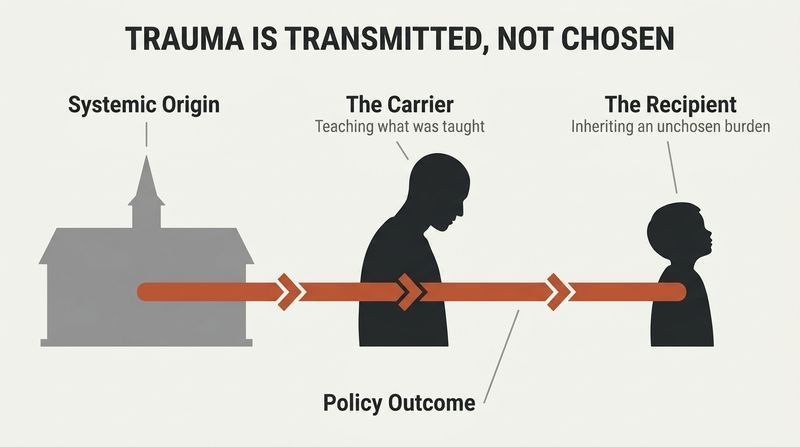
Thomas-Muller endured staggering childhood harm: sexual abuse by a teenage offender his stepfather left him with, abuse by relatives, and physical violence from his own mother, who once bashed his head against a wall. But he refuses to render his abusers as monsters. His mother learned violence at residential school and at home. She was, in his words, teaching him what had been taught to her.
His biological father was raped by a nun throughout his years at residential school. His stepfather Roddy, a champion kickboxer, came from a household saturated with domestic violence. Thomas-Muller frames abuse as a transmission chain, a policy outcome. Canada's residential schools forcibly removed children for over a century, which Article II of the UN Genocide Convention defines as genocide.
The refusal to demonize while refusing to excuse is the book's hardest ethical balance. It aligns with the cycle-of-violence literature: exposure to childhood abuse sharply elevates the odds of later perpetration, though most survivors do not become abusers. Thomas-Muller's insistence on causation without absolution resembles restorative justice philosophy, which separates the act from the intrinsic worth of the actor. A useful tension: naming transmission risks fatalism, implying trauma is destiny. His own life disproves that, making the account a testament to interruption rather than inevitability, to becoming the generation that breaks the chain.
Gang life sells young Native men belonging, power, and a shortcut to mattering
Homeless at seventeen, digging in garbage for food, Thomas-Muller called his estranged father, who connected him to the Manitoba Warriors, one of Canada's largest Indigenous gangs, run by his own uncle and brothers. He managed a drug house for sixty dollars a night. For a while it felt like the best job ever: weed, respect, purpose.
He is clear-eyed about the appeal. The Warriors began as his uncle's genuine vision, jobs and identity for ex-convicts, security at powwows, protection from other gangs. But muscle assembled for protection drifts toward drugs and prostitution. He witnessed brutal violence against women, including a woman with a broken leg fleeing a drug house with a needle still in her arm. His brother John eventually sat him down and ordered him out, sensing a police crackdown coming.
Thomas-Muller's analogy between Indigenous gangs and earlier Irish and Italian immigrant gangs is sociologically sharp: marginalized groups locked out of legitimate opportunity build parallel economies of crime that later launder into professions and businesses. This echoes strain theory in criminology, where blocked access to socially approved goals generates deviant means. What is often missed, and what he captures, is that gangs frequently originate as mutual-aid and identity projects before predation takes over. The crucial variable in his escape was not policing but relationship: a brother and a girlfriend who could see his potential and demand he act on it.
Culture, not just programs, is what pulls people out of the cycle
After leaving the Warriors, Thomas-Muller walked into Winnipeg's Aboriginal Centre for a resume and instead found a pipeline out of crime. Programs like Anishinaabe Oway-Ishi (Native people leading the way) and Medicine Fire Lodge blended job skills with ceremony: morning circles, burning sweetgrass, passing a rock so each person could speak what weighed on them.
The insight is that decolonization begins with the self. His mentor Larry Morrissette taught that reconnecting youth to ceremony, language, and elders was the real force against prison and addiction. Thomas-Muller reframed the trajectory: instead of a pipeline to prison, build a pipeline to Sundance. He co-founded Aboriginal Youth with Initiative, structured on a traditional clan governance model, growing it to a half-million-dollar budget serving inner-city high schools and reserves.
This is culturally grounded intervention, and it is increasingly evidence-backed. Studies of Indigenous youth show that cultural continuity, measured by community self-government, land control, and traditional practices, correlates strongly with dramatically lower suicide rates (Chandler and Lalonde's landmark British Columbia research). Thomas-Muller lived the mechanism: identity and belonging as protective factors. The subtle brilliance is redirecting the same hustle, risk appetite, and organizing talent that fueled gang life toward activism. A fair challenge: culture-based programs are hard to scale and fund, and depend on rare charismatic mentors, which raises the question of how to institutionalize what worked for him.
A warrior is defined by what he fights for, not by violence
Thomas-Muller draws a sharp line between soldier and warrior. A soldier uses violence as a tool and, ideally, never has to. A warrior is defined by the struggle itself, a purpose carried in the heart that cannot be set aside on weekends. Having seen enough real violence, he found no romance in it, associating it with weakness rather than strength.
His uncle Alec models the paradox. When the forestry company Tolko clear-cut half the family trapline, Alec chained himself to the railway tracks and fired his rifle at the company train. The train never returned; half the forest was saved. But Alec got two years in prison. The lesson: being right is not enough, because the rules can turn the right thing into a crime. Justice must be actively rolled onto different tracks.
The soldier-warrior distinction resonates with the just-war tradition and with Gandhian and Kingian nonviolence, where moral force outranks physical force. Thomas-Muller's version is grounded in Indigenous cosmology rather than borrowed philosophy, which gives it specificity. The uncle Alec story doubles as a critique of legal positivism: legality and justice are not identical, and permits can sanctify desecration. This is the intellectual seed of civil disobedience, from Thoreau to Standing Rock. The provocative claim, that being right is insufficient, refuses the comforting liberal faith that truth prevails on its own. Power must be organized, or injustice simply continues down the same tracks.
There is no justice without environmental justice; polluting land pollutes people
Hired by the Indigenous Environmental Network, Thomas-Muller drove 5,000 kilometres across the Navajo Nation auditing pipelines, coal mines, and abandoned uranium sites. He saw miners who had drunk uranium-tainted groundwater and carried radioactive dust home to wives and children, producing generations of cancer deaths. In Oklahoma he learned how white men married and outlived multiple Native wives to inherit oil-rich land.
The realization crystallized: extraction targets Indigenous land because that is where the resources are, and destroying the land destroys the people who live from it. This is what he calls environmental racism, the disproportionate siting of toxic industry in racialized communities. His brother cleaned a PCB waste site in Pukatawagan with no safety gear, given only a patch that turned black when he absorbed too much poison.
Thomas-Muller articulates a principle now central to the environmental justice movement, tracing to the 1980s Warren County protests and Robert Bullard's foundational research showing toxic facilities cluster in poor and minority communities. His contribution is fusing this with Indigenous ontology, where land and body are not separate, so pollution is not an externality but an assault on personhood. The bile-duct cancer cluster he documents downstream of the tar sands, linked to bioaccumulating hydrocarbons, illustrates the mechanism concretely. The framing challenges mainstream environmentalism's tendency to treat nature as scenery rather than as kin and food source and self.
Indigenous treaty rights are the pipeline industry's most feared weapon
Fighting the Alberta tar sands, the largest industrial project in human history, Thomas-Muller and his allies found their leverage in law, not just protest. Canadian treaties constitutionally protect the right to hunt, fish, and trap. His rights and title strategy: use those rights in court to choke-hold pipelines, keep the oil landlocked, and thereby crater the return on investment of an already high-cost, low-margin product.
The scale is staggering. Tar sands operations move more earth daily than could fill a domed stadium, and each barrel of oil poisons four to six barrels of fresh water. In 2008 the Beaver Lake Cree launched a constitutional challenge over 19,000 illegally sold leases. The movement helped push Obama to reject Keystone XL, later killed permanently by Biden. In forty years, no major Canadian environmental win happened without Indigenous leadership.
This is the book's most strategically instructive section: it reframes Indigenous sovereignty from moral appeal to financial risk, the language capital actually respects. By telling banks that litigation delays threaten their bottom line, activists weaponized fiduciary logic against extraction. This mirrors the divestment tactics that helped end apartheid and the shareholder-activism playbook. The reliance on British common law's respect for precedent is a shrewd judo move, turning the colonizer's own legal architecture into a defense. The vulnerability, which Thomas-Muller acknowledges, is precedent's double edge: a lost case could set back all First Nations, making case selection a high-stakes gamble.
The greatest threat is the Winter Spirit inside us, not outside enemies
Central to Cree cosmology is the Wi'tigo, a human possessed by the Winter Spirit, a being of insatiable rapacity that will eat its own family and even its own fingers and lips. Thomas-Muller's great-grandfather once fought one hand-to-hand; his hair turned white and he was bedridden all summer.
The Wi'tigo is Thomas-Muller's master metaphor for the darkness in every heart: greed, selfishness, the impulse to consume others to feed yourself. He applies it to capitalism, to the tar sands, and, unflinchingly, to himself. He argues the residential school architects were not simply bigots but people convinced they were doing good, which he finds more dangerous than open hatred. The lesson: monstrous harm can be committed by ordinary people who never intend evil, so vigilance must turn inward.
Using the Wi'tigo as a lens on consumer capitalism is a striking act of intellectual translation, and it has precedent: scholar Jack Forbes built a whole thesis around wetiko as the cannibal psychosis of colonialism. What elevates Thomas-Muller's version is the refusal to externalize the monster onto villains. His observation that sincere do-gooders commit genocide echoes Hannah Arendt's banality of evil, where atrocity flows from thoughtlessness and bureaucratic conviction rather than sadism. The unsettling implication is that moral certainty is itself a hazard. The framework demands self-suspicion, a rare posture in activist literature, which usually locates evil safely in the opponent.
Anger fuels the fight but eventually consumes the fighter
Thomas-Muller admits he barely noticed his own anger for years, as a fish does not notice water. Anger drove him into crime, into conflict with every authority, and even into activism, where injustice was gasoline on the fire. He burned bright and got things done, but he also burned those around him and himself.
The reckoning came when his biological father died. He relapsed, secretly drinking whiskey and taking whatever drugs he could find, nearly losing his marriage. He sought healing through a therapist, trauma and addiction support groups, and ceremony. An Oaxacan medicine woman diagnosed his core sickness as a ball of anger lodged in his gut. An elder gave him anger medicine to smudge with for a year. The philosopher's warning haunted him: choose your enemies wisely, because you come to resemble them.
This is the emotional hinge of the memoir and its most universal lesson. Anger is a legitimate response to injustice, and psychology increasingly validates moral anger as motivating. But the research on chronic hostility is equally clear: sustained anger corrodes cardiovascular health and relationships. Thomas-Muller's insight that a warrior can become the thing he fights maps onto Nietzsche's aphorism about gazing into the abyss. The healing arc, therapy plus ceremony plus community, models an integrated approach that neither Western clinical practice nor traditional practice alone provided. His candor about relapse, rather than a triumphant recovery narrative, is what makes the account trustworthy.
Everything is connected, so real victory liberates rather than defeats
The book's recurring refrain, everything is connected, becomes both cosmology and political strategy. The train tracks that severed his people from their past also carry food and loved ones home. His German adoptive father serviced tar sands trucks, placing someone he loves on the other side. He concludes there are no clean good guys and bad guys; everyone consumes more than the Earth can sustain.
So the goal is not to defeat enemies but to liberate everyone from the Winter Spirit. He eventually joined 350.org, an organization he once openly attacked as colonial for peddling carbon offsets, because he saw the power of coalition. The March for Jobs, Justice and Climate united 10,000 people across labour, feminist, migrant, and Indigenous movements. As Naomi Klein put it, changing everything takes everyone.
The move from purity to coalition is a mature political evolution, and a contested one. Thomas-Muller's earlier hostility to carbon offsets was well founded; offset markets have repeatedly been shown to overstate emissions cuts and displace Indigenous land users. His decision to work inside a big-budget NGO drew accusations of selling out, which he reports honestly. The tension between grassroots purity and institutional scale is perennial in social movements, from labor to civil rights. His resolution, that liberation-oriented victory beats domination-oriented victory, reframes political struggle in almost spiritual terms, consistent with the book's insistence that means and ends are inseparable, like heat and the stones in a sweat lodge.
The next Indigenous generation is prophecy made economic power
Thomas-Muller ends with hope grounded in demography. Seventy-five percent of Inuit, Metis, and First Nations people are under thirty; fifty-five percent under twenty-five. The University of Manitoba graduated 450 Indigenous students in 2018 alone. This is, he argues, the largest transfer of economic and consumer power to Indigenous people since before colonization, and he reads it as the fulfillment of the eighth fire prophecy, a generation freed from the colonial mindset.
His vision is concrete: urban reserves as tax-free development zones manufacturing wind turbines, solar panels, and battery technology; homes with passive solar and geothermal heat, since 38 percent of household income in his communities goes to heating leaky houses. Decommission Manitoba Hydro's dams, build renewable sovereignty, and follow the original instruction: if you take something, put something back.
Ending a trauma memoir with an economic development plan is an unusual and bracing choice, refusing to let suffering be the final word. The demographic argument is real: Canada's Indigenous population is its youngest and fastest-growing, a genuine source of leverage. The vision resembles the just transition framework, linking climate action to jobs and community wealth, and the growing Indigenous clean-energy sector lends it credibility. The reciprocity principle, put something back, offers an ethical foundation that extractive capitalism structurally lacks. A realist might note the enormous capital and political barriers, but the point is directional: sovereignty and sustainability, framed not as sacrifice but as regeneration.
Analysis
Life in the City of Dirty Water is a memoir structured around five Cree words, flight, warrior, water, healing, and fire, that trace a movement from dispossession to purpose. What makes it hard to summarize is that it fuses three books: a raw survival memoir of abuse and street life, a primer on Indigenous environmental activism and its strategic logic, and a work of Cree cosmology and spiritual instruction. Its power lies in refusing to keep these separate.
The organizing intelligence is the phrase everything is connected, which functions on multiple registers. Psychologically, it links childhood trauma to adult addiction. Politically, it links a single uncle chained to railway tracks to a continental coalition against pipelines. Spiritually, it links the individual soul to the land, ancestors, and future generations. The book's most original intellectual move is deploying the Wi'tigo, the cannibal Winter Spirit, as a unified theory of harm that covers residential schools, capitalism, addiction, and the author's own anger. This dissolves the comfortable boundary between victim and perpetrator that most trauma writing maintains.
Thomas-Muller writes against two dominant narratives simultaneously: the settler story that relegates colonization to the past, and the deficit story that pathologizes Indigenous dysfunction as cultural failure. By showing that his mother learned violence at residential school and that gangs began as mutual aid, he reframes dysfunction as a downstream policy effect while still holding space for agency and healing.
The memoir's honesty is its authority. He admits relapse, hypocrisy, promiscuity, and the accusation of selling out. He does not resolve into a triumphant recovery arc. Instead he offers the warrior ethic: strength that fights for rather than against, love as the most renewable energy, and reconciliation with self as prerequisite to reconciling the world. The closing turn toward Indigenous economic and clean-energy sovereignty transforms grief into blueprint, insisting the wounded generation becomes the teaching one.
Review Summary
Life in the City of Dirty Water is a memoir that elicits mixed reactions. Many readers appreciate the author's honesty in sharing his experiences with trauma, addiction, and activism. The book offers valuable insights into Indigenous perspectives and environmental issues. However, some criticize its disjointed structure and lack of cohesive narrative. While praised for its raw and candid approach, others find the writing style challenging to follow. Despite these critiques, many readers consider it an important work that sheds light on crucial social and environmental topics.
People Also Read



FAQ
What's Life in the City of Dirty Water about?
- Personal Journey: The memoir follows Clayton Thomas-Müller's life as an Indigenous man in Winnipeg, Manitoba, focusing on identity, trauma, and resilience.
- Cultural Context: It examines the effects of colonialism on Indigenous communities, especially those in urban areas.
- Healing and Activism: The book highlights the journey of healing from trauma and the advocacy for environmental justice and Indigenous rights.
Why should I read Life in the City of Dirty Water?
- Authentic Voice: It provides a raw perspective on Indigenous challenges, crucial for understanding contemporary issues.
- Inspiration for Change: The memoir is a testament to Indigenous resilience and the power of activism against systemic oppression.
- Cultural Education: Readers gain insights into Indigenous culture, history, and the ongoing fight for rights and recognition.
What are the key takeaways of Life in the City of Dirty Water?
- Resilience in Adversity: The memoir shows how struggles can lead to strength and activism, with community support being vital.
- Connection to Land: It emphasizes the deep bond Indigenous peoples have with their land and how environmental issues affect cultural identity.
- Importance of Storytelling: Sharing personal stories is highlighted as a means of healing and raising awareness about social issues.
What are the best quotes from Life in the City of Dirty Water and what do they mean?
- "You taught me how to hustle. You taught me how to survive.": Reflects lessons of resilience and resourcefulness learned from family and community.
- "Justice isn’t something you can count on.": Captures the pervasive nature of systemic injustices, especially for Indigenous peoples.
- "If you want a different outcome, you need justice to roll along different tracks.": Stresses the need for systemic change to achieve justice.
How does Life in the City of Dirty Water address the theme of identity?
- Cultural Heritage: Explores the complexities of Indigenous identity in urban settings, maintaining cultural connections amidst modern life.
- Personal Reflection: Thomas-Müller reflects on family, community, and colonialism's impact on his identity as an Indigenous man.
- Intersectionality: Shows how race, class, and personal history intersect to shape the author's experiences and worldview.
What role does family play in Life in the City of Dirty Water?
- Support System: Family is depicted as a crucial source of love and guidance through struggles.
- Legacy of Trauma: Addresses intergenerational trauma from colonialism and systemic oppression.
- Cultural Transmission: Family ties are essential for passing down cultural knowledge and traditions.
How does Clayton Thomas-Müller describe his experiences with activism in Life in the City of Dirty Water?
- Grassroots Organizing: Shares his journey from grassroots efforts to becoming a prominent voice in Indigenous rights.
- Collaboration and Solidarity: Emphasizes building alliances with other social movements for collective action.
- Personal Growth: Reflects on personal growth and lessons learned from activism's challenges and victories.
How does Life in the City of Dirty Water explore the theme of healing?
- Personal Healing Journey: Details the author's path to healing from trauma, highlighting storytelling and community support.
- Cultural Practices: Traditional practices and ceremonies are vital for healing and reconnecting with cultural identity.
- Activism as Healing: Engaging in activism is portrayed as a form of healing for individuals and communities.
What challenges does Thomas-Müller face in Life in the City of Dirty Water?
- Navigating Identity: Struggles with identity as an Indigenous man in a marginalizing society.
- Trauma and Healing: Discusses trauma from colonialism and systemic oppression, and the journey towards healing.
- Activism Fatigue: Addresses the emotional toll of activism, including burnout and the need for balance.
How does Life in the City of Dirty Water address the impact of colonialism?
- Personal and Collective Trauma: Shares family experiences with residential schools and colonial policies' lasting effects.
- Critique of Resource Extraction: Criticizes exploitation of Indigenous lands and its environmental and social consequences.
- Call for Reconciliation: Advocates for understanding colonial history as a step towards reconciliation.
What is the significance of the title Life in the City of Dirty Water?
- Metaphor for Struggle: Symbolizes challenges faced by Indigenous peoples in urban environments.
- Connection to Identity: Reflects struggles for clean water and environmental justice in Indigenous communities.
- Hope and Resilience: Despite challenges, conveys a message of hope and resilience in overcoming adversity.
What lessons does Life in the City of Dirty Water offer about activism?
- Empowerment through Action: Activism is a powerful tool for addressing injustices faced by Indigenous peoples.
- Community Solidarity: Highlights the importance of community support in the fight for justice and equality.
- Intersection of Personal and Political: Personal experiences inform and inspire activism, creating a deeper connection to the cause.
Download PDF
Download EPUB
.epub digital book format is ideal for reading ebooks on phones, tablets, and e-readers.








































