

Key Takeaways
Behind every great restaurant is organized chaos, crude loyalty, and a pirate crew
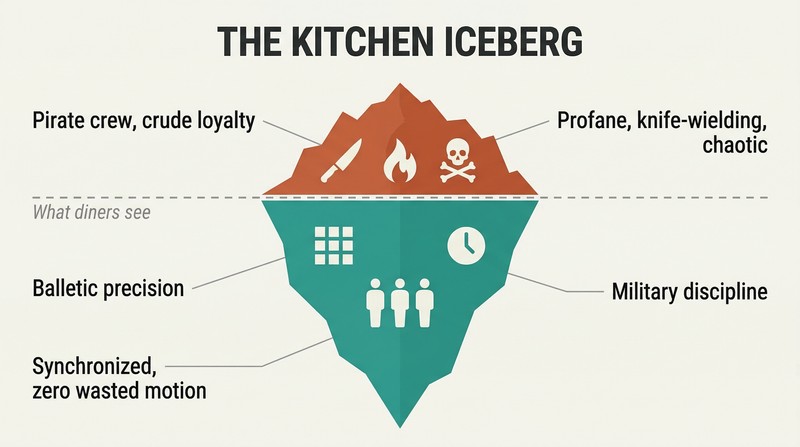
Kitchen as pirate ship. Anthony Bourdain spent over 25 years in New York restaurant kitchens — as dishwasher, fry cook, saucier, and chef. What he reveals is a subculture with a centuries-old militaristic hierarchy where cooks carry razor-sharp knives, communicate in profane multilingual slang, and form bonds tighter than family. His first kitchen — the Dreadnaught in Provincetown — featured cooks who dressed like pirates, drank everything in sight, and loaded stolen food into VW vans after hours.
Beneath the chaos is precision. A properly organized line cook moves with balletic grace. Stations must be set up identically every shift. Five cooks converge on a ten-top's order without a wasted movement. The chaos is the surface; underneath runs military discipline with a death's-head sense of humor.
Seek the first bite that scares you — it might redirect your life
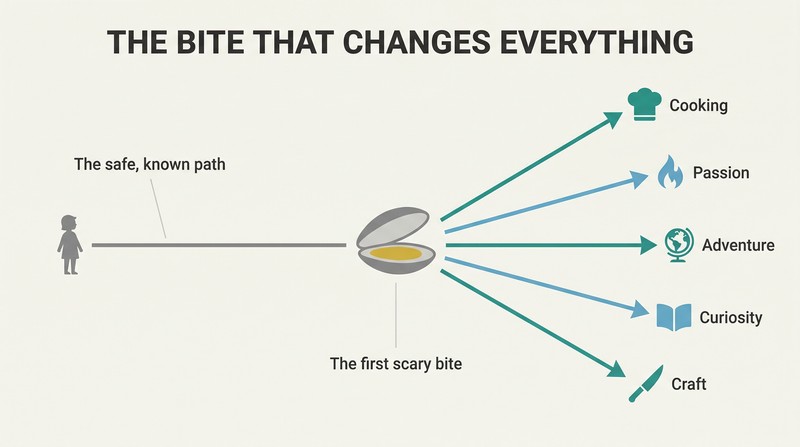
A cold soup changed everything. As a nine-year-old on vacation in France, Bourdain tasted his first vichyssoise on the Queen Mary — his first food he truly noticed and remembered. Later, his parents dined at La Pyramide, the legendary restaurant of Ferdinand Point, leaving young Bourdain and his brother in the car for three hours. The exclusion made him furious — and fiercely curious.
Spite became adventure. He resolved to outdo his foodie parents, eating brains, horsemeat, and stinky cheeses to shock his little brother. Then came his first raw oyster, plucked from the water by a French fisherman on a small boat. That raw, slimy, vaguely sexual-looking object was the gateway. Every subsequent chase — drugs, sex, cooking — stemmed from that single transformative bite off the coast of Bordeaux.
Hire the person who shows up every day, not the one with the best resume
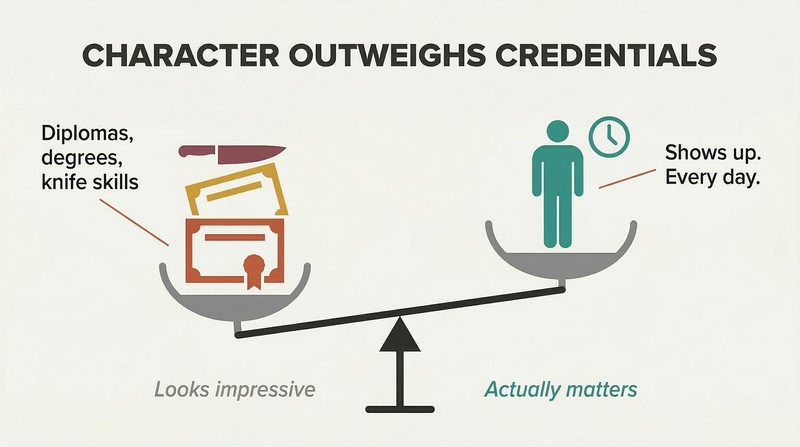
Bigfoot's creed. Bourdain's most important mentor was a legendary West Village restaurateur he calls "Bigfoot" — a micro-managing genius who ran his operations with near-supernatural control. Bigfoot hired ex-junkies from the gutter and turned them into trusted managers. His test was simple: does this person do what they say they're going to do? Two minutes late? Sent home. He didn't care about your culinary degree or your knife collection.
Reliability is the rarest skill. Bourdain contrasts CIA-educated American cooks — "a lazy, undisciplined and, worst of all, high-maintenance lot" — with the Ecuadorian and Mexican cooks who worked their way up from dishwasher. The immigrant who remembers scraping plates at four A.M. and never calls in sick is worth ten school-trained complainers with opinions about lemon grass.
Never order fish on Monday — insiders know when food rests
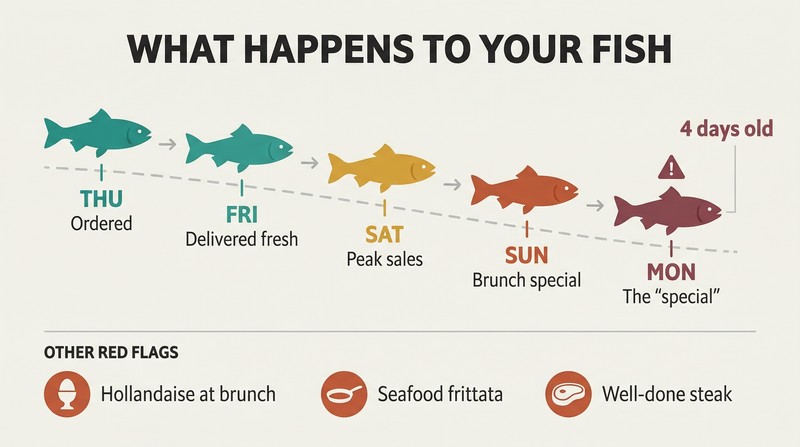
The Monday fish scam. Chefs order seafood Thursday for Friday delivery. The bulk sells Friday and Saturday. What's left Sunday becomes brunch special. By Monday, that tuna has been sitting in reach-ins for four days, commingling with chicken and lamb as line cooks plunge their fists in blindly. The Monday "special" is merchandising, not inspiration.
Other insider red flags:
1. Hollandaise at brunch — a bacterial playground held at lukewarm temperatures for hours
2. Seafood frittata — the classic dumping ground for weekend leftovers
3. Mussels at unknown restaurants — usually wallowing in their own liquid in the reach-in
4. Well-done steaks — chefs reserve their worst, skankiest cuts for customers who won't taste the difference
Protect your mise-en-place like your nervous system depends on it
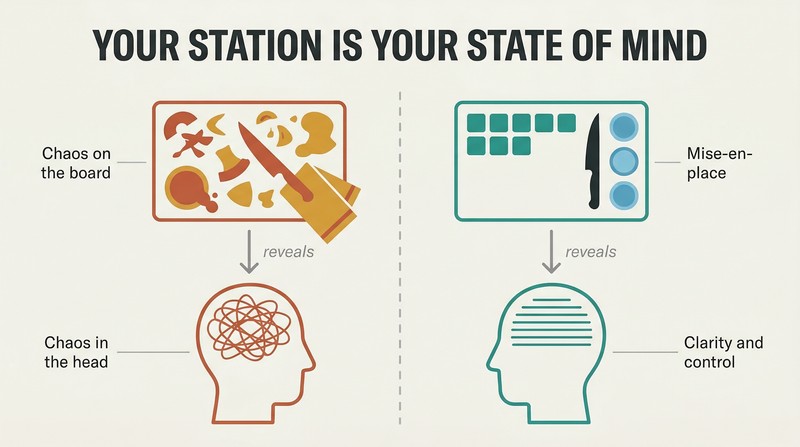
Mise-en-place defined. In professional kitchens, mise-en-place — literally "everything in its place" — is the cook's complete station setup: salt, crushed pepper, oils, wines, sauces, garnishes, back-ups, favorite pans, and portioned proteins, all arranged for blind-reach access during frantic service. Disturb a cook's meez and you'll trigger genuine rage. It's an extension of the cook's nervous system, and its condition reveals everything about the cook's mental state.
Clean station, clear head. One chef Bourdain worked with would press his palm onto a messy cutting board and hold it up: "That's what the inside of your head looks like now." Good cooks hoard clean, dry side-towels like gold, stashing them above ceiling tiles. Running low on towels mid-service is like running out of ammunition.
Prefer reliable craftsmen over brilliant, unreliable artists
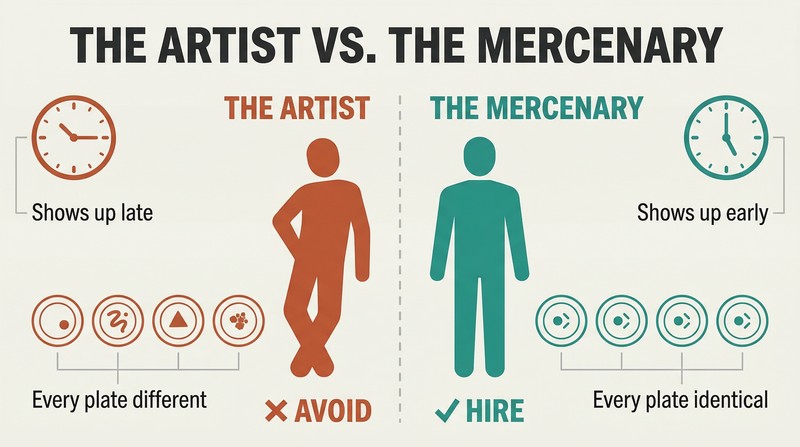
Three types of line cooks. Bourdain categorizes kitchen workers into Artists (high-maintenance specialists with delusions of grandeur), Exiles (those who can't survive a nine-to-five), and Mercenaries (professionals who do it well for cash). He'll take a standup mercenary over an artist any day. The artist shows up late because genius keeps its own hours. The mercenary shows up early because that's what professionals do.
Consistency beats creativity. Professional line cooking is not about innovative presentations — that was all decided before service. It's about mindless, unvarying repetition: the same dish executed identically the 200th time as the first. The great cathedrals of Europe were built by craftsmen, not designed by them. That distinction matters in every kitchen.
Three perfect ingredients beat twenty mediocre ones
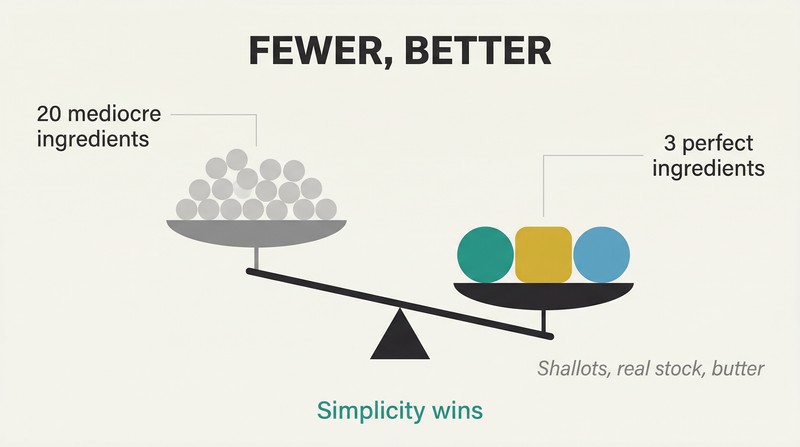
The Tuscan revelation. When Bourdain worked for Pino Luongo at Le Madri, he discovered that Italian cooks used almost no pre-made sauces. Walk-ins were nearly empty each morning — everything was made fresh from peeled, seeded tomatoes. A simple pasta pomodoro became "a thing of real beauty." The transformation was understanding that you taste the pasta, not just the sauce. Homey peasant dishes — white bean salad, grilled calamari, sautéed calves' liver — became inspiring through the sheer integrity of their few ingredients.
The restaurant's real secret weapon. At home, you probably don't use shallots (restaurants burn through 20 pounds a day), real stock from roasted bones, or nearly enough butter. Butter is almost always the first and last thing in a professional pan — the main reason restaurant food tastes different from yours.
Four out of five restaurants fail — most from ego, not bad cooking
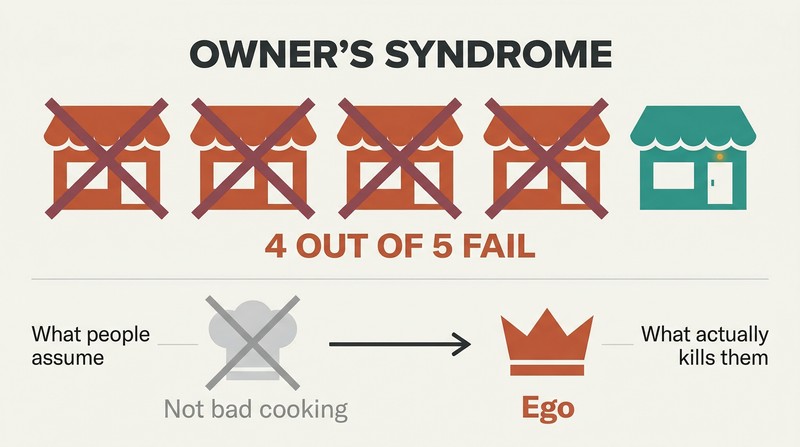
The retired dentist trap. Bourdain describes Owner's Syndrome — the destructive urge that causes otherwise sensible people to open restaurants. The classic victim is the retired professional whose friends said he throws great parties. He wants to swan about the dining room like Bogart in Casablanca. Those same friends drink for free until the place starts failing, then vanish. The chances of seeing a return on investment are roughly one in five.
Overreach kills winners too. Even successful operators succumb. A guy making money with two frat-bar saloons suddenly opens a jazz-club theme restaurant in Times Square. Bourdain watched the Silver Shadow — a once-brilliant restaurateur — expand into a multi-restaurant empire that eventually bankrupted even his original family provisions business and landed him in federal prison.
The backbone of American restaurants is immigrants who outwork culinary grads
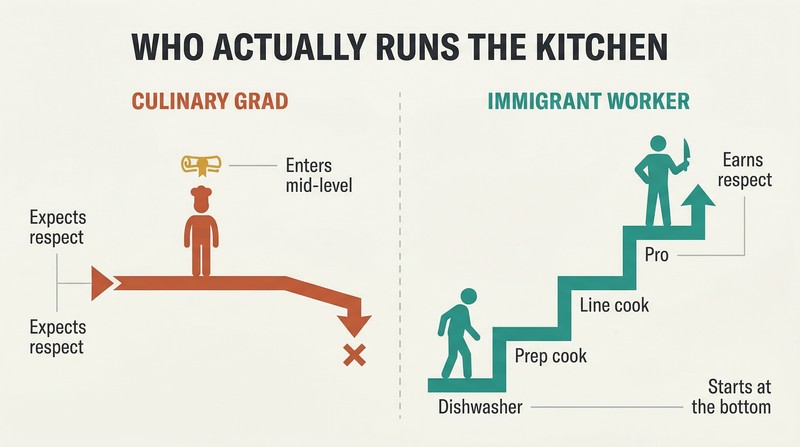
The invisible workforce. At Bourdain's restaurants, the line cooks, prep cooks, and dishwashers were overwhelmingly Mexican, Ecuadorian, Dominican, and Salvadorian. Many worked their way up from the bottom — scraping plates, hauling garbage at four A.M. — and became highly sought-after professionals. A cook who remembers emptying grease traps is more valuable and long-term than a culinary school graduate who thinks the world owes him a living.
Respect the backbone. Bourdain's blunt advice for aspiring chefs: learn Spanish. Know the distinct cultures of Mexico, El Salvador, Ecuador, and the Dominican Republic. A cook from Puebla is different from one from Mexico City. Someone who fled the Mano Blanco in El Salvador won't get along with the right-wing Cuban next to him. These are the people you'll count on — show them respect by knowing them.
Chase mastery over money — or spend your career fixing others' failures
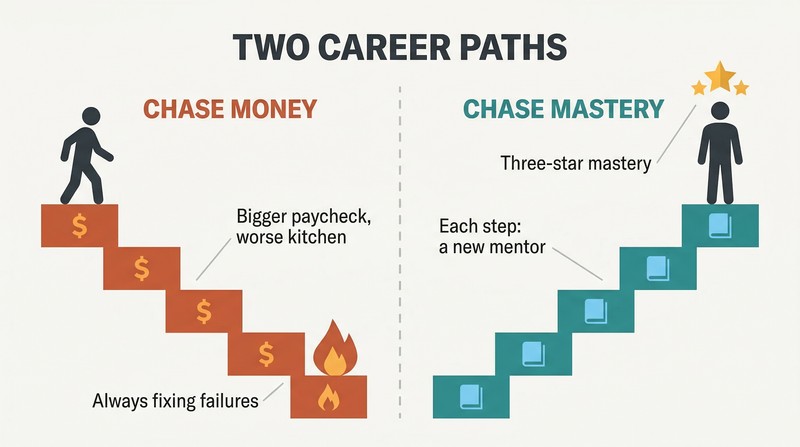
Scott Bryan chose differently. While Bourdain grabbed every chef's job that offered decent pay, Scott Bryan — the three-star chef at Veritas whom Bourdain considers the ideal cook — built his career through deliberate apprenticeships: Brendan Walsh at Arizona 206, Alfred Portale at Gotham, David Bouley, Eric Ripert at Le Bernardin, Grey Kunz at Lespinasse. He even crossed from savory to pastry under Richard Leach to round out his skills.
Bourdain's biggest regret. Instead of taking a pay cut to stage at great kitchens, Bourdain chased chef-sized paychecks at doomed operations — places usually hemorrhaging money when he arrived. He spent years as a hired gun cleaning up messes, hooked on salary and heroin in equal measure. The lesson he learned too late: invest in your education, not your lifestyle.
Eat without fear — your body is an amusement park, not a temple
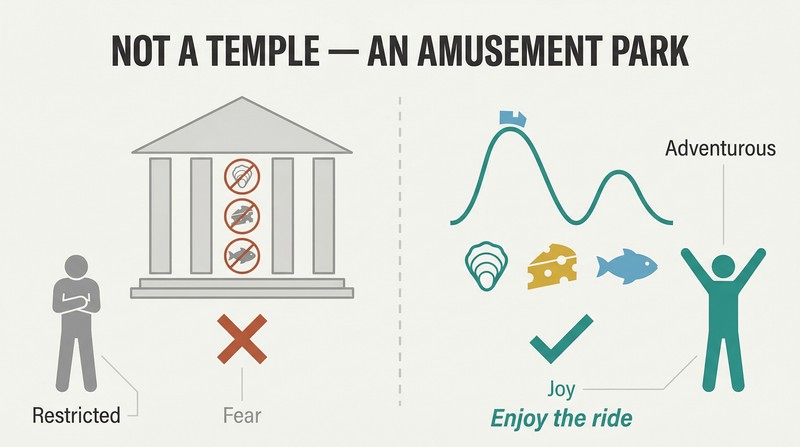
Risk is the point. Every once in a while, an oyster will make you sick. That doesn't mean you stop eating oysters. Bourdain ate at open-air Caribbean shacks with dubious refrigeration, trusted tamale stand owners he'd never met, and went for blowfish gizzard in strange Far Eastern cities the night before his plane left. The first people to eat foie gras, raw fish, or unpasteurized Stilton were daredevils — and we owe them everything.
The anti-germaphobe manifesto. Do you really want to travel in hermetically sealed popemobiles, eating only at Hard Rock Cafes and McDonald's? Bourdain argues that a world filled with bacteria is meant to be tasted, not feared. Eat the bread even if it's been recycled. Try the mystery meat. You only go around once.
Analysis
Kitchen Confidential, published in 2000, didn't just reveal restaurant secrets — it detonated the sanitized public image of professional cooking and birthed an entirely new genre: the chef memoir as gonzo journalism. Before Bourdain, America's relationship with chefs was filtered through Julia Child's warmth and the Food Network's safe demonstrations. Bourdain replaced that image with something closer to a war correspondent's dispatch: visceral, darkly comic, and deeply humane.
The book operates on multiple registers simultaneously. On the surface, it's a tell-all — don't order fish on Monday, your brunch hollandaise is a biohazard. Beneath that is a labor document of startling honesty. Bourdain's insistence that undocumented Ecuadorian line cooks outperform CIA graduates inverts the American meritocratic myth with the authority of someone who's worked both sides. His reverence for the unnamed prep cook who shows up every day at six A.M. anticipated, by two decades, the broader cultural reckoning with 'essential workers.'
The narrative arc is a classic addiction memoir disguised as a food book. Bourdain charts a trajectory from privileged New Jersey childhood through heroin addiction and career free-fall to eventual redemption through discipline — specifically, the discipline imposed by Bigfoot's unforgiving management system. The turning point isn't sobriety; it's accountability. Bigfoot didn't care whether you'd smoked crack the night before, as long as you showed up on time and did the work.
Perhaps most enduringly, the book articulates a philosophy of pleasure that is neither hedonistic nor puritanical. Bourdain argues for risk — culinary, professional, existential — as the organizing principle of a life worth living. The amusement-park metaphor is not nihilism; it's an ethical stance. In a world of infinite precautions, Bourdain insists that the willingness to eat the strange fish, to trust the stranger behind the counter, is itself a form of courage and generosity toward the world as it actually is.
Review Summary
Kitchen Confidential received mostly positive reviews for its raw, honest portrayal of restaurant kitchens. Readers appreciated Bourdain's witty, sarcastic writing style and vivid storytelling. Many found the behind-the-scenes look at the culinary world eye-opening and entertaining. Some criticized the book's structure and repetitiveness. Bourdain's brash personality and explicit content were polarizing, with some finding him arrogant while others admired his candidness. The book offers valuable insights into the restaurant industry and Bourdain's journey as a chef, leaving a lasting impact on readers.
People Also Read








Glossary
Mise-en-place
Cook's complete station setupThe organized arrangement of all ingredients, tools, sauces, garnishes, and back-up supplies a line cook needs for service, positioned for blind-reach access. Pronounced 'meez-on-ploss' and abbreviated by cooks as 'meez.' Bourdain calls it 'the religion of all good line cooks' — a cook's readiness made physical, reflecting their mental state.
86
Item gone or person removedIndustry-wide shorthand meaning a menu item is no longer available ('The halibut is 86'd'). Also used to describe firing an employee or banning a customer from a bar. One of the most universally recognized pieces of restaurant jargon, used as both verb and adjective across kitchens worldwide.
In the weeds
Overwhelmed and falling behindThe state of being hopelessly behind during service — too many orders, too little time, station in disarray. Also expressed as 'buried,' 'slammed,' or the French 'dans la merde.' The opposite of being set up and in control. Every cook's worst nightmare during a rush, and the condition that separates professionals from amateurs.
Mal carne
Incompetent or 'bad meat' cookItalian kitchen slang literally meaning 'bad meat,' used to label a cook who has been exposed as a pretender — someone whose skills don't match their bravado. Bourdain was tagged 'Mel' (short for mal carne) after being humiliated on the broiler station at Mario's restaurant in Provincetown. Also used for culinary school externs — abbreviated as 'Mel' or 'FNG' (Fucking New Guy).
Owner's Syndrome
Ego-driven compulsion to open restaurantsBourdain's term for the irrational desire of otherwise sensible people — typically successful in other fields — to open restaurants despite overwhelming odds of failure. Classic symptoms include the belief that hosting good dinner parties qualifies one for the restaurant business, mid-life crisis motivation, and the fatal assumption that celebrity friends will become paying regulars.
The Bigfoot System
Rigorous restaurant management frameworkThe operational philosophy Bourdain learned from his mentor 'Bigfoot,' a legendary West Village restaurateur. Key elements include: inventory sheets arranged in clockwise geographical order matching walk-in layout, strict 15-minutes-early arrival policy, independent intelligence networks for monitoring staff and competitors, freshly squeezed juices, standardized phone greetings, and the conviction that character matters more than culinary credentials.
Saving for well-done
Reserving worst cuts for well-doneThe time-honored kitchen practice of setting aside the toughest, oldest, or most damaged pieces of meat and fish for customers who order well-done, since heavy cooking destroys flavor distinctions anyway. A piece of sirloin that would otherwise be a total financial loss becomes revenue when served to someone who won't notice the difference through the char.
Monter au beurre
Finishing a sauce with butterThe French technique of swirling cold whole butter into a sauce just before serving to add richness, body, and a glossy sheen. Bourdain identifies this as one of the primary reasons restaurant sauces taste richer and creamier than home cooking — there is a 'big crock of softened butter on almost every cook's station' getting constant use.
FAQ
What's "Kitchen Confidential" about?
- Behind-the-scenes look: "Kitchen Confidential" by Anthony Bourdain offers a candid and often gritty look into the world of professional kitchens, revealing the chaotic and intense environment of restaurant life.
- Chef's journey: The book chronicles Bourdain's journey from a dishwasher to a renowned chef, sharing his experiences, challenges, and triumphs along the way.
- Subculture exploration: Bourdain delves into the unique subculture of chefs and cooks, highlighting the camaraderie and diverse personalities that define the culinary world.
Why should I read "Kitchen Confidential"?
- Authentic insider perspective: Anthony Bourdain provides an unfiltered and honest view of the restaurant industry, making it a must-read for food enthusiasts and those interested in hospitality.
- Engaging storytelling: Bourdain's humorous and candid storytelling offers a unique glimpse into a world usually hidden from the public eye, making the book both entertaining and informative.
- Cultural insights: The book explores the multicultural environment of restaurant kitchens, highlighting the contributions of immigrant workers and the rich tapestry of modern cuisine.
What are the key takeaways of "Kitchen Confidential"?
- Reality of restaurant life: Bourdain reveals the harsh realities of working in a professional kitchen, emphasizing the importance of discipline, endurance, and teamwork.
- Importance of experience: He stresses that real culinary skills are developed through hands-on experience rather than formal education alone.
- Passion for food: Despite the challenges, Bourdain's passion for food and cooking shines through, encouraging readers to embrace culinary adventures and savor good food.
What are the best quotes from "Kitchen Confidential" and what do they mean?
- "Your body is not a temple, it's an amusement park. Enjoy the ride." This quote encapsulates Bourdain's philosophy of living life to the fullest and embracing culinary experiences without fear.
- "Good food and good eating are about risk." Bourdain highlights the adventurous nature of culinary exploration, suggesting that trying new foods involves taking risks.
- "An ounce of sauce covers a multitude of sins." This humorously acknowledges the power of a well-made sauce to enhance or disguise a dish, underscoring the importance of skillful cooking techniques.
How does Anthony Bourdain describe the restaurant industry in "Kitchen Confidential"?
- Chaotic and intense: Bourdain describes the restaurant industry as a high-pressure environment where chaos and order coexist, requiring chefs to work quickly and efficiently.
- Subculture of chefs: The book explores the unique subculture of chefs, characterized by camaraderie, dark humor, and a shared passion for food.
- Unseen challenges: Bourdain sheds light on the challenges faced by restaurant workers, including long hours and physical demands, emphasizing the dedication required to succeed.
What advice does Anthony Bourdain give to aspiring chefs in "Kitchen Confidential"?
- Gain experience: Bourdain advises aspiring chefs to gain as much hands-on experience as possible, learning from seasoned professionals in various kitchens.
- Embrace discipline: He highlights the need for discipline and endurance, encouraging chefs to work hard and be prepared for the job's demands.
- Stay humble: Bourdain warns against arrogance, advising chefs to remain humble and open to learning, respecting the craft and its contributors.
How does "Kitchen Confidential" reflect Anthony Bourdain's personal journey and growth as a chef?
- From dishwasher to chef: The book chronicles Bourdain's journey from a dishwasher to a renowned chef, highlighting the challenges and triumphs he faced.
- Lessons learned: Bourdain shares the importance of discipline, experience, and passion for food, which contributed to his growth and success.
- Culinary passion: Despite hardships, Bourdain's love for food and cooking remains central, inspiring readers to appreciate the art of cooking.
How does Anthony Bourdain view the role of immigrants in the restaurant industry?
- Valuable contributors: Bourdain acknowledges the significant contributions of immigrant workers, praising their work ethic and dedication.
- Diverse backgrounds: He emphasizes the multicultural environment of kitchens, where diverse backgrounds create flavorful dishes.
- Respect and recognition: Bourdain advocates for recognizing and respecting the hard work of immigrant workers, valuing their loyalty and commitment.
What does Anthony Bourdain say about the importance of mise-en-place in "Kitchen Confidential"?
- Essential for success: Bourdain describes mise-en-place as crucial for maintaining order and efficiency in the kitchen.
- Extension of the cook: He views it as an extension of a cook's nervous system, where everything is precisely arranged for easy access.
- Work clean: Bourdain stresses the importance of working clean and keeping the station organized, as a messy station reflects a messy mind.
What is the significance of the "Mission to Tokyo" chapter in "Kitchen Confidential"?
- Cultural exploration: The chapter highlights Bourdain's cultural exploration and experiences in Japan, offering insights into different culinary traditions.
- Professional challenge: Bourdain's mission involves consulting a French chef in Japan, showcasing his adaptability and willingness to learn.
- Personal growth: It reflects Bourdain's personal growth and broadening culinary horizons, emphasizing the importance of embracing new experiences.
How does humor play a role in "Kitchen Confidential"?
- Engaging storytelling: Bourdain's use of humor makes the book engaging, drawing readers into his world with witty observations and anecdotes.
- Relatable experiences: Humor allows Bourdain to share relatable experiences, connecting with readers on a personal level.
- Coping mechanism: Humor serves as a coping mechanism for navigating the stresses of the culinary industry, reflecting the resilience of kitchen staff.
How does "Kitchen Confidential" reflect Anthony Bourdain's personality and philosophy?
- Candid and unfiltered: The book reflects Bourdain's straightforward and honest storytelling style, sharing experiences without embellishment.
- Passion for food: Bourdain's deep passion for food and cooking is evident, driving his career and adventures.
- Embrace of life: His philosophy of embracing life and new experiences encourages readers to live fully and fearlessly, showcasing his adventurous spirit.
Download PDF
Download EPUB
.epub digital book format is ideal for reading ebooks on phones, tablets, and e-readers.








































