

Key Takeaways
Treat life's red lights as delayed green lights in disguise
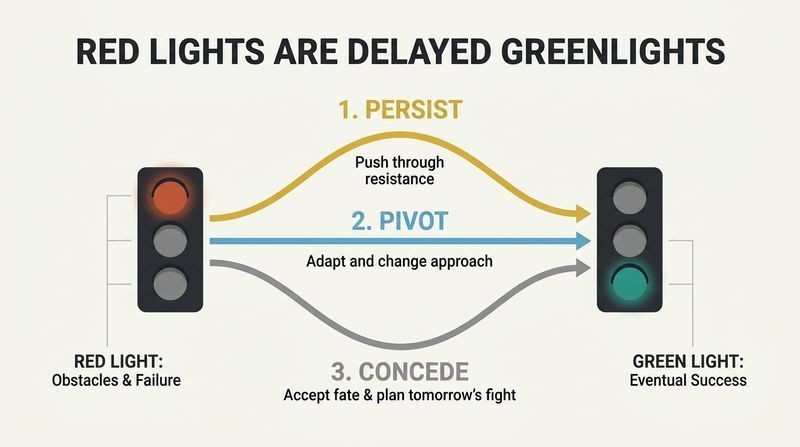
The book's central metaphor. McConaughey divides life into greenlights (approvals, success, joy, momentum) and red or yellow lights (failure, sickness, heartbreak, full stops). His thesis: the reds and yellows eventually turn green if you handle them well. Yesterday's disaster becomes tomorrow's blessing in the rearview mirror.
He frames this as getting relative with the inevitable. An outcome may be fixed, but how you respond is your choice. You have three moves when hitting resistance:
1. Persist (push on in your current pursuit)
2. Pivot (take a new approach to the same goal)
3. Concede (accept fate and live to fight another day)
The skill of a satisfying life, he argues, is knowing which of the three to choose, and when. Greenlights can be caught by luck, but also engineered through hard work and better choices.
What's striking is how this reframes Stoic philosophy for a mainstream audience. The dichotomy of control (some things are up to us, some are not) runs straight through Epictetus, and McConaughey's persist-pivot-concede trilemma echoes the Serenity Prayer's wisdom to change what you can and accept what you cannot. The risk in any "everything happens for a reason" framing is survivorship bias: it is easy to narrate hardship as fortune when you ended up an Oscar winner. Genuine tragedy sometimes stays tragic. Still, the practical value holds. Choosing your response deliberately, rather than reacting on autopilot, is the difference between being driven by events and steering through them.
Build fences before you climb them; discipline earns freedom
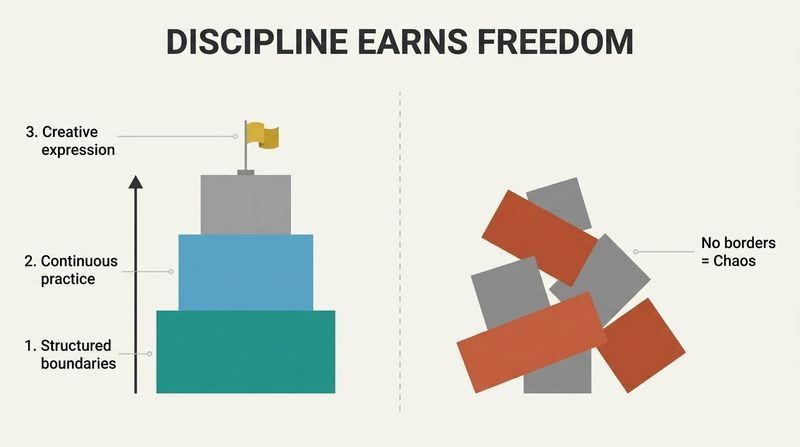
Creativity needs borders. McConaughey's father taught his sons the fundamentals before self-expression, block and tackle before playing wide receiver. The philosophy: structure creates responsibility, responsibility creates judgment, judgment creates choice, and freedom lives inside that choice.
His proof is a boyhood summer in Longview, Texas. At around ten, he snuck out nightly to steal lumber from a fenced yard, hauling 4x4s to a white pine, then spent two months building a thirteen-story tree house over a hundred feet tall. The discipline of the covert operation, the planning and repetition, produced his best summer. He argues we need guidelines, sacrifice, and observation early in any endeavor. Only once you truly know the space, the craft, and the plan should you let your freak flag fly. Without borders there is no form, no art, only chaos.
This contradicts the romantic myth of the untrained genius and aligns with serious creativity research. Studies of jazz improvisers show their spontaneity rests on years of drilled scales and memorized standards; the freedom is purchased with structure. Psychologist Anders Ericsson's work on deliberate practice makes the same point: mastery precedes meaningful innovation. Igor Stravinsky put it bluntly, saying the more constraints one imposes, the more one frees oneself. The tree house anecdote is charming but ethically slippery (it was theft), which McConaughey knows and folds into his family's outlaw logic. The deeper lesson stands: constraint is not the enemy of expression, it is the scaffold.
Find who you are by eliminating who you're not
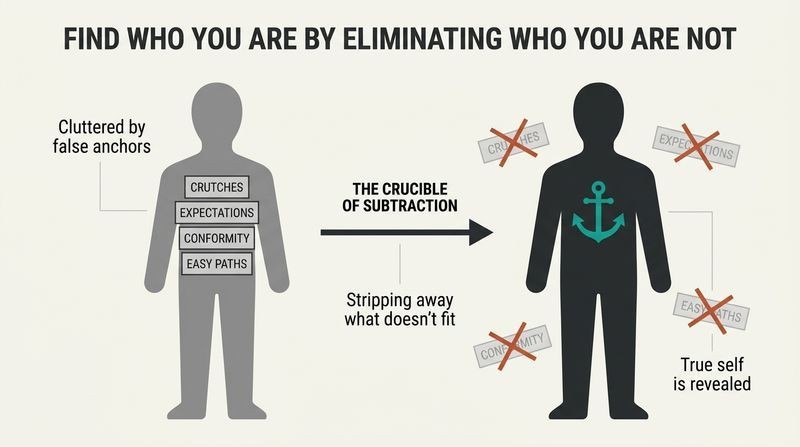
Identity through subtraction. McConaughey argues the first step toward knowing yourself is rarely "I know who I am" but "I know who I'm not." Too many options make tyrants of us; cutting the excess that doesn't feed you accidentally reveals more of what does.
His crucible was a year as an exchange student in rural Warnervale, Australia, at eighteen. His host family, the Dooleys, were bizarre: they forbade him from voicing opinions, demanded he call them "Mum and Pop," and made his life a slow psychological hell. Stripped of his crutches (no truck, no girlfriends, no straight A's, no curfew), he was forced inward for the first time. He drew a hard line at "Mum and Pop," and that single non-negotiable refusal gave him an anchor. The suffering, he realized, was one of the most important sacrifices of his life.
The via negativa (defining things by what they are not) has deep roots, from apophatic theology to Nassim Taleb's argument that removing harms often beats adding benefits. Psychologically, this maps onto identity formation research: adolescents consolidate a self partly by rejecting roles that feel false. There is also a counterpoint worth naming. Endless elimination can become its own trap, a fear of commitment dressed as discernment. McConaughey's insight works because he pairs subtraction with a hard boundary: the moment he refused to rename his living parents, he discovered a positive value, not just an absence. Knowing what you will not tolerate often clarifies what you stand for.
Kill the neediness; the town smells desperation before you speak
Want it, don't need it. When McConaughey arrived in Hollywood broke and eager, his mentor Don Phillips exploded at his request for an agent meeting, telling him the town smells needy and he'd be finished before he started. Don sent him to Europe instead, ordering him not to come back until he no longer needed it.
McConaughey rode motorcycles across the Alps for a month, forgot about auditions entirely, and returned relaxed. Within a week of finally meeting agents (acting like he wanted them, not needed them), he signed and booked a $48,500 role, then a $150,000 lead. The principle: desperation repels opportunity, while calm confidence attracts it. He connects this to his broader idea that the arrow doesn't seek the target, the target draws the arrow. Sometimes you stop chasing and let your magnetism do the work.
This tracks with what psychologists call the paradox of pursuit. Anxious attachment, whether in dating or job-hunting, signals low value and triggers avoidance in others. Behavioral economists note that scarcity mindset narrows cognition and worsens decisions, which fits McConaughey's claim that neediness sabotages performance. Yet the advice has a class dimension he glosses over: he could afford a month in Europe and had a well-connected mentor's couch. "Don't be needy" is easier when a safety net exists. The transferable core is real, though. Detaching from a specific outcome frees you to perform the underlying activity well, which is precisely what makes the outcome more likely.
Get less impressed and more involved with your own life
A rite of passage carved into a tree. When his father died suddenly during the filming of Dazed and Confused, McConaughey lost his safety net and coined a personal motto: less impressed, more involved. The idea is that the sooner you stop standing in awe of your accomplishments, relationships, and prospects, and instead roll up your sleeves and engage with them, the better you get at them.
He illustrates the danger of the opposite with his high school red sports car. As the popular guy with a truck, he had hustle, mudding trips, and a megaphone. He traded the truck for a candy-red 300ZX, then spent his time leaning against it, admiring his own reflection. The girls lost interest. He'd become impressed with the car and stopped being involved with the fun. He traded it back and instantly got his mojo back.
This is a sharp piece of folk psychology that anticipates the "flow" research of Mihaly Csikszentmihalyi. Flow arrives only when attention is fully absorbed in the activity itself, not in monitoring how you look doing it. Self-consciousness, watching yourself on an imaginary Jumbotron, is exactly what breaks performance, a phenomenon athletes call choking. McConaughey's later riff on the Houston Oilers blowing a 35-3 lead makes the same case: they put a ceiling on themselves and started spectating their own game. The reframe from awe to engagement is a practical antidote to the modern disease of performing life for an audience rather than living it.
Put yourself in places where truth can find you
Chase your dreams, literally. Twice, McConaughey had the identical vivid dream of floating down the Amazon surrounded by African tribesmen. Rather than dismiss it, he followed it: first a solo trek to the actual Amazon in Peru, later a journey up the Niger River to wrestle a champion in a Malian village. In Peru, after a night of stripping off every badge of identity and vomiting out his guilt, he woke transformed and stumbled onto a jungle floor carpeted with thousands of butterflies. A voice told him all he wanted was what he could see in front of him.
His takeaway: truth is always around us, but we can't access it unless we position ourselves to receive it. That requires deliberately entering low-noise environments (prayer, meditation, a walkabout, solitude) so the background signals of the psyche become audible.
The neuroscience of insight backs this up. The brain's default mode network, active during rest, wandering, and solitude, is where unexpected connections and self-reflection consolidate. Cultures worldwide institutionalize this through vision quests, pilgrimages, and monastic retreat, suggesting it answers a durable human need. McConaughey's noise-to-signal framing prefigures contemporary anxiety about digital overstimulation crowding out interiority. A skeptic would note confirmation bias: chase a dream to Mali and you will manufacture meaning from whatever you find. But the mechanism may not require the dream to be prophetic. The act of removing yourself from routine and lowering the input volume is itself what generates clarity, regardless of the mystical framing.
Sacrifice today's guaranteed money to earn tomorrow's meaningful work
Buying straw hats in winter. At the peak of his rom-com fame, McConaughey felt he'd become an entertainer, not an actor. So he stopped saying yes. For twenty months he turned down every romantic comedy offer, including one that climbed from $5 million to $14.5 million. He noted wryly that at $14.5 million the same script suddenly read better, funnier, higher quality. He still declined.
The strategy was deliberate un-branding. By refusing to give the industry what it expected, he made himself scarce, then novel. Eventually the offers stopped entirely, and in that silence, casting him became a fresh idea. The dramatic roles he'd wanted (The Lincoln Lawyer, Mud, Dallas Buyers Club) finally came. His logic: he was remembered by being forgotten. The target drew the arrow. Saying no was how he eventually got to say yes.
This is a masterclass in what economists call costly signaling and what strategists call deliberate scarcity. By walking away from millions, McConaughey signaled a seriousness that words could not. There is a parallel in Cal Newport's argument that career capital, not passion, buys autonomy, and in the luxury-brand practice of limiting supply to raise perceived value. The critical caveat, which he acknowledges, is that his money manager confirmed he could afford the hiatus. This is a bet available mainly to those with runway. For most people the lesson must be scaled: strategic, affordable refusals that redirect a reputation, rather than a two-year income blackout requiring a Hollywood fortune to survive.
Do the preparation that lets you be free to improvise
Freedom requires homework. Early in his career McConaughey booked a role in Scorpion Spring and, wanting to recapture the pure instinct of his breakout as Wooderson, deliberately refused to read the script. His theory was that knowing his character was enough. Then, seconds before rolling, he glanced at his lines: four pages of monologue, in Spanish. He panicked, asked for twelve minutes, and improvised his way through a scene he's too embarrassed to ever watch.
The lesson landed hard: knowing your man doesn't mean you know Spanish. Preparation and freedom are not opposites; preparation is what buys freedom. You must do the work to then do the job. He contrasts this with his Wooderson origin, where he built the character from three things he loved (his car, getting high, rock and roll) plus the girl he was chasing, generating the improvised line "alright, alright, alright."
The apparent contradiction with his "go with instinct" ethos resolves neatly: improvisation is not the absence of preparation but its highest expression. Jazz musicians, improv comedians, and elite athletes all rehearse relentlessly precisely so that in the moment they can respond without deliberation. Psychologist Gary Klein's research on expert intuition shows that trustworthy gut instinct is compressed experience, thousands of hours pattern-matched into a feeling. McConaughey's Wooderson worked because he had internalized the character deeply; Scorpion Spring failed because he mistook laziness for spontaneity. The distinction matters for anyone who romanticizes winging it. Effortless performance is the visible tip of invisible groundwork.
Simplify to five priorities, then cut to make A's
Process of elimination, applied to a career. With a baby on the way and his life sprawling, McConaughey realized he had five things on his desk: family, foundation, acting, a production company, and a music label. He felt he was making B's in all five. So he shut down the production company and the record label, keeping three commitments with the goal of making A's in each.
His phrase: simplify, focus, conserve to liberate. This is the same subtractive logic he used to find his identity in Australia, now turned on his professional life. Doing fewer things well beats doing many things adequately. Camila reinforced the all-in ethos with her own condition when he chose dramatic roles: no half-assing it, commit fully or don't commit. The result was concentration of force, energy no longer diluted across too many fronts.
This is essentialism before Greg McKeown named it, and it echoes Warren Buffett's reported advice to circle your top priorities and actively avoid the rest, because the near-misses are what quietly steal your life. Organizational research on "attention residue" shows that juggling multiple domains degrades performance in each, since the mind never fully lands. McConaughey's B-to-A framing is intuitive but worth pressure-testing: sometimes a portfolio of B efforts hedges risk better than betting everything on three A's. For him, financial security made concentration safe. The universal principle is that saying yes to everything is a decision to be mediocre everywhere, made by default rather than choice.
Write your résumé now so your eulogy reads well later
Begin with the end in mind. McConaughey frames the whole book around a distinction: death is the inevitable noun (your eulogy, already written the moment you die), while life is the relative verb (your résumé, which you author daily through your choices). He calls this the Soul Objective.
The practical move is to ask repeatedly, "What is success to me?" He notes that in a New Orleans voodoo shop, the only sold-out potion was for money, a sign of how thoroughly culture has financialized worth. But success might be a healthy family, a happy marriage, spiritual soundness, or leaving the world better. His one rule: never choose anything that jeopardizes your soul, and don't spend time with what antagonizes your character. Confronting mortality (through a father's death, a family crisis, a newborn) sharpens the question and gives courage to live truer.
The résumé-versus-eulogy distinction was popularized by David Brooks, who separated career-success virtues from the deeper qualities praised at funerals. McConaughey's version adds urgency by insisting you write the eulogy-worthy life now, in real time. Terror management theory in psychology finds that mortality awareness, handled well, can shift people toward intrinsic values and away from status-chasing, which is exactly the pivot he describes. The framework's strength is that it forces a definition of success rather than inheriting the culture's default. Its limit is that clarity about values does not automatically supply the means to live them. Still, asking "what is my hill?" before charging is rarely bad advice.
You don't win by fighting hardship; you win by outgrowing it
Turn the page. McConaughey relays a story from University of Texas football coach Darrell Royal. A famous country musician, caught with cocaine powder on his nose at a party, came to Royal ashamed and asked what to do. Royal, a man of few words, said he'd never had trouble turning the page in the book of his life. The musician got sober that day and stayed sober for decades.
The principle: you are the author of your own book, and you can simply turn the page on a bad habit or a rut. Guilt and regret, McConaughey argues, kill many people before their time. The move is not to wage war against your worse self but to own the mistake, make amends, and move forward. Get off the ride. Don't renegotiate with the past.
There is real behavioral science here. Research on habit change and relapse shows that shame and rumination tend to entrench bad behavior, while self-compassion and a clean forward focus predict recovery. The "fresh start effect" documented by Katherine Milkman finds that people act on new resolutions more successfully when they feel a temporal boundary, a new page, separating old self from new. Royal's laconic wisdom compresses this into a metaphor anyone can act on. The honest caveat is that severe addiction rarely turns on a single page; it usually demands sustained support and often clinical help. As a mindset for ordinary ruts, though, refusing to relitigate yesterday is liberating.
Marriage isn't losing half yourself; it's tripling into three
From destination to expedition. McConaughey resisted marriage for years, afraid of losing himself. The fear cracked when his three-year-old son asked why his mother didn't share the family last name, and he had to answer honestly. His pastor reframed the sacrament: two whole people uniting don't each surrender a half; they become more of themselves. He described it as a mystical multiplication, one times one equals three (wife, husband, and God).
The pastor's challenge sealed it: which is the bigger risk, going on the adventure or staying on the one you're on? McConaughey stopped seeing marriage as a supposed-to and started seeing it as a needed-to. He proposed, and Camila, echoing his own mother's move on his father, handed him an invitation to his own wedding along with a third ultrasound. He committed to the commitment and, for the first time, felt he could stumble without falling.
The reframe from marriage as constraint to marriage as expansion inverts the modern anxiety that partnership shrinks the self. Relationship researcher Arthur Aron's "self-expansion model" gives it empirical teeth: close relationships literally broaden a person's resources, perspectives, and identity, and couples who keep expanding together report higher satisfaction. Camila's earlier demand for her own bedroom, bathroom, and key in Australia embodies the healthy paradox, autonomy within union, that predicts durable bonds. The pastor's "bigger risk" question is a clever cognitive reframe, exposing that inaction is also a choice with consequences. What makes the account persuasive is that McConaughey names the real fear (losing himself) rather than pretending commitment is costless.
Analysis
Greenlights resists its own genre. It is neither a celebrity tell-all nor a self-help manual, but what McConaughey calls an "approach book," assembled from thirty-five years of diaries. That origin explains both its charm and its difficulty to summarize: the wisdom arrives embedded in idiosyncratic, sometimes tall-tale stories (a father revived by mouth-to-mouth, a wrestling match in a Malian dirt pit, an Oscar preceded by weight loss to 135 pounds), and its "bumperstickers" and free verse resist paraphrase. The prose is deliberately unpolished, phonetic, Texan. Stripping the philosophy from the voice risks flattening it into the platitudes it works hard to transcend.
Structurally, the book is a chronological life arranged around a single organizing metaphor. That metaphor, the greenlight, is elastic enough to absorb almost anything, which is both its power and its vulnerability. A framework that reinterprets every red light as an eventual green risks unfalsifiability and survivorship bias: it is easy to narrate obstacles as blessings from the summit of success. A working-class kid who became a movie star can afford to call his hardships fortunate. Readers without his outcomes, or his safety net, should extract the mechanism (deliberate response, strategic subtraction, prepared spontaneity) rather than the mysticism.
What elevates the book above motivational cliché is its consistency. The same subtractive logic drives his identity crisis in Australia, his five-priority career purge, and his un-branding hiatus. The same detachment principle appears in "want it, don't need it" and "the arrow doesn't seek the target." This coherence suggests a genuinely worked-out life philosophy, part Stoic, part Texas outlaw, part improvisational-actor's faith in instinct earned through preparation. The through-line, getting relative with the inevitable, is a serviceable operating system: accept what is fixed, own your response, and write a résumé worthy of the eulogy you cannot avoid.
Review Summary
Greenlights received mixed reviews. Many praised McConaughey's storytelling and found the book entertaining, appreciating his unique perspective and life lessons. Readers enjoyed his narration in the audiobook version. However, some critics found the book self-centered, preachy, and lacking depth. Concerns were raised about his portrayal of domestic violence and questionable behavior. While some considered it a fun and insightful memoir, others felt it was disappointing and narcissistic. The book's structure and McConaughey's writing style divided opinions, with some finding it refreshing and others finding it annoying.
People Also Read


FAQ
What's Greenlights about?
- Life Reflections: Greenlights is a memoir by Matthew McConaughey that delves into his life experiences, successes, and failures over fifty years. It combines personal stories with philosophical insights to offer a guide for living a fulfilling life.
- Concept of Greenlights: The book introduces "greenlights" as symbols of opportunities and affirmations in life. McConaughey explains how recognizing and pursuing these greenlights can lead to personal growth and happiness.
- A Letter to Life: McConaughey describes the memoir as a "letter of love to life," filled with lessons from both joyful and painful moments, guiding readers on their own journeys.
Why should I read Greenlights?
- Inspiration and Motivation: Readers will find inspiration in McConaughey's candid storytelling and his ability to turn challenges into opportunities, encouraging them to embrace their own paths.
- Unique Perspective: The memoir offers a unique perspective from a well-known actor, blending Hollywood experiences with universal life lessons, making it relatable and engaging.
- Practical Life Lessons: Filled with practical advice on handling life's ups and downs, the book is a valuable resource for improving mindset and approach to challenges.
What are the key takeaways of Greenlights?
- Embrace Challenges: McConaughey emphasizes facing challenges head-on and learning from them, suggesting that setbacks can lead to greenlights with the right mindset.
- Self-Discovery: The memoir encourages self-reflection and discovering one's true self, sharing McConaughey's journey of understanding his identity and values.
- Create Opportunities: A central theme is creating one's own greenlights through hard work, resilience, and a positive attitude, illustrating how taking control can lead to success.
What are the best quotes from Greenlights and what do they mean?
- "Greenlights mean go.": This quote encapsulates the book's essence, suggesting that recognizing and seizing opportunities is crucial for progress in life.
- "The art of living is the art of getting comfortable with the uncomfortable.": McConaughey highlights embracing discomfort as part of growth, encouraging readers to step outside their comfort zones.
- "I’m in the business of living.": Reflecting McConaughey's philosophy of prioritizing life experiences over material success, this quote emphasizes living fully and authentically.
What is the concept of "greenlights" in Greenlights?
- Definition of Greenlights: "Greenlights" symbolize moments of affirmation, success, and opportunities that propel individuals forward, representing positive signals in life.
- Recognizing Greenlights: McConaughey discusses identifying greenlights amidst challenges, encouraging readers to shift perspectives to see potential opportunities.
- Creating Greenlights: The memoir emphasizes creating greenlights through intention, hard work, and resilience, sharing strategies for turning challenges into success.
How does McConaughey describe his upbringing in Greenlights?
- Family Dynamics: McConaughey shares stories about his family, including the complexities of his parents' relationship and the lessons learned from them.
- Lessons from Childhood: He recounts childhood experiences that taught him resilience, humor, and the importance of love, providing insight into his personality.
- Cultural Influences: Growing up in Texas instilled a strong sense of identity and belonging, playing a significant role in his narrative.
How does McConaughey address failure in Greenlights?
- Learning from Failure: McConaughey emphasizes failure as an inevitable part of life and a valuable teacher, sharing personal stories of setbacks leading to growth.
- Resilience and Perseverance: The memoir encourages developing resilience in the face of failure, illustrating that a positive attitude can turn failures into greenlights.
- Redefining Success: He challenges traditional success notions, suggesting true success lies in the ability to rise after falling, encouraging readers to embrace their journeys.
How does McConaughey define success in Greenlights?
- Personal Fulfillment: McConaughey defines success as living authentically and pursuing passions rather than conforming to societal expectations.
- Impact on Others: He emphasizes positively influencing those around us, including being a good partner, parent, and friend.
- Continuous Growth: Success is seen as a continuous journey of growth and self-discovery, advocating for embracing change and new experiences.
How does McConaughey's career influence the themes in Greenlights?
- Hollywood Experiences: McConaughey shares insights from his Hollywood journey, including challenges and triumphs, informing his understanding of success and fulfillment.
- Navigating Fame: The memoir addresses fame's complexities and its impact on identity and relationships, reflecting on staying grounded amidst celebrity pressures.
- Artistic Integrity: He emphasizes artistic integrity and authenticity, underscoring themes of self-discovery and personal values through role choices.
What challenges did McConaughey face in his career as described in Greenlights?
- Typecasting in Hollywood: McConaughey discusses being pigeonholed into romantic comedy roles, feeling the need to explore more diverse characters.
- Personal Struggles: He shares battles with self-doubt and fame's pressure, emphasizing staying grounded and true to oneself.
- Navigating Relationships: The memoir touches on relationship complexities, particularly with family and romantic partners, influencing personal growth and career choices.
How does McConaughey describe his relationship with his mother in Greenlights?
- Complex Dynamics: McConaughey shares a tumultuous relationship with his mother, marked by love and conflict, sometimes clashing with his need for independence.
- Growth and Understanding: Over time, he learns to appreciate her influence and the lessons she imparted, acknowledging their evolving relationship.
- Emotional Connection: Despite challenges, McConaughey expresses a deep emotional bond with his mother, emphasizing family importance and love complexities.
What role does spirituality play in Greenlights?
- Personal Reflection: McConaughey discusses his spiritual journey and the importance of connecting with a higher power for guidance and clarity.
- Seeking Truth: He emphasizes seeking truth and understanding one's purpose, finding meaning in experiences and learning from them.
- Prayer and Intention: The memoir highlights prayer's role in his life, serving as a tool for reflection and intention-setting, leading to a more fulfilling life.
Download PDF
Download EPUB
.epub digital book format is ideal for reading ebooks on phones, tablets, and e-readers.








































