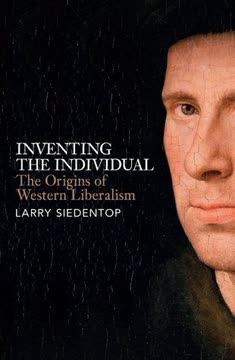
Key Takeaways
1. Ancient Society: A World Without Individuals
We must imagine ourselves into a world of humans or persons who were not ‘individuals’ as we would understand them now.
Family as foundation. Ancient Greek and Roman society was fundamentally structured around the family, not the individual. This was a world where ancestor worship and the paterfamilias, acting as both magistrate and high priest, created radically unequal social identities. The family hearth, with its sacred fire, was the center of a domestic religion, making the family the sole form of society and the primary unit of identity.
Corporate identity. The ancient city-state, or polis, emerged as a confederation of these family and tribal cults, not an association of individuals. Citizenship was a privilege tied to participation in these cults, excluding women, slaves, and foreigners. "Ancient liberty" meant having a share in public power, not individual rights or freedom of conscience, which were unintelligible concepts in a society where the city's demands were absolute.
Hierarchical reason. This social structure was mirrored in a teleological view of the cosmos, where "reason" was identified with social superiority and a natural hierarchy. Slaves were "living tools," and women were not fully rational agents. This worldview, where everything had a fixed place in a "great chain of being," left no room for the idea of inherent human equality or a universal moral agency.
2. Paul's Moral Revolution: The Birth of the Individual
There is neither Jew nor Greek, there is neither slave nor free, there is neither male nor female; for you are all one in Christ Jesus.
World turned upside down. The relentless spread of Roman power and the decline of local autonomy created a spiritual vacuum, making Jewish monotheism and its emphasis on God's will as command increasingly appealing. Saul of Tarsus, later St. Paul, seized this moment to articulate a revolutionary vision of Jesus as "the Christ," revealing God's love and presence in every believer.
Moral equality. Paul's core insight was the moral equality of all humans, a status shared equally by all as "children of God." This vision challenged the ancient assumption of natural inequality, positing a universal foundation for human action rooted in love and faith. It introduced the concept of conscience, creating a gap between individuals and their conventional social roles.
New creation. For Paul, faith in Christ enabled an "inner crucifixion" and the emergence of a transformed will, a "new creation" that transcended tribal or social identities. This "Christian liberty" was a universal freedom, utterly different from the privileged liberty of ancient citizens, and laid the groundwork for understanding human autonomy through submission to God's will.
3. Augustine and the Will: The Inner Self Emerges
My mind, questioning itself upon its own powers, feels that it cannot rightly trust its own report.
Reconstructing the self. St. Augustine, deeply influenced by Paul, systematically explored the human will and its complexities. His Confessions presented an unprecedented spiritual autobiography, portraying the will as the indispensable link between reason and appetite, and embedding it deeply within the conception of the self.
Humility and grace. Augustine rejected the Neoplatonic imagery of rational ascent and the pursuit of perfection through intellect alone. Instead, he emphasized humility and the necessity of divine grace to overcome the "weakness of the will" and the "shackles" of acquired habits. This perspective underscored the moral equality of all humans in their shared frailty and dependence on God.
Egalitarianism of the will. Augustine's insights into the will's complexity demolished ancient rationalism's aristocratic underpinnings. He argued that God's love is available to all, and that true freedom comes from aligning one's will with God's, a process requiring constant inner dialogue and self-examination. This egalitarian view of human agency became a cornerstone of Western theology for a millennium.
4. Monasticism: A New Model for Social Organization
Therefore brothers, let us be equal, from the least to the greatest, whether rich or poor, perfect in harmony and humility.
Withdrawal and redefinition. As Christianity gained official recognition, a protest movement emerged in the form of monasticism, with individuals withdrawing from urban life to seek salvation through asceticism. This movement, particularly in the West, became a new model for human association, founded on voluntary acts of will and individual conscience.
Dignity of labor. Monastic communities, governed by rules like St. Benedict's, emphasized celibacy, poverty, and self-denial, but also rehabilitated "work" as a dignified activity, separating it from the stigma of ancient slavery. This challenged the aristocratic contempt for labor and offered a vision of ordered life based on personal dignity and self-respect.
Egalitarian community. Monasticism presented an image of a society founded on equality, where authority was moral and consensual, rather than hereditary or coercive. The abbot's authority, for instance, was tempered by a "listening" culture, respecting the needs of individual monks. This model of self-regulation and shared values offered a glimpse of a new social order, distinct from the hierarchical structures of antiquity.
5. The Papal Revolution: Forging a Legal System for Individuals
That for him alone it is lawful to enact new laws according to the needs of the time.
Centralized authority. The fragmentation of the Carolingian empire and the disorder of feudalism created a vacuum that the Church, under the papacy, sought to fill. Inspired by monastic reforms, the papacy transformed itself into a centralized, self-governing corporation, asserting its legislative supremacy through papal decrees and a hierarchical court system.
Canon law's innovation. The development of canon law, drawing on and transforming Roman civil law, became the "first modern Western legal system." It provided coherence, predictability, and a universal framework for justice, attracting widespread litigation and reinforcing papal claims to plenitudo potestatis (plenitude of power) over individuals, rather than groups.
Sovereignty and equal subjection. Pope Gregory VII's Dictatus Papae boldly asserted papal sovereignty, merging the Roman concept of imperium with the Church's "care of souls." This made the individual the basic unit of legal subjection, establishing "equal subjection" to a sovereign authority. This revolutionary concept, rooted in Christian moral equality, laid the groundwork for the modern idea of the state.
6. Natural Rights: Anchoring Freedom in Individual Agency
Natural law [jus] is what is contained in the Law and the Gospel by which each is to do to another what he wants done to himself and forbidden to do to another what he does not want done to himself.
Golden Rule as foundation. Gratian's Decretum (c. 1140) fundamentally reshaped the ancient doctrine of natural law by identifying it with the biblical "golden rule," making equality and reciprocity the mainsprings of justice. This marked a departure from Roman law's hierarchical assumptions and stipulated that all "persons" should be considered "individuals" with an underlying equality of status.
Subjective rights. Twelfth-century canonists, building on Gratian, transformed natural law into a theory of natural rights—pre-social, moral rights inherent in the individual. They defined jus naturale as a "certain force instilled in every creature by nature to do good," implying an area of individual liberty and choice. This conversion of Christian "innerness" into legal language laid the foundation for modern liberalism.
Enforceable claims. While initially hesitant, later canonists developed legal procedures, such as "evangelical denunciation," to make these natural rights, particularly the right of self-preservation and the obligation to share with the poor, enforceable. This established a judicial sanction for the rights of the poor, demonstrating a new, more humane standard of justice.
7. The Democratizing of Reason: Challenging Ancient Hierarchy
Reason ceased to be something that used people, and became something people used.
Reason's new role. The papal revolution's emphasis on the individual as the basic social unit fostered a new, "democratized" understanding of reason. No longer solely the attribute of a superior class, reason became a faculty accessible to all, open to scrutiny, and grounded in shared faith. This shift challenged the ancient conflation of rationality with social hierarchy.
Generalization and abstraction. Canon law's systematic character and its concern for how rules affected "all souls equally" stimulated a new habit of generalization and abstraction. This led to philosophical debates, like that between "realists" and "nominalists," questioning whether general terms had an independent reality or were merely mental constructions, thereby undermining the corporate conception of society.
Analytical approach. The interaction between theological and legal arguments, particularly through the scholastic method in emerging universities, fostered a more precise yet tentative approach to reasoning. This involved analyzing logical inconsistencies, testing arguments, and generalizing results, ultimately leading to a clearer distinction between observable facts and moral prescriptions, and a more critical, less status-governed intelligence.
8. Urban Insurrections: Laying the Foundations of Secular Governance
It is to Jesus Christ that we owe the development of the laws and advantages of our city.
New urban identity. The revival of towns from the tenth century, fueled by refugees from serfdom and the rebirth of trade, created a new social class of artisans and merchants. These "burghers" formed self-governing associations, "swearing the commune" in the language of brotherhood, equality, and reciprocity, directly influenced by Christian moral intuitions.
Secular self-governance. Unlike ancient cities, medieval boroughs did not claim religious authority; they acknowledged the Church's monopoly on spiritual matters. This allowed them to develop as the "first secular governments" of Europe, free from quasi-religious ideas of lordship and paterfamilias, and founded on the formal equality and personal liberty of their inhabitants.
Constitutional seeds. Borough charters, acting as "peace treaties" and legal entities, defined immunities and citizens' rights, establishing a clear distinction between urban law, feudal law, and canon law. They enshrined principles of self-government, popular assemblies, and, eventually, a separation of powers, laying the groundwork for modern constitutionalism and the emergence of a "middle class" with a will to shape society.
9. Ockham's Nominalism: God's Freedom and Human Autonomy
No act is blameworthy unless it is in our power. For no one blames a man born blind, for he is blind by sense (caecus sensu). But if he is blind by his own act, then he is blameworthy.
God's radical freedom. William of Ockham, a leading Franciscan nominalist, asserted God's absolute freedom, arguing that the world and moral duties are results of divine choice, not constrained by eternal ideas or "rational necessity." This challenged Aquinas's Aristotelian synthesis, which Ockham saw as reintroducing pagan rationalism and compromising God's sovereignty.
Human freedom and rights. Ockham's emphasis on God's freedom reinforced human freedom as a birthright, a power to choose or not choose, underpinning moral responsibility. He distinguished between "right to rule" and "right to own" (dominium), arguing that rightful power must respect equality and reciprocity. This laid the conceptual groundwork for separating the state from civil society and defending individual natural rights, including the right to renounce property.
Reason's revised role. Ockham's nominalism refined reason's role, distinguishing deductive from inductive reasoning. He applied "Ockham's Razor" to eliminate unnecessary entities like Aristotle's "final causes," arguing that empirical knowledge is contingent and subject to observation, not a priori reasoning. This separation of "reasons" for human action from "causes" of external events prepared the way for modern experimental science and the "disenchantment" of the physical world.
10. Liberal Secularism: Christianity's Unintended Legacy
Secularism is Christianity’s gift to the world, ideas and practices which have often been turned against ‘excesses’ of the Christian church itself.
Moral roots of liberalism. Liberalism, though often seen as anti-religious, is deeply rooted in Christian moral intuitions. The conviction that freedom is a prerequisite for moral conduct and that uncoerced belief is the foundation of legitimate authority, developed within the Church from the 12th to 15th centuries, leading to the recasting of natural law as natural rights.
Secularism's true meaning. The separation of church and state, a core liberal objective, emerged from the Christian dualism of spiritual and temporal spheres. Properly understood, secularism is not non-belief or indifference, but a framework that identifies the conditions for authentic belief, distinguishing inner conviction from mere external conformity, and protecting a sphere of individual conscience and free action.
Europe's civil war. The historical narrative, particularly from the Enlightenment, has often minimized Christianity's role while maximizing the distance between modern Europe and the Middle Ages. This "civil war" between religious belief and "godless" secularism obscures their shared moral roots in Christian egalitarianism, which invented the individual and laid the foundation for "equal liberty" – Europe's noblest achievement and its unique contribution to world order.
People Also Read


 Immersive