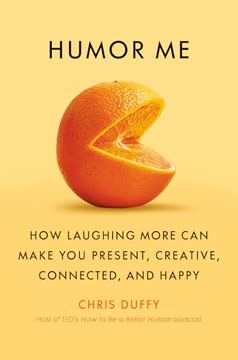
Key Takeaways
1. Cultivating Humor: A Skill for a Better, More Present Life
A life without humor, it seemed clear to me, wasn’t much of a life at all.
Humor is a portal. The author's personal epiphany, sparked by a hilarious student's cafeteria reviews, revealed that humor isn't just about telling jokes; it's a fundamental lens through which to view life. It offers joy, connection, and release, providing the energy and hope needed to navigate life's challenges. This perspective transforms shame into strength, fosters deeper connections, and builds confidence in social settings.
Humor is a practice. Unlike comedy, which is an art form, humor is a muscle that can be developed and strengthened. It's about building the capacity to see, notice, and celebrate the delightful weirdness of the world, and adopting a mindset receptive to laughter and joy. The misconception that a sense of humor is innate is false; anyone can cultivate it through simple, fun practices.
Beyond the punchline. A good sense of humor is inherently generous, prioritizing deep listening and a willingness to puncture tension with laughter. It signals vulnerability, honesty, and a desire to create warmth and joy, rather than constantly seeking to be the funniest person in the room. Ultimately, humor is about being fully present, as genuine laughter demands our complete attention, snapping us into the "cosmic giggle" of the moment.
2. Pillar 1: Embrace Absurdity by Noticing the World Around You
Noticing small moments and details brings more spontaneous laughter into your life and reveals the world around you to be a more magical, hilarious place.
Unblurring the background. The first step to laughing more is to notice more, actively pulling your mind out of "blur mode" to observe the absurdity and weirdness that permeates everyday life. Just as you notice every detail in a new home or someone else's bathroom, you can train your attention to see the familiar with fresh eyes, transforming mundane experiences into opportunities for humor.
Encryption theory. Cognitive psychologist Greg Bryant's "encryption theory" suggests that humor is a social test, a secret code that, when decrypted, signals shared understanding and belonging. This explains why explaining a joke kills it—the puzzle is solved. Being present allows you to both create these "riddles" and possess the "key" to unlock the humor sent your way, fostering connection.
Practices for presence:
- New-bathroom mindset: See the familiar as if for the first time.
- Different eyes: Imagine viewing your commute as a geologist, rat, or hawk.
- Seek weird facts: Explore obscure Wikipedia entries or bizarre histories.
- Don't dismiss the dull: Find joy in the mundane, like the Dull Men's Club celebrating vanilla or dictionaries.
- Celebrate the bad: Appreciate "art too bad to be ignored" at the Museum of Bad Art.
- Narrow your focus: Use a "finder" (like a camera's viewfinder) to spot details.
- Track your laughs: Keep a humor file of delightful observations.
3. Pillar 2: Master Self-Acceptance by Laughing at Yourself
When we’re able to laugh at ourselves and honestly name our imperfections and fallibilities, it takes away their power to shame us.
Defusing shame. Laughing at your own flaws, like the author's "pecked nose" zit, transforms embarrassment into glee. It's a powerful tool for self-acceptance, allowing you to own your ridiculousness and imperfections, which paradoxically makes you seem more confident, competent, and likable to others. Studies show that humorous self-disclosure can even make you appear more capable or sexually attractive.
Benign violation. Dr. Peter McGraw's "benign violation theory" explains that humor arises from situations that are both a "violation" (something off or unexpected) and "benign" (harmless). When laughing at yourself, the "violation" is your imperfection, and the "benign" aspect ensures it's gentle self-mockery, not self-bullying. Crossing the "benign" threshold turns humor into hurtful self-degradation, damaging self-esteem.
Techniques for self-humor:
- Observe others' reactions: Notice when people laugh at your self-statements (e.g., "I am a ruggedly masculine outdoorsman").
- Identify common phrases/quirks: What words or habits are "so you"? (e.g., texting "you rock!").
- Create a "starter pack": Envision the objects or clothes that define your archetype.
- Narrate your life as a documentary: Imagine David Attenborough describing your procrastination or fridge-gazing.
- Own your ignorance: Like the author admitting he knows nothing to Nobel laureates, or saying "I am a large baby with a beard" in Spanish.
4. Pillar 3: Build Connection by Taking Social Risks
Taking social risks, whether it’s running afoul of a business network’s terms of service or making a fool of yourself in public, is the third and final pillar.
Embrace rejection. Many people avoid social risks due to an exaggerated fear of rejection. Jia Jiang's "rejection therapy" (seeking 100 rejections) demonstrated that rejection is often less painful than imagined and can even be fun, leading to unexpected positive outcomes. Being willing to look foolish, like the author claiming to be "CEO of LinkedIn," can create memorable, humorous moments and open doors to connection.
Improvise your brain off. Taking social risks is easier when you're fully present and unselfconscious. Studies on jazz musicians and comedians show that improvisation "turns off" brain regions linked to self-censoring and inhibition, allowing self-expression to flow. This neurological shift helps quiet the anxious, self-critical voice, making it easier to trust instincts and engage authentically.
"Behave less" and connect:
- Talk to strangers: Initiate conversations on buses or in lines; a shared laugh can instantly bond.
- Share observations: Offer "conversational doorknobs" by sharing funny things you've noticed about the world or yourself.
- Subvert expectations: Like Nuar Alsadir's clown teacher, "behave less" by doing small, unexpected, playful actions (e.g., a little shimmy to music).
- Join the kids' table: Ask yourself, "What would a nine-year-old do?" to inspire unfiltered, unselfconscious playfulness.
5. The Math of Laughter: Understanding How Humor Works
Whether we’re in an improv scene or in real life, there’s something delightful about realizing that other people are experiencing the same things that we are.
Tension and release. Comedy, like horror, builds tension, but then releases it with laughter, offering catharsis. This shared experience, whether in an improv scene or real life, creates delight and connection, especially when acknowledging shared annoyances or absurdities. Understanding the mechanics of humor can help you both create and appreciate laughter more effectively.
Unwritten rules of comedy:
- Rule of Three: Introduce an idea, establish a pattern, then break it for a laugh (e.g., "Cup of coffee? Doughnut? Toupee?"). Three repetitions of a joke are maximally satisfying; more often leads to diminishing returns.
- Yes, And: In improv, affirm what your partner says ("yes") and then build on it ("and"). This collaborative spirit fosters trust and allows humor to grow (e.g., "We're in hell" or "wax figures").
- Take the Elevator, Not the Rocket Ship: Heighten stakes gradually for bigger laughs. Don't start with the wildest part; build up to it (e.g., the Celestial Seasonings Mint Room story).
- Start with the Second-Biggest Laugh: Set a humorous tone early to put people at ease and build momentum. Save your best for last to leave a strong impression.
- Pause for Laughter: The funniest part of a joke is usually at the end. A well-timed pause after the punchline allows the audience to react and savor the humor.
- Dark Rooms: Laughter is contagious and thrives in environments where people feel less self-conscious and more connected, like crowded, dimly lit comedy clubs.
- Pull the Thread, Don't Push It: Find unexpected connections between topics naturally, rather than forcing them. This creates satisfying, organic humor.
6. Humor as a Magnet: Forging Deeper Social Bonds
That level of connection, that rush of endorphins, makes us want more. We want to spend more time with the people who make us feel that way. They’re magnetic.
Shared lore and belonging. The deepest, most tear-inducing laughter often comes from "you had to be there" moments with friends or family, creating a shared lore that outsiders can't fully grasp. These inside jokes are a secret language, evidence of a unique group culture, strengthening relationships and reinforcing bonds. They make people feel special and included, like a "rewards card of a relationship."
Make others look good. Legendary improv duo TJ & Dave exemplify how generosity and deep attention to a partner, rather than self-promotion, lead to profound connection and humor. Their philosophy: "My use is to other people." By embracing "honest mistakes" and supporting others' quirks, you create a safe space where laughter flows from recognizing "the absurdity of just being us."
Conversational doorknobs. Psychologist Adam Mastroianni's research on conversations highlights the importance of "conversational doorknobs"—statements or questions that offer others an easy way to engage and build on the discussion. Instead of generic small talk, offer interesting information or bold claims that invite a "rejoinder," making interactions feel like "rock climbing" where you hoist each other skyward.
Becoming magnetic:
- Pay attention to doorknobs: Seize opportunities to deepen conversations or offer your own interesting "doorknobs."
- Make others look good: Smile, laugh, and embrace their mistakes to make them feel like a genius.
- Listen and callback: Remember details from earlier in the conversation to create satisfying, connecting callbacks.
- Be honest and vulnerable: Avoid using humor to deflect intimacy; allow genuine connection.
- Child's play: Engage with others, especially kids, by offering interesting information rather than asking boring questions, making them want to "run back to you."
7. Humor as Medicine: Healing, Resilience, and Coping with Grief
Humor takes you out of yourself and gives you a better, different perspective.
Laughter's therapeutic power. Research by Mimi Tse in Hong Kong showed that humor therapy significantly decreased pain and loneliness while increasing happiness and life satisfaction in elderly patients. Laughter, even forced, provides physical benefits like lower blood pressure and a rush of dopamine, acting as a powerful, side-effect-free adjunct to conventional medicine.
Grief and the "cosmic giggle." In the face of profound tragedy, humor is not a denial of suffering but a "necessary, triumphant act." Comedian Michael Cruz Kayne, after losing his infant son, found humor in the "ludicrousness of death," like a funeral home receipt saying "Thank you, come again." This unexpected laughter releases tension and helps navigate the "galaxy of emotions" that is grief, making the unspeakable speakable.
Resilience through shared absurdity:
- "Crack in everything": Leonard Cohen's lyric, "That's how the light gets in," suggests joy declares itself most intensely through heartbreak. Humor creates space for this light.
- "Fumbling through it": As Nora McInerny (Hot Young Widows Club) notes, humor makes discussing uncomfortable topics like grief more accessible, allowing people to connect over shared fumbling.
- Accepting mortality: Contemplating death, as psychologist Jordana Jacobs suggests, can deepen connection and joy in life, as petty resentments fade when we acknowledge life's transient nature.
- Oppressed groups' humor: Historically, groups facing suffering (e.g., Jewish, Black, North Koreans) develop humor as an "irrepressible opposing force" to maintain humanity, express frustration, and deflect prejudice.
8. Humor as Innovation: Laughing Towards Breakthroughs
Research that makes people LAUGH, then THINK.
The Ig Nobel approach. The Ig Nobel Prizes celebrate scientific discoveries that first make people laugh, then think. This highlights how humor can be a gateway to curiosity and intellectual openness. Many Ig Nobel winners go on to make significant discoveries, demonstrating that a willingness to explore the ridiculous can lead to groundbreaking insights.
Embrace "bad" ideas. Innovation often requires pursuing ideas that initially seem absurd or even terrible. Frans Johansson's "Medici Effect" argues that transformative change comes from interrupting default thought patterns and generating a high quantity of ideas, even if many are flops. Psychologist Dean Simonton found that an innovator's success is directly tied to their productivity—the more ideas, the higher the quality.
Strategies for playful innovation:
- Pursue failure: Deliberately aim for ambitious goals you're likely to "flop" at, as this encourages trying things outside your comfort zone.
- Assumption reversal: Generate new ideas by reversing baseline facts about a challenge (e.g., a restaurant with no menu or that charges for time, not food).
- Playful investigation: Like river otters experimenting with hoops, allow for experimentation and "honest mistakes" to weave aberrations into something new and delightful.
- Intellectual humility: Be willing to accept you might be wrong and open to changing your mind. This curiosity is key to learning and growth, and humor can make looking "stupid" less intimidating.
9. Punching Up: Humor as a Driver of Social Change
Joy is how we are able to engage and strengthen and support each other…. That’s why joy and happiness is infused into revolutionary work.
Truth-telling and narrative power. Humor can be an "eerily accurate" form of journalism, revealing societal fault lines and fundamental absurdities, as seen in Yugoslavian sketch comedy predicting war or Mike Judge's films satirizing corporate exploitation. It builds "narrative power" by shifting cultural feelings and beliefs, making serious issues accessible and engaging for a wider audience.
The jester's legacy. Historically, court jesters used humor to deliver "raw" facts and criticism to powerful rulers, often by agreeing wholeheartedly with a "harebrained scheme" to highlight its absurdity. This "punching up" allowed for truth-telling without direct confrontation, creating mental space for self-reflection and change.
Humor as a tool for change:
- Relieve tension: Humor combats cynicism and burnout in activism, making the long work of social change more bearable and even fun.
- "Vodka with a chaser": Amanda Nguyen used comedy with Funny or Die to "unlock stalled legislation" on sexual assault, showing humor can capture attention for serious causes.
- Punching up: Direct humor at those with more power or privilege. This is distinct from "punching down," which is bullying and perpetuates stereotypes.
- Acknowledge nuance: Recognize that "privilege is very volatile," as comedian Vir Das points out, and what constitutes "punching up" can be complex and context-dependent.
10. The Dark Side: Avoiding Bad Jokes and Bullying
Just because people are laughing, that doesn’t mean it’s a good thing.
Context is everything. The same joke can be loving or hurtful depending on who says it, to whom, and in what context. Humor is complex and nuanced; a laugh doesn't automatically validate a joke. Bullies often use humor as a weapon, getting laughs by targeting others, which can be misinterpreted as good humor but is ultimately destructive.
Affiliative vs. aggressive humor. Research shows that "affiliative humor" (spontaneous, witty, stress-reducing) leads to higher self-esteem and competence. In contrast, "aggressive humor" (hurting or alienating others) often correlates with lower self-esteem, as negative judgments directed outward can also be internalized.
Self-deprecating vs. self-insulting:
- Frequency matters: A one-off joke about being a "piece of garbage" might be fine, but constant self-deprecation can reinforce negative self-perception.
- Insecurity check: Jokes about genuine sources of pain or insecurity, even if they get laughs, can be damaging. As Joel Kim Booster learned, consistently joking about being "undesirable" can lead to internalizing that belief.
- Deflecting intimacy: Humor can be used as a shield to avoid vulnerability and genuine connection, keeping people at arm's length.
- Hogging the mic: Using humor to dominate conversations, even if entertaining, can prevent others from participating and building mutual connection.
Good for the world, good at making people laugh. A helpful framework is to assess if humor is both "good for the world" and "good at making people laugh." Laughter that masks hateful rhetoric or reinforces prejudice is dangerous. The best humor brings people in, welcomes them, and fosters connection, rather than pushing them away or creating deeper divides.
11. Living a Humorous Life: Lessons from a Centenarian
Humor takes you out of yourself and gives you a better, different perspective.
Mighty Mo's wisdom. The author's 103-year-old friend, Mighty Mo, a world champion swimmer, embodies a life filled with humor. Her quick wit, mischievous streak, and unique observations ("darker than the inside of a cow," "hair on his head got a deal on property in the chin") demonstrate a profound ability to find delight and perspective in everyday life.
Aging into humor. Many elderly individuals naturally improve at the three pillars of humor:
- Presence: Acknowledging mortality (e.g., "stopped buying green bananas") fosters living more presently.
- Laughing at self: Awareness of limitations comes with permission to laugh about physical changes, as there's no one left to impress.
- Social risks: Older folks often speak their minds without concern for others' opinions, embracing authenticity.
Embrace the "grown-up" paradox. While society often pressures us to "act like a grown-up" by being serious and flawless, both children and centenarians demonstrate the joy and freedom that come from letting go of ego and embracing humor. It's okay to laugh at "duties" or find tickle-worthy moments, even amidst responsibilities.
Author's personal shifts:
- Less phone time: Reduces technological bubbles, increasing presence and ability to notice details and connect.
- Track laughs: Keeping a humor file (videos, memes, overheard quotes) ensures a daily dose of levity and encourages active hunting for laughter.
- Say "yes" more: Embracing strange and unusual invitations (experimental harp bands, DIY film festivals) breaks routines and reveals a more magical, hilarious world.
- Appreciate inside jokes: Actively remembering and sharing obscure phrases strengthens existing friendships.
- Generate bad ideas: When seeking good ideas, intentionally producing many terrible ones can be fun and lead to unexpected breakthroughs.
- Humor in serious places: Incorporating silliness into volunteer work (e.g., food pantry) makes the work sustainable, prevents burnout, and fosters deeper connections among participants.
Review Summary
Humor Me receives generally positive reviews, averaging 3.76/5. Readers appreciate Duffy's warm, engaging voice and his framing of humor as a tool for connection, presence, and resilience rather than mere performance. Many found it funny, insightful, and well-researched. Common criticisms include it feeling surface-level at times, lacking actionable depth, and covering familiar ground for naturally humorous readers. The audiobook format was frequently praised. Overall, most readers found it a light, worthwhile read that encourages a more joyful, connected approach to daily life.
People Also Read






 Immersive








































