Key Takeaways
Appalachia's crisis runs deeper than lost jobs — it's family collapse
“It's about a culture that increasingly encourages social decay instead of counteracting it.”
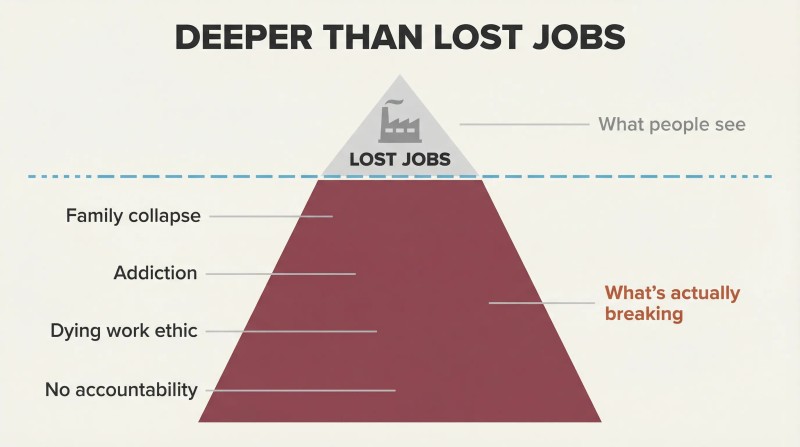
J.D. Vance grew up poor in Middletown, Ohio — a Rust Belt town built on Armco Steel, where millions of Appalachian migrants traveled the "hillbilly highway" for factory work. When those factories declined, communities disintegrated. But Vance argues the decay was never purely economic.
At a tile warehouse where Vance worked before Yale, a 19-year-old named Bob had a pregnant girlfriend, good pay, and health insurance — and still missed work weekly and took hour-long bathroom breaks. When fired, he asked, "How could you do this to me?" Vance identifies this as cultural, not structural: rising divorce, drug addiction, collapsing work ethic, and a refusal to take responsibility. Working-class whites are now the most pessimistic group in America — more so than groups with objectively worse material prospects.
One ferociously loving adult can overpower a childhood of chaos
“Remove any of these people from the equation, and I'm probably screwed.”
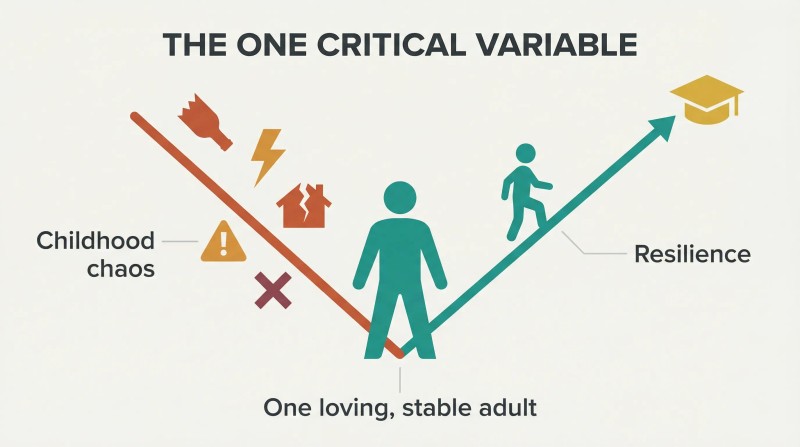
Mamaw — Vance's profane, gun-toting grandmother — was the critical variable. She dropped out before high school, nearly killed a man at twelve, and once set her alcoholic husband on fire. But she also demanded excellence, bought Vance a $180 graphing calculator she couldn't afford, and threatened to run over any friend she deemed a bad influence.
Social scientists call kids who thrive despite chaotic homes "resilient children" — and the research consistently identifies one loving, stable adult as the key ingredient. Mamaw was uncompromising in her belief that Vance could succeed. Her fierce advocacy, sustained across his final three years of high school, transformed his trajectory from potential dropout to Yale Law student. Without her, Vance says, he'd be a statistic.
Kids don't need perfection — they need to stay in one place
“I just wanted a home, and I wanted to stay there, and I wanted these goddamned strangers to stay the fuck out.”
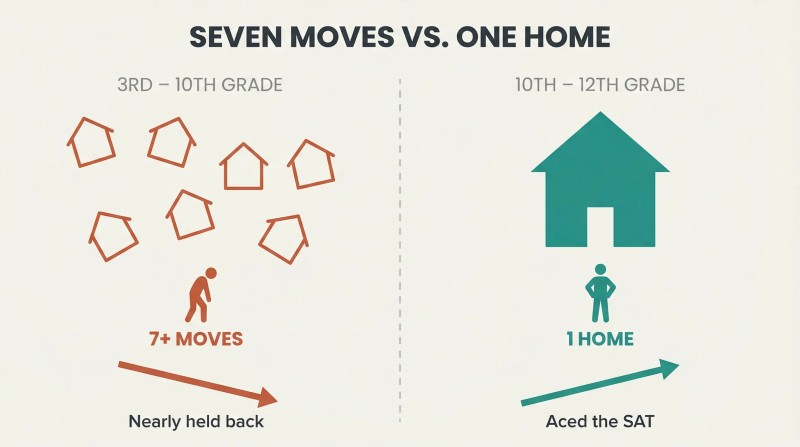
Between third and tenth grade, Vance moved at least seven times through his mother's revolving door of boyfriends and husbands. His grades cratered. He was nearly held back. He developed stomachaches from chronic stress and couldn't sleep because of nightly fighting. He stared at the end-of-day school bell like it was a ticking bomb.
Then everything changed. When he moved in with Mamaw permanently at fifteen, the contrast was stark: At the end of tenth, eleventh, and twelfth grade — same house, same person, no one else. His grades immediately improved. He aced the SAT. He found inspiring teachers. Not a better school, not more money — just the predictable calm of knowing where he'd sleep tomorrow night.
Childhood trauma rewires the brain for a war that never ends
“We are constantly ready to fight or flee, because there is constant exposure to the bear, whether that bear is an alcoholic dad or an unhinged mom.”
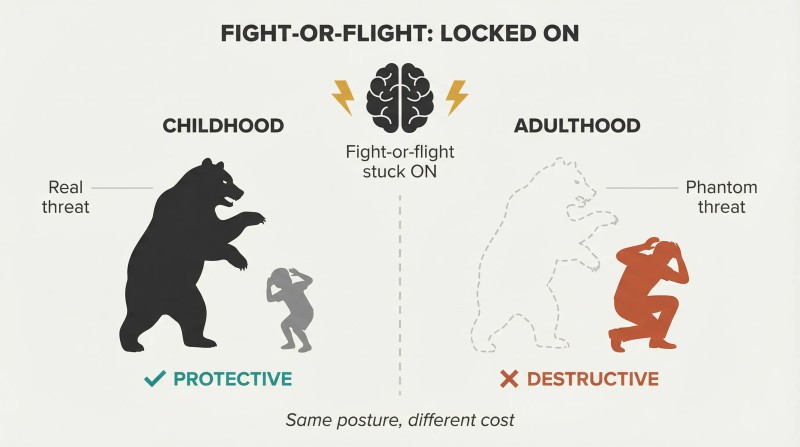
Adverse Childhood Experiences, or ACEs, are traumatic childhood events — parental addiction, domestic violence, verbal abuse, divorce. Vance scored a six on the ACE scale. His aunt scored seven. His wife and her brother-in-law each scored zero. Over 40% of working-class Americans have multiple ACEs, compared to 29% of the non-working class.
Harvard pediatricians found that constant childhood stress permanently alters brain chemistry, locking the fight-or-flight response into overdrive. Children become hardwired for conflict. Vance discovered this at Yale when his girlfriend Usha noticed he either exploded or withdrew completely during any disagreement — behaviors that protected him as a child but sabotaged him as an adult. ACE-affected children also face higher rates of anxiety, depression, obesity, and heart disease.
People preach hard work but model helplessness — kids see the gap
“You can walk through a town where 30 percent of the young men work fewer than twenty hours a week and find not a single person aware of his own laziness.”
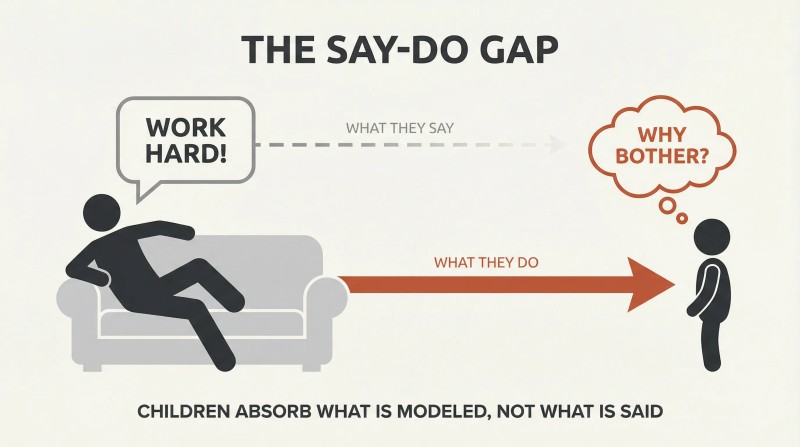
Vance noticed the contradiction early. In Middletown, people talked constantly about hard work's value, yet surveys showed working-class whites didn't actually work more hours than college-educated whites — they just reported that they did. A lifetime welfare recipient next door lectured about industriousness while trading food stamps for cash.
An HBO documentary crystallized it. An Appalachian patriarch drew strict lines between "men's work" and "women's work" but had never held a paying job. His son's verdict: "Only thing Daddy's worked is his goddamned ass." Children raised in this dissonance absorb the truth that adults model, not the words they speak. When rhetoric diverges from reality, kids learn cynicism — not ambition.
Believing the deck is stacked against you makes it so
“If you believe that hard work pays off, then you work hard; if you think it's hard to get ahead even when you try, then why try at all?”
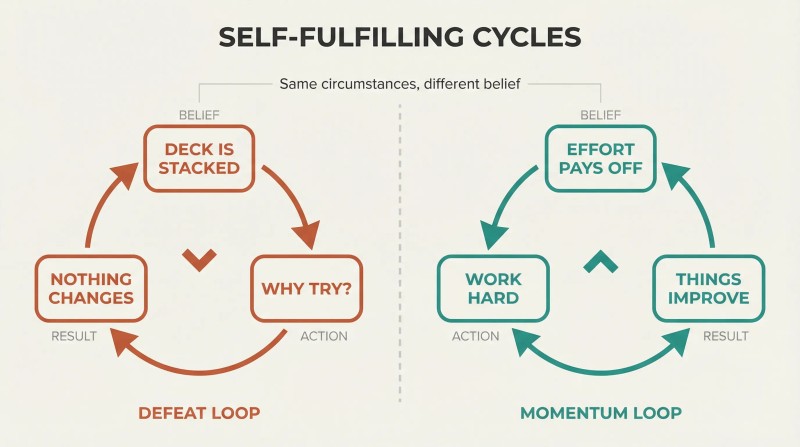
Working-class white pessimism is self-reinforcing. The Pew Economic Mobility Project found only 44% of working-class whites expect their children to fare better economically — far below Black Americans, Latinos, and college-educated whites. Vance encountered an old acquaintance who quit his job because he was "sick of waking up early," then blamed the "Obama economy" on Facebook.
Conservative rhetoric makes it worse. Instead of encouraging engagement, the political right increasingly tells working-class voters that external forces — government, immigrants, global trade — are solely responsible for their decline. Mamaw understood the paradox: she acknowledged unfairness but never let it become an excuse. "Never be like these fucking losers who think the deck is stacked against them," she told Vance. "You can do anything you want to."
The Marine Corps replaced learned helplessness with learned willfulness
“There's something powerful about realizing that you've undersold yourself — that somehow your mind confused lack of effort for inability.”
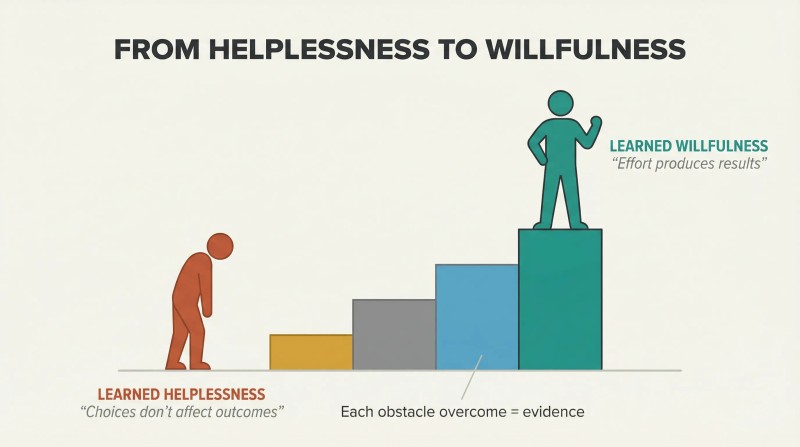
Before enlisting, Vance was overweight, had never run a mile continuously, and couldn't balance a checkbook. His cousin Rachael, a Marine veteran, told him the Corps would whip him into shape. She was right.
Boot camp attacked learned helplessness — the belief, common among kids from chaotic homes, that personal choices don't affect outcomes. The Marines replaced it with what Vance calls "learned willfulness": the conviction, built through repeated challenge, that effort produces results. Every obstacle overcome — climbing a thirty-foot rope, running three miles in nineteen minutes, surviving screaming drill instructors — built evidence that he'd undersold himself. The Corps also taught financial literacy, supervised car purchases (Vance almost signed a 21% loan), and forced doctor visits. He lost forty-five pounds and gained a sense of control.
The rules of success are hidden from those who need them most
“I had no idea that people did these things. Compare banks? I thought they were all the same.”
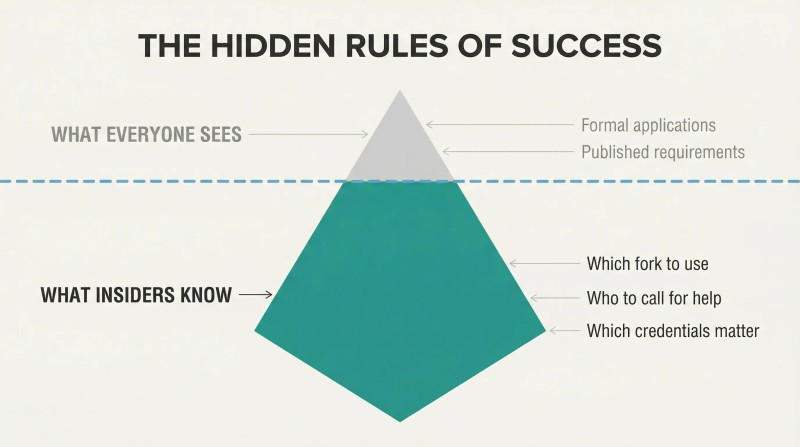
At Yale Law's recruiting dinners, Vance didn't know sparkling water meant carbonated, couldn't navigate multiple forks, and had to call his girlfriend from the bathroom for utensil advice. He never applied to Stanford because he couldn't bring himself to ask a dean he didn't know to sign a form — distrust of strangers cost him an opportunity.
The deeper problem was strategic. While classmates used alumni networks and family connections to prepare for The Yale Law Journal competition, Vance didn't even know what the Journal did. Professor Amy Chua became his guide — explaining which credentials mattered, which clerkships to pursue, and once talking him out of a prestigious position that would have wrecked his relationship. This is social capital: the informal knowledge and networks that wealthier peers absorb invisibly.
Upward mobility is cultural emigration, not just a pay raise
“For the first time in my life, I felt like an outsider in Middletown. And what turned me into an alien was my optimism.”
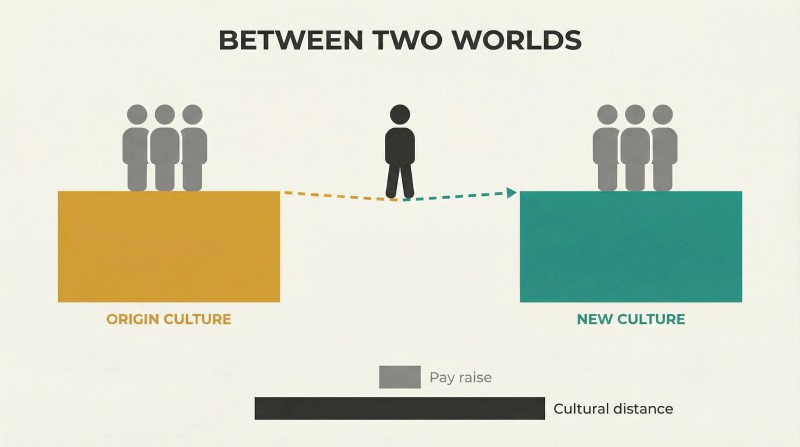
At a gas station near his aunt's house, a woman in a Yale T-shirt asked Vance if he went there. He lied: "No, but my girlfriend does." He couldn't claim membership in the elite without feeling like a traitor. This inner conflict — between hillbilly loyalty and Ivy League identity — followed him everywhere.
Mobility changes your norms, not just your income. Vance stopped eating fried food, started asking about sugar content, and took Yale friends to Cracker Barrel only to watch them recoil. Every one of his six groomsmen left their small Ohio towns and never returned — a pattern researchers call "brain drain." Working-class Americans who climb the ladder are statistically more likely to fall back down, partly because the cultural displacement never fully heals.
Your family's conflict patterns travel with you until you break them
“Nothing compares to the fear that you're becoming the monster in your closet.”
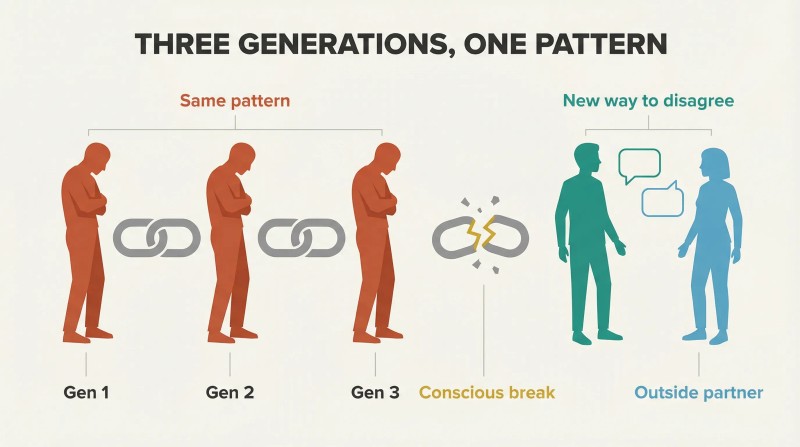
At Yale, Usha called Vance a "turtle" — he'd completely withdraw at the first hint of disagreement, or explode like his mother. After one fight, he stormed out of a D.C. hotel and wandered the streets until Usha found him on the steps of Ford's Theatre. He realized he'd inherited three generations of escape: his mom fled fights to motels, his grandma fled fights as a child.
The pattern was widespread. Vance's aunt confessed she used to physically brace for battle before her husband finished speaking. His sister would preemptively push her husband away. Both broke the cycle, but only through years of conscious effort. Strikingly, every family member who built a lasting marriage — Aunt Wee, Lindsay, cousin Gail — married someone from outside the hillbilly culture, someone who modeled a different way to disagree.
Analysis
Hillbilly Elegy occupies a peculiar intellectual niche: it is simultaneously a deeply personal memoir and an implicit sociological argument about the role of culture in perpetuating poverty. Vance's most provocative claim — that the white working class bears significant responsibility for its own decline — places him at odds with both the liberal structural-determinism of scholars like William Julius Wilson and the conservative tendency to blame government alone. What makes the argument compelling is Vance's refusal to choose sides; he holds structural and cultural explanations in sustained tension, much as his grandmother simultaneously blamed corporations, government, and her own neighbors.
The book's timing — published months before the 2016 presidential election — gave it outsized cultural influence as coastal commentators seized upon it as a Rosetta Stone for understanding Trump's base. This is both the book's blessing and its limitation. Vance writes about one specific subculture — Scots-Irish Appalachian transplants in the Rust Belt — yet readers often universalize his claims to all working-class white Americans, a population far more diverse than any single memoir can represent. The reliance on personal narrative, while gripping, can mask the heterogeneity of working-class experience and the structural barriers (deindustrialization, wage stagnation, the opioid pharmaceutical pipeline) that Vance acknowledges but underweights relative to cultural factors.
More enduring than its political relevance is Vance's integration of ACE research with lived experience. By translating clinical findings about childhood trauma into the texture of real life — fight-or-flight responses that follow you to law school, the inability to trust an apology, confusing love with combat — he makes empirical science visceral and immediate. His willingness to implicate himself as a carrier of the very pathologies he escaped gives the book an intellectual honesty rare in memoir. The unresolved tension at its core — between sympathy for his mother and accountability for her choices — mirrors the central dilemma of American poverty policy and ensures the book resists easy ideological capture. It is, ultimately, less a policy prescription than a diagnostic — and its most powerful insight may be that diagnosis itself is where healing begins.
Review Summary
Hillbilly Elegy receives mixed reviews, with some praising its personal insights into Appalachian culture and others criticizing its portrayal of working-class whites. Readers appreciate Vance's candid account of his challenging upbringing and his journey to success. Many find the book timely in explaining the cultural divide in America, while others argue it reinforces stereotypes. Critics question Vance's conservative perspective and his solutions to poverty. The book's popularity is attributed to its relevance during the 2016 election, sparking discussions about class and social mobility in America.
People Also Read


 Immersive

 Immersive



 Immersive
 Immersive
 Immersive
Glossary
Adverse Childhood Experiences (ACEs)
Traumatic childhood events with lasting effectsA set of traumatic childhood events identified by psychologists, including being verbally abused, witnessing domestic violence, living with an addict or someone depressed, parental separation, and physical abuse. Studies show ACEs are far more common in working-class families—over 40% have multiple ACEs versus 29% in the non-working class. Higher ACE scores correlate with anxiety, depression, heart disease, obesity, relationship instability, and poor school performance well into adulthood.
Learned helplessness
Belief that choices don't matterA psychological concept Vance applies to the mind-set common among people from chaotic, impoverished backgrounds—the belief that personal decisions have no meaningful effect on life outcomes. It develops naturally in environments where children witness adults failing despite effort, or where instability is so pervasive that planning seems futile. Vance argues this was the dominant lesson of his childhood environment in Middletown, Ohio, and that the Marine Corps systematically dismantled it.
Learned willfulness
Agency rebuilt through overcoming challengesVance's own term for the opposite of learned helplessness—the conviction, built through repeated experience of overcoming difficult challenges, that effort and discipline produce real results. He developed this concept primarily through Marine Corps boot camp, where every physical and mental obstacle overcome (climbing ropes, running miles, managing finances) served as concrete evidence that personal choices mattered and that he had underestimated his own capabilities.
Hillbilly highway
Appalachian migration routes to MidwestA colloquial term for the mass migration routes from Appalachian states—Kentucky, West Virginia, Tennessee—to industrial Midwest cities in Ohio, Michigan, and Indiana during the mid-twentieth century. In the 1950s, thirteen of every hundred Kentucky residents migrated north. By 1960, one million of Ohio's ten million residents were born in Appalachian states. Companies like Armco Steel actively recruited in coal country and encouraged family-based hiring, transplanting entire communities northward.
Social capital
Networks providing economic value and knowledgeAn economics term Vance uses to describe the networks of people, institutions, and informal knowledge that provide tangible economic value—connecting individuals to jobs, mentors, and critical information about how systems work. Vance argues its absence is among the most underappreciated barriers facing working-class Americans, who lack access to the guidance (how to dress for interviews, which credentials matter, how to navigate financial aid or loan markets) that wealthier peers absorb invisibly from family and social circles.
Greater Appalachia
Scots-Irish cultural region of AmericaThe broad cultural region stretching from Alabama and Georgia in the South to Ohio and parts of New York in the North, unified by Scots-Irish heritage and Appalachian traditions. Vance describes this region as 'remarkably cohesive' in its family structures, religion, politics, and social norms—including fierce loyalty, distrust of outsiders, an honor code valuing toughness, and disproportionately high rates of poverty, divorce, drug addiction, and pessimism about the future.
Resilient children
Kids thriving despite unstable homesA social science concept referring to children who prosper despite chaotic or abusive home environments because they have the sustained support of at least one loving, stable adult. Vance cites this research as explaining his own trajectory: his grandmother Mamaw served as that critical adult presence, providing the consistency, discipline, and unconditional belief that counteracted the instability created by his mother's addiction, revolving partners, and frequent moves.
FAQ
What's Hillbilly Elegy about?
- Personal Memoir: Hillbilly Elegy by J.D. Vance is a memoir detailing his upbringing in a working-class family in Ohio and Kentucky. It focuses on the struggles of the Scots-Irish community in the Rust Belt.
- Cultural Analysis: The book examines the impact of poverty, addiction, and family dynamics on Vance's life and the broader cultural issues affecting the Appalachian region.
- Family Influence: Vance highlights the significant role of his grandparents, especially his grandmother, in shaping his identity and aspirations.
Why should I read Hillbilly Elegy?
- Insight into Poverty: The memoir offers a candid look at the realities of growing up in a poor, working-class environment, providing a deeper understanding of socio-economic challenges.
- Cultural Reflection: Vance's narrative sheds light on the cultural identity of the Scots-Irish community, often overlooked in mainstream discussions about class and race in America.
- Personal Growth Journey: Readers can relate to Vance's journey of overcoming adversity, emphasizing the importance of family support and resilience.
What are the key takeaways of Hillbilly Elegy?
- Impact of Family: The memoir underscores the crucial role family plays in shaping one's future, with Vance crediting his grandparents for his success.
- Understanding Poverty: Vance illustrates how poverty affects mental health, education, and social mobility, arguing for a comprehensive understanding of these factors.
- Cultural Identity: The book highlights the importance of cultural identity and the challenges faced by those caught between different socio-economic worlds.
What are the best quotes from Hillbilly Elegy and what do they mean?
- "There are no villains in this story.": This quote reflects Vance's belief in the complexity of human behavior and the impact of circumstances on individuals.
- "You can do anything you want.": A statement from Mamaw, emphasizing hope, determination, and the belief in personal agency despite difficult circumstances.
- "The measure of a man is how he treats the women in his family.": This quote from Papaw highlights the importance of respect and honor within familial relationships.
How does J.D. Vance describe his childhood in Hillbilly Elegy?
- Chaotic Environment: Vance's childhood was marked by family instability and economic hardship, with his parents struggling with addiction.
- Support from Grandparents: His grandparents, particularly Mamaw, provided stability and love, instilling values of hard work and resilience.
- Cultural Context: Vance contextualizes his experiences within the broader cultural issues facing the Scots-Irish community, discussing generational poverty.
What role do addiction and substance abuse play in Hillbilly Elegy?
- Personal Struggles: Vance's family history is marked by addiction, particularly his mother's struggles with prescription drugs, illustrating its pervasive impact.
- Cultural Reflection: The memoir highlights how addiction is intertwined with poverty and lack of opportunity, requiring comprehensive solutions.
- Consequences of Addiction: Vance discusses the emotional and psychological toll of addiction on individuals and families, shaping his upbringing.
How does Vance's military service influence his perspective in Hillbilly Elegy?
- Discipline and Growth: Vance credits the Marine Corps with instilling discipline and a sense of purpose, helping him develop resilience.
- Contrast with Upbringing: Military service provided structure and a clear path, contrasting with his chaotic childhood and shaping his understanding of responsibility.
- Broader Worldview: The military exposed Vance to diverse perspectives, broadening his worldview and appreciation for hard work.
How does Vance's experience relate to the American Dream in Hillbilly Elegy?
- Complex Relationship: Vance's journey illustrates the complexities of the American Dream, particularly for those from disadvantaged backgrounds.
- Cultural Barriers: He discusses how cultural identity and family dynamics can hinder or help one's pursuit of the American Dream.
- Hope and Resilience: Despite obstacles, Vance's narrative conveys a message of hope and resilience, emphasizing the possibility of upward mobility.
What does Vance say about the Scots-Irish culture in Hillbilly Elegy?
- Distinct Identity: Vance describes the Scots-Irish as a unique cultural group with strong values of family, honor, and hard work.
- Challenges Faced: He discusses the challenges of poverty, addiction, and social isolation faced by this community.
- Cultural Resilience: Despite difficulties, Vance highlights the resilience of the Scots-Irish people, with their traditions shaping their lives.
How does Vance address the issue of class in Hillbilly Elegy?
- Class Disparities: Vance highlights the stark differences between the working class and the elite, affecting opportunities and perceptions.
- Impact on Identity: The memoir examines how class shapes personal identity and influences life choices, reflecting on Vance's own journey.
- Call for Understanding: Vance advocates for greater empathy between classes, recognizing the complexities of working-class life.
What solutions does Vance propose for the issues faced by the working class in Hillbilly Elegy?
- Community Support: Vance emphasizes the importance of community support and engagement in overcoming adversity.
- Education and Opportunity: He advocates for better access to education and job opportunities to break the cycle of poverty.
- Personal Responsibility: Vance stresses personal responsibility and agency in achieving success, urging individuals to take ownership of their lives.
How does Vance's relationship with his family evolve throughout Hillbilly Elegy?
- Complex Dynamics: Vance's relationship with his family is marked by love and conflict, particularly with his mother.
- Healing and Understanding: As he matures, Vance approaches his family with greater empathy, seeking to reconcile his feelings.
- Legacy of Support: Vance acknowledges the importance of his grandparents' support, striving to honor their legacy in his own family.
Download PDF
Download EPUB
.epub digital book format is ideal for reading ebooks on phones, tablets, and e-readers.








































