

Key Takeaways
Your gluten-free lifestyle is just a diet wearing a disguise
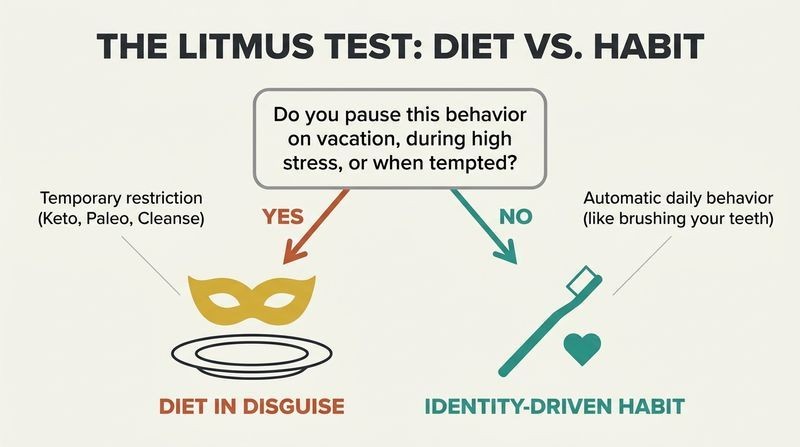
Duncan's litmus test is brutal and simple: if you would pause it on vacation, during stress, or when something delicious appears, it is a diet, not a habit. Nobody suspends tooth-brushing on holiday, and vegans do not eat steak just because work got busy, because those behaviors are woven into identity.
The $66 billion weight-loss industry rebrands the same restriction endlessly (keto, paleo, cleanses, clean eating), yet Brown University's National Weight Control Registry, which studies people who actually kept weight off, found no single winning diet. The only shared thread was small, permanent changes to everyday behavior. There is no peer-reviewed evidence that one diet beats another for long-term loss, and most regain within a year.
The reframe is sharp because it collapses the false hierarchy between trendy "lifestyles" and old-fashioned dieting. Behavioral science supports her: sustained change correlates with identity shift, not rule adherence, echoing James Clear's identity-based habits and Prochaska's stages of change. One nuance worth adding: some restrictive protocols do serve genuine medical needs (celiac disease affects roughly 1% of people), and elimination can be diagnostically useful. Duncan's target is the well-intentioned dieter chasing novelty, not the patient managing a condition. Her deeper point, that novelty itself is the industry's product, deserves emphasis. Each new diet sells hope, then quietly recycles "eat vegetables" underneath the branding.
You are not chasing thinness; you are chasing a feeling
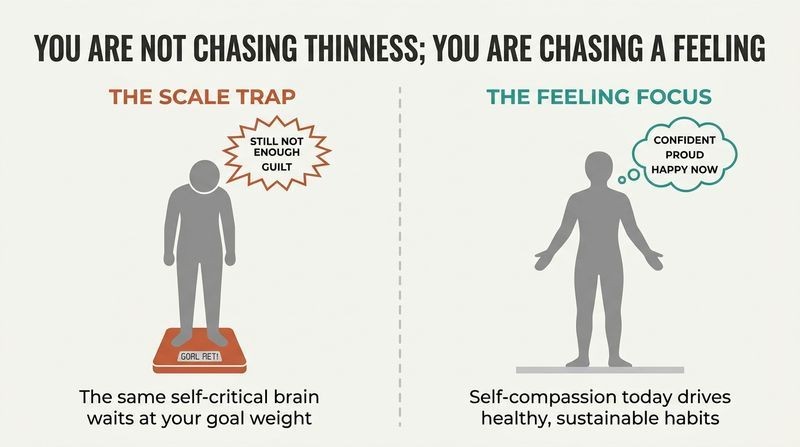
Duncan argues nobody actually wants a number on a scale. Ask "why" enough times about any goal and you arrive at happiness. You want visible abs because you imagine feeling confident, sexy, and proud, which all reduce to wanting to feel good.
The trap is the "monster at the end of the book": you arrive at your goal weight only to find the same self-critical brain waiting there. If you cannot feel good now, you will not feel good thinner. She cites a Duke University study where women who ate doughnuts and then received self-compassion messages later ate far less candy than those left to stew in guilt. A McGill study linked shame and self-criticism to increased hunger and weight gain. Practice the target feeling today, at your current weight.
This is affect-forecasting in action, the well-documented human tendency, studied by Daniel Gilbert and Tim Wilson, to overestimate how much future circumstances will change our emotional baseline. People adapt (hedonic adaptation), so the lottery winner and the amputee drift back toward their set points. Duncan translates this into practical self-compassion, aligning with Kristin Neff's research showing self-compassion outperforms self-criticism for behavior change. The challenge: "practice feeling sexy now" can sound like bypassing real distress, and for people with clinical body dysmorphia or eating disorders, affirmations are insufficient. But as a corrective to the punitive dieting mindset, the science is solid: shame is a terrible motivator.
Ditch willpower; build habits that run on autopilot instead
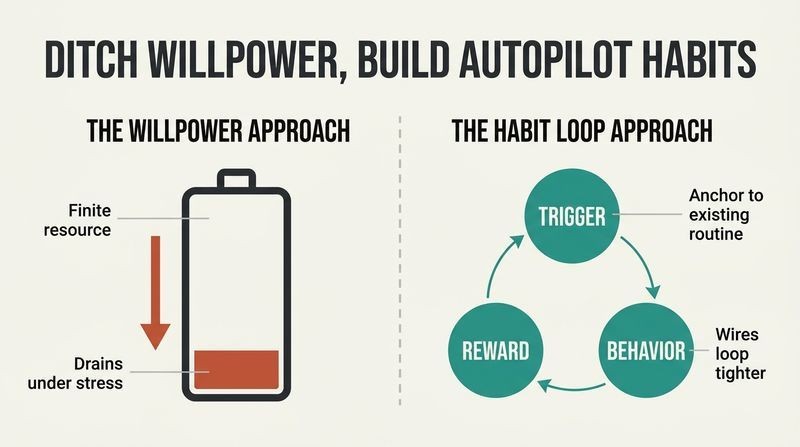
Discipline, motivation, and willpower are finite and drain fast. The initial thrill of purging your sugar stash fades, and six weeks later, stressed and hangry in traffic, you have no willpower left. Duncan notes 60% of New Year's resolutions collapse by February, and even after a heart attack only 14% of patients make lasting changes.
Her answer is the habit loop: a Trigger (time, place, person, or emotion) sets off a Behavior, which delivers a Reward that wires the loop tighter each time. Roughly 40-45% of daily actions are habits. To build one, anchor a new behavior to a nonnegotiable existing trigger (specific, consistent, logical), then bribe yourself with an immediate reward until the habit becomes intrinsically satisfying.
Duncan draws directly on Charles Duhigg's cue-routine-reward loop and the ego-depletion literature, though it is worth flagging that ego depletion has faced replication challenges in recent years. The durable insight survives regardless: environmental and automatic processes carry more behavioral load than conscious resolve. Her demand for an immediate reward is smart neuroscience, since dopamine reinforces on tight time delays; a reward promised for hours later fails to cement the loop. Her own example, permitting herself trashy TV only while on the treadmill, is temptation bundling, a technique Katherine Milkman validated experimentally. Pairing a want with a should reliably boosts adherence.
Fill half every plate with vegetables and stop counting everything else
This is habit number one and the whole nutrition plan. Aim for seven servings of vegetables daily and most other rules become noise. Only about 9% of Americans hit WHO vegetable targets, yet 60% are actively adding protein they do not need, often eating nearly twice the recommended amount.
Duncan's reframe: when you open the fridge, build the meal around vegetables first, not protein or starch. Vegetables are low-calorie (a broccoli binge is nearly impossible), fiber-rich, and packed with phytochemicals linked to lower rates of heart disease, cancer, and cognitive decline. She invokes the China Study, a twenty-year Cornell-Oxford-China collaboration, which concluded that people eating the most plant-based foods were healthiest. Protein does not give energy; carbohydrates do. Excess protein is just excess calories.
The vegetable-first heuristic is elegant because it adds rather than forbids, sidestepping the psychological reactance that makes restriction backfire. Volumetrics research by Barbara Rolls confirms that low-energy-density foods increase satiety per calorie, so people eating more vegetables naturally eat less of everything else without tracking. One caveat: the China Study, popularized by T. Colin Campbell, is observational and has drawn methodological criticism for overstating causal claims about animal protein. The broader consensus, that most people would benefit from more plants and fewer ultra-processed foods, stands on far firmer ground. Duncan's protein debunking is also timely given the current protein-marketing frenzy she rightly names as a fad.
Sleep deprivation makes you fat, foggy, and functionally drunk
Getting fewer than seven hours triggers a cascade that sabotages fat loss. Duncan lists the mechanisms: chronic short sleep raises cortisol, the stress hormone that slows metabolism and stores fat around the middle. Being awake 18 hours impairs you like a 0.08% blood alcohol level, legally drunk, and nobody makes great food choices drunk.
Sleep is also when your workout pays off: deep sleep releases growth hormone that repairs muscle. Skimp on it and you get the stress without the strengthening. Short sleep also spikes ghrelin (hunger) and suppresses leptin (fullness), so you crave that second and third slice of cake. Her prescriptions: consistent sleep and wake times, caffeine cutoff by 2pm, no screens an hour before bed, and no alcohol nightcap.
Duncan synthesizes mainstream sleep science accurately, and the field, led by researchers like Matthew Walker, has only grown more emphatic. The "functionally drunk" comparison comes from real occupational studies showing cognitive impairment equivalent to intoxication. Her framing of nighttime snacking as a sleep problem rather than a willpower problem is a genuinely useful reattribution: fatigue drives the body to seek quick energy from food. One addition worth noting is that sleep also regulates insulin sensitivity, so a single bad night measurably worsens glucose handling. The practical friction is real, though: telling exhausted parents and shift workers to simply sleep more ignores structural barriers she only partly addresses.
Chronic stress parks fat on your belly, so meditation is fat loss
Duncan distinguishes acute stress (a hard workout, a new skill) which builds us, from chronic stress (money worry, constant hustle) which the body cannot handle. Under chronic stress, the body dumps fat into the bloodstream, shuttles it to the midsection to protect vital organs, and cranks up cravings for sugar and fat.
Her yoga teacher's zinger captures it: the woman desperate to burn 500 calories might, if she sat still, discover why she eats 500 extra calories. Meditation is "a gym for your brain," shown in neuroimaging to shrink amygdala activity (fear and stress) and strengthen emotional regulation. The Blue Zones (Okinawa, Sardinia, Ikaria, and others) share low-stress living, tight social bonds, and purpose among their centenarians.
The stress-cortisol-visceral-fat pathway is well established, though the causal chain from meditation to weight loss is more indirect than the framing suggests. Meditation's stronger, better-replicated benefits are in emotional regulation and interrupting automatic reactivity, precisely what breaks a stress-eating loop. Duncan's most subversive claim is structural: she tells clients that a housekeeper or babysitter may be a better health investment than a spin studio. This reframes wellness as a time-and-capacity problem, not a discipline problem, which resonates with research on scarcity by Sendhil Mullainathan showing that cognitive bandwidth, not willpower, is often the binding constraint. Purpose and connection driving longevity is Dan Buettner's central Blue Zones finding.
You eat healthy food, just far too much of it
Most of Duncan's clients swear they eat well, and they do, yet they gain weight because portions balloon. Calories In, Calories Out (CICO) still governs. She recounts Tara, who "only" ate a salad for dinner but consumed two meals' worth via bites, licks, wine, and leftover macaroni while cooking. Barbara ate unlimited chicken and coconut balls because her low-carb plan called them "allowed," and gained weight anyway.
Her hand-based portions: vegetables fill half the plate, protein equals a palm, carbs a fist, fat a thumb. Eliminating a whole macronutrient backfires; studies show people given low-fat foods eat 60% more calories chasing satisfaction. Slow down, take twenty minutes per meal, and learn the difference between genuine hunger (physical, non-specific) and cravings (emotional, specific, and they fade if ignored).
The "healthy food, too much of it" diagnosis is underrated in a culture obsessed with food quality over quantity. Duncan resists the villain-nutrient narrative that sells books, pointing instead to the boring, unmarketable truth of energy balance. Her hand-portion method is a practical answer to the fact that most people cannot and will not weigh food long-term, and it self-scales to body size. The Okinawan hara hachi bun me practice, eating to 80% full, and the French "I'm no longer hungry" framing both point to interoceptive awareness, the skill of reading internal fullness signals that chronic distracted eating erodes. Deliberately experiencing hunger, she argues, recalibrates a broken signal.
Exercise consistently, but never to burn off what you ate
Consistency beats intensity by a mile: developing a routine you actually keep matters far more than picking the "optimal" workout. Duncan felt awful for telling a client Zumba was inferior to her quad routine, because the client had finally found something she would do. Strength training plus HIIT (short all-out bursts with rest) is most time-efficient for fat loss, boosting resting metabolism for up to 72 hours, but the best exercise is the one you will repeat.
Crucially, exercise is a poor weight-loss tool: burning off a side of fries takes about two hours on the elliptical. Skip the "I earned this treat" trap. Its real payoff is a keystone effect, cascading into better food choices, less evening drinking, better sleep, and immediate mood lift.
Duncan's separation of exercise from calorie-burning corrects one of fitness culture's most stubborn errors. The "constrained energy expenditure" research by anthropologist Herman Pontzer supports her: highly active populations do not burn dramatically more daily calories than sedentary ones, because the body adapts. Exercise earns its keep through metabolic, mood, and behavioral spillover, not the treadmill's calorie readout. Her keystone-habit framing, borrowed from Duhigg, is the strongest argument: the morning workout that makes you crave a nourishing breakfast is doing invisible work. The concept of NEAT (non-exercise activity thermogenesis), all the fidgeting, walking, and standing across a day, is genuinely underrated and may exceed structured exercise in total energy impact.
Name the bullshit story you tell to skip your habit
Bullshit is Duncan's word for the seductive internal excuses (Gretchen Rubin calls them loopholes) that let you abandon intentions guilt-free. She catalogs the varieties: the Diet-Starts-Tomorrow Bullshit ("this weekend is a write-off"), the Martyr Bullshit ("I should eat the hostess's appetizers to be polite"), the Good-Girl Bullshit ("I've been so good, I deserve a treat"), and the most dangerous, Victim Bullshit ("my kids won't let me exercise").
Her three-step counter: recognize the bullshit, deliver a firm breakup speech, and do the habit anyway. Meditation trains the detached observation needed to catch these thoughts. Victim language ("I fell off the wagon") is especially corrosive because it denies agency; she reframes it as "I decided to stay drunk for seven days," which is at least honest and empowering.
This is cognitive defusion, a core technique from Acceptance and Commitment Therapy, dressed in profanity. The skill of observing a thought as a thought rather than a command is exactly what mindfulness-based interventions cultivate, and it is well-validated for behavior change and relapse prevention. Duncan's insistence on language precision echoes attribution theory: internal, controllable attributions ("I chose") predict better persistence than external, uncontrollable ones ("it happened to me"). The Martyr Bullshit is a particularly astute cultural observation about how women are socialized to frame self-neglect as virtue. The breakup-speech device is memorable, though the real work is the daily unglamorous catching, which is harder than the naming.
When you can't do it right, do it deliberately half-assed
Perfectionism is the enemy of consistency. Duncan promises you will never execute your habits perfectly (guests, illness, real Champagne), and that demanding perfection guarantees collapse into the "Fuckits." Her fix, drawn from Duhigg's "small wins": shrink the habit to its tiniest version rather than skip it. Too sick to run 5K? Walk the block. Too busy for an hour of meal prep? Thaw something healthy.
A half-assed habit still counts because it keeps the loop alive, reinforces your identity as "someone who does this," and leverages momentum (once you are up and moving, your ego often pushes you further). Reward yourself just as enthusiastically for the small win. The teeniest version is bullshit-proof: no excuse can plausibly claim you cannot take ten deep breaths.
The genius here is inverting the all-or-nothing logic that traps high achievers. Behaviorally, this is habit maintenance over outcome maximization: the loop's neural wiring depends on frequency, not magnitude, so a tiny rep preserves the pathway a skipped day destroys. It echoes BJ Fogg's Tiny Habits and the productivity maxim that showing up beats optimizing. The identity mechanism is the deepest layer: every small win is, in Clear's phrase, a vote for the person you want to be. Duncan's martial-arts master line, that he loses balance constantly but recovers fast, captures the reframe perfectly. Mastery is not never falling; it is shortening the recovery.
Being fit is abnormal, so recruit a tribe to conform to
Duncan, a self-described former rebel, concedes that humans are wired to conform, and that "normal" now means overweight, stressed, in debt, underslept, and barely moving. Social disapproval triggers the brain's danger systems; the classic Solomon Asch line-length experiments showed people give obviously wrong answers to match a group.
The counterintuitive fix: use conformity for good by joining people who already live healthy. The strongest predictor of nonconformist behavior is having allies. Meanwhile, friends and family often sabotage you (one study found a fifth admit trying to undermine a dieting friend, and 75% of women report rarely getting support), usually because your change threatens their self-image. Her tactics: reassure them they are not judged, refuse to become boring, and ask directly and specifically for help.
Duncan's insight that fitness is statistically deviant reframes the struggle as swimming against a current, not fixing a personal flaw. This aligns with Nicholas Christakis and James Fowler's landmark network research showing obesity, smoking, and happiness spread through social ties like contagion, your friends' friends' behavior measurably shifts yours. The sabotage finding is sobering and rarely discussed: intimate relationships often enforce homeostasis, so a partner may unconsciously resist your change to preserve the relationship's equilibrium. Her scripted family conversation is practical relationship design. The subtle risk is echo-chamber insularity, but for someone drowning in a culture of default unhealth, deliberately engineering a new peer norm is among the highest-leverage moves available.
Analysis
Healthy as F ck is a self-help book in habit-science clothing, structured in three acts: mindset (get clear on whether and why you want to change), mechanics (seven keystone habits), and maintenance (environment design, social support, and relapse recovery). Oonagh Duncan, a Canadian fitness entrepreneur, writes in deliberately profane, comedic prose aimed primarily at women exhausted by the diet-industrial complex. The difficulty in summarizing it is that its substance is almost entirely borrowed, Duhigg's habit loop, Campbell's China Study, Rubin's loopholes, Buettner's Blue Zones, Robbins on identity, while its originality lies in voice, synthesis, and the specific reframe that emotional feeling, not weight, is the true goal.
Intellectually, the book's strongest move is refusing the villain-nutrient narrative. In an era of keto tribalism and protein mania, Duncan's boring insistence on vegetables, portions, sleep, and calories-in-calories-out is quietly contrarian and evidence-aligned. Her second strength is psychological honesty: she treats overeating as a downstream symptom of stress, sleep debt, shame, and time poverty rather than moral weakness, which converges with contemporary behavioral economics on bandwidth and scarcity.
The book's vulnerabilities are the ones its genre always carries. It leans on some contested science (ego depletion's replication problems, the China Study's observational limits) and occasionally overstates causal claims, meditation as fat loss, moderate drinking's dangers, while genuine correlation-causation caveats appear inconsistently. Its relentless positivity around "choosing your body" can underweight the reality of disordered eating, metabolic disease, and structural constraints that scripts and affirmations cannot dissolve.
Still, as a practical operating system, it coheres. The through-line, that identity change beats rule-following, that environment beats willpower, that consistency beats intensity, that self-compassion beats shame, represents the current consensus of behavioral science delivered with unusual accessibility. Its lasting value is permission: to want fitness without guilt, to pursue it imperfectly, and to stop paying the $66 billion hope industry for the same recycled restriction.
Review Summary
Healthy as F*ck receives mostly positive reviews for its no-nonsense approach to health and weight loss. Readers appreciate the author's humor, relatability, and focus on sustainable habits rather than quick fixes. Many find the book motivating and refreshing, praising its emphasis on self-love and mental health. Critics note some contradictory messages about body image and a lack of specific advice for certain dietary restrictions. Overall, reviewers find the book entertaining and helpful in developing a healthier mindset and lifestyle.
People Also Read
Glossary
7 Habits of Highly Healthy Motherfuckers
Seven keystone health habitsDuncan's core framework of seven high-leverage habits that deliver most fitness results: fill half your plate with vegetables, get seven-plus hours of sleep, reduce alcohol, meditate and reduce stress, eat appropriate portions, prep and plan food in advance, and exercise consistently. She frames them as keystone habits following the 80/20 rule, where 20% of effort yields 80% of results.
The Fuckits
The inevitable relapse phaseDuncan's term for the relapse stage of habit change, when you rebel against your new routines and think "fuck it, I'll start Monday." She maps it onto the Transtheoretical Model of behavior change and treats it as a normal, temporary phase (like puberty) rather than failure, to be recovered from quickly with minimal drama.
Bullshit
Self-sabotaging excuse storiesThe seductive internal excuses people use to justify skipping their habits, similar to what Gretchen Rubin calls loopholes. Duncan categorizes types including Diet-Starts-Tomorrow, Martyr, Aha-Moment, Victim, and Good-Girl Bullshit. Her three-step antidote: recognize the bullshit, deliver a firm breakup speech, and do the habit anyway.
Easy effort
Familiar busywork that avoids changeA concept Duncan attributes to John Berardi of Precision Nutrition: hard work that feels familiar and lets you stay basically the same, like running the same route you always run. It satisfies a work ethic and ticks boxes but never produces new results, unlike "real effort," which frightens you and demands genuine improvement.
Effort-to-results chart
Personal trade-off between effort and leannessDuncan's model showing that each person has a unique curve relating the effort they invest to the body they achieve. You consciously choose your sustainable spot on the curve, either picking an effort level and accepting the results, or picking a target result and accepting the required effort, then loving the outcome rather than berating yourself.
Habit loop
Trigger, behavior, reward cycleAdapted from Charles Duhigg, the three-part structure of any habit: a Trigger (time, place, person, or emotion) sets off a Behavior, which delivers a Reward. Each completed loop strengthens the link, eventually making the behavior automatic. To build habits, anchor them to reliable triggers and add immediate rewards; to break them, interrupt the trigger, behavior, or reward.
Small wins
Tiny versions of a habitDeliberately shrinking a habit to its smallest possible version on days you cannot do the full thing (a walk instead of a run, ten breaths instead of twenty minutes of meditation). Small wins keep the habit loop alive, reinforce your identity as someone who follows through, and often trigger momentum that leads to doing more than intended.
Keystone habit
Habit that triggers other habitsA single habit that sets off a chain reaction of other positive behaviors. Duncan's example is morning exercise, which makes her want a nourishing breakfast, pack a healthy lunch, drink less at night, and sleep earlier. Focusing on keystone habits applies the Pareto Principle: a small input creates disproportionately large downstream effects.
NEAT
Non-exercise activity calorie burnNon-Exercise Activity Thermogenesis, the calories burned through all daily movement that is not deliberate exercise: walking, standing, fidgeting, and physical work. Duncan cites it as one of the most underrated components of wellness, arguing that constant low-level movement throughout the day can matter more than a single intense workout followed by hours of sitting.
FAQ
What's "Healthy as F*ck" about?
- Author's Background: "Healthy as F*ck" is written by Oonagh Duncan, a fitness expert known for her habits-based approach to health and wellness.
- Core Message: The book emphasizes that achieving health and fitness is not about following fad diets but about cultivating sustainable habits.
- Focus on Feeling Good: Duncan stresses that fitness should be about feeling good rather than focusing solely on weight loss or a number on the scale.
- Practical Advice: The book provides practical steps and habits that readers can incorporate into their daily lives to improve their health and well-being.
Why should I read "Healthy as F*ck"?
- Realistic Approach: The book offers a no-nonsense, realistic approach to health that dismisses fad diets and focuses on sustainable habits.
- Empowerment: It empowers readers to take control of their health by making small, manageable changes rather than drastic, unsustainable ones.
- Humor and Relatability: Oonagh Duncan's writing is humorous and relatable, making the book an engaging read.
- Comprehensive Guide: It covers various aspects of health, including nutrition, exercise, sleep, and mental well-being, providing a holistic approach to fitness.
What are the key takeaways of "Healthy as F*ck"?
- Habits Over Diets: The book emphasizes the importance of developing healthy habits rather than relying on diets for weight loss.
- Mindset Matters: It highlights the significance of mindset and how feeling good should be the primary goal of any fitness journey.
- Simplicity and Consistency: Duncan advocates for simple, consistent actions that lead to long-term health benefits.
- Self-Love and Acceptance: The book encourages readers to love and accept themselves at every stage of their fitness journey.
What is Oonagh Duncan's method for getting healthy?
- Habits-Based Approach: Duncan's method focuses on creating and maintaining healthy habits rather than following restrictive diets.
- Seven Keystone Habits: She outlines seven key habits that contribute to overall health, including eating vegetables, getting enough sleep, and exercising consistently.
- Mindset Shift: The method involves shifting one's mindset to prioritize feeling good and being happy over achieving a specific weight or body type.
- Sustainability: The approach is designed to be sustainable, allowing individuals to maintain their health improvements over the long term.
How does "Healthy as F*ck" redefine fitness?
- Beyond Weight Loss: The book redefines fitness as a state of feeling good and being healthy, rather than just losing weight.
- Focus on Well-Being: It emphasizes overall well-being, including mental and emotional health, as integral parts of fitness.
- Practical and Realistic: Duncan provides practical advice that fits into everyday life, making fitness accessible to everyone.
- Empowerment and Self-Love: The book encourages readers to empower themselves through self-love and acceptance, redefining fitness as a personal journey.
What are the 7 Habits of Highly Healthy Motherfuckers?
- Vegetable Consumption: Fill half of every plate with vegetables to ensure a nutrient-rich diet.
- Adequate Sleep: Prioritize getting at least seven hours of sleep each night for optimal health.
- Limit Alcohol: Reduce alcohol consumption to improve health and fitness results.
- Stress Management: Practice stress-reducing activities like meditation to maintain mental well-being.
- Portion Control: Eat appropriate portions to avoid overeating and maintain a healthy weight.
- Meal Prep: Plan and prepare meals in advance to ensure healthy eating habits.
- Consistent Exercise: Engage in regular physical activity to boost energy and improve overall health.
How does Oonagh Duncan address diet culture in "Healthy as F*ck"?
- Critique of Diets: Duncan criticizes the diet industry for promoting unsustainable and often unhealthy practices.
- Focus on Habits: She advocates for a shift from dieting to developing healthy habits that can be maintained long-term.
- Empowerment Over Restriction: The book encourages readers to empower themselves through positive lifestyle changes rather than restrictive diets.
- Realistic Expectations: Duncan sets realistic expectations for health and fitness, emphasizing that it's about feeling good rather than achieving a specific body type.
What role does mindset play in "Healthy as F*ck"?
- Central to Success: Mindset is central to Duncan's approach, as she believes that feeling good is the ultimate goal of any fitness journey.
- Positive Thinking: The book encourages positive thinking and self-compassion as tools for achieving health and happiness.
- Identity Shift: Duncan emphasizes the importance of shifting one's identity to align with healthy habits and self-love.
- Overcoming Challenges: A strong mindset helps readers overcome challenges and setbacks, making it easier to maintain healthy habits.
What are some practical tips from "Healthy as F*ck"?
- Start Small: Begin with small, manageable changes to build momentum and avoid feeling overwhelmed.
- Find Enjoyment: Incorporate activities and foods you enjoy to make healthy habits more sustainable.
- Plan Ahead: Use meal prep and planning to ensure you have healthy options available.
- Stay Consistent: Focus on consistency rather than perfection to achieve long-term health benefits.
How does "Healthy as F*ck" approach self-love and acceptance?
- Foundation of Health: Self-love and acceptance are foundational to Duncan's approach, as they empower individuals to make positive changes.
- Body Positivity: The book promotes body positivity, encouraging readers to love themselves at every stage of their fitness journey.
- Focus on Feelings: Duncan emphasizes that the goal is to feel good and be happy, rather than achieving a specific body type.
- Empowerment: By accepting themselves, readers are empowered to take control of their health and make sustainable changes.
What are the best quotes from "Healthy as F*ck" and what do they mean?
- "It's not about your wheat intake, your ketones, or your net carbs—it's about your habits." This quote emphasizes the importance of habits over specific dietary restrictions.
- "The ultimate act of defiance is to love your body right now exactly as it is." Duncan encourages readers to embrace self-love and acceptance as a form of empowerment.
- "You don’t need more discipline, motivation, or willpower. You need better habits." The focus is on creating sustainable habits rather than relying on fleeting motivation.
- "If you want to feel good, you’ve got to focus on feeling good." This quote highlights the importance of prioritizing happiness and well-being in the fitness journey.
How can "Healthy as F*ck" help me achieve my fitness goals?
- Sustainable Habits: The book provides a framework for developing sustainable habits that lead to long-term health improvements.
- Mindset Shift: It encourages a mindset shift that prioritizes feeling good and being happy over achieving a specific weight or body type.
- Practical Advice: Duncan offers practical tips and strategies that can be easily incorporated into daily life.
- Empowerment: The book empowers readers to take control of their health and make positive changes that align with their personal goals.
Download PDF
Download EPUB
.epub digital book format is ideal for reading ebooks on phones, tablets, and e-readers.








































