


Key Takeaways
Understand his mind before you touch his body
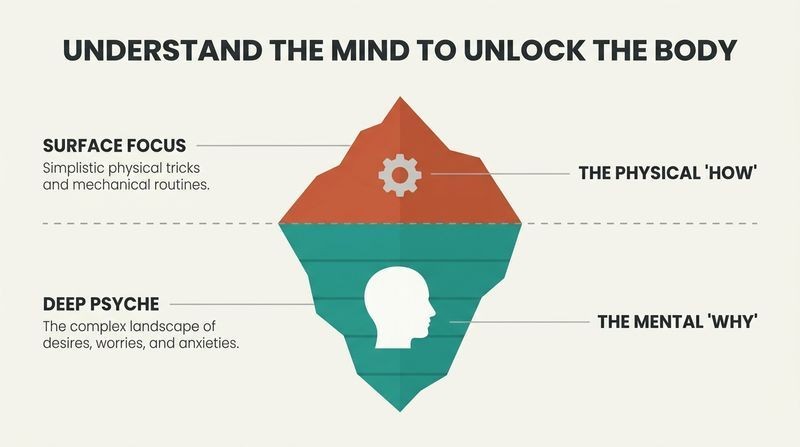
The one head, not two. Kerner's thesis rejects the cliche that men are simple sexual creatures ruled by their genitals. Sex manuals "dumb down" male sexuality into tricks: thigh-high stockings, a signature blow-job move, a spicy position. His counterargument is that men are as layered, anxious, and unfathomable as women, and that the penis is the last thing to understand, not the first.
Great sex is knowing why, not just how. The book promises a "Freaky Friday" tour of the male body, brain, and mind before any technique. Kerner's clinical philosophy borrows from the PLISSIT therapy model (permission, limited information, specific suggestions, intensive therapy) and reframes it as "See Me, Feel Me, Touch Me, Heal Me." A man must first be seen and felt before he can be pleasured.
What's striking is how Kerner inverts the entire genre he writes within. Most male-pleasure guides are mechanical checklists; he argues mechanics without psychology produce hollow orgasms. This echoes Emily Nagoski's later work in Come As You Are, which similarly insists context and mind drive arousal. The framing also has feminist lineage: Kerner explicitly positions this as the sequel to She Comes First, extending the logic of mutual attentiveness. One limitation worth noting: the book generalizes heavily about "men" and "women" from Kerner's clinical anecdotes and informal surveys, which are vivid but not representative samples.
Men armor their pelvis, so unlock it beyond the penis
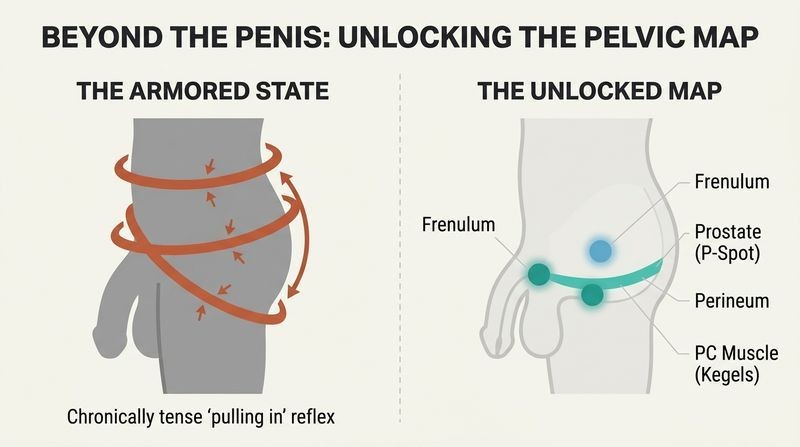
The instinct to protect. From boyhood, males protect their outward-growing genitals, and Kerner argues this reflex hardens into a permanent physical and psychological "pulling in" that grips the whole pelvic region. Yoga instructors, chiropractors, and Rolfers all report the adult male pelvis is chronically tense. Some of this is involuntary, like the cremaster reflex that yanks the testicles upward when the inner thigh is touched.
A whole map beyond the head. He catalogs neglected pleasure zones: the frenulum (the sensitive underside ridge below the glans), the perineum (the nerve-rich "taint"), and the prostate, which he calls the P-spot (P for protected). Men also have a PC (pubococcygeus) muscle, and doing kegels prolongs sex and intensifies climax. Opening the pelvis through relaxation and massage can even make a short penis appear longer.
The "armor" metaphor resonates with somatic psychology, particularly Wilhelm Reich's concept of muscular armoring, where chronic tension encodes emotional defense. Kerner's citation of Rolfing pioneer R. Louis Schultz grounds the idea in bodywork tradition. The claim that pelvic relaxation lengthens the penis is physiologically plausible (retracted penile tissue can descend) but overstated as a selling point. The broader insight is durable: framing sexual pleasure as full-body rather than genitally localized aligns with mindfulness-based sex therapy. The pathologizing of male "control" is provocative, though it risks treating a personality trait as a universal dysfunction to be corrected.
Spectatoring, watching yourself perform, sabotages his pleasure
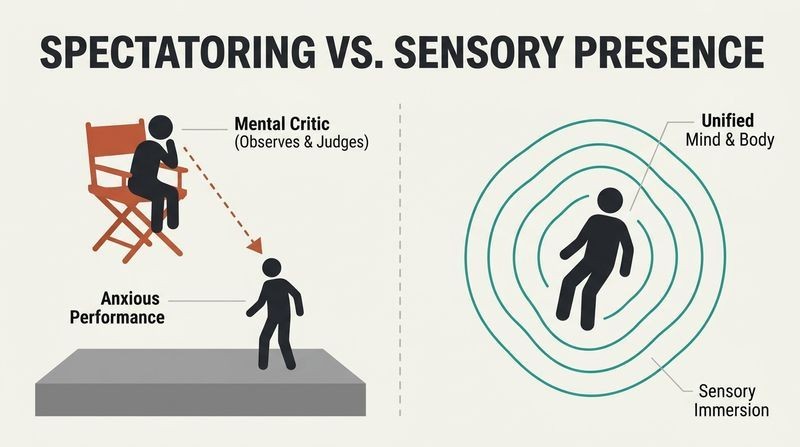
The self-conscious critic. Sex therapists call it spectatoring: mentally standing outside the act, judging your own performance instead of feeling it. Some clinicians consider it the primary cause of male sexual dysfunction. Just as a woman might lose an orgasm fretting about how she looks, a man is derailed by internal questions: Am I big enough? Will I stay hard? Will I last?
Porn and pills raise the stakes. Kerner argues Viagra, Cialis, and Levitra plus internet porn have inflamed a new epidemic of performance anxiety, targeting increasingly younger men. College men brag about recreational Viagra use not from need but to feel powerful. The irony: Viagra creates an expectation of performance only Viagra can meet, reinforcing the very penis-focused, intercourse-obsessed script that breeds anxiety in the first place.
Spectatoring, coined by Masters and Johnson, is one of the most transferable ideas here, essentially a sexual form of what psychologists call metacognitive interference, where monitoring a skill degrades its automatic execution (think of a golfer choking). The parallel to athletic "yips" is exact. Kerner's cultural critique anticipates today's conversations about porn-induced performance anxiety and SSRIs. His claim that spectatoring is the leading cause of dysfunction predates but aligns with mindfulness interventions now shown to reduce it. The critique of pharmaceutical marketing is sharp and largely vindicated by subsequent scrutiny of direct-to-consumer drug advertising.
For men, arousal makes desire; for women, desire precedes arousal
Why Viagra failed on women. Pfizer's drug boosted genital blood flow in both sexes, but only men reliably converted that arousal into wanting sex. Give a man an erection and he wants to use it. Women needed intimacy, trust, humor, and security first. This is why men more easily separate sex from love and can cheat while genuinely loving a partner.
Arousal can be a jumpstart. Kerner cites Rosemarie Basson and Michele Weiner-Davis: being touched leads to arousal, arousal triggers desire. PET scans show men focus more on genital sensation, women on mood and ambience. The practical upshot: sometimes the cure for a sex rut is simply having sex, because sex begets sex. He calls sex "both a poison and its own antidote," with silence and resentment being the poison.
This maps precisely onto the responsive-versus-spontaneous desire distinction popularized by Rosemarie Basson and later Emily Nagoski. The clinical value is enormous: countless couples pathologize a lower-desire partner who actually has normal responsive desire. Kerner deserves credit for surfacing this in 2006. However, the strict gendering (men spontaneous, women responsive) has since softened; research shows plenty of men with responsive desire and women with spontaneous desire, and the pattern correlates more with relationship duration and hormones than sex per se. Still, the actionable core, that engaging physically can generate wanting, is robust and counterintuitively liberating.
Sexual boredom is biochemical, not a sign of a broken relationship
Nature stokes then douses desire. Kerner argues the "seven-year itch" is now a two-year itch, and it has a chemical basis. Relationships move through lust, romantic love, and attachment. Early infatuation floods the brain with dopamine and norepinephrine, natural amphetamines driving obsession and pursuit. Helen Fisher's prairie vole research showed dopamine spikes 50% during their frenzied mating; their nearly identical montane cousins, lacking the receptors, stay promiscuous.
Attachment can starve desire. As couples bond, vasopressin (in men) and oxytocin (in women) produce comfort and security, but elevated vasopressin can lower testosterone, dampening lust. Delayed rewards actually raise dopamine, which is why long-distance couples and even post-argument make-up sex can sizzle. The fix is not a new partner but re-engineering novelty and anticipation to relight the brain.
The neurochemical framing draws heavily on Helen Fisher's tripartite model, which remains influential though critiqued for overreliance on animal models and small human fMRI samples. The vole story is genuinely illuminating: a single receptor difference reshaping mating behavior is a powerful argument for biology over willpower. Kerner's practical translation, manufacture novelty and delay, connects to Arthur Aron's research on self-expanding activities boosting relationship quality. One caveat: attributing boredom purely to chemistry risks letting couples off the hook for neglect, communication failures, and unaddressed resentment, which Kerner himself elsewhere identifies as the real culprits.
Walk the shaky bridge: adrenaline and novelty rekindle desire
The 1974 experiment. Psychologists Dutton and Aron stationed an attractive woman on two bridges over a Canadian canyon: one a terrifying 250-foot swaying suspension bridge, the other low and sturdy. Men she surveyed on the scary bridge were far more likely to call her afterward and ask her out. The mechanism is misattribution, or excitation transfer: the body's leftover arousal from fear gets reinterpreted as romantic attraction. Adrenaline does make the heart grow fonder.
Living on the sturdy bridge. Kerner's metaphor: most couples default to the safe, stable bridge and wonder why passion fades. Desire lives on the shaky one. The goal is not literal danger but importing surprise, risk, and exhilaration into a committed relationship, becoming, in his phrase, "the woman on the shaky bridge," whose greatest asset is her brain, not her body.
The Dutton-Aron bridge study is a social psychology classic, though it has replication caveats and the effect size is debated. The deeper principle, excitation transfer (Dolf Zillmann's theory), is well supported: arousal from one source amplifies emotional responses to another. This explains why couples report intense sex after skydiving, roller coasters, or fights. Kerner's genius is turning a lab finding into a relationship philosophy. The risk is that thrill-seeking becomes a treadmill; habituation means today's shaky bridge becomes tomorrow's sturdy one. Sustainable eroticism, as Esther Perel argues in Mating in Captivity, may depend more on cultivating mystery and separateness than on adrenaline spikes.
Fantasy is the mind's fingerprint, so stop suppressing it
Your erotic signature. Kerner calls fantasy the engine of desire and the lubricant of arousal. Physiologically all orgasms are identical (blood flow, muscle tension, contractions), so what makes 1,200 trillion human sex acts unique is imagination. Fantasizing during sex, even about someone other than your partner, is normal and healthy, not betrayal. Deactivation of fear centers in the brain is what lets orgasm happen; fantasy helps the mind let go.
Don't feed the white bear. He invokes psychologist Daniel Wegner's suppression study: told not to think of a white bear, subjects thought of nothing else. Suppressing a forbidden fantasy only amplifies it. Kerner traces the shame to Freud's notion that only unhappy people fantasize. Fantasies flow from our "love maps" (John Money's term for each person's unique erotic template), formed by childhood, early masturbation, and unmet emotional needs.
The white-bear experiment (ironic process theory) is one of psychology's most robust findings and applies far beyond sex, from dieting to intrusive thoughts in OCD. Kerner's use of it to destigmatize fantasy is therapeutically sound; guilt-driven suppression reliably backfires. The love-map concept, borrowed from sexologist John Money (whose broader legacy is deeply controversial), remains a useful metaphor even if its developmental mechanics are unproven. Kerner's real target is porn: he argues prefabricated visual fantasy crowds out the organic development of one's own erotic imagination, a claim that anticipates current debates about how ubiquitous streaming porn shapes desire and expectation.
Foreplay happens outside the bedroom, so decouple it from intercourse
Coreplay, not foreplay. Kerner rejects the dictionary definition of foreplay as mere warm-up for the "main event" of intercourse. That framing makes sex scripts predictable and keeps intercourse as the fixed endpoint. He coins coreplay: oral, manual, and sensual pleasuring treated as self-contained, equally valuable acts on a fluid menu, none ranked above another.
Eros as a lust for life. Foreplay, he argues, is mental and continuous. It is a squeeze under a restaurant table, a suggestive text at lunch, a stolen makeout in a movie theater, none of which need lead to sex. Intermittent rewards keep the brain lit up more than guaranteed ones. He invokes Freud's other definition of eros as "the life instinct," reframing foreplay as infusing daily life with erotic charge rather than performing a checklist before penetration.
Decoupling pleasure from intercourse is quietly radical and therapeutically potent; sensate-focus therapy (Masters and Johnson) works precisely by banning intercourse to remove goal pressure. The intermittent-reward point borrows from operant conditioning: variable reinforcement schedules produce the most persistent behavior, which is also why slot machines and dating apps are addictive. Kerner weaponizes this for intimacy. The reframe from foreplay to coreplay is more than semantic; it dismantles the coital imperative that leaves many women unsatisfied. The main tension is that some partners genuinely want intercourse as culmination, and a philosophy that de-privileges it must still honor that desire rather than replacing one orthodoxy with another.
For men, sex is often the only language of intimacy
Making love, not just fucking. Kerner provocatively claims men are in some ways more interested in making love than women, because for men sex is frequently the primary, sometimes only, channel for expressing emotion. Men are less socialized to cry, talk feelings, or show affection, so sexual intimacy carries a heavy emotional charge. Brain scans show more activity in men's insula, which links physical sensation to emotional significance.
The disconnection trap. This explains puzzling behaviors: a man initiates sex after a bitter argument hoping to reconnect, then is baffled his partner is still angry. He has "put the issue to bed"; she has not. It also explains why sexual disconnection makes men emotionally withdraw, increasing vulnerability to affairs. After a baby, rising oxytocin lowers a mother's testosterone and libido, while the new father feels like a third wheel, a dangerous combination.
This reframe challenges the lazy stereotype that women want connection and men want release. Kerner argues the arrow can run the other way: men often lack alternative intimacy outlets, so sex becomes overloaded with meaning. This aligns with research on male "restrictive emotionality" and alexithymia, and with sociologist work on how norms of masculinity limit men's emotional repertoires. The post-baby libido dip is well documented, driven by prolactin, oxytocin, exhaustion, and identity shift. The practical takeaway, that maintaining any physical connection (not necessarily intercourse) protects the emotional bond, is sound. The generalization still leans on Kerner's clinical impressions rather than controlled data.
Aim for a global orgasm by refusing to act locally
Local versus global. Kerner distinguishes a local orgasm (sharp, contained, penis-based) from a global one (full-bodied, resonant, spreading through the whole body). Because men rush through a compressed arousal arc with genital-only stimulation, they rarely build enough total-body muscular tension (myotonia) for the bigger release. The fix is relaxation: stress redirects blood to the limbs for fight-or-flight, while calm redirects it to the genitals. That is why men often get erections during massages.
Slow him down deliberately. Practical tactics: get him fully naked ("socks-off sex"), since skin is the largest organ; blindfold him to heighten touch; tie him up to relieve performance pressure and let him surrender control; and use his three erection types. Kerner reframes male arousal on a 1-to-5 scale that partners should stretch back toward 1-to-10, lingering in low-level arousal instead of racing to ejaculation.
The local/global distinction parallels tantric and Taoist traditions Kerner references through the White Tigress material, and echoes findings that whole-body muscular tension amplifies orgasm intensity. The relaxation-arousal link is physiologically accurate: erection is a parasympathetic (rest-and-digest) function, which is exactly why anxiety, a sympathetic state, causes dysfunction. Encouraging surrender and receptivity in men counters a cultural script demanding constant control, and the bondage-as-relaxation reframe is psychologically astute. One caveat: the claim that men "rarely" achieve global orgasm is hard to verify and may reflect selection bias in a sex therapist's caseload. Still, the prescription (slow down, relax, distribute sensation) is low-risk and widely echoed in sex therapy.
Premature ejaculation means distribute pleasure, don't dampen it
Silent and widespread. Kerner reports PE is roughly three times more common than erectile disorder in the US, yet sufferers hide it. Ironically women often read fast ejaculation as a flattering sign of passion, while erectile difficulty gets misread as rejection. Bad masturbation habits, decades of rushing to the glans, hard-wire rapid response.
The wrong fix and the right one. Desperate men wear double condoms, numb themselves, drink, or recite baseball stats, all attempts to reduce sensation. Kerner argues this is backward. The goal is to increase and spread pleasure across the body rather than deaden it. Strengthening the PC muscle through kegels helps a man separate orgasm from ejaculation and last longer. The frenulum squeeze technique, momentarily pressing blood out of the glans, delays the point of ejaculatory inevitability while building propulsive force for a stronger climax.
Kerner's reframe (redistribute rather than reduce sensation) is more sophisticated than the numbing-and-distraction folk remedies, which studies confirm are largely ineffective and can worsen anxiety. The squeeze technique traces to Masters and Johnson and remains a first-line behavioral treatment, alongside the stop-start method. The PC-muscle training claim is plausible; pelvic floor physiotherapy has growing evidence for PE. The masturbation-conditioning hypothesis is intuitive but not firmly established. Worth adding: PE has both lifelong (neurobiological, serotonin-linked) and acquired subtypes, and the lifelong form often responds better to pharmacology than behavioral tricks alone, a nuance the book's empowerment framing understates.
Lasting passion comes from mutual self-expansion, not new partners
Charlie's secret. The book opens and closes with Charlie, a Clooney-handsome colleague who brags about incredible sex with different women, until Kerner learns they are all one woman: his wife of nine years. Asked his secret, Charlie says they do nothing special. His insight, drawn from a TV show about the expanding universe, is that Einstein's blunder was assuming the cosmos was static, and couples make the same mistake assuming their relationship is fixed.
Fall in love with yourself through their eyes. Kerner connects this to Aron's theory that falling in love is self-expansion: the electric rush of discovering another person and rediscovering yourself. When couples stop asking questions, expansion stops and satisfaction plummets. Couples who keep doing novel, growth-oriented activities together sustain awe indefinitely. Charlie would not trade one night with his wife for a year at the Playboy Mansion, because their shared secret fantasies keep expanding "like the universe."
The Charlie bookend is effective narrative craft: it reframes the entire technique-heavy manual around a man whose sex life is spectacular precisely because it is not about technique. The self-expansion model (Arthur and Elaine Aron) is one of the better-supported theories in relationship science; couples assigned novel, challenging joint activities report higher satisfaction than those doing merely pleasant ones. The universe metaphor is a memorable delivery of the habituation problem. The honest limitation is survivorship bias: Charlie is one happy anecdote, and "keep expanding together" is easier prescribed than practiced amid careers, kids, and fatigue. Still, it locates eroticism in curiosity rather than acrobatics.
Analysis
He Comes Next is a 2006 sexuality self-help book structured in two halves: a physiological and psychological tour of male sexuality (Part I) and a technique manual (Part II). Its cleverness lies in a bait-and-switch: marketed as a guide to pleasuring men, it is really an argument that technique is worthless without psychology, and that male sexuality is far more emotionally freighted and anxiety-ridden than culture admits. Kerner explicitly frames the book as the feminist companion to his bestseller She Comes First, extending mutual-attentiveness logic in the reverse direction.
The book's intellectual spine is borrowed rather than original: Masters and Johnson's response cycle and spectatoring, Helen Fisher's neurochemistry of love, Basson's responsive desire, Dutton and Aron's bridge study, Wegner's ironic-process theory, and John Money's love maps. Kerner's contribution is synthesis and translation, taking scattered research and repackaging it into actionable relationship philosophy with memorable coinages: coreplay, the shaky bridge, local versus global orgasm, the P-spot, and SADD (sexual attention deficit disorder). His prose is relentlessly punny and breezy, which both aids accessibility and occasionally undercuts authority.
Methodologically, the book's weakness is its evidentiary base: much rests on Kerner's clinical anecdotes and small informal surveys, dressed with citations to legitimate studies. The heavy gender essentialism (men visual and spontaneous, women olfactory and responsive) reflects mid-2000s sexology and has since been complicated; the binary, heteronormative framing dates it. The pharmaceutical and porn critiques, by contrast, were prescient and align with current concerns about performance anxiety.
What endures is the reframe of male sexuality as guarded, anxious, and hungry for emotional connection rather than mechanically simple. The most transferable ideas, spectatoring, responsive desire, excitation transfer, decoupling pleasure from intercourse, and self-expansion as the antidote to boredom, remain staples of contemporary sex therapy. Read today, it is best treated as an accessible gateway to better-sourced works like Nagoski's Come As You Are and Perel's Mating in Captivity.
Review Summary
He Comes Next receives mixed reviews, with an average rating of 3.69/5. Readers appreciate its insights into male psychology and sexuality, finding it informative and eye-opening. Many value the focus on intimacy and emotional connection rather than just physical techniques. Some praise its feminist perspective and recommend it for both men and women. Critics find it obvious or lacking in new information. Overall, readers appreciate the book's approach to understanding male desire and improving sexual relationships, though some feel it could be more comprehensive or inclusive.
People Also Read





FAQ
1. What is "He Comes Next" by Ian Kerner about?
- A thinking woman’s guide: The book is a comprehensive guide for women who want to better understand and pleasure their male partners, focusing on both physical techniques and the psychological aspects of male sexuality.
- Beyond sex tips: Kerner aims to provide more than just sexual techniques; he offers a vision for a more connected, mutually satisfying sexual relationship.
- Male sexuality demystified: The book explores the complexity of male desire, arousal, and emotional needs, debunking myths and stereotypes about men being simple or always ready for sex.
- Empowerment and equality: It positions women as empowered partners who can lead, innovate, and inspire better sex for both themselves and their partners.
2. Why should I read "He Comes Next" by Ian Kerner?
- Level up your sex life: The book offers actionable advice for women who want to enhance intimacy, pleasure, and communication in their relationships.
- Understand the male perspective: It provides rare insight into the male sexual experience, including anxieties, desires, and the impact of cultural pressures.
- Move beyond clichés: Kerner challenges the idea that men are easy to please or only care about intercourse, showing that men are as complex and emotionally driven as women.
- Mutual satisfaction focus: The book emphasizes that great sex is about shared pleasure, not just male gratification, and that women’s enjoyment is central to a fulfilling sex life.
3. What are the key takeaways from "He Comes Next" by Ian Kerner?
- Male sexuality is complex: Men’s sexual needs and anxieties are often misunderstood or oversimplified; understanding them leads to better intimacy.
- Communication is crucial: Open, honest conversations about desires, fantasies, and insecurities are essential for a satisfying sex life.
- Foreplay and coreplay matter: Kerner redefines foreplay as an ongoing, essential part of sexual connection, not just a prelude to intercourse.
- Pleasure is mutual: The best sex happens when both partners are engaged, present, and focused on each other’s enjoyment, not just the end goal of orgasm.
4. How does Ian Kerner define and address male sexual anxiety in "He Comes Next"?
- Spectatoring and performance pressure: Kerner discusses how men often become self-conscious during sex, worrying about performance, size, and stamina, which can inhibit pleasure.
- Impact of porn and pharmaceuticals: The book explores how porn and drugs like Viagra can increase anxiety by setting unrealistic standards for male sexuality.
- Encouraging vulnerability: Kerner advocates for creating a safe space where men can let go of control, be vulnerable, and experience deeper pleasure.
- Role of the partner: Women are encouraged to reassure, communicate, and help men move beyond performance anxiety by focusing on connection and enjoyment.
5. What is the "shaky bridge" concept in "He Comes Next" by Ian Kerner?
- Origin in psychology: The "shaky bridge" refers to a psychological study where heightened excitement (from crossing a shaky bridge) increased sexual attraction, illustrating the power of novelty and adrenaline in desire.
- Metaphor for relationships: Kerner uses the shaky bridge as a metaphor for the excitement and risk that can reignite passion in long-term relationships.
- Practical application: He encourages couples to seek out new, thrilling, or slightly risky experiences together to stimulate desire and keep sex fresh.
- Empowering women: The "woman on the shaky bridge" is a symbol of a woman who understands and leverages the psychology of desire to create lasting attraction.
6. What are the main myths about male sexuality that "He Comes Next" by Ian Kerner debunks?
- Men are always ready for sex: The book shows that men’s desire is not constant and can be affected by stress, emotional connection, and relationship dynamics.
- Size is everything: Kerner explains that penis size is less important than most people think, and emotional connection and technique matter more.
- Men don’t need foreplay: The book argues that men benefit from and enjoy extended foreplay, sensual touch, and emotional intimacy.
- Men don’t have sexual insecurities: Kerner reveals that men often worry about performance, pleasing their partners, and being "normal," just like women do.
7. How does "He Comes Next" by Ian Kerner explain the male sexual response cycle?
- Five stages of response: The book covers desire, arousal, plateau, orgasm, and resolution, emphasizing that desire is not just the starting point but weaves throughout.
- Three types of erections: Kerner details psychogenic (mental), reflex (physical), and nocturnal (spontaneous) erections, each playing a role in male arousal.
- Orgasm vs. ejaculation: He clarifies that orgasm and ejaculation are related but distinct processes, and men can experience different types of orgasms.
- Importance of slowing down: The book encourages slowing the process to maximize pleasure and intimacy, rather than rushing to orgasm.
8. What practical techniques and advice does Ian Kerner offer for pleasuring a man in "He Comes Next"?
- Focus on the whole body: Kerner advocates for exploring the entire male pelvis and body, not just the penis, to enhance pleasure.
- Manual and oral techniques: The book provides detailed, step-by-step advice for manual stimulation, oral sex, and integrating these with emotional connection.
- Building anticipation: Techniques include teasing, varying touch, and using non-genital stimulation to build arousal before direct stimulation.
- Encouraging male submission: Kerner suggests that allowing men to be passive, tied up, or blindfolded can be highly pleasurable and help them let go.
9. How does "He Comes Next" by Ian Kerner address the role of fantasy and communication in sexual satisfaction?
- Fantasy as a healthy tool: The book normalizes sexual fantasy for both partners, emphasizing that it’s natural and can enhance intimacy.
- Overcoming guilt and shame: Kerner discusses how cultural and personal inhibitions can block the enjoyment of fantasy, and encourages open, nonjudgmental sharing.
- Practical exercises: He offers exercises for couples to safely share and explore fantasies, such as the "I want" statements and "I had a dream" technique.
- Fantasy fuels desire: Embracing and communicating about fantasies can break routine and reignite passion in long-term relationships.
10. What is the difference between "foreplay" and "coreplay" in "He Comes Next" by Ian Kerner?
- Redefining foreplay: Kerner argues that foreplay should not be seen as a mere prelude to intercourse, but as an essential, ongoing part of sexual connection.
- Coreplay concept: "Coreplay" is Kerner’s term for all non-intercourse sexual activities (manual, oral, sensual touch) that are valuable in their own right.
- Mutual pleasuring: The book encourages couples to see all forms of sexual activity as equally important, moving away from a hierarchy that puts intercourse at the top.
- Expanding the menu: By embracing coreplay, couples can keep sex varied, creative, and satisfying for both partners.
11. How does "He Comes Next" by Ian Kerner suggest couples can keep sex exciting in long-term relationships?
- Novelty and risk: Kerner recommends introducing new experiences, settings, and playful risks (the "shaky bridge" approach) to stimulate desire.
- Role of anticipation: Building sexual anticipation outside the bedroom through flirting, sexting, or planning surprises can reignite passion.
- Exploring fantasies together: Sharing and sometimes acting on fantasies keeps the relationship dynamic and prevents boredom.
- Continuous communication: Regular, honest conversations about desires, boundaries, and satisfaction help couples adapt and grow together sexually.
12. What are the best quotes from "He Comes Next" by Ian Kerner and what do they mean?
- "Sex is about expanding who we are, what we want, and what we think we want in the most incredibly intimate way."
- This quote encapsulates Kerner’s belief that sex is a journey of mutual growth, discovery, and self-expansion, not just a physical act.
- "The sex you give is only as good as the sex you get."
- Kerner emphasizes that mutual pleasure and satisfaction are essential; one partner’s enjoyment enhances the other’s.
- "Great sex isn’t about techniques or knowing what works; it’s about knowing how and why it works."
- The book prioritizes understanding, communication, and emotional connection over rote sexual tricks or positions.
- "You’re not simply going to play the part of the woman on the shaky bridge; you are the woman on the shaky bridge."
- This quote encourages women to embrace their power, creativity, and agency in shaping their sexual relationships.
About the Author
Other books by Ian Kerner

Download PDF
Download EPUB
.epub digital book format is ideal for reading ebooks on phones, tablets, and e-readers.








































