

Key Takeaways
Eight Greek gods live inside every man, shaping who he can be
Archetypes are inner blueprints. Bolen, a Jungian analyst, argues that the Greek gods are not quaint myths but living psychological patterns (archetypes) inherited through what Jung called the collective unconscious. Each god represents a distinct constellation of drives, emotions, and ways of perceiving. A Zeus man wants to rule; a Hermes man cannot stop moving; a Hephaestus man retreats to his workshop.
Nature plus circumstance. She compares archetypes to crystals (an invisible pattern that determines the shape once formed) and to seeds (whose growth depends on soil, care, and climate). Most men are a blend of several gods, with one or two dominant, and different gods rise at different life stages. Knowing which gods are active tells a man what work and love will feel meaningful.
The framework extends Jung's typology into a vivid, memorable pantheon, and its strength is granularity: rather than lumping men into "introvert" or "type A," it offers eight textured portraits. Critics of archetypal psychology note it resists falsification, functioning more like a hermeneutic lens than a testable theory. Still, its clinical value mirrors modern personality science, where Big Five traits or attachment styles similarly describe stable predispositions shaped by gene-environment interaction. The seed-and-crystal metaphor anticipates today's language of genetic potential expressed through epigenetics. What distinguishes Bolen is her insistence that these patterns carry sacred meaning, not just behavioral tendency.
Conformity is a Procrustean bed that amputates the parts of you that don't fit
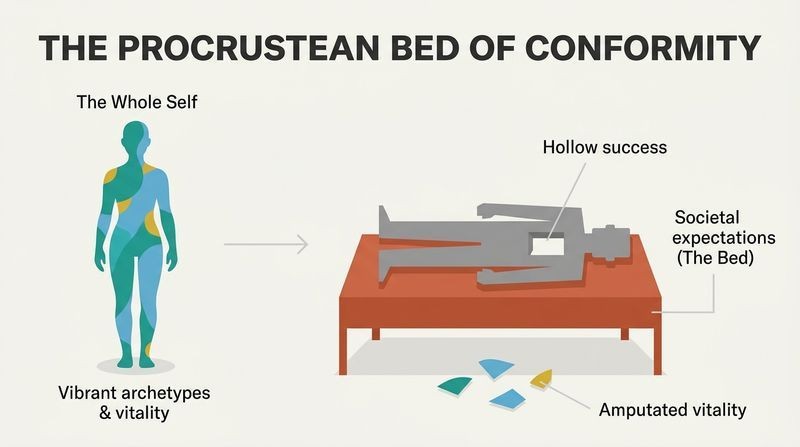
Success can feel empty. Bolen borrows the myth of Procrustes, the innkeeper who stretched short travelers or cut off the limbs of tall ones to fit his iron bed. Patriarchal culture, she argues, does the same to men psychologically, rewarding some archetypes and mutilating others. A man may look the part yet be inwardly hollow.
The editor who died a little. She cites William Broyles Jr., who ran Newsweek and confessed that each morning in his suit he "died a little," having climbed the wrong mountain. His marriage collapsed as he searched for what actually mattered. Bolen sees this as the signature male midlife ailment: a low-grade depression that arrives when a man is cut off from his own sources of vitality, masked by overwork, alcohol, or television.
The Procrustean image lands because it reframes achievement as potential self-harm, a counterintuitive claim in a success-worshipping culture. It resonates with Arthur Brooks's research on the "striver's curse" and with self-determination theory, which finds that externally driven goals (status, wealth) predict worse wellbeing than intrinsically aligned ones. Bolen's diagnosis of masculine depression as numbed disconnection presages later men's-health work by Terrence Real, who described male depression as covert and often masked by irritability or addiction. The scope limitation worth flagging: not every unhappy executive is betraying an archetype. Sometimes circumstances, not authenticity gaps, drive the malaise.
The Oedipus myth begins with a father trying to kill his son, not the reverse
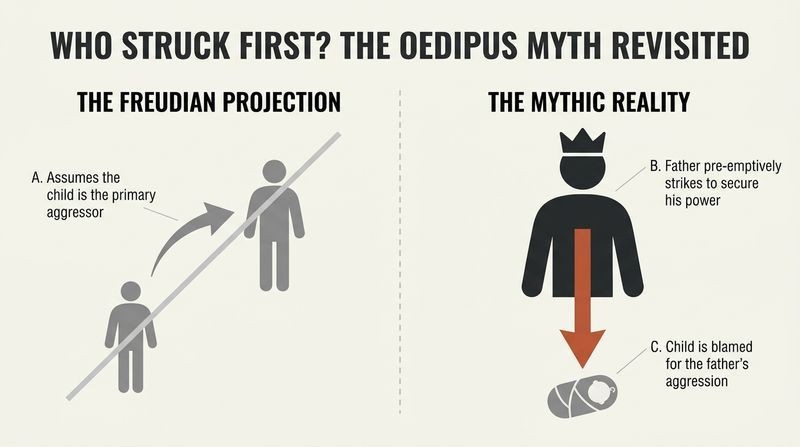
Blame the father, not the child. Freud built psychoanalysis on the son's supposed wish to kill his father and marry his mother. Bolen, drawing on Alice Miller, flips the script. In the actual myth, King Laius pierces baby Oedipus's ankles and leaves him to die because of a prophecy. Oedipus, raised elsewhere, kills a stranger on the road in self-defense, unaware it is his father.
A pattern across Sky Fathers. This mirrors Uranus burying his children, Cronus swallowing his, and Zeus swallowing pregnant Metis. Each father fears being overthrown and treats the newborn as a rival. Bolen calls the father who consumes a child's autonomy the "Cronus complex." The culture then blames children for what was done to them, echoed in the abused boy who concludes "I must deserve this."
This reversal is the book's most provocative scholarly move, and Alice Miller's influence is decisive. Miller argued that psychoanalysis systematically protected parents by locating pathology in children's fantasies. Bolen's application to mythology is elegant: the prophecy is a rationalization, the modern equivalent being what she calls a paranoid projection of the shadow. Attachment research and studies on the intergenerational transmission of abuse support the mechanism she describes, where maltreated children internalize blame and later repeat the pattern. The steelman for Freud is that internal conflict is real too. Bolen's contribution is insisting the wound usually starts with the wounder.
Match your work to your inner god or effort will never feel like joy
Doing is becoming. Bolen insists work satisfies only when it aligns with an active archetype. A Hephaestus man loses himself for hours in a basement workshop; a Hermes man thrives on the road making deals; an Apollo man excels at mastering skills and hitting distant targets. Force one to do the other's job and work becomes drudgery that drains rather than feeds.
Take the time. Because archetypes are activated by action ("doing is becoming"), a man must protect space for the god within. The businessman who loves woodworking must stop bringing office work home. The former athlete must join a neighborhood team or lose touch with his Ares energy. Bliss, she writes, comes in moments when what we do is consistent with our archetypal depths, making even ordinary acts feel sacred.
This is Bolen at her most actionable, and it converges strikingly with Csikszentmihalyi's flow research, where absorption arises when challenge meets intrinsic aptitude. Her "doing is becoming" also anticipates behavioral activation therapy and the identity-through-action thesis of James Clear, who argues habits vote for the self you become. The vocational implication is practical: audit where you lose track of time, then engineer more of it. A useful caution is that few people enjoy the luxury of perfectly god-matched work. Bolen's own examples skew toward artists and executives; the framework matters most when applied to how one spends discretionary time.
Zeus men command empires but can't feel their own hearts
The talking head is an incomplete man. Zeus, god of sky, will, and power, is the ruling archetype of patriarchy: the CEO, the alpha male, the dynasty builder who forges alliances and hurls thunderbolts (fires people) without losing sleep. His symbols, the eagle and thunderbolt, capture his gift for the panoramic overview and swift decisive strike. But he lives in his head, cut off from body and emotion.
The wound that won't heal. Bolen invokes the Grail legend's wounded king whose kingdom becomes a wasteland until an innocent fool asks "What ails thee?" The Zeus man rarely seeks help; growth arrives only through humbling crisis, a heart attack (the neglected organ of emotion literally failing), falling helplessly in love, or a wife or child cutting him off, forcing him down from the mountain.
The portrait aligns with research on power's corrosive effects: Dacher Keltner's studies show that gaining power reliably reduces empathy and perspective-taking, the "power paradox" in which the traits that earn status erode once status is achieved. Lord Acton's maxim about absolute power appears here as lived psychology. The heart-attack-as-metaphor is poetic rather than causal, though cardiology does link chronic hostility and emotional suppression to cardiac risk. Bolen's therapeutic insight, that a Zeus rarely enters therapy except at a spouse's insistence, matches clinical patterns in help-seeking, where men present later and often only under relational pressure.
Repressed emotion doesn't vanish; it erupts like Poseidon's tidal waves and earthquakes
The sea beneath the surface. Poseidon rules emotion and instinct, the moody, powerful ocean that can turn turbulent and batter everything in its path. In patriarchal culture this archetype gets repressed, driven underground in men trained to keep a lid on feeling. But buried emotion stays alive. It resurfaces as flooding rage or grief, often unleashed at home, the one place a man is permitted fury.
Two failure modes. Bolen distinguishes the tidal wave (an amplified version of normal feeling that overwhelms rationality) from the earthquake (feelings kept in underground caverns until pressure builds and the ground splits open). The remedy is developing an observing "I", an ego that can watch a complex take over and, by watching, drain its power. Creative expression, the deep-sea diver poet or composer, channels the same depths into beauty.
The hydraulic model of emotion, that suppressed feeling accumulates and bursts, is intuitive and partly supported. Research on expressive suppression (Gross) shows it increases physiological arousal and impairs relationships, consistent with Bolen's eruptions. Yet the pure catharsis premise is contested: venting anger often reinforces rather than discharges it (Bushman's work). Her stronger prescription, the observing "I," maps precisely onto mindfulness and metacognitive therapy, where labeling and witnessing an emotion loosens its grip. Bolen intuited decades early what affect-labeling neuroscience now shows: naming a feeling dampens amygdala activation. The domestic-violence linkage she draws is sober and clinically important.
Solitary, subjective men aren't broken; they carry Hades' underground riches
The invisible man. Hades, lord of the underworld, wore a cap of invisibility and rarely left his realm. As an archetype he is the introvert, the recluse, the man with little persona who reacts to inner subjective impressions rather than outer reality. In an extroverted, productivity-worshipping culture he is judged weird or inferior, and often internalizes that verdict as low self-esteem.
Riches in the dark. Yet Hades was also called Plouton, "the rich one." His realm holds the personal and collective unconscious, the source of dreams, visions, and creative depth. Bolen notes Hades men make natural depth psychologists, artists, and companions to the dying. Their growth requires crafting a persona to become visible, finding a "Persephone" who mediates them to the world, and activating Hermes to communicate the treasures they perceive within.
Bolen dignifies introversion long before Susan Cain's "Quiet" made the case to a mass audience, and her framing is arguably richer because it ties inwardness to creativity and mortality work. The comparison she draws, that a Hades man in an extroverted culture resembles a Black man in a white world, absorbing negative projections, is striking sociologically though it flattens important differences. Her Jungian "inferior function" language maps onto modern findings that introverts are penalized in Western workplaces despite comparable performance. The clinical caution: she carefully distinguishes healthy introversion from schizoid withdrawal and psychotic distortion, a nuance pop-psychology treatments of introversion often blur.
Aggression, sensuality, and ecstasy get exiled as the patriarchy's rejected sons
Zeus played favorites. Among his sons, Zeus favored the cerebral, emotionally distant Apollo and Hermes, the archetypes that get men ahead. He detested Ares (raw physical aggression and passion) and rejected Hephaestus (the wounded craftsman). Dionysus (ecstasy, sensuality, mysticism) he viewed with ambivalence. Bolen argues our culture repeats this favoritism inside each man's psyche.
The cost of exile. Ares, god of war, is also a dancer and a lover fully present in his body, yet men are shamed for such intensity (think John McEnroe booed for raging on a tennis court where Apollonian composure is demanded). Hephaestus channels rejection into creation. Dionysus offers ecstatic merger but risks madness. Bolen sees these devalued gods as the amputated emotional, sensual, and instinctual limbs modern men most need to reclaim for wholeness.
This is the book's cultural thesis in miniature: the patriarchy is bad for men too, not just women, because it rewards a narrow bandwidth of masculinity and pathologizes the rest. The claim finds support in contemporary work on "precarious manhood" (Vandello and Bosson), where masculinity is treated as a status constantly at risk and defended through emotional constriction. Bolen's observation that Ares energy, if honored, could flow into dance or protective devotion rather than violence is a genuinely generative reframe, echoing sublimation theory. The Ares-as-scapegoat analysis, linking the archetype to how societies project denigrated traits onto marginalized men, remains sharp social criticism.
Perpetual charmers like Hermes dazzle at beginnings but flee every commitment
Quicksilver personified. Hermes, the messenger god (Roman Mercury, hence "mercurial"), embodies quick wit, eloquence, travel, and trickery. As an archetype he is the salesman, negotiator, communicator, and guide who crosses every boundary with ease and rarely worries whether something is legal or right. Charming and inventive, he slips through the fingers of anyone trying to hold him.
The eternal adolescent trap. His shadow is the Puer Eternus, the man who never grows up, flitting job to job, woman to woman, thinking he has all the time in the world until midlife reveals he doesn't. Bolen's remedy: Hermes must develop Apollo (discipline, finishing what he starts) and seek a Zeus mentor (authority, respect for consequences). His genuine gift, when matured, is as a guide of souls, the therapist or teacher who accompanies others through transitions.
The Puer Eternus, drawn from Marie-Louise von Franz, remains one of Jungian psychology's most clinically useful concepts, describing arrested development masked by charm and possibility. It resonates with modern discussions of "failure to launch" and with attachment-avoidant relational patterns, where intimacy triggers flight. Bolen's prescription, importing Apollo's follow-through and Zeus's accountability, is essentially a call for ego-strengthening and mentorship, consistent with research showing that structure and committed relationships mature impulsive temperaments. The trickster's cross-cultural ubiquity (Coyote, Raven, Loki) that she notes underscores a deep point: societies both need and distrust the boundary-crosser who innovates precisely by breaking rules.
Your creative wound can parent you: rejection forges the Hephaestus craftsman
The only god who worked. Hephaestus, the lame smith flung off Olympus by a rejecting parent, was the sole Olympian who labored, forging beauty at his underground forge. Bolen makes him the archetype of the wounded creator whose art emerges from injury. He couldn't be beautiful, so he made beauty; his foot failed, but what he made worked perfectly, and through that reflection he recovered self-respect.
Wounds as parents. Quoting James Hillman, "the parent is the wound," she argues our wounds can become the mothers and fathers of our destinies. Young Jung, rejected by Freud and cast into isolation, recovered by literally rebuilding the stone villages of his boyhood, unlocking a stream of creative work. The Hephaestus man's danger is bottled rage and depression; his salvation is finding a medium to transform pent-up feeling into something visible.
The wounded-healer motif has deep roots (Chiron, the injured centaur who heals others) and strong modern echoes in post-traumatic growth research (Tedeschi and Calhoun), which finds that a subset of trauma survivors report increased creativity, meaning, and strength. Bolen's mechanism, externalizing inchoate inner pain into tangible form, aligns with expressive-writing studies (Pennebaker) showing health benefits from narrating adversity. The Jung anecdote is well documented and powerful. A necessary nuance: the romanticization of the wounded artist can obscure that untreated depression and rage more often destroy than create. Bolen is careful to specify that transformation requires a medium, skills, and enough nurture to survive the wound.
Culture can grow a new archetype once enough men choose love over power
The missing god. Bolen ends with the son of Metis (feminine wisdom) and Zeus, a foreseen child who would rule with an all-loving heart but was never born because Zeus swallowed pregnant Metis. She reads this as patriarchy swallowing feminine wisdom for millennia. Its return, through ecology, women's spirituality, and global interdependence, signals cultural transition.
How change propagates. She enlists Rupert Sheldrake's morphic field hypothesis and the parable of the Hundredth Monkey (when enough monkeys on one island learned to wash sweet potatoes, monkeys on distant islands suddenly did too). Her claim: as one man at a time trusts love over power, it grows easier for others, until a critical mass tips a new archetype into the collective unconscious. Luke Skywalker refusing to become his father is her mythic emblem of this choice.
This closing swings from clinical psychology to speculative metaphysics, and readers should know that Sheldrake's morphic resonance is rejected by mainstream biology as unfalsifiable, and the Hundredth Monkey story has been debunked as a distortion of the original primate research. As literal science, the chapter is weak. As myth and moral vision it is potent: the idea that individual acts of courage compound socially finds sturdier support in tipping-point sociology (Granovetter thresholds, Damon Centola's work on how roughly 25% minorities can flip social norms). Bolen's core exhortation, that we settle for power only when denied love, is a humane and quietly radical reframing of ambition.
Analysis
"Gods in Everyman" (1989) is Jean Shinoda Bolen's companion to "Goddesses in Everywoman," a Jungian typology of male psychology built on eight Greek gods. As a Jungian analyst and psychiatrist, Bolen occupies an unusual authorial position she foregrounds: a woman interpreting men's inner lives, drawing on the historical role of women as "dream carriers" and confidantes to men who confide little in each other. This vantage gives the book both intimacy and a built-in critical edge, since its organizing polemic is that patriarchy wounds men as surely as women.
Structurally the book is an anthology of archetypes wrapped in a thesis. Three father gods (Zeus, Poseidon, Hades) divide the psyche into power, emotion, and the unconscious; five sons (Apollo, Hermes, Ares, Hephaestus, Dionysus) represent favored and rejected ways of being male. Each chapter spirals from myth to archetype to life stages to pathology to growth, a repetitive but pedagogically effective structure.
The book's enduring value is threefold. First, its Alice Miller-inspired reinterpretation of the Oedipus and Sky Father myths, relocating aggression from son to father, remains a genuinely subversive contribution to how we read the origins of male wounding. Second, its dignification of the rejected archetypes (introverted Hades, emotional Poseidon, creative Hephaestus, ecstatic Dionysus) anticipates decades of later work on introversion, emotional literacy, and precarious manhood. Third, its practical throughline, that meaning and vitality require aligning action with one's dominant archetype, converges with flow research and self-determination theory.
The weaknesses are equally clear. Archetypal psychology resists empirical testing, and the final chapter's reliance on morphic fields and the discredited Hundredth Monkey story undercuts scientific credibility. The framework can also become a Procrustean bed of its own, sorting messy individuals into eight mythic boxes. Read as clinical poetry rather than data, though, Bolen offers a compassionate, still-relevant map for men seeking wholeness beyond the narrow success their culture rewards.
Review Summary
Gods in Everyman explores male archetypes through Greek mythology, offering insights into men's psychology and behavior. Readers find it useful for self-discovery and understanding others, though some criticize its focus on patriarchy. Many appreciate the book's depth and applicability, comparing it favorably to "Goddesses in Everywoman." Some find it repetitive or biased, while others praise its analysis of masculinity. The book resonates differently with readers based on their life experiences and familiarity with Jungian psychology. Overall, it's seen as a valuable resource for personal growth and relationship understanding.
People Also Read


FAQ
What's Gods in Everyman about?
- Exploration of Archetypes: Gods in Everyman by Jean Shinoda Bolen explores male archetypes derived from Greek mythology, such as Zeus, Poseidon, and Hades, and how they shape men's lives.
- Cultural Context: The book examines how these archetypes influence men's behavior, relationships, and self-perception within a patriarchal society.
- Integration of Archetypes: Bolen encourages readers to recognize and integrate these archetypes for greater self-awareness and emotional depth.
Why should I read Gods in Everyman?
- Understanding Male Psychology: The book provides insights into the psychological struggles men face, particularly regarding societal expectations and personal identity.
- Empowerment Through Knowledge: Learning about the gods within can empower readers to embrace their true selves and improve relationships.
- Relevance for Both Genders: While focused on men, it offers insights for women to better understand the men in their lives.
What are the key takeaways of Gods in Everyman?
- Archetypes Shape Identity: Understanding archetypes like Zeus, Poseidon, and Hades helps men recognize their strengths and weaknesses.
- Cultural Influence: The book discusses how patriarchal culture shapes men's identities and the archetypes they embody.
- Path to Wholeness: Integrating these archetypes can lead to a more balanced and fulfilling life.
What are the best quotes from Gods in Everyman and what do they mean?
- “Bliss and joy come...”: This quote emphasizes the importance of authenticity in achieving happiness by aligning actions with one's inner self.
- “If a boy or man tries...”: It highlights the conflict between societal expectations and personal authenticity, warning against sacrificing one's true nature.
- “There are ‘gods’ in women too...”: This quote suggests that the archetypes are not exclusive to men and can provide insights for women as well.
How does Jean Shinoda Bolen define archetypes in Gods in Everyman?
- Archetypes as Inner Patterns: Bolen defines archetypes as innate patterns within the psyche that shape personality and behavior.
- Connection to Greek Mythology: Greek gods are used as metaphors for these archetypes, each embodying specific traits and challenges.
- Influence on Relationships: Understanding these archetypes helps individuals navigate relationships more effectively.
What role do fathers play in shaping the archetypes discussed in Gods in Everyman?
- Father-Son Dynamics: The book explores complex father-son relationships and how patriarchal values influence these dynamics.
- Impact of Patriarchy: Patriarchal culture often leads to emotional distance and conflict between fathers and sons.
- Path to Understanding: Examining these relationships helps men gain insights into their identities and break free from limiting patterns.
How can understanding the gods in Gods in Everyman help in personal growth?
- Self-Discovery: Recognizing active archetypes within oneself leads to greater self-awareness and understanding.
- Emotional Integration: Embracing emotional depth and instincts, particularly through the Poseidon archetype, leads to a balanced life.
- Empowerment in Relationships: Understanding archetypes improves interpersonal relationships by fostering empathy and communication.
What psychological difficulties are associated with each archetype in Gods in Everyman?
- Zeus Archetype Difficulties: Men may struggle with emotional distance, arrogance, and fear of vulnerability, affecting relationships.
- Poseidon Archetype Difficulties: Emotional instability and difficulty expressing vulnerability can lead to destructive behaviors.
- Hades Archetype Difficulties: Issues of invisibility, isolation, and lack of emotional connection can lead to feelings of inferiority.
How does Jean Shinoda Bolen suggest integrating the archetypes in Gods in Everyman?
- Awareness and Acceptance: Recognizing and accepting various archetypes within oneself is crucial for integration and growth.
- Balancing Archetypes: Cultivating a balance between different archetypes allows for a holistic expression of self.
- Emotional Expression: Embracing vulnerability and emotional depth is essential for well-being and fulfilling relationships.
What methods does Jean Shinoda Bolen recommend for exploring the archetypes in Gods in Everyman?
- Journaling and Reflection: Keeping a journal helps explore personal experiences and feelings related to the archetypes.
- Therapeutic Exploration: Therapy provides a safe space to delve into archetypes and their impact on identity and relationships.
- Creative Expression: Using creative outlets like art or writing facilitates a deeper understanding of one's inner world.
How does Gods in Everyman address the concept of masculinity?
- Critique of Traditional Masculinity: Bolen critiques traditional masculinity that emphasizes stoicism and emotional suppression.
- Encouragement of Emotional Depth: The book encourages men to explore their emotional lives and embrace feminine aspects.
- Integration of Archetypes: Understanding various archetypes helps men navigate identities and societal expectations.
What role does the concept of the "eternal youth" play in Gods in Everyman?
- Puer Eternus Archetype: Represents the struggle to grow up and take on adult responsibilities, characterized by a fear of commitment.
- Impact on Relationships: Men may find it challenging to maintain long-term relationships due to a desire for freedom and adventure.
- Path to Maturity: Recognizing and integrating the Puer Eternus can lead to personal growth and maturity.
About the Author
Download PDF
Download EPUB
.epub digital book format is ideal for reading ebooks on phones, tablets, and e-readers.








































