

Key Takeaways
Seven Greek goddesses live inside every woman as competing inner forces
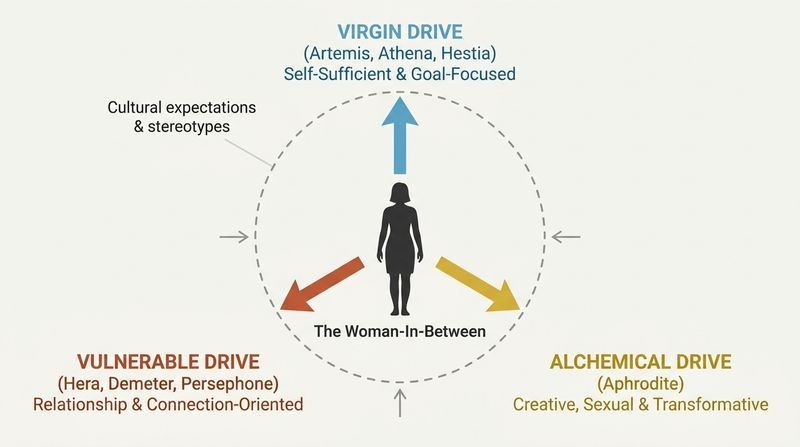
The core thesis. Jungian analyst Jean Shinoda Bolen argues that women are shaped from within by powerful patterns she calls archetypes, personified as seven Olympian goddesses, and from without by cultural stereotypes. She names every woman a "woman-in-between," pulled by inner goddesses and outer social expectations.
The seven fall into three groups:
1. Virgin goddesses (Artemis, Athena, Hestia): self-sufficient, focused on their own goals
2. Vulnerable goddesses (Hera, Demeter, Persephone): relationship-oriented as wife, mother, daughter
3. Alchemical goddess (Aphrodite): creative and sexual, transforming through connection
What fulfills one goddess feels meaningless to another. A complex woman hosts several at once, which explains internal conflict. Knowing which goddesses dominate offers self-knowledge about instincts, priorities, and sources of meaning.
Bolen's framework arrived in 1984 as a corrective to one-size-fits-all psychology, which defined a "normal" woman by a single template. Her insistence on diversity among women anticipates later personality science that maps traits along continuous dimensions rather than fixed types. The archetype-as-goddess device works because it externalizes traits, letting a woman observe her drives without shame. One caution worth noting: mapping personality onto ancient deities risks confirmation bias, since a rich enough pantheon can "explain" almost any behavior after the fact. The value lies less in taxonomic precision than in the permission it grants women to honor drives their families or culture never rewarded.
Use myths as insight tools that trigger the "Aha!" of self-recognition
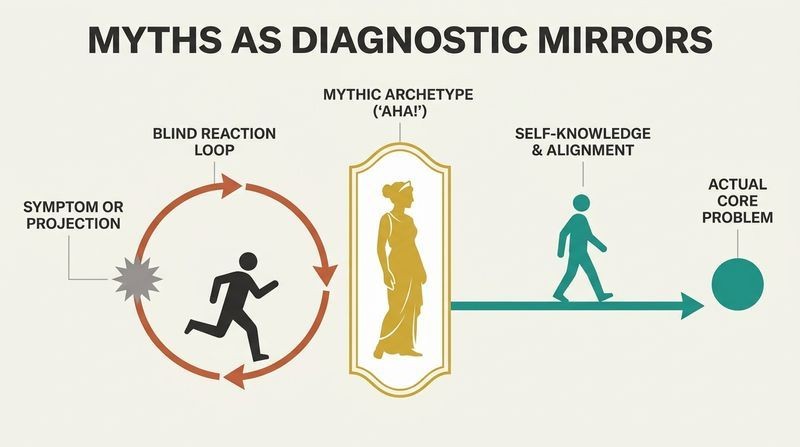
Myths as diagnostic mirrors. Bolen discovered the power of mythology when a jealous patient, obsessed with spying on her husband's mistress, revealed herself as raging Hera, whose fury targeted rival women rather than her philandering husband Zeus. Naming the pattern helped the patient redirect her energy toward confronting the actual marital problem.
Recognition produces change. She cites the abducted heiress Patty Hearst as a modern Persephone, and drew on Erich Neumann's use of the Amor and Psyche myth to help overwhelmed patients. A myth, Bolen notes (echoing Joseph Campbell's line that dream is personalized myth), stays alive across three thousand years because it rings true about shared human experience. The moment a woman intuitively grasps "Yes, that's why," theory becomes self-knowledge.
This is narrative therapy before the term existed. Contemporary clinical work confirms that reframing a personal struggle as an archetypal story reduces isolation and shame, giving suffering a larger meaning. The approach resonates with Acceptance and Commitment Therapy's use of metaphor and with cognitive science on how humans encode experience as narrative rather than data. The risk is interpretive over-reach: a skilled listener can find a fitting myth for anyone, and the "Aha!" feeling of recognition is not proof of accuracy. Still, as a tool for generating hypotheses about one's own motivation, storytelling beats abstract diagnostic labels for emotional traction.
The virgin goddess is the part of you that belongs to no man
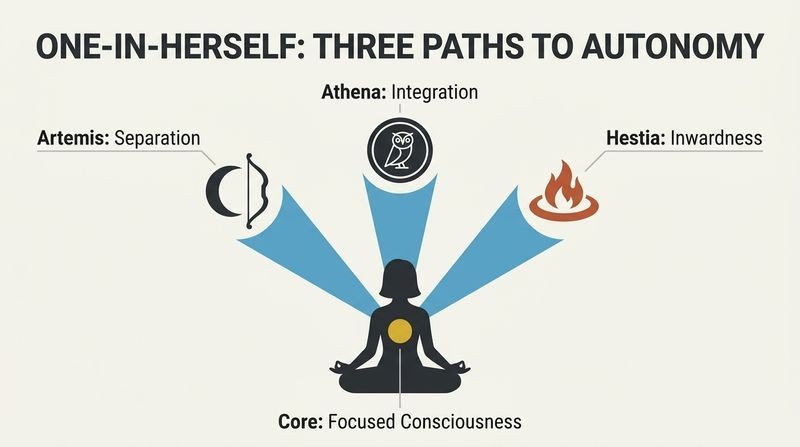
Independence as archetype. Artemis, Athena, and Hestia never married, were never seduced or overpowered, and stayed "one-in-herself," a phrase Bolen borrows from analyst Esther Harding. Being virgin here is psychological, not sexual: it names the part of a woman untouched by the need for male approval, acting from inner conviction rather than to please.
Three routes to autonomy. Each virgin goddess solved life in a patriarchy differently:
1. Artemis separated from men, roaming the wilderness with her band of women
2. Athena joined men as an equal or superior, becoming one of them
3. Hestia withdrew inward, tending the sacred hearth in solitude
All three share focused consciousness: the ability to concentrate like a beam of light on what matters, excluding everything else.
Bolen's boldest theoretical move is challenging Jung directly. Jung held that a woman who thinks clearly or achieves is merely using her "animus," a masculine element foreign to her true feminine nature. Freud went further, diagnosing ambition as a "masculinity complex." Bolen reframes competence, logic, and autonomy as authentically feminine, embodied by goddesses themselves. This matters historically: countless capable women had been taught their drive was unnatural. The reframe prefigures decades of feminist psychology. A modern reader might push back that assigning any trait a gender at all, feminine or masculine, is the deeper problem, but in 1984 reclaiming these qualities as women's own was genuinely liberating.
Artemis women aim like archers but can grow contemptuous of weakness
The huntress archetype. Artemis, goddess of the hunt and moon, embodies goal-focus, sisterhood, and fierce protection of women and the vulnerable. Bolen sees her in the women's movement, in the marathon runner's single-minded drive, and in Gloria Steinem. Artemis women rescue others, bond with women as "sisters," and pursue self-chosen targets undistracted.
The shadow side. The goddess who accidentally killed her beloved Orion in a competition, and who unleashed a destructive boar when offended, warns of Artemis's dangers:
1. Contempt for vulnerability in a man who needs her
2. Destructive rage out of proportion to the offense
3. Emotional inaccessibility from over-focus
4. Mercilessness that judges in absolute black and white
Growth comes through the Atalanta myth: golden apples of love and self-reflection slow the relentless racer.
The Artemis pattern maps onto what psychologists call agentic orientation, and Bolen is unusually honest about its costs. Her observation that intense focus can "cut her off from her own emotional life" echoes research on how high achievers sometimes struggle with intimacy, treating relationships as pursuits that lose appeal once won. The contempt-for-weakness dynamic is a sharp clinical insight: the very self-sufficiency that empowers can harden into disdain for dependency, including one's own. The corrective Bolen offers, developing vulnerability without abandoning drive, aligns with modern work on psychological wholeness, though she rightly notes this integration often waits until midlife, when the thrill of the chase fades.
Athena's armor makes her brilliant but capable of the Medusa effect
The father's daughter. Athena sprang fully grown from Zeus's head, claiming only one parent. She embodies strategic intelligence, craft, and alliance with powerful men, seen in the corporate strategist, the tenure-seeking academic, and figures like Clare Boothe Luce. Athena women are ruled by their heads, live within the "Golden Mean" of moderation, and are practically impervious to sexual jealousy.
The cost of the armor. Athena wore the Gorgon Medusa's head on her breastplate, whose gaze turned people to stone. Bolen names the "Medusa effect": Athena's critical, dissecting rationality can drain the life from a conversation and petrify others emotionally. Her growth tasks include recovering the child she never was (Athena was born adult), and re-membering her swallowed mother Metis, reconnecting to devalued feminine and maternal values.
The Athena portrait doubles as a shrewd study of the "Queen Bee," the woman who succeeds in male institutions yet declines to help other women advance, sometimes defending the status quo (Bolen cites Phyllis Schlafly opposing the Equal Rights Amendment). This anticipated organizational research on how token success can breed distancing from one's group. The Medusa effect is a striking piece of emotional intelligence avant la lettre: pure analytic scrutiny without warmth doesn't just fail to connect, it actively deadens. Yet Bolen's framing that Athena "lacks" empathy risks understating that strategic detachment is often adaptive survival in hostile environments, not merely a deficit to be corrected.
Hestia turns housekeeping into meditation and needs no audience
The forgotten goddess of the hearth. Hestia, least known Olympian, was never depicted in human form but felt as the living flame at a home's center. As archetype she is inner centeredness, the Self, a spiritual focus that makes a woman feel whole regardless of external circumstance. Bolen's test: when her husband is away, a Hestia woman still sets a proper table and brings fresh flowers for herself, because home is home because she lives there.
Tending as centering. For Hestia, folding laundry or clearing a closet becomes a meditative ordering of self, done in unhurried "participating time" rather than clock-watching. Her detachment gives a wise-woman quality that steadies the other archetypes. Her weakness: lacking a persona and assertiveness, she is easily overlooked and ill-equipped for a competitive world.
Hestia is the book's most countercultural archetype precisely because she measures nothing. In an economy that values output, visibility, and networking, an orientation toward invisible inner order looks like a liability, and Bolen candidly says so. Yet the pattern anticipates the mindfulness movement's later mainstreaming: the idea that fully absorbed, present-moment attention to mundane tasks produces genuine well-being now has substantial empirical support in contemplative neuroscience. Hestia also offers a corrective to the achievement archetypes: her groundedness ameliorates Hera's jealousy and Artemis's rage. The tension Bolen identifies, between inner sanctuary and worldly competence, remains a live dilemma for anyone temperamentally introverted in an extroverted culture.
Vulnerable goddesses draw identity from relationships, which makes them woundable
Relationship as the organizing pull. Hera, Demeter, and Persephone represent wife, mother, and daughter. Their well-being depends on a significant bond, and in myth each was raped, abducted, dominated, or humiliated, then responded with a recognizable symptom: Hera with jealous rage, Demeter and Persephone with depression. Women who embody them are attuned to others and susceptible to victimization.
Diffuse awareness. Unlike the virgin goddesses' focused beam, vulnerable goddesses have diffuse awareness, like a lamp casting warm light on everything in the room. It lets a mother hear a child whimper through conversation. Bolen observed her own children interrupting the instant she switched from diffuse attention to focused study, a pattern that quietly trains relationship-oriented women away from concentration and helps explain friction when they pursue careers.
The focused-versus-diffuse distinction is one of Bolen's most portable insights, and it reframes a common domestic conflict as a clash of attentional modes rather than character flaws. Her anecdote about children sensing the shift to focused consciousness resonates with attention research showing that caregivers maintain a low-grade monitoring state, and that deep focus genuinely reduces environmental responsiveness. The framing of vulnerability as victimization-prone deserves nuance, though: relationship-orientation is also the foundation of empathy, cooperation, and social intelligence, capacities modern psychology increasingly prizes. Bolen does not pathologize these women, but readers should resist reading "vulnerable" as "inferior." The label names a susceptibility, not a lesser worth.
Hera's rage targets the rival, never the husband who betrayed her
The marriage archetype. Hera, goddess of marriage, gives the deep drive to be a wife, a longing for the completeness and recognition of being a partner. When fulfilled by a devoted mate she is radiant; unmarried, she feels a hole in her psyche. Bolen notes even many lesbian women feel this same pull, suggesting it is not merely cultural conditioning.
The misdirected fury. Betrayed repeatedly by Zeus, the goddess Hera never punished him but hunted down the other women and their children. The "Medea Syndrome" names the extreme: the spurned woman who destroys her rival, or even her own children, to revenge herself. Bolen's insight is that vindictiveness is a psychological sleight of hand, letting a wounded woman feel powerful rather than rejected, while sparing the man she depends on.
Bolen's clinical observation that jealous rage flows toward the rival rather than the betrayer is psychologically acute and still underappreciated. Attacking the third party preserves the primary attachment, which the dependent partner cannot bear to lose, so the anger is displaced onto a safer target. This maps onto attachment theory's account of how threat to a bond activates protest behavior aimed at restoring it. The Medea example, a mother killing her children to punish their father, is extreme but illuminates the logic taken to its horrifying end. A modern extension: the same dynamic appears in online pile-ons and "other woman" shaming, where collective fury conveniently spares the more powerful betrayer.
Demeter's boundless nurturing curdles into depression when she can't say no
The maternal archetype. Demeter, grain goddess whose grief over abducted Persephone froze the earth into famine, embodies the drive to nurture through pregnancy or by feeding others physically, emotionally, and spiritually. Demeter women are Earth Mothers, drawn to helping professions, generous to a fault. Her compelling instinct can override birth control and reason, propelling a woman toward pregnancy against her own interest.
The shadow of overgiving. Because she cannot say no, the Demeter woman gets depleted and slides into passive-aggression or "empty-nest" depression when her mothering role ends, mirroring the goddess who stopped functioning and let nothing grow. Bolen cites sociologist Pauline Bart's study of over 500 hospitalized women: the most depressed were super-mothers who lost their role. Growth means becoming her own good mother and learning, like Persephone's task, to harden her heart and refuse.
Bolen connects an archetype to hard data, and the finding holds up: identity fusion with a single role, whether motherhood or career, predicts collapse when that role vanishes. The "empty nest depression" she describes overlaps with what clinicians now frame as an identity-foreclosure risk, and the antidote, cultivating multiple sources of meaning, is sound. Her observation that chronic inability to refuse breeds passive-aggression and psychosomatic symptoms anticipates research linking suppressed anger and caregiver burnout to physical illness. One tension: Bolen frames the destructive Demeter as withholding, but much maternal harm she describes (overcontrol, fostering dependency) comes from too much presence, not too little, a paradox worth sitting with.
Persephone stays the eternal maiden until she claims the pomegranate seeds
Two faces of the daughter. Persephone begins as the Kore, the nameless maiden who is receptive, compliant, and uncommitted, an "anima woman" who becomes whatever others project onto her. Many women linger here, playing at life, avoiding commitment because choosing forecloses options. The pattern is reinforced by the "Mother knows best" bond and a culture that equates femininity with passivity.
From captive to queen. In myth, Persephone eats pomegranate seeds in the underworld, an act Bolen reads as a hidden choice that transforms the abducted victim into Queen of the Underworld, guide to others in the depths. Women who descend into their own darkness (even through depression or breakdown) and return can become uniquely wise guides, therapists, and mediators between ordinary and unconscious reality. The maiden must cross a psychological threshold into committed adulthood.
The Persephone arc is the book's richest developmental story because it holds both danger and gift. Bolen's reading of the pomegranate seeds as a disguised act of self-determination (Persephone claims she was forced, but chose) is a subtle point about how the passive personality exercises agency covertly, through deviousness rather than open declaration. Her claim that some who survive psychosis become gifted healers echoes the "wounded healer" tradition and modern peer-support movements, where lived experience of the depths confers credibility. The caution: romanticizing breakdown is risky, and Bolen is careful to note that some captives never return. The maiden's refusal to commit, meanwhile, reads presciently as a portrait of prolonged emerging adulthood.
Aphrodite's "limelight" consciousness transforms whatever it touches into gold
The alchemical goddess. Aphrodite stands alone. Free to choose her lovers and never victimized, she generates attraction, creativity, and new life. Bolen coins "Aphrodite consciousness": a third attentional mode, neither the virgin's focused beam nor the vulnerable goddess's diffuse glow, but like theater limelight that both illuminates its object and is changed by it. It is the state of falling in love, of the artist absorbed in the canvas, of the therapist deeply present with a patient.
The Pygmalion power. Whoever Aphrodite bathes in her golden attention feels beautiful and comes alive, an effect Bolen links to researcher Robert Rosenthal's Pygmalion studies, where students rose to teachers' positive expectations. Her danger: living purely in the present, breaking hearts, moving serially from lover to lover or project to project without commitment.
Aphrodite consciousness is Bolen's most original theoretical contribution and the one most worth extracting from the mythic packaging. The idea that a reciprocal, mutually transforming attention drives creativity, love, and healing anticipates relational psychoanalysis and the research consensus that therapeutic outcome depends more on the quality of the alliance than on technique. The link to the Pygmalion effect grounds the mystical language in evidence: expectations measurably shape performance. The lover-artist parallel also illuminates why creative work feels erotic and why both can become addictive. The shadow Bolen names, chronic non-commitment and living as if there were no tomorrow, is the flip side of intensity, and her framing helps distinguish vitality from recklessness.
Chair your inner committee so you decide which goddess gets the golden apple
The judgment of Paris, internalized. When Eris tossed a golden apple "for the fairest," Hera, Athena, and Aphrodite each claimed it, and a mortal man judged. Bolen's point: in every woman these archetypes compete, and the danger is letting others (parents, culture, husbands) award the apple by rewarding only what pleases them. The heroine decides for herself.
The committee metaphor. Borrowing from analyst Joseph Wheelwright, Bolen pictures a healthy ego as chairing a committee of inner voices. Dysfunction takes predictable forms:
1. See-saw ambivalence, ego drifting to whichever side is winning
2. Committee chaos, ego overwhelmed (the "washing machine" feeling)
3. Biased chair, favoring some goddesses and censoring others, whose repressed needs erupt as moods, symptoms, or "acting out"
The heroine sorts the seeds, tolerates tension, and makes conscious choices aligned with her deepest values.
This closing framework is the book's practical payoff and its most durable idea: psychological health is not picking one archetype but developing an observing ego strong enough to arbitrate among many. It prefigures Internal Family Systems therapy, which similarly treats the psyche as a system of parts led by a centered Self, and it resonates with modern work on self-complexity as a buffer against depression. Georgia O'Keeffe's five-year struggle over whether to have a child illustrates that resolution requires actively endorsing an outcome, not passively yielding, or resentment poisons the result. Bolen's insistence that the true cost of any choice is the path not taken is quietly Stoic, and bracingly honest.
Analysis
Goddesses in Everywoman (1984) is a framework-driven work of Jungian feminist psychology, structured as a taxonomy of seven archetypes grouped into three categories, bracketed by an introduction on method and a closing chapter on integration. Its audience is general readers, primarily women seeking self-understanding, plus clinicians and "intuitive male readers." The summarizing challenge is the book's breadth: each goddess gets an exhaustive life-cycle treatment (childhood through old age, relationships, sexuality, pathology, growth), so distillation means extracting each archetype's essence and shadow without drowning in the encyclopedic detail.
Bolen's genuine intellectual contribution is threefold. First, she directly challenges Jung's anima-animus theory and Freud's penis-envy model, reframing competence, logic, and autonomy as authentically feminine rather than symptoms of a masculinity complex or a borrowed "masculine" animus. In 1984 this was consequential: it told capable women their drives were not pathological. Second, she introduces "Aphrodite consciousness" as a third mode of attention beyond Jung's focused and diffuse types, a concept that anticipates relational and intersubjective turns in later psychotherapy. Third, the committee-of-selves model at the book's end reframes maturity as ego-arbitration among many drives, prefiguring Internal Family Systems and self-complexity research.
The framework's weakness is falsifiability. A pantheon rich enough to explain any woman explains none in particular, and post-hoc pattern-matching feels persuasive precisely because it cannot fail. The "vulnerable" versus "virgin" vocabulary also risks smuggling in a hierarchy the author disclaims. And the exclusive focus on classical Greek deities, products of the very patriarchy Bolen critiques, means the models arrive pre-shaped by the constraints she wants women to transcend, a tension Gloria Steinem flags in her own foreword.
Still, the book endures because its device works therapeutically. Externalizing drives as goddesses grants permission, reduces shame, and offers a shared vocabulary for internal conflict. Its lasting message is agency: refuse to let others award your golden apple, and become the conscious chooser of your own life.
Review Summary
Goddesses in Everywoman explores female archetypes through Greek goddesses, offering insights into women's personalities and behaviors. Readers found it enlightening, empowering, and relevant despite its age. Many appreciated the Jungian approach and feminist perspective. Some criticized it as outdated or oversimplified, while others praised its depth and applicability. The book resonated with women seeking self-understanding and growth. It was particularly valued for its exploration of complex female identities and its potential to foster compassion and self-acceptance.
People Also Read




FAQ
What's Goddesses in Everywoman about?
- Exploration of Archetypes: The book explores Greek goddesses as archetypes that represent different aspects of women's psychology. Each goddess embodies specific traits and behaviors that influence women's lives and choices.
- Psychological Insights: It provides insights into how these archetypes manifest in women's lives, helping them understand their motivations, relationships, and personal growth.
- Empowerment through Understanding: By recognizing which goddess archetypes are active within them, women can gain self-knowledge and empowerment, leading to more conscious life choices.
Why should I read Goddesses in Everywoman?
- Self-Discovery Tool: The book serves as a guide for women seeking to understand themselves better through the lens of mythology and psychology. It helps readers identify their dominant archetypes and how these influence their lives.
- Cultural Relevance: It connects ancient mythology to contemporary issues faced by women, making it relevant for modern readers. The insights can help navigate personal and societal challenges.
- Encourages Personal Growth: The book encourages women to embrace their strengths and work on their weaknesses, fostering personal development and fulfillment.
What are the key takeaways of Goddesses in Everywoman?
- Seven Archetypes: The book identifies seven Greek goddesses—Artemis, Athena, Hestia, Hera, Demeter, Persephone, and Aphrodite—each representing different psychological patterns in women.
- Vulnerable vs. Virgin Goddesses: It distinguishes between vulnerable goddesses (Hera, Demeter, Persephone) who are relationship-oriented and virgin goddesses (Artemis, Athena, Hestia) who embody independence and self-sufficiency.
- Empowerment through Activation: Women can activate different goddess archetypes within themselves to address various life situations, leading to a more balanced and fulfilling life.
What are the best quotes from Goddesses in Everywoman and what do they mean?
- "Every woman has 'goddess-given' gifts...": This emphasizes that each woman possesses unique strengths linked to the goddess archetypes, which can be harnessed for personal growth.
- "The more complicated the woman...": This highlights the complexity of women's identities and the interplay of different archetypes in shaping their experiences.
- "A woman who is virgin...": This quote underscores the importance of self-identity and authenticity, encouraging women to act based on their values rather than societal expectations.
How does Goddesses in Everywoman define the concept of archetypes?
- Universal Patterns: Archetypes are described as universal patterns of instinctual behavior contained in the collective unconscious. They influence how women behave and react to others.
- Mythological Representation: The book uses Greek goddesses as personifications of these archetypes, making them relatable and applicable to modern women's lives.
- Self-Understanding: By identifying with specific archetypes, women can gain insights into their motivations and behaviors, leading to greater self-awareness and personal growth.
What is the significance of the virgin goddesses in Goddesses in Everywoman?
- Independence and Autonomy: The virgin goddesses—Artemis, Athena, and Hestia—represent aspects of women that are self-sufficient and independent. They embody the qualities of focus, strength, and self-direction.
- Avoidance of Victimization: Unlike the vulnerable goddesses, virgin goddesses are not defined by their relationships with men, allowing them to maintain their integrity and autonomy.
- Empowerment: The book encourages women to embrace these virgin goddess qualities to pursue their goals and assert their independence in a patriarchal society.
How do the vulnerable goddesses differ from the virgin goddesses in Goddesses in Everywoman?
- Relationship Orientation: The vulnerable goddesses—Hera, Demeter, and Persephone—are defined by their need for relationships and emotional connections. Their identities are often tied to their roles as wives, mothers, and daughters.
- Experiencing Vulnerability: These goddesses have experienced victimization and emotional suffering, reflecting the challenges women face in relationships. Their stories highlight the emotional complexities of love and loss.
- Growth Potential: While vulnerable, these goddesses also offer insights into resilience and the potential for growth through suffering, encouraging women to learn from their experiences.
How can women activate their goddess archetypes according to Goddesses in Everywoman?
- Conscious Invocation: Women can consciously invoke specific goddess archetypes by recognizing their presence in their lives and asking for their strengths. This can be done through meditation or reflection.
- Engaging in Activities: Participating in activities that resonate with a particular goddess can help activate her qualities. For example, pursuing creative endeavors can invoke Aphrodite, while competitive sports can activate Artemis.
- Personal Reflection: Women are encouraged to reflect on their life experiences and identify which goddess archetypes are most relevant to their current situations, allowing them to harness these energies for personal growth.
What psychological insights does Goddesses in Everywoman provide for therapists?
- Understanding Archetypes: The book offers therapists a framework for understanding the different archetypes that may influence their female clients' behaviors and emotional responses. This can aid in diagnosis and treatment.
- Interpersonal Dynamics: Knowledge of goddess patterns can help therapists understand the dynamics in their clients' relationships with men, women, and family members. It provides context for clients' feelings of inadequacy or conflict.
- Facilitating Growth: By recognizing which goddess archetypes are active in a woman's life, therapists can guide their clients toward personal growth and healing, helping them to activate more empowering aspects of their identities.
How does the concept of the heroine's journey manifest in Goddesses in Everywoman?
- Personal Growth: The heroine's journey is about personal growth and self-discovery. Bolen emphasizes that women must confront challenges and make choices that shape their identities.
- Facing Adversity: Just like mythological heroines, women face adversity and must navigate their paths with courage. This journey often involves overcoming obstacles and learning from experiences.
- Integration of Self: The journey culminates in the integration of various aspects of the self, leading to a more authentic and empowered identity. Bolen encourages women to embrace their complexities and find strength in their unique stories.
What role do the goddesses play in women's lives according to Goddesses in Everywoman?
- Guiding Forces: The goddesses serve as guiding forces that influence women's choices, relationships, and self-perception. Each goddess embodies specific traits that can empower or challenge women.
- Conflict and Resolution: The book discusses how these archetypes can conflict within a woman, leading to internal struggles. Recognizing these conflicts allows women to navigate their complexities more effectively.
- Path to Wholeness: Engaging with these goddesses can lead to a more integrated and whole self. Bolen encourages women to embrace all aspects of their identities, fostering personal growth and fulfillment.
What is the significance of the Judgment of Paris in Goddesses in Everywoman?
- Symbol of Inner Conflict: The Judgment of Paris serves as a metaphor for the inner conflicts women face regarding their identities and choices. It illustrates how different aspects of the self can compete for dominance.
- Choice and Consequence: The myth highlights the importance of choice and the consequences that follow. Women must navigate their desires and the expectations of others, much like Paris had to choose between the goddesses.
- Cultural Reflection: Bolen uses this myth to reflect on societal pressures and the roles women are expected to play. It encourages readers to consider how these archetypes influence their lives and decisions.
About the Author


Download PDF
Download EPUB
.epub digital book format is ideal for reading ebooks on phones, tablets, and e-readers.








































