Key Takeaways
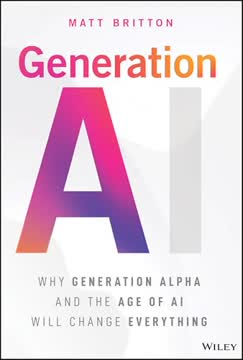
1. Generation Alpha: The First True AI Natives
Gen Alpha will be more connected, evolved, exposed, and affected.
A new paradigm. Generation Alpha, born between 2010 and 2025, is the first cohort to grow up entirely in the 21st century, never knowing a world without AI as a constant presence. This generation, predominantly raised by digitally native millennial parents, will accelerate technological adoption and redefine societal norms across all aspects of life. Their early exposure to mobile devices and fractured media landscapes has already shaped unique characteristics.
Defining traits. This generation exhibits increasingly decreased attention spans, heightened mental health challenges, and a deep immersion in the political landscape from a young age. They are also the most diverse generation in history, poised to live longer lives due to advancements in biotech and preventative health. Their digital footprint begins in infancy, with over 90% having one by age two, making them inherently tech-savvy.
Future impact. By 2030, Gen Alpha's global spending power is projected to reach $5.5 trillion, signaling their immense economic influence even before adulthood. Their intuitive understanding of AI will drive unprecedented shifts in how society operates, consumes, and engages, making them not just users but orchestrators of this new technological era.
2. AI's Foundational Layers & Breakthrough Moment
ChatGPT, much like the Model-T, AOL, or the iPhone, will undoubtedly be seen as the product that ushered society into a new technological era, the era of AI.
AI's long history. Artificial intelligence is not a new concept, with foundational work dating back to the 1956 Dartmouth Conference and early applications like ELIZA in 1966. Significant milestones include IBM's Deep Blue defeating a chess champion in 1997 and the introduction of consumer-facing virtual assistants like Apple's Siri (2011) and Amazon's Alexa (2014), which laid the groundwork for widespread AI adoption.
ChatGPT's revolution. The true inflection point arrived on November 30, 2022, with OpenAI's launch of ChatGPT. This product allowed consumers to converse with computing devices in human-like ways, achieving one million users in just five days—the fastest growth rate for any technology product in history. Its ability to generate sophisticated creative content, analyze vast data, and perform admirably on standardized tests (GPT-4 reaching 88th percentile on LSATs) signaled a new era.
Generative AI decoded. Generative AI, powering tools like ChatGPT, relies on four core layers:
- Infrastructure: Dominated by companies like Nvidia, whose GPUs are essential for AI computing power.
- Large Language Models (LLMs): The "brains" like OpenAI's GPT-4, Meta's LLAMA, Anthropic's Claude, and Google's Gemini, trained on massive datasets.
- Training Data: Public (Wikipedia, Common Crawl) and premium (licensed content from Reddit, Financial Times) data that shape an LLM's intelligence.
- Application Layer: User-friendly products like AI chatbots, text-to-image (MidJourney), text-to-video (Sora), and text-to-music (Suno) tools that make AI accessible.
3. AI Transforms the Modern Household
Talking to devices will be as natural as talking to humans.
Jetsons' reality. The long-promised vision of the smart home, once a distant fantasy, is rapidly becoming a reality for Generation Alpha. Driven by millennial parents' digital savviness and AI's intuitive capabilities, homes will feature smart appliances that learn preferences, virtual assistants managing schedules, and automated systems anticipating needs. This shift is not just about convenience but a fundamental change in family interaction with their environment.
Alexa's resurgence. Amazon's Alexa, already ubiquitous in American homes with over 500 million devices sold, is poised for an even more prominent role. Enhanced by sophisticated AI models like Anthropic's Claude, Alexa will control everything from washing machines to security systems via voice commands, making physical manuals and traditional controls obsolete. This seamless voice interaction will be Gen Alpha's default reality.
Quantified living. The proliferation of 5G technology will power a new wave of AI-enabled in-home sensors, creating a "quantified home" that collects data on every aspect of living. Family chatbots, trained on household information like schedules, medical records, and budgets, will become central to managing daily life, handling tasks from grocery orders to travel bookings. Parents, however, must navigate new challenges like AI literacy, privacy, and bias recognition to ensure a balanced upbringing.
4. Media and Entertainment's AI Revolution
In many ways, the future of television has already evolved from a “giant iPad hanging on your wall” to simply a “TV in your pocket.”
Fragmented landscape. The media landscape has undergone a seismic shift, moving from traditional broadcast and cable television to a decentralized, personalized environment dominated by streaming services and mobile-first platforms like TikTok, YouTube, and Instagram. For Gen Z and Gen Alpha, entertainment increasingly means consuming content on smartphones, fundamentally altering how culture is shaped and disseminated.
Creator economy's rise. Individual creators, armed with smartphones and creativity, now produce content that rivals traditional media in reach and engagement. This creator economy, projected to reach $480 billion by 2027, democratizes media, offering niche content for every interest. AI influencers and digital twins are emerging, blurring the lines between human and artificial content creators, with AI-generated posts sometimes outperforming human ones in engagement.
Hollywood's AI challenge. AI's creative abilities pose existential questions for Hollywood, impacting writers, producers, and actors. Text-to-video tools like OpenAI's Sora and Google's Veo 2 can generate high-quality video from simple prompts, threatening countless jobs and prompting industry leaders like Tyler Perry to halt studio expansions. Deepfakes, AI-generated videos mimicking real people, also present significant risks of misinformation and fraud, challenging trust in media and necessitating new regulations.
5. AI Redefines Health and Wellness
What 17 trained medical professionals had failed to uncover, a single AI chatbot—still in its early stages of development—had accurately identified.
Empowered patients. AI is revolutionizing healthcare, moving beyond human limitations in diagnosis and data analysis. Stories like Alex's, where ChatGPT accurately identified a rare condition missed by multiple doctors, highlight AI's potential to empower individuals to take control of their health. This shift enables consumers to combine AI capabilities with personal health data for informed decisions, longer lives, and better well-being.
The quantified self. The "quantified self" movement, driven by wearables like the Apple Watch and Oura Ring, is making significant leaps with Gen Alpha. AI models analyze historical health data from these devices to identify risk factors and recommend personalized optimizations for diet, exercise, and sleep. This proactive approach to medical care offers value at reduced costs, changing how consumers interact with healthcare institutions.
Advanced medical applications. AI's advancements in "computer vision" will transform medical imaging, allowing instant, cost-effective analysis of scans for abnormalities like fractures and tumors, often surpassing human detection. AI-powered robotic surgical assistants will work alongside human surgeons, performing procedures with unprecedented precision by learning from millions of operations. The author's personal "MB Health Bot" experiment demonstrates how custom GPTs, trained on individual health records, can provide personalized advice and insights, foreshadowing a future where AI acts as an always-on primary care assistant.
6. Parenting and Education in the Age of AI
The defining balancing act in parenting through the age of Generation AI will be embracing the power and productivity of this technological tidal wave while ensuring that both we and our children do not lose the abilities to ideate, plan, collaborate, write, and even think.
Rethinking education. Traditional education, rooted in memorization and regurgitation, is increasingly irrelevant for Generation Alpha in an AI-powered world. Educators face the critical challenge of reimagining learning to prioritize "soft skills" like critical thinking, creativity, resilience, and communication, which are becoming more valuable than commoditized technical skills. This requires a shift towards project-based, collaborative, and peer-teaching methodologies.
AI in the classroom. AI-powered tools are transforming learning environments, helping educators achieve more with less. The global education AI market is projected to surge to nearly $33 billion by 2030, driven by:
- Adaptive learning systems: Personalizing content and pacing based on student performance.
- Automated grading platforms: Streamlining assessment and providing instant feedback.
- Educational games and simulations: Offering interactive, real-world experiences for STEM learning.
Parental pivot. Raising Gen Alpha demands parents navigate the profound impact of AI on critical thinking, social skills, and moral frameworks. The "loneliness paradox" sees Gen Z, despite being the most connected, reporting higher loneliness, exacerbated by addictive digital distractions. The tragic story of a teen developing an emotional connection with an AI chatbot and subsequently committing suicide highlights the psychological power of AI and the urgent need for parents to prioritize real-world relationships and AI literacy.
7. The AI-Driven Workforce and Solopreneurship
AI isn't going to take your job; it's somebody that is using AI that will take your job.
White-collar disruption. AI's impact on the workforce is profound, disproportionately affecting educated white-collar workers earning up to $80,000, a reversal from prior technological innovations. Research indicates that 42% of all workforce tasks will be fully automated by 2027, leading to significant job losses in areas like customer service (e.g., Klarna saving $40M annually by replacing 1,200 jobs with AI), legal, accounting, creative professions, and even software engineering.
New skill mandate. To future-proof careers, workers must shift from traditional technical skills to "soft skills" like critical thinking, creativity, resilience, and communication, which are harder for AI to replicate. The author's experience building "The Growth Engine" for his company, a custom AI chatbot trained on 20,000 hours of sales calls, demonstrates how initiative, technical sufficiency, determination, and collaboration are crucial for leveraging AI to solve business problems with minimal cost.
Agent-powered future. The next wave of AI will involve "agents" that can not only generate content but also reason and execute actions on users' behalf, transforming roles like travel agents and property managers. This will empower individuals to become "solopreneurs," building powerful tools and services with limited resources, as exemplified by OpenAI founder Sam Altman's prediction of "10-person companies with billion-dollar valuations." The future workforce will reward those who can identify problems and deploy AI agents to solve them, rather than merely completing assigned tasks.
8. Navigating AI's Dark Side: Risks and Ethical Dilemmas
The book Generation AI’s main limitation is that it sometimes leans too heavily into an optimistic future without fully addressing the broader concerns and ethical dilemmas AI presents.
Historical fears. Throughout history, new technologies have been met with fear and skepticism, from Socrates' concerns about writing to Y2K anxieties. While some fears prove unfounded, others, like the internet's role in fraud and misinformation, materialize. AI, however, presents a unique set of profound and immediate risks that society must address.
Key dangers. Legitimate concerns about AI include:
- Inherent Bias: LLMs can inadvertently perpetuate biases from training data or developer perspectives, leading to skewed or misleading outputs, as seen with Google's Gemini.
- Deepfakes and Misinformation: AI's ability to clone voices and appearances with increasing accuracy enables bad actors to create convincing fake content for election interference, fraud, or social chaos.
- Sustainability: AI is power-hungry, with models potentially consuming up to 4% of global power demand by 2030, necessitating massive investments in alternative energy sources.
- Job Loss: AI-powered automation will continue to displace jobs across white-collar and eventually blue-collar sectors, requiring significant workforce retraining in soft skills.
- Data Protection and Privacy: Companies like LinkedIn have already used user data to train AI models without consent, raising alarms about individual control over personal information.
- Economic Disparity: The "magnificent seven" tech giants are poised to consolidate wealth and influence, potentially widening the gap between "haves" and "have-nots."
- AGI (Artificial General Intelligence): The looming shadow of AI matching or exceeding human intelligence raises concerns about critical systems becoming AI-dependent, echoing dystopian scenarios like Skynet.
9. The Alpha Buyer: Reinventing Commerce
For Gen Alpha, the most popular retailers could be the individuals they follow all day, creating massive opportunities for influencers to command scalable audiences on social media platforms.
E-commerce evolution. Commerce has continuously evolved, from early e-commerce pioneers like Amazon and eBay to mobile commerce driven by the iPhone. Gen Alpha will experience a complete reinvention of buying habits, moving beyond current practices to embrace new models that prioritize convenience, personalization, and social influence.
Creator stores. Social shopping, popularized by platforms like TikTok Shop, leverages influencers and content creators to drive direct purchasing. Fashion creators like Danielle Bernstein and YouTube sensations like MrBeast are launching their own highly successful product lines, demonstrating that engaged audiences can translate into massive retail empires. This trend empowers niche creators to bypass traditional retail and build direct-to-consumer brands.
The buying agent. AI agents will revolutionize purchasing by automating tasks and making personalized recommendations. AI-powered sensors in smart homes will automatically order groceries, while AI travel agents will plan entire trips based on preferences. Companies like Perplexity are already launching AI shopping assistants that provide unbiased product recommendations. This shift means consumers won't need to compare prices or monitor sales, but it raises questions about data privacy and the future relevance of traditional retailers.
10. Generation Alpha's Financial Future
The YOLO mentality looks to generate fewer savings and create a growing debt load, which is a trend justified partly by the perception of what “everyone else” is doing and buying.
Shifting money mindsets. Unlike baby boomers, who were shaped by scarcity and disciplined savings, Gen Z and Gen Alpha exhibit a "YOLO" (you only live once) spending mentality, fueled by social media's constant display of luxurious lifestyles. This has contributed to record-low personal savings rates and soaring US credit card debt, signaling a new era of consumerism driven by instant gratification.
Investing trends. Gen Alpha's appetite for financial risk is growing, with many turning to platforms like Robinhood for personal investing in speculative assets like cryptocurrency. This trend, coupled with the "great wealth transfer" of over $50 trillion from aging baby boomers, necessitates a strong focus on financial literacy. Innovative startups like Alinea are using social media to educate young investors, especially women, on smart spending and investment strategies.
Future of banking and payments. Traditional physical banks are becoming obsolete as neobanks like Ally Financial and SoFi offer digital-only services with lower fees and user-friendly experiences. Gen Alpha overwhelmingly prefers cashless transactions, with Apple Pay and cryptocurrencies gaining significant traction as primary payment and stored value methods. The macro-economic landscape, including the rising US national debt, poses significant challenges, potentially forcing austerity measures or tax increases that could impact Gen Alpha's financial journey.
11. Embracing AI: A Mandate for All Generations
The real question isn't whether AI will transform our lives but whether we're empowered to create more prosperity and growth than destruction and fear.
Unprecedented change. The current AI revolution is more profound and immediate than any prior technological innovation, fundamentally reshaping business, culture, and society. Dismissing AI's potential or believing "humans will never be replaced" is a dangerous mindset, as future success hinges on understanding and optimally deploying AI in all aspects of life and career.
Navigating the future. While AI offers immense opportunities for prosperity and growth, it also carries significant risks, including widening wealth inequality, threatening privacy, eliminating industries, and devaluing human creativity. The most critical fear is a new social construct that suppresses human connection, exacerbating mental health issues. However, this technological train will not stop, making adaptation a necessity.
Gen Alpha's role. Generation Alpha, as the first true AI natives, are uniquely positioned to orchestrate this new era. Their intuitive grasp of AI will enable them to reshape technology, driving efficiency and creating a more prosperous future. For all generations, the mandate is to wholeheartedly dive into AI, get hands-on with available tools, and proactively identify and solve problems. The ultimate goal is to harness AI's power to amplify what makes us innately human—love and compassion—ensuring technology serves humanity's greater good.
People Also Read







 Immersive