Key Takeaways
1. Human History is Natural History: The Deep Interconnectedness of Life
In the end, all history is natural history.
Biology's ultimate role. Human destiny, from ancient civilizations to modern societies, has always been profoundly shaped by biology and ecology. Wars, empires, and economic shifts are circumscribed by our interactions with nature and its impact on us. This fundamental truth, recognized by figures like Pliny and Aristotle, is often overlooked in conventional historical narratives.
Ecological disruption's cost. Modern human ingenuity, while transformative, has revealed the sobering limits of our agency. Our actions, such as deforestation for agriculture or industrial livestock farming, disrupt ecosystems, leading to species displacement and the rise of zoonotic diseases. The COVID-19 pandemic served as a stark reminder that bio-ecological imperatives, not human constructs, are our true rulers.
Zoonotic threats. The increasing frequency of new infections, particularly viral ones, is a direct result of human encroachment on wild habitats and the global trade in animals. Diseases like Lyme, M-pox, SARS, and potentially COVID-19, originate in animals and jump to humans, often exacerbated by climate change and habitat destruction. This interconnectedness means that the health of the world is indivisible from the health of nations.
2. Smallpox Inoculation: A Revolutionary Idea from the "Orient"
The Circassians are poor and their daughters are beautiful and indeed it is in them that they chiefly trade.
A surprising origin. The practice of smallpox inoculation, a counter-intuitive procedure of deliberately infecting a healthy person with a mild form of the disease to confer immunity, originated not in enlightened Europe but in the "barbaric orient." Circassian women, driven by the desire to preserve their daughters' beauty for the lucrative Ottoman marriage market, were among the earliest practitioners. This folk wisdom, documented by travelers like Aubry de La Mottraye, challenged European assumptions of cultural superiority.
Lady Mary's advocacy. Lady Mary Wortley Montagu, a smallpox survivor disfigured by the disease, encountered inoculation in Constantinople during her husband's embassy. Impressed by its effectiveness, she became a fierce advocate for its adoption in England, even inoculating her own children. Her efforts, alongside those of pioneering Greek physicians like Timoni and Pylarini, brought this "Turkish" innovation to the attention of the Royal Society.
Political urgency. The devastating impact of smallpox on European royalty, disrupting dynastic continuity and stable government, lent political urgency to finding a reliable prophylactic. The deaths of Queen Mary II, the Grand Dauphin, and Tsar Peter II underscored the need for a solution, making the English court, particularly Princess Caroline, receptive to this foreign practice despite widespread skepticism.
3. The Battle for Inoculation: Science Against Tradition and Self-Interest
All the doctors have said, prepare the subject . . . And me? I say, do not prepare.
Resistance to novelty. Despite empirical evidence and royal endorsement, inoculation faced fierce opposition in Europe. Religious figures condemned it as a sacrilegious interference with God's will, while many physicians resisted it due to ingrained beliefs in humoral theory and the financial threat it posed to their elaborate, often ineffective, treatments. Critics like Edmund Massey and William Wagstaffe dismissed it as a dangerous, alien practice.
Gatti's radical vision. Angelo Gatti, an unsung visionary of the Enlightenment, revolutionized inoculation by denouncing the complex "preparations" (purges, bleedings, special diets) as unscientific and self-serving. He argued that smallpox was caused by an external "virus" (a term he used), not internal imbalances, and that the body's natural defenses were sufficient. His work anticipated modern vaccination principles, advocating for minimal intervention and emphasizing the role of mothers in simple, home-administered procedures.
Commercialization and data. In England, inoculation became a mass phenomenon through commercialization, notably by the Sutton family, who offered "Safely! Quickly! Pleasantly!" treatments. Simultaneously, figures like James Jurin and Thomas Nettleton pioneered early epidemiology, collecting comparative data to prove inoculation's superior safety and efficacy over natural infection, laying the groundwork for evidence-based medicine.
4. Adrien Proust: Mapping Epidemics and Advocating Global Health
Cholera follows the routes of human travel . . . it is imported through human agency.
The geographer of epidemics. Marcel Proust's father, Adrien Proust, was a pioneering public health physician who became known as "the geographer of epidemics." Witnessing devastating cholera outbreaks in Paris, he challenged the prevailing "miasma" theory, which attributed disease to local environmental factors, and instead argued for the contagious nature of cholera, yellow fever, and plague. He meticulously tracked disease spread, recognizing that infections migrated along human travel routes.
International cooperation. Proust tirelessly campaigned for international sanitary cooperation, believing that epidemics transcended national borders and required a coordinated global response. He attended numerous International Sanitary Conferences, advocating for agreed-upon measures like quarantines, despite resistance from nations prioritizing trade over public health. His efforts were crucial in shifting the discourse towards a transnational approach to disease control.
Imperial context. Proust's travels to Russia, Persia, and Egypt, often commissioned by the French government, highlighted the complex interplay of science and imperialism. While seeking to "regenerate" the Levant with French medical expertise, he also observed how imperial expansion and new communication routes, like the Suez Canal, inadvertently accelerated the spread of disease, making global health a shared, if often contested, responsibility.
5. Waldemar Haffkine: A Personal Crusade for Cholera Vaccination
In the fatigue and despair of ever seeing the end of those efforts becoming effective, the image of death appeared to me as a welcome liberation.
A Jewish scientist's journey. Waldemar Mordechai Wolff Haffkine, a Jewish scientist from Odessa, embarked on a personal crusade to develop vaccines against lethal bacterial infections. His early life was marked by political activism and persecution in Tsarist Russia, including arrests for defending Jewish communities during pogroms. Mentored by Elie Metchnikoff, Haffkine dedicated himself to science, eventually joining the Pasteur Institute in Paris.
Cholera vaccine breakthrough. Despite skepticism from colleagues, Haffkine persevered in developing the first effective human vaccine against cholera. Using Pasteur's methodology of serial passaging through animals, he achieved a stable, virulent vibrio, then attenuated it for a two-dose human inoculation. In a dramatic act of self-experimentation, he was the first to receive his vaccine, proving its safety and efficacy.
India's urgent need. With cholera raging in India, Haffkine saw his vaccine as a vital tool for saving lives. Supported by figures like Lord Dufferin and Ernest Hankin, he brought his work to the subcontinent, conducting large-scale trials in challenging conditions. His commitment to voluntary vaccination and meticulous data collection, often amidst institutional resistance, laid the groundwork for mass immunization campaigns.
6. The Return of Plague: Colonialism's Unintended Consequences
Rats die in the east / Rats die in the west / People look upon dying rats / As if they were . . . A few days following the death of rats / People die like city walls.
Plague's modern resurgence. The "Black Death" returned in the late 19th century, arriving in Hong Kong in 1894 via steamship from plague-endemic regions like Yunnan. This modern installment of an ancient scourge was facilitated by increased global trade and rapid urbanization. Chinese folk wisdom, recognizing dead rats as harbingers of plague, foreshadowed the scientific discovery of the rat-flea vector by Paul-Louis Simond.
Draconian colonial response. British colonial authorities in Hong Kong and Bombay implemented harsh, militarized measures to combat the plague. Dr. James Lowson in Hong Kong, and Brigadier-General William Forbes Gatacre in Bombay, imposed forced inspections, segregation, demolitions, and burnings of property. These actions, often driven by a "sanitationist" obsession with "filth" rather than germ theory, caused immense suffering and outrage among the native populations.
The "Plague Album." The "Plague Visitation" album, commissioned by Gatacre, aimed to document the efficiency and benevolence of British medical imperialism. However, photographs like "The Death of Little Jacky" inadvertently captured the profound grief and dehumanization inflicted by these measures. The stark contrast between official narratives and the lived experience of the colonized revealed the inherent contradictions of imperial rule.
7. Plague Management: Fueling Indian Nationalism and Resistance
The tyranny of the Plague Committee . . . is too brutal to allow respectable people to breathe at ease.
Cultural clash. British plague measures in Bombay, including forced examinations of women, interference with burial rites, and destruction of homes, deeply offended Hindu and Muslim religious and social sensibilities. The imposition of "medical martial law" was seen as a sacrilegious violation of privacy and tradition, leading to widespread anger and resistance. Newspapers like Kalpataru condemned the indignities inflicted on "native ladies."
Rise of nationalism. This outrage became a potent catalyst for Indian nationalism. Figures like Lokmanya Bal Gangadhar Tilak, through his paper Kesari, weaponized public anger against the "tyranny of the Plague Committee," accusing British officials of deliberately undermining Hinduism. The assassination of Walter Rand, a plague commissioner, by the Chapekar brothers, who saw him as an enemy of their religion, marked a bloody turning point.
Mass action. The plague regime inadvertently united diverse communities, leading to unprecedented collective action. Muslims and Hindus, often at odds, joined forces in riots and hartals (strikes) against the measures. Dockworkers, millhands, and shopkeepers paralyzed Bombay, demonstrating the power of mass resistance against imperial authority. This convergence of religious, social, and economic grievances laid the groundwork for future nationalist movements.
8. Haffkine's Plague Vaccine: Triumph, Tragedy, and Unjust Blame
Haffkine . . . whose zeal and enthusiasm in the cause he so well advocates are beyond praise.
Mass production and global reach. Despite initial skepticism and limited resources, Haffkine rapidly scaled up plague vaccine production at the Parel Plague Research Laboratory in Bombay. By 1903, millions of doses had been produced and distributed across India and exported globally, making it the world's first large-scale vaccine production line. This unprecedented achievement offered a scientific alternative to the coercive and often ineffective colonial plague measures.
The Malkowal disaster. In October 1902, a tragic incident occurred in the Punjabi village of Malkowal, where 19 vaccinated individuals died from tetanus poisoning. An inquiry, led by Sir Lawrence Jenkins, prematurely concluded that the contamination originated in Haffkine's laboratory, despite evidence suggesting on-site contamination due to improper sterilization of instruments. This disaster abruptly halted the mass vaccination campaign and severely damaged Haffkine's reputation.
Disgrace and displacement. Lord Curzon, the Viceroy, furiously condemned Haffkine, even suggesting he be "hanged for his folly." Stripped of his directorship and effectively sidelined, Haffkine was removed from the laboratory he had built. This unjust blame, fueled by institutional prejudice and a preference for "sanitary" orthodoxy over bacteriological science, marked a devastating personal and professional blow, despite his immense contributions to public health.
9. Vindicating Science: The Fight Against "Administrative Barbarism"
The man who can do is not allowed to do because the man who cannot do is put in authority over him.
Ross's passionate defense. Ronald Ross, Britain's first Nobel laureate for his work on malaria, became Haffkine's most ardent champion. Recognizing a shared struggle against "administrative barbarism" and the institutional ignorance of the British Raj, Ross launched a relentless public campaign to vindicate Haffkine. Through letters to The Times, Nature, and medical journals, he meticulously exposed the flaws in the Malkowal inquiry and condemned the injustice inflicted upon his colleague.
Challenging authority. Ross and his allies, including William Simpson and other eminent bacteriologists, argued that the Malkowal disaster was due to local contamination, not laboratory negligence. They highlighted the critical detail of dropped forceps and the flawed reasoning of the inquiry, which prioritized maintaining official narratives over scientific truth. Their efforts forced the government to acknowledge "the benefit of the doubt" for Haffkine, though a full, unequivocal exoneration remained elusive.
The "medical Dreyfus case." The "Haffkine affair" became a cause célèbre, akin to a "medical Dreyfus case," exposing the deep-seated resistance within the imperial establishment to scientific innovation, especially when championed by an "outsider." This battle underscored the enduring tension between scientific integrity and the self-serving habits of power, where "men of real merit are fortunate if only they can escape without censure."
10. Haffkine's Legacy: Reconciling Science, Faith, and Jewish Identity
The faith which binds together the Jews has not been harmed by the advance of research, but on the contrary has been vindicated in its profoundest tenets.
A new vocation. After his professional disgrace and effective banishment from active research in India, Haffkine found a new vocation: safeguarding Jewish religious education in Eastern Europe. Dismayed by Soviet policies suppressing Hebrew and traditional Jewish life, he sought to reconcile scientific knowledge with religious learning, believing that Jewish survival depended on preserving ancient texts and rituals.
Science and Torah. Haffkine, who had become an observant Jew, argued that science and Torah were not mutually exclusive but mutually strengthening. He contended that many Jewish dietary laws and practices, like purging meat of blood, anticipated modern microbiology's understanding of infection. For him, the "sum total of scientific discoveries" pointed towards a singular, intricate Creator, aligning with the Jewish concept of Adon Olam.
Enduring influence. Though his active scientific career waned, Haffkine's vision of a harmonious relationship between science and faith, and his commitment to Jewish identity, shaped his later philanthropic efforts. His legacy in India, however, endured. The Parel laboratory was eventually renamed the Haffkine Institute, a testament to his pioneering work in vaccine production and a symbol of India's commitment to public health.
11. Enduring Lessons: The Perilous Interplay of Pandemics, Politics, and Nature
In our present historical extremity, there are no foreigners, only familiars: a single precious chain of connection that we snap at our utmost peril.
Cyclical challenges. The history of pandemics reveals a cyclical pattern of outbreaks, scientific breakthroughs, and societal resistance. From smallpox to cholera and plague, and now COVID-19, humanity repeatedly faces the same dilemmas: the tension between scientific consensus and popular skepticism, the politicization of public health, and the struggle for international cooperation against global threats.
The demonization of science. Contemporary responses to pandemics echo historical patterns, with scientists and public health officials often becoming targets of populist rage. Figures like Anthony Fauci are demonized as "unelected technocrats" or "dangerous frauds," accused of curtailing liberties and serving a "medical deep state." This anti-science rhetoric, fueled by conspiracy theories and misinformation, undermines trust in evidence-based interventions like vaccines.
Interconnected fate. The book concludes with a powerful reminder of the indivisible link between human, animal, and environmental health. The horseshoe crab, an ancient creature whose blue blood is vital for testing vaccine safety, symbolizes this profound interconnectedness. Our actions, whether through ecological disruption or political division, impact this delicate balance, underscoring that in the face of global challenges, our shared vulnerability demands collective responsibility and a recognition of our common humanity.
Review Summary
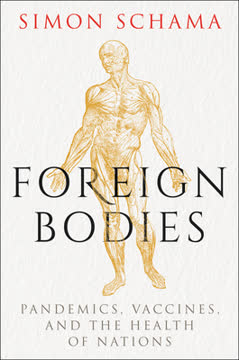
Reviews of Foreign Bodies are mixed, averaging 3.58/5. Many praise Schama's meticulous research, compelling storytelling, and focus on overlooked medical heroes like Waldemar Haffkine. The book draws vivid parallels between historical vaccine resistance and modern anti-vax sentiment. However, frequent criticisms cite the book's meandering structure, excessive digressions, and failure to deliver a cohesive thesis. Some felt misled by the title's promise of a comprehensive pandemic history. Readers with prior public health knowledge found little new material, while novices appreciated the wealth of fascinating, if sometimes overwhelming, detail.
People Also Read