


Key Takeaways
Every woman owns a working prostate that science erased for centuries
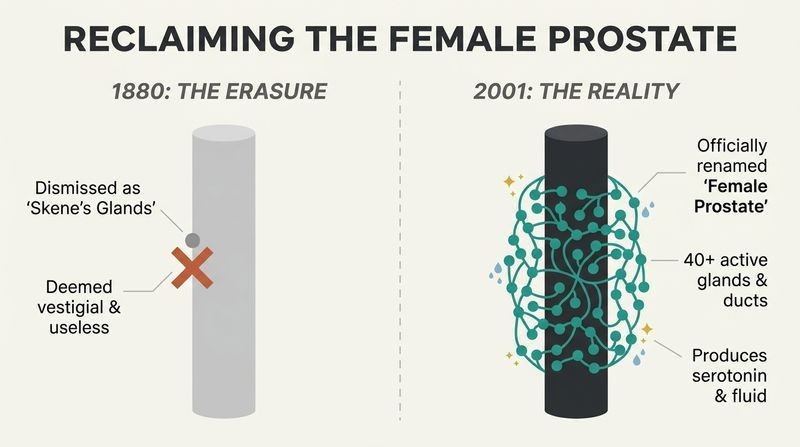
The missing organ. Sundahl's central claim is anatomical, not aspirational: all women are born with a female prostate, a network of roughly 40 glands and ducts (up to three times the number in men) wrapped around the urethral canal for about two inches. It manufactures ejaculate fluid and produces hormones like serotonin. Slovakian pathologist Milan Zaviacic's 13-year cellular study (1986-1999) established it so thoroughly that in 2001 the international anatomical terminology committee agreed to replace the dismissive label "paraurethral gland" with "female prostate."
Why the blackout mattered. In 1880, physician Alexander Skene found glands in the urethra, deemed them vestigial and useless, and focused only on how to drain them when clogged. That framing helped the medical establishment deny female ejaculation for over a century.
What's striking is how anatomy became ideology. Rebecca Chalker documented that female genitals were literally left blank in textbooks that meticulously dissected the penis. This echoes historian Thomas Laqueur's work showing that from antiquity through the Renaissance, medicine held a "one-sex" model treating male and female organs as analogous, only to fracture that view precisely as women began asserting rights. The claim that "all women" ejaculate remains contested (some researchers argue retrograde flow explains apparent non-ejaculators), but the existence of prostatic tissue and PSA in female fluid is now well supported. The deeper lesson: what gets named gets studied, and what stays unnamed stays invisible.
The pee sensation before orgasm is ejaculation knocking, not urine
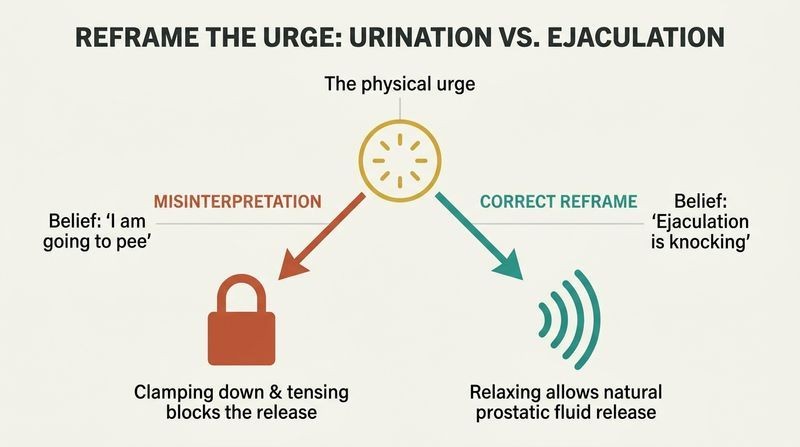
Reframe the urge. Many women clamp down during arousal because they feel like they might urinate. Sundahl argues this sensation is almost always the urge to ejaculate. Since people generally cannot urinate when aroused, tensing against it blocks the very release it signals. Female ejaculate is prostatic fluid: clear, watery, roughly 10% glucose with only trace urine markers (uric acid, urea, creatinine). Its smell is often light or absent, sometimes described as a "forest floor" aroma that shifts with the menstrual cycle.
The proof test. Sundahl offers a simple verification: blot ejaculate on white tissue, then urinate and blot again. If the first is clear and odorless while the second is yellow and smells of urine, you ejaculated. The fluids are chemically distinct, both merely sharing the urethral exit.
The physiology holds up better than skeptics assume. Multiple analyses since Whipple and Addiego's 1981 study found female ejaculate contains prostate specific antigen and prostatic acid phosphatase, markers once thought male-exclusive. The habitual clamping Sundahl describes maps onto what pelvic floor physiotherapists call guarding, a protective reflex that becomes chronic dysfunction. Her reframe (relabel the signal rather than suppress it) parallels interoception research showing that how we interpret bodily sensations shapes our physical response, much as anxiety and excitement share identical arousal signatures distinguished only by cognitive framing. A caveat worth noting: coital incontinence is real, so the two are not mutually exclusive.
You can ejaculate without an orgasm, so drop the performance pressure
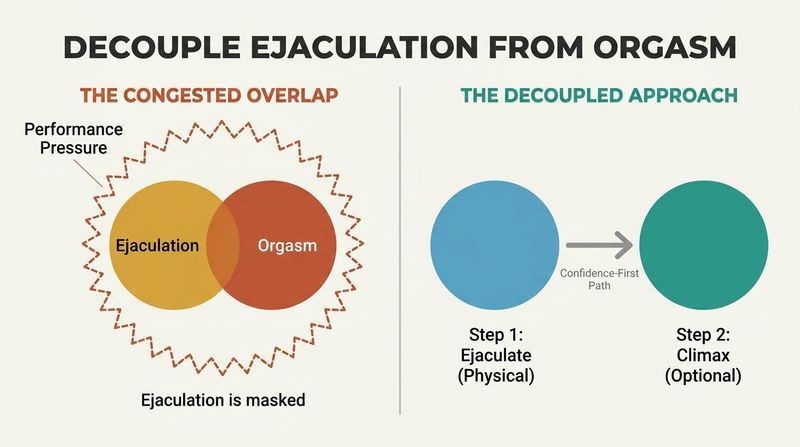
Decouple the two events. Sundahl insists ejaculation and orgasm are separate phenomena. Her entire teaching method starts by having women ejaculate without climaxing at all, removing the pressure to "perform." The technique: arouse the G-spot with slow, firm stimulation until it swells, then practice a cycle of stimulate, push out (as if urinating), hold, relax, and repeat, keeping a finger inside to build fluid before finally withdrawing and pushing to release.
Why order matters. Because ejaculation typically happens just as orgasm begins, the climax often masks it, which is why many women never noticed they were already doing it. Learning the mechanics first, in private, builds what Sundahl calls confidence in the body before adding the complications of orgasm or a partner.
This inversion is pedagogically shrewd. By separating a skill into its mechanical components before demanding the emotional peak, Sundahl applies something like deliberate practice, isolating a subskill under low-stakes conditions. It also defuses the goal-orientation that sex researchers repeatedly identify as counterproductive: spectatoring, Masters and Johnson's term for anxiously monitoring one's own performance, reliably inhibits arousal. The parallel to male multi-orgasm training is notable, since both rest on the same insight that ejaculation and orgasm are distinct neural events. The weaker point is generalizability: the claim that this works for essentially everyone rests more on workshop testimony than controlled study.
The clitoris is a four-inch internal organ, not a button
The iceberg tip. The visible clitoral glans is a fraction of the whole. The 1981 book A New View of a Woman's Body, illustrated by nurse Suzann Gage, mapped an erectile tissue network extending four to five inches inside: the shaft, legs, a urethral sponge surrounding the urethra, bulbs beneath the labia, and a perineal sponge between vagina and anus. A medical student watching a clitoral cadaver dissection said she had only ever known "the tip of an iceberg."
The G-spot redefined. Sundahl defines the G-spot not as a magic dot but as the female prostate plus its surrounding erectile tissue, felt through the vaginal roof as subtle ridges. When engorged, it swells and can be felt like a small firm egg pressing down through the vaginal wall.
The redefinition dissolves a decades-old false binary. Freud pitted "mature" vaginal orgasms against "immature" clitoral ones; Kinsey and later Masters and Johnson swung the pendulum to declare the vagina inert, empty space. Sundahl, following Josephine Lowndes Sevely, argues both camps missed that these are components of one integrated organ. Modern imaging supports the extensive internal structure: 2008 sonography by Buisson and Foldes visualized the clitoral complex in aroused states. The framing matters practically because women taught the clitoris is the sole pleasure site never explore the rest. The 2010 twin study claiming the G-spot may not exist illustrates how anatomy studies still lag behind lived experience.
Weak or chronically tense pelvic floor muscles sabotage both pleasure and health
The muscular gatekeeper. The pelvic floor muscles (a hammock connecting pubic bone to tailbone) support the sex organs and, when they contract, expel ejaculate. Weak muscles reduce the force and quantity of ejaculation and can cause incontinence. Tense muscles, often from habitually clamping to prevent "peeing" during sex, cut off circulation and invite infection. Dr. Kegel's 1947 biofeedback device eliminated incontinence in 93% of his 3,000 patients.
A widespread hidden problem. Chronic pelvic muscle tension (CPMT) affects roughly 30% of the population and can masquerade as chronic bladder infections, lower back pain, or vulvar pain. Sundahl herself learned her years of "bladder infections" were actually pelvic muscle tension. Both weak and tense muscles respond to targeted exercise, massage, and breathwork.
This is arguably the book's most medically actionable claim, and it aligns with mainstream pelvic health physiotherapy that has since gone semi-mainstream. The counterintuitive part is that tension, not just weakness, causes dysfunction, which is why generic "do more Kegels" advice can backfire for women who are already hypertonic. The Wise-Anderson protocol developed at Stanford treats chronic pelvic pain in men and women precisely by releasing overtight muscles. The framing of ejaculation-withholding as a driver of chronic tension is a plausible but under-tested hypothesis. Still, the practical upshot (assess whether your muscles are weak or tense before prescribing yourself exercises) is genuinely useful and rarely stated so clearly.
There are three orgasms on a spectrum, and only some produce ejaculate
Clitoral, uterine, blended. Drawing on the Singers' research, Sundahl describes three orgasm types along a continuum. Clitoral (vulvar) orgasms involve rhythmic pelvic floor contractions, feel insatiable, and need no penetration. Uterine orgasms come only from deep thrusting that jostles the cervix, are deeply emotional, and feature the apnea response (breath held then explosively released). The blended or G-spot orgasm combines both.
Why the middle zone matters. Ejaculation is most likely during a blended orgasm because it engages the pelvic nerve, which activates most of the pelvic floor muscles. The clitoris runs on the pudendal nerve, which fires only about a third of those muscles, so purely clitoral climaxes rarely produce noticeable ejaculate. To ejaculate, shift stimulation slightly toward the G-spot.
The two-nerve theory (pudendal for clitoris, pelvic for G-spot and cervix) is the mechanistic backbone here, and Whipple and Perry's uterine myograph work lent it early physiological support. Contemporary neuroscience adds a third player Sundahl does not emphasize: the vagus nerve, which Komisaruk and Whipple found can carry orgasmic signals even in women with severed spinal cords, possibly explaining the cervical orgasm's distinctive character. The spectrum framing is more useful than rigid categories because it accommodates individual variation. The one caution: labeling orgasms invites new performance anxieties (chasing the "better" uterine type), which Sundahl herself warns against by insisting none is superior.
Slow, firm, relaxed stimulation beats fast friction for the G-spot
Speed kills sensitivity. The G-spot, like a man's prostate, is naturally highly sensitive but numbs under rapid, hard thrusting, just as an overstimulated clitoris shuts down. Sundahl's mantra is the three R's: relax, relax, relax. Deep breathing carries erotic energy through the body and increases circulation; tension, the usual route to orgasm, is precisely what blocks ejaculation.
Never vibrate the G-spot. Vibration works for the clitoris but not for awakening G-spot pleasure, which depends on slow pressure and breath. Sundahl teaches a "come hither" curl against the firm tail of the organ, windshield-wiper strokes across its ridged body, and gentle rolling of the tissue. She likens the swollen prostate to a bunch of tiny grapes: nourish them until they burst, do not bruise them.
The advice cuts against pornographic scripts of vigorous jackhammering, and it aligns with what somatic sex educators call the difference between friction-based and pressure-based arousal. Physiologically, the recommendation to breathe and relax makes sense: sympathetic nervous system activation (the fight-or-flight tension of chasing climax) constricts blood flow, while parasympathetic relaxation enables the engorgement that makes the organ palpable and responsive. The prohibition on vibration is stated more absolutely than the evidence warrants; some women do report vibratory G-spot pleasure. But the core principle, that slowing down increases rather than decreases sensation, is a genuinely counterintuitive correction to the intuition that more stimulation equals more pleasure.
Learn solo first, then invite your partner into the discovery
Privacy protects the process. Sundahl strongly recommends women master ejaculation alone before attempting it with a partner. The reason is emotional safety: the fear of failing or being judged, or a partner's overeagerness, creates the exact pressure that blocks the letting-go ejaculation requires. Practicing solo builds an "erotic map" (a personal chart of which spots and touches feel best) that a woman can later communicate.
Then teach, don't perform. When ready, she frames it as shared exploration: asking a partner to help find the G-spot, giving live feedback like "slower, right there." Sundahl reports most men greet female ejaculation with excitement, not disgust, and that a partner's enthusiasm reduces the inhibition. Rejection, conversely, can make women unconsciously withhold ejaculate for years.
The sequencing reflects sound behavioral logic: build competence in a low-threat setting before raising the interpersonal stakes. It also quietly reframes sex education around self-knowledge as a prerequisite for partnered communication, an inversion of cultural scripts that treat women's pleasure as something a skilled partner delivers. The "erotic map" concept anticipates what sex therapists now call sexual self-modeling. One tension: the emphasis on partner enthusiasm places real weight on the partner's reaction, and the accounts of women who stopped ejaculating for years after rejection reveal how fragile the response is to social conditioning. This underscores that the block is rarely mechanical; it is relational and psychological.
Cultures worldwide once honored female ejaculate as sacred, not shameful
A global inheritance. Sundahl assembles cross-cultural evidence that female ejaculation was widely known and revered before Western Puritanism buried it. Ancient Greeks and Romans called female fluids liquor vitae, believed both sexes contributed "seed," and named the labia nymphae, or water goddesses. Indian Tantra honored amrita, the nectar of the gods, and some traditions encouraged drinking the emissions. Taoist China spoke of "three waters," the third being ejaculate at orgasm's peak.
Art and ritual. Japan's Edo-period shunga woodcuts depicted special urns for catching ejaculate, considered an aphrodisiac and anti-aging tonic. Indigenous traditions, from a Cherokee Quodoushka teaching to Micronesian practices called "spraying the wall," treated the fluid as life-giving. Even a medieval nun, Hildegard of Bingen, painted an anatomically accurate, mandala-like vulva.
The historical survey functions rhetorically to denaturalize modern squeamishness: if so many societies celebrated what the contemporary West pathologizes, the taboo looks contingent rather than inevitable. Methodologically, some of this deserves caution. Translations of ancient texts are contested, and Sundahl acknowledges terms like "urine" or "emissions" may have been substituted by uncomfortable translators, which cuts both ways as an interpretive lever. The Tantric and Taoist material is filtered through modern Western popularizers rather than primary scholarship. Still, the broad point stands: the "seed" theories of Hippocrates and Galen show female sexual fluid was a serious object of premodern medical inquiry, not a fringe curiosity, long before it vanished from view.
The G-spot stores emotional and sexual trauma that massage can release
Body armoring. Sundahl draws on Wilhelm Reich's theory that unresolved trauma lodges physically in muscles and organs as "armoring," blocking energy flow. The G-spot and pelvic floor, she argues, are logical storage sites for sexual wounds, showing up as numb or painful spots. One in four women experiences a violent sexual crime, and even "permitted but unwanted" sex creates a mind-body split that scars the tissue.
G-spot massage. In a healing session, a trusted "supporter" applies steady pressure to numb or painful areas while the "receiver" breathes, maintains eye contact, and names emotions as they surface (rage, grief, joy). The goal is not orgasm but releasing blocks so pleasure can return. Sundahl recounts her own session triggering, then healing, buried grief over a sister's death.
This is the book's most speculative territory, blending Reichian bioenergetics, Tantra, and somatic trauma theory. Reich's specific energy claims were scientifically discredited, but the broader intuition that trauma is held in the body has since gained empirical footing through Bessel van der Kolk's work and Peter Levine's Somatic Experiencing, both cited by Sundahl. Pelvic floor physiotherapists do observe that trauma survivors carry chronic pelvic tension. The genuine caution: reliving trauma alone, as Sundahl did, can retraumatize, which she explicitly warns against. Readers should treat this as a rationale for working with trained trauma-informed practitioners, not a DIY protocol, especially given how powerfully the described releases can destabilize.
Men who slow down and separate orgasm from ejaculation unlock more
The masculine reframe. Awakening a partner's G-spot requires patience that runs counter to the drive to climax quickly. Sundahl's solution is for men to become multi-orgasmic by separating orgasm from ejaculation, a skill she notes is ancient in Taoist practice. Ejaculation drains energy and ends the encounter; non-ejaculatory orgasm keeps men charged, erect longer, and emotionally present.
Beyond control to surrender. She distinguishes older "squeeze and withhold" control methods (which can feel like torture and increase pressure) from approaches like Jack Johnston's, which open into more pleasure rather than clamping down. A man with a spinal injury reported multi-orgasms felt "charging" rather than draining and eased his pain. The payoff for both partners is deeper intimacy and the emotional connection women often crave from sex.
The symmetry is elegant: women learn to add ejaculation to orgasm while men learn to subtract it, both by consciously controlling the same pelvic floor mechanism. The physiology is sound, since ejaculation and orgasm are separable events, and the post-ejaculatory refractory drop men experience is tied to prolactin release, which non-ejaculatory orgasm may avoid. Sundahl's critique of "control" versus "surrender" anticipates a real tension in the field between mechanical technique and embodied presence. The framing does lean on the generalization that women want emotional connection and men want willing partners, a heteronormative binary that risks essentialism, though the underlying skill of slowing down transfers across all pairings.
Analysis
This is a hybrid text: part anatomy primer, part instructional manual, part cultural history, and part feminist manifesto, aimed at women and their partners who want to understand and access female ejaculation. Its structure moves from science (the female prostate) to technique (solo, then partnered) to spirituality (healing and sacred sex), which makes it hard to summarize because it oscillates between falsifiable medical claims and unfalsifiable metaphysical ones without always signaling the shift.
Sundahl's strongest ground is anatomical and historical. The existence of the female prostate, the presence of PSA in female ejaculate, and the 2001 terminology change are defensible, and her framing of the "missing organ" as a feminist case study in medical erasure is genuinely illuminating. Her weakest ground is the universalist claim that all women can and should learn to ejaculate, which rests heavily on workshop testimonials and risks manufacturing a new performance standard, precisely the trap her own "drop the pressure" advice warns against. The forewords hedge this carefully (not all women ejaculate, nor need to), a nuance the main text sometimes overrides with its "YES YOU CAN" enthusiasm.
The book sits at an interesting historical juncture. Written in 2003 and revised in 2014, it predates the mainstreaming of pelvic floor physiotherapy and somatic trauma work, yet anticipates both. Its Reichian and Tantric frameworks will strike scientifically minded readers as dated or unfounded, but the underlying somatic insights have aged better than the vocabulary. The chronic pelvic muscle tension material is arguably the most durable and actionable contribution, quietly medical amid the mysticism.
Ultimately the work's value is less about squirting per se than about a mode of embodied self-knowledge: naming what culture left unnamed, replacing shame with curiosity, and treating sexual response as learnable rather than fixed. Read critically, separating the well-supported anatomy from the speculative energetics, it remains a pioneering and unusually practical entry in women's sexual literacy.
Review Summary
Female Ejaculation and the G-Spot receives mostly positive reviews, with readers praising its informative and educational content. Many find it helpful for understanding female anatomy and sexuality. The book is commended for its detailed instructions and exercises. Some readers appreciate its historical context and scientific approach. However, a few criticize the spiritual overtones and outdated references. The book is recommended for both men and women seeking to enhance their sexual knowledge and experiences. Some readers note the book's focus on heterosexual relationships and lack of inclusivity for non-binary individuals.
People Also Read










Glossary
Female prostate
Ejaculate-producing gland around female urethraAn organ of roughly 40 glands and ducts surrounding the female urethral canal for about two inches, homologous to the male prostate. It manufactures and expels ejaculate fluid and produces hormones such as serotonin. Long dismissed as vestigial "Skene's glands" or "paraurethral glands," it was formally recognized in anatomical terminology in 2001 following Milan Zaviacic's cellular research.
G-spot
Female prostate plus surrounding erectile tissueSundahl defines the G-spot not as a point on the vaginal wall but as the female prostate together with the erectile tissue that surrounds the urethral canal. Felt through the roof of the vagina as subtle ridges, it swells when aroused and can be stimulated to produce a distinct orgasm and ejaculation. Named after gynecologist Ernst Grafenberg.
Female ejaculate
Clear prostatic fluid, not urineA clear, watery fluid expelled through the urethra during arousal or orgasm, produced by the female prostate. Chemically it is prostatic fluid containing about 10% glucose, prostate specific antigen (PSA), and only trace urine markers. It is distinct from both vaginal lubrication and urine, though all three exit through the urethral opening.
Retrograde ejaculation
Ejaculate flowing into the bladderThe release of ejaculate fluid backward into the bladder rather than out of the body. A 1997 Spanish study by Francisco Cabello Santamaria found elevated PSA in the post-orgasm urine of 75% of women who did not visibly ejaculate, suggesting many women ejaculate retrograde without knowing it.
Chronic pelvic muscle tension (CPMT)
Persistent tightness of pelvic floorA condition of chronically tense pelvic floor muscles affecting an estimated 30% of the population. It can cause pain in the legs, back, perineum, vulva, or genitals, and masquerade as chronic bladder infections. Sundahl links it partly to habitual clamping to withhold ejaculate. Treated with physical therapy, massage, and breathwork rather than strengthening exercises alone.
Erotic map
Personal chart of pleasure spotsA mental image a woman builds of the specific sites on her G-spot and body that feel most pleasurable, along with the types and duration of touch she prefers. Developed through solo exploration, it becomes a communication tool for guiding a partner. Unique to each individual.
Body armoring
Trauma stored in muscle tensionA concept from psychologist Wilhelm Reich describing how emotional pain and trauma become physically stored in the muscles and organs, blocking the free flow of bodily energy. Sundahl applies it to the G-spot and pelvic floor, arguing sexual wounds lodge there as numb or painful spots that G-spot massage can help release.
Apnea response
Breath suspended during deep orgasmA temporary suspension of breathing, lasting up to 20 to 30 seconds, that occurs just before climax in uterine and blended orgasms, followed by an explosive exhale. It resembles the breath patterns of other intense emotional releases like sobbing or laughing and signals the deeply emotional nature of these orgasm types.
Blended orgasm
Combined clitoral and uterine climaxAlso called the G-spot or vaginal orgasm, it combines the rhythmic pelvic floor contractions of a clitoral orgasm with the emotional depth of a uterine orgasm. Because it engages the pelvic nerve and most of the pelvic floor muscles, it is the orgasm type most likely to produce female ejaculation.
Two-nerve theory
Separate nerves for clitoris, G-spotThe theory advanced by researchers Whipple and Perry that female sexual response runs on two distinct nerves: the pudendal nerve serving the clitoris and front third of the pelvic floor, and the pelvic nerve serving the urethra, prostate, uterus, and back two-thirds of the pelvic floor. This explains why clitoral and G-spot orgasms feel different and why the latter aids ejaculation.
FAQ
What's Female Ejaculation and the G-Spot about?
- Exploration of Female Anatomy: The book delves into the anatomy of female ejaculation and the G-spot, explaining how all women possess the physical ability to ejaculate.
- Techniques for Ejaculation: It provides practical techniques for women to learn how to ejaculate, both alone and with partners.
- Cultural Perspectives: The book explores historical and cultural views on female ejaculation, highlighting how different societies have recognized and celebrated this aspect of female sexuality.
Why should I read Female Ejaculation and the G-Spot?
- Empowerment Through Knowledge: Reading this book can empower women by providing them with knowledge about their bodies and sexual capabilities.
- Practical Guidance: The book offers step-by-step instructions and techniques for learning to ejaculate.
- Breaking Taboos: It addresses and challenges societal taboos surrounding female sexuality, helping to normalize discussions about female ejaculation and pleasure.
What are the key takeaways of Female Ejaculation and the G-Spot?
- All Women Can Ejaculate: The book asserts that "all women have the anatomy to ejaculate," emphasizing that this ability is a natural part of female sexuality.
- Understanding the G-Spot: It provides a detailed understanding of the G-spot, describing it as an organ that can be stimulated for pleasure.
- Emotional Connection: The book highlights the emotional aspects of G-spot orgasms, which can enhance intimacy and connection with partners.
What is the G-spot, according to Female Ejaculation and the G-Spot?
- Anatomical Definition: The G-spot is defined as "both the prostate and its erectile tissue," which surrounds the urethral canal.
- Location and Sensitivity: It is located about one to two inches inside the vagina and can become engorged and sensitive when stimulated.
- Distinct Orgasm: G-spot orgasms are distinct from clitoral orgasms, often described as "deep, melting love," and can lead to ejaculation.
How can I stimulate my G-spot effectively according to Female Ejaculation and the G-Spot?
- Use of Fingers or Toys: The book suggests using fingers or specifically designed sex toys to apply firm, steady pressure on the G-spot.
- Techniques to Try: Techniques such as the "come hither" motion or circular movements can help awaken sensitivity.
- Focus on Comfort: It emphasizes the importance of being relaxed and comfortable during stimulation, as tension can inhibit pleasure and ejaculation.
What techniques does Female Ejaculation and the G-Spot recommend for learning to ejaculate?
- Solo Exploration: Sundahl suggests starting with solo explorations to become familiar with the G-spot and the sensations associated with ejaculation.
- Pushing Technique: The book describes a technique where women can "push out the ejaculate as if forcing yourself to pee."
- Relaxation and Breathing: Emphasizing the importance of relaxation, the book advises women to "breathe deeply and relax."
How does Female Ejaculation and the G-Spot address the emotional aspects of female ejaculation?
- Emotional Release: Sundahl discusses how G-spot orgasms can trigger emotional responses, enhancing intimacy.
- Connection to Self: The book encourages women to connect with their emotions during sexual experiences for greater satisfaction.
- Visualization Techniques: It offers visualization exercises to help women ground their emotions and connect them to their sexual experiences.
What are some common misconceptions about female ejaculation addressed in Female Ejaculation and the G-Spot?
- Not Urine: The book clarifies that female ejaculate is not urine, emphasizing the importance of understanding this distinction.
- Cultural Taboos: Sundahl discusses how societal norms have led to misconceptions about female sexuality.
- Variability in Experience: The book acknowledges that not all women will experience ejaculation in the same way.
What are the best quotes from Female Ejaculation and the G-Spot and what do they mean?
- "All women have the anatomy to ejaculate": This quote emphasizes the natural ability of all women to experience ejaculation.
- "The G-spot is not merely a 'spot' on the wall of the vagina": Highlights the complexity and significance of the G-spot.
- "Ejaculation is real, it’s fun, it’s healing to our sexual psyches": Underscores the positive aspects of female ejaculation.
How can partners support each other in the journey of exploring female ejaculation, as discussed in Female Ejaculation and the G-Spot?
- Open Communication: The book stresses the importance of communication, encouraging partners to discuss their desires and experiences openly.
- Learning Together: Sundahl suggests that couples read the book together to foster understanding and collaboration.
- Encouragement and Patience: Partners should be patient and encouraging, recognizing that learning to ejaculate is a process.
What role do partners play in the process of female ejaculation according to Female Ejaculation and the G-Spot?
- Supportive Communication: The book emphasizes the importance of partners being supportive and communicative.
- Learning Together: It encourages couples to learn about each other’s bodies and preferences.
- Shared Experience: Exploring female ejaculation together can deepen the emotional connection between partners.
What resources does Female Ejaculation and the G-Spot provide for further exploration?
- References and Resources: The book includes a glossary, references, and a resources section for further information.
- Workshops and Classes: Sundahl mentions workshops and classes that focus on female sexuality.
- Online Resources: The author encourages readers to visit her website for additional materials, including videos and instructional content.
Download PDF
Download EPUB
.epub digital book format is ideal for reading ebooks on phones, tablets, and e-readers.








































