

Key Takeaways
Everyone carries a dragon of grandiosity, not just narcissists
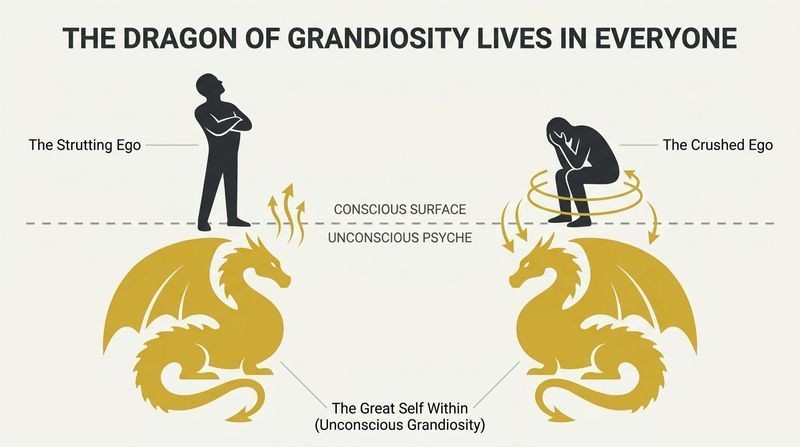
The god within burns in all of us. Moore, a Jungian analyst and theologian, argues that every human psyche contains what he calls the Great Self Within, a reservoir of grandiose, godlike energy. This is not a defect found only in obvious egomaniacs. It is species-wide hardware. Freud saw it as the insatiable id and the perfectionist superego, Adler as the hidden superiority complex behind every inferiority complex, Jung as the archetypal Self, Kohut as grandiose exhibitionistic self-organization.
The unsettling implication: the humble monk and the strutting celebrity sit on chairs of equal height. A person crushed by feeling worthless is often wrestling the same inner deity as someone who thinks they are hot stuff. The question is never whether you have grandiosity, only where it hides and how it leaks out.
What's striking is how Moore reframes narcissism from a diagnosis into a universal human condition, closer to the theological concept of sin than to a clinical label. This democratizes the problem in a useful way. Modern research on the self-serving bias and illusory superiority (most drivers rate themselves above average) supports the idea that inflated self-regard is baseline, not exceptional. The weakness is falsifiability: if both arrogance and self-loathing prove the dragon's presence, the theory risks explaining everything and therefore nothing. Still, as a working posture of humility, assuming you harbor hidden grandiosity is more productive than assuming you are the rare exception.
You either inflate with the god-energy or dump it onto others
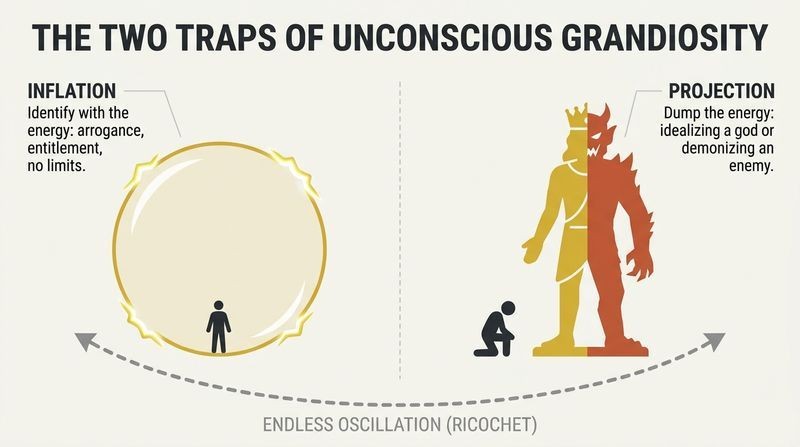
Two doomed strategies, one oscillation. When the ego cannot consciously relate to its grandiose energies, it defaults to one of two moves. It identifies with them, producing arrogance, entitlement, and the conviction that ordinary limits do not apply. Or it represses and projects them, idealizing other people (giving away your sovereignty, becoming dependent or masochistic) and demonizing enemies. Most people ricochet between the poles: inflated arrogance one moment, envious self-erasure the next.
Moore illustrates projection through therapy. A patient may crown the analyst a god or goddess, feel wonderful in that idealizing transference, and stay in treatment for twenty fruitless years. The symptoms vanish only because the grandiosity is parked in the therapist. The moment the analyst disappoints, the same patient recasts them as Satan. Nothing was healed; the energy simply had somewhere to sit.
This maps neatly onto attachment and relational patterns studied outside Jungian circles. The idealize-then-devalue cycle Moore describes in transference mirrors the splitting documented in borderline dynamics and in the honeymoon-to-contempt arc of romantic relationships. Kernberg and object-relations theorists describe the same pendulum. Moore's contribution is insisting the energy is not merely personal history but archetypal, a claim harder to test but clinically vivid. The practical takeaway transcends the metaphysics: notice when you are either exempting yourself from human limits or worshipping and then hating another person. Both signal misplaced god-energy that belongs neither in you nor on them.
Secular modernity smashed the containers that once held our grandiosity
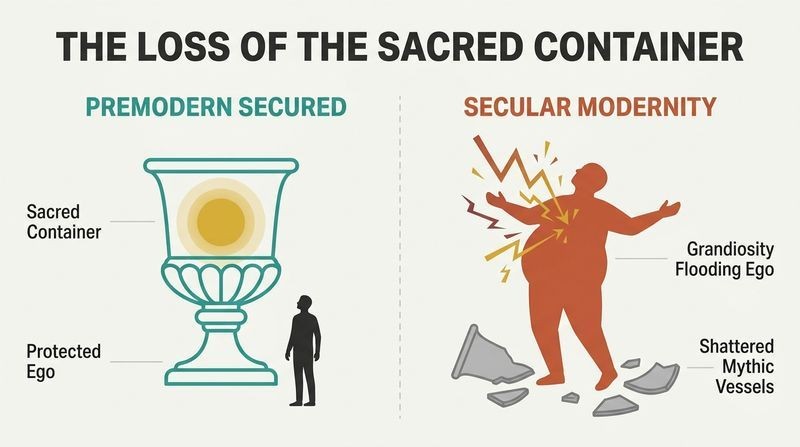
Losing the sacred center had a hidden cost. Drawing on Eliade, Berger, and Homans, Moore argues premodern people lived in two kinds of time and space: the profane everyday and the sacred realm reached through pilgrimage, ritual, and the axis mundi (the world's spiritual center, like Mecca's Kaaba or the Christian cross). These forms gave grandiose god-energy a home outside the human ego. The Enlightenment fantasy promised freedom from priests and kings would bring pure progress.
Instead, Moore says, we got the culture of narcissism. Strip away the mythic vessels and the god-energy has nowhere to go but into the ego, onto other people, or into what he calls demonic sacraments: addiction, compulsive consumption, the sexual exploitation of the vulnerable. Modern people journey outward to shopping and screens in an unconscious hunt for a center that no longer exists.
Moore joins a lineage of thinkers, from Durkheim to Charles Taylor's A Secular Age, who argue disenchantment left a psychological vacuum rather than liberation. The claim that consumerism and addiction are displaced religious hunger resonates with research linking materialism to lower well-being and with the framing of addiction as a search for connection. The contestable edge: secular societies in Scandinavia report high happiness and low violence, complicating any simple equation of secularism with pathology. Perhaps what matters is not religion per se but the presence of any genuine container for transcendence and limits, whether sacred, communal, or ritual.
Real humility is knowing your limits and asking for help
Not self-abasement, just accuracy. Moore strips humility down to two components: knowing your limitations and getting the help you need. That is all. It has nothing to do with an ascetic lifestyle, a soft voice, or self-effacement. The grandiose self hates precisely these two things because it wants no limits and refuses to ask anyone for anything.
This is why he praises twelve-step programs as models of what he calls guerilla spirituality. Members admit they cannot beat the problem alone, that they will always be vulnerable, and that they need the group. Moore contrasts this with the spiritual athlete alone in his hermitage, convinced he is the humblest man alive, a claim that is itself grandiose. He also reframes depression: for someone battling inflation, feeling heavy and worthless can function as ballast.
Defining humility as accurate self-assessment plus willingness to depend on others aligns closely with contemporary psychology's construct of humility as openness to feedback and secure self-worth, not low self-worth. It dissolves the common confusion between humility and self-deprecation, which research suggests are distinct. The twelve-step example is well chosen: admitting permanent vulnerability is empirically associated with better recovery outcomes than willpower-based approaches. One caution worth adding: Moore's point that chronic depression can mask grandiose perfectionism is insightful but should not be read as minimizing clinical depression, which has biological dimensions his ballast metaphor does not address.
Grandiosity wears four masks: king, warrior, magician, lover
The dragon is a shapeshifter with four favorite disguises. Moore's neo-Jungian map, extending the coniunctio (Jung's inner marriage of king and queen), holds that grandiose energy expresses itself through four archetypal configurations, each with a distinct hell:
1. King or queen: posturing control, addiction to being adored, rage at criticism
2. Warrior: workaholism, righteous aggression, needing an enemy to feel pure
3. Magician: cold detachment, believing your theory or doctrine alone is correct while evil is dismissed as illusion
4. Lover: drowning in your own feelings, victimhood, addiction, and compulsive merging
Your family programming shunts your grandiosity toward one form. The saint and the hell-raiser are equally inflated; they simply chose different masks. Recognizing your signature shape is the first step to catching the energy in the act.
The four-archetype scheme is Moore's best-known contribution, developed at length with Douglas Gillette. Its strength is diagnostic: instead of a vague sense of ego trouble, a person can ask which specific pattern they inhabit. It rhymes with other typologies (the Enneagram, DISC) that give inner life a usable vocabulary. The scholarly caveat is that archetypal typologies resist empirical validation and can become Barnum-effect mirrors in which everyone sees themselves everywhere. Used loosely as a self-reflective lens rather than a rigid taxonomy, the framework earns its keep, especially the insight that ascetic and hedonistic excess are two costumes for the same underlying inflation.
Deny that evil is real and you become its unwitting doorway
Two temptations to avoid. Moore warns against the New Age flight into the light that pretends evil is merely illusion or the absence of good, and against the ancient habit of locating evil entirely in a scapegoat to be burned or bombed. Both keep us from seeing that the capacity for atrocity is species-wide. He notes how readily we minimize the Holocaust or, conversely, make Germans carry the shadow for all humanity, rather than admit the genocidal impulse lives in everyone.
Folklore and horror films, he argues, understand evil better than modern theology. His recurring example is the film The Thing: an alien that infiltrates a camp unseen, so no one knows who is already infected. Evil, in the mythic imagination, gets you alone, gets you in the dark, and is inside the house before you notice the danger.
Moore's insistence on taking evil seriously echoes Jung's critique of the privatio boni doctrine and puts him at odds with therapeutic optimism. Empirically, the Milgram obedience experiments and Zimbardo's Stanford prison study lend weight to his claim that ordinary people harbor extraordinary destructive potential under the right conditions. Hannah Arendt's banality of evil, which Moore worries makes denial easier, actually supports his core point that atrocity is not confined to monsters. The horror-film analysis is genuinely sharp cultural criticism. The risk in his framing is that treating evil as an autonomous agency can itself become a way to dodge responsibility, the very projection he warns against.
Splitting turns your unfaced badness into someone else's demonization
The psychology of the elect. Moore, borrowing Erikson's term pseudo-speciation, explains how humans falsely reclassify hated others as a separate, subhuman species. The engine is splitting: I am good, you are bad; we are God's people, you are Satan's. This lets us expel our own badness onto an outside target. The more emotionally fragile or fundamentalist the person, the more they locate the enemy exclusively outside themselves.
Crucially, this is not merely inner work. Moore rejects the naive Jungian idea that if the Jews had integrated their shadow, Hitler would have seemed pleasant. Real enemies exist. But belonging to an exclusive tribe (religious, racial, ideological) lets individuals offload personal grandiosity onto the group, feel humble themselves, and sanction horrific tribal behavior. The tribe carries the god-complex so the member avoids fragmenting.
This is Moore at his most socially incisive. The mechanism he describes anticipates findings in social identity theory, where minimal group assignments produce in-group favoritism and out-group derogation almost instantly. His observation that liberals and fundamentalists both split, merely swapping who receives the demon projection, is a bracing corrective to the assumption that only one's opponents scapegoat. Jared Diamond's work on genocide, which Moore cites, and more recent scholarship on dehumanizing language before mass violence both reinforce the point. The actionable core: whenever a group grants you the comfort of being among the pure while others are irredeemable, you are likely displacing your own shadow onto them.
You cannot slay the dragon; you can only befriend it consciously
The title concept, and the whole book's turn. Western myth gave us the Beowulf and Moby Dick approach: the dragon is the enemy, so kill it. Moore says this heroic strategy always fails because the grandiose energies keep returning and cannot be destroyed. The therapeutic fantasy of being cured of grandiosity is just as false. What can be slain is only the ego's unconscious merger with the dragon, which is what initiation and adulthood require.
The alternative, drawn from Eastern traditions and Jung's study of Chinese thought, treats the dragon as the source of creativity, energy, and blessing. Related consciously and respectfully, with clear boundaries, it fuels a radiant life. Related to unconsciously, it becomes violence, addiction, and psychosis. Trying to live without its energy leaves you gray, depressed, and drained. The dragon guards the treasure.
The befriending move rescues the book from mere pathology-hunting and gives it a constructive telos. It parallels Jung's idea that what we repress gains power while what we consciously engage can be integrated, and it resonates with modern acceptance-based therapies (ACT) that counsel making room for difficult inner states rather than warring against them. The claim that suppressing vital energy produces a lifeless existence finds echo in research on emotional suppression's costs. The tension Moore leaves open is practical: befriending a force he also calls potentially satanic requires exactly the discernment and boundaries most people lack, which is why his emphasis on containers and community matters.
Anxiety shrinks as your hidden grandiosity comes into the light
A counterintuitive law. Moore proposes that unconscious grandiosity, not just external stress, drives much chronic anxiety. The bigger the gap between your secret godlike claims and your actual creaturely limits, the more your body floods with alarm. When you consciously face your inflated sense of entitlement, enlightenment, or victimhood, and accept that you are a mortal creature who needs help, anxiety mysteriously drops.
He ties this to embodiment. Treating your body with compassion, deep breathing, centered prayer, and focused problem-solving all affirm creaturehood and counter grandiosity. He even reads certain compulsive symptoms as the psyche's crude attempt to remind an inflated person they are human and embodied. As magician grandiosity declines you think more clearly; as warrior grandiosity declines you finally tackle real tasks instead of panicking; as lover grandiosity declines you can actually smell the flowers.
The proposition that grandiosity generates anxiety inverts the usual causal story and is genuinely thought-provoking. There is supporting logic in the perfectionism literature, where research consistently links perfectionistic standards to anxiety, depression, and even suicidality, exactly Moore's point that impossible self-demands torment the psyche. Self-compassion research (Kristin Neff) similarly finds that accepting one's ordinary, flawed humanity reduces anxiety and rumination. Where caution is warranted: anxiety has genuine neurobiological and genetic roots that no amount of deflating grandiosity will resolve, and framing all chronic anxiety as hidden inflation could shame people whose anxiety is constitutional. As one lever among several, though, the insight is valuable.
Build daily rituals to contain the god-energy: prayer, imagination, sweat
Concrete containers beat willpower. Moore, unusually for a psychoanalyst, prescribes spiritual and physical practice as survival technology, not piety. His toolkit for regulating grandiose energy includes:
1. Active imagination: an inner visualization dialogue with the king and queen within, which he calls a powerful form of prayer that keeps you from projecting or merging with god-energy
2. Prayer and meditation: anything that reminds the ego it is not God while staying connected to life energy
3. Regular exercise three to five times a week, which he says can rival antidepressants for some
4. Community, especially twelve-step-style groups that name the permanent struggle
5. Sacred objects and liturgy, from a rosary in the pocket to a marked liturgical year, as anchors for unstable psyches
Miss your ritual, he warns, and the grandiosity kicks up in other compulsions.
The move to treat prayer and ritual as mental-health infrastructure rather than mere belief is prescient. Subsequent research supports several claims: regular aerobic exercise shows antidepressant effects comparable to medication in some meta-analyses, and structured routines reliably reduce anxiety in unstable conditions. Active imagination anticipates evidence-based visualization and chair-work techniques now used in schema therapy and IFS (Internal Family Systems), which literally has clients dialogue with inner parts. Moore's framing of a rosary as a self-regulation anchor rhymes with research on transitional objects and grounding techniques. The through-line is sound: externalized, embodied, repeated practices regulate the psyche better than abstract resolve, which is exactly why habit and ritual outperform intention.
Spiritual people are most seduced by grandiosity dressed as holiness
The subtlest hell of all. Moore reserves sharp warnings for religious and spiritual life, where the dragon hides best. Displace your grandiosity onto your spiritual tribe and you can feel selflessly humble while your group makes arrogant, exclusive claims to be the true people of God. The original intent to serve one small part of a divine plan curdles into believing you are the divine plan.
He points to the shared temptation of the Abrahamic faiths to literalize their sense of election, seizing land and refusing to share the earth. The genuine jihad, every mystical tradition agrees, is the struggle against one's own idolatry. Moore's test for a tribe's hidden grandiosity is behavioral: how readily does it drop superiority claims to cooperate with other groups in feeding the hungry and freeing the oppressed? Shining tribes do not need to announce their specialness.
Grounding spiritual authenticity in cooperative compassion rather than doctrinal correctness gives Moore a usable, almost empirical criterion that cuts across traditions. It echoes the prophetic critique found within the religions themselves, from Amos to Jesus's warnings against showy piety, and aligns with research showing that intrinsic religiosity (faith as an end) correlates with prosocial behavior while extrinsic religiosity (faith for status or security) correlates with prejudice. His even-handedness is notable: he indicts the self-righteousness of the tolerant left as readily as the fundamentalist right. The enduring challenge he poses is that the more certain a group is of its exclusive righteousness, the more likely it is channeling exactly the inflation it condemns in others.
Analysis
Facing the Dragon is an anthology of lectures and essays, not a tightly argued monograph, which makes it both rich and repetitive. Written by Robert L. Moore, a neo-Jungian psychoanalyst and seminary professor, and framed by the shock of September 11, it fuses depth psychology with comparative religion to make one central claim: every human harbors grandiose god-energies (the dragon), and civilization's fate depends on whether we face them consciously or act them out.
Moore's real originality is synthetic. He braids Freud's id and superego, Adler's superiority complex, Kohut's self psychology, and Jung's archetypal Self into a single thesis, then adds his own four-archetype map (king, warrior, magician, lover) and his diagnosis of modernity. His strongest move is treating narcissism not as a rare disorder but as a universal condition akin to sin, which dissolves the reader's comfortable distance from the problem. His second strength is refusing both the New Age denial of evil and the tribal projection of it, holding a difficult middle where the enemy is genuinely both out there and in here.
The book's weaknesses are real. It leans heavily on assertion and clinical anecdote rather than data, and its archetypal claims resist testing. It idealizes premodern ritual while acknowledging its cruelties somewhat unevenly. The reliance on films and myth is illuminating but occasionally substitutes vividness for evidence. And its warnings about a coming apocalyptic reckoning read as more datable than the timeless psychology.
Yet its practical core is durable and increasingly validated: externalized ritual, embodiment, community, and honest self-audit regulate the psyche better than willpower. Its account of splitting and tribalism has only grown more relevant in an age of algorithmic outrage and polarized certainty. Read as diagnostic wisdom literature rather than falsifiable science, Moore offers a bracing corrective to both spiritual sentimentality and secular overconfidence, and a genuinely humane program for growing up.
Review Summary
Facing the Dragon receives high praise for its insights on grandiosity and human psychology. Readers appreciate Moore's exploration of the "dragon" archetype, representing inner grandiosity that can be destructive if unchecked. The book discusses how to integrate this energy positively, drawing on Jungian concepts. Some reviewers found the lecture-based format repetitive, but most valued the wisdom shared. The work is seen as crucial for understanding personal and societal issues, with many considering it a life-changing read despite its occasionally dense or outdated content.
People Also Read


Glossary
The dragon / Great Self Within
Inner reservoir of godlike energyMoore's central metaphor for the powerful grandiose energies present in every human psyche, also called the god-imago or archetypal Self. Not evil in itself, it is the source of both creativity and destruction. Faced consciously it brings radiance; ignored or identified with, it produces inflation, addiction, violence, and fragmentation. It can never be eliminated, only befriended.
Grandiosity
Godlike claims exceeding real limitsFantasies, wishes, and behaviors in which the ego's sense of itself exceeds what real experience supports, producing either mania, entitlement, and arrogance or, in reaction, depression and self-hate. Moore insists it is universal, not confined to clinical narcissists, and that the humble and the arrogant struggle with the same underlying force.
Lucifer complex
Unconscious identification with grandiose energyMoore's term for the destructive state that arises when the ego unconsciously merges with the dragon's grandiose energies, producing limitless claims, absence of empathy, and the capacity to incarnate evil. Distinct from the personal shadow, it is an archetypal force one must relate to consciously rather than attempt to integrate.
Splitting / pseudo-speciation
Casting the other as subhuman enemySplitting is the psyche's division of the world into all-good self and all-bad other. Pseudo-speciation, a term from Erik Erikson, is the resulting tendency to reclassify hated people as a separate, subhuman species. Together they let individuals expel their own badness onto scapegoats and fuel racism, fundamentalism, and genocide.
Active imagination
Inner dialogue with archetypal figuresA Jungian visualization practice Moore treats as a powerful form of prayer. The practitioner journeys inward to converse with inner figures such as the king and queen of the psyche. Done regularly, it helps the ego relate consciously to grandiose energies rather than projecting them onto others or merging with them, and Moore reports it lowers anxiety.
Coniunctio
Inner marriage of king and queenJung's alchemical image, adopted by Moore, of the archetypal Self pictured as the sacred marriage of king and queen (rex and regina). Moore expands it into an eightfold structure holding four inner couples: king/queen, warriors, magicians, and lovers, the deep architecture through which grandiose energy manifests.
Selfobject transference
Using another to hold your grandiosityA concept from Heinz Kohut's self psychology that Moore reinterprets archetypally. It is the relationship in which one person unconsciously uses another (a therapist, leader, or partner) to carry their own grandiose or idealizing energy. It relieves symptoms temporarily but is no cure, and collapses into rage when the idealized figure disappoints.
Dreaming innocence
Enchanted denial of one's grandiosityA phrase Moore borrows from theologian Paul Tillich for the state of enchanted unawareness in which people deny their own grandiosity and the reality of evil. It is torn open by the first genuine awareness of the dragon's presence, after which compassion and the fruits of the spirit can begin to grow.
FAQ
1. What is Facing the Dragon: Confronting Personal and Spiritual Grandiosity by Robert L. Moore about?
- Exploration of grandiosity: The book investigates the psychological and spiritual dynamics of grandiosity and evil within the human psyche, symbolized by the archetype of the dragon.
- Archetypal and interdisciplinary approach: Moore combines Jungian psychoanalysis, spiritual theology, and comparative mythology to decode how unconscious grandiose energies shape personal and collective behavior.
- Contemporary relevance: It addresses urgent issues like narcissism, tribalism, religious conflict, and ecological destruction, arguing these are fueled by unregulated archetypal energies.
- Call to conscious engagement: The central message is the necessity of consciously facing and integrating these powerful inner forces to prevent destructive outcomes and foster transformation.
2. Why should I read Facing the Dragon by Robert L. Moore?
- Timely psychological insights: The book offers a framework for understanding the unconscious forces behind violence, addiction, and social conflict in today’s world.
- Bridges psychology and spirituality: Moore uniquely integrates psychoanalytic science with spiritual wisdom, making the book valuable for both therapists and spiritual seekers.
- Practical tools for growth: It provides actionable guidance, such as ritualization and community engagement, to help readers regulate grandiosity and foster authentic maturity.
- Relevance for personal and social healing: The book is especially useful for those interested in personal development, leadership, or addressing collective crises.
3. What are the key takeaways from Facing the Dragon by Robert L. Moore?
- Grandiosity is universal: Unconscious grandiose energies are present in everyone and can be both creative and destructive.
- Archetypal structures matter: The king/queen, warrior, magician, and lover archetypes shape how grandiosity manifests in individuals and cultures.
- Conscious engagement is essential: Facing and befriending the “dragon” within is necessary for personal integration and social harmony.
- Ritual and community are vital: Healthy ritualization and supportive communities are crucial for containing and transforming grandiosity.
4. What is the "dragon" archetype in Facing the Dragon and why is it important?
- Symbol of grandiosity: The dragon represents the powerful, often unconscious grandiose energies within the psyche that can be creative or destructive.
- Dual nature: Mythologies depict the dragon as both a threat and a source of power, reflecting the ambivalence of these inner forces.
- Necessity of conscious engagement: Moore argues that the dragon cannot be destroyed but must be consciously faced, respected, and integrated to prevent chaos.
- Path to individuation: Befriending the dragon is a metaphor for the individuation process, leading to greater maturity and effectiveness.
5. How does Robert L. Moore define and explain human evil in Facing the Dragon?
- Evil as active force: Evil is described as a real, active presence capable of deception, seduction, and destruction, not just the absence of good.
- Possession and enchantment: Moore likens evil to a possession state or alien force that invades the psyche and community, undermining life and relationships.
- Rooted in grandiosity: Evil operates through grandiose energies that, when denied or unregulated, become malignant and destructive.
- Mythic and psychological roots: The book draws on folklore, mythology, and psychoanalysis to show how evil is intertwined with archetypal dynamics.
6. What are the four archetypal forms of grandiosity described in Facing the Dragon by Robert L. Moore?
- Royal archetype: Expresses grandiosity through control, hierarchy, and the need for idealizing projections, often leading to domination or paranoia.
- Warrior archetype: Manifests as workaholism, righteous rage, and aggression justified by a sense of moral superiority.
- Magician archetype: Shows grandiosity as emotional detachment and intellectual superiority, denying evil and avoiding compassionate action.
- Lover archetype: Centers on feelings, victimization, and bodily needs, leading to addictive behaviors, toxic shame, and dependency.
7. How does Facing the Dragon by Robert L. Moore explain the relationship between grandiosity and pathological tribalism?
- Projection onto groups: Individuals displace their unconscious grandiosity onto social groups, creating selfobject relationships that foster exclusivity.
- Malignant tribalism: This dynamic leads to demonization of outsiders, racism, religious fundamentalism, and even genocidal impulses.
- Cycle of violence: Unregulated grandiosity in groups perpetuates cycles of hatred and violence.
- Need for conscious regulation: Moore argues that insight and conscious engagement can transform these energies into cooperative, compassionate community life.
8. What is the "Diamond Body" model in Facing the Dragon and how does it help decode archetypal structures in the psyche?
- Framework for analysis: The Diamond Body is Moore’s model mapping four major archetypal configurations—king, warrior, magician, and lover—within a quaternary structure.
- Beyond stereotypes: It expands Jung’s ideas by recognizing both aggressive and receptive qualities in masculine and feminine archetypes.
- Dynamic interplay: The model helps analyze how grandiose energies manifest differently depending on which archetype dominates.
- Tool for integration: It provides a comprehensive tool for psychological and spiritual work, aiding in the conscious regulation of grandiosity.
9. What practical methods and advice does Facing the Dragon by Robert L. Moore offer for regulating grandiose energies?
- Active imagination: Moore recommends inner dialogue with archetypal figures as a way to become conscious of and regulate grandiosity.
- Ritual and exercise: Regular ritualization, including physical exercise and participation in worship or liturgy, helps channel grandiosity healthily.
- Community support: Engagement in religious communities or twelve-step programs provides social containment and accountability.
- Spiritual practice as survival: Prayer and spiritual disciplines are presented as essential techniques to manage overstimulation from archetypal energies.
10. How does Facing the Dragon by Robert L. Moore address spiritual narcissism and religious conflict?
- Spiritual grandiosity: The book highlights how spiritual groups often claim exclusive divine approval, leading to idolatry and conflict.
- Need for humility: Moore advocates for traditions to recognize their own unconscious grandiosity and set aside exclusivist claims.
- Cooperation over competition: He urges spiritual communities to engage in compassionate, cooperative action for the common good.
- Discernment is key: Leaders and individuals must develop discernment to differentiate authentic spirituality from ego-driven posturing.
11. What are the "dragon laws" in Facing the Dragon by Robert L. Moore and why are they significant?
- Inexorable psychic laws: The dragon laws summarize how unconscious grandiosity operates relentlessly, causing cycles of inflation and demonization.
- Four archetypal manifestations: They detail how grandiosity appears in royal, warrior, magician, and lover forms, each with characteristic psychological signs.
- Path to transformation: Awareness and respectful confrontation of these laws enable individuals to reduce anxiety and cultivate love, hope, peace, and joy.
- Personal and social healing: Understanding these laws is crucial for breaking cycles of violence and fostering healing.
12. What are the best quotes from Facing the Dragon by Robert L. Moore and what do they mean?
- On human evil: “Existential denial of the divine presence creates a demonic alchemy that hijacks the sacred energies of the soul and twists them into destructive powers of hideous strength.” This highlights how denying spirituality corrupts inner energies into evil.
- On spiritual warfare: “You do not want to struggle? Then do not start toward individuation, because it will be all you can deal with and more to work toward your individuation.” This underscores the necessity of inner struggle for growth.
- On grandiosity: “The human ego cannot contain God.” This statement captures the challenge of managing the archetypal Self’s grandiose energies without fragmentation or psychosis.
- On befriending the dragon: The book emphasizes that the dragon must be consciously faced and befriended, not destroyed, to realize one’s optimal potential.
About the Author

Download PDF
Download EPUB
.epub digital book format is ideal for reading ebooks on phones, tablets, and e-readers.








































