Key Takeaways
Own every failure — even the ones that aren't directly your fault
“Total responsibility for failure is a difficult thing to accept, and taking ownership when things go wrong requires extraordinary humility and courage.”
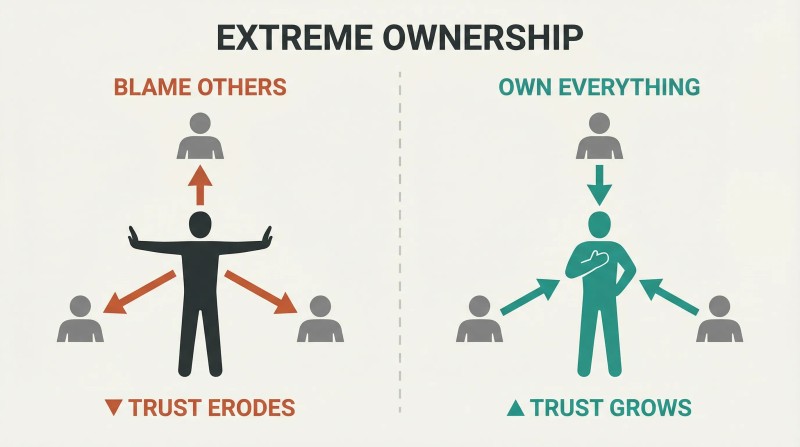
A near-disaster in Ramadi. During a massive 2006 operation, a "blue-on-blue" friendly fire incident erupted when rogue Iraqi soldiers entered a building held by SEAL snipers. An Iraqi soldier was killed, a SEAL was wounded, and an airstrike nearly leveled the building with Americans inside. When investigators arrived, SEAL task unit commander Jocko Willink stood before the room and took full blame despite dozens of individual errors: "There is only one person to blame for this: me."
Extreme Ownership means the leader owns everything that impacts the mission — subordinates' failures, broken communication, flawed coordination. Counterintuitively, owning blame increased his superiors' trust. In business, Willink coached a VP of manufacturing who'd blamed subordinates for eighteen months of failed execution. The breakthrough came when the VP opened his board presentation with what he would change — not what others had done wrong.
Your team's ceiling is set by its leadership, not its talent
“…when it comes to standards, as a leader, it's not what you preach, it's what you tolerate.”
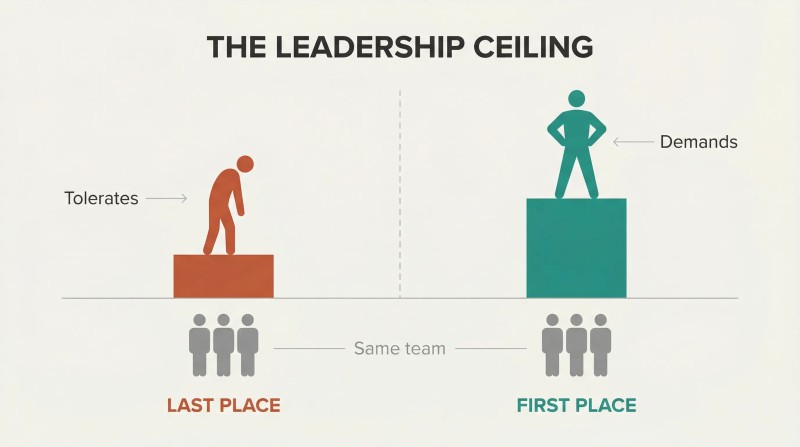
Same team, different leader, opposite results. During SEAL Hell Week — a brutal stretch with less than one hour of sleep over several days — instructors swapped leaders between the worst boat crew (Boat Crew VI, dead last in every race) and the best (Boat Crew II, winning every race). Within an hour, Boat Crew VI won first place. Same exhausted men, same heavy boats, same freezing ocean. Only the leader changed.
Standards enforcement is the mechanism. A leader who accepts subpar performance without consequences has set a new, lower standard — regardless of speeches given. In business, a CTO refused ownership of a failed product rollout — what the authors call a Tortured Genius, someone who accepts zero responsibility and blames everyone else. Despite his technical expertise, the CEO fired him. Under new ownership-minded leadership, the company rebounded toward profitability.
Ask 'why?' until you believe the mission, then pass belief down
“If a leader does not believe, he or she will not take the risks required to overcome the inevitable challenges necessary to win.”
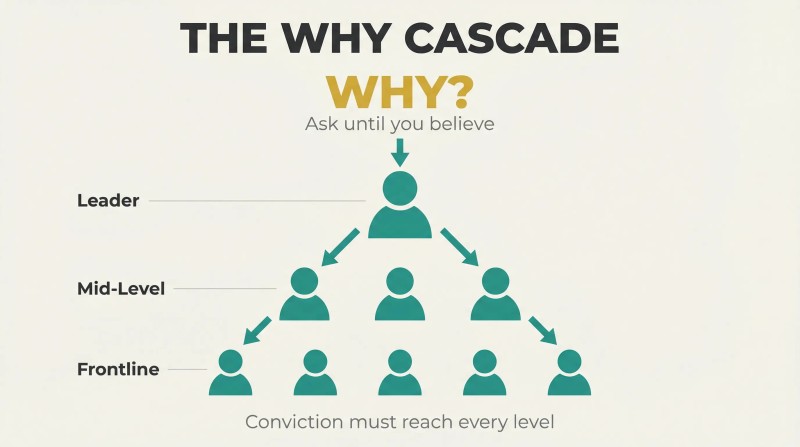
Willink's first reaction was "Hell no." When ordered to fight alongside poorly trained Iraqi soldiers — some wearing sandals, carrying rusted rifles, with questionable loyalty — his elite SEALs were livid. But Willink asked himself "Why?" from a strategic perspective and realized: if Iraqis never learned to secure their own country, Americans would be stuck there for generations. The Iraqi soldiers were also his "ticket to operate" — without them, missions wouldn't get approved.
Leaders must transmit the why. In a parallel business case, midlevel managers couldn't sell a new compensation plan to their sales teams because the CEO never explained the strategy behind it: lower overhead, lower prices, more volume for top producers. Once she explained the reasoning in a five-minute talk, the managers understood, believed, and could pass conviction down to their frontline teams.
Treat internal rivals as allies — the real enemy is outside
“Ego clouds and disrupts everything: the planning process, the ability to take good advice, and the ability to accept constructive criticism.”
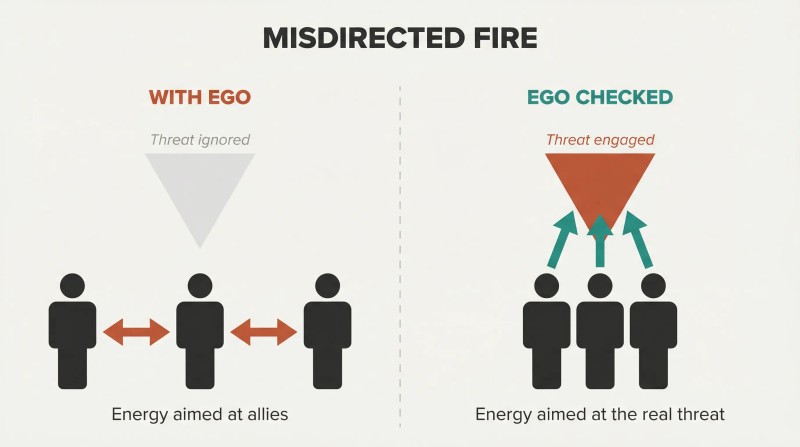
At Camp Corregidor in Ramadi, a highly capable unit arrived with superior gear and well-trained Iraqi soldiers. But some members refused to coordinate plans, talked down to battle-hardened Army soldiers, and ignored advice from SEALs who'd been fighting there for weeks. Within two weeks, the Army colonel expelled them. Despite impressive capability, their ego made them useless to the mission.
Ego also blocks conflict resolution. When a manager's drilling superintendent violated procedures — costing hundreds of thousands of dollars — the manager wanted a confrontation. Willink advised the counterintuitive approach: lead with ownership. Say "It's my fault for not explaining why we have these procedures." By checking your own ego first, you disarm the other person's defensiveness and open a path to actually solving the problem rather than escalating a turf war.
Break silos — departments that don't support each other doom the mission
“If the overall team fails, everyone fails, even if a specific member or an element within the team did their job successfully.”
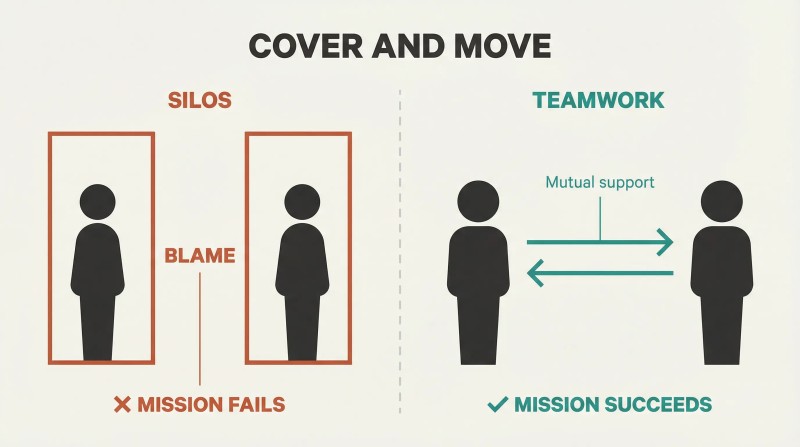
Cover and Move is the most fundamental tactic — and it simply means teamwork. After a day-long firefight deep in enemy territory, Leif Babin's SEAL sniper team patrolled back to base through dangerous streets and got into a serious gunfight. His platoon chief's correction was blunt: why didn't you leave the other SEAL sniper team in their elevated position to cover your movement? Babin had been so focused on his own team's problems that he forgot to coordinate with the greater team.
In business, the same myopia breeds blame. A production manager condemned a subsidiary company for costly downtime instead of engaging with them. Once he visited their operation, understood their resource constraints, and invited their field team to coordination meetings, the "us versus them" mentality dissolved. Downtime dropped to industry-leading levels.
Brief plans so the most junior person understands them
“If your team doesn't get it, you have not kept things simple and you have failed.”
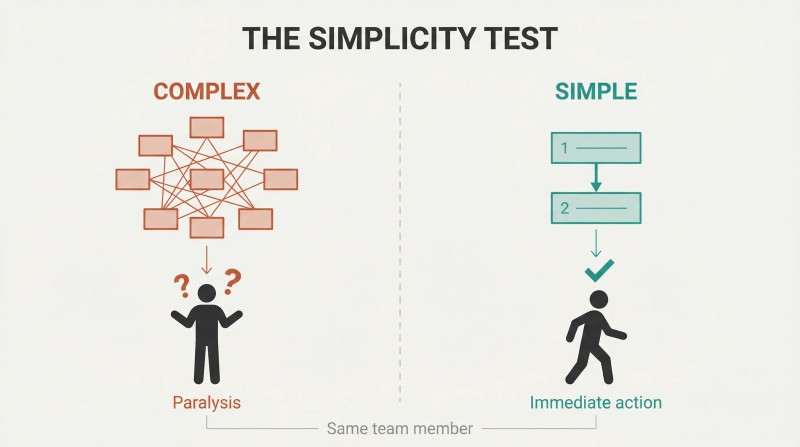
Complexity nearly killed a patrol. A U.S. Army lieutenant planned a two-kilometer route through enemy territory crossing three different units' battlespace over IED-laden roads. Willink simplified it to a few hundred meters within one unit's area. Twelve minutes after stepping off, the patrol got into a fierce firefight. The simplified plan — with clear building references and a single radio net — enabled rapid coordination that saved lives.
A manufacturing plant proved the same lesson. Engineers built an impossibly complex bonus system involving variable weights, tiered efficiency metrics, six-month rolling averages, and graduated fault multipliers. Employees had no idea what to focus on. Once simplified to two factors — weighted units produced and quality score — productivity surged almost immediately, and the company let go its four weakest performers as the rest absorbed their workload.
When overwhelmed, attack the single highest-priority problem first
“Relax. Look around. Make a call.”
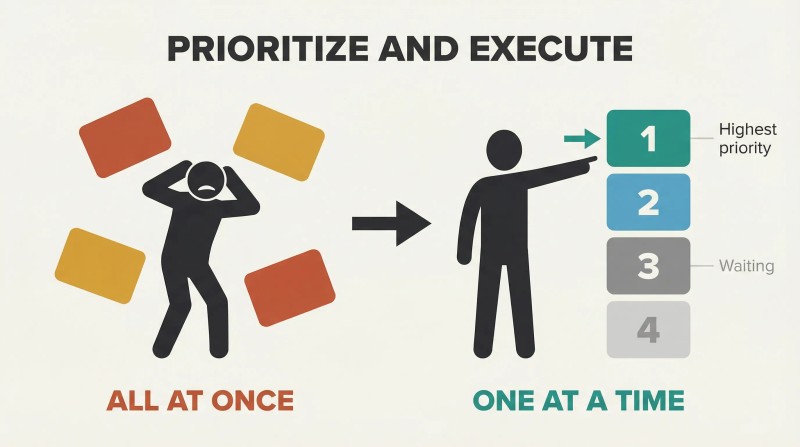
Babin's platoon was trapped. An IED was discovered at their only exit, a SEAL who'd fallen through a roof lay injured in the street below, an explosive charge was counting down, and the team was exposed on a rooftop surrounded by enemy fighters. Instead of panicking, Babin attacked each crisis sequentially:
1. Set security — without it, nothing else mattered
2. Find alternate exit — a breacher broke through a locked iron gate
3. Confirm head count — all personnel accounted for
4. Move to safety before the charge detonated
The same paralysis afflicts business leaders. A pharmaceutical CEO was simultaneously launching products, expanding distribution, overhauling his website, restructuring compensation, and building training programs. Willink's advice: focus the entire company's effort on one initiative — supporting the frontline sales force — until it had real momentum, then advance to the next.
Keep teams at 4-6 people and empower each leader to decide
“Human beings are generally not capable of managing more than six to ten people, particularly when things go sideways and inevitable contingencies arise.”
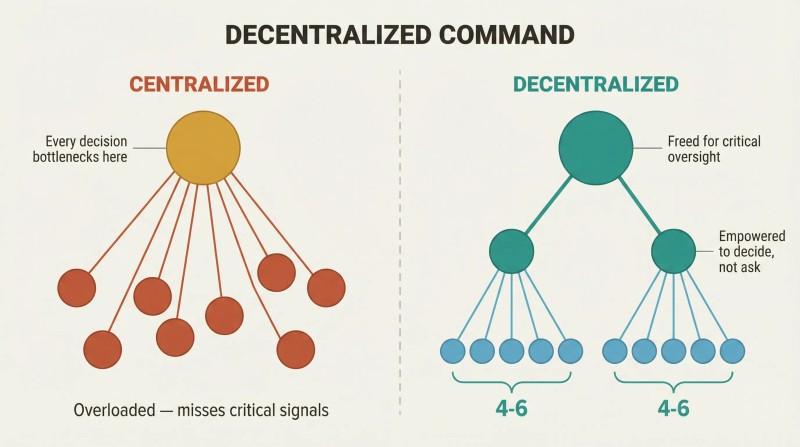
Decentralized Command prevented fratricide. During Ramadi's largest operation — multiple Army battalions, Marines, nearly 100 armored vehicles — Willink managed only his two platoon commanders. When Delta Platoon found their preplanned building unsuitable, the platoon commander radioed what he was going to do, not asking permission. This freed Willink to catch a lethal error: a Bradley Fighting Vehicle was about to fire on "enemy snipers" who were actually his own SEALs on a rooftop. By insisting on reconfirmation, he prevented disaster.
The building block is small teams with clear leaders. Each member must understand the Commander's Intent — the mission's overarching purpose and desired end state — so they can act independently toward unified goals. A business regional president oversaw branches ranging from 2 to 22 people. Restructuring into uniform teams of five or six with empowered leaders transformed performance.
If your boss won't approve your plan, you haven't informed them enough
“Leadership doesn't just flow down the chain of command, but up as well.”
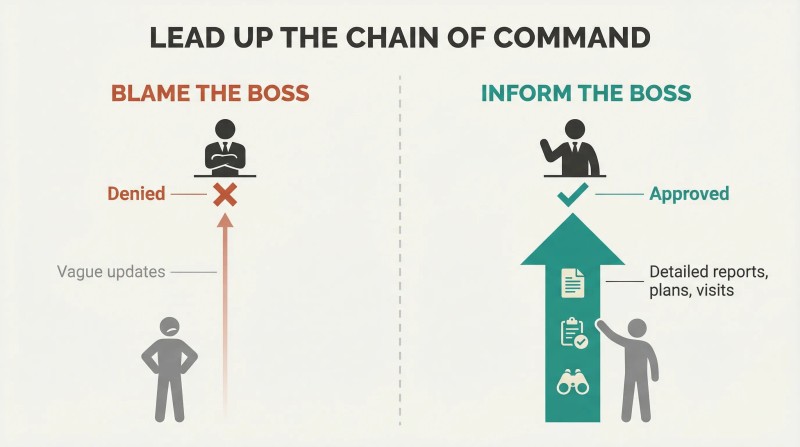
Babin was furious when his commanding officer's staff asked whether he'd coordinated a Quick Reaction Force — a question he found insulting in Ramadi, where QRFs were essential for survival on every operation. Willink's correction was sharp: "We can't expect them to be mind readers." The CO's staff, thirty miles away in safer Fallujah, couldn't understand Ramadi's reality without detailed information from the front lines.
Stop blaming the boss; start informing them. Task Unit Bruiser began providing extremely detailed mission plans and post-operational reports, and invited senior leaders to visit Ramadi and even join combat operations. The more information pushed up the chain, the more comfortable the CO became approving missions. In business, a frustrated field manager realized his corporate executives weren't sabotaging him — they simply lacked the information to support him. His job was to provide it.
Build disciplined SOPs so your team can improvise under pressure
“Instead of making us more rigid and unable to improvise, this discipline actually made us more flexible, more adaptable, and more efficient.”
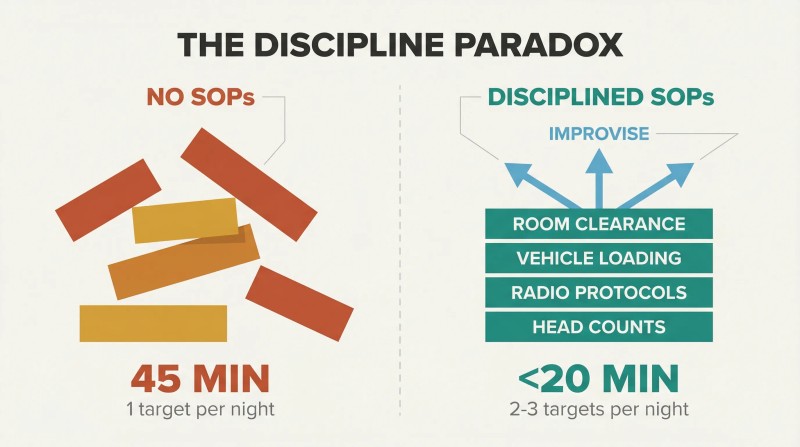
On early Baghdad raids, Willink's platoon ransacked target buildings — flipping furniture, smashing cabinets — taking 45 minutes while evidence was missed and entire rooms went unsearched. His assistant officer developed a disciplined system: designated room owners, labeled rooms, systematic floor-up searches, organized evidence bags. First rehearsal: 30 minutes. Second: 20. Third: 10. Actual mission: under 20 minutes with vastly superior evidence collection.
Discipline didn't restrict the team — it liberated them. The faster method enabled hitting two or three targets per night instead of one. Task Unit Bruiser standardized everything: vehicle loading, building exits, radio procedures, head counts. When chaos struck and plans changed mid-operation, these disciplined foundations meant only the changed portion needed explanation. The paradox held throughout: the tighter the procedures, the greater the team's freedom to adapt.
Analysis
Extreme Ownership is arguably the most influential military-to-business leadership book of the 2010s, and its rhetorical architecture explains why. By opening each chapter with visceral combat — friendly fire, IED-rigged doorways, snipers nearly shooting Americans — Willink and Babin create emotional anchors that make subsequent principles feel earned rather than platitudinous. The reader processes 'take total responsibility' not as a bumper sticker but as a survival mechanism tested under mortar fire. This is the book's structural genius: it borrows legitimacy from extreme contexts to sell principles for ordinary ones.
The intellectual core is more nuanced than its aggressive packaging suggests. The Dichotomy of Leadership — the final chapter — is quietly the most sophisticated insight. It argues that every preceding principle has a failure mode: confidence becomes arrogance, ownership becomes micromanagement, discipline becomes rigidity. This self-correcting mechanism transforms the framework from a set of rules into an oscillation system. Leaders don't optimize toward one pole but constantly rebalance between opposing forces — a subtlety that distinguishes this from the machismo often associated with military leadership literature.
What critics underappreciate is the implicit organizational psychology embedded in the Laws of Combat. Cover and Move maps to interdependence theory applied to business silos. Decentralized Command aligns remarkably with self-determination theory's autonomy principle. Prioritize and Execute echoes cognitive load research — the brain cannot effectively parallel-process complex decisions. The authors never cite these academic frameworks, but their battlefield-derived principles converge with decades of research, which may explain the book's intuitive resonance with business audiences.
The framework's blind spot is selection bias. SEAL teams begin with extraordinary human capital filtered through the most brutal screening process in the military. The claim that there are no bad teams, only bad leaders oversimplifies contexts where structural constraints, resource scarcity, or genuine talent deficits limit outcomes. Yet the underlying wager — that most teams have more latent capability than their leaders have unlocked — is probably correct for most business environments. The book's enduring contribution is reframing radical accountability not as punishment but as the most direct path to agency and power.
Review Summary
Extreme Ownership receives mixed reviews, with praise for its practical leadership principles and real-world examples from military and business settings. Critics appreciate the emphasis on personal responsibility and accountability. However, some find the writing style repetitive and overly focused on military experiences. Readers are divided on the book's applicability to civilian contexts, with some finding the lessons valuable across various fields, while others see the military perspective as limiting. Overall, the book is generally considered a thought-provoking read on leadership, despite its polarizing nature.
People Also Read



 Immersive

Glossary
Extreme Ownership
Leader's total responsibility mindsetThe foundational leadership principle that the leader is responsible for everything in their world that affects the mission. When subordinates fail, leaders must look at themselves first—for unclear instructions, inadequate training, or poor oversight. Rather than assigning blame, the leader takes full ownership of all outcomes, which builds trust and creates a culture of accountability throughout the team.
Laws of Combat
Four tactical principles for teamsThe four fundamental combat principles Willink and Babin applied to leadership: (1) Cover and Move—teamwork between all elements; (2) Simple—keep plans clear and concise; (3) Prioritize and Execute—handle problems sequentially by priority; (4) Decentralized Command—empower subordinate leaders to make decisions within defined boundaries. Together they form the operational framework for any high-performance team.
Cover and Move
Teamwork between all elementsThe first and most fundamental Law of Combat. All elements of a team must work together, supporting one another to accomplish the mission. In tactical terms, one group provides covering fire while another moves forward. Applied broadly, it means departments, teams, and supporting units must break down silos and mutually support each other rather than operating independently or in competition.
Prioritize and Execute
Sequential problem-solving under pressureThe third Law of Combat. When facing multiple simultaneous problems, a leader must resist solving them all at once. Instead: identify the highest-priority problem, communicate it clearly, direct the team's full effort toward it, then move to the next. Summarized by Willink's mantra 'Relax, look around, make a call.' Requires contingency planning to stay ahead of emerging challenges.
Decentralized Command
Empowering subordinate leaders' decisionsThe fourth Law of Combat. Teams must be broken into manageable elements of four to six people, each with a designated leader who understands the Commander's Intent. Junior leaders are empowered to make decisions within defined boundaries without waiting for approval. They tell senior leaders what they plan to do rather than asking what to do, enabling faster execution and freeing senior leaders for strategic oversight.
Commander's Intent
Mission's purpose and end stateThe most important element of any operational brief. It explains the overall purpose and desired result of the mission in clear, simple terms. When every team member understands Commander's Intent, they can make independent decisions that support the mission without requiring explicit direction for every contingency. It is the foundation enabling Decentralized Command to function effectively.
Tortured Genius
Refuses all responsibility for failuresA term from the SEAL community describing a leader or team member who accepts zero responsibility for mistakes, makes excuses, and blames everyone else for failures. In their mind, others simply cannot appreciate the genius of what they are doing. The Tortured Genius mindset is the opposite of Extreme Ownership and can have catastrophic impact on team performance when left unchecked by senior leadership.
Battlefield aloofness
Senior leader too disconnected frontlineA leadership failure where a senior leader is so far removed from frontline execution that they lose effectiveness. These leaders may give the appearance of control but have no real understanding of what their troops are doing and cannot direct their teams meaningfully. It represents one dangerous extreme in the positioning balance leaders must maintain—neither micromanaging in the details nor detached from operational reality.
FAQ
What's Extreme Ownership about?
- Leadership Lessons from Combat: Extreme Ownership shares leadership principles from U.S. Navy SEALs' experiences in Iraq, applicable to any team or organization.
- Focus on Team Dynamics: It emphasizes that effective leadership is about team success, not individual glory, highlighting collaboration and mutual support.
- Real-World Applications: The authors provide military examples and translate them into business and life lessons, offering practical tools for leaders.
Why should I read Extreme Ownership?
- Proven Leadership Principles: The book offers leadership principles honed in challenging environments, applicable to various leadership challenges.
- Applicable to Various Fields: Concepts of ownership, accountability, and teamwork are universally relevant, aiding in leadership skill improvement.
- Inspiration from Combat Stories: Engaging combat stories impart valuable lessons, with authors' humility making them relatable and impactful.
What are the key takeaways of Extreme Ownership?
- Extreme Ownership Defined: Leaders must take full responsibility for everything in their world, with no one else to blame.
- No Bad Teams, Only Bad Leaders: Team performance reflects leadership quality, emphasizing effective leadership for success.
- Simplicity in Communication: Simple plans and communication are crucial for success, with failure indicating ineffective leadership communication.
What is the concept of Extreme Ownership in [Book Title]?
- Total Responsibility: Leaders must accept complete responsibility for their team's failures and successes, fostering accountability.
- Learning from Mistakes: Acknowledging mistakes is essential for growth, encouraging leaders to find solutions rather than blame others.
- Cultural Impact: Extreme Ownership creates a culture of accountability, encouraging team members to take responsibility for their actions.
How does Extreme Ownership apply to business?
- Leadership Development: Combat leadership principles enhance business decision-making and team management skills.
- Team Collaboration: Emphasizes teamwork and communication for achieving business goals, improving efficiency and effectiveness.
- Crisis Management: Insights on handling crises with composure and informed decisions help leaders navigate challenges.
What are the Laws of Combat mentioned in Extreme Ownership?
- Cover and Move: Teamwork and mutual support are essential, with team members working together to protect each other.
- Simple: Plans and communication must be simple to avoid confusion and ensure clarity.
- Prioritize and Execute: Focus on critical tasks to maintain focus and avoid being overwhelmed by challenges.
- Decentralized Command: Empower subordinates to make decisions, fostering initiative and quick response to changes.
How do the authors define effective leadership in Extreme Ownership?
- Accountability: Effective leaders take full responsibility for their team's performance, focusing on solutions and improvements.
- Communication: Clear and concise communication ensures team understanding of the mission and roles.
- Empowerment: Leaders empower subordinates to take ownership of tasks, fostering accountability and initiative.
What challenges do the authors face in Extreme Ownership?
- Combat Situations: High-stakes combat decisions required effective leadership under extreme pressure.
- Team Dynamics: Building trust and collaboration among diverse team members, including cultural differences, was challenging.
- Personal Accountability: Confronting and learning from their own mistakes required humility and responsibility.
How can I implement the principles of Extreme Ownership in my life?
- Self-Reflection: Assess your actions and decisions, acknowledging mistakes and taking responsibility.
- Clear Communication: Practice clear and simple communication, ensuring understanding of roles and missions.
- Encourage Teamwork: Foster collaboration and support, encouraging open communication and task ownership.
What is the significance of the title Extreme Ownership?
- Core Philosophy: The title emphasizes leaders taking complete responsibility for actions and team performance.
- Cultural Shift: Encourages a cultural shift towards responsibility and collaboration, improving performance.
- Universal Application: Principles apply across contexts, from military to business and personal life, highlighting effective leadership.
What are the best quotes from Extreme Ownership and what do they mean?
- “Relax. Look around. Make a call.”: Stresses composure in chaos, assessing environments for informed decisions.
- “Cover and Move”: Highlights teamwork and mutual support, covering vulnerabilities to achieve missions.
- “Believe”: Leaders must believe in the mission to inspire team commitment and dedication.
What is the role of communication in Extreme Ownership?
- Simplicity is Key: Simple communication ensures understanding and prevents confusion.
- Clarity in Mission: Clear communication of mission and roles is vital for team success.
- Leader's Responsibility: Failure in communication reflects on leadership, emphasizing the need for effective communication strategies.
About the Author
Other books by Jocko Willink




Download PDF
Download EPUB
.epub digital book format is ideal for reading ebooks on phones, tablets, and e-readers.








































