

Plot Summary
Prologue
Ernest Cunningham1 — a writer of how-to guides about mystery fiction — opens with a confession: everyone in his family has killed someone. His brother, his stepsister, his wife, his father, his mother, his sister-in-law, his uncle, his stepfather, his aunt, and Ernest1 himself. He promises to be a reliable narrator, playing fair by Ronald Knox's ten commandments of detective fiction.
Every clue will be laid out as he finds it, every thought disclosed. The story involves several murders, a serial killer called the Black Tongue, $267,000 in cash, and a family reunion at an isolated mountain resort. He's writing it all down with one hand, his other wrapped in a cast — a detail whose explanation is coming.
The Spider-Web Burial
Three years before the reunion, Michael2 showed up at Ernest's1 door past midnight with a smashed headlight and a body in his back seat. Alan Holton14 had been shot; Michael2 hit him with his car afterward. A bag stuffed with $267,000 sat in the footwell.
Michael2 drove them to a clearing blanketed in spider webs so thick and white they resembled snow, and they started digging. Then the body moved — Alan14 was alive. Ernest1 pleaded for a hospital. Michael2 walked over to check on him instead. Minutes passed. He returned and said they could bury him now.
Ernest1 called the police that morning and testified at trial. Their stepfather Marcelo,6 a powerful lawyer, negotiated Michael2 three years. Their mother Audrey3 walked out of the courtroom, and the family shut Ernest1 out. The $267,000 sat in his closet, unmentioned.
Reunion Bingo for Outcasts
Ernest1 arrived late to Sky Lodge Mountain Retreat, having wrestled tyre chains onto his Honda in the slush. His Aunt Katherine7 — the hyper-organised teetotaller who'd planned the weekend with spreadsheets — greeted him with cold displeasure.
Around the lunch table: his mother Audrey,3 who wouldn't meet his eyes; stepfather Marcelo,6 a corporate lawyer allergic to cold; Michael's2 ex-wife Lucy,8 overdressed and pushing her pyramid scheme; Katherine's7 husband Andy,10 eager to defuse tension. Ernest's1 stepsister Sofia5 — Marcelo's6 daughter, a surgeon, his only ally since the trial — slipped him a bingo card listing predicted family disasters.
That night, Sofia5 visited his chalet and asked for fifty thousand dollars from the bag of cash, claiming personal trouble. While she stood before him, the room phone rang from her chalet — someone else was inside it.
Ash on Unmelted Snow
By morning, a crowd had formed on the snow-covered golf course around a dead man lying on his back, face blackened and mouth caked in dark residue. A young officer named Crawford9 arrived from town, flustered and out of his depth.
Sofia5 volunteered as a doctor and examined the body, finding blood beneath the jacket and a deep laceration circling the neck. She, Ernest,1 and Andy10 carried the corpse downhill to a maintenance shed. Three sets of footprints led uphill, but only one returned.
At breakfast, Sofia5 declared it murder and invoked a serial killer called the Black Tongue — someone who suffocated victims using ash, mimicking an ancient Persian torture. Katherine7 attacked Sofia's5 credibility, revealing she'd been suspended from surgery and sued for malpractice. No one at the resort could identify the dead man.
The Wrong Cunningham Cuffed
Michael2 emerged from the passenger side of a moving truck looking healthier than when he'd gone to prison — styled hair, smooth skin, broad shoulders. Erin,4 Ernest's1 estranged wife, stepped from the driver's side; their prison-born relationship now public.
Michael2 greeted everyone warmly, even shaking Ernest's1 hand and saying he owed him a conversation. Then Crawford9 handcuffed him. Michael2 had been released a day earlier than claimed — no alibi for the night someone died on the golf course. Marcelo6 erupted with legal fury, but Michael2 cooperated willingly, refusing Marcelo6 as counsel and pointing at Ernest1 instead.
Lucy8 suggested locking him in the Drying Room — a rubber-sealed boot closet with a slide bolt on the outside. As Erin4 embraced Michael2 before he was led away, she slipped her hand into his back pocket and whispered to Ernest1 that the money belonged to the family.
Thank You for Prison
In the fetid, carpeted closet, surrounded by damp ski boots and the drone of a heat lamp, Michael2 surprised Ernest1 with a hug and an unexpected confession: sending him to prison was the right thing to do. He'd killed Alan Holton14 on purpose, he admitted — then explained why.
Alan14 had been a corrupt police officer, the very man who'd shot their father Robert13 during a petrol station confrontation decades ago. Robert13 hadn't been a simple criminal; he'd been working undercover for a detective, gathering evidence against a collective called the Sabres.
Alan14 was selling Michael2 information about their father's death — the purpose of the $267,000. But when Alan14 taunted Michael2 with details of how he'd killed Robert,13 Michael2 strangled him. He gave Ernest1 the truck keys and told him to see for himself what was inside.
Two Bodies, One Coffin
Ernest1 heaved open the truck's rear door to find a dirt-caked coffin with ornate chrome handles. Michael2 and Erin4 had dug it up the night before his release — explaining the truck, the filth under Michael's2 fingernails, and the lie about his release date.
An infinity symbol was carved into the wood, and Ernest's1 memory fired: at a state funeral years ago, an officer had scratched the same mark into a coffin with a Swiss Army knife. This was Brian Clarke's casket — Alan Holton's14 partner, the policeman Robert13 had shot.
Inside lay the expected skeleton, but cradled against it was a second, much smaller set of bones. A child, with a jagged hole in the back of the skull. Michael2 had brought this up the mountain to show Ernest.1 Before he could ask why, the truck began to move.
Sinking With the Dead
The truck rolled downhill, picking up speed toward the frozen lake. Inside, Ernest1 slid backward as the coffin slammed into his forearm, pinning it against the wall. His fingers came away slick with blood. Erin4 ran alongside, trying to boost herself up through the half-open rear door.
Sofia5 and Crawford9 joined the chase but couldn't stop the momentum. Ernest1 tied a cargo strap around his waist and flung the buckle out through the opening. The truck crashed through the ice. Water poured in.
As the truck tilted vertical, Ernest1 used gravity to tip the coffin off his shattered hand, took a final breath, and went under. Erin4 had grabbed the strap from the surface and pulled. He woke naked in a guesthouse bed, his ruined hand fused inside an oven mitt, Juliette11 the resort owner having resuscitated him with CPR.
The Sabres' Smoking Gun
Marcelo6 sat at Ernest's1 bedside and confessed. He'd been Robert's13 lawyer, helping broker a deal: Robert13 would inform on the Sabres in exchange for immunity. The Sabres had kidnapped a wealthy girl named Rebecca McAuley; the family botched the ransom, and Rebecca vanished.
Robert13 had photographed evidence of the murder — proof he was trying to deliver to his police handler, Detective Alison Humphreys, the night he was killed. Then Marcelo6 dropped the connection: Humphreys was also the Black Tongue's second victim, suffocated in her Sydney apartment.
The first victims — an elderly Brisbane couple named Williams — had written to Michael2 in prison. Everyone tied to this thirty-five-year-old case was being hunted. The Rolex on Marcelo's6 wrist, he added, had been Robert's13 — left in his will to Ernest's1 youngest brother Jeremy,12 who had supposedly died as a child in a hot car.
The Drying Room Tomb
Ernest1 limped downstairs and opened the rubber-sealed door to a haze of black particles. Michael2 was slumped beneath a broken window, zip-tied to a coat rack, coated head to toe in ash. A tunnel bored through the snowdrift behind the glass had served as a chimney — someone pumped ash in with a leaf-blower while everyone was occupied by the truck and the lake.
Ernest1 fell to his knees, smeared ash from his brother's mouth, tried breathing life into him, and retched from the tarred slime coating Michael's2 lips. His tears cut clear circles in the soot on Michael's2 cheeks.
In the bar afterward, Sofia5 confirmed the method matched the Black Tongue. Lucy,8 guilt-racked over suggesting the inescapable room, was shown the photo of Green Boots and fled in visible shock — not from horror at the image, but from recognition.
The Letters She Hid
Erin4 asked to stay in Ernest's1 chalet that night, and from the loft above she told him the truth about their marriage. Her mother had died giving birth to her, and her father blamed her every day of her childhood.
When Ernest1 wanted to start a family, she'd agreed out of love but secretly kept taking birth control pills — for weeks that became months that became years — while he drove to fertility clinics and obsessed over ice baths. She'd intercepted the clinic's letters and phone calls, hiding results proving his fertility was fine.
She wasn't cruel; she was terrified of dying in childbirth and leaving a child to bear the same blame her father had given her. She also handed Ernest1 a jeweler's loupe she'd pickpocketed from Michael2 during his arrest — a magnifying tool he'd kept since the night Alan14 died.
Lucy Gone, McAuleys Found
Lucy's8 body was found the next morning, half-buried by the guesthouse wall, her pale hand reaching from a snowdrift. She had jumped from the roof — no ash, just broken bones and bright lipstick against bloodless skin. No one had told her the Drying Room was left unlocked; she'd died believing she'd sealed Michael's2 fate.
Ernest,1 Andy,10 and Juliette11 crossed the ridge in a tank-like snow vehicle and discovered Rebecca McAuley's parents — Edgar15 and Siobhan — registered at the neighboring resort. The McAuleys revealed Michael2 had been brokering a deal: their daughter's body and photographs of her murder in exchange for payment.
They'd already given three hundred thousand dollars, with four hundred thousand more ready. They also revealed that Audrey3 had visited two nights ago — not to negotiate, but to warn them the truth could get their family killed.
Jeremy Never Died
Ernest1 found his mother handcuffed to a bedpost with stolen police cuffs, refusing to leave the mountain without Michael's2 body. He confronted her with what the McAuleys had revealed. Jeremy12 hadn't died of heatstroke in a rooftop car that summer day.
The Sabres had snatched him as leverage, demanding Robert's13 incriminating photographs in exchange. Audrey3 couldn't find the photos. The Sabres told her they'd killed Jeremy12 to ensure her permanent silence, and she'd played along — pretending he'd perished in the heat, enduring thirty-five years of blame for a death that was actually a kidnapping.
She'd never told anyone except Marcelo,6 who helped finalize the legal paperwork seven years later. Through tears, she admitted the truth she'd buried even deeper than grief: Jeremy12 might be alive, raised somewhere under a different name.
Crawford Is a Cunningham
In the library, Ernest1 assembled the solution for the gathered family. Sofia5 had swapped Marcelo's6 real Rolex with a fake during his shoulder surgery to fund an oxycodone addiction. The genuine watch — containing a microdot of Robert's13 photographs beneath its bulletproof glass — landed in Alan's14 pawn shop.
Alan14 found the microdot and offered it first to another Cunningham brother: Jeremy,12 alive, raised by foster parents named Williams in Brisbane without knowing his true identity. When the Williamses admitted they'd hidden his origins, Jeremy12 killed them — the Black Tongue's first victims. He murdered Humphreys for her role in Robert's13 death.
He killed the local police sergeant, stole his uniform, and infiltrated the reunion as Officer Crawford9 to prove he belonged among killers. When Michael2 rejected him rather than embracing a fellow murderer, Jeremy12 suffocated him in ash. Ernest1 turned to the man at the back of the room and called him Jeremy.12
The Library Ignites
Jeremy12 confirmed everything with bewildered sincerity — he'd truly believed a family of killers would welcome one more. Then he plunged a burning log onto the carpet. The library's bone-dry paperbacks detonated shelf by shelf, flames leaping between spines like electric current.
Jeremy12 grabbed Katherine7 by the throat and slammed her into the mantle. Andy10 — the boring horticulturist who'd spent the whole weekend searching for something useful to do — seized the fireplace poker and cracked it across Jeremy's12 jaw. The floor gave way beneath Jeremy,12 dropping him into the inferno below.
Everyone scrambled out as the guesthouse burned to its timber bones. Jeremy12 crawled from the rubble into the snow. Ernest1 sat beside him. His dying brother asked if Ernest1 also dreamed of choking — the shared wound of two boys who'd once gasped for air in a locked car. Ernest1 said yes. Jeremy12 stopped breathing.
Epilogue
Back home, Ernest1 and Erin4 sold the house and began their divorce as a team. The bag of money was split among the family and Lucy's8 relatives, her funeral paid for in full. Sofia5 was cleared of malpractice after oxycodone from her burn treatment provided a convenient alibi.
Audrey3 and Marcelo6 had Ernest1 over for weekly dinners. As Ernest1 packed the last boxes, he found the bingo card Michael2 had written on in the Drying Room — and remembered his brother pressing something into the paper with a pen tip, contact lens case open beside him as cover. Ernest1 held a magnifying app over the period Michael2 had added after his edit.
It bloomed into sixteen photographs: images of two figures carrying a sleeping bag from a mansion to a car trunk, and a face caught in the porchlight. Edgar McAuley.15 Rebecca's15 kidnapping had been staged by her own father to cover a murder. Ernest1 called the police.
Analysis
Everyone in My Family Has Killed Someone performs a rare double act: it's simultaneously a love letter to Golden Age mystery fiction and a demolition of the genre's emotional blind spots. By making Ernest1 both Watson and detective — and crucially, a member of the suspect pool — Stevenson collapses the comfortable distance classic mysteries maintain between crime and consequence. In Christie's parlour, death is an intellectual puzzle; in the Cunningham family, it's the thing you swallow at breakfast. The novel's deepest insight concerns inherited trauma as a chain of causation. Every Cunningham killing traces back to Robert's13 original miscalculation — not robbery, but the naive belief that cooperating with authority would protect his family. The institution he trusted weaponized his loyalty, and his death taught Audrey3 that the only safe allegiance is to blood. This lesson calcifies through generations: Audrey's3 fortress mentality, Michael's2 willingness to kill for family honor, Jeremy's12 murderous desperation to belong to killers who might understand him. Ernest's1 decision to testify cracks this cycle but at enormous cost — he must lose his family to save it from itself.
The meta-narrative framework — Knox's commandments, Ernest's1 how-to guides — is more than clever postmodernism. It embodies Ernest's1 fundamental coping mechanism: imposing structure on chaos. When trauma is too large to process emotionally, he processes it formally, transforming his brother's murder into a puzzle with rules. The genre conventions become psychological armor, and the act of writing this book becomes his therapy.
Most devastatingly, the novel interrogates what 'family' means beyond genetics. Sofia5 and Ernest1 bond as fellow outsiders. Lucy8 dies trying to earn a surname she was divorced from. Jeremy12 kills to claim one. The Cunninghams' reputation as killers — the stigma Ernest1 spent his life fleeing — is the beacon that draws their lost brother home, seeking belonging among people he mistakenly believes will understand his violence. Stevenson's conclusion is that family isn't blood or marriage or hyphenated surnames: it's who you'd sit beside in the snow while they stop breathing.
Review Summary
Everyone in My Family Has Killed Someone is a clever, entertaining mystery that pays homage to Golden Age detective fiction. Narrated by Ernest Cunningham, it follows a family reunion at a ski resort where murder unfolds. Readers appreciated the wit, dark humor, and meta-fictional elements, though some found it convoluted. The book's unique structure and narrative style, including breaking the fourth wall, received praise. While some readers found it brilliant and engaging, others struggled with its complexity. Overall, it's described as a fresh take on classic murder mysteries, with comparisons to Agatha Christie and Knives Out.
People Also Read


Characters
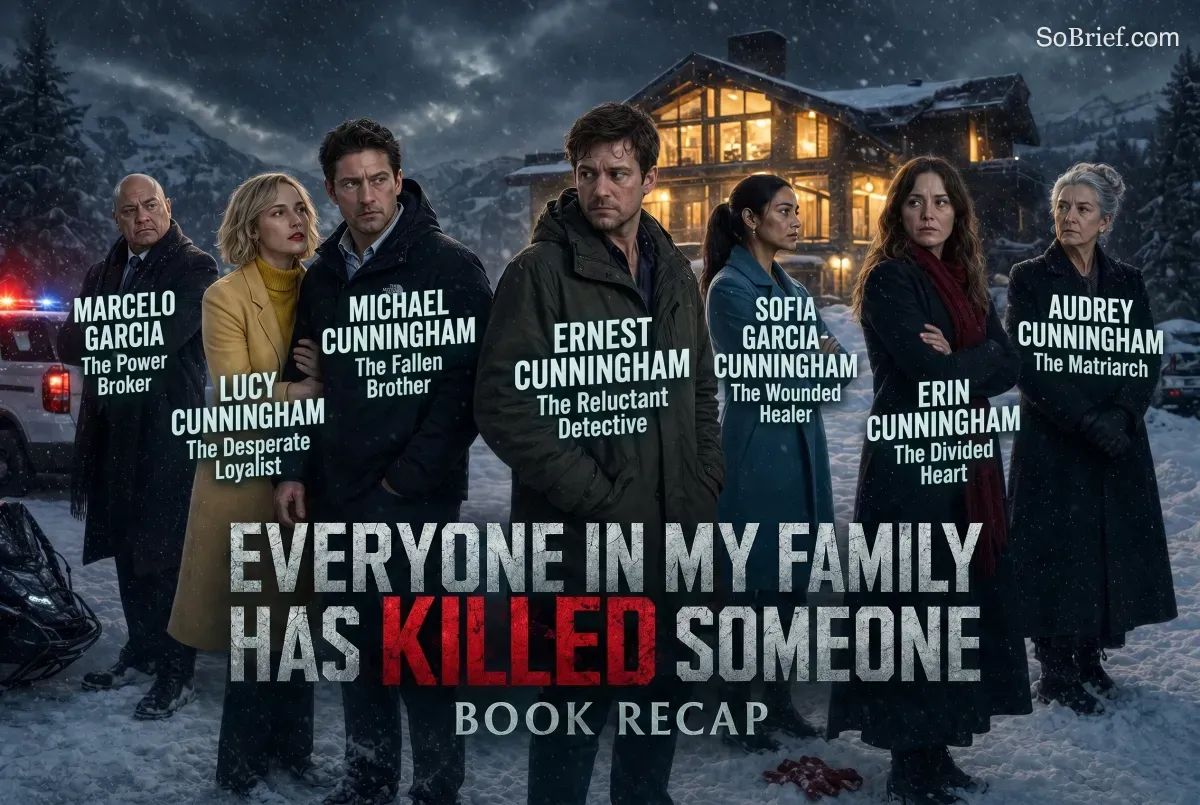
Ernest Cunningham
Narrator and reluctant detectiveErnest is a writer of how-to guides about mystery fiction who has never actually solved one. At forty-one, he's defined by the decision that fractured his family: testifying against his brother Michael2 for murder. He processes trauma through humor and intellectual distance, deploying wit as both shield and deflection. His deepest wound is a failed marriage to Erin4, destroyed not by infidelity but by his inability to see the pain beneath her deceptions. Ernest craves belonging in a family that has expelled him, yet his moral compass—the very quality that compelled him to testify—is what ultimately makes him the only Cunningham his brother trusts. His arc negotiates loyalty to blood against loyalty to truth, discovering they need not be opposites.
Michael Cunningham
Imprisoned brother, returnedErnest's1 older brother enters the narrative as a man who killed someone, but the reasons reveal layers of grief, rage, and complicated justice. Imprisoned for three years, he emerges not hardened but humbled, having weighed the value of a life and found his own reckoning wanting. His relationship with Erin4 began through prison letters—connection found in the strictest boundaries. Michael's core drive is to transform violence into something redemptive, to make meaning from what he did to Alan Holton14. He trusts Ernest1 precisely because Ernest1 condemned him, reasoning that a brother willing to testify is the only one whose loyalty isn't blind. His warmth upon release is genuine, masking a dangerous secret he carried up the mountain.
Audrey
Fierce, secretive matriarchErnest1 and Michael's2 mother is the family's emotional bedrock and its strictest gatekeeper. A former bank teller who once disarmed a robber with his own shotgun, Audrey's fierceness masks decades of compounded loss—her husband, her youngest son, her faith in institutions. She raised her boys with a siege mentality after Robert's13 death, teaching them that family was a fortress and the outside world a threat. Her refusal to speak to Ernest1 after the trial stems not from cruelty but from terror: she watched her husband's cooperation with police destroy everything, and Ernest's1 testimony repeated the pattern. Audrey's secrets run deeper than anyone suspects, her protective silence endangering the very people she shields.
Erin
Ernest's estranged wifeErin is shaped by a childhood of targeted blame. Raised by an abusive father who told her daily that she'd killed her mother in childbirth, she learned to associate intimacy with danger and love with performance. Her marriage to Ernest1 collapsed under the weight of a secret she couldn't voice: a terror of pregnancy so profound she sabotaged their fertility treatments rather than confess it. Her connection to Michael2—epistolary, then romantic—represents both genuine feeling and flight from domestic vulnerability. Erin is perceptive and fiercely brave in crisis, yet trust itself remains her fundamental struggle. She is drawn to Michael's2 letters because their physical distance made the relationship feel safe from the closeness that terrified her.
Sofia Garcia-Cunningham
Stepsister, surgeon, allyMarcelo's6 daughter and Ernest's1 stepsister, Sofia is a brilliant surgeon concealing a dependency that threatens her career and identity. Inserted into the Cunningham family as a child, she occupies the same outsider position as Ernest1—bonded to him precisely because neither fully belongs. Her dark humor and medical expertise make her Ernest's1 most valuable investigative partner. She carries private shame about choices that have rippled far beyond her awareness, and her physical deterioration across the weekend tells a story she's desperate to keep silent.
Marcelo Garcia
Stepfather, powerful lawyerErnest's1 stepfather, a corporate lawyer who married Audrey3 after befriending her late husband Robert13. He wears Robert's platinum Rolex as a vow to protect the family. Marcelo projects control through wealth and courtroom dominance, but beneath the expensive watch and the legal bluster lives genuine paternal love—and decades of knowledge about Robert's13 criminal past that he's never fully disclosed. He defends family members selectively, and the reasons for his choices prove more strategic than they first appear.
Katherine Millot
Aunt, reformed organiserErnest's1 aunt and Robert's13 much-younger sister, Katherine organized the reunion with spreadsheet precision. A reformed alcoholic since a car crash that killed her passenger and mangled her leg, she channels guilt into rigid control—of schedules, of others, of substances. Her sobriety is both her proudest achievement and her sharpest weapon, wielded against anyone she suspects of weakness. Her harsh treatment of Sofia5 conceals an intervention disguised as hostility, and her insistence on staying at the resort has motives beyond non-refundable deposits.
Lucy
Michael's desperate ex-wifeMichael's2 ex-wife clings to a marriage that legally ended via prison mail. She invests in pyramid schemes that drain her finances and feed a curated fiction of success, her Instagram a gallery of manufactured independence. Lucy came to the reunion overdressed and over-hopeful, desperate to reclaim Michael2 before Erin4 could cement her claim. Beneath the fluorescent lipstick and the bravado is a woman terrified of being discarded—and one who knows more about the weekend's arrangements than she initially reveals.
Officer Crawford
Flustered arriving policemanThe young policeman from Jindabyne who arrives at Sky Lodge to investigate the body on the golf course. Seemingly flustered and inexperienced, Crawford oscillates between bumbling incompetence and surprising firmness. He doesn't carry a gun. His nervousness around the corpse reads as squeamishness, but his behavior—who he shows the victim's photo to, who he keeps at a distance—hints at a more calculated agenda beneath the borrowed uniform. His green eyes hold a watchfulness that occasionally pierces through the performance.
Andy Millot
Katherine's underestimated husbandKatherine's7 husband is the family's comic relief and its most underestimated member. A horticulturist who grows grass for sports fields, Andy is boring by profession and proxy by marriage—always advocating for Katherine7 while sneaking blokey asides to the men. His eagerness to please masks a desire to matter, to be more than the man who fetches his wife's handbag in a blizzard. He is the type of man who says the wrong thing at exactly the right time, and whose moment of usefulness arrives when no one expects it.
Juliette Henderson
Practical, sharp resort ownerThe third-generation owner of Sky Lodge, Juliette wrestles with whether to sell her family's legacy to a neighboring resort operator16. Raised between the mountain and boarding school, she returned after her parents' death and never left. She's practical, well-read in detective fiction, and sharper than any of the self-appointed investigators. Her review of snow-cam footage proves more useful than any official police work, and her motivations—protecting guests, protecting property value, protecting history—shift as the body count rises.
Jeremy Cunningham
Lost youngest brotherErnest's1 youngest brother, believed to have died as a child on a scorching summer day in a locked car. His death is the family's deepest wound—the loss that haunts Ernest's1 recurring dreams of choking and calcified Audrey's3 fortress mentality around her surviving sons.
Robert Cunningham
Dead father, cop-killerErnest's1 father, killed during a petrol station confrontation with police. Publicly remembered as a junkie cop-killer, his true history proves far more complex—and more courageous—than the family was ever allowed to know.
Alan Holton
Corrupt cop turned pawnbrokerThe man Michael2 killed in the spider-web clearing. A former police officer turned petty criminal, Alan spent decades sitting on dangerous secrets before trying to sell them for a price that got him killed.
Edgar McAuley
Grieving father of RebeccaRebecca McAuley's father, a wealthy man who has waited thirty-five years to recover his daughter's body. His polished grief and generous payments conceal layers the investigation has yet to peel back.
Gavin
Neighboring resort operatorOwner of SuperShred Resort across the ridge, a snowboarder-turned-businessman who wants to buy Sky Lodge for its land. He provides the Oversnow vehicle that becomes the family's escape route.
Plot Devices
The Bag of $267,000
Blood money linking all suspectsA Nike sports bag stuffed with cash that Ernest1 has kept hidden for three years after Michael2 asked him to hold it. The money was paid by Rebecca McAuley's parents15 as a down payment for information about their kidnapped daughter. The bag generates suspicion and motive for nearly every character: Sofia5 wants fifty thousand from it, Erin4 knows about it, Michael2 expects it back. Its specific amount—$267,000 instead of the expected $300,000—becomes a crucial clue, revealing that Michael2 skimmed thirty-three thousand to pay off Lucy's8 debts before his fatal meeting with Alan14. The gap between what was owed and what was paid is what triggered the gun, the struggle, and everything that followed.
Knox's Ten Commandments
Fair-play narrative contractRonald Knox's 1929 rules for detective fiction serve as both the novel's structural backbone and Ernest's1 investigative framework. Printed in the epigraph, the commandments—no supernatural agencies, the criminal must appear early, no concealed clues—function as a contract between Ernest1-as-narrator and the reader. He explicitly promises to follow them, transforming the novel into a puzzle that can theoretically be solved alongside him. The rules also operate as thematic commentary: in a family that lives by its own code of loyalty above law, Knox's insistence on fairness and transparency represents the opposite value system—the one Ernest1 chose when he testified. Ernest1 references them throughout as both guide and comfort.
The Rolex Watch
Hidden evidence carrierMarcelo's6 platinum Presidential Rolex appears throughout the story as a marker of his wealth and fatherly stewardship, but it was originally Robert Cunningham's13—left in his will to Jeremy12. Its true significance lies beneath the bulletproof glass face, where Robert13 hid a microdot containing shrunken photographs of a murder, using World War II-era espionage techniques. The watch's journey—from Robert13 to Marcelo6, stolen by Sofia5 during surgery to fund an addiction, sold through criminal channels to Alan Holton's14 pawn shop, discovered by Alan14, and ultimately pursued by Michael2—forms the hidden spine of the entire mystery. Its weight, marketing slogans, and robustness are all clues Ernest1 eventually pieces together.
The Bingo Card
Final microdot hiding placeSofia5 creates bingo cards for herself and Ernest1 as a private game, each square predicting a family disaster. The card gains unexpected significance when Michael2 borrows it in the Drying Room to edit a square from 'Ernest ruins something' to 'Ernest fixes something,' adding a period at the end. That period is a microdot—sixteen shrunken photographs of Rebecca McAuley's kidnapping, transferred using the tip of a pen under the cover of his contact lens case. Michael's2 instruction not to lose the card, and to look closely, goes unheeded until the epilogue, when Ernest1 finally magnifies the dot and discovers the evidence that solves the original crime.
The Snow Cam
Surveillance with blind spotsSky Lodge's homepage features a weather camera that photographs the driveway and chalet area every three minutes. Juliette11 shows Ernest1 the footage, revealing Marcelo's6 car leaving and returning the night before the murder, and tracking movements between chalets. The camera's fixed interval becomes both investigative tool and exploitable vulnerability: anyone who knew the three-minute timing could move between frames undetected. The killer used this by timing movements to the refresh cycle, turning the resort's transparency into a blind spot. The footage also captures telling details—Erin's4 hand in Michael's2 pocket, the truck's absurd size—that gain significance only in hindsight.
FAQ
Synopsis & Basic Details
What is Everyone in My Family Has Killed Someone about?
- Dark family secrets: The Cunningham family, each member having killed someone, gathers for a reunion at a secluded mountain resort, setting the stage for murder and mayhem.
- A snowstorm traps them: A snowstorm isolates the family, forcing them to confront their past and the secrets they've tried to bury, as a new murder occurs.
- Ernest investigates: Ernest Cunningham, the narrator, attempts to solve the mystery while grappling with his own family history and the question of whether he can trust anyone, including himself.
Why should I read Everyone in My Family Has Killed Someone?
- Unique narrative voice: The story is told by Ernest Cunningham, a self-aware and often humorous narrator who breaks the fourth wall, offering a fresh perspective on the classic murder mystery genre.
- Intricate plot twists: The novel is filled with unexpected twists and turns, keeping readers guessing until the very end as the complex web of family secrets and hidden motivations is revealed.
- Exploration of dark themes: The book delves into themes of family loyalty, guilt, and the consequences of violence, offering a thought-provoking exploration of human nature and the complexities of morality.
What is the background of Everyone in My Family Has Killed Someone?
- Australian setting: The story is set in the Snowy Mountains of Australia, providing a unique and atmospheric backdrop for the murder mystery, with the isolated location adding to the sense of tension and suspense.
- Modern take on Golden Age: The novel draws inspiration from classic Golden Age detective fiction, such as Agatha Christie, while incorporating modern elements and a contemporary narrative style.
- Exploration of family dynamics: The story delves into the complexities of family relationships, exploring themes of loyalty, betrayal, and the impact of past trauma on present-day interactions.
What are the most memorable quotes in Everyone in My Family Has Killed Someone?
- "Family is gravity.": This quote encapsulates the inescapable pull of family ties, even when those ties are fraught with darkness and violence, highlighting the central theme of the novel.
- "One day you'll realise family isn't about whose blood runs in your veins, it's who you'd spill it for.": Sofia's words challenge the traditional definition of family, suggesting that loyalty and sacrifice are more important than blood relations, a sentiment that resonates throughout the story.
- "The reunion starts when my son arrives.": Audrey's declaration underscores the weight of the past and the anticipation surrounding Michael's return, setting the stage for the explosive events that follow.
What writing style, narrative choices, and literary techniques does Benjamin Stevenson use?
- Self-aware narrator: Stevenson employs a highly self-aware narrator, Ernest Cunningham, who frequently breaks the fourth wall, commenting on the conventions of the mystery genre and directly addressing the reader.
- Metafictional elements: The novel incorporates metafictional elements, such as references to Ronald Knox's "Ten Commandments of Detective Fiction," blurring the lines between fiction and reality and inviting readers to engage with the story on a deeper level.
- Humorous tone: Despite the dark subject matter, Stevenson infuses the narrative with a humorous tone, using wit and sarcasm to lighten the mood and create a more engaging reading experience.
Hidden Details & Subtle Connections
What are some minor details that add significant meaning?
- The recurring mention of snow: The snow, initially a picturesque backdrop, becomes a symbol of isolation, concealment, and the coldness of the Cunningham family's relationships, reflecting the emotional distance between them.
- The specific brand of Lucy's car: The redacted car type, linked to a multi-level marketing company, subtly reveals Lucy's desperation for success and her vulnerability to exploitation, highlighting her character's flaws and motivations.
- The description of Katherine's clothing: Katherine's pristine, off-the-rack adventure gear underscores her need for control and order, contrasting with the chaotic and unpredictable nature of her family.
What are some subtle foreshadowing and callbacks?
- Michael's initial phone call: Michael's call from a pay phone or bar foreshadows his troubled state and the events that led to Alan Holton's death, hinting at a deeper involvement than he initially reveals.
- The description of the state funeral: The description of the state funeral in Chapter 4 foreshadows the later revelation that it was for the policeman killed by Ernest's father, creating a sense of unease and hinting at the family's dark past.
- The mention of the library fireplace: The initial description of the library fireplace in Chapter 2, as a source of "fireside comfort and rejuvenation," is ironic given that it later becomes the scene of a deadly fire, highlighting the deceptive nature of appearances.
What are some unexpected character connections?
- Alan Holton and Robert Cunningham: The revelation that Alan Holton was the policeman who killed Robert Cunningham adds a layer of complexity to the story, highlighting the cyclical nature of violence and the interconnectedness of the characters' lives.
- Erin and Michael: The bond between Erin and Michael, formed during his time in prison, creates a love triangle that challenges traditional family dynamics and adds emotional tension to the narrative.
- Audrey and Marcelo: The fact that Marcelo was Robert Cunningham's lawyer before marrying Audrey reveals a hidden connection between the two men, raising questions about Marcelo's motivations and his role in the family's past.
Who are the most significant supporting characters?
- Sofia Garcia-Cunningham: As Ernest's stepsister and confidante, Sofia provides a unique perspective on the Cunningham family, offering support and insight while grappling with her own personal struggles.
- Katherine Millot: As the organizer of the family reunion, Katherine plays a crucial role in bringing the Cunninghams together, while her own secrets and motivations add complexity to the narrative.
- Juliette Henderson: As the owner of Sky Lodge, Juliette provides an outsider's perspective on the Cunningham family, offering assistance and insight while navigating her own business challenges.
Psychological, Emotional, & Relational Analysis
What are some unspoken motivations of the characters?
- Audrey's need for control: Audrey's controlling behavior stems from a deep-seated fear of losing her family, a result of the trauma she experienced after her husband's death and Jeremy's disappearance.
- Michael's desire for redemption: Michael's actions throughout the story suggest a desire for redemption, as he attempts to atone for his past mistakes and reconnect with his family.
- Erin's search for stability: Erin's bond with Michael may be rooted in a desire for stability and connection, seeking solace in a relationship that offers a sense of belonging and understanding.
What psychological complexities do the characters exhibit?
- Ernest's survivor's guilt: Ernest grapples with survivor's guilt, feeling responsible for the events that have befallen his family and questioning his own worthiness of happiness.
- Sofia's addiction: Sofia's addiction to painkillers highlights her vulnerability and her struggle to cope with the pressures of her profession and her personal life.
- Katherine's repressed emotions: Katherine's teetotalism and meticulous planning may be a way of repressing her own emotions and maintaining a sense of control in the face of chaos.
What are the major emotional turning points?
- Michael's confession: Michael's confession to killing Alan Holton forces Ernest to confront the reality of his brother's actions and the darkness that exists within his family.
- The discovery of Jeremy's fate: The revelation that Jeremy is alive and responsible for the murders shatters the family's perception of their past and forces them to confront the consequences of their actions.
- Erin's confession: Erin's confession about her mother's death and her inability to have children with Ernest reveals the depth of her emotional turmoil and the reasons behind her strained relationship with Ernest.
How do relationship dynamics evolve?
- Ernest and Audrey: The relationship between Ernest and Audrey evolves from strained and distant to one of understanding and empathy, as they both come to terms with their past and find a way to reconnect.
- Ernest and Michael: The relationship between Ernest and Michael shifts from one of betrayal and resentment to one of reluctant understanding and acceptance, as they both grapple with their family's dark history.
- Ernest and Erin: The relationship between Ernest and Erin undergoes a transformation, as they confront their past mistakes and find a way to move forward, either together or apart.
Interpretation & Debate
Which parts of the story remain ambiguous or open-ended?
- The true nature of Robert Cunningham: The extent of Robert Cunningham's involvement in criminal activities and his motivations for working with the police remain ambiguous, leaving readers to question his true character and legacy.
- The identity of Rebecca McAuley's killer: While the story identifies Edgar McAuley as the killer, the full details of Rebecca's murder and the motivations of those involved remain somewhat unclear, leaving room for interpretation.
- The future of the Cunningham family: The ending of the story leaves the future of the Cunningham family open-ended, as they attempt to rebuild their lives and break the cycle of violence, but their ability to do so remains uncertain.
What are some debatable, controversial scenes or moments in Everyone in My Family Has Killed Someone?
- Ernest's decision to testify against Michael: Ernest's decision to testify against his brother is a controversial moment, as it challenges the traditional notion of family loyalty and raises questions about the morality of his actions.
- Michael's murder of Alan Holton: Michael's decision to kill Alan Holton is a morally ambiguous moment, as it raises questions about the justification of violence and the consequences of revenge.
- Audrey's actions in the past: Audrey's actions in the past, including her decision to keep the truth about Jeremy's death a secret, are open to interpretation, as they raise questions about the lengths to which a mother will go to protect her family.
Everyone in My Family Has Killed Someone Ending Explained: How It Ends & What It Means
- Jeremy's death and the fire: Jeremy's death in the fire symbolizes the destruction of the Cunningham family's dark past and the potential for a new beginning, as they attempt to break the cycle of violence and create a brighter future.
- Ernest's decision to help Jeremy: Ernest's decision to help Jeremy, despite his actions, highlights the theme of family loyalty and the potential for redemption, even in the face of unspeakable acts.
- The revelation of the photographs: The discovery of the photographs and the identity of Rebecca McAuley's killer brings closure to the mystery, but also underscores the lasting impact of violence and the difficulty of escaping the past.
Ernest Cunningham Series

About the Author
Other books by Benjamin Stevenson
Download PDF
Download EPUB
.epub digital book format is ideal for reading ebooks on phones, tablets, and e-readers.








































