
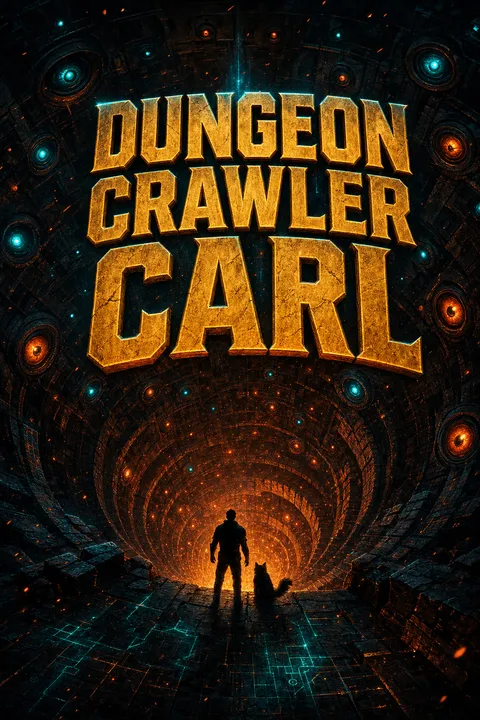


Plot Summary
The Night the World Fell
At 2:23 AM on a freezing Seattle January night, Carl1 steps outside in boxers, a leather jacket, and his ex-girlfriend's15 pink Crocs to retrieve Princess Donut,2 a pampered show cat stranded in a tree. In that instant every building crushes to dust, killing everyone sheltered indoors, including his elderly neighbor.
A robotic voice announces that an alien Syndicate has seized Earth for its minerals and converted the crust into an 18-level World Dungeon operated by the Borant Corporation.
Freezing, with warm glowing entrances scattered across the ruined city, Carl1 clutches the cat2 and runs toward the nearest staircase. His petty breakup, a defiant cigarette, and a cat's2 whim have, by pure accident, saved his life. The apocalypse arrives dressed as a bureaucratic eviction notice.
The opening reframes cosmic catastrophe as cold administrative procedure, a satirical inversion that defines the book's tone: humanity is livestock, and extinction is a line item. Carl's survival hinges on trivial human messiness (a cheating girlfriend, a smoke break, a stubborn cat), suggesting that meaning in an indifferent universe is accidental rather than earned. The pink Crocs and lack of pants render him absurd and vulnerable, stripping away heroic pretense. Grief is deferred by shock; the sheer scale of death loses meaning against a single severed head at his feet. Dinniman establishes survival as improvisation, not destiny, and dark comedy as the psyche's shield against unbearable loss.
Da Tutorial Guild
Fleeing a goblin Murder Dozer, Carl1 bludgeons his pursuers to death with bare hands and reaches a locked door guarded by Mordecai,3 a bearded rat-creature guildmaster. Mordecai3 reveals the horror: humans were seeded on Earth as livestock long ago, and the crawl is an intergalactic reality program watched by trillions. Survival depends on views, followers, and wealthy patrons who send loot.
He walks Carl1 through menus, stats, and skills, including an AI whose reward messages betray a bizarre fetish for bare feet. Carl1 opens ten loot boxes and scores a legendary trollskin shirt and nightgaunt cloak, yet still receives neither pants nor shoes. He absorbs the brutal arithmetic of the game: descend all eighteen levels, or die.
The tutorial functions as exposition weaponized into satire, indicting reality television, exploitative monetization, and audience complicity in cruelty. Mordecai, a former crawler now indentured, embodies institutional despair dressed as customer service. The revelation that humanity was farmed collapses anthropocentric comfort, positioning Carl as both product and performer. The AI's foot fetish and snarky achievement text externalize a sadistic algorithmic gaze, making even encouragement feel like violation. Carl's pragmatism, forged in Coast Guard training, contrasts with Mordecai's weary acceptance. The scene establishes the central tension: to survive, one must entertain the very system that enslaves you, turning agency itself into a commodity performed for an unseen, hungry crowd.
The Cat Who Talks
Intending to sell it, Carl1 instead watches Donut2 devour an enhanced pet biscuit and dissolve into goo before reforming with startling new stats. She now speaks, demands her full champion show-cat title, and reveals a mind sharpened by years spent watching television from his lap.
Her charisma is astronomical, letting her charm nearly any creature into obedience. Ignoring Mordecai's3 warning, she magically dons the Crown of the Sepsis Whore, permanently binding herself to the royal line of the Blood Sultanate, a status that promises a bloody reckoning on floor nine.
Beneath the arrogance, Donut2 confesses terror at being alone and clings to Carl.1 The gruff marine tech and the haughty Persian2 become an inseparable, bickering unit against the maze.
Donut's transformation literalizes the fantasy of the pet as secret person, and Dinniman mines it for both comedy and pathos. Her diva persona masks abandonment anxiety: severed from Beatrice and her old identity, she overcompensates with titles and control. The crown, chosen for its color despite dire warnings, encodes vanity's long-term cost, a Chekhov's gun aimed at floor nine. The partnership formalizes as codependence born of mutual loneliness rather than sentiment. Their banter becomes emotional infrastructure, a way to metabolize horror through bickering. The scene interrogates identity as performance while grounding the surreal in recognizable grief, establishing the emotional core that will anchor every subsequent atrocity.
The Hoarder's Chamber
After killing a lava-spitting Bad Llama and swarms of vermin, Carl1 tosses goblin dynamite into a garbage-choked room expecting easy loot and instead triggers a Neighborhood Boss fight.
A fifteen-foot obese woman, the Hoarder, erupts from the trash, vomiting cockroaches while pleading in Spanish, unmistakably a human transformed against her will. Carl1 loops a dog chain around her throat as Donut2 fires magic missiles, then finishes her with bare fists, nauseated by her humanity.
Mordecai3 afterward teaches that every boss conceals an exploitable weakness. The kill leaves Carl1 shaken rather than triumphant, forcing him to confront that the dungeon's monsters are often terrified people, and that killing them, however grotesque, is the only path deeper.
The Hoarder crystallizes the book's ethical engine: violence here is not clean fantasy slaughter but the murder of recognizable, suffering humans. Her Spanish pleas, untranslated for Carl, spare him full comprehension yet deepen the reader's horror, implicating the audience directly. The boss as caricature (a hoarder, a person society discarded) satirizes how spectacle dehumanizes the marginalized before literally monstering them. Carl's revulsion marks his moral center; he refuses to enjoy cruelty even as the system rewards it. Mordecai's lesson about weaknesses reframes survival as attentive reading rather than brute force, foreshadowing Carl's tactical identity as a problem-solver who studies systems to beat them from within.
Goblin War and War Criminal
Back in goblin territory, Donut's2 charisma seduces two pierced shamankas, Rory and Lorelai, who trade a steam-powered chopper for meth Carl1 looted from the llama. To cover their tracks, Donut2 casually ignites a meth war between goblins and llamas. Carl1 then rolls a barrel of black powder into the goblin chieftain's chamber and detonates it, killing the boss.
Donut2 reveals too late that the room held goblin infants and pregnant mothers, saddling Carl1 with the War Criminal achievement. He is sickened, wrestling with guilt while the game showers him with loot for the slaughter. The pair flee north as surviving goblins mobilize, and Carl1 silently repeats his private mantra that the dungeon will not break him.
This sequence escalates the moral corrosion the crawl demands, pushing Carl into genuine atrocity and denying him the comfort of ignorance. The game rewards war crimes with prizes, exposing how incentive structures launder brutality into achievement. Donut's charm ability weaponizes intimacy, letting the pair glimpse monsters' personhood moments before exploiting it, which sharpens rather than dulls the ethical sting. Carl's guilt, and his refusal to rationalize it away despite the AI's cheerful absolution, defines his resistance: he will do terrible things to survive but insists on feeling their weight. The mantra becomes a psychological firewall, a declaration that complicity is not the same as consent, and suffering witnessed is dignity preserved.
The Doomed Elder Convoy
Following spray-painted signs, Carl1 and Donut2 find Team Meadow Lark: eldercare workers Brandon,6 his near-silent brother Chris,9 sword-wielding Imani,7 and nurse Yolanda,8 shepherding dozens of frail residents plus a feral homeless woman named Agatha.10
The lone stairwell down is guarded by a Ball of Swine, a borough boss that crushes victims by rolling through a maze. To prepare, Carl1 and Donut2 storm a gym boss called the Juicer, a steroid-bloated lizard-man who hurls flaming weights, and barely survive when Donut2 nearly dies tearing open his throat.
Moved by the workers' refusal to abandon their helpless charges, Carl1 commits to helping the group descend despite the tactical cost to himself. Conscience, not the leaderboard, becomes his compass.
The elder convoy introduces the book's most sustained ethical dilemma: whether to protect the useless in a world that monetizes only the strong. Brandon and his colleagues embody unglamorous duty, caregivers who keep caregiving after the world ends, offering a counterpoint to the crawl's Darwinian logic. Carl's decision to help, echoing his earlier guilt, defines heroism as burden rather than glory. The Juicer, a caricature of toxic gym culture, provides comic relief while advancing the survival stakes and testing the pair's combat synergy. Donut's near-death reveals the fragility beneath her bravado. The section argues that dignity lies in whom we refuse to abandon, even when abandonment would be rational.
The Speedbump Gambit
Using looted goblin tools, Brandon6 and Chris9 help Carl1 build a collapsible tortoise-shell fort engineered to wedge the Ball of Swine against the maze ceiling. Inside the neon-lit spiral arena, the crawlers deploy spike strips and their fortress, popping the sphere apart into dozens of disoriented tuxedoed Tuskling nobles. They slaughter the confused aristocrats and drop the forcefield sealing the stairs.
Leveled up and victorious, Carl1 and Donut2 decide not to abandon the elders after all, establishing a shared party chat and pledging to scout each floor ahead. They descend first to clear the way. The book's opening act closes on hard-won solidarity wrenched from relentless carnage, a fragile human alliance amid an inhuman machine.
The fortress gambit showcases Carl's defining competence: engineering and improvisation triumphing over overwhelming force, a working-class hero who fixes things rather than swings a sword. The absurd spectacle of ballroom-dressed pig aristocrats being pulverized satirizes both class hierarchy and the game's cultural mash-ups. The collaborative build deepens the theme of collective survival against individualist incentives. Choosing to remain the elders' protectors, rather than descend and forget them, cements the pair's moral arc and rejects the crawl's atomizing pressures. The party chat becomes a lifeline of connection. Dinniman frames ingenuity and loyalty as the truest resistance to a system designed to isolate, exhaust, and consume.
Live from the Crab Couch
Instead of arriving on floor two, Carl1 and Donut2 materialize on a production yacht for Dungeon Crawler After Hours, hosted by Odette,4 a legless human veteran encased in a monstrous crab-and-mantis costume that was once her crawler armor. Donut2 works the trillion-strong audience like a born entertainer, coining Carl's1 unwilling catchphrase, an exasperated curse aimed at her.
Off-air, Odette4 reveals she once trained Mordecai,3 urges them never to change Donut's2 beloved cat race, and explains that loot is engineered to keep profitable crawlers alive. Fame, she warns, is both armor and snare. Carl1 departs uneasy, sensing that Donut's2 growing addiction to applause could prove as lethal as any beast waiting in the maze below.
The interview exposes the meta-layer of the crawl: survival is now inseparable from celebrity, and performance becomes a second combat system. Odette, a survivor who monetized her own maiming, models the moral compromise of longevity, useful yet self-serving, embodying her own warning about trusting those whose motives are unclear. Donut's natural showmanship reveals a shadow side to her charm, hinting that the spotlight may corrupt. Carl's discomfort registers the danger of internalizing the audience's gaze, of becoming what entertains one's captors. The catchphrase, born of genuine frustration, is commodified into brand, dramatizing how authentic emotion is strip-mined for spectacle in an attention economy.
The Killers in the Bathroom
On floor two, amid grubs, dingoes, and kobolds, Carl1 and Donut2 meet Frank Q,11 who claims to be a federal agent forced to kill fellow crawlers in self-defense. Carl1 reads the lies instantly, notices Frank11 secretly typing to a hidden partner, and braces for betrayal. Frank11 and his concealed accomplice Maggie My12 fire their guns, but the safe room's ironclad no-violence rule freezes them mid-shot, sparing the pair.
Fleeing, Carl1 plants a lit stick of goblin dynamite inside a rat corpse, gambling that the loot-hungry killers will detonate it. The meeting introduces a chilling new threat, humans hunting humans for experience, and proves that Carl's1 cold, observant, tactical mind is his most reliable weapon of all.
The safe-room ambush shifts the antagonist from monsters to people, arguing that the dungeon merely amplifies human predation already latent in scarcity. Carl's hyper-vigilance, traced to a childhood under a bullying father, becomes survival intelligence: he decodes microbehaviors others miss. The system's rule against violence in safe zones offers a rare structural mercy, ironically the only reliable morality in the game. Carl's corpse trap reveals his willingness to kill preemptively, complicating his ethical purity and foreshadowing consequences. The scene explores how trust becomes a fatal luxury and how the crawl weaponizes loneliness, turning every hopeful reunion between survivors into a potential execution. Paranoia is reframed as clear-eyed reading of danger.
Blended Into Immunity
Investigating a pyramid-scheme moonshine operation run by clurichauns and fairy managers, Carl1 and Donut2 confront Krakaren, a shrieking octopus boss who smashes through walls with disease-laden tentacles. Racing against death, Carl1 pedals a bicycle blender to make an immunity smoothie from moonshine and a fairy corpse, then rigs a huge explosion that leaves him deaf, burned, and broken but alive, saved partly by an enchanted pedicure buff protecting his feet.
In the aftermath they meet Zev,5 a two-foot kua-tin admin in a diving suit assigned as their PR agent. Carl's1 furious tirade at her, born of exhaustion and grief, unexpectedly forges an alliance, as Zev5 admits everyone trapped in the machine is terrified, herself very much included.
Krakaren satirizes anti-science grift and multi-level-marketing culture, transmuting real-world social parasitism into a literal disease-spreading monster. Carl's frantic smoothie-blending epitomizes the book's comedy of desperate ingenuity, survival as grotesque MacGyverism. His near-death underscores the escalating physical toll and the thin margin between cleverness and catastrophe. Zev's introduction humanizes the enemy apparatus: even the kua-tin functionaries live under existential threat from their own ultranationalist government. Carl's outburst, and Zev's disarming honesty, reframe the conflict as many frightened beings caught in one exploitative system rather than simple good versus evil. Solidarity, the section suggests, can cross species lines when all parties recognize their shared captivity.
The Price of a Full Bladder
While escorting the elder convoy on a wheeled train toward the stairs, an addled resident named Jack urinates on a wall, triggering the dungeon's cruelest penalty, a Rage Elemental plucked from floor thirteen.
The smoke-and-claw monstrosity instantly shreds nurse Yolanda8 and an elderly man, and Carl1 barely shields ancient Mrs. McGibbons16 with his single-use Protective Shell before diving into a safe room. The creature besieges the door without pause.
Yolanda's8 quiet, heroic death devastates the survivors and confirms Zev's5 warning that Borant's government wants the crawlers exterminated quickly. Carl1 grieves the gentle woman he barely knew,8 a nurse who reminded him of the mother who abandoned him, and once more silently swears the game will not break him.
Yolanda's death delivers the book's rawest grief, elevating a minor caregiver into a symbol of selfless decency destroyed by capricious cruelty. The trigger, an old man's involuntary act, indicts a system that punishes human frailty with disproportionate horror, exposing the sadism beneath the game's rules. Carl's projection of maternal longing onto Yolanda reveals his unhealed childhood wound and explains his fierce protectiveness of the vulnerable. The elemental, imported from a far deeper floor, confirms the political conspiracy to accelerate deaths for profit. The section fuses personal loss with structural critique, arguing that the machine's real violence is bureaucratic indifference weaponized against the weakest, and that mourning itself becomes an act of defiance.
Mother of All Bombs
Trapped as the Rage Elemental batters the safe room door, Carl1 builds the MOAB, a chopper-towed ramp that fires wheeled bombs while fleeing. He lures the level 93 beast on a screaming chase through grub-choked halls, carpet-bombing it, then teleports himself and Donut2 clear at the last instant with her Puddle Jumper spell, leaving the creature to plunge into the stairwell hole, where the dungeon's own rules dissolve any mob attempting to descend.
The exploit denies them experience but saves their lives and finally lets Team Meadow Lark reach floor three. Carl1 shares a tender goodbye with the confused, dying-of-age Mrs. McGibbons.16 Ingenuity, not brute strength, remains Carl1 and Donut's2 genuine superpower against impossible odds.
The MOAB set-piece is the book's fullest expression of Carl as trickster-engineer, defeating an unkillable foe by turning the dungeon's rules against itself rather than out-fighting it. The refusal of experience for the exploit dramatizes the system's petty vindictiveness while affirming that survival, not score, is victory. Mrs. McGibbons's farewell, her mind slipping between the maze and a long-ago tunnel of love, injects heartbreaking tenderness, honoring lives that the game deems worthless dead weight. The rescue completes the elder-convoy arc with quiet triumph. Dinniman frames intelligence as a moral force: to outwit oppression is to preserve both bodies and the humanity the crawl works relentlessly to erase.
Naughty Little Piggie
A cruel game show called Death Watch, hosted by an orc prince known as the Maestro,13 torments crawlers by forcing them to gamble for teleport rescues. Carl1 sabotages the sadistic format, tricking two trapped crawlers into escaping and publicly branding the preening prince13 a coward before his own audience.
Soon after, a mysterious, flawlessly produced sex-tape parody pairing Carl1 and the Maestro13 goes viral, humiliating the powerful Skull Empire and rocketing Carl's1 fame while the ruling Party gleefully celebrates the insult to a rival government. Carl1 challenges the Maestro13 to single combat on floor nine, where the prince13 boasts he will reign as War Leader. A personal vendetta with vast intergalactic political stakes is born.
The Death Watch episode dramatizes Carl's evolving mastery of the media arena as a battlefield, defeating a bully not with force but by manipulating crowd psychology and the very spectacle meant to degrade him. The Maestro embodies inherited privilege and casual cruelty, a foil whose power Carl neutralizes through defiance and wit. The viral parody weaponizes humiliation upward, inverting the usual flow of degradation from powerful to powerless. Yet Carl's rising fame entangles him in factional politics beyond his understanding, illustrating how individual acts ripple through vast systems. The section satirizes celebrity culture and imperial fragility while advancing the floor-nine confrontation as the narrative's distant, gathering storm.
The Mother Who Chose
On the same broadcast, Carl1 reunites with Frank Q,11 now maimed and hollow after Carl's1 rat-corpse dynamite trap severed his hand and killed his teenage daughter Yvette. Maggie My12 reveals she strangled her own dying daughter to claim the experience kill, then blames Carl1 and vows to hunt him, earning a legendary crawler-tracking potion from the delighted Maestro.13
Back in the dungeon, Carl1 and Donut2 win a menagerie reward room and select a vicious pink hatchling named Mongo,14 who bites relentlessly until, through patient training, he finally bonds with Donut.2 Odette4 later reveals Mongo14 is a velociraptor. The tender absurdity of raising a murder-chicken14 offsets the mounting dread of a grief-crazed stalker12 now armed to track them anywhere.
This section juxtaposes profound moral horror with domestic comedy, a signature Dinniman tonal collision. Maggie's filicide, whether desperate mercy or ambition, refuses easy judgment and burdens Carl with unintended lethal consequences, complicating his self-image as the ethical crawler. Her vow, backed by a tracking potion, converts a resolved conflict into a persistent existential threat, weaponizing grief into obsession. Mongo's adoption offers hope and continuity, a new dependent to nurture, mirroring the pair's own found-family bond. The raptor's slow bonding literalizes the labor of trust after trauma. Together the threads argue that even amid atrocity, care and cruelty coexist, and that consequences, once loosed, cannot be recalled.
Agatha's Impossible Cart
Preparing to descend, Carl1 discovers that the shopping cart he once absorbed from the mad, cackling Agatha10 contains contraband Valtay Corporation tech: an illegal communication relay, a personal shield, and a pulse pistol.
Agatha10 reappears, cryptic and hostile, warning Carl1 to mind his own business and hinting that the dungeon's monsters already fear her. Odette4 later reveals the Valtay Corporation is a parasitic, water-dwelling megapower whose fleet waits to seize bankrupt Borant and will run the next season entirely.
Suspecting Agatha10 is far more than a confused survivor, Carl1 wisely resolves to keep his distance. The mystery widens the story's frame, confirming that Carl1 and Donut2 are minor pieces in a game vastly larger than the maze around them.
Agatha's contraband tech pierces the local horror of the dungeon to reveal galactic corporate warfare humming beneath it, recontextualizing everything as a battlefield between rival megapowers. Her cryptic menace and impossible knowledge mark her as a wildcard whose true nature and allegiance remain tantalizingly withheld. Odette's exposition about the Valtay Corporation transforms Borant's tyranny into merely one predator among many, deepening the sense of nested exploitation. Carl's decision to disengage reflects hard-won wisdom about unclear motives. The section functions as narrative widening-of-aperture, seeding the larger conspiracy while reminding readers that survival requires knowing which mysteries to solve and which to leave dangerous and untouched.
Epilogue
After a triumphant final interview with Odette,4 where the Maestro's13 Death Watch is shamed into hiatus and Carl1 publicly renews his challenge to the disgraced prince,13 Odette4 offers parting counsel before floor three. She urges the pair to choose a class with mapping ability, let Donut2 select first, and consider a hidden, morally fraught option buried among Donut's2 high-charisma choices that would greatly boost survival while enraging someone.
Donut2 torments the newly bonded Mongo,14 revealed to be a velociraptor, while Carl1 braces for the unknown. The pair stand at the threshold of race and class selection, fame surging, enemies gathering, and the long climb toward floor eighteen scarcely begun.
The epilogue functions as a hinge, resolving the immediate media conflict while opening deliberate doors toward future descent. Odette's cryptic advice about a morally fraught, charisma-gated choice plants narrative anticipation and reaffirms the recurring theme that every survival advantage carries an ethical price. Mongo's identity as a velociraptor lands as comic revelation and promise of future power, a nurtured threat maturing alongside the protagonists. The threshold imagery captures the book's structural rhythm: each floor a fresh gauntlet, each victory merely permission to face worse. Dinniman closes not with resolution but with momentum, framing the crawl as an endless negotiation between agency and captivity, humor and horror, survival and self.
Analysis
Dungeon Crawler Carl weaponizes the LitRPG genre into biting satire, using its stat screens and loot boxes to skewer reality television, algorithmic exploitation, and the monetization of human suffering. Beneath the absurdist comedy of talking cats and murder-chickens runs a serious meditation on dignity under captivity. Carl's1 recurring mantra, that the game will not break him, articulates the book's central ethical stance: survival requires atrocity, but complicity need not become consent. His insistence on feeling the weight of every kill, from the pleading Hoarder to the goblin infants, marks the difference between a person and a product. The narrative's genius lies in its tonal collisions, splicing genuine grief (Yolanda's8 death, Mrs. McGibbons's16 fading memory) with lowbrow gags, so that horror and hilarity amplify rather than cancel each other. This whiplash mirrors trauma's own psychology, where laughter becomes the mind's defense against the unbearable. The crawl functions as a mirror for late capitalism: sentient beings farmed as content, rewarded for spectacle, punished for frailty, all watched by an audience whose attention is the true currency. Fame, the story argues, is both armor and cage, and Donut's2 intoxication with applause warns how the oppressed can internalize their oppressors' gaze. Carl1 embodies working-class competence, defeating power through engineering and observation rather than chosen-one destiny, reframing intelligence as moral resistance. The found family he builds, with Donut,2 Zev,5 Mongo,14 and the doomed elders, insists that connection defies a system engineered to isolate and consume. Ultimately the book asks what remains human when survival demands the inhuman, and answers through Carl's1 stubborn conscience and gallows humor: the refusal to enjoy cruelty, the choice to protect the useless, and the insistence on mourning. Its brilliance is making readers laugh while quietly indicting the very appetite for spectacle that keeps them turning pages.
Review Summary
Dungeon Crawler Carl receives high praise for its humor, unique premise, and entertaining storytelling. Readers appreciate the blend of post-apocalyptic and LitRPG elements, with many highlighting the audiobook experience as exceptional. The dynamic between Carl and Princess Donut is particularly enjoyed. While some find the repetitive nature of dungeon crawling tiresome, most consider it a fun, addictive read. Critics note it may not appeal to those seeking deeper themes or character development, but fans of gaming and light-hearted adventures are likely to be thoroughly entertained.
People Also Read

Characters
Carl
Reluctant barefoot survivorA twenty-seven-year-old former Coast Guard marine technician, Carl enters the dungeon in boxers and pink Crocs after rescuing his ex's15 cat2. Large, physically capable, and averse to drama, he masks a childhood wound: an abandoning, bullying father and a mother who left, leaving him with acute vigilance and a horror of cruelty. He fights primarily with bare fists and improvised explosives, thinking like an engineer who studies systems to exploit them. Carl's defining trait is stubborn conscience: he does terrible things to survive but refuses to enjoy them or let the game erode his humanity, repeating a private mantra of defiance. Protective of the weak, sardonic under pressure, and quietly grieving a vanished world, he is a working-class everyman forged into an unlikely, principled hero.
Princess Donut
Talking champion show catA pampered, Best-in-Show Persian belonging to Carl's1 ex-girlfriend15, Donut becomes a sapient, speaking crawler after eating an enhanced biscuit. She wields devastating magic missiles and near-limitless charisma that charms most creatures into obedience. Imperious, vain, and demanding of her royal titles, she masks deep abandonment anxiety and a genuine terror of loneliness beneath diva theatrics. Raised on television watched from Carl's1 lap, she is startlingly media-savvy and thrives on audience adoration, a hunger that worries Carl1. Reckless yet timid, quick-witted yet emotionally raw, she oscillates between selfishness and fierce loyalty. Her bond with Carl1, expressed through relentless banter and mutual rescue, forms the emotional heart of the story. Donut is comic relief, tactical asset, and wounded child in one fluffy, crowned package.
Mordecai
Weary shapeshifting guideA former crawler now indentured as a tutorial guildmaster, Mordecai changes form each floor, from rat to bugaboo to other creatures, though he was born a skyfowl. Having reached floor eleven himself, he carries centuries of grief, including a framed photo of his lost brother and his mother's ashes. Bound by strict rules about what he may reveal, he offers Carl1 coded guidance, wry cynicism, and hard-earned wisdom about weaknesses and survival. His fatigue and buried compassion make him a poignant mentor figure haunted by the game's endless cruelty.
Odette
Self-serving talk show hostA legless human veteran and the galaxy's most beloved interviewer, Odette hosts her show inside a monstrous crab-and-mantis costume built from her own crawler armor. She once reached the thirteenth floor and trained Mordecai3, with whom she shares a painful history. Shrewd, charismatic, and unabashedly motivated by profit, she helps Carl1 and Donut2 only because their survival enriches her. Her advice is invaluable yet always transactional, embodying her own warning never to trust anyone whose motives are unclear.
Zev
Anxious kua-tin publicistA two-foot-tall kua-tin admin in a bulky water-filled diving suit, Zev is assigned as Carl1 and Donut's2 PR agent to schedule interviews. Initially resented as an enemy functionary, she reveals herself as a frightened cog living under threat from her own ultranationalist government. A devoted fan of human television, she bonds with Donut2 over shows, becoming a wary ally who genuinely wants her clients to survive because their success protects her.
Brandon
Devoted maintenance caregiverA stocky eldercare maintenance worker wielding a lightning maul, Brandon leads Team Meadow Lark's effort to protect dozens of frail nursing-home residents. Kind, dutiful, and practically skilled, he refuses to abandon the helpless despite hopeless odds. His engineering know-how proves crucial to Carl's1 improvised fortress. He embodies unglamorous heroism, the caregiver who keeps caring after the apocalypse, and forms a warm, mutually respectful friendship with Carl1.
Imani
Haunted sword-wielding nurseA slight, roughly twenty-year-old eldercare worker carrying a longsword, Imani bears many crawler-killer skulls, the tragic result of being forced to end her own dying patients. Hollow-eyed and mostly silent, she nonetheless tends the residents with exhausted tenderness. Practical and grimly capable, she contributes tactical ideas and unflinching resolve. Her trauma embodies the impossible choices the dungeon inflicts on decent people.
Yolanda
Selfless veteran nurseA short, warm Hispanic nurse and bowwoman on Team Meadow Lark, Yolanda radiates maternal kindness and unwavering dedication to her patients. She reminds Carl1 of the mother he never had, embodying quiet, everyday heroism amid horror.
Chris
Silent skilled brotherBrandon's6 taller, near-mute older brother and fellow maintenance worker, once wrongly deemed slow. He rarely speaks, but when he does people listen. His engineering skill and quiet steadiness make him indispensable to the group's improvised builds.
Agatha
Cryptic homeless wildcardA cackling, prune-skinned homeless woman who accidentally saved a nursing home by setting a fire, Agatha pushes a shopping cart everywhere and refuses the tutorial. Hostile and elusive, she seems oddly untouchable in the dungeon and guards secrets far beyond an ordinary survivor. Her cart holds contraband alien technology, marking her as a dangerous mystery Carl1 learns to avoid.
Frank Q
Lying crawler-killerA tall, cop-like man who claims to be a federal agent, Frank hunts fellow crawlers for experience alongside his partner12 and family. A practiced liar, he ambushes Carl1 in a safe room. Later maimed and hollowed by tragedy stemming from Carl's1 trap, he becomes a broken, guilt-ridden shell trailing behind his vengeful partner12.
Maggie My
Vengeful predator crawlerFrank's11 athletic, ruthless partner, Maggie possesses an area stealth ability and a high crawler-killer count. Capable of horrifying choices in the name of survival, she blames Carl1 for her family's ruin and swears to hunt him and Donut2 down, becoming armed with a powerful tracking ability that makes her a persistent, escalating menace.
The Maestro
Sadistic orc princeA muscular young orc prince of the powerful Skull Empire, the Maestro hosts a cruel game show that tortures crawlers for entertainment. Arrogant, cheesy, and thin-skinned, he flaunts royal lineage and boasts he will command his clan on floor nine. Carl1 publicly humiliates him, sparking a personal rivalry loaded with intergalactic political consequences.
Mongo
Biting velociraptor hatchlingA pink-feathered hatchling won from a menagerie reward room, Mongo is a fiercely aggressive, endlessly biting creature who slowly bonds with Donut2 through patient training. Revealed to be a velociraptor, he promises to grow into a formidable fighter and a chaotic new member of their found family.
Beatrice
Carl's absent ex-girlfriendCarl's1 girlfriend and Donut's2 owner, Bea was on a Bahamas trip with her ex when Carl1 broke up with her over her lies. Devoted to showing her prize cat2, she is a haunting absence, presumed lost when the world fell, and a lingering emotional thread for both Carl1 and Donut2.
Mrs. McGibbons
Frail centenarian residentA ninety-nine-year-old nursing-home resident whose memory drifts between the maze and her late husband Barry, Mrs. McGibbons embodies the fragile lives the game deems worthless. Her tender farewell with Carl1 underscores the human cost of the crawl.
Plot Devices
The World Dungeon Broadcast
Monetized survival spectacleThe entire crawl is an intergalactic reality show watched by trillions, in which crawlers accumulate views, followers, and patrons who purchase loot boxes. This framing device transforms survival into performance, forcing Carl1 and Donut2 to entertain their captors to earn better equipment and stay alive. It drives the plot's satire of reality television, monetization, and audience complicity, generating interview sequences, PR agents, and fame-based stakes. The system rewards spectacle and cruelty with prizes, creating constant moral tension between doing what survives and doing what is right. It also anchors the political conspiracy, since ratings, advertising, and bankruptcy pressures dictate how quickly the game accelerates toward the crawlers' deaths.
Loot Boxes and Snarky AI
Randomized reward engineAchievements and boss kills grant tiered loot boxes containing gear, potions, and skills, narrated by a cruel, joke-cracking AI whose messages reveal a fetish for bare feet. Ostensibly random, the loot is secretly engineered to keep profitable crawlers alive or to torment them for entertainment, as Odette4 explains. The device delivers Carl's1 signature build (bare-knuckle gauntlet, trollskin shirt, explosives) and Donut's2 spells, while its mocking commentary externalizes the sadistic algorithmic gaze governing the crawl. It structures progression, comedy, and the recurring tension that even rewards arrive as insults, making empowerment feel like violation.
The Enhanced Pet Biscuit
Catalyst for Donut's riseA rare item won in Carl's1 legendary pet box, the enhanced biscuit carries over a hundred possible effects when fed to a pet. When Donut2 eats it, she dissolves and reforms as a sapient, speaking crawler with soaring charisma and offensive magic. This single act transforms the entire premise, converting a helpless cat2 into Carl's1 indispensable partner and the story's co-protagonist. It enables Donut's2 charm-based manipulation of monsters, her spellcasting, and her media stardom, while grounding the surreal transformation in her preexisting personality and grief. Without it, the central relationship and much of the plot could not exist.
Crown of the Sepsis Whore
Fatal future obligationA fleeting, unique tiara Donut2 dons for its color despite explicit warnings, the crown permanently enrolls her in the royal line of the Blood Sultanate on floor nine. Removing it will not undo the status, and it obligates royal members to slay the Sultan and all other family before descending past that floor. The device functions as a long-fuse Chekhov's gun, encoding vanity's cost and seeding a distant, dangerous confrontation tied to the orc prince's13 boasts about Faction Wars. It shadows the pair's future, reminding readers that early impulsive choices carry escalating, unavoidable consequences deep in the crawl.
Improvised Explosives and Builds
Ingenuity over brute forceCarl's1 engineering background and dimensional inventory let him craft weapons and traps from looted materials: black-powder barrels, moonshine firebombs (the Carl's Jug O' Boom), modular fortresses, and the bicycle-powered MOAB bomb launcher. This device defines his heroism as cleverness rather than raw power, enabling victories against bosses and even a level 93 elemental far beyond his combat level. It powers the book's comedy of desperate MacGyverism and its central thesis that outwitting an oppressive system preserves both survival and humanity. His crafting also earns royalties and codex entries, weaving invention into the game's economy and his growing legend.
FAQ
Synopsis & Basic Details
What is Dungeon Crawler Carl about?
- Earth becomes a game: The Borant Corporation seizes Earth, turning its interior into a World Dungeon, forcing surviving humans to compete for resource reclamation.
- Unlikely duo crawls: Carl, a marine tech, and his ex-girlfriend's Persian cat, Donut, become crawlers, navigating the dungeon's treacherous levels.
- Survival and spectacle: They must battle monsters, complete quests, and gain viewership to survive, all while dealing with the dungeon's absurd and often deadly rules.
Why should I read Dungeon Crawler Carl?
- Unique LitRPG blend: It combines LitRPG elements with dark humor, pop culture references, and a compelling narrative.
- Character-driven story: The dynamic between Carl and Donut, along with a cast of quirky characters, provides emotional depth and entertainment.
- Social commentary: The story satirizes reality TV, corporate greed, and the human condition through the lens of an intergalactic game show.
What is the background of Dungeon Crawler Carl?
- Interstellar economics: The story is set against a backdrop of interstellar economics, where corporations mine planets for resources and exploit indigenous species through entertainment.
- Syndicate governance: The Syndicate, a governing body of over three billion star systems, oversees the resource reclamation process and ensures regulations are followed.
- Earth's failure to appeal: Earth failed to file a proper appeal for mineral rights, leading to its seizure and transformation into a World Dungeon.
What are the most memorable quotes in Dungeon Crawler Carl?
- "You are so dead.": This recurring phrase highlights the constant danger and high stakes faced by the crawlers in the dungeon.
- "It's quite simple, really. You need to assist me to this 18th level, so I can exit this hellscape and resume my rightful place as liege.": This quote encapsulates Donut's self-assuredness and the power dynamic between her and Carl.
- "We need to be more cautious," I said. "We can't just blindly stumble around." "No, we need to level up," Donut said.: This exchange highlights the contrasting approaches to survival between Carl and Donut.
What writing style, narrative choices, and literary techniques does Matt Dinniman use?
- First-person perspective: The story is told from Carl's point of view, providing a sarcastic and relatable voice that draws the reader into his experiences.
- Humorous tone: Dinniman employs dark humor, witty banter, and absurd situations to create an engaging and entertaining narrative.
- Pop culture references: The story is filled with references to movies, video games, and internet culture, adding layers of meaning and appealing to a wide audience.
Hidden Details & Subtle Connections
What are some minor details that add significant meaning?
- The pink Crocs: Carl's footwear symbolizes his unpreparedness and the absurdity of his situation, contrasting with the deadly environment.
- Donut's Best-in-Show ribbons: These ribbons highlight Beatrice's obsession with cat shows and the superficiality of that world, contrasting with the real dangers of the dungeon.
- The recurring mention of the winter storm: The storm emphasizes the initial vulnerability of the survivors and the harsh conditions they face before entering the dungeon.
What are some subtle foreshadowing and callbacks?
- Mordecai's warnings about floor 10: His cryptic advice foreshadows the difficult choices and potential dangers that await crawlers on that level.
- The initial description of the Goblin Murder Dozer: The detailed description foreshadows its later appearance and the threat it poses to Carl.
- The AI's foot fetish comments: These seemingly throwaway lines foreshadow Carl's eventual reliance on his bare feet as a weapon and the AI's continued obsession with it.
What are some unexpected character connections?
- Odette and Mordecai's past: Their shared history as dungeon crawlers and Odette's role as Mordecai's trainer reveal a deeper connection between the two NPCs.
- The connection between the skyfowls and changelings: Mordecai's transformation from a skyfowl to a changeling highlights the dungeon's ability to alter and reshape its inhabitants.
- The connection between the Blood Sultanate and the Sepsis Whore crown: The crown's description foreshadows the challenges and dangers that await crawlers on the ninth floor.
Who are the most significant supporting characters?
- Mordecai: As a tutorial guide, he provides crucial information and guidance to Carl and Donut, shaping their understanding of the dungeon's rules and mechanics.
- Zev: As a Borant Corporation assistant communications representative, she offers insights into the corporate and political forces at play in the dungeon.
- Brandon An: As a compassionate leader of a group of elderly survivors, he represents the potential for humanity and kindness in a brutal world.
Psychological, Emotional, & Relational Analysis
What are some unspoken motivations of the characters?
- Carl's desire for connection: Despite his initial reluctance, Carl forms a strong bond with Donut, seeking companionship and purpose in a world stripped of meaning.
- Donut's need for validation: Donut's pursuit of fame and recognition stems from a deep-seated need for validation, rooted in her past as a show cat.
- Mordecai's longing for home: Mordecai's wistful memories of his former life as a skyfowl reveal a deep longing for home and a sense of displacement.
What psychological complexities do the characters exhibit?
- Carl's survivor's guilt: Carl grapples with the guilt of surviving the initial cataclysm while so many others perished, driving him to protect those he can.
- Donut's internal conflict: Donut struggles to reconcile her pampered past with her newfound responsibilities as a crawler, leading to internal conflict and growth.
- Imani's trauma: Imani's stoicism and haunted eyes hint at the trauma she has experienced, shaping her actions and decisions.
What are the major emotional turning points?
- Carl's decision to enter the dungeon: This marks a turning point as he embraces his new reality and commits to surviving the challenges ahead.
- Donut's transformation: Her transformation into a talking, spell-casting cat marks a turning point in their relationship and their approach to survival.
- The death of Yolanda: This event forces Carl to confront the harsh realities of the dungeon and the moral complexities of their situation.
How do relationship dynamics evolve?
- Carl and Donut's bond deepens: Their initial reliance on each other for survival evolves into a genuine friendship and partnership, marked by mutual respect and affection.
- Carl and Mordecai's relationship shifts: Their initial dynamic as guide and student evolves into a more complex relationship, marked by shared experiences and mutual respect.
- Carl and the other crawlers: Carl's interactions with other crawlers, such as Brandon and Imani, reveal the potential for both cooperation and conflict in a world where survival is paramount.
Interpretation & Debate
Which parts of the story remain ambiguous or open-ended?
- The true nature of the Syndicate: The motives and goals of the Syndicate remain shrouded in mystery, leaving readers to question their intentions and the true nature of the game.
- The fate of Earth: The ultimate fate of Earth and its inhabitants remains uncertain, leaving readers to speculate on the possibility of reclaiming their world.
- The meaning of the dungeon: The dungeon's purpose and design raise questions about the nature of reality and the forces that shape human existence.
What are some debatable, controversial scenes or moments in Dungeon Crawler Carl?
- The killing of the goblin engineer: Carl's brutal killing of the goblin engineer raises questions about the morality of violence and the dehumanizing effects of the dungeon.
- The death of the Hoarder: The scene where Carl is forced to kill the Hoarder, a mentally ill woman, raises questions about the ethics of killing and the treatment of vulnerable individuals.
- The decision to use the Enhanced Pet Biscuit on Donut: Carl's initial hesitation to use the biscuit on Donut raises questions about his priorities and his willingness to sacrifice her for personal gain.
Dungeon Crawler Carl Ending Explained: How It Ends & What It Means
- The story is ongoing: As of the end of the first book, Carl and Donut are only on the second floor, with 16 more levels to go, so there is no ending to explain.
- The journey is the focus: The story emphasizes the ongoing struggle for survival and the characters' growth and development, rather than a definitive resolution.
- Themes of hope and resilience: Despite the bleak circumstances, the story offers glimmers of hope and celebrates the resilience of the human spirit in the face of adversity.
Dungeon Crawler Carl Series
About the Author
Other books by Matt Dinniman
Download PDF
Download EPUB
.epub digital book format is ideal for reading ebooks on phones, tablets, and e-readers.








































