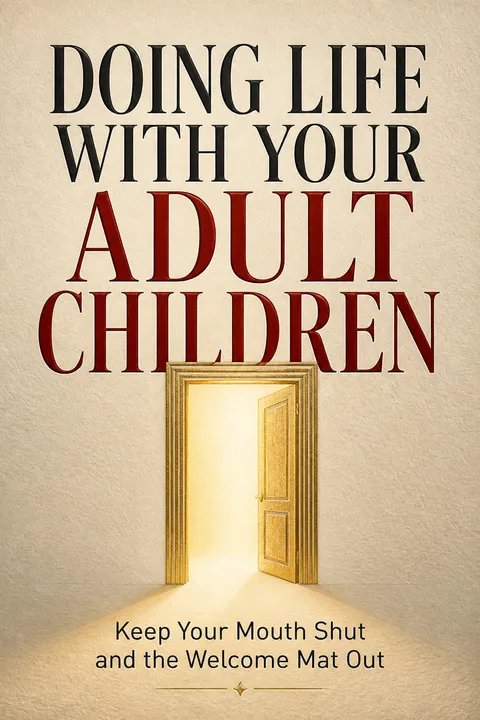


Key Takeaways
Fire yourself from the parenting job you actually enjoyed
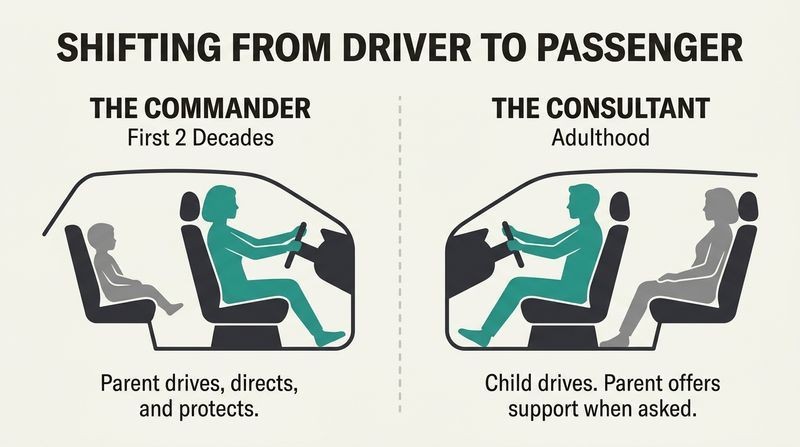
The control you loved must end. Burns argues that for the first two decades, parents rightly serve as providers, caretakers, and bosses. Then adulthood arrives (often the day a kid leaves for college), and that job description expires. Clinging to it drives children away. The new role is consultant, not commander: encourage without intruding, care without enabling dependency, and initiate fun rather than lectures.
A clumsy dance for both sides. Burns describes the transition as an awkward dance where nobody knows the steps, and just when you master it with one child, the next reaches adulthood and you start over. He frames it bluntly: you must love them enough to let them go, grieving the loss of your front-seat role so you can build an adult-to-adult relationship from the back seat.
What's striking is how Burns locates the primary problem in the parent, not the child. This aligns with family systems theory, where a system resists change when one member refuses a new role. Developmental psychologist Erik Erikson framed midlife around "generativity," guiding the next generation without controlling it, which is precisely the shift Burns describes. The consultant metaphor is useful but has limits: consultants are paid and can be fired, whereas parents remain emotionally bonded for life. The harder truth beneath his framing is that releasing control also means releasing the illusion that good parenting guarantees good outcomes.
Keep your mouth shut and the welcome mat out
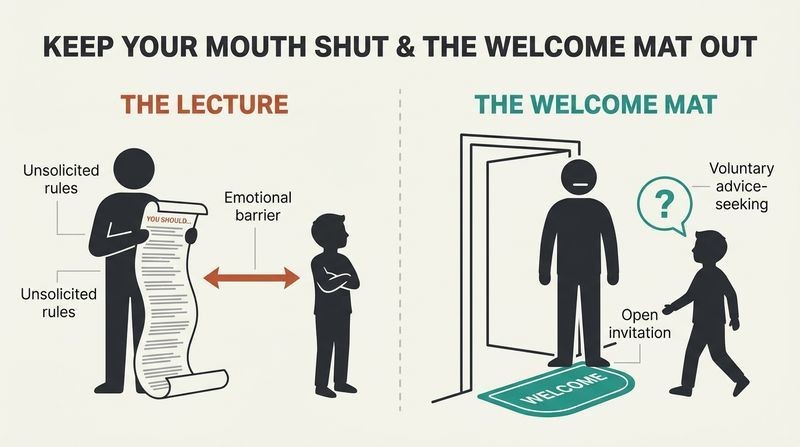
Unsolicited advice reads as criticism. This is the book's central thesis. However lovingly intended, guidance offered to an adult child signals distrust and restricts their sense of freedom, so they resist. Burns urges parents to let experience teach instead, trusting that silence plus an open door invites children to seek counsel on their own terms.
Rob and the snowboarding trip. Rob once read his daughter a "dad list" of concerns; it produced tears and distance. He changed tactics, took her snowboarding, and simply enjoyed her company. She texted afterward that it was one of their best times together, then volunteered that she was already changing the very things he worried about. Burns contrasts a conversation (dialogue, respect, questions) with a lecture (raised voice, "you should" statements, sounding superior), and points to Billy Graham greeting his broken daughter with only, "Welcome home."
The insight maps onto psychological reactance theory: when people feel their autonomy threatened, they double down on the threatened behavior, so advice can backfire into entrenchment. Motivational interviewing, used in addiction counseling, rests on the same principle, drawing change out through open questions rather than pushing it in. One caution: "keep your mouth shut" can shade into avoidance of genuinely necessary conversations about safety or abuse. Burns carves out that exception elsewhere. The deeper wisdom is relational sequencing: connection must precede influence. You earn the right to be heard, and only then is advice received as care rather than control.
Put your own oxygen mask on before rescuing your child
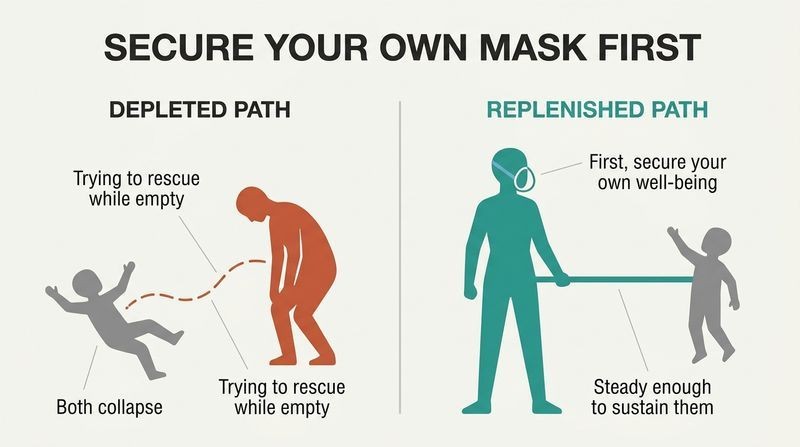
Depleted parents help no one. When Brenda and Ted arrived heartbroken over their daughter's drug use and cohabitation, Burns diagnosed a problem they hadn't named: they were doing nothing for themselves and it was killing them. He invokes the airline instruction to secure your own mask first. Self-care of mind, body, and soul is not selfish; it is what keeps you steady enough to be useful.
Grief is required, not optional. Burns insists that letting go of the child who once needed you for everything is a real loss that must be mourned before a new relationship can form. He borrows the image of Moses needing Aaron and Hur to hold up his tired arms during battle: no parent should carry a struggling adult child alone. Build a support team, replenish yourself, and refuse the silent shame that says a wayward child equals bad parenting.
This reframes parental burnout as a legitimate clinical concern rather than weakness. Research on caregiver fatigue shows that chronic stress without recovery erodes exactly the emotional regulation needed for difficult relationships. Burns's naming of "silent shame" is astute; it connects to Brene Brown's work distinguishing guilt (I did something bad) from shame (I am bad), and parents of struggling adults often marinate in the latter, comparing themselves to airbrushed holiday cards. The grief point is underappreciated in parenting literature. Ambiguous loss, mourning someone still present but changed, is a recognized psychological category, and normalizing it may prevent parents from pathologizing an ordinary developmental transition.
Your kids inhabit "emerging adulthood," a life stage you never had
A new chapter between adolescence and adulthood. Burns leans on psychologist Jeffrey Arnett, who coined "emerging adulthood" for the late teens through twenties, marked by five traits: identity exploration, instability, self-focus, feeling in-between, and optimism about possibilities. Burns adds his own tongue-in-cheek term, "adultolescence," for grownups still carrying adolescent traits.
Screenagers who work to live. Today's young adults are shaped by devices (on screens over a third of waking hours), raised on participation trophies that bred entitlement, and determined to work to live rather than live to work. Many hold a post-Christian worldview where expressing disapproval of another's lifestyle feels unloving. Burns names the "cringe factor" (pornography, whose average first-exposure age he cites as eleven, and cohabitation) and the "faith factor" (atheism doubling in Generation Z). His prescription: become a student of your child's culture rather than judging it.
Arnett's framework is genuinely influential, though contested. Critics note emerging adulthood is partly a luxury of affluent societies; working-class youth and those in the developing world often skip it entirely. So some of what Burns attributes to generational character may be economic structure: crushing student debt, unaffordable housing, and a gig economy that delays the milestones that once defined adulthood. His participation-trophy critique is popular but empirically shaky; the research linking trophies to narcissism is thin. Still, the core counsel is sound and humane: understanding the cultural water your child swims in beats moralizing about it, and curiosity is a better bridge than condemnation.
Meet them in the messy middle with affection, warmth, and encouragement
Love without necessarily approving. Burns calls the "messy middle" the place where you hold firmly to your own moral convictions while genuinely loving a child who has chosen differently. It is uncomfortable and refuses both capitulation and estrangement. You can attend the wedding you disagree with, visit the city your daughter loves on her terms, and go to the concert whose lyrics you dislike, all to enter their world.
Parent with AWE. Burns distills his mother's magnetic influence over young people into three letters: Affection, Warmth, and Encouragement. She wasn't tech-savvy or cool, but everyone knew she loved them, and so she earned the right to be heard. He keeps AWE on his desk as a reminder that regardless of what a generation believes or does, a parent can always offer a large dose of these three things.
The messy middle is essentially the practice of holding two truths at once, a skill dialectical behavior therapy calls "walking the middle path": full acceptance of a person alongside a desire for change. It resists the all-or-nothing thinking that fractures families, where disapproval hardens into cutoff. AWE is a memorable mnemonic, though its power depends on authenticity; performed warmth deployed to eventually change someone reads as manipulation and children detect it. The strongest version of Burns's point is that unconditional regard is not endorsement. Attachment research confirms that a secure base, felt acceptance, is precisely what gives people the safety to change course voluntarily.
Stop bailing them out; consequences teach what lectures cannot
Enabling shields kids from reality. Burns defines enabling as doing for others what they can and should do for themselves, allowing irresponsibility to continue painlessly. When Sean's parents complained their college grad partied and wouldn't work, Burns told them Sean didn't have the problem, they did: they still paid his phone, made his bed, and cooked separate dinners. Get him off the family payroll.
Let them earn the outcome. Bob and Cheryl could have hired a top attorney to erase their daughter's DUI. Instead they let her face a revoked license, DUI school, and a decade of raised insurance. She never repeated the mistake. Burns urges clear expectations, a written contract of understanding for kids living at home (be productive, honor house standards, be financially responsible, share chores, meet a timeline), and consequences created with the child, since people support what they help build.
The enabling-versus-helping distinction comes straight from addiction recovery culture, and Burns applies it broadly to launch failures. Behavioral economics reinforces his logic: when parents absorb the costs of poor choices, they create moral hazard, distorting the incentives that normally guide decisions. The collaborative contract is smart; self-determination theory shows that autonomy-supportive structure (rules the person helped set) produces more durable behavior change than imposed rules. One tension worth flagging: consequences and cruelty can look similar from inside pain, and Burns rightly distinguishes natural consequences (which teach) from punishment (which breeds resentment). The art is calibrating consequences to the child's actual capacity, not to parental frustration.
Land the helicopter and let individuation run its course
Hovering serves the parent's need, not the child's. The term helicopter parent (coined in 1969) describes a mother or father who overhovers. Burns's damning example: a Stanford MBA mom who phoned a college president to contest her son's grade, then blurted that she had written the paper herself. Overprotective parents often can't let go because they need to be needed, sacrificing their finances, marriage, and the child's maturity.
Individuation is the goal, not betrayal. Drawing on Cloud and Townsend, Burns frames individuation as the child perceiving themselves as distinct, a "not-me" that must exist before a healthy "me" can. When his oldest daughter wrote that she had to disown her parents' faith to own her own, it stung, then he recognized it as health. Reduced texting and privacy signal the road to independence, not rejection. He likens it to an acorn: becoming a mature oak takes a lifetime.
Individuation, rooted in Margaret Mahler's developmental theory and echoed by Murray Bowen's "differentiation of self," is one of the more robust concepts Burns imports. Bowen argued that the healthiest families allow members to be both connected and separate, and that fused families (where distance feels like disloyalty) produce more anxiety, not less. The daughter's faith declaration is a textbook example of what James Fowler called moving from conventional to individuative faith, a stage that requires questioning inherited belief to make it one's own. The counterintuitive payoff Burns names is real: parents who tolerate healthy separation often end up closer to their adult children than those who cling.
You cannot want your child's turnaround more than they do
Redemption runs on their timeline. When a friend's daughter announced a rushed marriage he opposed, Burns advised attending the wedding (presence conveys love without approval) while predicting a crash and staying available for it. The crash came; she moved home, got counseling, and rebuilt. Burns reframes the prodigal son parable as the story of a waiting father who watched the road daily, welcomed his son lavishly, yet still set boundaries on his return.
Tough love, not meanness. Tough love means firm limits enforced with warmth, not to hurt but to redirect. Burns's tools: don't bail them out (their crisis needn't become yours), don't become a "one-topic parent" fixated on what's wrong, don't dump your anger on them (vent to a trusted friend instead), seek professional help for addictions or mental illness, and daily relinquish the child to God. Faith, he notes via Tony Campolo, atrophies from disuse like an unexercised muscle.
The principle that motivation cannot be transplanted is central to addiction treatment, where the Stages of Change model shows people move through precontemplation, contemplation, and action at their own pace; external urgency rarely accelerates it and often triggers resistance. Burns's "one-topic parent" warning is sharp: when every interaction orbits a single grievance, the relationship narrows until the child avoids it entirely. His prodigal reading is theologically rich, emphasizing that grace and boundaries coexist, the father runs to embrace but the son still returns to a structured household. The unresolved tension, which Burns honestly holds, is that not every story ends in reconciliation; some children never come home.
Money is parents' number one worry, so aim for financial independence
Cutting the check can be the cruelest kindness. Burns cites Arnett's Clark poll ranking money as parents' top concern about adult children, above bad partners or careers. Over 75 percent of parents give financial help at some point. Karen and Eric called their 26-year-old son the "money pit"; Burns saw they were funding his dependence out of fear he'd otherwise fail. Love sometimes means saying no even when you can afford yes.
Teach stewardship, then exit. Burns's six principles, drawn partly from planner Ron Blue: spend less than you make; debt is slavery (a friend's son doubled a bike's cost with credit card interest); delayed gratification wins (compounding can turn small sums enormous); give 10 percent and save 10 percent; keep a budget; and talk openly about money even when it's gone badly. He urges a clear exit strategy communicated in advance, plus a "no surprise" estate, recalling wealthy parents who left everything to charity without telling their children, who then sued.
Burns's financial theology blends practical planning with the recovery framing of enabling. The behavioral core is sound: research on "financial enmeshment" shows that ongoing parental subsidies can suppress a young adult's development of financial self-efficacy. Yet his individualist framing sits uneasily with economic reality; in high-cost regions, multigenerational support is often rational rather than pathological, and many cultures treat pooled family finances as normal, not dysfunctional. The estate anecdote makes a durable point behavioral economists confirm: perceived unfairness, more than the dollar amount, drives inheritance disputes, and transparency defuses the resentment that ambush bequests ignite. Talking about money, however awkward, is cheaper than litigation.
With in-laws and step-kids, wear beige and win them with kindness
Your child chose them; you didn't. Burns's mother-of-the-groom joke, "wear beige and keep your mouth shut," becomes a strategy. Criticizing an in-law, their parenting, or their treatment of your child forces your adult child to choose, and you lose. The access to your child and future grandchildren runs through the very spouse you may dislike. Marie learned this the hard way: her relentless attacks on her daughter's husband got her banned from their home and cut off from her grandson.
Warmth is the crowbar. One mother thawed a prickly daughter-in-law with a weekly ten-dollar Starbucks card and chocolate-covered strawberries until they became best friends. Carly and David lowered their expectations, became the fun grandparents, and slowly earned access. Burns's five tips: don't make your child choose, don't complain, don't relitigate old family wounds, offer support (babysit, cheer), and negotiate holidays for a win-win, like celebrating Thanksgiving on the Sunday before.
The counsel is essentially strategic restraint, and it echoes research on triangulation in family systems: when a third party inserts themselves into a couple's conflicts, they typically become the target of the couple's united defensiveness. Studies on in-law relationships find mother-in-law and daughter-in-law tension is among the most common family stressors, often because both women feel they are competing for the same man's loyalty. Burns's reframe, that honoring the in-law honors your child, sidesteps the competition. The gift-giving example risks sounding transactional, but the underlying mechanism (repeated small positive interactions building trust) is well supported by relationship science. The holiday negotiation tip is quietly brilliant conflict engineering.
Be the transitional generation and make grandparenting your legacy
You get 936 weeks, then they launch. Burns cites the Orange group's calculation that from birth to eighteen you have roughly 936 weeks with a child, and given longer lifespans, a grandparent might invest two decades helping grandchildren launch. He champions being the "party-time" grandparent his own mother and grandmother modeled: present, fun, generous, endlessly gracious, celebrating everything, but never disciplining or advising unless asked, since access runs through the adult-child gatekeepers.
Break the chain, start a new one. Burns and his wife call themselves the "transitional generation," choosing to recover from rather than repeat their ancestors' regrettable patterns, passing a stronger foundation forward. When his grandson was named James after him, he grasped the point: few descendants will remember your name, yet your choices redirect generations. The legacy that matters is not wealth but faith and love, the footprints your descendants walk in.
The "transitional generation" idea has real weight in family psychology. Bowen's multigenerational transmission process describes how dysfunction (and health) passes down family lines, and the deliberate decision to interrupt an inherited pattern is what therapists call breaking the cycle. The 936-weeks framing is a scarcity-based motivational device, similar to memento mori practices that sharpen attention by naming finitude. The grandparent-as-gatekeeper caution is practically wise: research on grandparent access consistently shows it depends on the quality of the parent relationship. Burns's insistence that legacy is character rather than money aligns with studies finding that adults recall grandparents' warmth and presence far more than any inheritance.
Analysis
Jim Burns writes squarely within evangelical Christian parenting literature, but the psychological spine of "Doing Life with Your Adult Children" is broadly secular and sturdy: adult children must individuate, and parents must relinquish control, or the relationship calcifies. The book's structure is nine principles, each a chapter, each anchored by memorable aphorisms ("keep your mouth shut and the welcome mat out," "wear beige," "they will never know how far the town is if you carry them on your back") and by composite case studies drawn from Burns's HomeWord focus groups and seminars. Its great strength is diagnostic honesty about the parent. Burns repeatedly relocates the presenting problem from the wayward child to the hovering, enabling, advice-dispensing parent, a move that is both humbling and empowering because it targets the only person the reader can actually change.
The intellectual scaffolding leans on credible sources: Arnett's emerging adulthood, Cloud and Townsend's boundaries and individuation, Ron Blue's financial stewardship. Where Burns is weakest is in generational essentialism, treating economic conditions (debt, housing costs, gig work) as if they were character traits of millennials and Gen Z, and in the participation-trophy critique, which outruns the evidence. His framing is also unmistakably shaped by a conservative moral vision, and readers outside that frame will notice that "cringe factor" issues (cohabitation, changing sexuality, leaving the church) are treated as deviations rather than choices, even as Burns counsels radical acceptance of the person.
Yet that tension is precisely the book's most useful contribution: the "messy middle," holding firm convictions while extending unconditional warmth. This is emotionally sophisticated and rare in prescriptive parenting books. Burns's core insight, that connection must precede influence and that presence conveys love without requiring approval, transcends its religious packaging. The book is less a system than a posture: patient, self-aware, willing to grieve, and stubbornly hopeful that welcomed doors eventually get walked through.
Review Summary
Doing Life with Your Adult Children receives mostly positive reviews for its practical advice on navigating relationships with adult children. Readers appreciate the emphasis on respecting autonomy, offering support without being intrusive, and maintaining healthy boundaries. Many find the Christian perspective helpful, though some feel it's too narrow. The book's advice on communication, finances, and grandparenting is particularly praised. Critics note that it doesn't adequately address dysfunctional family dynamics or legitimate grievances adult children may have. Overall, readers find it a valuable resource for adapting to this new parenting stage.
People Also Read






Glossary
Emerging adulthood
New life stage after adolescenceA developmental stage coined by psychologist Jeffrey Arnett covering roughly the late teens through the twenties, characterized by five features: identity exploration, instability, self-focus, feeling in-between adolescence and adulthood, and optimism about future possibilities. Burns uses it to explain why today's young adults delay traditional milestones like marriage, career, and full independence far longer than previous generations did.
Adultolescence
Grown-ups still carrying adolescent traitsBurns's own informal term for young adults who look like grownups and demand adult treatment yet still display latent adolescent behaviors and dependencies. It captures the awkward in-between quality of a generation living in adult bodies while lingering in exploratory, self-focused patterns more typical of the teenage years.
The messy middle
Holding convictions while loving differentlyBurns's term for the uncomfortable posture of maintaining your own firm moral or spiritual convictions while genuinely loving and staying connected to a child who has chosen a different path. It rejects both surrendering your values and cutting off the relationship, insisting you can disagree without withdrawing love or approval-conditional access.
AWE
Affection, warmth, and encouragementAn acronym Burns draws from his mother's influence over young people, standing for Affection, Warmth, and Encouragement. It represents the emotional posture a parent or grandparent can always offer an adult child regardless of disagreement, and which earns the trust and "right to be heard" that lecturing destroys.
Cringe factor
Morally uncomfortable generational behaviorsBurns's label for the behaviors in young-adult culture that most distress the parents in his focus groups, especially pornography use and cohabitation, but also drug use, gender-identity questions, and legal trouble. Named because these issues make parents uncomfortable and often surface as tense conflicts around family gatherings.
Helicopter parent
Overhovering, overprotective parentA term coined in 1969 for a parent who hovers over and overinvests in a child's life, remaining overprotective into young adulthood. Burns argues such parents often can't let go because they need to be needed, and that "landing the helicopter" (refusing to do for adult children what they can do themselves) is essential to launching them.
Individuation
Becoming a separate, distinct selfDrawn from psychologists Cloud and Townsend, the healthy developmental process by which a child comes to perceive themselves as distinct from their parents, a "not-me" experience that must precede a stable sense of self. Burns frames adult children's growing privacy, distance, and questioning of inherited beliefs as signs of this necessary maturation rather than rejection.
Transitional generation
Family members who break bad patternsBurns and his wife's self-description as the generation that deliberately chose to recover from rather than repeat the regrettable patterns, choices, and dysfunctions inherited from previous generations, thereby passing a stronger foundation of faith and love forward to children and grandchildren.
FAQ
What's "Doing Life with Your Adult Children" about?
- Overview: "Doing Life with Your Adult Children" by Jim Burns provides guidance for parents navigating the transition from parenting children to relating to them as adults.
- Focus: The book emphasizes the importance of changing parental roles, offering practical advice on how to maintain healthy relationships with adult children.
- Challenges Addressed: It covers common challenges such as setting boundaries, dealing with financial independence, and respecting adult children's life choices.
- Goal: The ultimate goal is to help parents foster a positive, adult-to-adult relationship with their children.
Why should I read "Doing Life with Your Adult Children"?
- Practical Advice: The book offers down-to-earth, actionable advice for parents struggling with the transition to having adult children.
- Relatable Stories: It includes real-life stories and examples that many parents will find relatable and insightful.
- Expert Endorsements: The book is endorsed by several well-known authors and family experts, adding credibility to its advice.
- Biblical Perspective: For those interested, it provides a biblically-based approach to parenting adult children.
What are the key takeaways of "Doing Life with Your Adult Children"?
- Role Change: Parents must transition from being in control to being mentors and coaches.
- Boundaries and Independence: Setting clear boundaries is crucial for helping adult children become independent.
- Communication: Unsolicited advice is often seen as criticism; listening and respecting adult children is key.
- Cultural Awareness: Understanding the cultural influences on today's young adults can improve parent-child relationships.
What are the best quotes from "Doing Life with Your Adult Children" and what do they mean?
- "Keep Your Mouth Shut and the Welcome Mat Out": This emphasizes the importance of listening over giving unsolicited advice.
- "You’re Fired!": Reflects the need for parents to change their role as their children become adults.
- "They Will Never Know How Far the Town Is If You Carry Them on Your Back": Highlights the importance of allowing children to experience consequences to learn responsibility.
- "Wear Beige and Keep Your Mouth Shut": Advises parents to avoid meddling in their children's marriages and relationships.
How does Jim Burns suggest parents handle financial support for adult children?
- Exit Strategy: Develop a clear plan for ending financial support to encourage independence.
- Teach Responsibility: Educate children on financial principles like budgeting and saving.
- Avoid Enabling: Be cautious not to support poor financial decisions that foster dependency.
- Communication: Discuss financial expectations openly to prevent misunderstandings.
What is the "messy middle" as described in "Doing Life with Your Adult Children"?
- Definition: The "messy middle" refers to the complex space where parents hold onto their values while loving children who may choose different paths.
- Cultural Differences: It acknowledges the cultural shifts that influence young adults today, which can be challenging for parents to navigate.
- Balancing Act: Parents must balance maintaining their moral base with showing unconditional love and support.
- Practical Approach: The book offers strategies for maintaining positive relationships despite these challenges.
How does "Doing Life with Your Adult Children" address the issue of adult children violating family values?
- Tough Love: Encourages setting firm boundaries and allowing children to face the consequences of their actions.
- Maintain Relationship: Stresses the importance of keeping communication open and not becoming a one-topic parent.
- Support and Guidance: Offers guidance on how to support children without enabling poor choices.
- Hope for Redemption: Emphasizes that it's never too late for redemption and positive change.
What advice does Jim Burns give for dealing with in-laws and stepfamilies?
- Respect and Support: Focus on supporting your child's marriage and respecting their partner, even if you don't agree with their choice.
- Avoid Criticism: Refrain from criticizing your in-law or their parenting style to maintain a positive relationship.
- Be Patient: Understand that blending families takes time and effort, and patience is key.
- Celebrate Togetherness: Find ways to celebrate family occasions that include everyone, fostering unity.
How does "Doing Life with Your Adult Children" suggest parents handle adult children who fail to launch?
- Set Boundaries: Establish clear expectations and consequences for adult children living at home.
- Encourage Independence: Foster a sense of responsibility by requiring contributions to household chores and expenses.
- Avoid Helicopter Parenting: Resist the urge to hover and allow children to make their own decisions and mistakes.
- Support Growth: Provide support and encouragement as they work towards independence.
What role does faith play in "Doing Life with Your Adult Children"?
- Biblical Principles: The book uses biblical principles to guide parents in their relationships with adult children.
- Faith Factor: It addresses the challenges of adult children straying from faith and how parents can maintain hope and influence.
- Spiritual Legacy: Encourages parents to focus on leaving a spiritual legacy for their children and grandchildren.
- Prayer and Trust: Emphasizes the importance of prayer and trusting God with the outcomes of their children's lives.
How can grandparents leave a lasting legacy according to "Doing Life with Your Adult Children"?
- Be Present: Actively participate in your grandchildren's lives and create lasting memories.
- Mentorship: Serve as a mentor and advisor, offering wisdom and guidance.
- Celebrate Milestones: Recognize and celebrate important milestones and rites of passage.
- Spiritual Influence: Focus on being a positive spiritual influence and passing down family values.
What are some practical strategies from "Doing Life with Your Adult Children" for maintaining a healthy parent-adult child relationship?
- Communication: Practice open and respectful communication, avoiding unsolicited advice.
- Boundaries: Set and enforce healthy boundaries to promote independence.
- Cultural Understanding: Stay informed about the cultural influences affecting your children.
- Support and Encouragement: Be a source of support and encouragement, focusing on building a positive relationship.
Download PDF
Download EPUB
.epub digital book format is ideal for reading ebooks on phones, tablets, and e-readers.








































