

Key Takeaways
Forfeit your right to anger before the offense even arrives
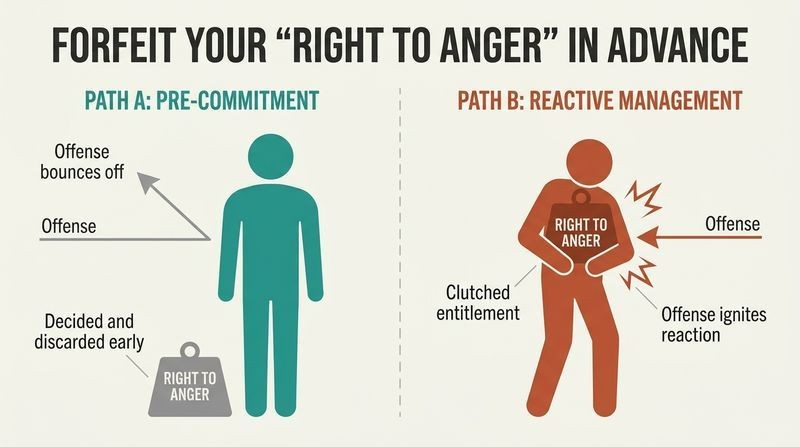
The book's radical thesis: you can decide, in advance, that no person and no event will be allowed to make you angry and resentful. Hansen first heard the idea at a business meeting and found it offensive, then spent months hunting Scripture to disprove it before concluding the speaker was right. He is not talking about barbecue sauce that affronts your taste buds. He means the taking of offense, the presumption that you are entitled to hold onto anger.
Why forfeit rather than manage it: Hansen argues the right to anger does not actually exist for followers of Jesus. Ephesians tells believers to get rid of all bitterness and rage, not to ration it. He notes people always say you can keep anger "for a little while," but he can find no such allowance in the teaching of Jesus. The choice is a daily, pre-committed decision, not a feeling to be talked down after the fact.
What's striking is how this inverts modern therapeutic culture, which treats anger as data to be honored and expressed. Hansen sides instead with Stoic and contemplative traditions: Seneca called anger a temporary madness, and Buddhist practice frames it as a fire that burns its own vessel. The pre-commitment mechanism echoes behavioral economics research on precommitment devices, deciding now removes the in-the-moment negotiation where willpower reliably fails. The scope limit matters, though. Hansen targets resentment, not the initial neurological spark of anger, which is involuntary. The claim is really about what you do in the seconds after, which is defensible and practical.
"Righteous anger" is almost always self-flattery in disguise
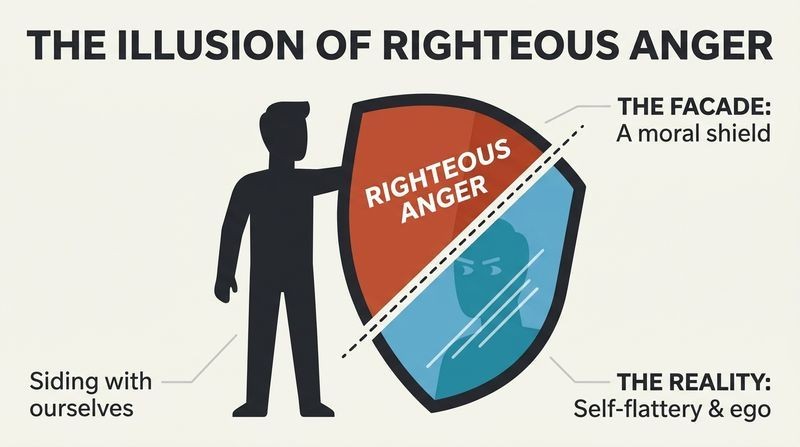
Your anger feels righteous because it is yours. Hansen confesses he finds Brant Hansen's anger more justified than anyone else's, because he always sides with himself and his own arguments are amazingly convincing to him. He cites Proverbs: you may believe you are doing right, but the Lord judges your reasons. Anger is a feeling that supplies its own justification, sweeping in before critical thinking can arrive.
We retrofit Scripture to license it. Hansen points out that Eugene Peterson's paraphrase renders "in your anger do not sin" as "you do well to be angry," a phrase not in the original. Meanwhile James says human anger does not produce God's righteousness, and Proverbs locates anger in the lap of fools. Hansen's rule: the very thing that makes your anger feel righteous is precisely the thing Jesus tells you to forgive.
This maps cleanly onto what psychologists call the self-serving bias and naive realism, the near-universal conviction that one sees the world objectively while opponents are biased. Studies of moral outrage suggest it often functions to signal virtue and cleanse guilt rather than to correct wrongdoing. Hansen's theological framing arrives at the same destination secular researchers do. A fair pushback: some anger genuinely tracks injustice rather than ego, and collapsing all of it into vanity risks moral numbness. Hansen partly answers this by separating anger from action, but the reader should hold the distinction between offense at personal slight and grief over genuine harm.
You are morally guilty of the very thing that enrages you
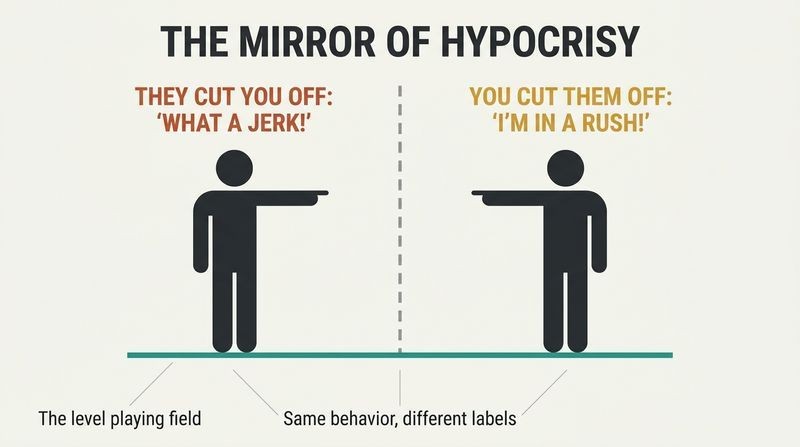
Everyone's an idiot but me. Hansen describes cursing a driver who cut into a parking lot, then doing the identical maneuver himself the next day and cursing the driver who was now waiting where he had waited. The other guy is always the jerk, because he is always "that guy" and you are always "this guy." He suggests an experiment: sit in a food court and count how often people confess their own wrongs versus recounting others' wrongs.
Jesus levels the field. In the Sermon on the Mount, hatred makes you the moral equal of a murderer and lust the equal of an adulterer, because you simply lacked the opportunity or nerve to act on your heart. In the story of the unmerciful servant, forgiven a fortune yet refusing to forgive pocket change, Hansen says we are not merely as guilty as those we resent. Before God, we are worse.
The moral-equivalence claim is the book's most provocative and most contestable. Critics reasonably object that equating a hateful thought with genocide flattens real moral gradations that law and ethics depend on. Hansen is making a specific point about standing to judge, not about legal or social consequences, which is a narrower and stronger claim. The insight has practical power: recognizing your own capacity for the offense you condemn is the engine of empathy. It echoes Solzhenitsyn's line that the line between good and evil runs through every human heart, and Aleksandr's insight that no one is purely villain or victim.
Distrust your verdict; you cannot read anyone's motives, including your own
You are worse than clueless about others' hearts. Hansen leans on Paul, who said he did not even judge himself, leaving that to God. We never know the backstory, the brain chemistry, the history behind someone's behavior, yet we render confident verdicts anyway. Proverbs warns that the first person to plead a case seems right until the other side speaks, and in every conflict the first side you hear is your own.
Smart people are more, not less, self-deceiving. Hansen cites Yale professor Dan Kahan's study finding that people skilled at math suddenly fail a math problem when the correct answer conflicts with their politics, and the better they were at math, the harder they worked to avoid the truth. This held for liberals and conservatives alike. Rather than change beliefs to fit reality, we rearrange reality to fit beliefs, which is a decisive reason to pre-decide against offense.
Kahan's motivated-numeracy work is real and unsettling: intelligence becomes a tool for rationalization rather than a safeguard against it. This connects to the broader replication of confirmation bias and to Jonathan Haidt's metaphor of reason as a press secretary defending decisions the emotional elephant already made. Hansen's application is unusually humble for a certainty-prone genre: because self-knowledge is unreliable, epistemic humility should translate into behavioral restraint. One could extend this further. The same argument that dissolves your right to anger also warns against smug certainty in the opposite direction, judging the judgers, a trap the book mostly avoids but readers should watch for.
Gratitude and anger cannot occupy the same heart at once
Adjust expectations, then be amazed. Hansen argues that in a broken world, selfishness, decay, and betrayal are the rule, so being scandalized by them is naive. The Onion headline he loves, "Neighbors Remember Serial Killer as Serial Killer," mocks our habit of insisting bad actors "didn't seem the type." Jesus, John's Gospel says, did not entrust himself to people because he knew human nature. Stop being shocked.
Then gaze at the exceptions. Once you expect brokenness, kindness becomes astonishing: the driver who lets you merge, the friend who apologizes, the woman who forgave from a hospital bed the driver who cost a man his legs, the widow Jan who forgave her husband's killer a day after his murder in Kabul. Grace, sacrifice, and love are the beautiful exceptions worth breathing in. And crucially, Hansen insists these two states are mutually exclusive: one drains life, the other fills it with wonder.
The neuroscience quietly supports the exclusivity claim. Gratitude activates prefrontal and reward circuitry associated with calm and prosocial behavior, while anger recruits threat systems, and the autonomic states are largely incompatible. Robert Emmons's gratitude research links the practice to lower stress and better sleep. Hansen's reframe is essentially a cognitive-reappraisal technique dressed in theology: lower the baseline expectation and the same event that once offended now delights. The risk is complacency, expecting evil could shade into tolerating it. Hansen guards against this by keeping wonder, not resignation, as the goal. Expecting the worst while actively cherishing the best is a surprisingly resilient emotional posture.
Nursing offense is exhausting; letting go is where rest lives
Anger is a full-time job. Hansen catalogs the labor of offense: the simmering, the rehearsing of grievances, the recruiting of others to your side, the mental gymnastics to justify yourself. He borrows the line from the film The Help, where Aibileen asks the venomous Hilly, "Ain't you tired?" That question, he says, was meant for him. Carrying the self-appointed gavel and pronouncing everyone guilty is a genuine physical, mental, and spiritual drain.
Rest is a present-tense offer. Hansen reinterprets Jesus's promise of rest not as an afterlife reward but as a livable lifestyle now. He and his wife chose a lower-paying job over law school to protect family time, and neighbors kept telling them their ordinary togetherness looked so unusual it made one man think about God. Psalm 46's "be still" originally meant to stop fighting and drop your arms. Quit policing the world, quit parenting strangers, and you sleep better.
There is real physiology here. Chronic hostility and rumination are among the best-documented psychosocial predictors of cardiovascular disease, the classic Type A hostility research and subsequent work linking trait anger to inflammation and hypertension. Forgiveness interventions in clinical psychology reliably reduce anxiety and depression. Hansen's "ain't you tired" is, in effect, a somatic marker: the fatigue is the body reporting the cost of sustained threat arousal. The countercultural family-time thread also lands amid research on hurry and burnout. One caveat: rest framed as letting go can be misheard as passivity or suppression, which backfires. Hansen means release, not repression, a meaningful clinical distinction.
Grace changes hearts; rules never have and never will
Welcome people, don't fumigate them. Hansen's friend Michael, an evangelical, bought a downtown building that had hosted a transgressive AIDS-benefit art show. Instead of evicting the artists, he hosted them, catered the wine and strawberries in a tuxedo, and greeted everyone at the door. A Wiccan neighbor loved him because he hugged her rather than treating her as a project. Hansen calls this refusing to be offended as a door-opener to real relationship.
Redeem the culture, don't condemn it. He recounts Mike Yaconelli's story of a priest who could not bury a soldier's non-member friend inside the churchyard fence, then rose in the night and moved the fence. Jesus dined with the tax collector Zacchaeus and a whole diner of prostitutes got a birthday party in Tony Campolo's story, prompting the cook to say he would join a church like that. Hearts change by encountering unearned love, not by superior morality.
This is the book's evangelistic core, and it aligns with persuasion research showing that shame and moral condemnation trigger reactance and entrench positions rather than shifting them, while warmth and perceived acceptance lower defenses. Contact theory in social psychology finds prejudice erodes through genuine relationship, not argument. Hansen's "move the fence" ethic is essentially inclusion before conformity, the reverse of the belong-only-after-you-behave model. A thoughtful tension: grace that never names wrong can curdle into indifference, and Hansen insists sin is real and God intends to change people. The balance he strikes, love first and let God handle transformation, is pastorally shrewd but demands the humility to release control of outcomes.
You can fight injustice fiercely without a drop of anger
Anger and action are not the same thing. Hansen attacks the assumption that if you are not angry you are complicit. He notes the best police officers and soldiers do not operate out of rage, because anger does not enhance judgment. A University of British Columbia study on "slacktivism" found people who publicly liked a cause were less likely to donate real money, outrage substituting for sacrifice. The book Who Really Cares reports the loudest protesters of injustice are often the least generous with their own resources.
Love is the superior fuel. Martin Luther King Jr. admonished himself not to harbor anger and to absorb an enemy's anger without returning it. Dietrich Bonhoeffer rejected the split between righteous indignation and unjustifiable anger entirely, yet still joined a plot against Hitler, proof that decisive action need not be born of rage. Paul says charity without love is just noise. Scripture repeatedly commands waiting on God, which Hansen calls the hardest, most un-American instruction.
The distinction between anger and action is empirically underrated. Moral-outrage studies suggest expressed anger often discharges the motivation to act rather than fueling it, exactly Hansen's slacktivism point. The King and Bonhoeffer examples are well chosen because both were fierce actors who distrusted anger as an engine. Cognitively, anger narrows attention and inflates optimism about risky action, degrading strategic judgment, which is why hostage negotiators and surgeons train it out. The steelman is strong. The honest limit: anger can be an ignition source that gets bystanders off the sidelines, and love is harder to summon on demand. Hansen's answer is that sustained justice work outlasts anger and requires love to endure.
Anger and worry are both symptoms of not trusting God
Zebras don't get ulcers; you do. Hansen draws on Stanford neuroendocrinologist Robert Sapolsky, whose book explains that animals trigger the fight-or-flight stress response only during real, brief threats, then reset. Humans, uniquely, sustain that response over imagined threats, credit-card fears, preschool waitlists, chess games that burn thousands of calories through thought alone. The chronic version corrodes immune function, gut, heart, fertility, and even ages our DNA. Jesus told us to learn from the birds and not borrow trouble from tomorrow.
Threat is really a trust problem. Hansen connects worry, anger, and insecurity to a single root: distrust of God. Timothy Keller frames chronic worry as arrogance, the assumption that you know how your life must go and God is getting it wrong. Choosing to be unoffendable, Hansen concludes, means actually trusting God to run the universe you keep trying to police.
Sapolsky's core finding is robust and widely cited: the human capacity for abstract, anticipatory stress is a double-edged evolutionary gift, and chronic glucocorticoid exposure is genuinely damaging, including telomere shortening associated with cellular aging. The convergence between a self-described strident atheist's data and Jesus's teaching on worry is a rhetorically effective move. The trust framing is where believers and skeptics part ways, but the underlying mechanism is universal: perceived control and secure attachment buffer stress reactivity, a finding from attachment theory to health psychology. Even a secular reader can extract the actionable core, that relinquishing the illusion of total control measurably lowers the physiological cost of living.
Real security comes only from being loved by God, never from achievement
Even the impressive are insecure. Hansen describes his "Ultimate Dude" bodyguard in Afghanistan: Special Forces veteran, plastic surgeon, inventor, six-foot-four, marrying a beauty-queen runner-up, and privately admitting he feels he is always falling short of something he cannot name. Supermodel Cameron Russell says models are the most physically insecure people on the planet, having the thinnest thighs and shiniest hair and still feeling threatened. There is no "there" you arrive at where the threat stops.
Anchoring worth elsewhere makes offense a way of life. If your "glory," what Scripture calls self-worth, rests on looks, money, status, or even ministry success, you live under permanent threat because whatever you gained can be lost. Christians, Hansen notes, are expert at dressing striving in ministry language, which only hides the insecurity. The one who has nothing left to lose cannot be threatened, and only God's unconditional love provides that footing.
The insecurity-of-the-successful observation is well supported: hedonic adaptation means external achievements deliver diminishing and temporary boosts to well-being, and contingent self-worth research by Jennifer Crocker shows that basing esteem on domains like appearance or achievement predicts more anxiety and instability, not less. Hansen's theological solution, worth grounded in being loved rather than performing, parallels secular findings that unconditional positive regard and secure attachment produce the most stable self-esteem. The practical upshot transcends religion: any identity anchored in comparison is inherently fragile because comparison is infinite. The book's insight is that offendability is downstream of insecurity, which reframes touchiness as a diagnostic signal rather than a character flaw to white-knuckle.
Become hard to offend by having less of yourself to defend
The inflamed ego is a sore joint. Borrowing from Timothy Keller, Hansen compares the self-focused ego to an injured shoulder: you are constantly, painfully aware of it, bracing and adjusting to protect it. Real humility, per C.S. Lewis, is not self-deprecation but self-forgetfulness, the cheerful person genuinely interested in you who is not thinking about himself at all. Hansen's ninety-year-old grandmother simply stopped caring about approval; he cites the spotlight-effect study where students wearing embarrassing Barry Manilow shirts assumed 80 percent of peers noticed when almost none did.
Humility is God's preferred instrument. Scripture points to ants, who accomplish enormous feats with no leader, no big picture, each simply doing the task in front of it. A young couple who scanned their wedding list to lend money to a few African families ended up facilitating over five hundred million dollars in loans, then insisted God did it. When you decide in advance to be unoffendable, you are choosing this self-forgetfulness, and there is simply less of you left to wound.
The spotlight-effect research by Gilovich and colleagues is genuine and liberating: humans systematically overestimate how much others notice and judge them, meaning most social anxiety is a math error. Lewis's redefinition of humility as self-forgetfulness rather than self-abasement anticipates modern work distinguishing healthy from fragile self-esteem, and quiet-ego research links low defensiveness to greater resilience and compassion. The ant metaphor is a sharp critique of the leadership-industrial complex, echoing findings that distributed, emergent systems often outperform top-down command. The closing move is elegant: offendability and ego size are proportional, so cultivating self-forgetfulness is not moral heroics but a practical reduction of one's own attack surface.
Analysis
Unoffendable belongs to the confessional wing of Christian living writing, closer to Anne Lamott's self-deprecation than to systematic theology. Its structure is a spiral rather than a staircase: Hansen circles one thesis, that believers should forfeit the right to anger entirely, and re-approaches it through radio-booth anecdotes, film references, and pointed misreadings of Scripture he wants to correct. The difficulty in summarizing it is that its persuasive force lives in tone and accumulation, not argument. The logical spine is thin and occasionally overstated; the emotional and narrative texture is where conviction accrues.
The book's genuinely contrarian move is denying the category of righteous anger to humans while granting it to God, on the grounds of character asymmetry: God can be trusted with vengeance and judgment because he is perfect and not himself guilty, whereas we are compromised judges who cannot even read our own motives. This is theologically defensible within a Reformed-inflected grace framework and psychologically shrewd given the self-serving-bias literature. Its vulnerability is the flattening of moral distinctions implied by the "you're just as guilty, actually worse" claim, which critics inside and outside the faith reasonably resist. What elevates the book above genre boilerplate is its integration of secular evidence, Sapolsky on stress physiology, Kahan on motivated reasoning, the spotlight effect, that independently converges on its spiritual claims. The reader need not share Hansen's theology to extract a durable operating principle: pre-commit to releasing offense, expect brokenness while cherishing exceptions, separate anger from action, and locate self-worth outside the reach of comparison. The weakest passages risk sanctifying passivity or spiritualizing suppression, and the family-lifestyle material occasionally tips into humble-bragging that Hansen half-acknowledges. But the central diagnosis, that touchiness is a symptom of insecurity and distrust rather than moral seriousness, is both original in its framing and unusually actionable for a book built largely from stories.
Review Summary
Unoffendable is highly praised by readers for its challenging message about letting go of anger and choosing to be unoffendable. Many found it life-changing, emphasizing the importance of forgiveness, humility, and loving others as Jesus did. Readers appreciated Hansen's conversational style and humor, though some felt it was repetitive. The book's core message resonated strongly with most, encouraging a shift in perspective towards gratitude and grace. Some reviewers noted it challenged common Christian beliefs about righteous anger, prompting thoughtful reflection on biblical teachings.
People Also Read









FAQ
What's "Unoffendable" about?
- Central Theme: "Unoffendable" by Brant Hansen explores the idea that Christians can choose to be unoffendable, relinquishing their right to anger and offense.
- Radical Grace: The book emphasizes radical grace and humility, encouraging readers to let go of self-righteousness and embrace forgiveness.
- Practical Application: Hansen provides practical advice on how to live a life free from anger, focusing on love and understanding rather than judgment.
- Cultural Critique: The book critiques the modern culture of outrage and offense, suggesting a countercultural approach rooted in Christian teachings.
Why should I read "Unoffendable"?
- Life Improvement: Hansen argues that choosing to be unoffendable can lead to a more peaceful and joyful life.
- Spiritual Growth: The book offers insights into spiritual growth by aligning one's life more closely with the teachings of Jesus.
- Practical Wisdom: It provides practical wisdom on dealing with anger and offense in everyday situations.
- Cultural Relevance: The book addresses the pervasive culture of offense and offers a refreshing perspective on how to navigate it.
What are the key takeaways of "Unoffendable"?
- Choice of Offense: Being offended is a choice, and Christians are encouraged to choose not to be offended.
- Forgiveness and Grace: Emphasizes the importance of forgiveness and extending grace to others as a reflection of God's love.
- Humility and Trust: Encourages readers to trust God and practice humility, recognizing their own imperfections.
- Freedom from Anger: Letting go of anger leads to freedom and a more fulfilling life.
How does Brant Hansen define "righteous anger" in "Unoffendable"?
- Myth of Righteous Anger: Hansen argues that the concept of "righteous anger" is often misused and not supported by Scripture.
- Anger vs. Action: He distinguishes between anger and action, suggesting that one can act against injustice without harboring anger.
- Biblical Perspective: The book emphasizes that the Bible consistently advises against holding onto anger.
- Destructive Nature: Hansen highlights the destructive nature of anger and its incompatibility with a life of grace.
What practical advice does "Unoffendable" offer for dealing with anger?
- Choose to Let Go: Hansen advises readers to consciously choose to let go of anger and offense.
- Focus on Love: Encourages focusing on love and understanding rather than judgment and resentment.
- Forgive Quickly: Suggests forgiving others quickly to prevent anger from taking root.
- Trust in God: Emphasizes trusting God to handle justice and letting go of the need to control outcomes.
What are the best quotes from "Unoffendable" and what do they mean?
- "You can choose to be 'unoffendable.'": This quote encapsulates the book's central message that being offended is a choice.
- "Anger is extraordinarily easy. It's our default setting.": Highlights how natural it is to become angry, but also how important it is to overcome this instinct.
- "Love is very difficult. Love is a miracle.": Emphasizes the transformative power of love and its ability to overcome anger and offense.
- "We should forfeit our right to be offended.": Suggests that letting go of offense is a sacrifice that pleases God and leads to personal freedom.
How does "Unoffendable" address the concept of humility?
- Humility as Freedom: Hansen presents humility as a path to freedom from anger and offense.
- Self-Forgetfulness: Encourages self-forgetfulness, focusing less on oneself and more on others.
- Biblical Foundation: The book draws on biblical teachings to illustrate the importance of humility in the Christian life.
- Ego and Offense: Links an inflated ego to being easily offended, suggesting humility as a remedy.
What role does forgiveness play in "Unoffendable"?
- Central to the Message: Forgiveness is central to the book's message, seen as essential for living an unoffendable life.
- Reflecting God's Love: Forgiving others is portrayed as a reflection of God's love and grace toward us.
- Practical Steps: Hansen provides practical steps for forgiving others, emphasizing the importance of quick forgiveness.
- Freedom from Resentment: Highlights how forgiveness frees individuals from resentment and bitterness.
How does "Unoffendable" critique modern culture?
- Culture of Outrage: Critiques the modern culture of outrage and perpetual offense, suggesting it is counterproductive.
- Countercultural Approach: Proposes a countercultural approach rooted in grace, forgiveness, and love.
- Impact on Relationships: Discusses how the culture of offense negatively impacts relationships and community.
- Call to Action: Encourages readers to be different by choosing not to participate in the culture of outrage.
What is the significance of the title "Unoffendable"?
- Choice and Empowerment: The title signifies the empowering choice to live without taking offense.
- Radical Concept: It introduces a radical concept that challenges societal norms and expectations.
- Spiritual Implications: Reflects the spiritual implications of living a life free from anger and offense.
- Invitation to Change: Serves as an invitation for readers to change their perspective and approach to life.
How does Brant Hansen use personal stories in "Unoffendable"?
- Relatable Examples: Hansen uses personal stories to provide relatable examples of dealing with offense and anger.
- Illustrating Points: These stories illustrate key points and concepts in a practical, engaging way.
- Authenticity and Vulnerability: His personal anecdotes add authenticity and vulnerability to the book's message.
- Connecting with Readers: The stories help connect with readers on a personal level, making the advice more accessible.
What impact does "Unoffendable" aim to have on its readers?
- Transformative Change: Aims to inspire transformative change in how readers approach anger and offense.
- Spiritual Growth: Encourages spiritual growth by aligning more closely with the teachings of Jesus.
- Improved Relationships: Seeks to improve relationships by promoting forgiveness and understanding.
- Cultural Shift: Aspires to contribute to a cultural shift away from outrage and toward grace and love.
About the Author


Download PDF
Download EPUB
.epub digital book format is ideal for reading ebooks on phones, tablets, and e-readers.








































