

Key Takeaways
A billion-dollar idea can die from the wrong body language
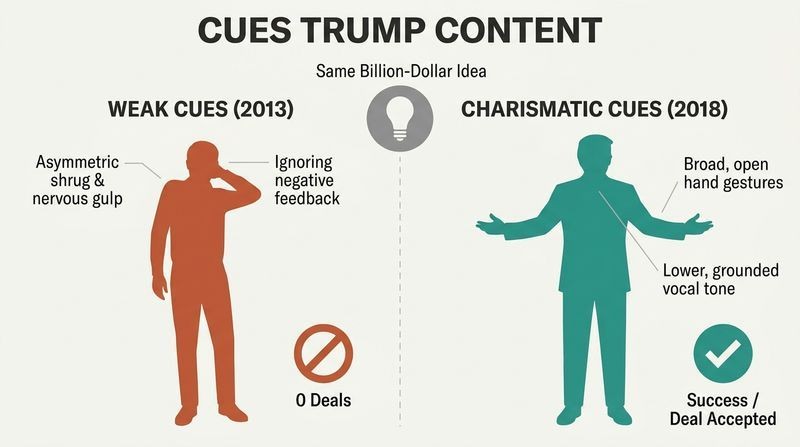
Content alone never lands. Jamie Siminoff pitched his video doorbell (then Doorbot) on Shark Tank in 2013 and got zero investors despite strong sales. His idea was sound; his signals betrayed him. He asked his own name instead of stating it (a question inflection that reads as insecurity), leaked a one-sided shoulder shrug when naming his price, gulped nervously under pressure, and paused mid-sentence in ways our brains read as dishonesty.
He also missed incoming signals. When investor Mark Cuban pulled his mouth into a doubtful shrug, Siminoff barreled on, hearing only the words "Good for you!" and missing the message. Five years later he returned as an investor, transformed: broad gestures, handshakes, a lower voice. Same person, different cues.
What's striking is how this reframes competence itself. We assume merit speaks for itself, but Albert Mehrabian's classic (if often misquoted) work and decades of thin-slice research from Nalini Ambady show observers form durable judgments in seconds from nonverbal channels alone. The danger is overcorrection: reading cues as a deterministic code invites false positives. Siminoff's gulp could have been flu, not fraud. Van Edwards's own later rule about clustering three signals guards against this. The deeper point holds across fields, from courtroom testimony to medical malpractice: perceived competence, not actual competence, drives outcomes, which is both liberating and unsettling.
Charisma is warmth plus competence, and most people lopside one
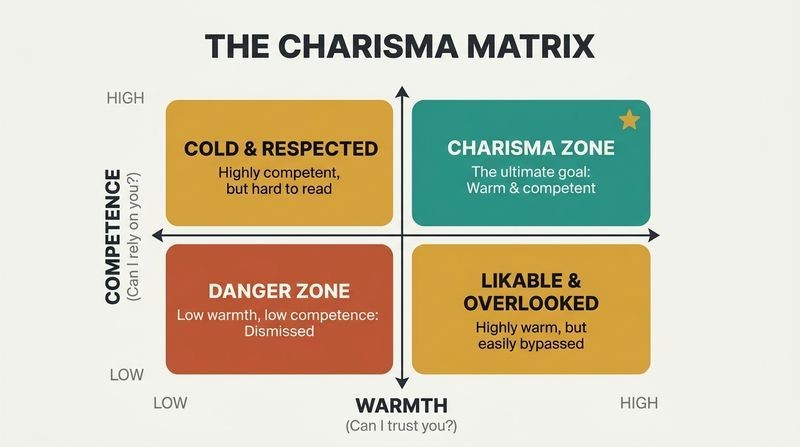
Two questions everyone silently asks. Drawing on Princeton research by Susan Fiske and colleagues, Van Edwards argues warmth and competence cues account for roughly 82% of our impressions. Warmth answers "Can I trust you?" Competence answers "Can I rely on you?" Charismatic people signal both, landing in what she calls the Charisma Zone.
Imbalance is the hidden saboteur. Highly warm people (think Steve Wozniak) get liked but overlooked and interrupted. Highly competent people (Elon Musk, Anna Wintour) get respected but seen as cold and hard to read. The worst spot is the Danger Zone, low on both, where you get dismissed and pitied. Even doctors rated low on warmth get sued more, regardless of actual medical errors. The fix: treat the scale like a dial, adding whichever cue a situation demands.
The warmth-competence model is one of social psychology's most replicated findings, underpinning the Stereotype Content Model that explains how we judge entire social groups, not just individuals. Van Edwards's contribution is making it operational. A useful tension: warmth and competence can trade off perceptually, so aggressively signaling one can suppress the other, a dynamic Fiske calls compensation. The famous duos framing (Kirk and Spock, Holmes and Watson) is memorable but risks implying people are fixed types. The stronger claim, well supported here, is that the same person can flex both, as Bezos does when he shifts from laughing tour guide to low-voiced legacy-builder.
Your cues are contagious, so label bad moods to disarm them
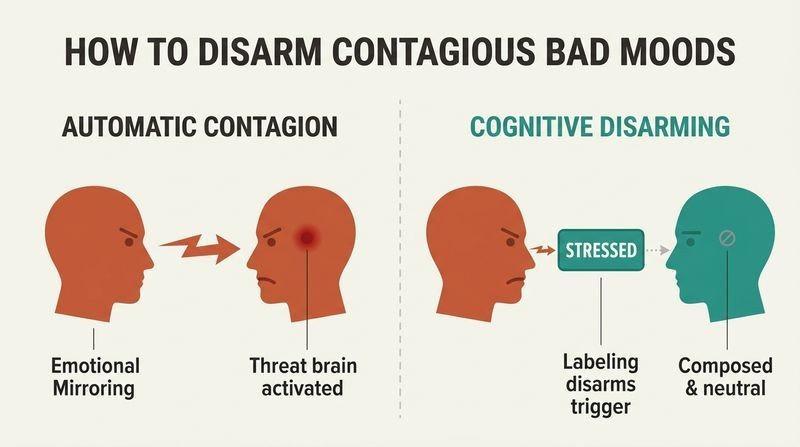
Emotions spread like a virus. Van Edwards calls this emotional contagion: one person's feelings directly trigger the same in others. In a salary-committee experiment, a single planted actor projecting a mood shifted an entire group's cooperation and decisions, and nobody could say why. We mimic others' facial muscles within milliseconds, catching moods in as little as five minutes even while working on separate tasks.
Naming defuses. UCLA neuroscientist Matthew Lieberman found that merely labeling an emotion ("that's an angry face") disengages the amygdala and calms the fear response. So spotting and naming a negative cue reduces its grip on you, and projecting calm confidence pulls others toward it. Cues run in loops: you decode, internalize, then encode a response.
The contagion research is robust, echoing work on mirror neurons and Sigal Barsade's group-emotion studies. The labeling insight connects to a broader therapeutic principle: affect labeling, the backbone of many mindfulness and cognitive interventions, converts raw feeling into manageable information. A caveat worth flagging: contagion cuts both ways and can be exhausting for those in caregiving or service roles, a phenomenon researchers call emotional labor. The book's optimistic framing, that leaders can deliberately spread productive feeling, is real but incomplete without acknowledging the toll of constant emotional self-regulation, something Arlie Hochschild documented in flight attendants decades ago.
Lean in, open up, and point your toes to show you care
Five nonverbal moves do most of the work. Van Edwards teaches charisma cues that read as both warm and competent:
1. Leaning in, which activates your own motivation circuitry and reads as interest
2. Keeping an open body, since crossed arms signal a closed mind (Brian Dean's split test found an open-armed photo lifted sign-ups 5.4%)
3. Fronting, aiming your toes, torso, and top at someone to signal respect
4. Smart use of space across four zones from intimate to public
5. Purposeful gaze
Basketball great John Stockton used fronting to telegraph passes, racking up a record 15,806 assists. Pediatrician Kofi Essel high-fives the child first, drops to eye level, and turns his whole body toward parents, building trust in seconds.
These map neatly onto immediacy, a construct communication scholars have studied since the 1970s: behaviors that reduce psychological distance. The fronting insight is genuinely useful because feet are less consciously controlled than faces, making them a more honest tell, a point echoed in deception research on leakage. One nuance the reader should hold: the split-test conversion bump is a web-metric result, not proof that open posture changes minds in live negotiation. And cultural variation matters more than the brisk treatment suggests. Eye contact norms, personal-space bubbles, and touch tolerance differ sharply across cultures, so these cues are dialects, not a universal grammar.
Deliver three warmth cues in the first three minutes
Little wows build loyalty. Disney trains every employee, from janitors to princesses, in specific warmth behaviors, contributing to a 70% customer return rate. Warmth cues also create a halo effect: people who saw a professor teach with warmth cues rated even his accent and looks more favorably. Van Edwards's warmth toolkit:
1. Head tilts, which expose the vulnerable neck and signal listening
2. Slow triple nods, which get people to talk 67% more and can sway jurors
3. Quick eyebrow raises to show curiosity
4. Genuine (eye-crinkling) smiles, as rewarding to the brain as thousands of chocolate bars
5. Appropriate touch, which releases trust-building oxytocin (touchier NBA teams win more)
Her rule of thumb: show three warmth cues in the first three minutes.
The touch-and-oxytocin claim deserves a gentle asterisk. Paul Zak's oxytocin work is provocative but has faced replication challenges, and the hormone's effects are context-dependent, sometimes increasing in-group favoritism rather than universal warmth. Still, the behavioral advice is sound and low-risk. The nod-persuasion finding connects to research on embodied cognition: physical movement shapes judgment, not just the reverse. What elevates this section is the halo-effect point, which is really a warning: warmth is not mere decoration but a gatekeeper for how your competence gets perceived at all. Cold experts routinely fail to transmit expertise because the audience never lowers its guard enough to receive it.
Take up space and steeple your hands to broadcast competence
The Nixon-Kennedy debate is the cautionary tale. In 1960, a sick, underweight Nixon leaked negative cues: runner's feet poised to flee, white-knuckling the chair, self-soothing thigh rubs, shifty gaze. Kennedy sat calm, planted, and looked into the camera. More than half of voters said the debates influenced them. Van Edwards's competence cues:
1. Expansive posture (small fixes: shoulders down, feet wider, hands rotated out)
2. The lower-lid flex, signaling intense focus
3. Steepling fingers, a relaxed power pose for the hands
4. Explanatory gestures, which boost comprehension up to 60%
5. Palm flashes for commanding attention
Top TED speakers averaged 465 hand gestures in 18 minutes versus 272 for the least-watched.
The posture-and-confidence link is the most contested terrain in this book. The original power-posing research (Carney, Cuddy, Yap) claimed hormonal changes that have largely failed to replicate, though the felt-sense-of-confidence effect survives better. Van Edwards wisely emphasizes small, natural adjustments over Superman poses. The gesture research is on firmer ground: Susan Goldin-Meadow's decades of work show gesture genuinely offloads cognitive burden for speaker and listener alike, which is why explanatory gestures aid comprehension. The Nixon story is a compelling reminder that in mediated communication, the visual channel can override substance entirely, a lesson every era of new media relearns.
Danger Zone cues cluster in threes, so investigate before you judge
Negative cues are red flags, not verdicts. Van Edwards catalogs the leaks that signal anxiety, shame, or deception: lip purse (Lance Armstrong pressed his lips after denying doping), distancing (Nixon stepped back after "I am not a crook"), self-comforting touches, blocking the body or eyes, and the shame touch (fingers to forehead, eyes down).
Read faces for anger, sadness, and contempt. A furrowed brow means irritation and actually makes the furrower feel worse. Contempt, a one-sided smirk, is the most dangerous: John Gottman found it predicts divorce with 93% accuracy. Crucially, no single cue proves anything. Van Edwards insists on clusters: look for three incongruent signals around the same topic before concluding something is off, guarding against the mosquito-bite false positive.
This is the book's most scientifically responsible move. Popular body-language culture is riddled with the myth of the single tell, the Pinocchio's-nose fantasy that leads to confident but wrong judgments, exactly what deception researcher Aldert Vrij warns against. The clustering-plus-context rule mirrors how trained interviewers actually work. Gottman's 93% figure is genuinely impressive but often misread: it comes from predicting outcomes in already-studied couples, not cold forecasting, and contempt matters because it signals corrosive disrespect, not because a smirk is magic. The healthiest reframe here is diagnostic humility: cues open questions rather than close them.
Never ask your statements, and never let your sentences fry out
How you sound outranks what you say. In a study of surgeons, listeners rated warmth and competence from garbled clips with no intelligible words, and those vocal ratings predicted who got sued for malpractice. Van Edwards's vocal power cues:
1. Use your lowest comfortable pitch (anxiety pushes voices high)
2. Kill the question inflection on statements, which reads as insecurity and invites doubt (a salesman's uptalk on price triggered constant haggling until he fixed it)
3. Eliminate vocal fry, the creaky rattle from running out of breath
4. Vary volume to mark importance
5. Replace "um" with a breathing pause
Speaking faster does not convey more, since Brown University researchers found fast and slow speech transmit information at the same rate.
The vocal-fry discussion carries hidden politics worth naming. The cited research does show fry undermines perceived competence, but sociolinguists point out the penalty falls disproportionately on young women whose speech patterns get policed more harshly than men's, raising the question of whether we should coach the speaker or educate the listener. Van Edwards leans practical, and the breath-based fixes are physiologically sound. The pitch finding connects to primate signaling, where lower frequencies advertise size and dominance. The strongest, least controversial takeaway is about pauses: silence tolerance is a genuine marker of status, since only the secure feel entitled to make a room wait.
Warm words trigger collaboration; competent words trigger productivity
Names and phrasing steer behavior. In a classic experiment, the identical game produced two-thirds cooperation when called the Community Game but only one-third when called the Wall Street Game. Word choice is a cue. Warm words (together, collaborate, happy) act like a verbal head tilt; competent words (data, effective, streamline) act like a steeple.
Hotmail's growth hack proves it. Founders added "PS: I Love You. Get Your Free Email at Hotmail.com" to every outgoing message, and 80% of new users came from friends. That line balances the warmest possible phrase with a competent free-offer hook. Van Edwards recommends auditing your emails, spicing up the first ten words, and matching your audience: warm people want inspiration (stories, testimonials), competent people want information (data, research).
The framing effect behind the Community/Wall Street study is bedrock behavioral economics, tracing to Kahneman and Tversky, and its application to everyday language is underused. What Van Edwards adds is a practical vocabulary sorting system. A worthwhile caution: the resume experiments she cites moved perceptions only about 5 to 15%, meaningful at scale but not transformative, and gender effects complicate the picture, since the same warm words that help men may reinforce stereotypes that already pin women as warm-but-less-competent. The verbal-mirroring research (servers repeating orders earn 70% more tips) links to linguistic accommodation theory, where matching another's speech style signals belonging and builds rapport almost automatically.
Engineer your environment, fonts, and colors to prime the right neural map
Objects and images trigger associations you don't notice. Van Edwards calls these neural maps: mention moon and ocean, and people name Tide detergent. Sugarfina sells gummy bears in Tiffany-blue boxes at luxury prices by borrowing the visual metaphor of jewelry. Netflix found 82% of viewing choices come from images, not text.
Small cues bias big judgments. People holding rough puzzle pieces rated interactions as more awkward; heavy clipboards made resumes seem more serious. Fonts carry personality, and color activates associations (red spurs action and wins competitions, blue signals calm and trust, green reads eco-friendly, yellow feels joyful but strains eyes). Glasses bumped perceived competence 8%. You can also build a nonverbal brand: Ben Franklin wore plain cotton at Versailles; a man's shrunken shirts, sleeves rolled, made him "a problem solver."
This is embodied cognition applied to branding, drawing on John Bargh's priming studies, some of which have faced replication scrutiny, so the rough-puzzle and heavy-clipboard effects should be held as suggestive rather than settled. Color psychology in particular is, as Van Edwards candidly admits, largely pseudoscience with no universal map, and associations shift across cultures (white means mourning in parts of Asia). The durable insight survives the caveats: perception is constructed from far more inputs than we consciously track, so controlling your visual context is controlling a channel most people leave on autopilot. The nonverbal-brand idea is essentially semiotics for individuals, a memorable signature that makes you legible at a glance.
Trusting people read others more accurately than suspicious ones
Cue-reading is not gotcha-hunting. Van Edwards's closing rule flips the intuition: research found the more trusting you are of others, the more accurately you detect hidden emotions. Suspicion narrows attention and breeds false positives; openness lets you notice the full range of signals, including the moment something genuinely goes wrong.
Cues amplify truth, they don't manufacture it. She insists you cannot fake competence for long, and faking warmth is exhausting and eventually exposed. The honest path is to build real rapport, find genuine common ground, and then let your cues carry that reality clearly. The whole system, from the palm-up invitation to the breathing pause, works only in service of something true, which is why she frames the goal as alignment between what you feel and what you signal.
This ending quietly resolves the book's central ethical risk. A manual on signal manipulation could easily become a manipulator's handbook, and the trust-accuracy finding (echoing work by Nancy Carter and Mark Weber) is the philosophical anchor that prevents it. There is a paradox here worth sitting with: the people best at reading others are not the guarded cynics but the generous, which inverts the tough-minded detective archetype. It connects to research on high self-monitors, who adapt fluidly to social contexts yet risk feeling inauthentic. Van Edwards's resolution, congruence over performance, aligns with Carl Rogers's concept of authenticity as the precondition for genuine connection, not its enemy.
Analysis
Cues sits in a crowded genre (body-language self-help) but distinguishes itself through two moves: a single organizing theory (the warmth-competence Charisma Scale) and an unusually broad channel taxonomy spanning nonverbal, vocal, verbal, and imagery cues. That structure is the book's greatest strength and its subtlest weakness. The strength is coherence: nearly every one of the forty-plus discrete cues gets sorted as building warmth, competence, both, or neither, giving readers a diagnostic dial rather than a scattershot list. The weakness is that the four-channel scope forces breadth over depth, and the evidence base is uneven. Some claims rest on landmark, well-replicated research (Fiske's stereotype content model, Goldin-Meadow on gesture, Ambady's thin slices). Others lean on studies from psychology's replication-crisis danger zone (power posing, priming, oxytocin) or on the author's own in-house Science of People experiments, which are intriguing but not peer-reviewed. A discerning reader should weight the recommendations by how physiologically grounded they are: breath-based vocal fixes and gesture advice are safer bets than color psychology, which Van Edwards herself concedes is mostly pseudoscience. Intellectually, the book's best contribution is practical rather than theoretical. It operationalizes decades of social-psychology findings into rehearsable behaviors, and its clustering rule (require three incongruent cues before judging) is a genuinely responsible antidote to the pop-culture myth of the single tell. The recurring ethical tension, that a guide to signal engineering could enable manipulation, is handled deftly by the closing insight that trust improves accuracy and that faked warmth self-destructs. What the book underplays is structural: cues are read through the biases of the observer, so the same behavior earns different verdicts depending on the actor's gender, race, and status, a point Van Edwards raises but treats as a coaching problem for the disadvantaged rather than a systemic one. Read as a skills manual for making your real competence and warmth legible, it delivers. Read as settled science, it overreaches. The wise use splits the difference: adopt the low-risk, high-frequency behaviors, hold the flashier claims loosely, and remember her own best rule, that congruence beats performance.
Review Summary
Cues is praised for its practical advice on improving communication through body language, vocal cues, and word choice. Readers appreciate the scientific backing and real-life examples. Many found it helpful for professional development and social interactions. Some criticize it as obvious or manipulative, while others note its focus on neurotypical communication. The book's structure and Vanessa Van Edwards' engaging writing style are frequently commended. Overall, it's seen as a valuable resource for enhancing charisma and understanding nonverbal cues.
People Also Read


FAQ
What's Cues: Master the Secret Language of Charismatic Communication about?
- Focus on Cues: The book explores verbal, nonverbal, and vocal signals, or cues, that influence human interactions. It highlights how these cues shape perceptions in personal and professional settings.
- Charisma and Communication: Vanessa Van Edwards breaks down charisma into warmth and competence, offering strategies to enhance communication skills through effective cue management.
- Real-Life Applications: Insights are supported by research and case studies, aiming to help readers become more engaging and persuasive communicators.
Why should I read Cues: Master the Secret Language of Charismatic Communication?
- Enhance Communication Skills: The book provides actionable advice for improving interpersonal communication, crucial for personal and professional success.
- Understand Nonverbal Signals: Readers learn to decode and use nonverbal cues, which constitute a significant portion of communication, to avoid miscommunications.
- Boost Confidence: By mastering cues, readers can project confidence and ensure their messages are both heard and felt.
What are the key takeaways of Cues: Master the Secret Language of Charismatic Communication?
- Balance Warmth and Competence: The book stresses the importance of balancing these cues to be perceived as charismatic, building trust and credibility.
- Nonverbal Cues Matter: Body language and facial expressions significantly impact message reception, and managing these cues can enhance communication effectiveness.
- Practical Strategies: Techniques like head tilts, nodding, and palm gestures are provided to enhance warmth and competence in social situations.
How does Cues: Master the Secret Language of Charismatic Communication define charisma?
- Warmth and Competence: Charisma is a blend of warmth and competence cues, which account for a large part of our impressions of others.
- Continuous Assessment: People constantly evaluate others for warmth and competence, influencing connections and interactions.
- Charisma Scale: The book introduces a scale to help readers assess their warmth and competence, guiding personal development in communication.
What are some practical strategies from Cues: Master the Secret Language of Charismatic Communication?
- Use Head Tilts: Shows interest and curiosity, making you more likable, especially in difficult conversations.
- Nod to Encourage: Encourages others to share more, showing agreement and empathy.
- Employ Palm Gestures: Open palm gestures signal openness and invite engagement, emphasizing points and encouraging dialogue.
What are the "Danger Zone" cues mentioned in Cues: Master the Secret Language of Charismatic Communication?
- Distancing Cues: Include stepping back or leaning away, indicating discomfort or disengagement.
- Self-Comforting Gestures: Actions like rubbing the neck suggest anxiety, detracting from charisma.
- Blocking Behaviors: Crossing arms or using objects as barriers signals defensiveness, creating emotional distance.
How can I improve my vocal cues according to Cues: Master the Secret Language of Charismatic Communication?
- Lower Your Pitch: Projects confidence and authority, as nervousness often raises pitch.
- Control Your Pace: A measured pace conveys calmness, while pauses enhance message impact.
- Use Vocal Variety: Varying tone and volume keeps listeners engaged and conveys enthusiasm.
What is the "Question Inflection" mentioned in Cues: Master the Secret Language of Charismatic Communication?
- Definition: Occurs when a speaker's voice rises at the end of a statement, making it sound like a question.
- Impact on Communication: Signals uncertainty, inviting doubt and undermining authority.
- Actionable Advice: Practice using a neutral or downward inflection to sound more confident and assertive.
How does Cues: Master the Secret Language of Charismatic Communication address vocal fry?
- Definition of Vocal Fry: A creaky, raspy sound from insufficient breath support, signaling anxiety.
- Negative Perception: Can negatively impact professional success, perceived as a lack of confidence.
- Elimination Techniques: Speak louder with more breath support and practice shorter sentences for clarity.
What are "Vocal Invitations" in Cues: Master the Secret Language of Charismatic Communication?
- Definition: Sounds or phrases like "uh-huh" that encourage others to continue speaking.
- Importance in Communication: Enhances rapport, making others feel heard and valued, crucial for trust.
- Practical Application: Use in interactions to create an inviting atmosphere, especially in professional settings.
How can I improve my first impression according to Cues: Master the Secret Language of Charismatic Communication?
- Memorable Greetings: A strong vocal first impression is crucial; practice confident greetings.
- Positive Body Language: Open posture and a warm smile convey friendliness and approachability.
- Mindset Check: Ensure a positive mindset before interactions to present your best self.
What role does color play in communication as discussed in Cues: Master the Secret Language of Charismatic Communication?
- Color Psychology: Colors evoke specific emotions; red inspires action, blue suggests calmness and trust.
- Branding and Presentation: Right colors enhance messages and influence perceptions.
- Practical Tips: Be mindful of colors in attire and materials; avoid too much yellow, use blue for trust.
About the Author
Download PDF
Download EPUB
.epub digital book format is ideal for reading ebooks on phones, tablets, and e-readers.








































