
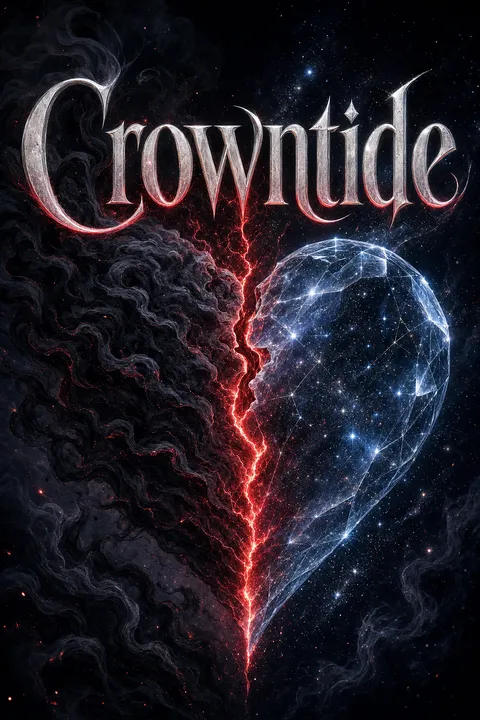


Plot Summary
Enemies Bound by One Love
At a scorched maze, Grim,2 demon ruler of Nightshade, weeps over the spot where Isla1 disappeared, then hurls himself at Oro,3 king of Lightlark. The two men beat each other bloody, both undone by the same woman. Grim2 presses a blade to Oro's3 throat and demands to know if he loves her. Oro3 cannot lie: yes. Rather than kill his rival, Grim2 proposes an alliance.
Isla1 opened a portal and dragged her unkillable ancestor Lark5 into another world to spare their own, carrying the universe's most powerful stone, Infinite, on her neck. Grim2 confesses he clasped that diamond there himself. Centuries of war and a buried friendship collapse into a fragile partnership, and they clasp hands.
Aster opens with a masterstroke of romantasy structure: the love triangle inverted into cooperation. Grief becomes the solvent that dissolves male rivalry, and the question Grim extracts at knifepoint (do you love her?) reframes possession as shared devotion. The scene establishes the book's governing paradox, that love is simultaneously weapon and wound. By making both men admit vulnerability before we meet the beloved, the narrative centers Isla as an absent gravitational force. The handshake is a contract signed in blood, foreshadowing that their alliance is provisional, always one prophecy away from fracture. It also seeds the central dread: only one can ultimately keep her.
The Climb for Infinite
In flashback, Grim2 recalls scaling the cursed island of Atlas to win the sentient diamond Infinite as a wedding gift for Isla.1 The mountain strips his senses and forces him to relive centuries of slaughter, including the pleading soldiers he gutted without mercy. Worst of all, he confronts his sister Laila, whom he accidentally killed as a boy with his shadows, securing his place as heir.
The stone interrogates his love, testing whether it survives her monstrousness and even her potential betrayal. Grim2 answers that his love is infinite, that he would thank her even if she killed him. The diamond finally accepts him, carving something vital from his soul, and grants his wish: them, together, forever.
This backstory functions as a psychological x-ray of Grim, exposing the guilt engine beneath his cruelty. His fratricide reframes his entire ruthlessness as penance, a way to make his sister's death mean something. The trial structure (relive your sins to earn power) literalizes the romantasy conviction that love must be proven through suffering. Crucially, the diamond demands unconditional love, love that endures betrayal and monstrosity, which becomes the thematic yardstick the whole novel measures. The stone extracting a critical piece of him quietly foreshadows cost and vulnerability. Aster uses the climb to argue that true devotion is not blind but clear-eyed, embracing the worst in the beloved.
Stranded in a World of Ash
Isla1 crashes through the portal with Lark5 into a desert of silver-black ash, a world flattened into ruin. Her abilities are smothered by an invisible second gravity, and her dying life-force has only days left. Scavengers in gray tunics overpower and bind both women, dragging them by ropes behind a cart heaped with the mangled dead.
Isla1 realizes this planet was once vibrant, its forests and cities reduced to dust by some catastrophic power. Fleeting mirages show her the paradise it used to be. She steals a dagger, frees herself briefly, and tries to kill the weakened Lark5 to absorb her power, but a water-draining sand creature and the storm-wielding scavengers prove escape is nearly impossible.
Isla's arrival inverts the hero's quest: she came seeking the power to undo her sins and finds only annihilation's aftermath. The ash-world is a memento mori, a preview of what her own realm might become. Her immediate powerlessness strips away the godlike abilities that made her dangerous, forcing her to survive on the childhood training she resents. The mirages of lost beauty introduce the novel's grief for ruined things, and her instinct to kill Lark reveals her transactional desperation: she needs the ancestor's power to resurrect the innocents she killed. The scene reframes her sacrifice as a trap, deepening the stakes from personal survival to cosmic reckoning.
The Prophecy Called Crowntide
Oro3 and Grim2 confront Cleo,6 the Moonling ruler who secretly helped Isla1 open the portal in exchange for a chance to revive her dead son. Cleo6 reveals a prophecy given to her alone: five hundred years after the curses, a person born of life and death, marked by halves, would decide the fate of the world by choosing one side without losing themselves.
Worse, she names a coming war between worlds that would determine the fate of the entire universe: Crowntide. She then divulges that Oro's late father3 spent his reign hunting not a place but a person, a lost king, whose map she can provide. The rivals realize saving Isla1 and saving all existence are now the same errand.
Cleo embodies the novel's moral grayness: a traitor whose treachery springs from maternal love, mirroring the men's own willingness to burn worlds for Isla. Her prophecy escalates the register from romance to cosmic stakes, giving the rescue mission civilizational weight. The concept of a person marked by halves crystallizes Isla's identity crisis (Wildling and Nightshade, creator and killer) into fate itself. Naming the war Crowntide converts an abstract dread into a countdown. Aster also plants a mystery box, the lost king, that rewards the reader's forward momentum. The scene demonstrates how prophecy in this genre operates less as destiny than as pressure, forcing characters toward impossible choices.
The Prisoner Beneath the Sea
Following the map, Cleo6 splits an entire ocean and holds it open while Oro3 and Grim2 descend miles to an ancient underwater prison. There they hack through hundreds of chained, drowning-and-reviving inmates, saving each other despite their venom, until they reach a silver-haired man bound by ten chains who chose his sentence to live a thousand lives.
He confirms Cronan,4 the original Nightshade founder, escaped death long ago and now hunts Isla1 as his Worldkey, the being who can unlock the universe. He hands them the Threads of Time, warning it can break the universe or save it, and instructs them to seek knowledge in the cursed world where the curse victims still live.
The set piece fuses spectacle with intimacy: two enemies forced into rhythm, discovering that hatred and partnership can coexist. The prison of eternal drowning is a haunting image of purgatory, and the lost king who chose imprisonment to experience infinite lifetimes offers a philosophical counterweight to Cronan's conquest hunger. The revelation that Isla is a key, an instrument rather than an agent, sharpens the tragedy of her sacrifice: she fled to save her world and delivered its destroyer his final tool. The Threads of Time enters as a Chekhov's gun with explicit dual potential. Aster braids exposition into action so revelation never stalls momentum.
The Forest That Remembers
Escaping the ash-desert through a storm portal, Isla1 and Lark5 land in the Forgotten Forest, woods that trap travelers inside their memories. Isla1 relives her brutal childhood: guardian Terra14 carving her open in training, calling her the ruin of their realm, destroying her dead mother's few keepsakes, and Isla1 discovering the starstick hidden beneath her floorboards.
A radiant silver-haired woman rescues her from bark-skinned warriors and leads her to a bottomless silver pool. The woman validates Isla's1 suffering, insists she was only a child forged into a weapon, and gives her water that buys more life. She promises the pool will be a shield of remembered strength whenever Isla1 doubts herself, then warns that Cronan4 is coming.
This is the novel's emotional core, a therapy session disguised as fantasy. By forcing Isla to witness her own abuse from the outside, Aster stages the psychological work of reparenting: the silver woman offers the compassion Isla never received, breaking the internalized voice of Terra that equates worth with usefulness. The forest that forces you through your past literalizes trauma's grip on the present. The silver pool becomes an anchor of self-belief, a portable interior sanctuary. Crucially, healing here is framed as prerequisite to power, not opposed to it. The mysterious woman's uncanny knowledge seeds a later revelation while modeling that survival requires making peace with what shaped you.
Cronan Cracks Her Mind
Cronan,4 an older and colder mirror of Grim,2 captures Isla1 and immediately recognizes the diamond he has torn galaxies apart to find. Because Infinite must choose its wearer, he cannot simply seize it; instead he decides to control Isla1 and use her as his weapon. Day after day his crown-borne shadows pierce her skull, trying to reshape her memories and break her will.
Fearing he will find and use Grim2 and Oro3 against her, Isla1 makes an agonizing choice: she reaches for the glimmering threads binding her soul to both men and severs them. Worlds away, both Grim2 and Oro3 feel their connection to her vanish, plunging them into terror that she has died.
The mind invasion dramatizes the ultimate violation, autonomy itself under siege, and Isla's counterstrategy reveals her defining ethic: she protects others by sacrificing her own comfort. Severing the bonds is a love language of self-erasure, echoing Grim's willingness to be killed and thanked for it. Cronan functions as Grim's shadow-self, the man Grim might have become without love, making their kinship the book's central warning. The diamond's requirement of consent (it must choose) plants the mechanism that keeps Isla alive and valuable. Aster weaponizes the romantasy staple of the soul bond by turning its rupture into an act of devotion, transmuting connection's severance into protection.
Conversations With the Dead
Guided by the lost king, Oro3 and Grim2 travel to the cursed world where victims of the curses linger. Grim2 meets the withered soul of his father, who cares only whether he claimed Infinite, and lets his centuries of hatred finally dissolve. Oro3 reunites with his beloved dead brother Egan,17 who abdicated for love, and with Violet, Isla's1 ancestor, who still asks tenderly after the friend who murdered her.
Through Azul,7 the Skyling ruler, they consult his dead scholar husband, who reveals that an ancient oracle's drowned lungs seeded pools of linked sacred water across worlds. If the pool on Lightlark can be connected to its original, it could become a portal home.
The cursed world is a liminal space where the novel processes its themes of forgiveness and the persistence of love beyond death. Grim releasing his father's grip completes the arc begun on Atlas: Isla's love has outshone his inherited darkness, making old wounds meaningless. Oro's encounter with Egan retroactively humanizes his resentment of a brother whose choice caused the curses, teaching Oro that fate would have found them regardless. Violet's undimmed affection for her betrayer prefigures Isla's own complicated love for Aurora. Thematically, the section argues that souls persist through love and choice. Practically, it advances the plot by revealing the sacred-water mechanism the rescue requires.
Drowning in the Past
Back on Lightlark, Oro3 discovers the Threads of Time let him witness thousands of years distilled into moments, but the relic burrows into his veins and nearly consumes him. When his friends pull him free, he has spent days lost and even lashes out, injuring Enya,8 Zed, and Calder in a power-drunk frenzy.
Realizing portaling is required to truly travel time, Oro3 uses Grim's2 flair to hurl himself into the past, where he confronts his ancestor Horus,16 founder of Lightlark. Horus16 reluctantly lists what building a portal to the otherworld, named Skyshade, demands: portaling ability, immense energy, a living piece of that world, and great Sunling, Nightshade, and Wildling power, warning the journey itself could kill them.
Oro's addiction to the Threads externalizes a deeper hunger: the fantasy that knowing all history could let him prevent suffering. His near-loss of self, and his harming of the friends he loves, marks the crossing of his own moral threshold, the disciplined king who prided himself on control now tasting the seduction of unchecked power. This mirrors Isla's lifelong struggle and Cronan's endpoint, tightening the novel's triadic parallel. Horus functions as reluctant oracle, converting the vague quest into a concrete checklist that structures the coming climax. Aster uses time travel not for paradox play but for characterization, showing that the past informs but cannot be rewritten without catastrophe.
The Choice at the Tide Pool
The team assembles every requirement: the Lightlark tide pool linked to Skyshade's waters, a ring holding a living shred of the otherworld storm, and raw energy from Cinder,9 a preternaturally powerful Starling child guarded by the rebel Maren. Isla,1 visiting Grim2 and Oro3 through their dreams, agrees to reopen her severed bond and lend her Wildling power to complete the bridge.
But she insists on a devastating condition: only one of them may cross, since someone must stay to protect their people. She will not reveal whom she will choose. Standing waist-deep in the glowing pool, Oro3 and Grim2 thank each other, and Cinder9 strikes the water with a bolt of pure energy, forming the door.
The triangle finally forces its reckoning: the choice both men have dreaded becomes literal geography. Isla's insistence that one stay behind reframes romantic selection as civic duty, refusing to let love override responsibility. Cinder's inclusion introduces a poignant ethical strain, the recruitment of a child into cosmic war, echoing Oro's and Isla's stolen childhoods. The men's mutual gratitude at the threshold is the alliance's emotional peak, generosity born of shared grief. Aster deliberately withholds Isla's decision, converting the portal's opening into a suspense engine. The scene crystallizes the novel's thesis that every meaningful choice costs something irretrievable, and that love, here, must be rationed against survival.
The Husband Who Forgets
Isla1 chooses Grim,2 opening the bridge and pulling him to Skyshade just as she overpowers Cronan4 and seizes his crown. For a triumphant instant they reach for each other. Then Cronan4 breaches Grim's2 mind and permanently erases every memory of Isla.1 Grim2 looks at his own wife and sees a stranger, an enemy powerful enough to ruin his realm.
On Cronan's4 order he attacks, and only a summoned storm lets Isla1 deflect his shadows. Heartbroken, she flees through a portal, severing their bond again to keep him from tracking her. Meanwhile, on Lightlark, the open portal spews monstrous beasts, leaving Oro3 alone to hold the line as his friends and the child Cinder9 weaken.
Aster delivers the cruelest possible reversal: Isla chooses Grim and immediately loses him, the reward becoming the punishment. Memory erasure is the novel's recurring violation, and its permanence here raises the stakes beyond the earlier, recoverable amnesia Grim once inflicted on her, a bitter karmic symmetry. Grim reduced to Cronan's instrument literalizes the fear that he is merely his ancestor's echo. The scene splits the narrative into two sieges: Isla's private war to reclaim a husband who hates her, and Oro's public war to keep a world from drowning in beasts. Love and duty are now geographically divorced, and both fronts are losing.
Wooing a Stranger
Hiding briefly with a kind villager named Jessel,15 Isla1 is recaptured and paraded at Cronan's4 grim feasts, where lords eat from bones of dead gods. Refusing to abandon Grim,2 she works to rekindle their bond from nothing: recounting how they met, showing him the scar over his heart he kept as a reminder of her, and revealing their lives are magically tied.
She heals a failing skyre on his arm, the marking that lets him wield power in this world, and slowly cracks his indifference into desire. To gain a healing drop of Lark's5 blood, she trades away the feather Lark5 craves. When Cronan4 slaughters captured villagers for sport, Isla1 kills Jessel15 herself, intending to absorb and later resurrect her.
This section reframes romance as archaeology, Isla excavating a love that no longer exists in her beloved's memory, an inversion of the earlier arc where Grim rebuilt her erased feelings. The healing of his skyre is intimacy weaponized as strategy, blurring genuine care and manipulation. Her murder of Jessel is the book's darkest moral knot: an atrocity committed as mercy, since her absorption flair offers the only hope of revival. It demonstrates how Cronan's cruelty contaminates even the good, and how Isla increasingly resembles the monster she resists. The feasts on divine bones render conquest as consumption. Aster keeps sympathy taut by exposing the calculus of survival beneath every terrible act.
Killing the Ancestor
Realizing she cannot defeat Cronan4 alone, Isla1 makes a final bargain with the broken, barely-regenerating Lark:5 let herself be killed so Isla1 can absorb her power and later resurrect her, joining forces against their shared tormentor. Family, Isla1 pleads, must mean something. Lark5 relents and tells Isla1 exactly how to end her.
In a single stroke Isla1 kills her ancestor5 and floods with ancient, immortal regenerative power, becoming the last living ruler of her bloodline. She learns Cronan's4 crucial weakness by turning his own mind-invasion technique against him, mapping the labyrinth of his thoughts while he tortures her. She carves his secret skyre into her palm with Lark's5 feather, restoring her powers even under his void.
The pact with Lark completes a bitter reconciliation between two women who despise each other yet share blood and a captor, dramatizing how oppression forges unlikely kinship. Isla absorbing Lark's immortality is the plant that will pay off catastrophically for Cronan, turning her greatest vulnerability into her trump card. The image of Isla learning by being tortured, converting Cronan's violation into education, is the novel's sharpest articulation of survival as transmutation: the abuser inadvertently arms the abused. Aster stages empowerment not as triumphant awakening but as grim resourcefulness born of desperation. The scene repositions Isla from victim to strategist, gathering the pieces that make the climax possible while deepening the family tragedy.
The Duel Through Memories
Grim2 opens Isla's1 cell, insisting she flee because he remembers a world worth saving even if not a life worth living. Refusing to leave without him, she escapes to the Forgotten Forest and pulls her diamond to summon him. There she forces their entire love story upon him, dueling him inside their shared memories: their first meeting, his proposal, their wedding, their mutual deaths for each other.
His shadowblade finally falls, his hand cupping her face, and he admits he remembers everything. Then he says he simply does not care. Cronan4 strides in, revealing Grim2 led him straight to the elusive Pool of Possibilities, and forces Isla1 to open it or watch a shadow-dagger pierce her husband's heart.
The memory-duel is a stunning formal device: combat as recollection, each clash of blades melting shadow into starlight until past and present fuse. It literalizes the labor of love, that connection is not given but rebuilt through relentless insistence. Grim's devastating I remember, I just do not care weaponizes emotional withholding, and the reader is meant to doubt it, sensing the fight raging beneath his flat delivery. The betrayal (leading Cronan to the pool) reframes Grim's cruelty as possibly strategic self-preservation, since he has glimpsed his own death. Aster sustains agonizing ambiguity about whether Grim is villain, coward, or a man calculating survival, refusing easy redemption while keeping hope flickering.
Death, Rebirth, Betrayal
Cronan4 breaks Isla's1 neck to claim the diamond, but her stolen immortality snaps her spine back into place. Rising like something reborn, she pours her absorbed power into the Pool of Possibilities, resurrecting everyone she has killed, including Cleo's6 son and Jessel,15 while her ancestor Aurora10 appears to hold Cronan4 off.
Cronan4 repeatedly drowns her, demanding she deliver Oro3 to him, but Isla1 remembers her own strength, breaks free, and glimpses the one weapon that can truly kill him: the Heartblade. Grim2 reaches for her at last, their bond reformed, then betrays her again, portaling Cronan's4 crown away and hurling him from the pool. As his shadows turn on Isla,1 the pool drags her and the revived home, leaving Grim2 behind.
The climax pays off every plant: Lark's immortality nullifies Cronan's killing blow, the pool becomes a resurrection engine, and absorption is redeemed as creation rather than theft. Isla's rise from her own repeated drowning fulfills the phoenix motif Oro's mother taught, strength found in ashes. Grim's final act is the book's most tortured beat: he reunites with her only to sabotage her again, seemingly to escape his foreseen death, yet is dragged from her regardless. Aster refuses catharsis, converting triumph and treachery into the same instant. The introduction of the Heartblade as the sole god-killer sets the terms for the sequel while the love triangle remains unresolved and bleeding.
Home to a Breaking Sky
Isla1 surfaces at the Lightlark tide pool amid the people she resurrected, caught in Oro's3 arms, her eyes green and human again. Grim,2 she reports, chose Cronan,4 though the reformed bridge between them proves he still loves her. Oro,3 who has seen the many futures in the pool, is haunted by a truth he can barely voice: the prophecy still demands a death.
Before he can speak, the sky tears open and dozens of Cronan's4 conquered worlds portal in to invade. Because Isla1 now cannot be killed without her own consent, and because the Heartblade alone can slay Cronan,4 the war of Crowntide finally arrives. One of the three will wield the blade, one will die by it, one will decide creation's fate.
The ending refuses resolution in favor of escalation, converting a rescue quest into the opening of apocalyptic war. Isla's homecoming is bittersweet: she saved the dead and herself but lost Grim to the enemy, love and victory once more mutually exclusive. Oro's silent burden, having peered at every future, positions him for a wrenching moral choice about whether to sacrifice the woman he loves for the world. The cliffhanger reframes the prophecy as newly fluid, since time-meddling has multiplied possible futures, restoring agency even as it withholds relief. Aster closes on the novel's thesis distilled: destiny is authored by choice, and every crown is paid for in blood.
Analysis
Crowntide is a study in love as both salvation and catastrophe, built on a triangle that refuses the usual jealousy in favor of shared sacrifice. Aster structures the novel around parallels: Isla,1 Grim,2 and Cronan4 all began as children who killed and were forged into weapons, and each represents a different destination for that trauma. Cronan4 is the endpoint of guilt without love, hollowing himself into a world-devouring void; Grim2 is guilt redeemed, barely, by devotion; Isla1 is guilt still fighting toward self-forgiveness. The recurring image of the divided soul, the halved heart, the split fate, insists that identity is not fixed but chosen, and that choosing is agony precisely because every path costs something irretrievable. The book's most sophisticated move is treating trauma-work as literal magic. The Forgotten Forest and the silver pool stage the psychological labor of reparenting and self-compassion as plot mechanics, arguing that healing precedes power rather than opposing it. Isla1 learns from her abuser, converting Cronan's4 violations into education, dramatizing survival as transmutation: pain becomes the blade she wields against its source. Memory becomes the novel's battleground, with erasure as the ultimate violation and remembrance as the ultimate resistance; the memory-duel, where lovers fight inside their own history until shadow and starlight fuse, is a striking formal fusion of combat and recollection. Aster refuses easy catharsis. The climax delivers triumph and betrayal in the same instant, and the ending escalates rather than resolves, converting a rescue into apocalyptic war. The takeaway is bracing: fate is authored by choice, strength lies not in remaining unbroken but in never staying broken, and love, unlike power, is the only truly infinite thing, a force that creates worlds even as it threatens to end them.
People Also Read

Characters
Isla Crown
Divided worldmaker queenRuler of both Wildling and Starling realms, Isla wields all six powers and wears the sentient diamond Infinite. Raised in cruel isolation by guardians who called her weak and monstrous, she carries deep shame over the deaths her uncontrolled power has caused, including a razed village and her own parents. Her flair is absorption: she consumes the souls and powers of those she kills. Torn between two men who each hold half her soul, she is defined by an almost reckless loyalty, leading with her heart even when it ruins her. Isla's arc is a reclamation of self-worth, learning that survival is not weakness and that her scars prove endurance rather than failure. Fierce, stubborn, and quietly desperate to be loved for who she is.
Grim Malvere
Demon ruler, devoted husbandThe portaling ruler of Nightshade, Grim spent centuries as his father's emotionless sword after accidentally killing his sister Laila as a child. Haunted by guilt, he folded his feelings away until Isla1, whom he calls Hearteater, became his spring after endless winter. He is possessive, ruthless, and unashamed of his own villainy, yet insists Isla1 makes his monstrousness bearable. His love is total and clear-eyed, embracing her worst; he claimed the universe's deadliest diamond and bound his own life to hers to keep her alive. Grim believes love is for fools but happily plays the fool for her. His central flaw, taking choices away from those he loves in the name of protection, is the wound he can never forgive himself for inflicting.
Oro Rey
Golden king of LightlarkKing of Lightlark and ruler of Sunling, Oro can sense truths and never intended to wear a crown, inheriting it after his brother's death17 launched the curses. Bound to his island by nexus, so his death would kill all his people, he carries enormous duty and prizes self-control above all. For centuries his heart lay frozen until Isla1 thawed it; she is his fire, his eternal summer, the reminder that his world is worth saving. Honest to a fault and quietly noble, Oro loves Isla1 so selflessly he wants her back even if she is not his. His arc tests whether a man who has always chosen his people can survive loving someone fate may set against the world, and whether strength means never breaking.
Cronan
Universe-devouring founderThe original Nightshade founder and Grim's2 distant ancestor, long presumed dead but merely escaped into the otherworld of Skyshade. A near-emotionless void who has torn galaxies apart, he collects conquered worlds in a crown of broken metal and rules a subservient Astral Council. Cronan believes love is a fatal weakness and that some worlds deserve destruction. He hunts Isla1 as his Worldkey, the being who can unlock the universe, and covets the diamond that once cursed and cast him out. Cold, patient, and cruel, he tortures minds to reshape them and always offers a poisoned second chance. He functions as Grim's2 shadow-self, the man Grim2 might have become without love, a warning of where guilt and power lead when devotion is refused.
Lark
Immortal ancestor, ruthless enemyIsla's1 ancient ancestor and a founding Wildling worldbuilder, Lark is effectively unkillable, able to regenerate from ribbons of flesh. She once dreamed of building a new world with Cronan4 and Horus16 before betrayals buried her for millennia. Bitter, mocking, and merciless, she has killed hundreds and nearly destroyed Isla's1 world, yet in the ash-realm she becomes a reluctant ally against their shared tormentor. Her cynical wisdom about nature, death, and the cost of love needles Isla1 toward hard truths.
Cleo
Grieving Moonling rulerThe immensely powerful Moonling ruler and Oro's3 former merciless instructor, Cleo helped Isla1 open the portal to reclaim her dead son. A mother who has endured unimaginable loss, she is cold, fearless, and transactional, aligning with whichever side serves her purpose. She cleaves oceans and holds them open through sheer will. Her maternal desperation mirrors the men's love for Isla1, making her a traitor whose treachery is entirely understandable.
Azul
Thoughtful Skyling democratThe Skyling ruler who built a functioning democracy and sheltered most of Lightlark's refugees on his newland. Thoughtful and measured, he weighs his words carefully and grieves a husband lost to the curses. Azul aids the rescue by contacting the dead and delivers the novel's most disturbing counsel about the prophecy, that ending the world may require a single blade through a single heart.
Enya
Oro's fierce friendOro's3 oldest friend, a fiery-winged warrior who has stood beside him through war, loss, and grief. Sharp-tongued and fiercely protective, she is honest about her doubts regarding Isla1 yet steadies Oro3 when he splinters. Enya serves as his conscience and anchor, willing to risk herself to pull him back from the brink of his own power.
Cinder
Prodigy Starling childA young Starling girl of staggering, unprecedented power who can feel energies across worlds. Bright, headstrong, and eager to help, she dreams of another world calling to her. Guarded fiercely by her cousin Maren, Cinder becomes essential to opening the portal, embodying the troubling recruitment of children into cosmic conflict that echoes Isla's1 own stolen childhood.
Aurora
Isla's lost best friendOnce known to Isla1 as Celeste, the Starling ruler who became her first and only childhood friend, later revealed as Aurora, the witch whose heartbreak spun the curses. Split between good and evil since her parents' deaths, she loved fiercely and killed fiercely. Her complicated bond with Isla1 mirrors the novel's theme that love and betrayal can coexist in one heart.
Astria
Grim's loyal generalGrim's2 Nightshade general and Isla's1 cousin, who wears crossed swords and manages the realm and its hungry creatures in the rulers' absence. Steadfast and capable, she aids Oro3 on Nightshade and helps rally reinforcements.
Lynx
Isla's bonded pantherIsla's1 enormous bonded panther, once her mother's, who grieves her absence and can share visions across the bond. Fiercely loyal, he distrusts Grim2, favors Oro3, and becomes a crucial link for communicating with the trapped Isla1.
Wraith
Grim's mourning dragonGrim's2 dragon, grown enormous from the shared grief he and Isla1 felt at her departure. Loyal and sorrowful, he refuses to fly until Grim2 needs help finding her, embodying the little family Isla1 and Grim2 built together.
Terra
Isla's cruel guardianOne of Isla's1 childhood guardians, who trained her with brutal, bloody harshness, called her the ruin of their realm, and destroyed her dead mother's keepsakes. She represents the internalized voice of worthlessness Isla1 must overcome.
Jessel
Kind ash-world villagerA generous woman in a hidden oasis village who offers the fugitive Isla1 water, food, and shelter without question. Raising orphaned boys whose parents died opposing Cronan4, she embodies the fragile decency surviving in a ruined world.
Horus
Founding ancestor kingThe original king of Lightlark and Oro's3 ancestor, one of three founders who fled Skyshade. Reluctant and wary, he reveals the requirements for building a portal and warns that some powers destroy the balance and are better left unused.
Egan
Oro's beloved brotherOro's3 elder brother, who abdicated the throne for love of Violet, inadvertently triggering the curses and his own death. Encountered as a lingering soul, he offers Oro3 forgiveness and cryptic guidance about sacrifice and love.
Plot Devices
The diamond Infinite
Amplifier and soul-lockThe universe's most powerful object, a sentient black diamond Grim2 claimed on Atlas and clasped around Isla's1 neck as a marriage gift. It amplifies existing power and, crucially, must choose its wearer, refusing to be simply seized. Bound by Isla's1 marriage oath, it cannot come off unless she dies, which is why Cronan4 cannot merely take it. Throughout the novel it functions as both the ultimate prize (Cronan4 needs it to conquer the universe) and Isla's1 shield, its refusal to accept Cronan4 forcing him to keep her alive. In the climax it glows to fortify her strength, cutting through despair and shadow, embodying the theme that only love, not force, is truly infinite.
The Threads of Time
Time-viewing and travelA pile of woven golden threads surrendered by the lost king, described as the key to breaking or saving the universe. When touched and unraveled, they let the wielder witness thousands of years of the past distilled into moments; combined with portaling power, they permit actual travel through time. The relic is addictive and dangerous, burrowing into the user's veins and nearly killing Oro3. He uses it to consult his ancestor Horus16 and learn how to build a portal. In the villain's4 hands it becomes a tool to summon different eras through stacked portals and to potentially revisit a fateful past choice, making it central to the coming war over the fate of all worlds.
The Pool of Possibilities
Sees pasts and futuresA bottomless silver pool tied to the drowned lungs of an ancient oracle, connected across worlds by enchantment. Guided by a silver-haired woman, those it chooses may submerge and ask how different choices would have unfolded, seeing every alternate outcome. It first heals Isla1 by helping her forgive her past, then becomes strategic: Oro3 consults it to glimpse futures and a hidden weapon, and Cronan4 covets it to identify the one past choice he must change. Linked to Lightlark's tide pool, it doubles as the portal home. The device literalizes the novel's meditation on choice, fate, and self-forgiveness, insisting that peace comes only after making peace with what has already happened.
Storms and skyres
Power keys in a voidIn Skyshade, Cronan's4 void-like presence smothers everyone's abilities, but storms drawn to power act as portals and briefly restore magic; skyres, symbols carved into skin, can bypass the block entirely. Isla's1 powers flicker to life only in storms, and both she and Grim2 discover Cronan's4 secret skyre, an infinity-shaped and maze-shaped marking scarred into the very ruined landscape. Carving it into skin with a powerful object grants immunity to Cronan's4 suppression. These interlocking rules govern nearly every battle in the otherworld, turning weather and self-mutilation into lifelines. They externalize the theme that even in a poisoned, powerless place, defiance and ingenuity can reopen a path to strength.
Permanent memory erasure
Weaponizes love's fragilityCronan's4 mind abilities let him not just read thoughts but reshape and delete them. His signature blow against the lovers is erasing Grim's2 memories of Isla1 for good, an irreversible severing that turns a devoted husband into a hunter who sees his wife as a stranger and enemy. This bitterly mirrors Grim's2 own earlier, recoverable erasure of Isla's1 memories, delivering karmic symmetry. The device drives the entire back half of the novel, forcing Isla1 to rebuild a love from nothing by reliving their story inside shared memories. It embodies the central question of whether love survives when its record is destroyed, testing whether devotion lives in remembrance or in the soul itself.
Download PDF
Download EPUB
.epub digital book format is ideal for reading ebooks on phones, tablets, and e-readers.








































