

Plot Summary
The Door That Shouldn't Open
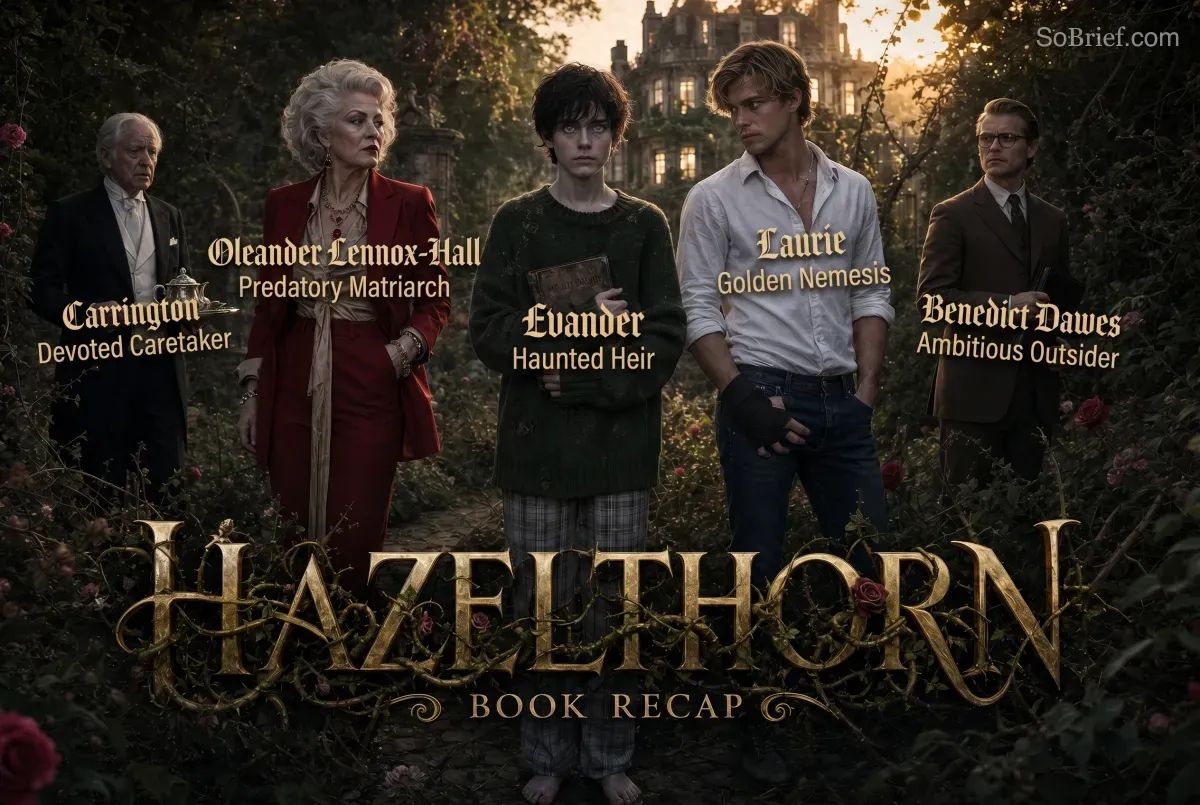
At eight p.m., the lock on Evander's1 bedroom door turns — but no one enters. For seven years, the seventeen-year-old has lived in one room of Hazelthorn Estate's north wing, medicated daily by the butler Carrington,4 raised by a distant guardian named Byron Lennox-Hall.3
Amnesia has eaten everything before age ten, when Byron's3 grandson Laurie2 supposedly attacked him in the garden and nearly killed him. The door swings open onto inky darkness. Evander1 creeps downstairs and finds Laurie2 sprawled across a parlor chaise, golden-haired and freshly expelled from boarding school.
Their reunion is electric — Laurie's2 lazy indifference against Evander's1 trembling fury. They are forbidden from being left alone together. But Byron,3 supposedly away on business, is in the conservatory among his plants, and no one is enforcing the rules tonight.
Black Veins and Growing Things
Evander1 confronts Byron3 among the conservatory's seedlings and hanging ferns. His guardian scolds him for escaping, mentions another upcoming surgery, refuses to explain why the door was unlocked. Then Byron3 drinks his tea. Something shifts beneath his throat.
His veins thread black. Mucus the color of tar froths around what looks like leaves pushing up from inside him, and his body convulses so violently the wicker chair collapses. Evander1 tries chest compressions while screaming for help.
With his last rasping breath, Byron3 makes Evander1 swear to never enter the gardens. By the time Laurie2 bursts in, Byron's3 eyes have gone vacant. Carrington4 arrives, wailing. An overturned teacup bleeds crimson across the tiles. Hazelthorn sits too far from any town for help to arrive in time.
A Billion-Dollar Cuckoo
Carrington4 drags Evander1 upstairs and locks him in. Three days pass with no food, no visitors, no explanation — only the slow curdling of grief and the growing certainty that Byron3 was murdered.
When Laurie2 finally opens the door, he brings bitter news: Byron3 is dead, Carrington4 was hospitalized from shock, and a young attorney named Dawes5 has arrived to read the will. In Byron's3 cavernous study, Dawes5 recites a single page. The entire estate and 1.1 billion dollars pass to Evander1 as sole heir. Laurie's2 name appears nowhere.
If Evander1 cannot inherit, everything goes to charity and Hazelthorn will be razed. The orphan bolts from the room. He has stolen a grandson's birthright without meaning to, and the boy who once tried to kill him now has a billion reasons to try again.
Dirt Between His Teeth
Out the back door, past brambles that claw at his bare feet, Evander1 enters the garden he has feared since childhood. The estate grounds are monstrous — ivy strangling stone walls, hedges grown to twice his height, plants that seem to breathe.
He devours wild tomatoes, then shoves fistfuls of compost into his mouth in horrified compulsion, unable to stop. Buried in a potting mix sack, his fingers close on a fat green journal: the Hazelthorn Field Guide, hand-illustrated with plants no botany textbook contains. Flowers lined with teeth.
Berries that compel self-amputation. Leaves sharp as steel. When Laurie2 discovers him hiding behind the soil bags — mouth smeared with dirt — he simply wipes Evander's1 chin without comment. The field guide becomes his map to a mystery no one wants him to solve.
The Aunt With Ruby Claws
Byron's3 sister Oleander6 explodes into the north wing in leopard-print heels and ruby earrings, seizing control as new legal guardian. She pinches Evander's1 cheeks with crimson talons, barks renovation plans at her trembling assistant Jessica,9 and begins reshaping Hazelthorn to her will.
More relatives arrive for the funeral: Oleander's6 son Bane,7 reeking of cologne and entitlement with unexplained scratches on his arms, and Laurie's2 aunt Azalea,8 draped in pearls and performative grief. Meanwhile, Laurie2 drops a quieter bomb: Byron3 never went on business trips.
He was a paranoid recluse who remained home for years, deliberately choosing not to visit the boy locked upstairs. The only father Evander1 knew was always one floor away. The locked door, the crushing solitude — none of it was necessary distance. It was abandonment.
The Butler With No Stomach
Evander1 wakes in darkness to skeletal fingers stroking his hair. Carrington4 leans over the bed, but his butler's uniform hangs open to reveal a hollowed torso — no skin, no organs, just a single shoot rooted into his pelvis with vines threaded around exposed vertebrae.
Dirt streams from his mouth as he rasps that the garden wants Evander1 back, then forces a poisonous berry between his teeth. Evander1 kicks through the butler's empty ribcage and sprints through pitch-black hallways until he crashes into Laurie.2
For the first time, he is held without cruelty — Laurie's2 arms circling his ribs, a thumb tracing slow pressure against fevered skin. Laurie2 tells him that pain is meant to take up space, that screaming is not something to apologize for. Under the bed later, they find proof of the intrusion: a mass of dead vines and toxic flowers.
Murder Behind the Red Door
Following shadows into the midnight garden, Evander1 watches Bane7 lead Jessica9 through the blood-painted red door into a circular walled garden. Six empty beds surround a grotesque faun fountain. Jessica9 digs on Bane's7 orders and screams when her trowel strikes a buried arm — someone was already planted there.
Bane7 drives a small knife into the side of her neck without hesitation. Blood sprays like dark rain. He saws deeper, then kneels in the mud and pulls a ruby from the blood-soaked earth, holding it to the moonlight with mild disappointment.
Before Evander1 can cry out, Laurie2 yanks him backward, clamping a hand over his mouth with crushing force. Pressed to the cobblestones, Evander1 finally understands: the Lennox-Halls feed human blood to the garden and harvest gemstones from the graves.
The Game Was a Sacrifice
Evander1 turns on Laurie2 with fury that splits his lungs. The childhood game was a sacrifice — Laurie2 fed him to the garden for a ruby. Laurie2 admits it, insists he was ten and terrified, but Evander1 snatches a stone and stands over Laurie's2 cowering body.
One strike could crack his skull open. Laurie2 shields his face with the practiced flinch of someone accustomed to being hit, and Evander1 drops the rock. Seconds later, the Carrington-creature4 ambushes them — skeletal claws raking Laurie's2 chest.
Evander1 kills it by smashing its skull until compost spills from shattered bone. Then he stumbles into the estate pool and nearly drowns, thrashing and sinking — until a vine wraps his wrist and gently pulls him out. The garden that should want him dead pats his tearstained cheek like a mother.
Evander Is No One
Over breakfast sardines, Azalea8 casually dismantles Evander's1 entire history. Laurie's2 father didn't die in a four-person car accident — he killed his own wife by feeding her to the garden, then drove into a tree alone. Evander's1 parents were never in any car.
When Azalea8 asks his surname, Evander's1 mind goes blank. He has no last name. He storms upstairs and tears his beloved parents' photo from its frame. On the back: half a recipe, a kitchenware ad. It was clipped from a magazine — a stock photo of smiling strangers. Then the final blade falls.
Laurie's2 full name is Laurence Evan Alexander Lennox-Hall. Evan-Alexander. Evander. He carries the name of a lonely boy's imaginary friend, bestowed on something that was never supposed to be real. Everything he believed about himself was someone else's fiction.
Split Open While Sleeping
Oleander6 and Bane7 corner Evander1 in his room. Bane7 punches him in the stomach, locks him in a headlock, and wrenches his head back while Oleander6 pours foul, thick medicine down his throat — far more than Carrington4 ever administered. The world spins.
Hands unbutton his shirt. Fingers poke at scars, dig into knotted tissue. He wakes a week later, bandaged sternum to hip, too drugged to move. Oleander6 tells him plainly: stop fighting or she will keep cutting. He will not see Laurie2 again. Beneath fresh sutures, his ribs ache where bone was harvested.
The horror crystallizes — Byron3 had been opening him up for years, always insisting it was necessary. Evander1 was too sedated to question why a childhood wound required so many surgeries, or what exactly they kept taking out of him.
Hammer Through Glass
Laurie's2 face appears outside Evander's1 second-story window, perched on the ivy trellis with a hammer in his fist. He swings it through the glass, pries the lock free, and climbs inside — bruised, filthy, furious. He'd been locked in a bathroom for days; Bane7 tried to force him to dig his own grave.
He helps Evander1 purge the sedatives, holds his hand on the bathroom floor, asks permission before every touch. When Bane7 arrives with another dose, Laurie2 smashes the door into his face and steals a key from his pocket.
They escape through a hidden crack in the wall into tunnels running between Hazelthorn's ancient bones. In the suffocating dark, Evander's1 terror peaks — and he crushes his mouth to Laurie's,2 biting through his lower lip until blood floods both their tongues. Hunger and desire, impossible to separate.
The Attic Full of Confessions
Byron's3 secret attic office is wallpapered in madness — blood-red words slashed across bare wood confessing guilt, begging forgiveness, declaring godhood. Dawes's5 suitcase sits on the couch: the attorney has been secretly living in Hazelthorn, hoarding stolen rubies and blackmail linking Byron3 to local disappearances.
In a locked drawer, Evander1 finds the real will — the sole heir named is Laurence Lennox-Hall.2 Dawes5 swapped names during the reading. Laurie,2 unable to read the documents himself, finally confesses everything: his grandfather tortured him for weeks to enforce silence, botched surgery on his wrist as punishment, denied all help for his severe dyslexia.
He tells Evander1 every truth he's been too terrified to speak. Evander1 kisses his neck, then the corner of his mouth — so gently this time that Laurie2 nearly buckles.
The Monster Was Always Him
Hours vanish to an episode. Evander1 wakes on the conservatory floor surrounded by plants that have doubled in size. Laurie2 huddles behind Byron's3 old wicker chair, bleeding from ragged bite marks in his side — Evander1 attacked him while the garden controlled his unconscious body.
Looking at his own torn-open chest, Evander1 finds not blood but dirt, bark, and clover growing between ribs of green wood. Laurie's2 confession comes soft and shattered: he never tried to sacrifice Evander1 to the garden. As a child, he sacrificed his own blood and dug something up from the soil.
Evander1 was not a boy nearly buried alive. He was grown from the earth, shaped by a lonely child's wish for a friend. Byron3 spent seven years harvesting his flowering bones to propagate a second blood garden. The monster Evander1 hunted across every index card was himself.
Long May You Rot
The Lennox-Halls and Dawes5 converge to carve Evander1 apart. Dawes5 demands a hand — fresh, with roots — to grow his own Hazelthorn elsewhere. Bane7 holds Evander1 while Dawes5 severs his wrist with blunt pruning shears that cannot cut clean.
Oleander6 strangles Laurie2 and buries him in the garden. Dressed for the funeral wake, Evander1 lets toxic flowers bloom from his stump and crushes their petals into the dinner wine. At a candlelit table crowded with ruby-draped Lennox-Halls, he raises his glass and toasts Byron's3 memory — grateful, he says, for a true taste of Hazelthorn.
They drink. Hands clutch throats. Hearts stutter and seize. Years of being slowly poisoned have made Evander1 immune to the very toxins his body produces. One by one, the people who cut him open fall silent.
Two Boys in the Locked Garden
A hand of bark and leaves sprouts from Evander's1 stump as the garden tears through Hazelthorn — trees punching through walls, roots ripping floors, ivy sealing the gates. He finds Dawes5 trying to flee and lets the garden take him underground.
Then he runs for the red door and digs through soil with branching fingers until he pulls Laurie2 out — cold, dirt-caked, but breathing. The garden stitched his wound with vines and comfrey instead of consuming him. They lie together in moonlit grass while the ruined mansion sags behind them.
Laurie2 locks the red door, throws the key into the ivy, and refuses to leave. He says he never wanted anything out in the world. The estate gates seal shut behind walls of greenery. Nobody will find them. One boy made of wood and thorns, another choosing to stay with what that means.
Analysis
Evander's1 amnesia and captivity are not gothic decoration — they form a precise architecture of what it means to grow up under authoritarian control that rewrites your identity while calling it love. Byron's3 'treatment' mirrors real patterns of medical abuse and institutional gaslighting: every surgery unnecessary, every sedative calibrated to keep its recipient too disoriented to question why he doesn't feel right in his own body. The novel's central question — what remains when you strip away everything someone told you about yourself? — yields answers that are terrifying rather than comforting.
The garden operates as a structural metaphor for marginalized rage. Fed blood against its nature for generations, exploited for the wealth it produces, and condemned when it retaliates, the garden was not born monstrous — it was made so by sustained extraction. This maps precisely onto the dynamics of communities whose justified anger is then cited as evidence of inherent dangerousness. Evander's1 'episodes,' recast from shameful pathology into suppressed identity asserting itself, challenge the clinical language historically weaponized against those who inconvenience systems designed to exploit them.
The queer love story is deliberately built as impossible intimacy between two people conditioned to see themselves as destructive. Kisses draw blood, desire blurs into consumption, tenderness arrives only after violence — because the novel insists that love forged under abuse carries its scars into every embrace. The ambiguous ending asks whether hunger and gentleness can coexist, and refuses a sanitized answer.
The book's autistic representation is structural rather than decorative. Evander's1 sensory overwhelm, his stimming punished as symptoms, his need for deep pressure, his literal-mindedness in a household built on subtext — all are framed not as deficits but as traits deliberately weaponized by those who profited from his compliance. His liberation is not learning to perform normalcy. It is refusing the performance entirely and discovering that what he is — thorns and all — was never the problem.
Review Summary
Hazelthorn by C.G. Drews is a gothic queer thriller praised for its atmospheric, immersive writing and botanical body horror. Reviewers laud the haunting mansion setting, complex relationship between protagonists Evander and Laurie, and excellent autistic representation. The plot follows seventeen-year-old Evander, confined by his guardian, who must solve a murder mystery while navigating a dangerous garden and his complicated feelings toward Laurie. Most reviewers gave 4-5 stars, highlighting the beautiful prose, tension, and emotional depth, though some found pacing slow or descriptions repetitive. The book's themes of autonomy, ableism, and rage resonated deeply with readers.
People Also Read
Characters
Evander
Hazelthorn's locked-away wardA seventeen-year-old who has spent seven years locked in a single bedroom of Hazelthorn Estate, medicated daily and told he is gravely ill. Amnesia has devoured everything before age ten, leaving him with surgery scars, an inexplicable hunger, and the conviction that Laurie2 once tried to kill him. Autistic and acutely sensitive—to textures, sounds, the wrongness of his own body—Evander oscillates between the meticulous gentlemanliness Byron3 drilled into him and something feral pressing at the seams. He is conditioned to be silent, obedient, and ashamed of every outburst, yet beneath the compliance thrums a detective's relentless curiosity. His investigation into Byron's3 death becomes an investigation into his own identity, peeling back layer after layer of carefully constructed lies until nothing he believed about himself remains intact.
Laurie
Byron's sardonic grandsonByron's3 seventeen-year-old grandson, whose sardonic exterior is armor forged from a lifetime of abuse. A permanently braced left wrist, severe untreated dyslexia, and a family that openly despises him have left Laurie with practiced apathy that masks volatile pain. He wields cruelty as self-defense and silence as survival, but underneath burns a fierce protective instinct—particularly toward Evander1, whom he watches with an intensity mixing guilt and adoration in dangerous measure. Laurie knows far more than he reveals, parceling secrets not from malice but from terror conditioned into him since childhood. His bravery surfaces in quiet acts: reading stories through a locked door as a child, wiping dirt from someone's mouth, holding a panicking boy and telling him that pain is allowed to be loud.
Byron Lennox-Hall
Hazelthorn's patriarchThe austere patriarch of Hazelthorn Estate—wealthy, reclusive, and obsessively controlling. To Evander1, he is the only father figure, capable of measured affection between chess games and book deliveries. To Laurie2, he is a tyrant who enforces obedience through brutality. Byron's obsession with the estate's secrets drives every decision he makes about the two boys under his roof, and his private writings betray guilt his public persona refuses to acknowledge.
Carrington
Hazelthorn's dutiful butlerThe elderly butler who serves the Lennox-Hall family with rigorous, cold efficiency. He brings Evander1 meals, administers medicine, and locks doors with professional obligation that never warms to affection. His loyalty to Byron3 borders on reverence, and his thin-lipped distaste for the boy he tends is poorly concealed beneath courteous duty. What becomes of him after Byron's3 death raises disturbing questions.
Dawes
Opportunistic estate attorneyA young attorney in tortoiseshell glasses who arrives to execute Byron's3 will with enthusiasm slightly miscalibrated for a funeral. His affable smile and polished appearance mask ambitions that reach far beyond a junior lawyer's career. He positions himself as Evander's1 ally while spending suspicious amounts of time alone in Byron's3 locked office, and his predecessor's sudden illness feels less like coincidence the longer he stays.
Oleander Lennox-Hall
Byron's domineering sisterByron's3 formidable sister—tall, relentless, and armored in bold fashion and ruby jewelry. Banned from Hazelthorn for decades, she arrives with the velocity of a woman who considers patience beneath her. She views guardianship of Evander1 as her rightful claim and treats every person around her as either a tool to wield or an obstacle to flatten, wielding power through intimidation, manipulation, and sheer force of personality.
Bane Lennox-Hall
Oleander's entitled sonOleander's6 son, a man in his forties who radiates the desperate entitlement of inherited wealth he hasn't earned. He coats manipulation in flattery so transparent it's almost impressive. His proximity to Hazelthorn—he's been living in the nearby town—and the unexplained scratches on his arms raise immediate suspicion about how well he knows the estate's grounds and what he's been doing there.
Azalea Lennox-Hall
Laurie's detached auntLaurie's2 aunt and the most elegantly unmoored of the Lennox-Halls. She speaks of family tragedies with the same breathy tone she uses for champagne preferences, combining genuine love of luxury with a worldview that sorts people into useful and expendable categories. Her casual candor occasionally reveals truths no one intended to share.
Jessica
Oleander's doomed assistantOleander's6 young, overwhelmed assistant, perpetually clutching a clipboard and fighting tears. She represents the civilian hired for ordinary work who stumbles into the machinery of extraordinary cruelty.
Plot Devices
The Hazelthorn Field Guide
Maps the garden's secretsAn ancient hand-bound journal filled with watercolor illustrations and cryptic margin notes, discovered by Evander1 hidden in a greenhouse potting mix sack. It catalogs plants that exist in no standard botany reference—flowers with teeth, berries that induce self-harm, ivy sharp as steel—alongside journal entries documenting experiments with garden specimens. The field guide becomes Evander's1 primary tool for understanding the impossible ecosystem of Hazelthorn, identifying the poisonous nightshades that may have killed Byron3, and beginning to piece together what the estate has been cultivating in secret. Its presence in a place Evander1 could stumble upon it—rather than locked in Byron's3 office—suggests someone, or something, wanted him to find it.
The Red Door
Guards the garden's hungry centerA single vermilion door set into an ivy-covered garden wall, locked with an iron key. Its surface is coated in dried blood—a fact Evander1 senses before he's told, drawn to press his tongue to the wood by an instinct he can't explain. Behind it lies a circular walled garden containing six empty beds and a grotesque faun fountain, where the Lennox-Hall family has conducted its most terrible rituals for generations. A heartbeat seems to pulse from behind it. The door functions as the boundary between the estate's maintained fiction of normalcy and its buried truth, and whoever controls its key controls access to Hazelthorn's darkest source of power.
Evander's Episodes
Justify Evander's captivityPeriods where Evander1 blacks out, loses time, and wakes bruised and exhausted—labeled 'episodes' by Byron3 and Carrington4 and treated as the primary justification for his confinement and daily medication. He has been taught to view them with shame, as evidence of his fragility and his danger to himself. Throughout the story, episodes strike at moments of extreme emotional overload, and Evander1 never remembers what his body does while he's absent. The progressive discovery of what actually happens during these blackouts—and why they've been pathologized—becomes one of the novel's central mysteries, forcing both Evander1 and the reader to question whether his 'illness' was ever illness at all.
The Will
Controls the family's powerByron's3 Last Will and Testament drives the plot from the moment it is read aloud, naming Evander1 as sole heir to a billion-dollar estate and cutting every Lennox-Hall descendant from the fortune. This single document turns Evander1 into a target, makes Laurie2 his reluctant rival, and lures the extended family to Hazelthorn like carrion birds. The will functions as a mechanism of control—whoever shapes its terms shapes the power dynamics of the entire estate. Whether the will as read reflects Byron's3 true intentions becomes a critical question, since the reading was conducted by an attorney no one had met before5, in a room with only two witnesses: a boy too anxious to challenge authority and another who couldn't verify the document himself.
The Rubies
Blood crystallized into wealthRubies appear everywhere in the Lennox-Hall world—set into wineglasses, studded into watches, draped around necks in lavish jewelry. Their ubiquity registers as old-money ostentation until Evander1 discovers their origin: the garden produces them in exchange for human blood soaked into its soil. Each gemstone represents a life taken, and the Lennox-Hall fortune is built entirely on this currency of sacrifice. The rubies function as a moral litmus test for every character—who wears them knowingly, who pursues them actively, and who refuses to touch them. They retroactively poison every scene of opulent dining and elegant dress with the knowledge of what each glinting red stone cost to produce.
About the Author


Download PDF
Download EPUB
.epub digital book format is ideal for reading ebooks on phones, tablets, and e-readers.








































